---
license: mit
library_name: transformers
pipeline_tag: text-generation
language:
- en
- ru
- zh
- vi
- kk
- ja
---
## NOESIS / AMAImedia
Released as part of the NOESIS Professional Multilingual Dubbing Automation Platform (framework: DHCF-FNO — Deterministic Hybrid Control Framework for Frozen Neural Operators).
- **Founder:** Ilia Bolotnikov
- **Organization:** AMAImedia.com
- **X (Twitter):** [@AMAImediacom](https://x.com/AMAImediacom)
- **LinkedIn:** [Ilia Bolotnikov](https://www.linkedin.com/in/ilia-bolotnikov)
- **Telegram:** [@djbionicl](https://t.me/djbionicl)
- **Release date:** 2026-08-26
## AMAImedia
- **Original repository:** [zai-org/GLM-5.3-Flash](https://huggingface.co/zai-org/GLM-5.3-Flash)
---
# GLM-5.3-Flash
Join our WeChat or Discord community.
Check out the GLM-5.3-Flash blog and GLM-5 technical report.
Use GLM-5.3-Flash API services on the Z.ai API Platform.
## Introduction
We introduce GLM-5.3-Flash, the first natively multimodal model in the GLM-5 series. With 320B total parameters and just 18B active parameters, it is designed for efficient long-context, coding, agentic, and multimodal workloads.
GLM-5.3-Flash starts from a newly trained base model, with its architecture and training recipe redesigned around capability and efficiency. It combines sparse and linear attention with Manifold-Constrained Hyper-Connections (mHC) and a multimodal pre-training corpus.
## Serve GLM-5.3-Flash Locally
GLM-5.3-Flash supports deployment with the following frameworks:
- [SGLang](https://github.com/sgl-project/sglang) — see the [cookbook](https://cookbook.sglang.io/autoregressive/GLM/GLM-5.3-Flash)
- [vLLM](https://github.com/vllm-project/vllm) — see the [recipes](https://recipes.vllm.ai/zai-org/GLM-5.3-Flash)
- [TokenSpeed](https://github.com/lightseekorg/tokenspeed) — see the [model recipe](https://lightseek.org/tokenspeed/recipes/models#glm-5-3-flash)
- [KTransformers](https://github.com/kvcache-ai/ktransformers) — see the [tutorial](https://github.com/kvcache-ai/ktransformers/blob/main/doc/en/kt-kernel/GLM-5.3-Flash-Tutorial.md)
## Usage
### Transformers: text generation
```python
import torch
from transformers import AutoModelForCausalLM, AutoTokenizer
model_id = "AMAImedia/GLM-5.3-Flash"
tokenizer = AutoTokenizer.from_pretrained(model_id, trust_remote_code=True)
model = AutoModelForCausalLM.from_pretrained(
model_id,
torch_dtype=torch.bfloat16,
device_map="auto",
trust_remote_code=True,
)
messages = [{"role": "user", "content": "Explain the main benefits of multimodal agents."}]
inputs = tokenizer.apply_chat_template(
messages,
add_generation_prompt=True,
return_tensors="pt",
).to(model.device)
with torch.inference_mode():
output = model.generate(
inputs,
max_new_tokens=512,
temperature=0.7,
top_p=0.9,
do_sample=True,
)
print(tokenizer.decode(output[0][inputs.shape[-1]:], skip_special_tokens=True))
```
### Transformers: multimodal input
For image questions, use the official GLM processor and multimodal message format documented by the model implementation. Keep image inputs in the message content and use the processor to build model inputs; verify the exact API against the installed Transformers version.
```python
from transformers import AutoProcessor, AutoModelForMultimodalLM
model_id = "AMAImedia/GLM-5.3-Flash"
processor = AutoProcessor.from_pretrained(model_id, trust_remote_code=True)
model = AutoModelForMultimodalLM.from_pretrained(
model_id,
device_map="auto",
torch_dtype="auto",
trust_remote_code=True,
)
messages = [{
"role": "user",
"content": [
{"type": "image", "url": "https://huggingface.co/datasets/huggingface/documentation-images/resolve/main/p-blog/candy.JPG"},
{"type": "text", "text": "What is shown in this image?"},
],
}]
inputs = processor.apply_chat_template(
messages,
add_generation_prompt=True,
tokenize=True,
return_dict=True,
return_tensors="pt",
).to(model.device)
outputs = model.generate(**inputs, max_new_tokens=128)
print(processor.decode(outputs[0][inputs["input_ids"].shape[-1]:], skip_special_tokens=True))
```
### vLLM
```bash
pip install -U vllm
vllm serve AMAImedia/GLM-5.3-Flash \
--trust-remote-code \
--tensor-parallel-size 8 \
--max-model-len 131072
```
The server exposes an OpenAI-compatible endpoint:
```python
from openai import OpenAI
client = OpenAI(base_url="http://localhost:8000/v1", api_key="EMPTY")
response = client.chat.completions.create(
model="AMAImedia/GLM-5.3-Flash",
messages=[{"role": "user", "content": "Write a concise summary of this document."}],
temperature=0.7,
max_tokens=512,
)
print(response.choices[0].message.content)
```
### Practical deployment notes
Use `bfloat16` where supported, or a framework-supported quantized checkpoint when GPU memory is limited. For multimodal serving, follow the selected framework's documented image-input format. Confirm the installed framework version, GPU memory requirements, tensor-parallel configuration, and supported context length before production deployment.
## Footnotes
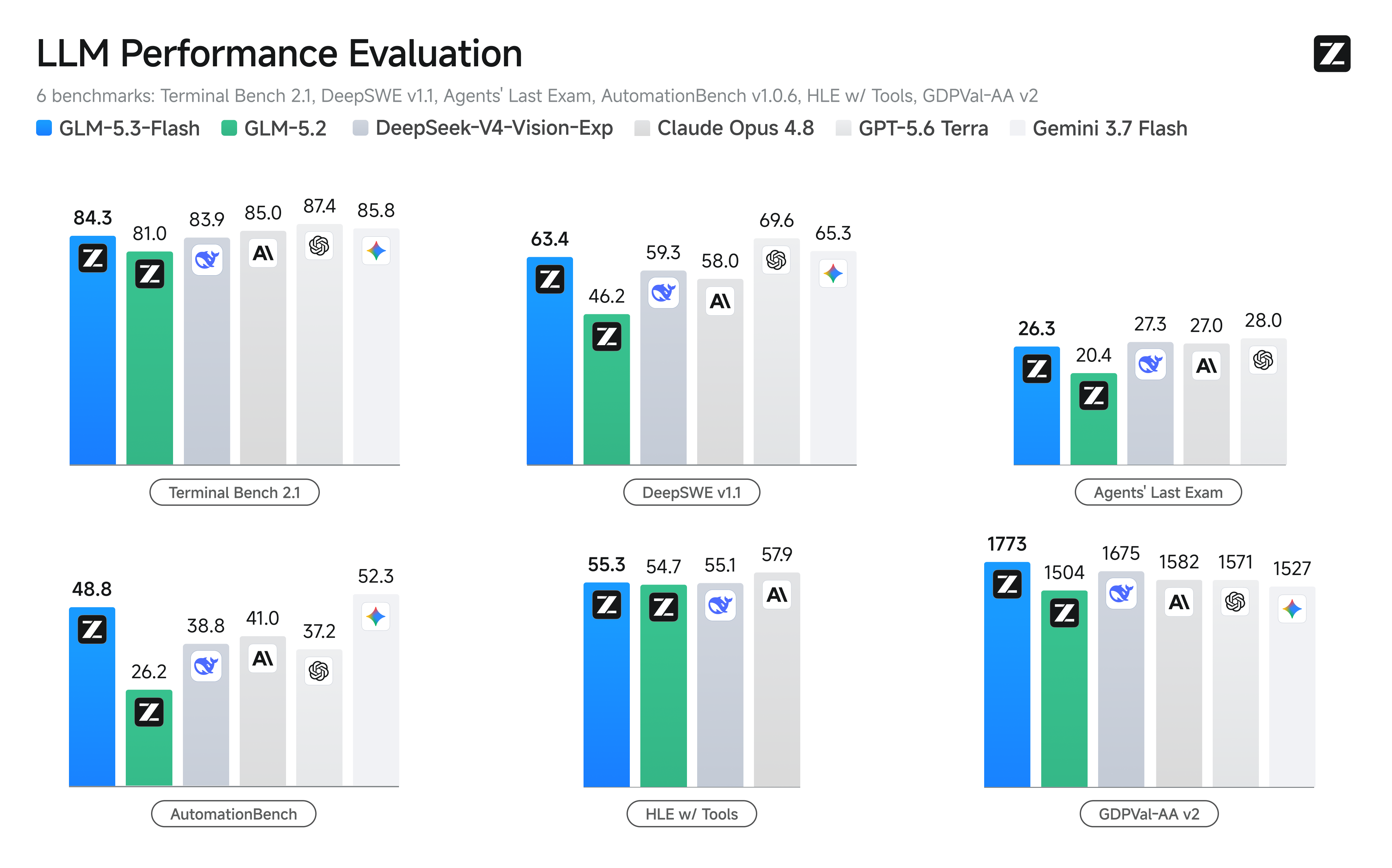
* **HLE w/ tools (full set):** Evaluation uses temperature=1.0 and top_p=0.95 with a maximum generation length of 163,840 tokens and a maximum context length of 300,000 tokens.
* **NL2Repo:** Evaluation uses temperature=1.0, top_p=1.0, and max_new_tokens=64k under 1M context.
* **DeepSWE:** Evaluation uses temperature=0.95, top_p=1.0, timeout=6h, and 400K context.
* **Terminal-Bench 2.1:** Evaluation uses temperature=1.0, top_p=1, max_new_tokens=65536, and a 6h timeout.
* **Toolathlon Verified:** Results are reported as pass@1 averaged over three independent runs.
* **AutomationBench:** Evaluation uses AutomationBench v1.0.6.
* **GDPval-AA v2:** Models are evaluated by Artificial Analysis.
* **BabyVision:** Evaluation uses temperature=1.0, top_p=0.95, and a maximum context length of 164K tokens.
## Citation
If you find GLM-5.3-Flash useful in your research, please cite the official technical report:
```bibtex
@misc{glm5team2026glm5vibecodingagentic,
title={GLM-5: from Vibe Coding to Agentic Engineering},
author={GLM-5-Team},
year={2026},
eprint={2602.15763},
archivePrefix={arXiv},
primaryClass={cs.LG},
url={https://arxiv.org/abs/2602.15763},
}
```
