## Serving with vLLM
This checkpoint needs a patched vLLM (MiniMax-M3 compressed-tensors support).
The patch is Python-only, so it installs on top of upstream's **precompiled
binaries** — no CUDA compilation.
### Install
```bash
# uv (skip if already installed)
curl -LsSf https://astral.sh/uv/install.sh | sh
# clone the fork + fetch the upstream base commit
git clone https://github.com/toncao/vllm.git
cd vllm
git remote add upstream https://github.com/vllm-project/vllm.git
git fetch upstream a7fdfeef72323eb3db6f0620e4ea200290d0ca5a
git checkout minimax-m3-compressed-tensors
# Python 3.12 env + install with upstream precompiled kernels
uv venv --python 3.12
source .venv/bin/activate
VLLM_USE_PRECOMPILED=1 uv pip install -e . --torch-backend=auto
```
### Serve
```bash
vllm serve cyankiwi/MiniMax-M3-AWQ-INT4 --block-size 128
```
---
MiniMax-M3 is a native multimodal model with 1M context. It has ~428B parameters and ~23B activated parameters.
**Highlights:**
- **Native Multimodality:** M3 undergoes mixed-modality training from the very first step, enabling deeper semantic fusion across text, image, and video.
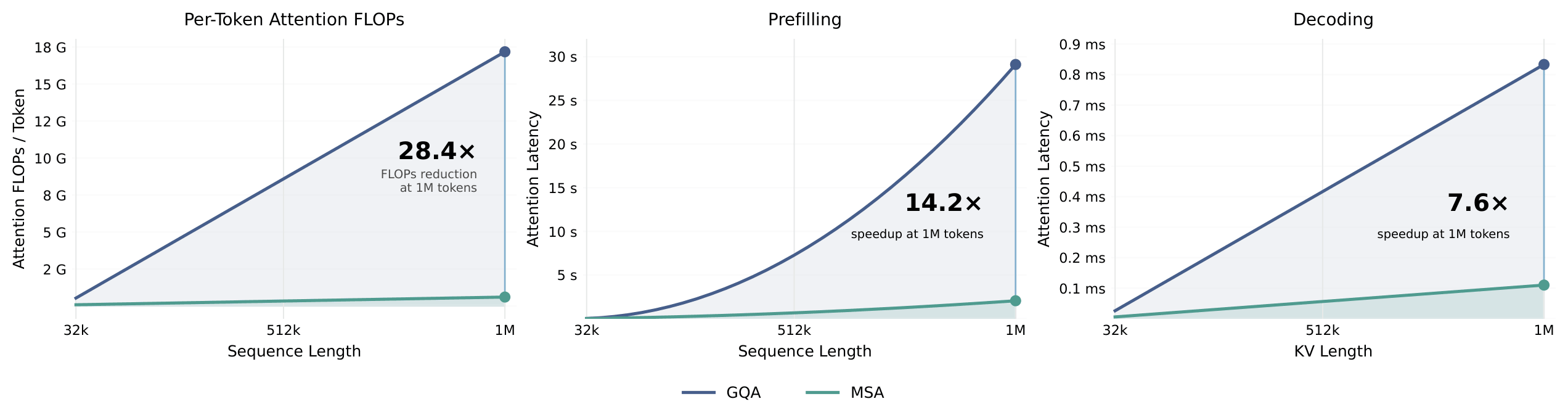
- **Context Scaling via Sparse Attention:** M3 introduces MiniMax Sparse Attention (MSA) to improve long context efficiency. M3 delivers 9× prefill and 15× decode speedups compared to M2 at 1M context, reducing per-token compute to 1/20.
- **Coding & Cowork Capability:** M3 achieves frontier-level performance across long-horizon agentic benchmarks, excelling in both coding and cowork.
## MiniMax Sparse Attention (MSA)
M3 is powered by [**MiniMax Sparse Attention (MSA)**](https://github.com/MiniMax-AI/MSA), a high-performance sparse attention operator designed for million-token contexts. Compared with GQA, MSA dramatically reduces the attention compute and memory footprint while preserving model quality.
> 📄 Read the technical report: [arXiv:2606.13392](https://arxiv.org/abs/2606.13392) · [Hugging Face Papers](https://huggingface.co/papers/2606.13392)
## How to Use
- [MiniMax Agent](https://agent.minimax.io/)
- [MiniMax API](https://platform.minimax.io/)
M3 supports two reasoning modes:
- **thinking** — for complex reasoning, agentic tasks, and long-horizon collaboration.
- **non-thinking** — for latency-sensitive scenarios such as chat and code completion.
## Local Deployment
Download the model:
```bash
hf download MiniMaxAI/MiniMax-M3 --local-dir MiniMax-M3
```
We recommend the following inference frameworks (listed alphabetically) to serve the model:
- [SGLang](https://docs.sglang.io/) - see [SGLang cookbook](https://docs.sglang.io/cookbook/autoregressive/MiniMax/MiniMax-M3).
- [vLLM](https://github.com/vllm-project/vllm) - see [vLLM recipes](https://recipes.vllm.ai/MiniMaxAI/MiniMax-M3).
- [Transformers](https://github.com/huggingface/transformers) - see [Transformers docs](https://huggingface.co/docs/transformers/model_doc/minimax_m3_vl).
### Inference Parameters
We recommend the following parameters for best performance: `temperature=1.0`, `top_p=0.95`, `top_k=40`.
## Contact Us
Contact us at [model@minimax.io](mailto:model@minimax.io).