

File size: 9,802 Bytes
5b52f82 | 1 2 3 4 5 6 7 8 9 10 11 12 13 14 15 16 17 18 19 20 21 22 23 24 25 26 27 28 29 30 31 32 33 34 35 36 37 38 39 40 41 42 43 44 45 46 47 48 49 50 51 52 53 54 55 56 57 58 59 60 61 62 63 64 65 66 67 68 69 70 71 72 73 74 75 76 77 78 79 80 81 82 83 84 85 86 87 88 89 90 91 92 93 94 95 96 97 98 99 100 101 102 103 104 105 106 107 108 109 110 111 112 113 114 115 116 117 118 119 120 121 122 123 124 125 126 127 128 129 130 131 132 133 134 135 136 137 138 139 140 141 142 143 144 145 146 147 148 149 150 151 152 153 154 155 156 157 158 159 160 161 162 163 164 165 166 167 168 169 170 171 172 173 174 175 176 177 178 179 180 181 182 183 184 185 186 187 188 189 190 191 192 193 194 195 196 197 198 199 200 201 202 203 204 205 206 207 208 209 210 211 212 213 214 215 216 217 218 | # JBMO 2016 <br> Problems and solutions
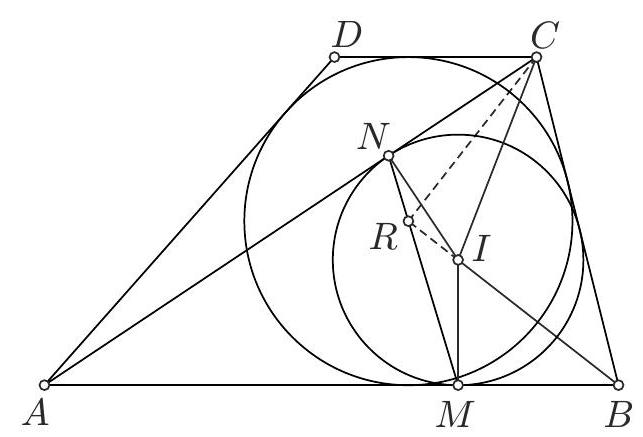
Problem 1. A trapezoid $A B C D(A B \| C D, A B>C D)$ is circumscribed. The incircle of the triangle $A B C$ touches the lines $A B$ and $A C$ at the points $M$ and $N$, respectively. Prove that the incenter of the trapezoid $A B C D$ lies on the line $M N$.
## Solution.
Version 1. Let $I$ be the incenter of triangle $A B C$ and $R$ be the common point of the lines $B I$ and $M N$. Since
$$
m(\widehat{A N M})=90^{\circ}-\frac{1}{2} m(\widehat{M A N}) \quad \text { and } \quad m(\widehat{B I C})=90^{\circ}+\frac{1}{2} m(\widehat{M A N})
$$
the quadrilateral $I R N C$ is cyclic.
It follows that $m(\widehat{B R C})=90^{\circ}$ and therefore
$$
m(\widehat{B C R})=90^{\circ}-m(\widehat{C B R})=90^{\circ}-\frac{1}{2}\left(180^{\circ}-m(\widehat{B C D})\right)=\frac{1}{2} m(\widehat{B C D})
$$
So, $(C R$ is the angle bisector of $\widehat{D C B}$ and $R$ is the incenter of the trapezoid.
Version 2. If $R$ is the incentre of the trapezoid $A B C D$, then $B, I$ and $R$ are collinear,
and $m(\widehat{B R C})=90^{\circ}$.
The quadrilateral $I R N C$ is cyclic.
Then $m(\widehat{M N C})=90^{\circ}+\frac{1}{2} \cdot m(\widehat{B A C})$
and $m(\widehat{R N C})=m(\widehat{B I C})=90^{\circ}+\frac{1}{2} \cdot m(\widehat{B A C})$,
so that $m(\widehat{M N C})=m(\widehat{R N C})$ and the points $M, R$ and $N$ are collinear.
Version 3. If $R$ is the incentre of the trapezoid $A B C D$, let $M^{\prime} \in(A B)$ and $N^{\prime} \in(A C)$ be the unique points, such that $R \in M^{\prime} N^{\prime}$ and $\left(A M^{\prime}\right) \equiv\left(A N^{\prime}\right)$.
Let $S$ be the intersection point of $C R$ and $A B$. Then $C R=R S$.
Consider $K \in A C$ such that $S K \| M^{\prime} N^{\prime}$. Then $N^{\prime}$ is the midpoint of $(C K)$.
We deduce
$$
A N^{\prime}=\frac{A K+A C}{2}=\frac{A S+A C}{2}=\frac{A B-B S+A C}{2}=\frac{A B+A C-B C}{2}=A N
$$
We conclude that $N=N^{\prime}$, hence $M=M^{\prime}$, and $R, M, N$ are collinear.
Problem 2. Let $a, b$ and $c$ be positive real numbers. Prove that
$$
\frac{8}{(a+b)^{2}+4 a b c}+\frac{8}{(b+c)^{2}+4 a b c}+\frac{8}{(c+a)^{2}+4 a b c}+a^{2}+b^{2}+c^{2} \geq \frac{8}{a+3}+\frac{8}{b+3}+\frac{8}{c+3}
$$
Solution. Since $2 a b \leq a^{2}+b^{2}$, it follows that $(a+b)^{2} \leq 2\left(a^{2}+b^{2}\right)$
and $4 a b c \leq 2 c\left(a^{2}+b^{2}\right)$, for any positive reals $a, b, c$.
Adding these inequalities, we find
$$
(a+b)^{2}+4 a b c \leq 2\left(a^{2}+b^{2}\right)(c+1)
$$
so that
$$
\frac{8}{(a+b)^{2}+4 a b c} \geq \frac{4}{\left(a^{2}+b^{2}\right)(c+1)}
$$
Using the AM-GM inequality, we have
$$
\frac{4}{\left(a^{2}+b^{2}\right)(c+1)}+\frac{a^{2}+b^{2}}{2} \geq 2 \sqrt{\frac{2}{c+1}}=\frac{4}{\sqrt{2(c+1)}}
$$
respectively
$$
\frac{c+3}{8}=\frac{(c+1)+2}{8} \geq \frac{\sqrt{2(c+1)}}{4}
$$
We conclude that
$$
\frac{4}{\left(a^{2}+b^{2}\right)(c+1)}+\frac{a^{2}+b^{2}}{2} \geq \frac{8}{c+3}
$$
and finally
$$
\frac{8}{(a+b)^{2}+4 a b c}+\frac{8}{(a+c)^{2}+4 a b c}+\frac{8}{(b+c)^{2}+4 a b c}+a^{2}+b^{2}+c^{2} \geq \frac{8}{a+3}+\frac{8}{b+3}+\frac{8}{c+3}
$$
Problem 3. Find all the triples of integers $(a, b, c)$ such that the number
$$
N=\frac{(a-b)(b-c)(c-a)}{2}+2
$$
is a power of 2016 .
(A power of 2016 is an integer of the form $2016^{n}$, where $n$ is a non-negative integer.)
Solution. Let $a, b, c$ be integers and $n$ be a positive integer such that
$$
(a-b)(b-c)(c-a)+4=2 \cdot 2016^{n}
$$
We set $a-b=-x, b-c=-y$ and we rewrite the equation as
$$
x y(x+y)+4=2 \cdot 2016^{n}
$$
If $n>0$, then the right hand side is divisible by 7 , so we have that
$$
x y(x+y)+4 \equiv 0 \quad(\bmod 7)
$$
or
$$
3 x y(x+y) \equiv 2 \quad(\bmod 7)
$$
or
$$
(x+y)^{3}-x^{3}-y^{3} \equiv 2 \quad(\bmod 7)
$$
Note that, by Fermat's Little Theorem, for any integer $k$ the cubic residues are $k^{3} \equiv-1,0,1$ $(\bmod 7)$.
It follows that in (1) some of $(x+y)^{3}, x^{3}$ and $y^{3}$ should be divisible by 7 .
But in this case, $x y(x+y)$ is divisible by 7 and this is a contradiction.
So, the only possibility is to have $n=0$ and consequently, $x y(x+y)+4=2$, or, equivalently, $x y(x+y)=-2$.
The solutions for this are $(x, y) \in\{(-1,-1),(2,-1),(-1,2)\}$,
so the required triples are $(a, b, c)=(k+2, k+1, k), k \in \mathbb{Z}$, and all their cyclic permutations. (9)
Alternative version: If $n>0$ then 9 divides $(a-b)(b-c)(c-a)+4$, that is, the equation $x y(x+y)+4 \equiv 0(\bmod 9))$ has the solution $x=b-a, y=c-b$.
But then $x$ and $y$ have to be 1 modulo 3 , implying $x y(x+y) \equiv 2(\bmod 9)$, which is a contradiction.
We can continue now as in the first version.
Problem 4. A $5 \times 5$ table is called regular if each of its cells contains one of four pairwise distinct real numbers, such that each of them occurs exactly once in every $2 \times 2$ subtable. The sum of all numbers of a regular table is called the total sum of the table. With any four numbers, one constructs all possible regular tables, computes their total sums and counts the distinct outcomes. Determine the maximum possible count.
Solution. We will prove that the maximum number of total sums is 60 .
The proof is based on the following claim.
Claim. In a regular table either each row contains exactly two of the numbers, or each column contains exactly two of the numbers.
Proof of the Claim. Indeed, let $R$ be a row containing at least three of the numbers. Then, in row $R$ we can find three of the numbers in consecutive positions, let $x, y, z$ be the numbers in consecutive positions(where $\{x, y, s, z\}=\{a, b, c, d\}$ ). Due to our hypothesis that in every $2 \times 2$ subarray each number is used exactly once, in the row above $\mathrm{R}$ (if there is such a row), precisely above the numbers $x, y, z$ will be the numbers $z, t, x$ in this order. And above them will be the numbers $x, y, z$ in this order. The same happens in the rows below $R$ (see at the following figure).
$$
\left(\begin{array}{lllll}
\bullet & x & y & z & \bullet \\
\bullet & z & t & x & \bullet \\
\bullet & x & y & z & \bullet \\
\bullet & z & t & x & \bullet \\
\bullet & x & y & z & \bullet
\end{array}\right)
$$
Completing all the array, it easily follows that each column contains exactly two of the numbers and our claim is proven.
Rotating the matrix (if it is necessary), we may assume that each row contains exactly two of the numbers. If we forget the first row and column from the array, we obtain a $4 \times 4$ array, that can be divided into four $2 \times 2$ subarrays, containing thus each number exactly four times, with a total sum of $4(a+b+c+d)$.
It suffices to find how many different ways are there to put the numbers in the first row $R_{1}$ and the first column $C_{1}$.
Denoting by $a_{1}, b_{1}, c_{1}, d_{1}$ the number of appearances of $a, b, c$, and respectively $d$ in $R_{1}$ and $C_{1}$, the total sum of the numbers in the entire $5 \times 5$ array will be
$$
S=4(a+b+c+d)+a_{1} \cdot a+b_{1} \cdot b+c_{1} \cdot c+d_{1} \cdot d
$$
If the first, the third and the fifth row contain the numbers $x, y$, with $x$ denoting the number at the entry $(1,1)$, then the second and the fourth row will contain only the numbers $z, t$, with $z$ denoting the number at the entry $(2,1)$. Then $x_{1}+y_{1}=7$ and $x_{1} \geqslant 3, y_{1} \geqslant 2, z_{1}+t_{1}=2$, and $z_{1} \geqslant t_{1}$. Then $\left\{x_{1}, y_{1}\right\}=\{5,2\}$ or $\left\{x_{1}, y_{1}\right\}=\{4,3\}$, respectively $\left\{z_{1}, t_{1}\right\}=\{2,0\}$ or $\left\{z_{1}, t_{1}\right\}=\{1,1\}$
Then $\left(a_{1}, b_{1}, c_{1}, d_{1}\right)$ is obtained by permuting one of the following quadruples:
$$
(5,2,2,0),(5,2,1,1),(4,3,2,0),(4,3,1,1)
$$
There are a total of $\frac{4!}{2!}=12$ permutations of $(5,2,2,0)$, also 12 permutations of $(5,2,1,1), 24$ permutations of $(4,3,2,0)$ and finally, there are 12 permutations of $(4,3,1,1)$. Hence, there are at most 60 different possible total sums.
We can obtain indeed each of these 60 combinations: take three rows ababa alternating with two rows $c d c d c$ to get $(5,2,2,0)$; take three rows ababa alternating with one row $c d c d c$ and a row $(d c d c d)$ to get $(5,2,1,1)$; take three rows $a b a b c$ alternating with two rows $c d c d a$ to get $(4,3,2,0)$; take three rows $a b c d a$ alternating with two rows $c d a b c$ to get $(4,3,1,1)$.
By choosing for example $a=10^{3}, b=10^{2}, c=10, d=1$, we can make all these sums different. (8)
Hence, 60 is indeed the maximum possible number of different sums.
Alternative Version: Consider a regular table containing the four distinct numbers $a, b, c, d$. The four $2 \times 2$ corners contain each all the four numbers, so that, if $a_{1}, b_{1}, c_{1}, d_{1}$ are the numbers of appearances of $a, b, c$, and respectively $d$ in the middle row and column, then
$$
S=4(a+b+c+d)+a_{1} \cdot a+b_{1} \cdot b+c_{1} \cdot c+d_{1} \cdot d
$$
Consider the numbers $x$ in position $(3,3), y$ in position $(3,2), y^{\prime}$ in position $(3,4), z$ in position $(2,3)$ and $z^{\prime}$ in position $(4,3)$.
If $z \neq z^{\prime}=t$, then $y=y^{\prime}$, and in positions $(3,1)$ and $(3,5)$ there will be the number $x$.
The second and fourth row can only contain now the numbers $z$ and $t$, respectively the first and fifth row only $x$ and $y$.
Then $x_{1}+y_{1}=7$ and $x_{1} \geqslant 3, y_{1} \geqslant 2, z_{1}+t_{1}=2$, and $z_{1} \geqslant t_{1}$. Then $\left\{x_{1}, y_{1}\right\}=\{5,2\}$ or $\left\{x_{1}, y_{1}\right\}=\{4,3\}$, respectively $\left\{z_{1}, t_{1}\right\}=\{2,0\}$ or $\left\{z_{1}, t_{1}\right\}=\{1,1\}$.
One can continue now as in the first version.
|