

File size: 9,073 Bytes
5b52f82 | 1 2 3 4 5 6 7 8 9 10 11 12 13 14 15 16 17 18 19 20 21 22 23 24 25 26 27 28 29 30 31 32 33 34 35 36 37 38 39 40 41 42 43 44 45 46 47 48 49 50 51 52 53 54 55 56 57 58 59 60 61 62 63 64 65 66 67 68 69 70 71 72 73 74 75 76 77 78 79 80 81 82 83 84 85 86 87 88 89 90 91 92 93 94 95 96 97 98 99 100 101 102 103 104 105 106 107 108 109 110 111 112 113 114 115 116 117 118 119 120 121 122 123 124 125 126 127 128 129 130 131 132 133 134 135 136 137 138 139 140 141 142 143 144 145 146 147 148 149 150 151 152 153 154 155 156 157 158 159 160 161 162 163 164 165 166 167 168 169 170 171 172 173 174 175 176 | 
$19^{\text {th }}$ Junior Balkan Mathematical Olympiad June 24-29, 2015, Belgrade, Serbia
Problem 1. Find all prime numbers $a, b, c$ and positive integers $k$ which satisfy the equation
$$
a^{2}+b^{2}+16 \cdot c^{2}=9 \cdot k^{2}+1
$$
# Solution:
The relation $9 \cdot k^{2}+1 \equiv 1(\bmod 3)$ implies
$$
a^{2}+b^{2}+16 \cdot c^{2} \equiv 1(\bmod 3) \Leftrightarrow a^{2}+b^{2}+c^{2} \equiv 1(\bmod 3)
$$
Since $a^{2} \equiv 0,1(\bmod 3), \quad b^{2} \equiv 0,1(\bmod 3), c^{2} \equiv 0,1(\bmod 3)$, we have:
| $a^{2}$ | 0 | 0 | 0 | 0 | 1 | 1 | 1 | 1 |
| :---: | :---: | :---: | :---: | :---: | :---: | :---: | :---: | :---: |
| $b^{2}$ | 0 | 0 | 1 | 1 | 0 | 0 | 1 | 1 |
| $c^{2}$ | 0 | 1 | 0 | 1 | 0 | 1 | 0 | 1 |
| $a^{2}+b^{2}+c^{2}$ | 0 | 1 | 1 | 2 | 1 | 2 | 2 | 0 |
From the previous table it follows that two of three prime numbers $a, b, c$ are equal to 3 .
Case 1. $a=b=3$
We have
$$
\begin{aligned}
& a^{2}+b^{2}+16 \cdot c^{2}=9 \cdot k^{2}+1 \Leftrightarrow 9 \cdot k^{2}-16 \cdot c^{2}=17 \Leftrightarrow(3 k-4 c) \cdot(3 k+4 c)=17, \\
& \Leftrightarrow\left\{\begin{array} { l }
{ 3 k - 4 c = 1 , } \\
{ 3 k + 4 c = 1 7 , }
\end{array} \Leftrightarrow \left\{\begin{array}{l}
c=2, \\
k=3,
\end{array} \text { and } \quad(a, b, c, k)=(3,3,2,3) .\right.\right.
\end{aligned}
$$
Case 2. $c=3$
If $\left(3, b_{0}, c, k\right)$ is a solution of the given equation, then $\left(b_{0}, 3, c, k\right)$ is a solution too.
Let $a=3$. We have
$$
a^{2}+b^{2}+16 \cdot c^{2}=9 \cdot k^{2}+1 \Leftrightarrow 9 \cdot k^{2}-b^{2}=152 \Leftrightarrow(3 k-b) \cdot(3 k+b)=152 .
$$
Both factors shall have the same parity and we obtain only 2 cases:
- $\left\{\begin{array}{l}3 k-b=2, \\ 3 k+b=76,\end{array} \Leftrightarrow\left\{\begin{array}{l}b=37, \\ k=13,\end{array}\right.\right.$ and $(a, b, c, k)=(3,37,3,13)$;
- $\left\{\begin{array}{l}3 k-b=4, \\ 3 k+b=38,\end{array} \Leftrightarrow\left\{\begin{array}{l}b=17, \\ k=7,\end{array}\right.\right.$ and $(a, b, c, k)=(3,17,3,7)$.
So, the given equation has 5 solutions:
$\{(37,3,3,13),(17,3,3,7),(3,37,3,13),(3,17,3,7),(3,3,2,3)\}$.
Problem 2. Let $a, b, c$ be positive real numbers such that $a+b+c=3$. Find the minimum value of the expression
$$
A=\frac{2-a^{3}}{a}+\frac{2-b^{3}}{b}+\frac{2-c^{3}}{c}
$$
$19^{\text {th }}$ Junior Balkan Mathematical Olympiad June 24-29, 2015, Belgrade, Serbia
## Solution:
We can rewrite $A$ as follows:
$$
\begin{aligned}
& A=\frac{2-a^{3}}{a}+\frac{2-b^{3}}{b}+\frac{2-c^{3}}{c}=2\left(\frac{1}{a}+\frac{1}{b}+\frac{1}{c}\right)-a^{2}-b^{2}-c^{2}= \\
& 2\left(\frac{a b+b c+c a}{a b c}\right)-\left(a^{2}+b^{2}+c^{2}\right)=2\left(\frac{a b+b c+c a}{a b c}\right)-\left((a+b+c)^{2}-2(a b+b c+c a)\right)= \\
& 2\left(\frac{a b+b c+c a}{a b c}\right)-(9-2(a b+b c+c a))=2\left(\frac{a b+b c+c a}{a b c}\right)+2(a b+b c+c a)-9= \\
& 2(a b+b c+c a)\left(\frac{1}{a b c}+1\right)-9
\end{aligned}
$$
Recall now the well-known inequality $(x+y+z)^{2} \geq 3(x y+y z+z x)$ and set $x=a b, y=b c, z=c a$, to obtain $(a b+b c+c a)^{2} \geq 3 a b c(a+b+c)=9 a b c$, where we have used $a+b+c=3$. By taking the square roots on both sides of the last one we obtain:
$$
a b+b c+c a \geq 3 \sqrt{a b c}
$$
Also by using AM-GM inequality we get that
$$
\frac{1}{a b c}+1 \geq 2 \sqrt{\frac{1}{a b c}}
$$
Multiplication of (1) and (2) gives:
$$
(a b+b c+c a)\left(\frac{1}{a b c}+1\right) \geq 3 \sqrt{a b c} \cdot 2 \sqrt{\frac{1}{a b c}}=6
$$
So $A \geq 2 \cdot 6-9=3$ and the equality holds if and only if $a=b=c=1$, so the minimum value is 3.
Problem 3. Let $\triangle A B C$ be an acute triangle. The lines $l_{1}, l_{2}$ are perpendicular to $A B$ at the points $A, B$ respectively. The perpendicular lines from the midpoint $M$ of $A B$ to the sides of the triangle $A C, B C$ intersect the lines $l_{1}, l_{2}$ at the points $E, F$, respectively. If $D$ is the intersection point of $E F$ and $M C$, prove that
$$
\angle A D B=\angle E M F
$$
## Solution:
Let $H, G$ be the points of intersection of $M E, M F$ with $A C, B C$ respectively. From the similarity of triangles $\triangle M H A$ and $\triangle M A E$ we get $\frac{M H}{M A}=\frac{M A}{M E}$, thus
$$
M A^{2}=M H \cdot M E
$$
Similarly, from the similarity of triangles $\triangle M B G$ and $\triangle M F B$ we get $\frac{M B}{M F}=\frac{M G}{M B}$, thus
$$
M B^{2}=M F \cdot M G
$$
Since $M A=M B$, from (1), (2), we conclude that the points $E, H, G, F$ are concyclic.
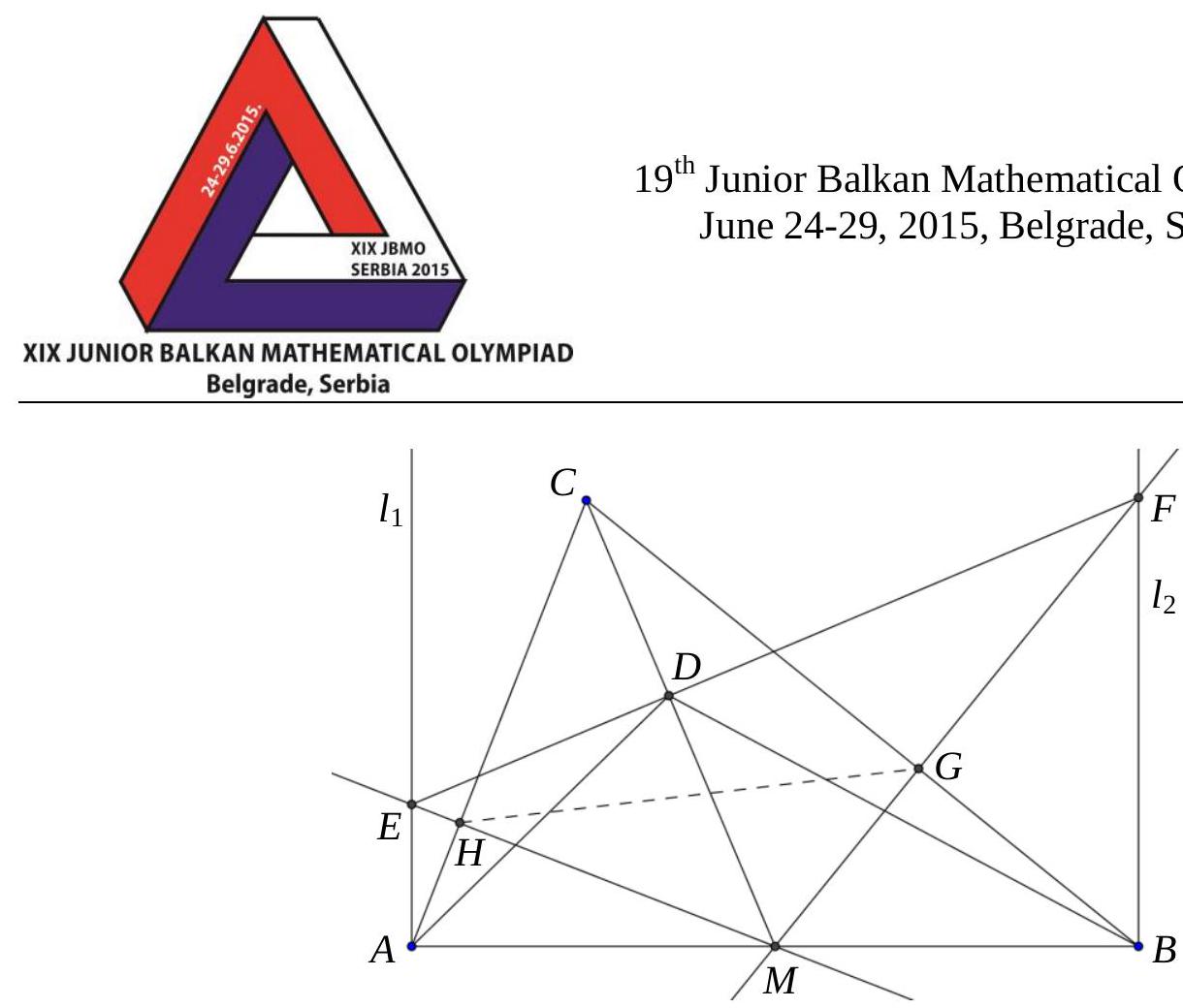
Therefore, we get that $\angle F E H=\angle F E M=\angle H G M$. Also, the quadrilateral $C H M G$ is cyclic, so $\angle C M H=\angle H G C$. We have
$$
\angle F E H+\angle C M H=\angle H G M+\angle H G C=90^{\circ}
$$
thus $C M \perp E F$. Now, from the cyclic quadrilaterals $F D M B$ and $E A M D$, we get that $\angle D F M=\angle D B M$ and $\angle D E M=\angle D A M$. Therefore, the triangles $\triangle E M F$ and $\triangle A D B$ are similar, so $\angle A D B=\angle E M F$.
## Problem 4.
An $L$-figure is one of the following four pieces, each consisting of three unit squares:
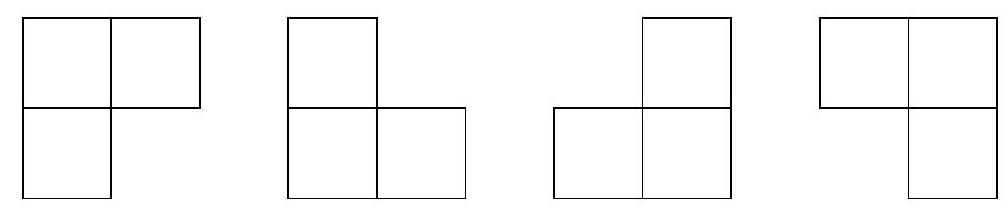
A $5 \times 5$ board, consisting of 25 unit squares, a positive integer $k \leq 25$ and an unlimited supply $L$-figures are given. Two players, $\boldsymbol{A}$ and $\boldsymbol{B}$, play the following game: starting with $\boldsymbol{A}$ they alternatively mark a previously unmarked unit square until they marked a total of $k$ unit squares.
We say that a placement of $L$-figures on unmarked unit squares is called good if the $L$-figure do not overlap and each of them covers exactly three unmarked unit squares of the board. $\boldsymbol{B}$ wins if every $\boldsymbol{g o o d}$ placement of $L$-figures leaves uncovered at least three unmarked unit squares. Determine the minimum value of $k$ for which $\boldsymbol{B}$ has a winning strategy.
## Solution:
We will show that player $\boldsymbol{A}$ wins if $k=1,2,3$, but player $\boldsymbol{B}$ wins if $k=4$. Thus the smallest $k$ for which $\boldsymbol{B}$ has a winning strategy exists and is equal to 4 .
If $k=1$, player $\boldsymbol{A}$ marks the upper left corner of the square and then fills it as follows.
## $19^{\text {th }}$ Junior Balkan Mathematical Olympiad
June 24-29, 2015, Belgrade, Serbia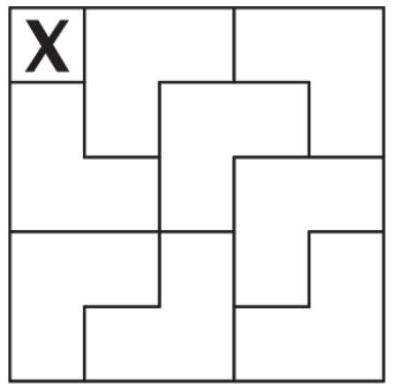
If $k=2$, player $\boldsymbol{A}$ marks the upper left corner of the square. Whatever square player $\boldsymbol{B}$ marks, then player $\boldsymbol{A}$ can fill in the square in exactly the same pattern as above except that he doesn't put the $L$-figure which covers the marked square of $\boldsymbol{B}$. Player $\boldsymbol{A}$ wins because he has left only two unmarked squares uncovered.
For $k=3$, player $\boldsymbol{A}$ wins by following the same strategy. When he has to mark a square for the second time, he marks any yet unmarked square of the $L$-figure that covers the marked square of $\boldsymbol{B}$.
Let us now show that for $k=4$ player $\boldsymbol{B}$ has a winning strategy. Since there will be 21 unmarked squares, player $\boldsymbol{A}$ will need to cover all of them with seven $L$-figures. We can assume that in his first move, player $\boldsymbol{A}$ does not mark any square in the bottom two rows of the chessboard (otherwise just rotate the chessboard). In his first move player $\boldsymbol{B}$ marks the square labeled 1 in the following figure.
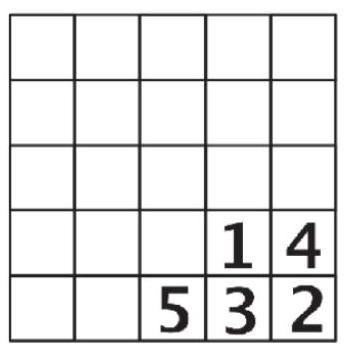
If player $\boldsymbol{A}$ in his next move does not mark any of the squares labeled 2,3 and 4 then player $\boldsymbol{B}$ marks the square labeled 3 . Player $\boldsymbol{B}$ wins as the square labeled 2 is left unmarked but cannot be covered with an $L$-figure.
If player $\boldsymbol{A}$ in his next move marks the square labeled 2, then player $\boldsymbol{B}$ marks the square labeled 5. Player $\boldsymbol{B}$ wins as the square labeled 3 is left unmarked but cannot be covered with an $L$-figure.
Finally, if player $\boldsymbol{A}$ in his next move marks one of the squares labeled 3 or 4, player $\boldsymbol{B}$ marks the other of these two squares. Player $\boldsymbol{B}$ wins as the square labeled 2 is left unmarked but cannot be covered with an $L$-figure.
Since we have covered all possible cases, player $\boldsymbol{B}$ wins when $k=4$.
|