

File size: 14,600 Bytes
eebb93b | 1 2 3 4 5 6 7 8 9 10 11 12 13 14 15 16 17 18 19 20 21 22 23 24 25 26 27 28 29 30 31 32 33 34 35 36 37 38 39 40 41 42 43 44 45 46 47 48 49 50 51 52 53 54 55 56 57 58 59 60 61 62 63 64 65 66 67 68 69 70 71 72 73 74 75 76 77 78 79 80 81 82 83 84 85 86 87 88 89 90 91 92 93 94 95 96 97 98 99 100 101 102 103 104 105 106 107 108 109 110 111 112 113 114 115 116 117 118 119 120 121 122 123 124 125 126 127 128 129 130 131 132 133 134 135 136 137 138 139 140 141 142 143 144 145 146 147 148 149 150 151 152 153 154 155 156 157 158 159 160 161 162 163 164 165 166 167 168 169 170 171 172 173 174 175 176 177 178 179 180 181 182 183 184 185 186 187 188 189 190 191 192 193 194 195 196 197 198 199 200 201 202 203 204 205 206 207 208 209 210 211 212 213 214 215 216 217 218 219 220 221 222 223 224 225 226 227 228 229 230 231 232 233 234 235 236 237 238 239 240 241 242 243 244 245 246 247 248 249 250 251 252 253 254 255 256 257 258 259 260 261 262 263 264 265 266 | # USAMO 2007 Solution Notes
Evan Chen《陳誼廷》
15 April 2024
This is a compilation of solutions for the 2007 USAMO. The ideas of the solution are a mix of my own work, the solutions provided by the competition organizers, and solutions found by the community. However, all the writing is maintained by me.
These notes will tend to be a bit more advanced and terse than the "official" solutions from the organizers. In particular, if a theorem or technique is not known to beginners but is still considered "standard", then I often prefer to use this theory anyways, rather than try to work around or conceal it. For example, in geometry problems I typically use directed angles without further comment, rather than awkwardly work around configuration issues. Similarly, sentences like "let $\mathbb{R}$ denote the set of real numbers" are typically omitted entirely.
Corrections and comments are welcome!
## Contents
0 Problems ..... 2
1 Solutions to Day 1 ..... 3
1.1 USAMO 2007/1, proposed by Sam Vandervelde ..... 3
1.2 USAMO 2007/2, proposed by Gregory Galperin ..... 4
1.3 USAMO 2007/3, proposed by Andras Gyarfas ..... 5
2 Solutions to Day 2 ..... 7
2.1 USAMO 2007/4, proposed by Reid Barton ..... 7
2.2 USAMO 2007/5, proposed by Titu Andreescu ..... 8
2.3 USAMO 2007/6, proposed by Sung-Yoon Kim ..... 9
## §0 Problems
1. Let $n$ be a positive integer. Define a sequence by setting $a_{1}=n$ and, for each $k>1$, letting $a_{k}$ be the unique integer in the range $0 \leq a_{k} \leq k-1$ for which $a_{1}+a_{2}+\cdots+a_{k}$ is divisible by $k$. (For instance, when $n=9$ the obtained sequence is $9,1,2,0,3,3,3, \ldots$ ) Prove that for any $n$ the sequence $a_{1}, a_{2}, \ldots$ eventually becomes constant.
2. Decide whether it possible to cover all lattice points in $\mathbb{R}^{2}$ by an (infinite) family of disks whose interiors are disjoint such that the radius of each disk is at least 5 .
3. Let $S$ be a set containing $n^{2}+n-1$ elements. Suppose that the $n$-element subsets of $S$ are partitioned into two classes. Prove that there are at least $n$ pairwise disjoint sets in the same class.
4. An animal with $n$ cells is a connected figure consisting of $n$ equal-sized square cells (equivalently, a polyomino with $n$ cells). A dinosaur is an animal with at least 2007 cells. It is said to be primitive it its cells cannot be partitioned into two or more dinosaurs. Find with proof the maximum number of cells in a primitive dinosaur.
5. Prove that for every nonnegative integer $n$, the number $7^{7^{n}}+1$ is the product of at least $2 n+3$ (not necessarily distinct) primes.
6. Let $A B C$ be an acute triangle with $\omega, S$, and $R$ being its incircle, circumcircle, and circumradius, respectively. Circle $\omega_{A}$ is tangent internally to $S$ at $A$ and tangent externally to $\omega$. Circle $S_{A}$ is tangent internally to $S$ at $A$ and tangent internally to $\omega$.
Let $P_{A}$ and $Q_{A}$ denote the centers of $\omega_{A}$ and $S_{A}$, respectively. Define points $P_{B}$, $Q_{B}, P_{C}, Q_{C}$ analogously. Prove that
$$
8 P_{A} Q_{A} \cdot P_{B} Q_{B} \cdot P_{C} Q_{C} \leq R^{3}
$$
with equality if and only if triangle $A B C$ is equilateral.
## §1 Solutions to Day 1
## §1.1 USAMO 2007/1, proposed by Sam Vandervelde
Available online at https://aops.com/community/p825490.
## Problem statement
Let $n$ be a positive integer. Define a sequence by setting $a_{1}=n$ and, for each $k>1$, letting $a_{k}$ be the unique integer in the range $0 \leq a_{k} \leq k-1$ for which $a_{1}+a_{2}+\cdots+a_{k}$ is divisible by $k$. (For instance, when $n=9$ the obtained sequence is $9,1,2,0,3,3,3, \ldots$ ) Prove that for any $n$ the sequence $a_{1}, a_{2}, \ldots$ eventually becomes constant.
For each $k$, the number
$$
b_{k}:=\frac{1}{k}\left(a_{1}+\cdots+a_{k}\right)
$$
is a nonnegative integer.
Claim - The sequence $\left(b_{k}\right)$ is eventually constant.
Proof. Since
$$
b_{k+1}=\frac{a_{1}+\cdots+a_{k}+a_{k+1}}{k+1} \leq \frac{k b_{k}+k}{k+1}<b_{k}+1
$$
and therefore $b_{k+1} \leq b_{k}$ for all $k$. Hence the sequence $b_{k}$ must eventually be constant.
This can only happen once the sequence is constant: indeed if $N$ is an index such that $b_{N}=b_{N+1}=\cdots=b$ then
$$
a_{k}=(k+1) b_{k+1}-k \cdot b_{k}=(k+1) \cdot b-k \cdot b=b
$$
for any $k \geq N$. In other words, $a_{N}=a_{N+1}=\cdots=b$ as well.
## §1.2 USAMO 2007/2, proposed by Gregory Galperin
Available online at https://aops.com/community/p825495.
## Problem statement
Decide whether it possible to cover all lattice points in $\mathbb{R}^{2}$ by an (infinite) family of disks whose interiors are disjoint such that the radius of each disk is at least 5.
The answer is no.
Assume not. Take a disk $\odot O$ not touching any member of the family, and then enlarge it until it is maximal. Then, it must be tangent to at least three other disks, say $\odot A$, $\odot B, \odot C$. Suppose WLOG that $\angle A O B \leq 120^{\circ}$. Denote the radii of $\odot O, \odot A, \odot B$ by $r$, $a, b$.
But the Law of Cosines gives
$$
(a+b)^{2} \leq(a+r)^{2}+(b+r)^{2}+(a+r)(b+r)
$$
which rewrites as
$$
12 r^{2} \geq(a-3 r)(b-3 r) \geq(5-3 r)^{2}
$$
which one can check is impossible for $r \leq 1 / \sqrt{2}$. Thus $r>1 / \sqrt{2}$.
In particular $(\odot O)$ must contain a lattice point as it contains a unit square.
Remark. The order of the argument here matters in subtle ways. A common approach is to try and reduce to the "optimal" case where we have three mutually tangent circles, and then apply the Descarte circle theorem. There are ways in which this approach can fail if the execution is not done with care. (In particular, one cannot simply say to reduce to this case, without some justification.)
For example: it is not true that, given an infinite family of disks, we can enlarge disks until we get three mutually tangent ones. As a counterexample consider the "square grid" in which a circle is centered at $(10 m, 10 n)$ for each $m, n \in \mathbb{Z}$ and has radius 5 . Thus it is also not possible to simply pick three nearby circles and construct a circle tangent to all three: that newly constructed circle might intersect a fourth disk not in the picture.
Thus, when constructing the small disk $\odot O$ in the above solution, it seems easiest to start with a point not covered and grow $\odot O$ until it is tangent to some three circles, and then argue by cosine law. Otherwise it not easy to determine which three circles to start with.
In all solutions it seems easier to prove that a disjoint circle of radius $1 / \sqrt{2}$ exists, and then finally deduce it has a lattice point, rather than trying to work the lattice point into the existence proof.
## §1.3 USAMO 2007/3, proposed by Andras Gyarfas
Available online at https://aops.com/community/p825499.
## Problem statement
Let $S$ be a set containing $n^{2}+n-1$ elements. Suppose that the $n$-element subsets of $S$ are partitioned into two classes. Prove that there are at least $n$ pairwise disjoint sets in the same class.
We present two solutions which are really equivalent, but phrased differently. We refer to the two classes as "red" and "blue", respectively.
【 First solution (Grant Yu). We define a set of $n+1$ elements to be useful if it has $n$-element subsets in each class.
Consider a maximal collection of disjoint useful sets and assume there are $p$ such sets. Then, let $T$ be the set of elements remaining (i.e. not in one of chosen useful sets).
Claim - All subsets of $T$ of size $n$ are the same color.
Proof. Assume there was a red set $R$ in $T$. Replace the elements of $R$ one by one until we get to any other subset $R^{\prime}$ of $T$. At each step, because no sets of $T$ form a useful set, the set remains red - so $R^{\prime}$ is red too. Since $R^{\prime}$ is arbitrary, this proves the claim.
We have $|T|=n^{2}+n-1-p(n+1)$, and in particular $p<n$. WLOG all sets in $T$ are red. We can extract another red set from each of our chosen useful sets. So we can get at least
$$
p+\left\lfloor\frac{|T|}{n}\right\rfloor=p+\left\lfloor n+1-p-\frac{1+p}{n}\right\rfloor \geq p+(n-p)=n .
$$
## ब Second solution (by induction). We prove more strongly that:
Claim - Let $S$ be a set containing $k \cdot(n+1)-1$ elements. Then we can find $k$ pairwise disjoint sets of the same color.
The proof is by induction on $k \geq 1$. The base case $k=1$ this is immediate; $\binom{S}{n}$ is a single set.
For the inductive step, assume for contradiction the problem fails. Let $T$ be any subset of $S$ of size $(k-1)(n+1)-1$. By the induction hypothesis, among the subsets of $T$ alone, we can already find $k-1$ pairwise disjoint sets of the same color. Now $S \backslash T$ has size $n+1$, and so we would have to have that all $\binom{n+1}{n}$ subsets of $S \backslash T$ are the same color.
By varying $T$, the set $S \backslash T$ ranges over all of $\binom{S}{k+1}$. This causes all sets to be the same color, contradiction.
Remark. Victor Wang writes the following:
I don't really like this problem, but I think the main motivation for generalizing the problem is that the original problem doesn't allow you to look at small cases. (Also, it's not initially clear where the $n^{2}+n-1$ comes from.) And
pretty much the simplest way to get lots of similarly-flavored small cases is to start with $k=2,3$ in "find the smallest $N(n, k)$ such that when we partition the $n$-subsets of a $\geq N(n, k)$-set into 2 classes, we can find some $k$ pairwise disjoint sets in the same class".
## §2 Solutions to Day 2
## §2.1 USAMO 2007/4, proposed by Reid Barton
Available online at https://aops.com/community/p825505.
## Problem statement
An animal with $n$ cells is a connected figure consisting of $n$ equal-sized square cells (equivalently, a polyomino with $n$ cells). A dinosaur is an animal with at least 2007 cells. It is said to be primitive it its cells cannot be partitioned into two or more dinosaurs. Find with proof the maximum number of cells in a primitive dinosaur.
In fact it's true for any tree with maximum degree $\leq 4$. Here is the solution of Andrew Geng.
Let $T$ be such a tree (a spanning tree of the dinosaur graph) which corresponds to a primitive dinosaur.
Claim - There exists a vertex $v$ such that when $v$ is deleted, no dinosaurs result.
Proof. Assume for contradiction that all vertices are bad (leave a dinosaur when deleted). Consider two adjacent vertices $v, w$ in $T$. By checking possibilities, one sees that, say, the dinosaur in $T-v$ contains $w$ and the dinosaur of $T-w$. We can repeat in this way; since $T$ is acyclic, this eventually becomes a contradiction.
When this vertex is deleted, we get at most 4 components, each with $\leq 2006$ vertices, giving the answer of $4 \cdot 2006+1=8025$. The construction is easy (take a "cross", for example).
## §2.2 USAMO 2007/5, proposed by Titu Andreescu
Available online at https://aops.com/community/p825508.
## Problem statement
Prove that for every nonnegative integer $n$, the number $7^{7^{n}}+1$ is the product of at least $2 n+3$ (not necessarily distinct) primes.
We prove this by induction on $n$ by showing that
$$
\frac{X^{7}+1}{X+1}=X^{6}-X^{5}+\cdots+1
$$
is never prime for $X=7^{7^{n}}$, hence we gain at least two additional prime factors whenever we increase $n$ by one.
Indeed, the quotient may be written as
$$
(X+1)^{6}-7 X \cdot\left(X^{2}+X+1\right)^{2}
$$
which becomes a difference of squares, hence composite.
## §2.3 USAMO 2007/6, proposed by Sung-Yoon Kim
Available online at https://aops.com/community/p825515.
## Problem statement
Let $A B C$ be an acute triangle with $\omega, S$, and $R$ being its incircle, circumcircle, and circumradius, respectively. Circle $\omega_{A}$ is tangent internally to $S$ at $A$ and tangent externally to $\omega$. Circle $S_{A}$ is tangent internally to $S$ at $A$ and tangent internally to $\omega$.
Let $P_{A}$ and $Q_{A}$ denote the centers of $\omega_{A}$ and $S_{A}$, respectively. Define points $P_{B}$, $Q_{B}, P_{C}, Q_{C}$ analogously. Prove that
$$
8 P_{A} Q_{A} \cdot P_{B} Q_{B} \cdot P_{C} Q_{C} \leq R^{3}
$$
with equality if and only if triangle $A B C$ is equilateral.
It turns out we can compute $P_{A} Q_{A}$ explicitly. Let us invert around $A$ with radius $s-a$ (hence fixing the incircle) and then compose this with a reflection around the angle bisector of $\angle B A C$. We denote the image of the composed map via
$$
\bullet \mapsto \bullet^{*} \mapsto \bullet^{+}
$$
We overlay this inversion with the original diagram.
Let $P_{A} Q_{A}$ meet $\omega_{A}$ again at $P$ and $S_{A}$ again at $Q$. Now observe that $\omega_{A}^{*}$ is a line parallel to $S^{*}$; that is, it is perpendicular to $\overline{P Q}$. Moreover, it is tangent to $\omega^{*}=\omega$.
Now upon the reflection, we find that $\omega^{+}=\omega^{*}=\omega$, but line $\overline{P Q}$ gets mapped to the altitude from $A$ to $\overline{B C}$, since $\overline{P Q}$ originally contained the circumcenter $O$ (isogonal to the orthocenter). But this means that $\omega_{A}^{*}$ is none other than the $\overline{B C}$ ! Hence $P^{+}$is actually the foot of the altitude from $A$ onto $\overline{B C}$.
By similar work, we find that $Q^{+}$is the point on $\overline{A P^{+}}$such that $P^{+} Q^{+}=2 r$.
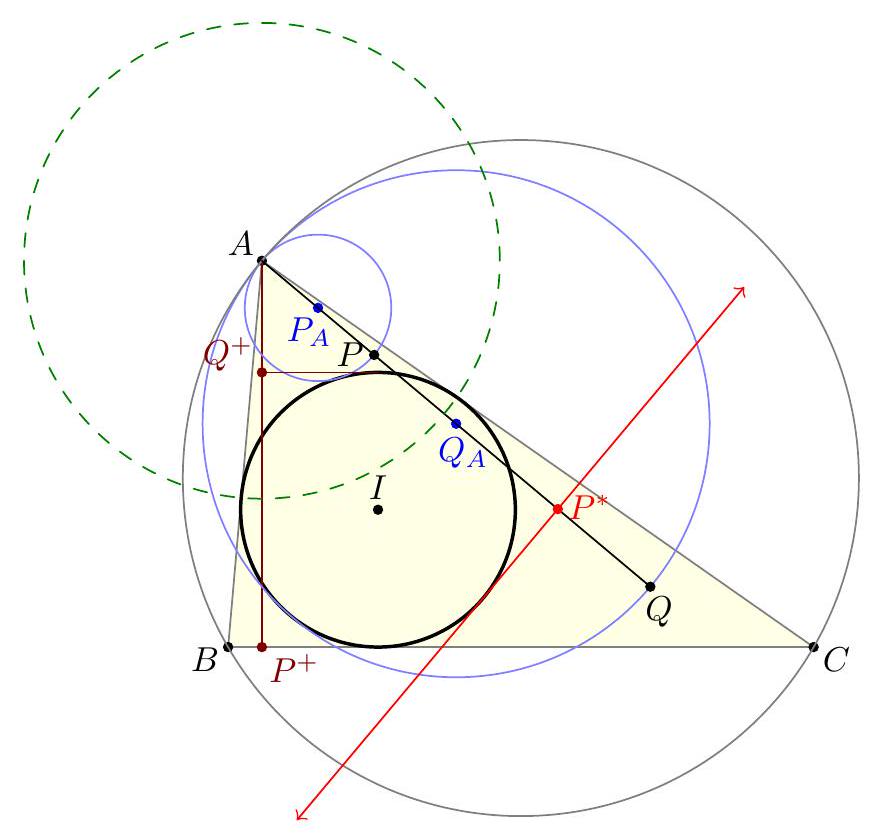
Now we can compute all the lengths directly. We have that
$$
A P_{A}=\frac{1}{2} A P=\frac{(s-a)^{2}}{2 A P^{+}}=\frac{1}{2}(s-a)^{2} \cdot \frac{1}{h_{a}}
$$
and
$$
A Q_{A}=\frac{1}{2} A Q=\frac{(s-a)^{2}}{2 A Q^{+}}=\frac{1}{2}(s-a)^{2} \cdot \frac{1}{h_{a}-2 r}
$$
where $h_{a}=\frac{2 K}{a}$ is the length of the $A$-altitude, with $K$ the area of $A B C$ as usual. Now it follows that
$$
P_{A} Q_{A}=\frac{1}{2}(s-a)^{2}\left(\frac{2 r}{h_{a}\left(h_{a}-2 r\right)}\right) .
$$
This can be simplified, as
$$
h_{a}-2 r=\frac{2 K}{a}-\frac{2 K}{s}=2 K \cdot \frac{s-a}{a s}
$$
Hence
$$
P_{A} Q_{A}=\frac{a^{2} r s(s-a)}{4 K^{2}}=\frac{a^{2}(s-a)}{4 K} .
$$
Hence, the problem is just asking us to show that
$$
a^{2} b^{2} c^{2}(s-a)(s-b)(s-c) \leq 8(R K)^{3}
$$
Using $a b c=4 R K$ and $(s-a)(s-b)(s-c)=\frac{1}{s} K^{2}=r K$, we find that this becomes
$$
2(s-a)(s-b)(s-c) \leq R K \Longleftrightarrow 2 r \leq R
$$
which follows immediately from $I O^{2}=R(R-2 r)$. Alternatively, one may rewrite this as Schur's Inequality in the form
$$
a b c \geq(-a+b+c)(a-b+c)(a+b-c)
$$
|