

File size: 21,905 Bytes
eebb93b | 1 2 3 4 5 6 7 8 9 10 11 12 13 14 15 16 17 18 19 20 21 22 23 24 25 26 27 28 29 30 31 32 33 34 35 36 37 38 39 40 41 42 43 44 45 46 47 48 49 50 51 52 53 54 55 56 57 58 59 60 61 62 63 64 65 66 67 68 69 70 71 72 73 74 75 76 77 78 79 80 81 82 83 84 85 86 87 88 89 90 91 92 93 94 95 96 97 98 99 100 101 102 103 104 105 106 107 108 109 110 111 112 113 114 115 116 117 118 119 120 121 122 123 124 125 126 127 128 129 130 131 132 133 134 135 136 137 138 139 140 141 142 143 144 145 146 147 148 149 150 151 152 153 154 155 156 157 158 159 160 161 162 163 164 165 166 167 168 169 170 171 172 173 174 175 176 177 178 179 180 181 182 183 184 185 186 187 188 189 190 191 192 193 194 195 196 197 198 199 200 201 202 203 204 205 206 207 208 209 210 211 212 213 214 215 216 217 218 219 220 221 222 223 224 225 226 227 228 229 230 231 232 233 234 235 236 237 238 239 240 241 242 243 244 245 246 247 248 249 250 251 252 253 254 255 256 257 258 259 260 261 262 263 264 265 266 267 268 269 270 271 272 273 274 275 276 277 278 279 280 281 282 283 284 285 286 287 288 289 290 291 292 293 294 295 296 297 298 299 300 301 302 303 304 305 306 307 308 309 310 311 312 313 314 315 316 317 318 319 320 321 322 323 324 325 326 327 328 329 330 331 332 333 334 335 336 337 338 339 340 341 342 343 344 345 346 347 348 349 350 351 352 353 354 355 356 357 358 359 360 361 362 363 364 365 366 367 368 369 370 371 372 373 374 375 376 377 378 379 380 381 382 383 384 385 386 387 388 389 390 391 392 393 394 395 396 397 398 399 400 401 402 403 404 405 406 407 408 409 410 411 412 413 414 415 416 417 418 | # USAMO 2015 Solution Notes
Evan Chen《陳誼廷》
15 April 2024
This is a compilation of solutions for the 2015 USAMO. The ideas of the solution are a mix of my own work, the solutions provided by the competition organizers, and solutions found by the community. However, all the writing is maintained by me.
These notes will tend to be a bit more advanced and terse than the "official" solutions from the organizers. In particular, if a theorem or technique is not known to beginners but is still considered "standard", then I often prefer to use this theory anyways, rather than try to work around or conceal it. For example, in geometry problems I typically use directed angles without further comment, rather than awkwardly work around configuration issues. Similarly, sentences like "let $\mathbb{R}$ denote the set of real numbers" are typically omitted entirely.
Corrections and comments are welcome!
## Contents
0 Problems ..... 2
1 Solutions to Day 1 ..... 3
1.1 USAMO 2015/1, proposed by Titu Andreescu ..... 3
1.2 USAMO 2015/2, proposed by Zuming Feng, Jacek Fabrykowski ..... 4
1.3 USAMO 2015/3, proposed by Gabriel Carroll ..... 7
2 Solutions to Day 2 ..... 9
2.1 USAMO 2015/4, proposed by Maria Monks Gillespie ..... 9
2.2 USAMO 2015/5, proposed by Mohsen Jamaali ..... 11
2.3 USAMO 2015/6, proposed by Iurie Boreico ..... 12
## §0 Problems
1. Solve in integers the equation
$$
x^{2}+x y+y^{2}=\left(\frac{x+y}{3}+1\right)^{3}
$$
2. Quadrilateral $A P B Q$ is inscribed in circle $\omega$ with $\angle P=\angle Q=90^{\circ}$ and $A P=$ $A Q<B P$. Let $X$ be a variable point on segment $\overline{P Q}$. Line $A X$ meets $\omega$ again at $S$ (other than $A$ ). Point $T$ lies on $\operatorname{arc} A Q B$ of $\omega$ such that $\overline{X T}$ is perpendicular to $\overline{A X}$. Let $M$ denote the midpoint of chord $\overline{S T}$.
As $X$ varies on segment $\overline{P Q}$, show that $M$ moves along a circle.
3. Let $S=\{1,2, \ldots, n\}$, where $n \geq 1$. Each of the $2^{n}$ subsets of $S$ is to be colored red or blue. (The subset itself is assigned a color and not its individual elements.) For any set $T \subseteq S$, we then write $f(T)$ for the number of subsets of $T$ that are blue.
Determine the number of colorings that satisfy the following condition: for any subsets $T_{1}$ and $T_{2}$ of $S$,
$$
f\left(T_{1}\right) f\left(T_{2}\right)=f\left(T_{1} \cup T_{2}\right) f\left(T_{1} \cap T_{2}\right)
$$
4. Steve is piling $m \geq 1$ indistinguishable stones on the squares of an $n \times n$ grid. Each square can have an arbitrarily high pile of stones. After he finished piling his stones in some manner, he can then perform stone moves, defined as follows. Consider any four grid squares, which are corners of a rectangle, i.e. in positions $(i, k),(i, l)$, $(j, k),(j, l)$ for some $1 \leq i, j, k, l \leq n$, such that $i<j$ and $k<l$. A stone move consists of either removing one stone from each of $(i, k)$ and $(j, l)$ and moving them to $(i, l)$ and $(j, k)$ respectively, or removing one stone from each of $(i, l)$ and $(j, k)$ and moving them to $(i, k)$ and $(j, l)$ respectively.
Two ways of piling the stones are equivalent if they can be obtained from one another by a sequence of stone moves. How many different non-equivalent ways can Steve pile the stones on the grid?
5. Let $a, b, c, d, e$ be distinct positive integers such that $a^{4}+b^{4}=c^{4}+d^{4}=e^{5}$. Show that $a c+b d$ is a composite number.
6. Consider $0<\lambda<1$, and let $A$ be a multiset of positive integers. Let $A_{n}=\{a \in$ $A: a \leq n\}$. Assume that for every $n \in \mathbb{N}$, the multiset $A_{n}$ contains at most $n \lambda$ numbers. Show that there are infinitely many $n \in \mathbb{N}$ for which the sum of the elements in $A_{n}$ is at most $\frac{n(n+1)}{2} \lambda$.
## §1 Solutions to Day 1
## §1.1 USAMO 2015/1, proposed by Titu Andreescu
Available online at https://aops.com/community/p4769940.
## Problem statement
Solve in integers the equation
$$
x^{2}+x y+y^{2}=\left(\frac{x+y}{3}+1\right)^{3}
$$
We do the trick of setting $a=x+y$ and $b=x-y$. This rewrites the equation as
$$
\frac{1}{4}\left((a+b)^{2}+(a+b)(a-b)+(a-b)^{2}\right)=\left(\frac{a}{3}+1\right)^{3}
$$
where $a, b \in \mathbb{Z}$ have the same parity. This becomes
$$
3 a^{2}+b^{2}=4\left(\frac{a}{3}+1\right)^{3}
$$
which is enough to imply $3 \mid a$, so let $a=3 c$. Miraculously, this becomes
$$
b^{2}=(c-2)^{2}(4 c+1)
$$
So a solution must have $4 c+1=m^{2}$, with $m$ odd. This gives
$$
x=\frac{1}{8}\left(3\left(m^{2}-1\right) \pm\left(m^{3}-9 m\right)\right) \quad \text { and } \quad y=\frac{1}{8}\left(3\left(m^{2}-1\right) \mp\left(m^{3}-9 m\right)\right) .
$$
For mod 8 reasons, this always generates a valid integer solution, so this is the complete curve of solutions. Actually, putting $m=2 n+1$ gives the much nicer curve
$$
x=n^{3}+3 n^{2}-1 \quad \text { and } \quad y=-n^{3}+3 n+1
$$
and permutations.
For $n=0,1,2,3$ this gives the first few solutions are $(-1,1),(3,3),(19,-1),(53,-17)$, (and permutations).
## §1.2 USAMO 2015/2, proposed by Zuming Feng, Jacek Fabrykowski
Available online at https://aops.com/community/p4769957.
## Problem statement
Quadrilateral $A P B Q$ is inscribed in circle $\omega$ with $\angle P=\angle Q=90^{\circ}$ and $A P=A Q<$ $B P$. Let $X$ be a variable point on segment $\overline{P Q}$. Line $A X$ meets $\omega$ again at $S$ (other than $A$ ). Point $T$ lies on $\operatorname{arc} A Q B$ of $\omega$ such that $\overline{X T}$ is perpendicular to $\overline{A X}$. Let $M$ denote the midpoint of chord $\overline{S T}$.
As $X$ varies on segment $\overline{P Q}$, show that $M$ moves along a circle.
We present three solutions, one by complex numbers, two more synthetic. (A fourth solution using median formulas is also possible.) Most solutions will prove that the center of the fixed circle is the midpoint of $\overline{A O}$ (with $O$ the center of $\omega$ ); this can be recovered empirically by letting
- $X$ approach $P$ (giving the midpoint of $\overline{B P}$ )
- $X$ approach $Q$ (giving the point $Q$ ), and
- $X$ at the midpoint of $\overline{P Q}$ (giving the midpoint of $\overline{B Q}$ )
which determines the circle; this circle then passes through $P$ by symmetry and we can find the center by taking the intersection of two perpendicular bisectors (which two?).
【 Complex solution (Evan Chen). Toss on the complex unit circle with $a=-1, b=1$, $z=-\frac{1}{2}$. Let $s$ and $t$ be on the unit circle. We claim $Z$ is the center.
It follows from standard formulas that
$$
x=\frac{1}{2}(s+t-1+s / t)
$$
thus
$$
4 \operatorname{Re} x+2=s+t+\frac{1}{s}+\frac{1}{t}+\frac{s}{t}+\frac{t}{s}
$$
which depends only on $P$ and $Q$, and not on $X$. Thus
$$
4\left|z-\frac{s+t}{2}\right|^{2}=|s+t+1|^{2}=3+(4 \operatorname{Re} x+2)
$$
does not depend on $X$, done.
『 Homothety solution (Alex Whatley). Let $G, N, O$ denote the centroid, nine-point center, and circumcenter of triangle $A S T$, respectively. Let $Y$ denote the midpoint of $\overline{A S}$. Then the three points $X, Y, M$ lie on the nine-point circle of triangle $A S T$, which is centered at $N$ and has radius $\frac{1}{2} A O$.
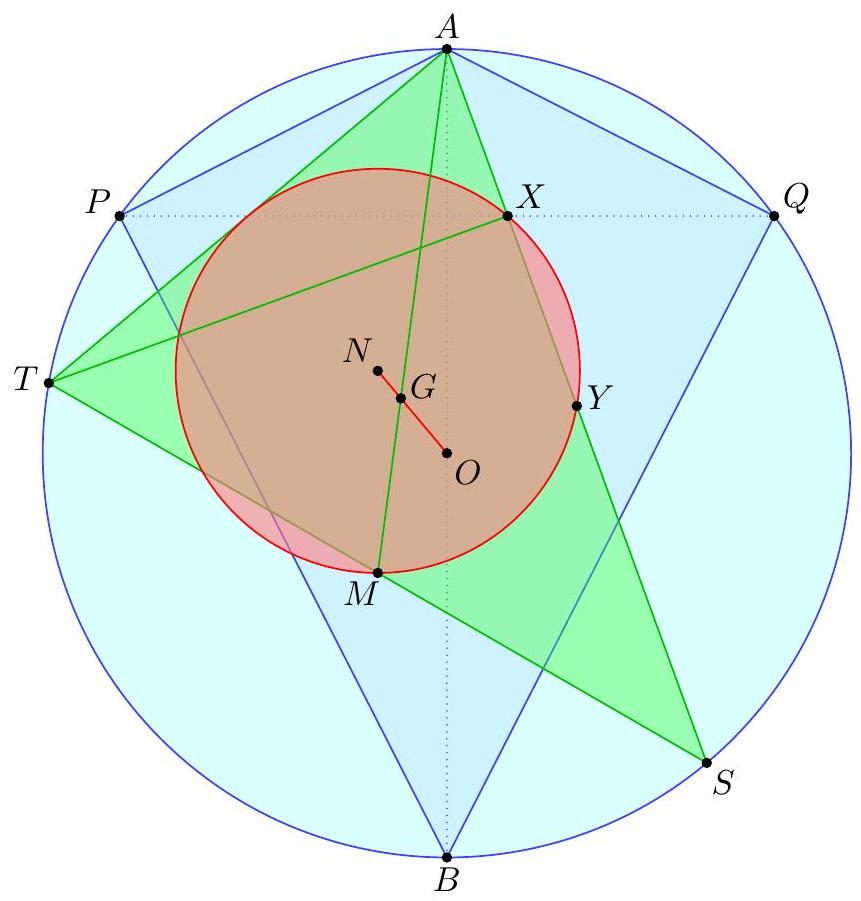
Let $R$ denote the radius of $\omega$. Note that the nine-point circle of $\triangle A S T$ has radius equal to $\frac{1}{2} R$, and hence is independent of $S$ and $T$. Then the power of $A$ with respect to the nine-point circle equals
$$
A N^{2}-\left(\frac{1}{2} R\right)^{2}=A X \cdot A Y=\frac{1}{2} A X \cdot A S=\frac{1}{2} A Q^{2}
$$
and hence
$$
A N^{2}=\left(\frac{1}{2} R\right)^{2}+\frac{1}{2} A Q^{2}
$$
which does not depend on the choice of $X$. So $N$ moves along a circle centered at $A$.
Since the points $O, G, N$ are collinear on the Euler line of $\triangle A S T$ with
$$
G O=\frac{2}{3} N O
$$
it follows by homothety that $G$ moves along a circle as well, whose center is situated one-third of the way from $A$ to $O$. Finally, since $A, G, M$ are collinear with
$$
A M=\frac{3}{2} A G
$$
it follows that $M$ moves along a circle centered at the midpoint of $\overline{A O}$.
『 Power of a point solution (Zuming Feng, official solution). We complete the picture by letting $\triangle K Y X$ be the orthic triangle of $\triangle A S T$; in that case line $X Y$ meets the $\omega$ again at $P$ and $Q$.
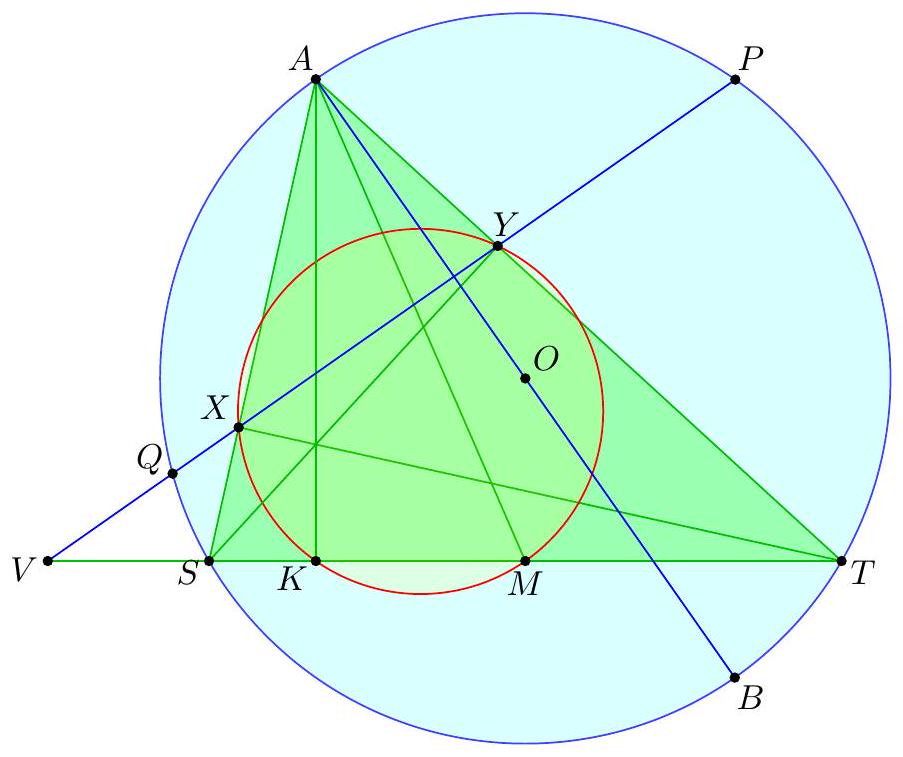
The main claim is:
Claim - Quadrilateral $P Q K M$ is cyclic.
Proof. To see this, we use power of a point: let $V=\overline{Q X Y P} \cap \overline{S K M T}$. One approach is that since $(V K ; S T)=-1$ we have $V Q \cdot V P=V S \cdot V T=V K \cdot V M$. A longer approach is more elementary:
$$
V Q \cdot V P=V S \cdot V T=V X \cdot V Y=V K \cdot V M
$$
using the nine-point circle, and the circle with diameter $\overline{S T}$.
But the circumcenter of $P Q K M$, is the midpoint of $\overline{A O}$, since it lies on the perpendicular bisectors of $\overline{K M}$ and $\overline{P Q}$. So it is fixed, the end.
## §1.3 USAMO 2015/3, proposed by Gabriel Carroll
Available online at https://aops.com/community/p4769949.
## Problem statement
Let $S=\{1,2, \ldots, n\}$, where $n \geq 1$. Each of the $2^{n}$ subsets of $S$ is to be colored red or blue. (The subset itself is assigned a color and not its individual elements.) For any set $T \subseteq S$, we then write $f(T)$ for the number of subsets of $T$ that are blue.
Determine the number of colorings that satisfy the following condition: for any subsets $T_{1}$ and $T_{2}$ of $S$,
$$
f\left(T_{1}\right) f\left(T_{2}\right)=f\left(T_{1} \cup T_{2}\right) f\left(T_{1} \cap T_{2}\right)
$$
For an $n$-coloring $\mathcal{C}$ (by which we mean a coloring of the subsets of $\{1, \ldots, n\}$ ), define the support of $\mathcal{C}$ as
$$
\operatorname{supp}(\mathcal{C})=\{T \mid f(T) \neq 0\}
$$
Call a coloring nontrivial if $\operatorname{supp}(\mathcal{C}) \neq \varnothing$ (equivalently, the coloring is not all red). In that case, notice that
- the support is closed under unions and intersections: since if $f\left(T_{1}\right) f\left(T_{2}\right) \neq 0$ then necessarily both $f\left(T_{1} \cap T_{2}\right)$ and $f\left(T_{1} \cup T_{2}\right)$ are nonzero; and
- the support is obviously upwards closed.
Thus, the support must take the form
$$
\operatorname{supp}(\mathcal{C})=[X, S] \stackrel{\text { def }}{=}\{T \mid X \subseteq T \subseteq S\}
$$
for some set $X$ (for example by letting $X$ be the minimal (by size) element of the support).
Say $\mathcal{C}$ has full support if $X=\varnothing$ (equivalently, $\varnothing$ is blue).
## Lemma
For a given $n$ and $B \subseteq\{1, \ldots, n\}$, there is exactly one $n$-coloring with full support in which the singletons colored blue are exactly those in $B$. Therefore there are exactly $2^{n} n$-colorings with full support.
Proof. To see there is at least one coloring, color only the subsets of $B$ blue. In that case
$$
f(T)=2^{|T \cap B|}
$$
which satisfies the condition by Inclusion-Exclusion. To see this extension is unique, note that $f(\{b\})$ is determined for each $b$ and we can then determine $f(T)$ inductively on $|T|$; hence there is at most one way to complete a coloring of the singletons, which completes the proof.
For a general nontrivial $n$-coloring $\mathcal{C}$, note that if $\operatorname{supp}(\mathcal{C})=[X, S]$, then we can think of it as an $(n-|X|)$-coloring with full support. For $|X|=k$, there are $\binom{n}{k}$ possible choices of $X \subseteq S$. Adding back in the trivial coloring, the final answer is
$$
1+\sum_{k=0}^{n}\binom{n}{k} 2^{k}=1+3^{n}
$$
Remark. To be more explicit, the possible nontrivial colorings are exactly described by specifying two sets $X$ and $Y$ with $X \subseteq Y$, and coloring blue only the sets $T$ with $X \subseteq T \subseteq Y$. In particular, one deduces that in a working coloring, $f(T)$ is always either zero or a power of two. If one manages to notice this while working on the problem, it is quite helpful for motivating the solution, as it leads one to suspect that the working colorings have good structure.
## §2 Solutions to Day 2
## §2.1 USAMO 2015/4, proposed by Maria Monks Gillespie
Available online at https://aops.com/community/p4774079.
## Problem statement
Steve is piling $m \geq 1$ indistinguishable stones on the squares of an $n \times n$ grid. Each square can have an arbitrarily high pile of stones. After he finished piling his stones in some manner, he can then perform stone moves, defined as follows. Consider any four grid squares, which are corners of a rectangle, i.e. in positions $(i, k),(i, l),(j, k)$, $(j, l)$ for some $1 \leq i, j, k, l \leq n$, such that $i<j$ and $k<l$. A stone move consists of either removing one stone from each of $(i, k)$ and $(j, l)$ and moving them to $(i, l)$ and $(j, k)$ respectively, or removing one stone from each of $(i, l)$ and $(j, k)$ and moving them to $(i, k)$ and $(j, l)$ respectively.
Two ways of piling the stones are equivalent if they can be obtained from one another by a sequence of stone moves. How many different non-equivalent ways can Steve pile the stones on the grid?
The answer is $\binom{m+n-1}{n-1}^{2}$. The main observation is that the ordered sequence of column counts (i.e. the number of stones in the first, second, etc. column) is invariant under stone moves, as does the analogous sequence of row counts.
\ Definitions. Call these numbers $\left(c_{1}, c_{2}, \ldots, c_{n}\right)$ and $\left(r_{1}, r_{2}, \ldots, r_{n}\right)$ respectively, with $\sum c_{i}=\sum r_{i}=m$. We say that the sequence $\left(c_{1}, \ldots, c_{n}, r_{1}, \ldots, r_{n}\right)$ is the signature of the configuration. These are the $2 m$ blue and red numbers shown in the example below (in this example we have $m=8$ and $n=3$ ).

Signature: $(5,2,1 ; 3,3,2)$
By stars-and-bars, the number of possible values $\left(c_{1}, \ldots, c_{n}\right)$ is $\binom{m+n-1}{n-1}$. The same is true for $\left(r_{1}, \ldots, r_{m}\right)$. So if we're just counting signatures, the total number of possible signatures is $\binom{m+n-1}{n-1}^{2}$.
【 Outline and setup. We are far from done. To show that the number of non-equivalent ways is also this number, we need to show that signatures correspond to pilings. In other words, we need to prove:
1. Check that signatures are invariant around moves (trivial; we did this already);
2. Check conversely that two configurations are equivalent if they have the same signatures (the hard part of the problem); and
3. Show that each signature is realized by at least one configuration (not immediate, but pretty easy).
Most procedures to the second step are algorithmic in nature, but Ankan Bhattacharya gives the following far cleaner approach. Rather than having a grid of stones, we simply consider the multiset of ordered pairs $(x, y)$ corresponding to the stones. Then:
- a stone move corresponds to switching two $y$-coordinates in two different pairs.
- we redefine the signature to be the multiset $(X, Y)$ of $x$ and $y$ coordinates which appear. Explicitly, $X$ is the multiset that contains $c_{i}$ copies of the number $i$ for each $i$.
For example, consider the earlier example which had
- Two stones each at $(1,1),(1,2)$.
- One stone each at $(1,3),(2,1),(2,3),(3,2)$.
Its signature can then be reinterpreted as
$$
(5,2,1 ; 3,3,2) \longleftrightarrow\left\{\begin{array}{l}
X=\{1,1,1,1,1,2,2,3\} \\
Y=\{1,1,1,2,2,2,3,3\}
\end{array}\right.
$$
In that sense, the entire grid is quite misleading!
『 Proof that two configurations with the same signature are equivalent. The second part is completed just because transpositions generate any permutation. To be explicit, given two sets of stones, we can permute the labels so that the first set is $\left(x_{1}, y_{1}\right), \ldots$, $\left(x_{m}, y_{m}\right)$ and the second set of stones is $\left(x_{1}, y_{1}^{\prime}\right), \ldots,\left(x_{m}, y_{m}^{\prime}\right)$. Then we just induce the correct permutation on $\left(y_{i}\right)$ to get $\left(y_{i}^{\prime}\right)$.
ब Proof that any signature has at least one configuration. Sort the elements of $X$ and $Y$ arbitrarily (say, in non-decreasing order). Put a stone whose $x$-coordinate is the $i$ th element of $X$, and whose $y$-coordinate is the $i$ th element of $Y$, for each $i=1,2, \ldots, m$. Then this gives a stone placement of $m$ stones with signature $(X, Y)$.
For example, if
$$
\begin{aligned}
X & =\{1,1,1,1,1,2,2,3\} \\
Y & =\{1,1,1,2,2,2,3,3\}
\end{aligned}
$$
then placing stones at $(1,1),(1,1),(1,1),(1,2),(1,2),(2,2),(2,3),(3,3)$ gives a valid piling with this signature.
## §2.2 USAMO 2015/5, proposed by Mohsen Jamaali
Available online at https://aops.com/community/p4774020.
## Problem statement
Let $a, b, c, d, e$ be distinct positive integers such that $a^{4}+b^{4}=c^{4}+d^{4}=e^{5}$. Show that $a c+b d$ is a composite number.
Assume to the contrary that $p=a c+b d$, so that
$$
\begin{aligned}
a c & \equiv-b d \quad(\bmod p) \\
\Longrightarrow a^{4} c^{4} & \equiv b^{4} d^{4} \quad(\bmod p) \\
\Longrightarrow a^{4}\left(e^{5}-d^{4}\right) & \equiv\left(e^{5}-a^{4}\right) d^{4} \quad(\bmod p) \\
\Longrightarrow a^{4} e^{5} & \equiv d^{4} e^{5} \quad(\bmod p) \\
\Longrightarrow e^{5}\left(a^{4}-d^{4}\right) & \equiv 0 \quad(\bmod p)
\end{aligned}
$$
and hence
$$
p \mid e^{5}(a-d)(a+d)\left(a^{2}+d^{2}\right)
$$
Claim - We should have $p>e$.
Proof. We have $e^{5}=a^{4}+b^{4} \leq a^{5}+b^{5}<(a c+b d)^{5}=p^{5}$.
Thus the above equation implies $p \leq \max \left(a-d, a+d, a^{2}+d^{2}\right)=a^{2}+d^{2}$. Similarly, $p \leq b^{2}+c^{2}$. So
$$
a c+b d=p \leq \min \left\{a^{2}+d^{2}, b^{2}+c^{2}\right\}
$$
or by subtraction
$$
0 \leq \min \{a(a-c)+d(d-b), b(b-d)+c(c-a)\} .
$$
But since $a^{4}+b^{4}=c^{4}+d^{4}$ the numbers $a-c$ and $d-b$ should have the same sign, and so this is an obvious contradiction.
## §2.3 USAMO 2015/6, proposed by lurie Boreico
Available online at https://aops.com/community/p4774023.
## Problem statement
Consider $0<\lambda<1$, and let $A$ be a multiset of positive integers. Let $A_{n}=\{a \in A$ : $a \leq n\}$. Assume that for every $n \in \mathbb{N}$, the multiset $A_{n}$ contains at most $n \lambda$ numbers. Show that there are infinitely many $n \in \mathbb{N}$ for which the sum of the elements in $A_{n}$ is at most $\frac{n(n+1)}{2} \lambda$.
For brevity, $\# S$ denotes $|S|$. Let $x_{n}=n \lambda-\# A_{n} \geq 0$. We now proceed by contradiction by assuming the conclusion fails for $n$ large enough; that is,
$$
\begin{aligned}
\frac{n(n+1)}{2} \lambda & <\sum_{a \in A_{n}} a \\
& =1\left(\# A_{1}-\# A_{0}\right)+2\left(\# A_{2}-\# A_{1}\right)+\cdots+n\left(\# A_{n}-\# A_{n-1}\right) \\
& =n \# A_{n}-\left(\# A_{1}+\cdots+\# A_{n-1}\right) \\
& =n\left(n \lambda-x_{n}\right)-\left[\left(\lambda-x_{1}\right)+\left(2 \lambda-x_{2}\right)+\cdots+\left((n-1) \lambda-x_{n-1}\right)\right] \\
& =\frac{n(n+1)}{2} \lambda-n x_{n}+\left(x_{1}+\cdots+x_{n-1}\right) .
\end{aligned}
$$
This means that for all sufficiently large $n$, say $n \geq N_{0}$, we have
$$
x_{n}<\frac{x_{1}+\cdots+x_{n-1}}{n} \quad \forall n \geq N_{0}
$$
In particular, each $x_{n}$ is the less than the average of all preceding terms. Intuitively this means $x_{n}$ should become close to each other, since they are also nonnegative.
However, we have a second condition we haven't used yet: the "integer" condition implies
$$
\left|x_{n+1}-x_{n}\right|=|\lambda-\#\{n \in A\}|>\varepsilon
$$
for some fixed $\varepsilon>0$, namely $\varepsilon=\min \{\lambda, 1-\lambda\}$. Using the fact that consecutive terms differ by some fixed $\varepsilon$, we will derive a contradiction.
If we let $M$ be the average of $x_{1}, \ldots, x_{N_{0}}$, then we ought to have
$$
x_{n}<M \quad \forall n>N_{0} .
$$
Hence for $n>N_{0}$ we have $x_{n}+x_{n+1}<2 M-\varepsilon$, and so for large enough $n$ the average must drop to just above $M-\frac{1}{2} \varepsilon$. Thus for some large $N_{1}>N_{0}$, we will have
$$
x_{n}<M-\frac{1}{3} \varepsilon \quad \forall n>N_{1} .
$$
If we repeat this argument then with a large $N_{2}>N_{1}$, we obtain
$$
x_{n}<M-\frac{2}{3} \varepsilon \quad \forall n>N_{2}
$$
and so on and so forth. This is a clear contradiction.
Remark. Note that if $A=\{2,2,3,4,5, \ldots\}$ and $\lambda=1$ then contradiction. So the condition that $0<\lambda<1$ cannot be dropped, and (by scaling) neither can the condition that $A \subseteq \mathbb{Z}$.
Remark (Suggested by Zhao Ting-wei). Despite the relation
$$
x_{n}<\frac{x_{1}+\cdots+x_{n-1}}{n} \quad \forall n \geq N_{0}
$$
implying that $x_{n}$ is bounded, it does not alone imply that $x_{n}$ converges, not even to some nonzero value. Zhao Ting-Wei showed me that one can have a sequence which is zero "every so often" yet where the average is nonzero.
A counterexample is given explicitly by
$$
x_{n}= \begin{cases}1000 & n=1 \\ 0 & n \text { is a power of } 10 \\ 1+\frac{1}{n} & \text { otherwise }\end{cases}
$$
which does not have a limit. For completeness, let's check this - let $H_{n}$ denote the $n$ 'th harmonic number, and compute
$$
\begin{aligned}
\sum_{1}^{n-1} x_{n} & =1000+(n-1)+H_{n-1}-\sum_{k=1}^{\left\lfloor\log _{10} n\right\rfloor}\left(1+\frac{1}{10^{k}}\right) \\
& >n+999+H_{n-1}-\log _{10} n-\left(1+\frac{1}{10}+\ldots\right) \\
& >n+997+H_{n-1}-\log _{10} n>n+1
\end{aligned}
$$
so $1+\frac{1}{n}<\frac{1}{n} \sum_{1}^{n-1} x_{n}$ as needed.
|