

File size: 11,699 Bytes
8a551e6 | 1 2 3 4 5 6 7 8 9 10 11 12 13 14 15 16 17 18 19 20 21 22 23 24 25 26 27 28 29 30 31 32 33 34 35 36 37 38 39 40 41 42 43 44 45 46 47 48 49 50 51 52 53 54 55 56 57 58 59 60 61 62 63 64 65 66 67 68 69 70 71 72 73 74 75 76 77 78 79 80 81 82 83 84 85 86 87 88 89 90 91 92 93 94 95 96 | # The $6^{\text {th }}$ Romanian Master of Mathematics Competition
## Solutions for the Day 1
Problem 1. For a positive integer $a$, define a sequence of integers $x_{1}, x_{2}, \ldots$ by letting $x_{1}=a$ and $x_{n+1}=2 x_{n}+1$ for $n \geq 1$. Let $y_{n}=2^{x_{n}}-1$. Determine the largest possible $k$ such that, for some positive integer $a$, the numbers $y_{1}, \ldots, y_{k}$ are all prime.
(Russia) Valery Senderov
Solution. The largest such is $k=2$. Notice first that if $y_{i}$ is prime, then $x_{i}$ is prime as well. Actually, if $x_{i}=1$ then $y_{i}=1$ which is not prime, and if $x_{i}=m n$ for integer $m, n>1$ then $2^{m}-1 \mid 2^{x_{i}}-1=y_{i}$, so $y_{i}$ is composite. In particular, if $y_{1}, y_{2}, \ldots, y_{k}$ are primes for some $k \geq 1$ then $a=x_{1}$ is also prime.
Now we claim that for every odd prime $a$ at least one of the numbers $y_{1}, y_{2}, y_{3}$ is composite (and thus $k<3$ ). Assume, to the contrary, that $y_{1}, y_{2}$, and $y_{3}$ are primes; then $x_{1}, x_{2}, x_{3}$ are primes as well. Since $x_{1} \geq 3$ is odd, we have $x_{2}>3$ and $x_{2} \equiv 3(\bmod 4)$; consequently, $x_{3} \equiv 7$ $(\bmod 8)$. This implies that 2 is a quadratic residue modulo $p=x_{3}$, so $2 \equiv s^{2}(\bmod p)$ for some integer $s$, and hence $2^{x_{2}}=2^{(p-1) / 2} \equiv s^{p-1} \equiv 1(\bmod p)$. This means that $p \mid y_{2}$, thus $2^{x_{2}}-1=x_{3}=2 x_{2}+1$. But it is easy to show that $2^{t}-1>2 t+1$ for all integer $t>3$. A contradiction.
Finally, if $a=2$, then the numbers $y_{1}=3$ and $y_{2}=31$ are primes, while $y_{3}=2^{11}-1$ is divisible by 23 ; in this case we may choose $k=2$ but not $k=3$.
Remark. The fact that $23 \mid 2^{11}-1$ can be shown along the lines in the solution, since 2 is a quadratic residue modulo $x_{4}=23$.
Problem 2. Does there exist a pair $(g, h)$ of functions $g, h: \mathbb{R} \rightarrow \mathbb{R}$ such that the only function $f: \mathbb{R} \rightarrow \mathbb{R}$ satisfying $f(g(x))=g(f(x))$ and $f(h(x))=h(f(x))$ for all $x \in \mathbb{R}$ is the identity function $f(x) \equiv x$ ?
(United Kingdom) Alexander Betts
Solution 1. Such a tester pair exists. We may biject $\mathbb{R}$ with the closed unit interval, so it suffices to find a tester pair for that instead. We give an explicit example: take some positive real numbers $\alpha, \beta$ (which we will specify further later). Take
$$
g(x)=\max (x-\alpha, 0) \quad \text { and } \quad h(x)=\min (x+\beta, 1) .
$$
Say a set $S \subseteq[0,1]$ is invariant if $f(S) \subseteq S$ for all functions $f$ commuting with both $g$ and $h$. Note that intersections and unions of invariant sets are invariant. Preimages of invariant sets under $g$ and $h$ are also invariant; indeed, if $S$ is invariant and, say, $T=g^{-1}(S)$, then $g(f(T))=$ $f(g(T)) \subseteq f(S) \subseteq S$, thus $f(T) \subseteq T$.
We claim that (if we choose $\alpha+\beta<1$ ) the intervals $[0, n \alpha-m \beta]$ are invariant where $n$ and $m$ are nonnegative integers with $0 \leq n \alpha-m \beta \leq 1$. We prove this by induction on $m+n$.
The set $\{0\}$ is invariant, as for any $f$ commuting with $g$ we have $g(f(0))=f(g(0))=f(0)$, so $f(0)$ is a fixed point of $g$. This gives that $f(0)=0$, thus the induction base is established.
Suppose now we have some $m, n$ such that $\left[0, n^{\prime} \alpha-m^{\prime} \beta\right]$ is invariant whenever $m^{\prime}+n^{\prime}<$ $m+n$. At least one of the numbers $(n-1) \alpha-m \beta$ and $n \alpha-(m-1) \beta$ lies in $(0,1)$. Note however that in the first case $[0, n \alpha-m \beta]=g^{-1}([0,(n-1) \alpha-m \beta])$, so $[0, n \alpha-m \beta]$ is invariant. In the second case $[0, n \alpha-m \beta]=h^{-1}([0, n \alpha-(m-1) \beta])$, so again $[0, n \alpha-m \beta]$ is invariant. This completes the induction.
We claim that if we choose $\alpha+\beta<1$, where $0<\alpha \notin \mathbb{Q}$ and $\beta=1 / k$ for some integer $k>1$, then all intervals $[0, \delta]$ are invariant for $0 \leq \delta<1$. This occurs, as by the previous claim, for all nonnegative integers $n$ we have $[0,(n \alpha \bmod 1)]$ is invariant. The set of $n \alpha \bmod 1$ is dense in $[0,1]$, so in particular
$$
[0, \delta]=\bigcap_{(n \alpha \bmod 1)>\delta}[0,(n \alpha \bmod 1)]
$$
is invariant.
A similar argument establishes that $[\delta, 1]$ is invariant, so by intersecting these $\{\delta\}$ is invariant for $0<\delta<1$. Yet we also have $\{0\},\{1\}$ both invariant, which proves $f$ to be the identity.
Solution 2. Let us agree that a sequence $\mathbf{x}=\left(x_{n}\right)_{n=1,2, \ldots}$ is cofinally non-constant if for every index $m$ there exists an index $n>m$ such that $x_{m} \neq x_{n}$.
Biject $\mathbb{R}$ with the set of cofinally non-constant sequences of 0 's and 1 's, and define $g$ and $h$ by
$$
g(\epsilon, \mathbf{x})=\left\{\begin{array}{ll}
\epsilon, \mathbf{x} & \text { if } \epsilon=0 \\
\mathbf{x} & \text { else }
\end{array} \quad \text { and } \quad h(\epsilon, \mathbf{x})= \begin{cases}\epsilon, \mathbf{x} & \text { if } \epsilon=1 \\
\mathbf{x} & \text { else }\end{cases}\right.
$$
where $\epsilon, \mathbf{x}$ denotes the sequence formed by appending $\mathbf{x}$ to the single-element sequence $\epsilon$. Note that $g$ fixes precisely those sequences beginning with 0 , and $h$ fixes precisely those beginning with 1.
Now assume that $f$ commutes with both $f$ and $g$. To prove that $f(\mathbf{x})=\mathbf{x}$ for all $\mathbf{x}$ we show that $\mathbf{x}$ and $f(\mathbf{x})$ share the same first $n$ terms, by induction on $n$.
The base case $n=1$ is simple, as we have noticed above that the set of sequences beginning with a 0 is precisely the set of $g$-fixed points, so is preserved by $f$, and similarly for the set of sequences starting with 1.
Suppose that $f(\mathbf{x})$ and $\mathbf{x}$ agree for the first $n$ terms, whatever $\mathbf{x}$. Consider any sequence, and write it as $\mathbf{x}=\epsilon, \mathbf{y}$. Without loss of generality, we may (and will) assume that $\epsilon=0$, so $f(\mathbf{x})=0, \mathbf{y}^{\prime}$ by the base case. Yet then $f(\mathbf{y})=f(h(\mathbf{x}))=h(f(\mathbf{x}))=h\left(0, \mathbf{y}^{\prime}\right)=\mathbf{y}^{\prime}$. Consequently, $f(\mathbf{x})=0, f(\mathbf{y})$, so $f(\mathbf{x})$ and $\mathbf{x}$ agree for the first $n+1$ terms by the inductive hypothesis.
Thus $f$ fixes all of cofinally non-constant sequences, and the conclusion follows.
Solution 3. (Ilya Bogdanov) We will show that there exists a tester pair of bijective functions $g$ and $h$.
First of all, let us find out when a pair of functions is a tester pair. Let $g, h: \mathbb{R} \rightarrow \mathbb{R}$ be arbitrary functions. We construct a directed graph $G_{g, h}$ with $\mathbb{R}$ as the set of vertices, its edges being painted with two colors: for every vertex $x \in \mathbb{R}$, we introduce a red edge $x \rightarrow g(x)$ and a blue edge $x \rightarrow h(x)$.
Now, assume that the function $f: \mathbb{R} \rightarrow \mathbb{R}$ satisfies $f(g(x))=g(f(x))$ and $f(h(x))=h(f(x))$ for all $x \in \mathbb{R}$. This means exactly that if there exists an edge $x \rightarrow y$, then there also exists an edge $f(x) \rightarrow f(y)$ of the same color; that is $-f$ is an endomorphism of $G_{g, h}$.
Thus, a pair $(g, h)$ is a tester pair if and only if the graph $G_{g, h}$ admits no nontrivial endomorphisms. Notice that each endomorphism maps a component into a component. Thus, to construct a tester pair, it suffices to construct a continuum of components with no nontrivial endomorphisms and no homomorphisms from one to another. It can be done in many ways; below we present one of them.
Let $g(x)=x+1$; the construction of $h$ is more involved. For every $x \in[0,1)$ we define the set $S_{x}=x+\mathbb{Z}$; the sets $S_{x}$ will be exactly the components of $G_{g, h}$. Now we will construct these components.
Let us fix any $x \in[0,1)$; let $x=0 . x_{1} x_{2} \ldots$ be the binary representation of $x$. Define $h(x-n)=x-n+1$ for every $n>3$. Next, let $h(x-3)=x, h(x)=x-2, h(x-2)=x-1$, and $h(x-1)=x+1$ (that would be a "marker" which fixes a point in our component).
Next, for every $i=1,2, \ldots$, we define
(1) $h(x+3 i-2)=x+3 i-1, h(x+3 i-1)=x+3 i$, and $h(x+3 i)=x+3 i+1$, if $x_{i}=0$;
(2) $h(x+3 i-2)=x+3 i, h(x+3 i)=3 i-1$, and $h(x+3 i-1)=x+3 i+1$, if $x_{i}=1$.
Clearly, $h$ is a bijection mapping each $S_{x}$ to itself. Now we claim that the graph $G_{g, h}$ satisfies the desired conditions.
Consider any homomorphism $f_{x}: S_{x} \rightarrow S_{y}$ ( $x$ and $y$ may coincide). Since $g$ is a bijection, consideration of the red edges shows that $f_{x}(x+n)=x+n+k$ for a fixed real $k$. Next, there exists a blue edge $(x-3) \rightarrow x$, and the only blue edge of the form $(y+m-3) \rightarrow(y+m)$ is $(y-3) \rightarrow y$; thus $f_{x}(x)=y$, and $k=0$.
Next, if $x_{i}=0$ then there exists a blue edge $(x+3 i-2) \rightarrow(x+3 i-1)$; then the edge $(y+3 i-2) \rightarrow(y+3 i-1)$ also should exist, so $y_{i}=0$. Analogously, if $x_{i}=1$ then there exists a blue edge $(x+3 i-2) \rightarrow(x+3 i)$; then the edge $(y+3 i-2) \rightarrow(y+3 i)$ also should exist, so $y_{i}=1$. We conclude that $x=y$, and $f_{x}$ is the identity mapping, as required.
Remark. If $g$ and $h$ are injections, then the components of $G_{g, h}$ are at most countable. So the set of possible pairwise non-isomorphic such components is continual; hence there is no bijective tester pair for a hyper-continual set instead of $\mathbb{R}$.
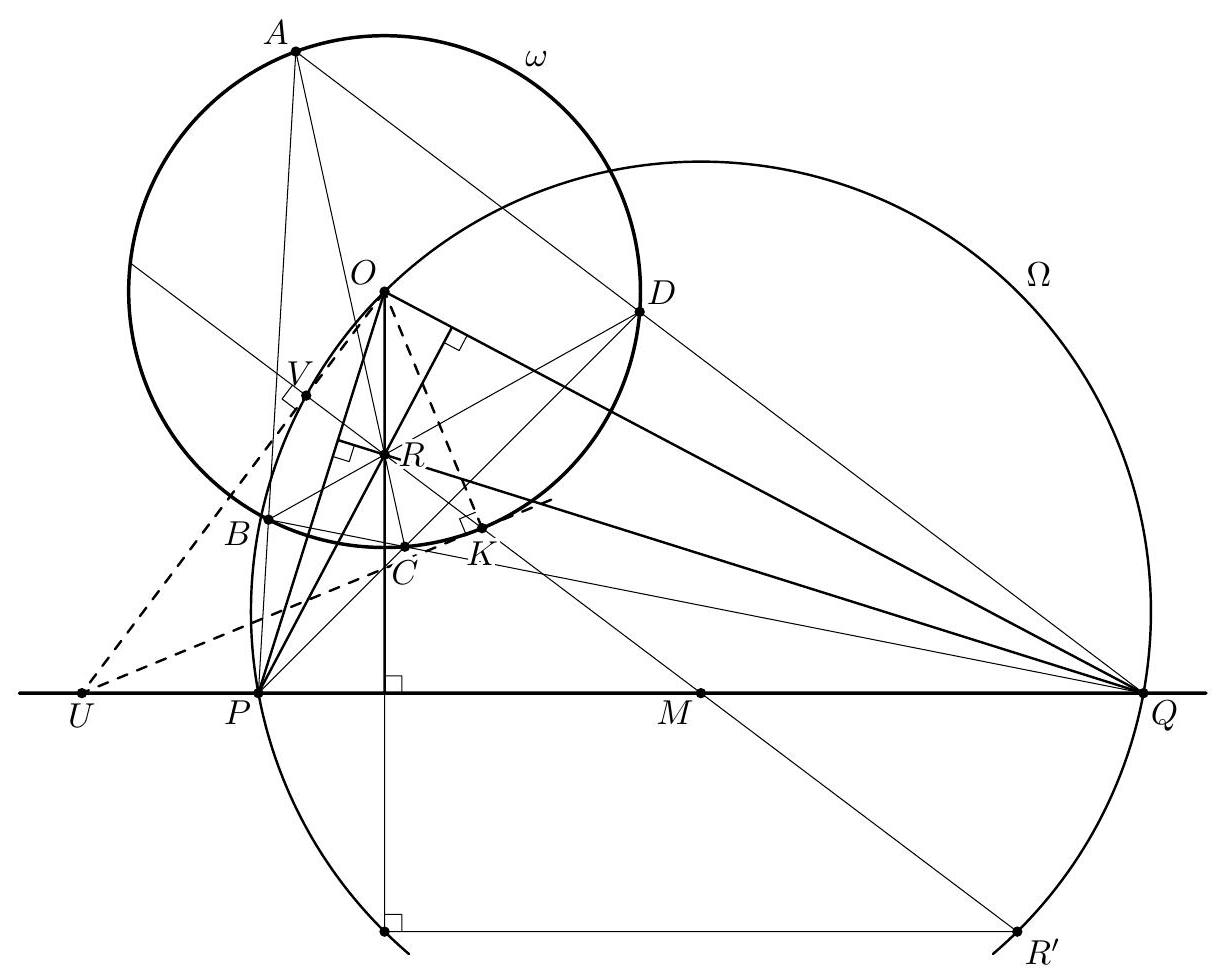
Problem 3. Let $A B C D$ be a quadrilateral inscribed in a circle $\omega$. The lines $A B$ and $C D$ meet at $P$, the lines $A D$ and $B C$ meet at $Q$, and the diagonals $A C$ and $B D$ meet at $R$. Let $M$ be the midpoint of the segment $P Q$, and let $K$ be the common point of the segment $M R$ and the circle $\omega$. Prove that the circumcircle of the triangle $K P Q$ and $\omega$ are tangent to one another.
(Russia) MedeubeK Kungozhin
Solution. Let $O$ be the centre of $\omega$. Notice that the points $P, Q$, and $R$ are the poles (with respect to $\omega$ ) of the lines $Q R, R P$, and $P Q$, respectively. Hence we have $O P \perp Q R, O Q \perp R P$, and $O R \perp P Q$, thus $R$ is the orthocentre of the triangle $O P Q$. Now, if $M R \perp P Q$, then the points $P$ and $Q$ are the reflections of one another in the line $M R=M O$, and the triangle $P Q K$ is symmetrical with respect to this line. In this case the statement of the problem is trivial.
Otherwise, let $V$ be the foot of the perpendicular from $O$ to $M R$, and let $U$ be the common point of the lines $O V$ and $P Q$. Since $U$ lies on the polar line of $R$ and $O U \perp M R$, we obtain that $U$ is the pole of $M R$. Therefore, the line $U K$ is tangent to $\omega$. Hence it is enough to prove that $U K^{2}=U P \cdot U Q$, since this relation implies that $U K$ is also tangent to the circle $K P Q$.
From the rectangular triangle $O K U$, we get $U K^{2}=U V \cdot U O$. Let $\Omega$ be the circumcircle of triangle $O P Q$, and let $R^{\prime}$ be the reflection of its orthocentre $R$ in the midpoint $M$ of the side $P Q$. It is well known that $R^{\prime}$ is the point of $\Omega$ opposite to $O$, hence $O R^{\prime}$ is the diameter of $\Omega$. Finally, since $\angle O V R^{\prime}=90^{\circ}$, the point $V$ also lies on $\Omega$, hence $U P \cdot U Q=U V \cdot U O=U K^{2}$, as required.
Remark. The statement of the problem is still true if $K$ is the other common point of the line $M R$ and $\omega$.
|