

File size: 14,266 Bytes
8a551e6 | 1 2 3 4 5 6 7 8 9 10 11 12 13 14 15 16 17 18 19 20 21 22 23 24 25 26 27 28 29 30 31 32 33 34 35 36 37 38 39 40 41 42 43 44 45 46 47 48 49 50 51 52 53 54 55 56 57 58 59 60 61 62 63 64 65 66 67 68 69 70 71 72 73 74 75 76 77 78 79 80 81 82 83 84 85 86 87 88 89 90 91 92 93 | # The $8^{\text {th }}$ Romanian Master of Mathematics Competition
Day 1 — Solutions
Problem 1. Let $A B C$ be a triangle and let $D$ be a point on the segment $B C, D \neq B$ and $D \neq C$. The circle $A B D$ meets the segment $A C$ again at an interior point $E$. The circle $A C D$ meets the segment $A B$ again at an interior point $F$. Let $A^{\prime}$ be the reflection of $A$ in the line $B C$. The lines $A^{\prime} C$ and $D E$ meet at $P$, and the lines $A^{\prime} B$ and $D F$ meet at $Q$. Prove that the lines $A D, B P$ and $C Q$ are concurrent (or all parallel).
Solution 1. (Ilya Bogdanov) Let $\sigma$ denote reflection in the line $B C$. Since $\angle B D F=\angle B A C=$ $\angle C D E$, by concyclicity, the lines $D E$ and $D F$ are images of one another under $\sigma$, so the lines $A C$ and $D F$ meet at $P^{\prime}=\sigma(P)$, and the lines $A B$ and $D E$ meet at $Q^{\prime}=\sigma(Q)$. Consequently, the lines $P Q$ and $P^{\prime} Q^{\prime}=\sigma(P Q)$ meet at some (possibly ideal) point $R$ on the line $B C$.
Since the pairs of lines $(C A, Q D),(A B, D P),(B C, P Q)$ meet at three collinear points, namely $P^{\prime}, Q^{\prime}, R$ respectively, the triangles $A B C$ and $D P Q$ are perspective, i.e., the lines $A D, B P, C Q$ are concurrent, by the Desargues theorem.
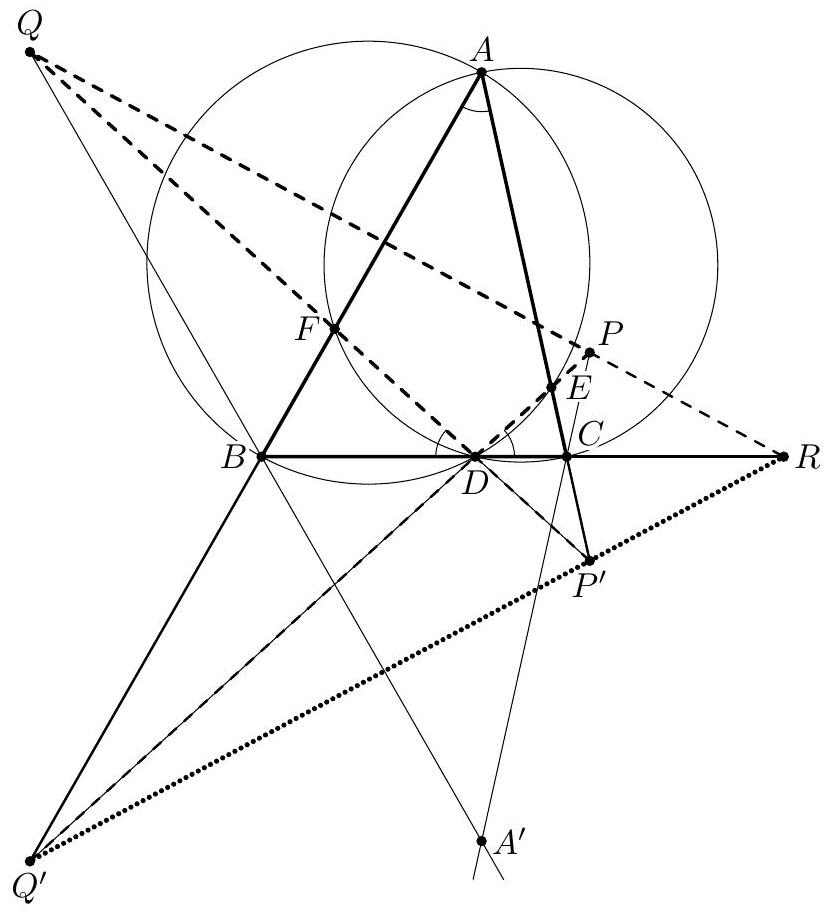
Fig. 1
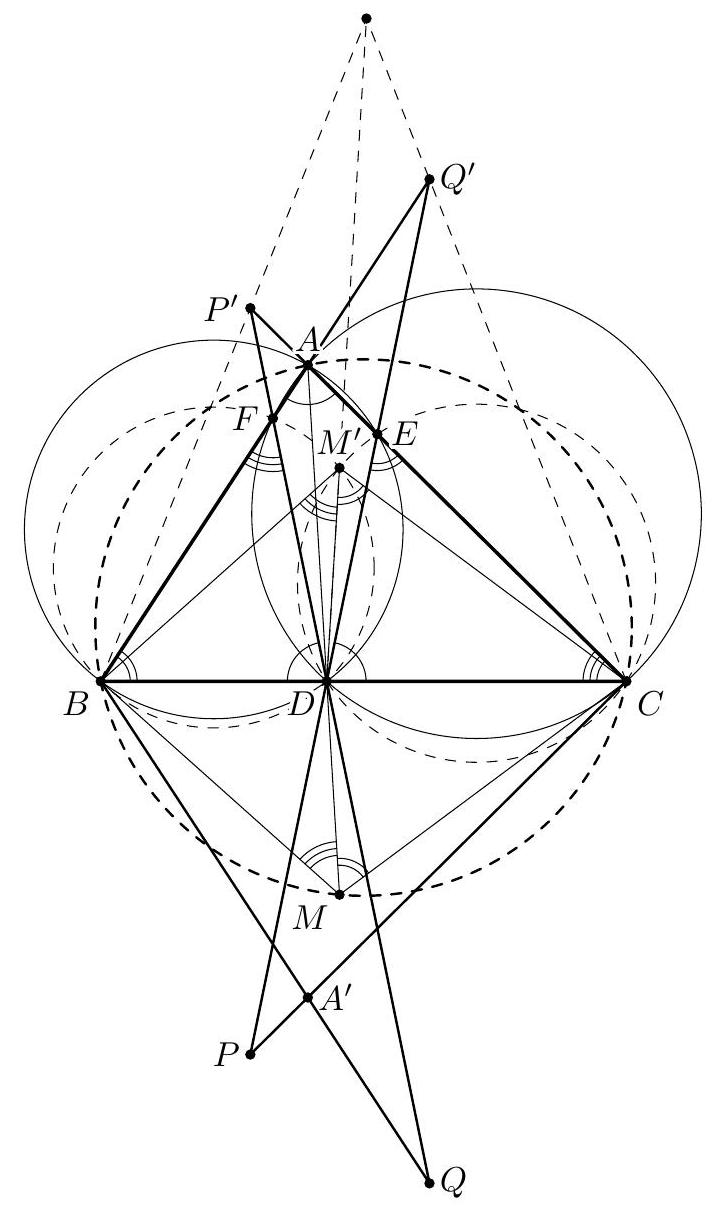
Fig. 2
Solution 2. As in the first solution, $\sigma$ denotes reflection in the line $B C$, the lines $D E$ and $D F$ are images of one another under $\sigma$, the lines $A C$ and $D F$ meet at $P^{\prime}=\sigma(P)$, and the lines $A B$ and $D E$ meet at $Q^{\prime}=\sigma(Q)$.
Let the line $A D$ meet the circle $A B C$ again at $M$. Letting $M^{\prime}=\sigma(M)$, it is sufficient to prove that the lines $D M^{\prime}=\sigma(A D), B P^{\prime}=\sigma(B P)$ and $C Q^{\prime}=\sigma(C Q)$ are concurrent.
Begin by noticing that $\angle\left(B M^{\prime}, M^{\prime} D\right)=-\angle(B M, M A)=-\angle(B C, C A)=\angle(B F, F D)$, to infer that $M^{\prime}$ lies on the circle $B D F$. Similarly, $M^{\prime}$ lies on the circle $C D E$, so the line $D M^{\prime}$ is the radical axis of the circles $B D F$ and $C D E$.
Since $P^{\prime}$ lies on the lines $A C$ and $D F$, it is the radical centre of the circles $A B C, A D C$, and $B D F$; hence the line $B P^{\prime}$ is the radical axis of the circles $B D F$ and $A B C$. Similarly, the line $C Q^{\prime}$ is the radical axis of the circles $C D E$ and $A B C$. So the conclusion follows: the lines $D M^{\prime}$, $B P^{\prime}$ and $C Q^{\prime}$ are concurrent at the radical centre of the circles $A B C, B D F$ and $C D E$; thus the lines $D M, B P^{\prime}$ and $C Q^{\prime}$ are also concurrent.
Solution 3. (Ilya Bogdanov) As in the previous solutions, $\sigma$ denotes reflection in the line $B C$. Let the lines $B E$ and $C F$ meet at $X$. Due to the circles $B D E A$ and $C D F A$, we have $\angle X B D=$ $\angle E A D=\angle X F D$, so the quadrilateral $B F X D$ is cyclic; similarly, the quadrilateral $C E X D$ is cyclic. Hence $\angle X D B=\angle C F A=\angle C D A$, the lines $D X$ and $D A$ are therefore images of one another under $\sigma$, and $X^{\prime}=\sigma(X)$ lies on the line $A D$. Let $E^{\prime}=\sigma(E)$ and $F^{\prime}=\sigma(F)$, and apply the Pappus theorem to the hexagon $B P F^{\prime} C Q E^{\prime}$ to infer that $X^{\prime}, D$, and $B P \cap C Q$ are collinear. The conclusion follows.
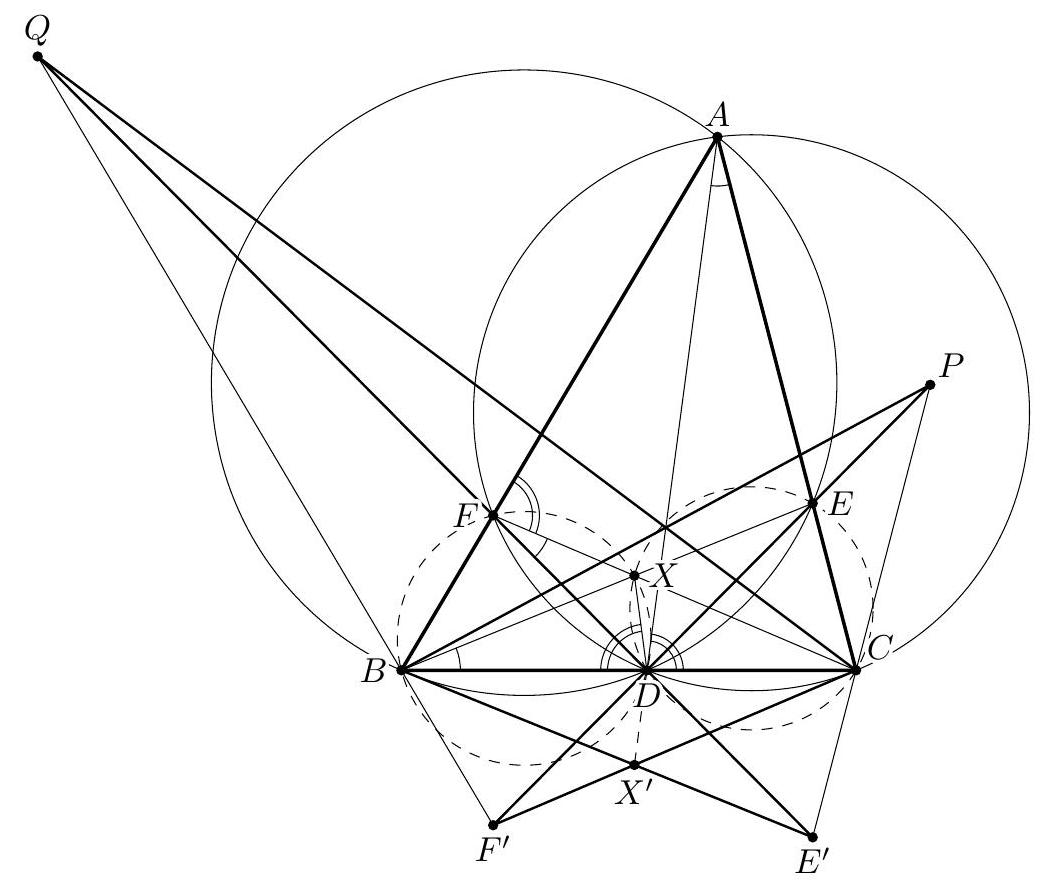
Fig. 3
Remark. In fact, the point $X$ in Solution 3 and the point $M$ in Solution 2 coincide.
Problem 2. Given positive integers $m$ and $n \geq m$, determine the largest number of dominoes ( $1 \times 2$ or $2 \times 1$ rectangles) that can be placed on a rectangular board with $m$ rows and $2 n$ columns consisting of cells ( $1 \times 1$ squares) so that:
(i) each domino covers exactly two adjacent cells of the board;
(ii) no two dominoes overlap;
(iii) no two form a $2 \times 2$ square; and
(iv) the bottom row of the board is completely covered by $n$ dominoes.
Solution 1. The required maximum is $m n-\lfloor m / 2\rfloor$ and is achieved by the brick-like vertically symmetric arrangement of blocks of $n$ and $n-1$ horizontal dominoes placed on alternate rows, so that the bottom row of the board is completely covered by $n$ dominoes.
To show that the number of dominoes in an arrangement satisfying the conditions in the statement does not exceed $m n-\lfloor m / 2\rfloor$, label the rows upwards $0,1, \ldots, m-1$, and, for each
$i$ in this range, draw a vertically symmetric block of $n-i$ fictitious horizontal dominoes in the $i$-th row (so the block on the $i$-th row leaves out $i$ cells on either side) - Figure 4 illustrates the case $m=n=6$. A fictitious domino is good if it is completely covered by a domino in the arrangement; otherwise, it is bad.
If the fictitious dominoes are all good, then the dominoes in the arrangement that cover no fictitious domino, if any, all lie in two triangular regions of side-length $m-1$ at the upper-left and upper-right corners of the board. Colour the cells of the board chess-like and notice that in each of the two triangular regions the number of black cells and the number of white cells differ by $\lfloor m / 2\rfloor$. Since each domino covers two cells of different colours, at least $\lfloor m / 2\rfloor$ cells are not covered in each of these regions, and the conclusion follows.
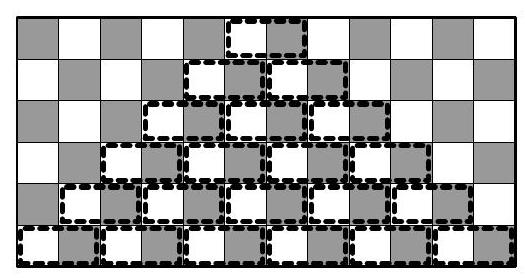
Fig. 4
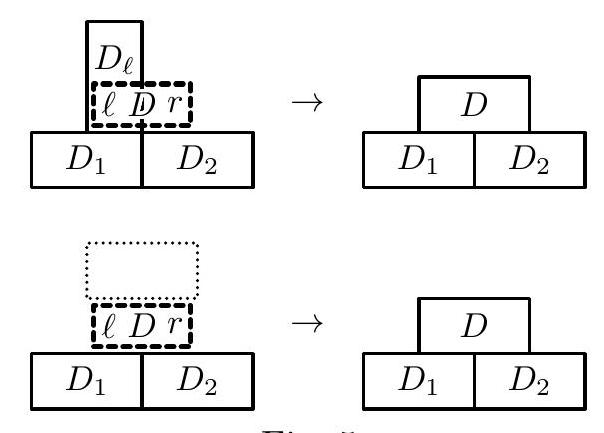
Fig. 5
To deal with the remaining case where bad fictitious dominoes are present, we show that an arrangement satisfying the conditions in the statement can be transformed into another such with at least as many dominoes, but fewer bad fictitious dominoes. A finite number of such transformations eventually leads to an arrangement of at least as many dominoes all of whose fictitious dominoes are good, and the conclusion follows by the preceding.
Consider the row of minimal rank containing bad fictitious dominoes - this is certainly not the bottom row - and let $D$ be one such. Let $\ell$, respectively $r$, be the left, respectively right, cell of $D$ and notice that the cell below $\ell$, respectively $r$, is the right, respectively left, cell of a domino $D_{1}$, respectively $D_{2}$, in the arrangement.
If $\ell$ is covered by a domino $D_{\ell}$ in the arrangement, since $D$ is bad and no two dominoes in the arrangement form a square, it follows that $D_{\ell}$ is vertical. If $r$ were also covered by a domino $D_{r}$ in the arrangement, then $D_{r}$ would also be vertical, and would therefore form a square with $D_{\ell}$ - a contradiction. Hence $r$ is not covered, and there is room for $D_{\ell}$ to be placed so as to cover $D$, to obtain a new arrangement satisfying the conditions in the statement; the latter has as many dominoes as the former, but fewer bad fictitious dominoes. The case where $r$ is covered is dealt with similarly.
Finally, if neither cell of $D$ is covered, addition of an extra domino to cover $D$ and, if necessary, removal of the domino above $D$ to avoid formation of a square, yields a new arrangement satisfying the conditions in the statement; the latter has at least as many dominoes as the former, but fewer bad fictitious dominoes. (Figure 5 illustrates the two cases.)
Solution 2. (sketch by Ilya Bogdanov) We present an alternative proof of the bound.
Label the rows upwards $0,1, \ldots, m-1$, and the columns from the left to the right by $0,1, \ldots, 2 n-1$; label each cell by the pair of its column's and row's numbers, so that $(1,0)$ is the second left cell in the bottom row. Colour the cells chess-like so that $(0,0)$ is white. For $0 \leq i \leq n-1$, we say that the $i$ th white diagonal is the set of cells of the form $(2 i+k, k)$, where $k$ ranges over all appropriate indices. Similarly, the ith black diagonal is the set of cells of the form $(2 i+1-k, k)$. (Notice that the white cells in the upper-left corner and the black cells in the upper-right corner are not covered by these diagonals.)
Claim. Assume that $K$ lowest cells of some white diagonal are all covered by dominoes. Then all these $K$ dominoes face right or up from the diagonal. (In other words, the black cell of any such
domino is to the right or to the top of its white cell.) Similarly, if $K$ lowest cells of some black diagonal are covered by dominoes, then all these dominoes face left or up from the diagonal.
Proof. By symmetry, it suffices to prove the first statement. Assume that $K$ lowest cells of the $i$ th white diagonal is completely covered. We prove by induction on $k<K$ that the required claim holds for the domino covering $(2 i+k, k)$. The base case $k=0$ holds due to the problem condition. To establish the step, one observes that if $(2 i+k, k)$ is covered by a domino facing up of right, while $(2 i+k+1, k+1)$ is covered by a domino facing down or left, then these two dominoes form a square.
We turn to the solution. We will prove that there are at least $d=\lfloor m / 2\rfloor$ empty white cells. Since each domino covers exactly one white cell, the required bound follows.
If each of the first $d$ white diagonals contains an empty cell, the result is clear. Otherwise, let $i<d$ be the least index of a completely covered white diagonal. We say that the dominoes covering our diagonal are distinguished. After removing the distinguished dominoes, the board splits into two parts; the left part $L$ contains $i$ empty white cells on the previous diagonals. So, it suffices to prove that the right part $R$ contains at least $d-i$ empty white cells.
Let $j$ be the number of distinguished dominoes facing up. Then at least $j-i$ of these dominoes cover some cells of (distinct) black diagonals (the relation $m \leq n$ is used). Each such domino faces down from the corresponding black diagonal - so, by the Claim, each such black diagonal contains an empty cell in $R$. Thus, $R$ contains at least $j-i$ empty black cells.
Now, let $w$ be the number of white cells in $R$. Then the number of black cells in $R$ is $w-d+j$, and at least $i-j$ of those are empty. Thus, the number of dominoes in $R$ is at most $(w-d+j)-(j-i)=w-(d-i)$, so $R$ contains at least $d-i$ empty white cells, as we wanted to show.
Remark. The conclusion still holds if some row, not necessarily the bottom row, is completely covered by $n$ dominoes - apply the result in the problem to the upper and lower parts of the board overlapping along a row completely covered by $n$ dominoes.
However, omission of the condition that the bottom row be covered by $n$ dominoes reduces the minimal number of uncovered cells dramatically. For instance, all but two cells of a $(2 k+1) \times(4 k+2)$ board can be covered by dominoes no two of which form a $2 \times 2$ square.
Problem 3. A cubic sequence is a sequence of integers given by $a_{n}=n^{3}+b n^{2}+c n+d$, where $b, c$ and $d$ are integer constants and $n$ ranges over all integers, including negative integers.
(a) Show that there exists a cubic sequence such that the only terms of the sequence which are squares of integers are $a_{2015}$ and $a_{2016}$.
(b) Determine the possible values of $a_{2015} \cdot a_{2016}$ for a cubic sequence satisfying the condition in part (a).
Solution. The only possible value of $a_{2015} \cdot a_{2016}$ is 0 . For simplicity, by performing a translation of the sequence (which may change the defining constants $b, c$ and $d$ ), we may instead concern ourselves with the values $a_{0}$ and $a_{1}$, rather than $a_{2015}$ and $a_{2016}$.
Suppose now that we have a cubic sequence $a_{n}$ with $a_{0}=p^{2}$ and $a_{1}=q^{2}$ square numbers. We will show that $p=0$ or $q=0$. Consider the line $y=(q-p) x+p$ passing through $(0, p)$ and $(1, q)$; the latter are two points the line under consideration and the cubic $y^{2}=x^{3}+b x^{2}+c x+d$ share. Hence the two must share a third point whose $x$-coordinate is the third root of the polynomial $t^{3}+\left(b-(q-p)^{2}\right) t^{2}+(c-2(q-p) p) t+\left(d-p^{2}\right)$ (it may well happen that this third point coincide with one of the other two points the line and the cubic share).
Notice that the sum of the three roots is $(q-p)^{2}-b$, so the third intersection has integral $x$-coordinate $X=(q-p)^{2}-b-1$. Its $y$-coordinate $Y=(q-p) X+p$ is also an integer, and hence $a_{X}=X^{3}+b X^{2}+c X+d=Y^{2}$ is a square. This contradicts our assumption on the sequence unless $X=0$ or $X=1$, i.e. unless $(q-p)^{2}=b+1$ or $(q-p)^{2}=b+2$.
Applying the same argument to the line through $(0,-p)$ and $(1, q)$, we find that $(q+p)^{2}=b+1$ or $b+2$ also. Since $(q-p)^{2}$ and $(q+p)^{2}$ have the same parity, they must be equal, and hence $p q=0$, as desired.
It remains to show that such sequences exist, say when $p=0$. Consider the sequence $a_{n}=$ $n^{3}+\left(q^{2}-2\right) n^{2}+n$, chosen to satisfy $a_{0}=0$ and $a_{1}=q^{2}$. We will show that when $q=1$, the only square terms of the sequence are $a_{0}=0$ and $a_{1}=1$. Indeed, suppose that $a_{n}=n\left(n^{2}-n+1\right)$ is square. Since the second factor is positive, and the two factors are coprime, both must be squares; in particular, $n \geq 0$. The case $n=0$ is clear, so let $n \geq 1$. Finally, if $n>1$, then $(n-1)^{2}<n^{2}-n+1<n^{2}$, so $n^{2}-n+1$ is not a square. Consequently, $n=0$ or $n=1$, and the conclusion follows.
Remark. The values $q=3$ and $q=4$ work as well. In the former case, the only square terms of the sequence $a_{n}=n\left(n^{2}+7 n+1\right)$ are $a_{0}=0$ and $a_{1}=9$. In the other case, the only square terms of the sequence $a_{n}=n\left(n^{2}+14 n+1\right)$ are $a_{0}=0$ and $a_{1}=16$.
|