

File size: 19,623 Bytes
8a551e6 | 1 2 3 4 5 6 7 8 9 10 11 12 13 14 15 16 17 18 19 20 21 22 23 24 25 26 27 28 29 30 31 32 33 34 35 36 37 38 39 40 41 42 43 44 45 46 47 48 49 50 51 52 53 54 55 56 57 58 59 60 61 62 63 64 65 66 67 68 69 70 71 72 73 74 75 76 77 78 79 80 81 82 83 84 85 86 87 88 89 90 91 92 93 94 95 96 97 98 99 100 101 102 103 104 105 106 107 108 109 110 111 112 113 114 115 116 117 118 119 120 121 122 123 124 125 126 127 128 129 130 131 132 133 134 135 136 137 138 139 140 141 142 143 144 145 146 147 148 149 150 151 152 153 154 155 156 157 158 159 160 161 162 163 164 | Problem 4. Given a triangle $A B C$, let $H$ and $O$ be its orthocentre and circumcentre, respectively. Let $K$ be the midpoint of the line segment $A H$. Let further $\ell$ be a line through $O$, and let $P$ and $Q$ be the orthogonal projections of $B$ and $C$ onto $\ell$, respectively. Prove that $K P+K Q \geq B C$.
# Russia, Vasily Mokin
Solution 1. Fix the origin at $O$ and the real axis along $\ell$. A lower case letter denotes the complex coordinate of the corresponding point in the configuration. For convenience, let $|a|=|b|=|c|=1$.
Clearly, $k=a+\frac{1}{2}(b+c), p=a+\frac{1}{2}\left(b+\frac{1}{b}\right)$ and $q=a+\frac{1}{2}\left(c+\frac{1}{c}\right)$.
Then $|k-p|=\left|a+\frac{1}{2}\left(c-\frac{1}{b}\right)\right|=\frac{1}{2}|2 a b+b c-1|$, since $|b|=1$.
Similarly, $|k-q|=\frac{1}{2}|2 a c+b c-1|$, so, since $|a|=1$,
$|k-p|+|k-q|=\frac{1}{2}|2 a b+b c-1|+\frac{1}{2}|2 a c+b c-1|$
$$
\geq \frac{1}{2}|2 a(b-c)|=|b-c|,
$$
as required.
Solution 2. Let $M$ be the midpoint of $B C$, and let $R$ be the projection of $M$ onto $\ell$. In other words, $R$ is the midpoint of $P Q$. Since $\angle B P O=\angle B M O=$ $90^{\circ}$, the points $B, P, O$, and $M$ are concyclic, so $\angle(O M, O B)=\angle(P M, P B)=\angle(P M, M R)$, so the right triangles $M R P$ and $O M B$ are similar and have different orientation. Similarly, the triangles $M R Q$ and $O M C$ are similar and have different orientation, hence so are the triangles $O B C$ and $M P Q$.
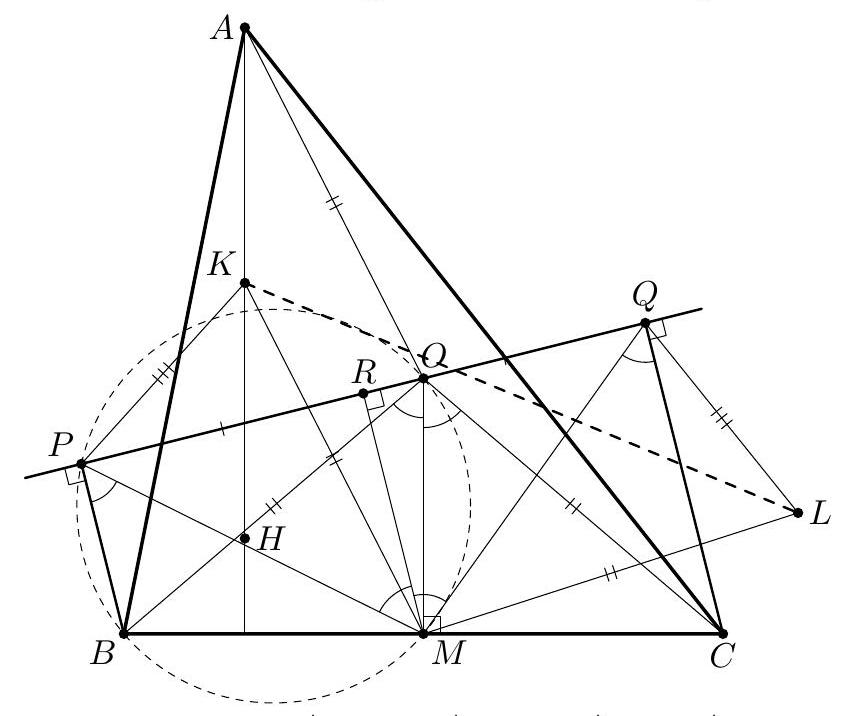
Recall that $\overrightarrow{A H}=2 \overrightarrow{O M}$, so $\overrightarrow{O M}=\overrightarrow{A K}$. Hence $A O M K$ is a parallelogram, so $M K=O A=O B=$ $O C$.
Consider the rotation through $\angle(\overrightarrow{O C}, \overrightarrow{O B})$ about $M$. It maps $P$ to $Q$; let it map $K$ to some point $L$. Then $M K=M L=O B=O C$ and $\angle L M K=\angle B O C$, so the triangles $O B C$ and $M K L$ are congruent. Hence $B C=K L \leq K Q+L Q=$ $K Q+K P$, as required.
Solution 3. Let $\alpha=\angle(P B, B C)=\angle(Q C, B C)$. Since $P$ lies on the circle of diameter $O B$, $\angle(O P, O M)=\alpha$. Since also $Q$ lies on the circle of diameter $O C$, it immediately follows that
$M P=M Q=R \sin \alpha$ by sine theorem in triangles $\triangle O P M$ and $\triangle O Q M$.
Because $P Q$ is the projection of $B C$ on line $\ell$, it follows that $P Q=B C \sin \alpha$. Just like in the first solution, $K M=A O=R$ (the circumradius of triangle $\triangle A B C)$.
Now apply Ptolemy's inequality for the quadrilateral $K P M Q$ : $K P \cdot M Q+K Q \cdot M P \geq P Q \cdot K M$, and now substitute the relations from above, leading to
$$
R \sin \alpha(K P+K Q) \geq R \sin \alpha \cdot B C
$$
which is precisely the conclusion whenever $\sin \alpha \neq 0$. The case when $\sin \alpha=0$ can be treated either directly, or via a limit argument.
Solution 4. Denote by $R$ and $O$ the circumradius and the circumcentre of triangle $A B C$, respectively. As in Solution 1, we see that $M K=R$.
Assume now that $\ell$ is fixed, while $A$ moves along the fixed circle $(A B C)$. Then $K$ will move along a cricle centred at $M$ with radius $R$. We must show that for each point $K$ on this circle we have $B C \leq K P+K Q$. In doing so, we prove that the afore-mentioned circle contains an ellipse with foci at $Q$ and $P$ with distance $B C$.
Let $S$ be the foot of the perpendicular from $M$ to $P Q$, it is easy to verify that $S$ is the center of the ellipse. We shall then consider it as the origin. Let $u=\frac{B C}{2}$ and $t=\frac{P Q}{2}$; notice that $u$ is the major semi-axis of the ellipse and $\sqrt{u^{2}-t^{2}}$ is the minor one. Assume $X(x, y)$ is a point on this ellipse. We now need to prove $M X \leq R$.
Since $X$ is on the ellipse, we can write $(x, y)=$ $\left(u \cos \theta, \sqrt{u^{2}-t^{2}} \sin \theta\right)$, for some $\theta \in(0,2 \pi)$. Since $M X^{2}=x^{2}+(y+M S)^{2}$, we can expand and obtain $M X^{2}=u^{2}+M S^{2}-t^{2} \cdot \sin ^{2} \theta+2 M S \cdot \sqrt{u^{2}-t^{2}} \cdot \sin \theta$.
Add and subtract $M S^{2}\left(u^{2}-t^{2}\right) / t^{2}$ in order to obtain a square on the right hand side: $M X^{2}=u^{2}+$ $M S^{2}+\frac{M S^{2}\left(u^{2}-t^{2}\right)}{t^{2}}-\left(t \sin \theta-\frac{M S \sqrt{u^{2}-t^{2}}}{t}\right)^{2}$. It now suffices to show that $u^{2}+M S^{2}+\frac{M S^{2}\left(u^{2}-t^{2}\right)}{t^{2}}=$ $R^{2}$, since then it would immediately follow that $M X^{2} \leq R^{2}$.
Applying Pythagorean theorem in triangles $O B M$ and $O S M$, we obtain $R^{2}=u^{2}+O M^{2}$ and $O M^{2}=M S^{2}+O S^{2}$, so it remains to prove that $O S^{2}=\frac{M S^{2}\left(u^{2}-t^{2}\right)}{t^{2}} . \quad$ Let $\alpha=\angle(O P, B M)$, then $O S / M S=\tan ^{t^{2}} \alpha$ and $t / u=\cos \alpha$, so $O S^{2}=$ $M S^{2} \tan ^{2} \alpha=M S^{2}\left(\frac{1-\cos ^{2} \alpha}{\cos ^{2} \alpha}\right)=M S^{2} \cdot \frac{u^{2}-t^{2}}{t^{2}}$, which is the desired result.
Problem 5. Let $P(x), Q(x), R(x)$ and $S(x)$ be non-constant polynomials with real coefficients such that $P(Q(x))=R(S(x))$. Suppose that the degree of $P(x)$ is divisible by the degree of $R(x)$.
Prove that there is a polynomial $T(x)$ with real coefficients such that $P(x)=R(T(x))$.
## Iran, NaVid Safaei
Solution 1. Degree comparison of $P(Q(x))$ and $R(S(x))$ implies that $q=\operatorname{deg} Q \mid \operatorname{deg} S=s$. We will show that $S(x)=T(Q(x))$ for some polynomial $T$. Then $P(Q(x))=R(S(x))=R(T(Q(x)))$, so the polynomial $P(t)-R(T(t))$ vanishes upon substitution $t=S(x)$; it therefore vanishes identically, as desired.
Choose the polynomials $T(x)$ and $M(x)$ such that
$$
S(x)=T(Q(x))+M(x)
$$
where $\operatorname{deg} M$ is minimised; if $M=0$, then we get the desired result. For the sake of contradiction, suppose $M \neq 0$. Then $q \nmid m=\operatorname{deg} M$; otherwise, $M(x)=\beta Q(x)^{m / q}+M_{1}(x)$, where $\beta$ is some number and $\operatorname{deg} M_{1}<\operatorname{deg} M$, contradicting the choice of $M$. In particular, $0<m<s$ and hence $\operatorname{deg} T(Q(x))=s$.
Substitute now (*) into $R(S(x))-P(Q(x))=$ 0 ; let $\alpha$ be the leading coefficient of $R(x)$ and let $r=\operatorname{deg} R(x)$. Expand the brackets to get a sum of powers of $Q(x)$ and other terms including powers of $M(x)$ as well. Amongst the latter, the unique term of highest degree is $\operatorname{arM}(x) T(Q(x))^{r-1}$. So, for some polyno$\operatorname{mial} N(x), \quad N(Q(x))=\alpha r M(x) T(Q(x))^{r-1}+$ a polynomial of lower degree.
This is impossible, since $q$ divides the degree of the left-hand member, but not that of the righthand member.
Solution 2. All polynomials in the solution have real coefficients. As usual, the degree of a polynomial $f(x)$ is denoted $\operatorname{deg} f(x)$.
Of all pairs of polynomials $P(x), R(x)$, satisfying the conditions in the statement, choose one, say, $P_{0}(x), R_{0}(x)$, so that $P_{0}(Q(x))=R_{0}(S(x))$ has a minimal (positive) degree. We will show that $\operatorname{deg} R_{0}(x)=1$, say, $R_{0}(x)=\alpha x+\beta$ for some real numbers $\alpha \neq 0$ and $\beta$, so $P_{0}(Q(x))=\alpha S(x)+\beta$. Hence $S(x)=T(Q(x))$ for some polynomial $T(x)$.
Now, if $P(x)$ and $R(x)$ are polynomials satisfying $P(Q(x))=R(S(x))$, then $P(Q(x))=$ $R(T(Q(x)))$. Since $Q(x)$ is not constant, it takes infinitely many values, so $P(x)$ and $R(T(x))$ agree at infinitely many points, implying that $P(x)=$ $R(T(x))$, as required.
It is therefore sufficient to solve the problem in the particular case where $F(x)=P(Q(x))=$ $R(S(x))$ has a minimal degree. Let $d=$ $\operatorname{gcd}(\operatorname{deg} Q(x), \operatorname{deg} S(x))$ to write $\operatorname{deg} Q(x)=a d$ and $\operatorname{deg} S(x)=b d$, where $\operatorname{gcd}(a, b)=1$. Then
$\operatorname{deg} P(x)=b c, \operatorname{deg} R(x)=a c$ and $\operatorname{deg} F(x)=a b c d$ for some positive integer $c$. We will show that minimality of $\operatorname{deg} F(x)$ forces $c=1$, so $\operatorname{deg} P(x)=b$, $\operatorname{deg} R(x)=a$ and $\operatorname{deg} F(x)=a b d$. The conditions $a=\operatorname{deg} R(x) \mid \operatorname{deg} P(x)=b$ and $\operatorname{gcd}(a, b)=1$ then force $a=1$, as stated above.
Consequently, the only thing we are left with is the proof of the fact that $c=1$. For convenience, we may and will assume that $P(x), Q(x), R(x), S(x)$ are all monic; hence so is $F(x)$. The argument hinges on the lemma below.
Lemma. If $f(x)$ is a monic polynomial of degree $m n$, then there exists a degree $n$ monic polynomial $g(x)$ such that $\operatorname{deg}\left(f(x)-g(x)^{m}\right)<(m-1) n$. (If $m=0$ or 1 , or $n=0$, the conclusion is still consistent with the usual convention that the identically zero polynomial has degree $-\infty$.)
Proof. Write $f(x)=\sum_{k=0}^{m n} \alpha_{k} x^{k}, \alpha_{m n}=1$, and seek $g(x)=\sum_{k=0}^{n} \beta_{k} x^{k}, \beta_{n}=1$, so as to fit the bill. To this end, notice that, for each positive integer $k \leq n$, the coefficient of $x^{m n-k}$ in the expansion of $g(x)^{m}$ is of the form $m \beta_{n-k}+\varphi_{k}\left(\beta_{n}, \ldots, \beta_{n-k+1}\right)$, where $\varphi_{k}\left(\beta_{n}, \ldots, \beta_{n-k+1}\right)$ is an algebraic expression in $\beta_{n}, \ldots, \beta_{n-k+1}$. Recall that $\beta_{n}=1$ to determine the $\beta_{n-k}$ recursively by requiring $\beta_{n-k}=$ $\frac{1}{m}\left(a_{m n-k}-\varphi_{k}\left(\beta_{n}, \ldots, \beta_{n-k+1}\right)\right), k=1, \ldots, n$.
The outcome is then the desired polynomial $g(x)$.
We are now in a position to prove that $c=$ 1. Suppose, if possible, that $c>1$. By the lemma, there exist monic polynomials $U(x)$ and $V(x)$ of degree $b$ and $a$, respectively, such that $\operatorname{deg}\left(P(x)-U(x)^{c}\right)<(c-1) b$ and $\operatorname{deg}(R(x)-$ $\left.V(x)^{c}\right)<(c-1) a$. Then $\operatorname{deg}\left(F(x)-U(Q(x))^{c}\right)=$ $\operatorname{deg}\left(P(Q(x))-U(Q(x))^{c}\right)<(c-1) a b d, \operatorname{deg}(F(x)-$ $\left.V(S(x))^{c}\right)=\operatorname{deg}\left(R(S(x))-V(S(x))^{c}\right)<(c-1) a b d$, so $\operatorname{deg}\left(U(Q(x))^{c}-V(S(x))^{c}\right)=\operatorname{deg}((F(x)-$ $\left.\left.V(S(x))^{c}\right)-\left(F(x)-U(Q(x))^{c}\right)\right)<(c-1) a b d$.
On the other hand, $U(Q(x))^{c}-V(S(x))^{c}=$ $(U(Q(x))-V(S(x)))\left(U(Q(x))^{c-1}+\cdots+\right.$ $\left.V(S(x))^{c-1}\right)$.
By the preceding, the degree of the left-hand member is (strictly) less than $(c-1) a b d$ which is precisely the degree of the second factor in the righthand member. This forces $U(Q(x))=V(S(x))$, so $U(Q(x))=V(S(x))$ has degree $a b d<a b c d=$ $\operatorname{deg} F(x)$ - a contradiction. Consequently, $c=1$. This completes the argument and concludes the proof.
Problem 6. Let $r, g, b$ be non-negative integers. Let $\Gamma$ be a connected graph on $r+g+b+1$ vertices. The edges of $\Gamma$ are each coloured red, green or blue. It turns out that $\Gamma$ has
- a spanning tree in which exactly $r$ of the edges are red,
- a spanning tree in which exactly $g$ of the edges are green and
- a spanning tree in which exactly $b$ of the edges are blue.
Prove that $\Gamma$ has a spanning tree in which exactly $r$ of the edges are red, exactly $g$ of the edges are green and exactly $b$ of the edges are blue.
Russia, Vasily Mokin
Solution 1. Induct on $n=r+g+b$. The base case, $n=1$, is clear.
Let now $n>1$. Let $V$ denote the vertex set of $\Gamma$, and let $T_{r}, T_{g}$, and $T_{b}$ be the trees with exactly $r$ red edges, $g$ green edges, and $b$ blue edges, respectively. Consider two cases.
Case 1: There exists a partition $V=A \sqcup B$ of the vertex set into two non-empty parts such that the edges joining the parts all bear the same colour, say, blue.
Since $\Gamma$ is connected, it has a (necessarily blue) edge connecting $A$ and $B$. Let $e$ be one such.
Assume that $T$, one of the three trees, does not contain $e$. Then the graph $T \cup\{e\}$ has a cycle $C$ through $e$. The cycle $C$ should contain another edge $e^{\prime}$ connecting $A$ and $B$; the edge $e^{\prime}$ is also blue. Replace $e^{\prime}$ by $e$ in $T$ to get another tree $T^{\prime}$ with the same number of edges of each colour as in $T$, but containing $e$.
Performing such an operation to all three trees, we arrive at the situation where the three trees $T_{r}^{\prime}$, $T_{g}^{\prime}$, and $T_{b}^{\prime}$ all contain $e$. Now shrink $e$ by identifying its endpoints to obtain a graph $\Gamma^{*}$, and set $r^{*}=r, g^{*}=g$, and $b^{*}=b-1$. The new graph satisfies the conditions in the statement for those new values - indeed, under the shrinking, each of the trees $T_{r}^{\prime}, T_{g}^{\prime}$, and $T_{b}^{\prime}$ loses a blue edge. So $\Gamma^{*}$ has a spanning tree with exactly $r$ red, exactly $g$
green, and exactly $b-1$ blue edges. Finally, pass back to $\Gamma$ by restoring $e$, to obtain the a desired spanning tree in $\Gamma$.
Case 2: There is no such a partition.
Consider all possible collections $(R, G, B)$, where $R, G$ and $B$ are acyclic sets consisting of $r$ red edges, $g$ green edges, and $b$ blue edges, respectively. By the problem assumptions, there is at least one such collection. Amongst all such collections, consider one such that the graph on $V$ with edge set $R \cup G \cup B$ has the smallest number $k$ of components. If $k=1$, then the collection provides the edges of a desired tree (the number of edges is one less than the number of vertices).
Assume now that $k \geq 2$; then in the resulting graph some component $K$ contains a cycle $C$. Since $R, G$, and $B$ are acyclic, $C$ contains edges of at least two colours, say, red and green. By assumption, the edges joining $V(K)$ to $V \backslash V(K)$ bear at least two colours; so one of these edges is either red or green. Without loss of generality, consider a red such edge $e$.
Let $e^{\prime}$ be a red edge in $C$ and set $R^{\prime}=R \backslash\left\{e^{\prime}\right\} \cup$ $\{e\}$. Then $\left(R^{\prime}, G, B\right)$ is a valid collection providing a smaller number of components. This contradicts minimality of the choice above and concludes the proof.
Problem 6. Let $r, g, b$ be non-negative integers. Let $\Gamma$ be a connected graph on $r+g+b+1$ vertices. The edges of $\Gamma$ are each coloured red, green or blue. It turns out that $\Gamma$ has
- a spanning tree in which exactly $r$ of the edges are red,
- a spanning tree in which exactly $g$ of the edges are green and
- a spanning tree in which exactly $b$ of the edges are blue.
Prove that $\Gamma$ has a spanning tree in which exactly $r$ of the edges are red, exactly $g$ of the edges are green and exactly $b$ of the edges are blue.
Solution 2. For a spanning tree $T$ in $\Gamma$, denote by $r(T), g(T)$, and $b(T)$ the number of red, green, and blue edges in $T$, respectively.
Assume that $\mathcal{C}$ is some collection of spanning trees in $\Gamma$. Write
$$
\begin{array}{rlrl}
r(\mathcal{C}) & =\min _{T \in \mathcal{C}} r(T), & & g(\mathcal{C})=\min _{T \in \mathcal{C}} g(T) \\
b(\mathcal{C}) & =\min _{T \in \mathcal{C}} b(T), & & R(\mathcal{C})=\max _{T \in \mathcal{C}}(T) \\
G(\mathcal{C}) & =\max _{T \in \mathcal{C}} g(T), & B(\mathcal{C})=\max _{T \in \mathcal{C}} b(T)
\end{array}
$$
Say that a collection $\mathcal{C}$ is good if $r \in[r(\mathcal{C}, R(\mathcal{C})]$, $g \in[g(\mathcal{C}, G(\mathcal{C})]$, and $b \in[b(\mathcal{C}, B(\mathcal{C})]$. By the problem conditions, the collection of all spanning trees in $\Gamma$ is good.
For a good collection $\mathcal{C}$, say that an edge $e$ of $\Gamma$ is suspicious if $e$ belongs to some tree in $\mathcal{C}$ but not to all trees in $\mathcal{C}$. Choose now a good collection $\mathcal{C}$ minimizing the number of suspicious edges. If $\mathcal{C}$ contains a desired tree, we are done. Otherwise, without loss of generality, $r(\mathcal{C})<r$ and $G(\mathcal{C})>g$.
We now distinguish two cases.
Case 1: $B(\mathcal{C})=b$ 。
Let $T^{0}$ be a tree in $\mathcal{C}$ with $g\left(T^{0}\right)=g(\mathcal{C}) \leq g$. Since $G(\mathcal{C})>g$, there exists a green edge $e$ contained in some tree in $\mathcal{C}$ but not in $T^{0}$; clearly, $e$ is suspicious. Fix one such green edge $e$.
Now, for every $T$ in $\mathcal{C}$, define a spanning tree $T_{1}$ of $\Gamma$ as follows. If $T$ does not contain $e$, then $T_{1}=T$; in particular, $\left(T^{0}\right)_{1}=T^{0}$. Otherwise, the graph $T \backslash\{e\}$ falls into two components. The tree $T_{0}$ contains some edge $e^{\prime}$ joining those components; this edge is necessarily suspicious. Choose one such edge and define $T_{1}=T \backslash\{e\} \cup\left\{e^{\prime}\right\}$.
Let $\mathcal{C}_{1}=\left\{T_{1}: T \in \mathcal{C}\right\}$. All edges suspicious for $\mathcal{C}_{1}$ are also suspicious for $\mathcal{C}$, but no tree in $\mathcal{C}_{1}$ con-
## Russia, Vasily Mokin
tains $e$. So the number of suspicious edges for $\mathcal{C}_{1}$ is strictly smaller than that for $\mathcal{C}$.
We now show that $\mathcal{C}_{1}$ is good, reaching thereby a contradiction with the choice of $\mathcal{C}$. For every $T$ in $\mathcal{C}$, the tree $T_{1}$ either coincides with $T$ or is obtained from it by removing a green edge and adding an edge of some colour. This already shows that $g\left(\mathcal{C}_{1}\right) \leq g(\mathcal{C}) \leq g, G\left(\mathcal{C}_{1}\right) \geq G(\mathcal{C})-1 \geq g$, $R\left(\mathcal{C}_{1}\right) \geq R(\mathcal{C}) \geq r, r\left(\mathcal{C}_{1}\right) \leq r(\mathcal{C})+1 \leq r$, and $B\left(\mathcal{C}_{1}\right) \geq B(\mathcal{C}) \geq b$. Finally, we get $b\left(T^{0}\right) \leq$ $B(\mathcal{C})=b$; since $\mathcal{C}_{1}$ contains $T^{0}$, it follows that $b\left(\mathcal{C}_{1}\right) \leq b\left(T^{0}\right) \leq b$, which concludes the proof.
Case 2: $B(\mathcal{C})>b$.
Consider a tree $T^{0}$ in $\mathcal{C}$ satisfying $r\left(T^{0}\right)=$ $R(\mathcal{C}) \geq r$. Since $r(\mathcal{C})<r$, the tree $T^{0}$ contains a suspicious red edge. Fix one such edge $e$.
Now, for every $T$ in $\mathcal{C}$, define a spanning tree $T_{2}$ of $\Gamma$ as follows. If $T$ contains $e$, then $T_{2}=T$; in particular, $\left(T^{0}\right)_{2}=T^{0}$. Otherwise, the graph $T \cup\{e\}$ contains a cycle $C$ through $e$. This cycle contains an edge $e^{\prime}$ absent from $T^{0}$ (otherwise $T^{0}$ would contain the cycle $C$ ), so $e^{\prime}$ is suspicious. Choose one such edge and define $T_{2}=T \backslash\left\{e^{\prime}\right\} \cup\{e\}$.
Let $\mathcal{C}_{2}=\left\{T_{2}: T \in \mathcal{C}\right\}$. All edges suspicious for $\mathcal{C}_{2}$ are also suspicious for $\mathcal{C}$, but all trees in $\mathcal{C}_{2}$ contain $e$. So the number of suspicious edges for $\mathcal{C}_{2}$ is strictly smaller than that for $\mathcal{C}$.
We now show that $\mathcal{C}_{2}$ is good, reaching again a contradiction. For every $T$ in $\mathcal{C}$, the tree $T_{2}$ either coincides with $T$ or is obtained from it by removing some edge and adding a red edge. This shows that $r\left(\mathcal{C}_{2}\right) \leq r(\mathcal{C})+1 \leq r, R\left(\mathcal{C}_{2}\right) \geq R(\mathcal{C}) \geq r$, $G\left(\mathcal{C}_{2}\right) \geq G(\mathcal{C})-1 \geq g, g\left(\mathcal{C}_{2}\right) \leq g(\mathcal{C}) \leq g$, $b\left(\mathcal{C}_{1}\right) \leq b(\mathcal{C}) \leq b$ and $B\left(\mathcal{C}_{2}\right) \geq B(\mathcal{C})-1 \geq b$. This concludes the proof.
|