

File size: 11,807 Bytes
eebb93b | 1 2 3 4 5 6 7 8 9 10 11 12 13 14 15 16 17 18 19 20 21 22 23 24 25 26 27 28 29 30 31 32 33 34 35 36 37 38 39 40 41 42 43 44 45 46 47 48 49 50 51 52 53 54 55 56 57 58 59 60 61 62 63 64 65 66 67 68 69 70 71 72 73 74 75 76 77 78 79 80 81 82 83 84 85 86 87 88 89 90 91 92 93 94 95 96 97 98 99 100 101 102 103 104 105 106 107 108 109 110 111 112 113 114 115 116 117 118 119 120 121 122 123 124 125 126 127 128 129 130 131 132 133 134 135 136 137 138 139 140 141 142 143 144 145 146 147 148 149 150 151 152 153 154 155 156 157 158 159 160 161 162 163 164 165 166 167 168 169 170 171 172 173 174 175 176 177 178 179 180 181 182 183 184 185 186 187 188 189 190 191 192 193 194 195 196 197 198 199 200 201 202 203 204 205 206 207 208 209 210 211 212 213 214 215 216 217 218 219 220 221 222 223 224 225 226 227 228 229 230 231 232 233 234 235 236 237 238 239 240 241 242 243 244 245 246 247 248 249 250 251 252 253 254 255 256 257 | # JMO 2013 Solution Notes
Evan Chen《陳誼廷》
15 April 2024
#### Abstract
This is a compilation of solutions for the 2013 JMO. The ideas of the solution are a mix of my own work, the solutions provided by the competition organizers, and solutions found by the community. However, all the writing is maintained by me.
These notes will tend to be a bit more advanced and terse than the "official" solutions from the organizers. In particular, if a theorem or technique is not known to beginners but is still considered "standard", then I often prefer to use this theory anyways, rather than try to work around or conceal it. For example, in geometry problems I typically use directed angles without further comment, rather than awkwardly work around configuration issues. Similarly, sentences like "let $\mathbb{R}$ denote the set of real numbers" are typically omitted entirely.
Corrections and comments are welcome!
## Contents
0 Problems
1 Solutions to Day 1
1.1 JMO 2013/1, proposed by Titu Andreescu ..... 3
1.2 JMO 2013/2, proposed by Sungyoon Kim ..... 4
1.3 JMO 2013/3, proposed by Zuming Feng
2 Solutions to Day 2 ..... 6
2.1 JMO 2013/4, proposed by Kiran Kedlaya ..... 6
2.2 JMO 2013/5, proposed by Zuming Feng ..... 7
2.3 JMO 2013/6, proposed by Titu Andreescu ..... 8
## §0 Problems
1. Are there integers $a$ and $b$ such that $a^{5} b+3$ and $a b^{5}+3$ are both perfect cubes of integers?
2. Each cell of an $m \times n$ board is filled with some nonnegative integer. Two numbers in the filling are said to be adjacent if their cells share a common side. The filling is called a garden if it satisfies the following two conditions:
(i) The difference between any two adjacent numbers is either 0 or 1 .
(ii) If a number is less than or equal to all of its adjacent numbers, then it is equal to 0.
Determine the number of distinct gardens in terms of $m$ and $n$.
3. In triangle $A B C$, points $P, Q, R$ lie on sides $B C, C A, A B$, respectively. Let $\omega_{A}$, $\omega_{B}, \omega_{C}$ denote the circumcircles of triangles $A Q R, B R P, C P Q$, respectively. Given the fact that segment $A P$ intersects $\omega_{A}, \omega_{B}, \omega_{C}$ again at $X, Y, Z$ respectively, prove that $Y X / X Z=B P / P C$.
4. Let $f(n)$ be the number of ways to write $n$ as a sum of powers of 2 , where we keep track of the order of the summation. For example, $f(4)=6$ because 4 can be written as $4,2+2,2+1+1,1+2+1,1+1+2$, and $1+1+1+1$. Find the smallest $n$ greater than 2013 for which $f(n)$ is odd.
5. Quadrilateral $X A B Y$ is inscribed in the semicircle $\omega$ with diameter $\overline{X Y}$. Segments $A Y$ and $B X$ meet at $P$. Point $Z$ is the foot of the perpendicular from $P$ to line $\overline{X Y}$. Point $C$ lies on $\omega$ such that line $X C$ is perpendicular to line $A Z$. Let $Q$ be the intersection of segments $A Y$ and $X C$. Prove that
$$
\frac{B Y}{X P}+\frac{C Y}{X Q}=\frac{A Y}{A X}
$$
6. Find all real numbers $x, y, z \geq 1$ satisfying
$$
\min (\sqrt{x+x y z}, \sqrt{y+x y z}, \sqrt{z+x y z})=\sqrt{x-1}+\sqrt{y-1}+\sqrt{z-1} .
$$
## §1 Solutions to Day 1
## §1.1 JMO 2013/1, proposed by Titu Andreescu
Available online at https://aops.com/community/p3041819.
## Problem statement
Are there integers $a$ and $b$ such that $a^{5} b+3$ and $a b^{5}+3$ are both perfect cubes of integers?
No, there do not exist such $a$ and $b$.
We prove this in two cases.
- Assume $3 \mid a b$. WLOG we have $3 \mid a$, but then $a^{5} b+3 \equiv 3(\bmod 9)$, contradiction.
- Assume $3 \nmid a b$. Then $a^{5} b+3$ is a cube not divisible by 3 , so it is $\pm 1 \bmod 9$, and we conclude
$$
a^{5} b \in\{5,7\} \quad(\bmod 9)
$$
Analogously
$$
a b^{5} \in\{5,7\} \quad(\bmod 9)
$$
We claim however these two equations cannot hold simultaneously. Indeed $(a b)^{6} \equiv 1$ $(\bmod 9)$ by Euler's theorem, despite $5 \cdot 5 \equiv 7,5 \cdot 7 \equiv 8,7 \cdot 7 \equiv 4 \bmod 9$.
## §1.2 JMO 2013/2, proposed by Sungyoon Kim
Available online at https://aops.com/community/p3041818.
## Problem statement
Each cell of an $m \times n$ board is filled with some nonnegative integer. Two numbers in the filling are said to be adjacent if their cells share a common side. The filling is called a garden if it satisfies the following two conditions:
(i) The difference between any two adjacent numbers is either 0 or 1 .
(ii) If a number is less than or equal to all of its adjacent numbers, then it is equal to 0 .
Determine the number of distinct gardens in terms of $m$ and $n$.
The numerical answer is $2^{m n}-1$. But we claim much more, by giving an explicit description of all gardens:
Let $S$ be any nonempty subset of the $m n$ cells. Suppose we fill each cell $\theta$ with the minimum (taxicab) distance from $\theta$ to some cell in $S$ (in particular, we write 0 if $\theta \in S$ ). Then
- This gives a garden, and
- All gardens are of this form.
Since there are $2^{m n}-1$ such nonempty subsets $S$, this would finish the problem. An example of a garden with $|S|=3$ is shown below.
$$
\left[\begin{array}{llllll}
2 & 1 & 2 & 1 & 0 & 1 \\
1 & 0 & 1 & 2 & 1 & 2 \\
1 & 1 & 2 & 3 & 2 & 3 \\
0 & 1 & 2 & 3 & 3 & 4
\end{array}\right]
$$
It is actually fairly easy to see that this procedure always gives a garden; so we focus our attention on showing that every garden is of this form.
Given a garden, note first that it has at least one cell with a zero in it - by considering the minimum number across the entire garden. Now let $S$ be the (thus nonempty) set of cells with a zero written in them. We contend that this works, i.e. the following sentence holds:
Claim - If a cell $\theta$ is labeled $d$, then the minimum distance from that cell to a cell in $S$ is $d$.
Proof. The proof is by induction on $d$, with $d=0$ being by definition. Now, consider any cell $\theta$ labeled $d \geq 1$. Every neighbor of $\theta$ has label at least $d-1$, so any path will necessarily take $d-1$ steps after leaving $\theta$. Conversely, there is some $d-1$ adjacent to $\theta$ by (ii). Stepping on this cell and using the minimal path (by induction hypothesis) gives us a path to a cell in $S$ with length exactly $d$. So the shortest path does indeed have distance $d$, as desired.
## §1.3 JMO 2013/3, proposed by Zuming Feng
Available online at https://aops.com/community/p3041822.
## Problem statement
In triangle $A B C$, points $P, Q, R$ lie on sides $B C, C A, A B$, respectively. Let $\omega_{A}$, $\omega_{B}, \omega_{C}$ denote the circumcircles of triangles $A Q R, B R P, C P Q$, respectively. Given the fact that segment $A P$ intersects $\omega_{A}, \omega_{B}, \omega_{C}$ again at $X, Y, Z$ respectively, prove that $Y X / X Z=B P / P C$.
Let $M$ be the concurrence point of $\omega_{A}, \omega_{B}, \omega_{C}$ (by Miquel's theorem).
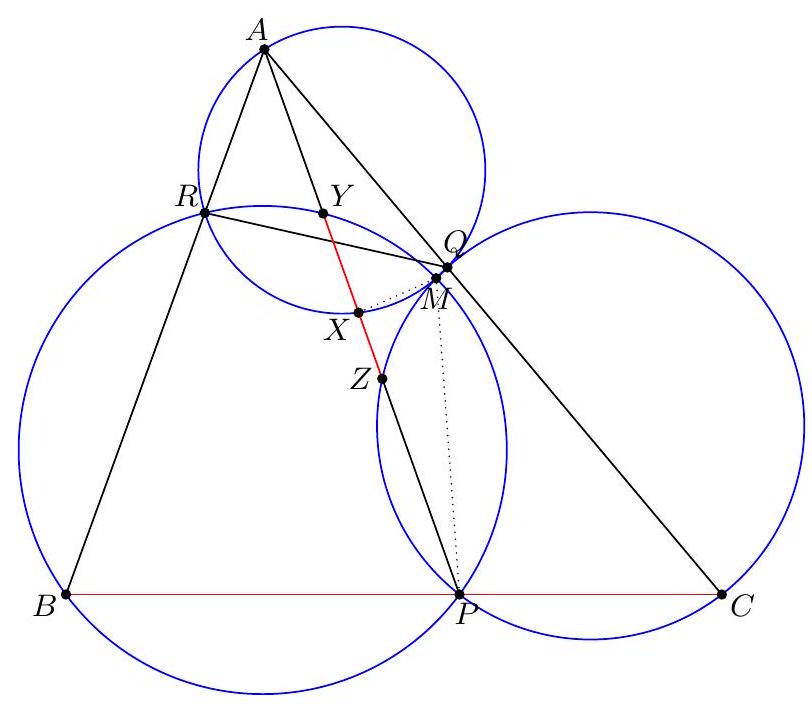
Then $M$ is the center of a spiral similarity sending $\overline{Y Z}$ to $\overline{B C}$. So it suffices to show that this spiral similarity also sends $X$ to $P$, but
$$
\measuredangle M X Y=\measuredangle M X A=\measuredangle M R A=\measuredangle M R B=\measuredangle M P B
$$
so this follows.
## §2 Solutions to Day 2
## §2.1 JMO 2013/4, proposed by Kiran Kedlaya
Available online at https://aops.com/community/p3043748.
## Problem statement
Let $f(n)$ be the number of ways to write $n$ as a sum of powers of 2 , where we keep track of the order of the summation. For example, $f(4)=6$ because 4 can be written as $4,2+2,2+1+1,1+2+1,1+1+2$, and $1+1+1+1$. Find the smallest $n$ greater than 2013 for which $f(n)$ is odd.
The answer is 2047.
For convenience, we agree that $f(0)=1$. Then by considering cases on the first number in the representation, we derive the recurrence
$$
f(n)=\sum_{k=0}^{\left\lfloor\log _{2} n\right\rfloor} f\left(n-2^{k}\right)
$$
We wish to understand the parity of $f$. The first few values are
$$
\begin{aligned}
& f(0)=1 \\
& f(1)=1 \\
& f(2)=2 \\
& f(3)=3 \\
& f(4)=6 \\
& f(5)=10 \\
& f(6)=18 \\
& f(7)=31 .
\end{aligned}
$$
Inspired by the data we make the key claim that
Claim - $f(n)$ is odd if and only if $n+1$ is a power of 2.
Proof. We call a number repetitive if it is zero or its binary representation consists entirely of 1 's. So we want to prove that $f(n)$ is odd if and only if $n$ is repetitive.
This only takes a few cases:
- If $n=2^{k}$, then $(\odot)$ has exactly two repetitive terms on the right-hand side, namely 0 and $2^{k}-1$.
- If $n=2^{k}+2^{\ell}-1$, then $(\odot)$ has exactly two repetitive terms on the right-hand side, namely $2^{\ell+1}-1$ and $2^{\ell}-1$.
- If $n=2^{k}-1$, then $(\bigcirc)$ has exactly one repetitive terms on the right-hand side, namely $2^{k-1}-1$.
- For other $n$, there are no repetitive terms at all on the right-hand side of $(\Omega)$.
Thus the induction checks out.
So the final answer to the problem is 2047.
## §2.2 JMO 2013/5, proposed by Zuming Feng
Available online at https://aops.com/community/p3043750.
## Problem statement
Quadrilateral $X A B Y$ is inscribed in the semicircle $\omega$ with diameter $\overline{X Y}$. Segments $A Y$ and $B X$ meet at $P$. Point $Z$ is the foot of the perpendicular from $P$ to line $\overline{X Y}$. Point $C$ lies on $\omega$ such that line $X C$ is perpendicular to line $A Z$. Let $Q$ be the intersection of segments $A Y$ and $X C$. Prove that
$$
\frac{B Y}{X P}+\frac{C Y}{X Q}=\frac{A Y}{A X}
$$
Let $\beta=\angle Y X P$ and $\alpha=\angle P Y X$ and set $X Y=1$. We do not direct angles in the following solution.
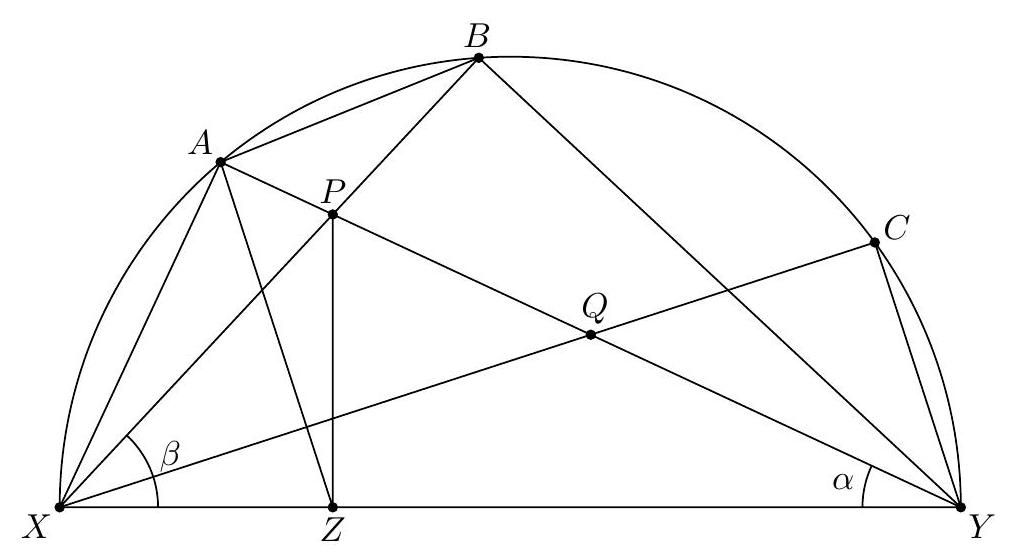
Observe that
$$
\angle A Z X=\angle A P X=\alpha+\beta
$$
since $A P Z X$ is cyclic. In particular, $\angle C X Y=90^{\circ}-(\alpha+\beta)$. It is immediate that
$$
B Y=\sin \beta, \quad C Y=\cos (\alpha+\beta), \quad A Y=\cos \alpha, \quad A X=\sin \alpha
$$
The Law of Sines on $\triangle X P Y$ gives $X P=X Y \frac{\sin \alpha}{\sin (\alpha+\beta)}$, and on $\triangle X Q Y$ gives $X Q=$ $X Y \frac{\sin \alpha}{\sin (90+\beta)}=\frac{\sin \alpha}{\cos \beta}$. So, the given is equivalent to
$$
\frac{\sin \beta}{\frac{\sin \alpha}{\sin (\alpha+\beta)}}+\frac{\cos (\alpha+\beta)}{\frac{\sin \alpha}{\cos \beta}}=\frac{\cos \alpha}{\sin \alpha}
$$
which is equivalent to $\cos \alpha=\cos \beta \cos (\alpha+\beta)+\sin \beta \sin (\alpha+\beta)$. This is obvious, because the right-hand side is just $\cos ((\alpha+\beta)-\beta)$.
## §2.3 JMO 2013/6, proposed by Titu Andreescu
Available online at https://aops.com/community/p3043752.
## Problem statement
Find all real numbers $x, y, z \geq 1$ satisfying
$$
\min (\sqrt{x+x y z}, \sqrt{y+x y z}, \sqrt{z+x y z})=\sqrt{x-1}+\sqrt{y-1}+\sqrt{z-1}
$$
Set $x=1+a, y=1+b, z=1+c$ which eliminates the $x, y, z \geq 1$ condition. Assume without loss of generality that $a \leq b \leq c$. Then the given equation rewrites as
$$
\sqrt{(1+a)(1+(1+b)(1+c))}=\sqrt{a}+\sqrt{b}+\sqrt{c}
$$
In fact, we are going to prove the left-hand side always exceeds the right-hand side, and then determine the equality cases. We have:
$$
\begin{aligned}
(1+a)(1+(1+b)(1+c)) & =(a+1)(1+(b+1)(1+c)) \\
& \leq(a+1)\left(1+(\sqrt{b}+\sqrt{c})^{2}\right) \\
& \leq(\sqrt{a}+(\sqrt{b}+\sqrt{c}))^{2}
\end{aligned}
$$
by two applications of Cauchy-Schwarz.
Equality holds if $b c=1$ and $1 / a=\sqrt{b}+\sqrt{c}$. Letting $c=t^{2}$ for $t \geq 1$, we recover $b=t^{-2} \leq t^{2}$ and $a=\frac{1}{t+1 / t} \leq t^{2}$.
Hence the solution set is
$$
(x, y, z)=\left(1+\left(\frac{t}{t^{2}+1}\right)^{2}, 1+\frac{1}{t^{2}}, 1+t^{2}\right)
$$
and permutations, for any $t>0$.
|