

File size: 17,558 Bytes
eebb93b | 1 2 3 4 5 6 7 8 9 10 11 12 13 14 15 16 17 18 19 20 21 22 23 24 25 26 27 28 29 30 31 32 33 34 35 36 37 38 39 40 41 42 43 44 45 46 47 48 49 50 51 52 53 54 55 56 57 58 59 60 61 62 63 64 65 66 67 68 69 70 71 72 73 74 75 76 77 78 79 80 81 82 83 84 85 86 87 88 89 90 91 92 93 94 95 96 97 98 99 100 101 102 103 104 105 106 107 108 109 110 111 112 113 114 115 116 117 118 119 120 121 122 123 124 125 126 127 128 129 130 131 132 133 134 135 136 137 138 139 140 141 142 143 144 145 146 147 148 149 150 151 152 153 154 155 156 157 158 159 160 161 162 163 164 165 166 167 168 169 170 171 172 173 174 175 176 177 178 179 180 181 182 183 184 185 186 187 188 189 190 191 192 193 194 195 196 197 198 199 200 201 202 203 204 205 206 207 208 209 210 211 212 213 214 215 216 217 218 219 220 221 222 223 224 225 226 227 228 229 230 231 232 233 234 235 236 237 238 239 240 241 242 243 244 245 246 247 248 249 250 251 252 253 254 255 256 257 258 259 260 261 262 263 264 265 266 267 268 269 270 271 272 273 274 275 276 277 278 279 280 281 282 283 284 285 286 287 288 289 290 291 292 293 294 295 296 297 298 299 300 301 302 303 304 305 306 307 308 309 310 311 312 313 314 315 316 | # JMO 2022 Solution Notes
Evan Chen《陳誼廷》
15 April 2024
#### Abstract
This is a compilation of solutions for the 2022 JMO. The ideas of the solution are a mix of my own work, the solutions provided by the competition organizers, and solutions found by the community. However, all the writing is maintained by me.
These notes will tend to be a bit more advanced and terse than the "official" solutions from the organizers. In particular, if a theorem or technique is not known to beginners but is still considered "standard", then I often prefer to use this theory anyways, rather than try to work around or conceal it. For example, in geometry problems I typically use directed angles without further comment, rather than awkwardly work around configuration issues. Similarly, sentences like "let $\mathbb{R}$ denote the set of real numbers" are typically omitted entirely.
Corrections and comments are welcome!
## Contents
0 Problems
1 Solutions to Day 1
1.1 JMO 2022/1, proposed by Holden Mui ..... 3
1.2 JMO 2022/2, proposed by Ankan Bhattacharya ..... 4
1.3 JMO 2022/3, proposed by Ankan Bhattacharya
2 Solutions to Day 2 ..... 7
2.1 JMO 2022/4, proposed by Ankan Bhattacharya ..... 7
2.2 JMO 2022/5, proposed by Holden Mui ..... 9
2.3 JMO 2022/6, proposed by Ankan Bhattacharya ..... 10
## §0 Problems
1. For which positive integers $m$ does there exist an infinite sequence in $\mathbb{Z} / m \mathbb{Z}$ which is both an arithmetic progression and a geometric progression, but is nonconstant?
2. Let $a$ and $b$ be positive integers. Every cell of an $(a+b+1) \times(a+b+1)$ grid is colored either amber or bronze such that there are at least $a^{2}+a b-b$ amber cells and at least $b^{2}+a b-a$ bronze cells. Prove that it is possible to choose $a$ amber cells and $b$ bronze cells such that no two of the $a+b$ chosen cells lie in the same row or column.
3. Let $b \geq 2$ and $w \geq 2$ be fixed integers, and $n=b+w$. Given are $2 b$ identical black rods and $2 w$ identical white rods, each of side length 1.
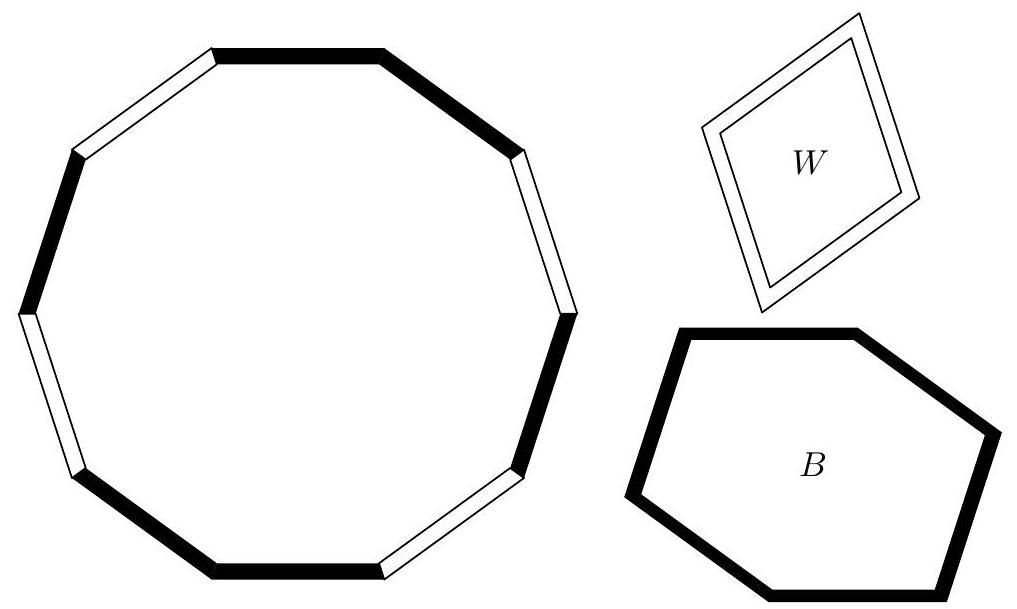
We assemble a regular $2 n$-gon using these rods so that parallel sides are the same color. Then, a convex $2 b$-gon $B$ is formed by translating the black rods, and a convex $2 w$-gon $W$ is formed by translating the white rods. An example of one way of doing the assembly when $b=3$ and $w=2$ is shown below, as well as the resulting polygons $B$ and $W$.
Prove that the difference of the areas of $B$ and $W$ depends only on the numbers $b$ and $w$, and not on how the $2 n$-gon was assembled.
4. Let $A B C D$ be a rhombus, and let $K$ and $L$ be points such that $K$ lies inside the rhombus, $L$ lies outside the rhombus, and $K A=K B=L C=L D$. Prove that there exist points $X$ and $Y$ on lines $A C$ and $B D$ such that $K X L Y$ is also a rhombus.
5. Find all pairs of primes $(p, q)$ for which $p-q$ and $p q-q$ are both perfect squares.
6. Let $a_{0}, b_{0}, c_{0}$ be complex numbers, and define
$$
\begin{aligned}
a_{n+1} & =a_{n}^{2}+2 b_{n} c_{n} \\
b_{n+1} & =b_{n}^{2}+2 c_{n} a_{n} \\
c_{n+1} & =c_{n}^{2}+2 a_{n} b_{n}
\end{aligned}
$$
for all nonnegative integers $n$. Suppose that $\max \left\{\left|a_{n}\right|,\left|b_{n}\right|,\left|c_{n}\right|\right\} \leq 2022$ for all $n \geq 0$. Prove that
$$
\left|a_{0}\right|^{2}+\left|b_{0}\right|^{2}+\left|c_{0}\right|^{2} \leq 1
$$
## §1 Solutions to Day 1
## §1.1 JMO 2022/1, proposed by Holden Mui
Available online at https://aops.com/community/p24774800.
## Problem statement
For which positive integers $m$ does there exist an infinite sequence in $\mathbb{Z} / m \mathbb{Z}$ which is both an arithmetic progression and a geometric progression, but is nonconstant?
Answer: $m$ must not be squarefree.
The problem is essentially asking when there exists a nonconstant arithmetic progression in $\mathbb{Z} / m \mathbb{Z}$ which is also a geometric progression. Now,
- If $m$ is squarefree, then consider three $(s-d, d, s+d)$ in arithmetic progression. It's geometric if and only if $d^{2}=(s-d)(s+d)(\bmod m)$, meaning $d^{2} \equiv 0(\bmod m)$. Then $d \equiv 0(\bmod m)$. So any arithmetic progression which is also geometric is constant in this case.
- Conversely if $p^{2} \mid m$ for some prime $p$, then any arithmetic progression with common difference $m / p$ is geometric by the same calculation.
## §1.2 JMO 2022/2, proposed by Ankan Bhattacharya
Available online at https://aops.com/community/p24774812.
## Problem statement
Let $a$ and $b$ be positive integers. Every cell of an $(a+b+1) \times(a+b+1)$ grid is colored either amber or bronze such that there are at least $a^{2}+a b-b$ amber cells and at least $b^{2}+a b-a$ bronze cells. Prove that it is possible to choose $a$ amber cells and $b$ bronze cells such that no two of the $a+b$ chosen cells lie in the same row or column.
Claim - There exists a transversal $T_{a}$ with at least $a$ amber cells. Analogously, there exists a transversal $T_{b}$ with at least $b$ bronze cells.
Proof. If one picks a random transversal, the expected value of the number of amber cells is at least
$$
\frac{a^{2}+a b-b}{a+b+1}=(a-1)+\frac{1}{a+b+1}>a-1
$$
Now imagine we transform $T_{a}$ to $T_{b}$ in some number of steps, by repeatedly choosing cells $c$ and $c^{\prime}$ and swapping them with the two other corners of the rectangle formed by their row/column, as shown in the figure.
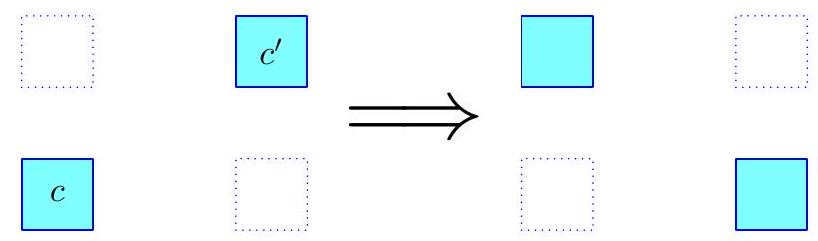
By "discrete intermediate value theorem", the number of amber cells will be either $a$ or $a+1$ at some point during this transformation. This completes the proof.
## §1.3 JMO 2022/3, proposed by Ankan Bhattacharya
Available online at https://aops.com/community/p24775345.
## Problem statement
Let $b \geq 2$ and $w \geq 2$ be fixed integers, and $n=b+w$. Given are $2 b$ identical black rods and $2 w$ identical white rods, each of side length 1.
We assemble a regular $2 n$-gon using these rods so that parallel sides are the same color. Then, a convex $2 b$-gon $B$ is formed by translating the black rods, and a convex $2 w$-gon $W$ is formed by translating the white rods. An example of one way of doing the assembly when $b=3$ and $w=2$ is shown below, as well as the resulting polygons $B$ and $W$.

Prove that the difference of the areas of $B$ and $W$ depends only on the numbers $b$ and $w$, and not on how the $2 n$-gon was assembled.
We are going to prove that one may swap a black rod with an adjacent white rod (as well as the rods parallel to them) without affecting the difference in the areas of $B-W$. Let $\vec{u}$ and $\vec{v}$ denote the originally black and white vectors that were adjacent on the $2 n$-gon and are now going to be swapped. Let $\vec{x}$ denote the sum of all the other black vectors between $\vec{u}$ and $-\vec{u}$, and define $\vec{y}$ similarly. See the diagram below, where $B_{0}$ and $W_{0}$ are the polygons before the swap, and $B_{1}$ and $W_{1}$ are the resulting changed polygons.
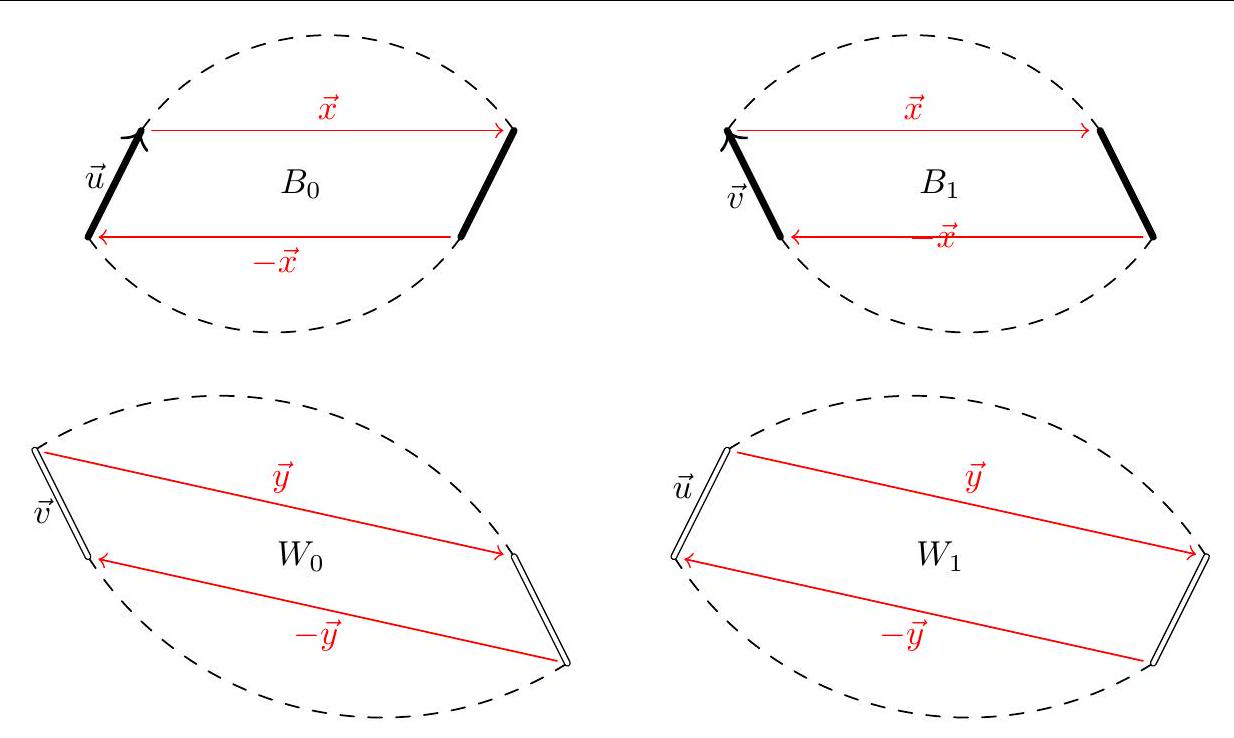
Observe that the only change in $B$ and $W$ is in the parallelograms shown above in each diagram. Letting $\wedge$ denote the wedge product, we need to show that
$$
\vec{u} \wedge \vec{x}-\vec{v} \wedge \vec{y}=\vec{v} \wedge \vec{x}-\vec{u} \wedge \vec{y}
$$
which can be rewritten as
$$
(\vec{u}-\vec{v}) \wedge(\vec{x}+\vec{y})=0
$$
In other words, it would suffice to show $\vec{u}-\vec{v}$ and $\vec{x}+\vec{y}$ are parallel. (Students not familiar with wedge products can replace every $\wedge$ with the cross product $\times$ instead.)
Claim - Both $\vec{u}-\vec{v}$ and $\vec{x}+\vec{y}$ are perpendicular to vector $\vec{u}+\vec{v}$.
Proof. We have $(\vec{u}-\vec{v}) \perp(\vec{u}+\vec{v})$ because $\vec{u}$ and $\vec{v}$ are the same length.
For the other perpendicularity, note that $\vec{u}+\vec{v}+\vec{x}+\vec{y}$ traces out a diameter of the circumcircle of the original $2 n$-gon; call this diameter $A B$, so
$$
A+\vec{u}+\vec{v}+\vec{x}+\vec{y}=B
$$
Now point $A+\vec{u}+\vec{v}$ is a point on this semicircle, which means (by the inscribed angle theorem) the angle between $\vec{u}+\vec{v}$ and $\vec{x}+\vec{y}$ is $90^{\circ}$.
## §2 Solutions to Day 2
## §2.1 JMO 2022/4, proposed by Ankan Bhattacharya
Available online at https://aops.com/community/p24774800.
## Problem statement
Let $A B C D$ be a rhombus, and let $K$ and $L$ be points such that $K$ lies inside the rhombus, $L$ lies outside the rhombus, and $K A=K B=L C=L D$. Prove that there exist points $X$ and $Y$ on lines $A C$ and $B D$ such that $K X L Y$ is also a rhombus.
To start, notice that $\triangle A K B \cong \triangle D L C$ by SSS. Then by the condition $K$ lies inside the rhombus while $L$ lies outside it, we find that the two congruent triangles are just translations of each other (i.e. they have the same orientation).
『 First solution. Let $M$ be the midpoint of $\overline{K L}$ and is $O$ the center of the rhombus.
$$
\text { Claim }-\overline{M O} \perp \overline{A B} .
$$
Proof. Let $U$ and $V$ denote the midpoint of $\overline{A B}$ and $\overline{C D}$ respectively. Then $\overline{K U}$ and $\overline{L V}$ are obviously translates, and perpendicular to $\overline{A B} \| \overline{C D}$. Since $M$ is the midpoint of $\overline{K L}$ and $O$ is the midpoint of $\overline{U V}$, the result follows.
We choose $X$ and $Y$ to be the intersections of the perpendicular bisector of $\overline{K L}$ with $\overline{A C}$ and $\overline{B D}$.
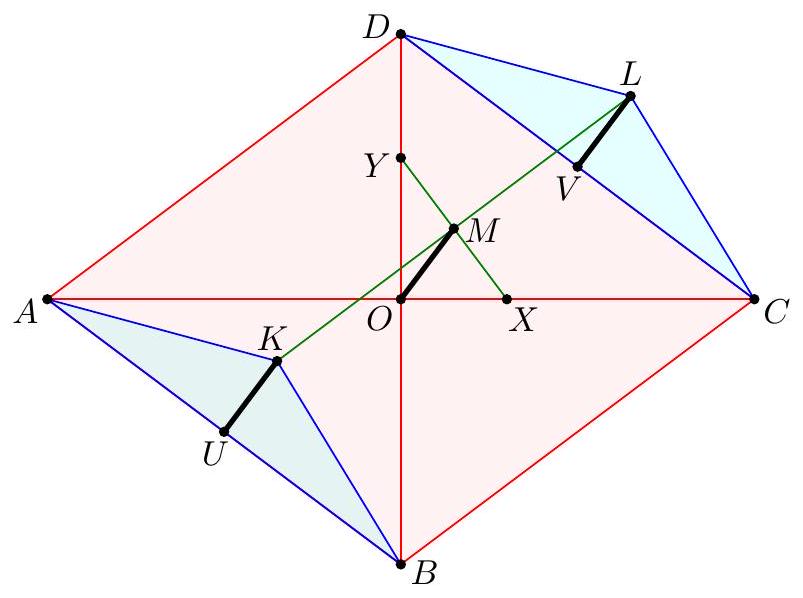
Claim - The midpoint of $\overline{X Y}$ coincides with the midpoint of $\overline{K L}$.
Proof. Because
$$
\begin{aligned}
& \overline{X Y} \perp \overline{K L} \| \overline{B C} \\
& \overline{M O} \perp \overline{A B} \\
& \overline{B D} \perp \overline{A C}
\end{aligned}
$$
it follows that $\triangle M O Y$, which was determined by the three lines $\overline{X Y}, \overline{M O}, \overline{B D}$, is similar to $\triangle A B C$. In particular, it is isosceles with $M Y=M O$. Analogously, $M X=M O$.
Remark. It is also possible to simply use coordinates to prove both claims.
【 Second solution (author's solution). In this solution, we instead define $X$ and $Y$ as the intersections of the circles centered at $K$ and $L$ of equal radii $K A$, which will be denoted $\omega_{K}$ and $\omega_{L}$. It is clear that $K X L Y$ is a rhombus under this construction, so it suffices to show that $X$ and $Y$ lie on $A C$ and $B D$ (in some order).
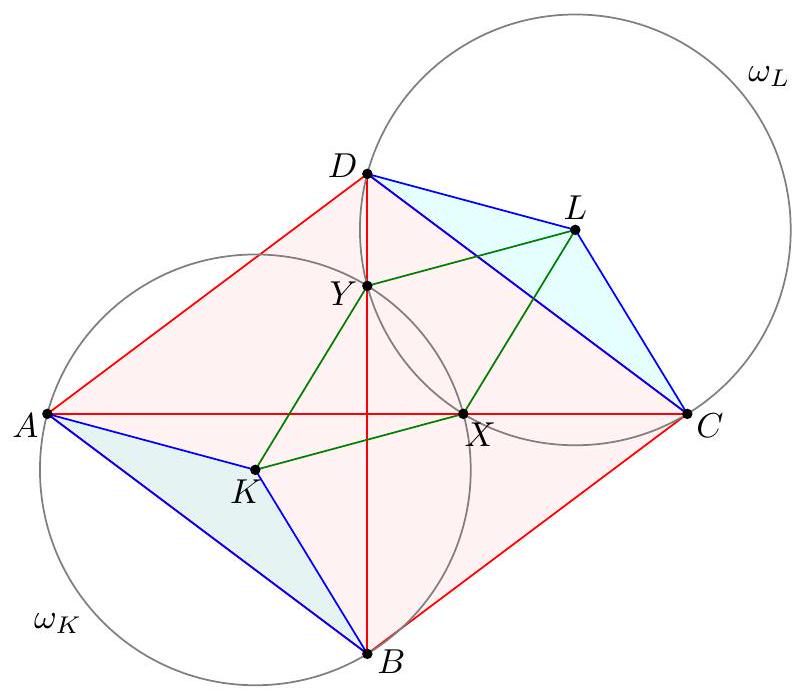
To see this, let $\overline{A C}$ meet $\omega_{K}$ again at $X^{\prime}$. We have
$$
\measuredangle C X^{\prime} D=\measuredangle B X^{\prime} C=\measuredangle B X^{\prime} A=\frac{1}{2} \mathrm{~m} \overparen{A B}=\mathrm{m} \overparen{C D}
$$
where the arcs are directed modulo $360^{\circ}$; here $\overparen{A B}$ is the arc of $\omega_{K}$ cut out by $\measuredangle A X B$, and $\overparen{D C}$ is the analogous arc of $\omega_{L}$. This implies $X^{\prime}$ lies on $\omega_{L}$ by the inscribed angle theorem. Hence $X=X^{\prime}$, and it follows $X$ lies on $\overline{A C}$.
Analogously $Y$ lies on $B D$.
Remark. The angle calculation above can also be replaced with a length calculation, as follows.
Let $M$ and $N$ be the projections of $K$ and $L$ onto $\overline{A C}$, respectively. Then $X^{\prime}$ is the reflection of $A$ across $M$; analogously, the second intersection $X^{\prime \prime}$ with $\overline{A C}$ should be the reflection of $C$ across $N$. So to get $X=X^{\prime}=X^{\prime \prime}$, we would need to show $A C=2 M N$.
However, note that $A K L D$ is a parallelogram. As $M N$ was the projection of $\overline{K L}$ onto $\overline{A C}$, its length should be the same as the projection of $\overline{A D}$ onto $\overline{A C}$, which is obviously $\frac{1}{2} A C$ because the projection of $D$ onto $\overline{A C}$ is exactly the midpoint of $\overline{A C}$ (i.e. the center of the rhombus).
## §2.2 JMO 2022/5, proposed by Holden Mui
Available online at https://aops.com/community/p24774670.
## Problem statement
Find all pairs of primes $(p, q)$ for which $p-q$ and $p q-q$ are both perfect squares.
The answer is $(3,2)$ only. This obviously works so we focus on showing it is the only one.
【 Approach using difference of squares (from author). Set
$$
\begin{aligned}
a^{2} & =p-q \\
b^{2} & =p q-q .
\end{aligned}
$$
Note that $0<a<p$, and $0<b<p$ (because $q \leq p$ ). Now subtracting gives
$$
\underbrace{(b-a)}_{<p} \underbrace{(b+a)}_{<2 p}=b^{2}-a^{2}=p(q-1)
$$
The inequalities above now force $b+a=p$. Hence $q-1=b-a$.
This means $p$ and $q-1$ have the same parity, which can only occur if $q=2$. Finally, taking $\bmod 3$ shows $p \equiv 0(\bmod 3)$. So $(3,2)$ is the only possibility (and it does work).
【 Divisibility approach (Aharshi Roy). Since $p q-q=q(p-1)$ is a square, it follows that $q$ divides $p-1$ and that $\frac{p-1}{q}$ is a perfect square too. Hence the number
$$
s^{2}:=(p-q) \cdot \frac{p-1}{q}=\frac{p^{2}-q p-p+q}{q}
$$
is also a perfect square. Rewriting this equation gives
$$
q=\frac{p^{2}-p}{s^{2}+(p-1)}
$$
In particular, $s^{2}+(p-1)$ divides $p^{2}-p$, and in particular $s \leq p$. We consider two cases:
- If $s^{2}+(p-1)$ is not divisible by $p$, then it must divide $p-1$, which can only happen if $s^{2}=0$, or $p=q$. However, it's easy to check there are no solutions in this case.
- Otherwise, we should have $s^{2} \equiv 1(\bmod p)$, so either $s=1$ or $s=p-1$. If $s=p-1$ we get $q=1$ which is absurd. On the other hand, if $s=1$ we conclude $q=p-1$ and hence $q=2, p=3$.
## §2.3 JMO 2022/6, proposed by Ankan Bhattacharya
Available online at https://aops.com/community/p24775314.
## Problem statement
Let $a_{0}, b_{0}, c_{0}$ be complex numbers, and define
$$
\begin{aligned}
a_{n+1} & =a_{n}^{2}+2 b_{n} c_{n} \\
b_{n+1} & =b_{n}^{2}+2 c_{n} a_{n} \\
c_{n+1} & =c_{n}^{2}+2 a_{n} b_{n}
\end{aligned}
$$
for all nonnegative integers $n$. Suppose that $\max \left\{\left|a_{n}\right|,\left|b_{n}\right|,\left|c_{n}\right|\right\} \leq 2022$ for all $n \geq 0$. Prove that
$$
\left|a_{0}\right|^{2}+\left|b_{0}\right|^{2}+\left|c_{0}\right|^{2} \leq 1
$$
For brevity, set $s_{n}:=\left|a_{n}\right|^{2}+\left|b_{n}\right|^{2}+\left|c_{n}\right|^{2}$. Note that the $s_{n}$ are real numbers.
Claim (Key miraculous identity) - We have
$$
s_{n+1}-s_{n}^{2}=2\left|a_{n} \overline{b_{n}}+b_{n} \overline{c_{n}}+c_{n} \overline{a_{n}}\right|^{2}
$$
Proof. We prove this by mechanical calculation. First,
$$
\begin{aligned}
s_{n+1} & =\left|a_{n}^{2}+2 b_{n} c_{n}\right|^{2}+\left|b_{n}^{2}+2 c_{n} a_{n}\right|^{2}+\left|c_{n}^{2}+2 a_{n} b_{n}\right|^{2} \\
& =\sum_{\text {cyc }}\left|a_{n}^{2}+2 b_{n} c_{n}\right|^{2} \\
& =\sum_{\text {cyc }}\left(a_{n}^{2}+2 b_{n} c_{n}\right)\left({\overline{a_{n}}}^{2}+2 \overline{b_{n}} \overline{c_{n}}\right) \\
& =\sum_{\text {cyc }}\left(\left|a_{n}\right|^{4}+2{\overline{a_{n}}}^{2} b_{n} c_{n}+2 a_{n}^{2} \overline{b_{n}} \overline{c_{n}}+4\left|b_{n}\right|^{2}\left|c_{n}\right|^{2}\right) \\
& =s_{n}^{2}+2 \sum_{\text {cyc }}\left({\overline{a_{n}}}^{2} b_{n} c_{n}+a_{n}^{2} \overline{b_{n}} \overline{c_{n}}+\left|b_{n}\right|^{2}\left|c_{n}\right|^{2}\right)
\end{aligned}
$$
Meanwhile,
$$
\begin{aligned}
&\left|a_{n} \overline{b_{n}}+b_{n} \overline{c_{n}}+c_{n} \overline{a_{n}}\right|^{2}=\left(a_{n} \overline{b_{n}}+b_{n} \overline{c_{n}}+c_{n} \overline{a_{n}}\right)\left(\overline{a_{n}} b_{n}+\overline{b_{n}} c_{n}+\overline{c_{n}} a_{n}\right) \\
&=\left|a_{n}\right|^{2}\left|b_{n}^{2}\right|+a_{n}{\overline{b_{n}}}^{2} c_{n}+a_{n}^{2} \overline{b_{n}} \overline{c_{n}} \\
&+\overline{a_{n}} b_{n}^{2} \overline{c_{n}}+\left|b_{n}\right|^{2}\left|c_{n}\right|^{2}+a_{n} b_{n} \bar{c}^{2} \\
&+{\overline{a_{n}}}^{2} b_{n} c_{n}+\overline{a_{n}} \overline{b_{n}} c_{n}^{2}+\left|a_{n}\right|^{2}\left|c_{n}\right|^{2}
\end{aligned}
$$
which exactly matches the earlier sum, term for term.
In particular, $s_{n+1} \geq s_{n}^{2}$, so applying repeatedly,
$$
s_{n} \geq s_{0}^{2^{n}}
$$
Hence if $s_{0}>1$, it follows $s_{n}$ is unbounded, contradicting $\max \left\{\left|a_{n}\right|,\left|b_{n}\right|,\left|c_{n}\right|\right\} \leq 2022$.
Remark. The originally intended solution was to capture all three recursions in the following way. First, change the recursion to
$$
\begin{aligned}
a_{n+1} & =a_{n}^{2}+2 b_{n} c_{n} \\
c_{n+1} & =b_{n}^{2}+2 c_{n} a_{n} \\
b_{n+1} & =c_{n}^{2}+2 a_{n} b_{n}
\end{aligned}
$$
which is OK because we are just rearranging the terms in each triple. Then if $\omega$ is any complex number with $\omega^{3}=1$, and we define
$$
z_{n}:=a_{n}+b_{n} \omega+c_{n} \omega^{2},
$$
the recursion amounts to saying that $z_{n+1}=z_{n}^{2}$. This allows us to analyze $\left|z_{n}\right|$ in a similar way as above, as now $\left|z_{n}\right|=\left|z_{0}\right|^{2^{n}}$.
|