

File size: 21,893 Bytes
4f3431c | 1 2 3 4 5 6 7 8 9 10 11 12 13 14 15 16 17 18 19 20 21 22 23 24 25 26 27 28 29 30 31 32 33 34 35 36 37 38 39 40 41 42 43 44 45 46 47 48 49 50 51 52 53 54 55 56 57 58 59 60 61 62 63 64 65 66 67 68 69 70 71 72 73 74 75 76 77 78 79 80 81 82 83 84 85 86 87 88 89 90 91 92 93 94 95 96 97 98 99 100 101 102 103 104 105 106 107 108 109 110 111 112 113 114 115 116 117 118 119 120 121 122 123 124 125 126 127 128 129 130 131 132 133 134 135 136 137 138 139 140 141 142 143 144 145 146 147 148 149 150 151 152 153 154 155 156 157 158 159 160 161 162 163 164 165 166 167 168 169 170 171 172 173 174 175 176 177 178 179 180 181 182 183 184 185 186 187 188 189 190 191 192 193 194 195 196 197 198 199 200 201 202 203 204 205 206 207 208 209 210 211 212 213 214 215 216 217 218 219 220 221 222 223 224 225 226 227 228 229 230 231 232 233 234 235 236 237 238 239 240 241 242 243 244 245 246 247 248 249 250 251 252 253 254 255 256 257 258 259 260 261 262 263 264 265 266 267 268 269 270 271 272 273 274 275 276 277 278 279 280 281 282 283 284 285 286 287 288 289 290 291 292 293 294 295 296 297 298 299 300 301 302 303 304 305 306 307 308 309 310 311 312 313 314 315 316 317 318 319 320 321 322 323 324 325 326 327 328 329 330 331 332 333 334 335 336 337 338 339 340 341 342 343 344 345 346 347 348 349 350 351 352 353 354 355 356 357 358 359 | # Baltic Way 2001
## Hamburg, November 4, 2001
## Problems
1. A set of 8 problems was prepared for an examination. Each student was given 3 of them. No two students received more than one common problem. What is the largest possible number of students?
2. Let $n \geqslant 2$ be a positive integer. Find whether there exist $n$ pairwise nonintersecting nonempty subsets of $\{1,2,3, \ldots\}$ such that each positive integer can be expressed in a unique way as a sum of at most $n$ integers, all from different subsets.
3. The numbers $1,2, \ldots, 49$ are placed in a $7 \times 7$ array, and the sum of the numbers in each row and in each column is computed. Some of these 14 sums are odd while others are even. Let $A$ denote the sum of all the odd sums and $B$ the sum of all even sums. Is it possible that the numbers were placed in the array in such a way that $A=B$ ?
4. Let $p$ and $q$ be two different primes. Prove that
$$
\left\lfloor\frac{p}{q}\right\rfloor+\left\lfloor\frac{2 p}{q}\right\rfloor+\left\lfloor\frac{3 p}{q}\right\rfloor+\ldots+\left\lfloor\frac{(q-1) p}{q}\right\rfloor=\frac{1}{2}(p-1)(q-1) .
$$
(Here $\lfloor x\rfloor$ denotes the largest integer not greater than $x$.)
5. Let 2001 given points on a circle be colored either red or green. In one step all points are recolored simultaneously in the following way: If both direct neighbors of a point $P$ have the same color as $P$, then the color of $P$ remains unchanged, otherwise $P$ obtains the other color. Starting with the first coloring $F_{1}$, we obtain the colorings $F_{2}, F_{3}, \ldots$ after several recoloring steps. Prove that there is a number $n_{0} \leqslant 1000$ such that $F_{n_{0}}=F_{n_{0}+2}$. Is the assertion also true if 1000 is replaced by 999 ?
6. The points $A, B, C, D, E$ lie on the circle $c$ in this order and satisfy $A B \| E C$ and $A C \| E D$. The line tangent to the circle $c$ at $E$ meets the line $A B$ at $P$. The lines $B D$ and $E C$ meet at $Q$. Prove that $|A C|=|P Q|$.
7. Given a parallelogram $A B C D$. A circle passing through $A$ meets the line segments $A B, A C$ and $A D$ at inner points $M, K, N$, respectively. Prove that
$$
|A B| \cdot|A M|+|A D| \cdot|A N|=|A K| \cdot|A C| .
$$
8. Let $A B C D$ be a convex quadrilateral, and let $N$ be the midpoint of $B C$. Suppose further that $\angle A N D=135^{\circ}$. Prove that
$$
|A B|+|C D|+\frac{1}{\sqrt{2}} \cdot|B C| \geqslant|A D|
$$
9. Given a rhombus $A B C D$, find the locus of the points $P$ lying inside the rhombus and satisfying $\angle A P D+\angle B P C=180^{\circ}$.
10. In a triangle $A B C$, the bisector of $\angle B A C$ meets the side $B C$ at the point $D$. Knowing that $|B D| \cdot|C D|=|A D|^{2}$ and $\angle A D B=45^{\circ}$, determine the angles of triangle $A B C$.
11. The real-valued function $f$ is defined for all positive integers. For any integers $a>1, b>1$ with $d=\operatorname{gcd}(a, b)$, we have
$$
f(a b)=f(d) \cdot\left(f\left(\frac{a}{d}\right)+f\left(\frac{b}{d}\right)\right),
$$
Determine all possible values of $f(2001)$.
12. Let $a_{1}, a_{2}, \ldots, a_{n}$ be positive real numbers such that $\sum_{i=1}^{n} a_{i}^{3}=3$ and $\sum_{i=1}^{n} a_{i}^{5}=5$. Prove that $\sum_{i=1}^{n} a_{i}>\frac{3}{2}$.
13. Let $a_{0}, a_{1}, a_{2}, \ldots$ be a sequence of real numbers satisfying $a_{0}=1$ and $a_{n}=a_{\lfloor 7 n / 9\rfloor}+a_{\lfloor n / 9\rfloor}$ for $n=1,2, \ldots$ Prove that there exists a positive integer $k$ with $a_{k}<\frac{k}{2001 !}$.
(Here $\lfloor x\rfloor$ denotes the largest integer not greater than $x$.)
14. There are $2 n$ cards. On each card some real number $x, 1 \leqslant x \leqslant 2$, is written (there can be different numbers on different cards). Prove that
the cards can be divided into two heaps with sums $s_{1}$ and $s_{2}$ so that $\frac{n}{n+1} \leqslant \frac{s_{1}}{s_{2}} \leqslant 1$.
15. Let $a_{0}, a_{1}, a_{2}, \ldots$ be a sequence of positive real numbers satisfying $i \cdot a_{i}^{2} \geqslant(i+1) \cdot a_{i-1} a_{i+1}$ for $i=1,2, \ldots$ Furthermore, let $x$ and $y$ be positive reals, and let $b_{i}=x a_{i}+y a_{i-1}$ for $i=1,2, \ldots$ Prove that the inequality $i \cdot b_{i}^{2}>(i+1) \cdot b_{i-1} b_{i+1}$ holds for all integers $i \geqslant 2$.
16. Let $f$ be a real-valued function defined on the positive integers satisfying the following condition: For all $n>1$ there exists a prime divisor $p$ of $n$ such that
$$
f(n)=f\left(\frac{n}{p}\right)-f(p)
$$
Given that $f(2001)=1$, what is the value of $f(2002)$ ?
17. Let $n$ be a positive integer. Prove that at least $2^{n-1}+n$ numbers can be chosen from the set $\left\{1,2,3, \ldots, 2^{n}\right\}$ such that for any two different chosen numbers $x$ and $y, x+y$ is not a divisor of $x \cdot y$.
18. Let $a$ be an odd integer. Prove that $a^{2^{n}}+2^{2^{n}}$ and $a^{2^{m}}+2^{2^{m}}$ are relatively prime for all positive integers $n$ and $m$ with $n \neq m$.
19. What is the smallest positive odd integer having the same number of positive divisors as 360 ?
20. From a sequence of integers $(a, b, c, d)$ each of the sequences
$$
(c, d, a, b),(b, a, d, c),(a+n c, b+n d, c, d),(a+n b, b, c+n d, d),
$$
for arbitrary integer $n$ can be obtained by one step. Is it possible to obtain $(3,4,5,7)$ from $(1,2,3,4)$ through a sequence of such steps?
## Solutions
1. Answer: 8 .
Denote the problems by $A, B, C, D, E, F, G, H$, then 8 possible problem sets are $A B C, A D E, A F G, B D G, B F H, C D H, C E F, E G H$. Hence, there could be 8 students.
Suppose that some problem (e.g., $A$ ) was given to 4 students. Then each of these 4 students should receive 2 different "supplementary" problems, and there should be at least 9 problems - a contradiction. Therefore each problem was given to at most 3 students, and there were at most $8 \cdot 3=24$ "awardings" of problems. As each student was "awarded" 3 problems, there were at most 8 students.
2. Answer: yes.
Let $A_{1}$ be the set of positive integers whose only non-zero digits may be the 1 -st, the $(n+1)$-st, the $(2 n+1)$-st etc. from the end; $A_{2}$ be the set of positive integers whose only non-zero digits may be the 2 -nd, the $(n+2)$ nd, the $(2 n+2)$-nd etc. from the end, and so on. The sets $A_{1}, A_{2}, \ldots, A_{n}$ have the required property.
Remark. This problem is quite similar to problem 18 from Baltic Way 1997.
3. Answer: no.
If this were possible, then $2 \cdot(1+\ldots+49)=A+B=2 B$. But $B$ is even since it is the sum of even numbers, whereas $1+\ldots+49=25 \cdot 49$ is odd. This is a contradiction.
4. The line $y=\frac{p}{q} x$ contains the diagonal of the rectangle with vertices $(0,0)$, $(q, 0),(q, p)$ and $(0, p)$ and passes through no points with integer coordinates in the interior of that rectangle. For $k=1,2, \ldots, q-1$ the summand $\left\lfloor\frac{k p}{q}\right\rfloor$ counts the number of interior points of the rectangle lying below the diagonal $y=\frac{p}{q} x$ and having $x$-coordinate equal to $k$. Therefore the sum in consideration counts all interior points with integer coordinates below the diagonal, which is exactly half the number of all points with integer coordinates in the interior of the rectangle, i.e. $\frac{1}{2} \cdot(p-1)(q-1)$.
Remark. The integers $p$ and $q$ need not be primes: in the solution we only used the fact that they are coprime.
5. Answer: no.
Let the points be denoted by $1,2, \ldots, 2001$ such that $i, j$ are neighbors if $|i-j|=1$ or $\{i, j\}=\{1,2001\}$. We say that $k$ points form a monochromatic segment of length $k$ if the points are consecutive on the circle and if
they all have the same color. For a coloring $F$ let $d(F)$ be the maximum length of a monochromatic segment. Note that $d\left(F_{n}\right)>1$ for all $n$ since 2001 is odd. If $d\left(F_{1}\right)=2001$ then all points have the same color, hence $F_{1}=F_{2}=F_{3}=\ldots$ and we can choose $n_{0}=1$. Thus, let $1<d\left(F_{1}\right)<2001$. Below we shall prove the following implications:
If $3<d\left(F_{n}\right)<2001$, then $d\left(F_{n+1}\right)=d\left(F_{n}\right)-2 ;$
If $d\left(F_{n}\right)=3$, then $d\left(F_{n+1}\right)=2$;
If $d\left(F_{n}\right)=2$, then $d\left(F_{n+1}\right)=d\left(F_{n}\right)$ and $F_{n+2}=F_{n}$;
From (1) and (2) it follows that $d\left(F_{1000}\right) \leqslant 2$, hence by (3) we have $F_{1000}=F_{1002}$. Moreover, if $F_{1}$ is the coloring where 1 is colored red and all other points are colored green, then $d\left(F_{1}\right)=2000$ and thus $d\left(F_{1}\right)>d\left(F_{2}\right)>\ldots>d\left(F_{1000}\right)=2$ which shows that, for all $n<1000, F_{n} \neq F_{n+2}$ and thus 1000 cannot be replaced by 999 .
It remains to prove (1)-(3). Let $(i+1, \ldots, i+k)$ be a longest monochromatic segment for $F_{n}$ (considering the labels of the points modulo 2001). Then $(i+2, \ldots, i+k-1)$ is a monochromatic segment for $F_{n+1}$ and thus $d\left(F_{n+1}\right) \geqslant d\left(F_{n}\right)-2$. Moreover, if $(i+1, \ldots, i+k)$ is a longest monochromatic segment for $F_{n+1}$ where $k \geqslant 3$, then $(i, \ldots, i+k+1)$ is a monochromatic segment for $F_{n}$. From this and $F_{n+1}>1$ the implications (1) and (2) clearly follow. For proof of (3) note that if $d\left(F_{n}\right) \leqslant 2$ then $F_{n+1}$ is obtained from $F_{n}$ by changing the colour of all points.
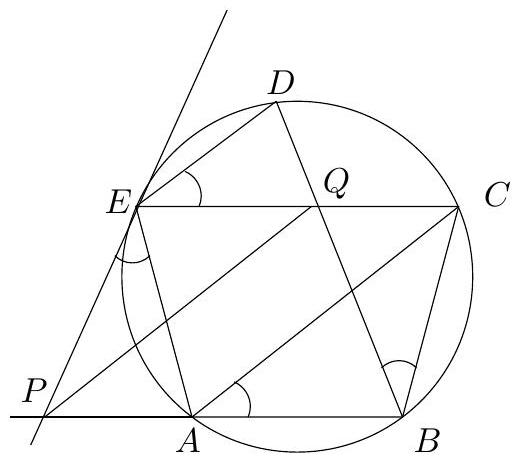
Figure 1
6. The arcs $B C$ and $A E$ are of equal length (see Figure 1). Also, since
$A B \| E C$ and $E D \| A C$, we have $\angle C A B=\angle D E C$ and the $\operatorname{arcs} D C$ and $B C$ are of equal length. Since $P E$ is tangent to $c$ and $|A E|=|D C|$, then $\angle P E A=\angle D B C=\angle Q B C$. As $A B C D$ is inscribed in $c$, we have $\angle Q C B=180^{\circ}-\angle E A B=\angle P A E$. Also, $A B C D$ is an isosceles trapezium, whence $|A E|=|B C|$. So the triangles $A P E$ and $C Q B$ are congruent, and $|Q C|=|P A|$. Now $P A C Q$ is a quadrilateral with a pair of opposite sides equal and parallel. So $P A C Q$ is a parallelogram, and $|P Q|=|A C|$.
7. Let $X$ be the point on segment $A C$ such that $\angle A D X=\angle A K N$, then
$$
\angle A X D=\angle A N K=180^{\circ}-\angle A M K
$$
(see Figure 2). Triangles $N A K$ and $X A D$ are similar, having two pairs of equal angles, hence $|A X|=\frac{|A N| \cdot|A D|}{|A K|}$. Since triangles $M A K$ and $X C D$ are also similar, we have $|C X|=\frac{|A M| \cdot|C D|}{|A K|}=\frac{|A M| \cdot|A B|}{|A K|}$ and
$$
|A M| \cdot|A B|+|A N| \cdot|A D|=(|A X|+|C X|) \cdot|A K|=|A C| \cdot|A K| \text {. }
$$
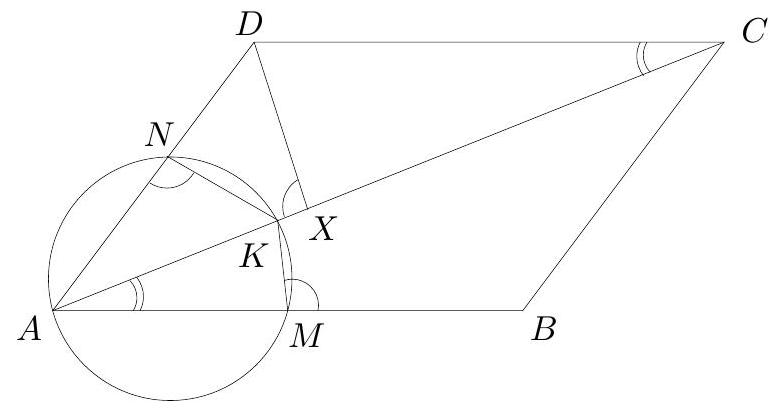
Figure 2
8. Let $X$ be the point symmetric to $B$ with respect to $A N$, and let $Y$ be the point symmetric to $C$ with respect to $D N$ (see Figure 3 ). Then
$$
\angle X N Y=180^{\circ}-2 \cdot\left(180^{\circ}-135^{\circ}\right)=90^{\circ}
$$
and $|N X|=|N Y|=\frac{|B C|}{2}$. Therefore, $|X Y|=\frac{|B C|}{\sqrt{2}}$. Moreover, we have
$$
\begin{aligned}
& |A X|=|A B| \text { and }|D Y|=|D C| \text {. Consequently, } \\
& \qquad|A D| \leqslant|A X|+|X Y|+|Y D|=|A B|+\frac{|B C|}{\sqrt{2}}+|D C| .
\end{aligned}
$$
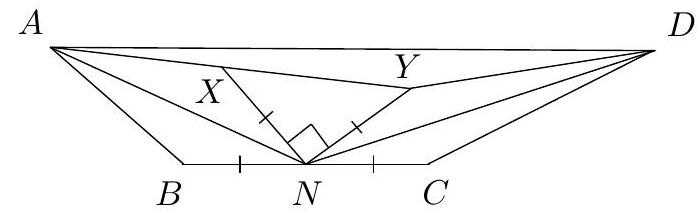
Figure 3
9. Answer: the locus of the points $P$ is the union of the diagonals $A C$ and $B D$.
Let $Q$ be a point such that $P Q C D$ is a parallelogram (see Figure 4). Then $A B Q P$ is also a parallelogram. From the equality $\angle A P D+\angle B P C=180^{\circ}$ it follows that $\angle B Q C+\angle B P C=180^{\circ}$, so the points $B, Q, C, P$ lie on a common circle. Therefore, $\angle P B C=\angle P Q C=\angle P D C$, and since $|B C|=|C D|$, we obtain that $\angle C P B=\angle C P D$ or $\angle C P B+\angle C P D=180^{\circ}$. Hence, the point $P$ lies on the segment $A C$ or on the segment $B D$.
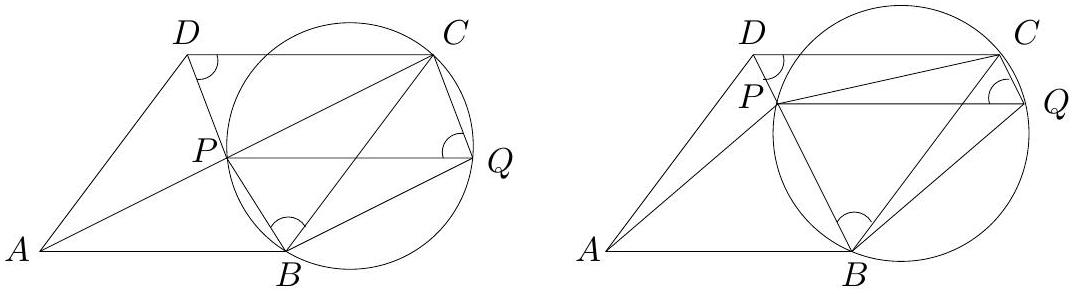
Figure 4
Conversely, any point $P$ lying on the diagonal $A C$ satisfies the equation $\angle B P C=\angle D P C$. Therefore, $\angle A P D+\angle B P C=180^{\circ}$. Analogously, we show that the last equation holds if the point $P$ lies on the diagonal $B D$.
10. Answer: $\angle B A C=60^{\circ}, \angle A B C=105^{\circ}$ and $\angle A C B=15^{\circ}$.
Suppose the line $A D$ meets the circumcircle of triangle $A B C$ at $A$ and $E$ (see Figure 5). Let $M$ be the midpoint of $B C$ and $O$ the circumcentre of triangle $A B C$. Since the arcs $B E$ and $E C$ are equal, then the points $O$, $M, E$ are collinear and $O E$ is perpendicular to $B C$. From the equality
$\angle C D E=\angle A D B=45^{\circ}$ it follows that $\angle A E O=45^{\circ}$. Since $|A O|=|E O|$, we have $\angle A O E=90^{\circ}$ and $A O \| D M$.
From the equality $|B D| \cdot|C D|=|A D|^{2}$ we obtain $|A D|=|D E|$, which implies that $|O M|=|M E|$. Therefore $|B O|=|B E|$ and also $|B O|=|E O|$. Hence the triangle $B O E$ is equilateral. This gives $\angle B A E=30^{\circ}$, so $\angle B A C=60^{\circ}$. Summing up the angles of the triangle $A B D$ we obtain $\angle A B C=105^{\circ}$ and from this $\angle A C B=15^{\circ}$.
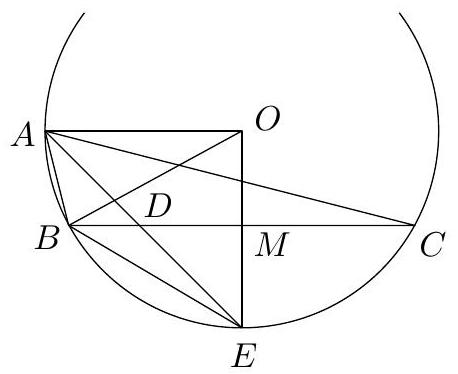
Figure 5
11. Answer: 0 and $\frac{1}{2}$.
Obviously the constant functions $f(n)=0$ and $f(n)=\frac{1}{2}$ provide solutions.
We show that there are no other solutions. Assume $f(2001) \neq 0$. Since $2001=3 \cdot 667$ and $\operatorname{gcd}(3,667)=1$, then
$$
f(2001)=f(1) \cdot(f(3)+f(667)),
$$
and $f(1) \neq 0$. Since $\operatorname{gcd}(2001,2001)=2001$ then
$$
f\left(2001^{2}\right)=f(2001)(2 \cdot f(1)) \neq 0 .
$$
Also $\operatorname{gcd}\left(2001,2001^{3}\right)=2001$, so
$$
f\left(2001^{4}\right)=f(2001) \cdot\left(f(1)+f\left(2001^{2}\right)\right)=f(1) f(2001)(1+2 f(2001))
$$
On the other hand, $\operatorname{gcd}\left(2001^{2}, 2001^{2}\right)=2001^{2}$ and
$$
f\left(2001^{4}\right)=f\left(2001^{2}\right) \cdot(f(1)+f(1))=2 f(1) f\left(2001^{2}\right)=4 f(1)^{2} f(2001) .
$$
So $4 f(1)=1+2 f(2001)$ and $f(2001)=2 f(1)-\frac{1}{2}$. Exactly the same
argument starting from $f\left(2001^{2}\right) \neq 0$ instead of $f(2001)$ shows that $f\left(2001^{2}\right)=2 f(1)-\frac{1}{2}$. So
$$
2 f(1)-\frac{1}{2}=2 f(1)\left(2 f(1)-\frac{1}{2}\right) \text {. }
$$
Since $2 f(1)-\frac{1}{2}=f(2001) \neq 0$, we have $f(1)=\frac{1}{2}$, which implies $f(2001)=2 f(1)-\frac{1}{2}=\frac{1}{2}$.
12. By Hölder's inequality,
$$
\sum_{i=1}^{n} a^{3}=\sum_{i=1}^{n}\left(a_{i} \cdot a_{i}^{2}\right) \leqslant\left(\sum_{i=1}^{n} a_{i}^{5 / 3}\right)^{3 / 5} \cdot\left(\sum_{i=1}^{n}\left(a_{i}^{2}\right)^{5 / 2}\right)^{2 / 5} .
$$
We will show that
$$
\sum_{i=1}^{n} a_{i}^{5 / 3} \leqslant\left(\sum_{i=1}^{n} a_{i}\right)^{5 / 3}
$$
Let $S=\sum_{i=1}^{n} a_{i}$, then (4) is equivalent to
$$
\sum_{i=1}^{n}\left(\frac{a_{i}}{S}\right)^{5 / 3} \leqslant 1=\sum_{i=1}^{n} \frac{a_{i}}{S}
$$
which holds since $0<\frac{a_{i}}{S} \leqslant 1$ and $\frac{5}{3}>1$ yield $\left(\frac{a_{i}}{S}\right)^{5 / 3} \leqslant \frac{a_{i}}{S}$. So,
$$
\sum_{i=1}^{n} a_{i}^{3} \leqslant\left(\sum_{i=1}^{n} a_{i}\right) \cdot\left(\sum_{i=1}^{n} a_{i}^{5}\right)^{2 / 5}
$$
which gives $\sum_{i=1}^{n} a_{i} \geqslant \frac{3}{5^{2 / 5}}>\frac{3}{2}$, since $2^{5}>5^{2}$ and hence $2>5^{2 / 5}$.
13. Consider the equation
$$
\left(\frac{7}{9}\right)^{x}+\left(\frac{1}{9}\right)^{x}=1 .
$$
It has a root $\frac{1}{2}<\alpha<1$, because $\sqrt{\frac{7}{9}}+\sqrt{\frac{1}{9}}=\frac{\sqrt{7}+1}{3}>1$ and $\frac{7}{9}+\frac{1}{9}<1$. We will prove that $a_{n} \leqslant M \cdot n^{\alpha}$ for some $M>0-$ since $\frac{n^{\alpha}}{n}$ will be arbitrarily small for large enough $n$, the claim follows from this immediately. We choose $M$ so that the inequality $a_{n} \leqslant M \cdot n^{\alpha}$ holds for $1 \leqslant n \leqslant 8$; since for $n \geqslant 9$ we have $1<[7 n / 9]<n$ and $1 \leqslant[n / 9]<n$, it follows by induction that
$$
\begin{aligned}
a_{n} & =a_{[7 n / 9]}+a_{[n / 9]} \leqslant M \cdot\left[\frac{7 n}{9}\right]^{\alpha}+M \cdot\left[\frac{n}{9}\right]^{\alpha} \leqslant \\
& \leqslant M \cdot\left(\frac{7 n}{9}\right)^{\alpha}+M \cdot\left(\frac{n}{9}\right)^{\alpha}=M \cdot n^{\alpha} \cdot\left(\left(\frac{7}{9}\right)^{\alpha}+\left(\frac{1}{9}\right)^{\alpha}\right)=M \cdot n^{\alpha} .
\end{aligned}
$$
14. Let the numbers be $x_{1} \leqslant x_{2} \leqslant \ldots \leqslant x_{2 n-1} \leqslant x_{2 n}$. We will show that the choice $s_{1}=x_{1}+x_{3}+x_{5}+\cdots+x_{2 n-1}$ and $s_{2}=x_{2}+x_{4}+\cdots+x_{2 n}$ solves the problem. Indeed, the inequality $\frac{s_{1}}{s_{2}} \leqslant 1$ is obvious and we have
$$
\begin{aligned}
\frac{s_{1}}{s_{2}} & =\frac{x_{1}+x_{3}+x_{5}+\ldots+x_{2 n-1}}{x_{2}+x_{4}+x_{6}+\ldots+x_{2 n}}=\frac{\left(x_{3}+x_{5}+\ldots+x_{2 n-1}\right)+x_{1}}{\left(x_{2}+x_{4}+\ldots+x_{2 n-2}\right)+x_{2 n}} \geqslant \\
& \geqslant \frac{\left(x_{3}+x_{5}+\ldots+x_{2 n-1}\right)+1}{\left(x_{2}+x_{4}+\ldots+x_{2 n-2}\right)+2} \geqslant \frac{\left(x_{2}+x_{4}+\ldots+x_{2 n-2}\right)+1}{\left(x_{2}+x_{4}+\ldots+x_{2 n-2}\right)+2}= \\
& =1-\frac{1}{\left(x_{2}+x_{4}+\ldots+x_{2 n-2}\right)+2} \geqslant 1-\frac{1}{(n-1)+2}=\frac{n}{n+1} .
\end{aligned}
$$
15. Let $i \geqslant 2$. We are given the inequalities
$$
(i-1) \cdot a_{i-1}^{2} \geqslant i \cdot a_{i} a_{i-2}
$$
and
$$
i \cdot a_{i}^{2} \geqslant(i+1) \cdot a_{i+1} a_{i-1} .
$$
Multiplying both sides of (6) by $x^{2}$, we obtain
$$
i \cdot x^{2} \cdot a_{i}^{2} \geqslant(i+1) \cdot x^{2} \cdot a_{i+1} a_{i-1}
$$
By (5),
$$
\frac{a_{i-1}^{2}}{a_{i} a_{i-2}} \geqslant \frac{i}{i-1}=1+\frac{1}{i-1}>1+\frac{1}{i}=\frac{i+1}{i}
$$
which implies
$$
i \cdot y^{2} \cdot a_{i-1}^{2}>(i+1) \cdot y^{2} \cdot a_{i} a_{i-2} .
$$
Multiplying (5) and (6), and dividing both sides of the resulting inequality by $i a_{i} a_{i-1}$, we get
$$
(i-1) \cdot a_{i} a_{i-1} \geqslant(i+1) \cdot a_{i+1} a_{i-2} .
$$
Adding $(i+1) a_{i} a_{i-1}$ to both sides of the last inequality and multiplying both sides of the resulting inequality by $x y$ gives
$$
i \cdot 2 x y \cdot a_{i} a_{i-1} \geqslant(i+1) \cdot x y \cdot\left(a_{i+1} a_{i-2}+a_{i} a_{i-1}\right) .
$$
Finally, adding up (7), (8) and (9) results in
$$
i \cdot\left(x a_{i}+y a_{i-1}\right)^{2}>(i+1) \cdot\left(x a_{i+1}+y a_{i}\right)\left(x a_{i-1}+y a_{i-2}\right)
$$
which is equivalent to the claim.
16. Answer: 2.
For any prime $p$ we have $f(p)=f(1)-f(p)$ and thus $f(p)=\frac{f(1)}{2}$. If $n$ is a product of two primes $p$ and $q$, then $f(n)=f(p)-f(q)$ or $f(n)=f(q)-f(p)$, so $f(n)=0$. By the same reasoning we find that if $n$ is a product of three primes, then there is a prime $p$ such that
$$
f(n)=f\left(\frac{n}{p}\right)-f(p)=-f(p)=-\frac{f(1)}{2} .
$$
By simple induction we can show that if $n$ is the product of $k$ primes, then $f(n)=(2-k) \cdot \frac{f(1)}{2}$. In particular, $f(2001)=f(3 \cdot 23 \cdot 29)=1$ so $f(1)=-2$. Therefore, $f(2002)=f(2 \cdot 7 \cdot 11 \cdot 13)=-f(1)=2$.
17. We choose the numbers $1,3,5, \ldots, 2^{n}-1$ and $2,4,8,16, \ldots, 2^{n}$, i.e. all odd numbers and all powers of 2 . Consider the three possible cases.
(1) If $x=2 a-1$ and $y=2 b-1$, then $x+y=(2 a-1)+(2 b-1)=2(a+b-1)$ is even and does not divide $x y=(2 a-1)(2 b-1)$ which is odd.
(2) If $x=2^{k}$ and $y=2^{m}$ where $k<m$, then $x+y=2^{k}\left(2^{m-k}+1\right)$ has an odd divisor greater than 1 and hence does not divide $x y=2^{a+b}$.
(3) If $x=2^{k}$ and $y=2 b-1$, then $x+y=2^{k}+(2 b-1)>(2 b-1)$ is odd and hence does not divide $x y=2^{k}(2 b-1)$ which has $2 b-1$ as its largest odd divisor.
18. Rewriting $a^{2^{n}}+2^{2^{n}}=a^{2^{n}}-2^{2^{n}}+2 \cdot 2^{2^{n}}$ and making repeated use of the identity
$$
a^{2^{n}}-2^{2^{n}}=\left(a^{2^{n-1}}-2^{2^{n-1}}\right) \cdot\left(a^{2^{n-1}}+2^{2^{n-1}}\right)
$$
we get
$$
\begin{gathered}
a^{2^{n}}+2^{2^{n}}=\left(a^{2^{n-1}}+2^{2^{n-1}}\right) \cdot\left(a^{2^{n-2}}+2^{2^{n-2}}\right) \cdot \ldots \cdot\left(a^{2^{m}}+2^{2^{m}}\right) \cdot \ldots \\
\ldots \cdot\left(a^{2}+2^{2}\right) \cdot(a+2) \cdot(a-2)+2 \cdot 2^{2^{n}}
\end{gathered}
$$
For $n>m$, assume that $a^{2^{n}}+2^{2^{n}}$ and $a^{2^{m}}+2^{2^{m}}$ have a common divisor $d>1$. Then an odd integer $d$ divides $2 \cdot 2^{2^{n}}$, a contradiction.
19. Answer: 31185 .
An integer with the prime factorization $p_{1}^{r_{1}} \cdot p_{2}^{r_{2}} \cdot \ldots \cdot p_{k}^{r_{k}}$ (where $p_{1}, p_{2}, \ldots$, $p_{k}$ are distinct primes) has precisely $\left(r_{1}+1\right) \cdot\left(r_{2}+1\right) \cdot \ldots \cdot\left(r_{k}+1\right)$ distinct positive divisors. Since $360=2^{3} \cdot 3^{2} \cdot 5$, it follows that 360 has $4 \cdot 3 \cdot 2=24$ positive divisors. Since $24=3 \cdot 2 \cdot 2 \cdot 2$, it is easy to check that the smallest odd number with 24 positive divisors is $3^{2} \cdot 5 \cdot 7 \cdot 11=31185$.
20. Answer: no.
Under all transformations $(a, b, c, d) \rightarrow\left(a^{\prime}, b^{\prime}, c^{\prime}, d^{\prime}\right)$ allowed in the problem we have $|a d-b c|=\left|a^{\prime} d^{\prime}-b^{\prime} c^{\prime}\right|$, but $|1 \cdot 4-2 \cdot 3|=2 \neq 1=|3 \cdot 7-4 \cdot 5|$.
Remark. The transformations allowed in the problem are in fact the elementary transformations of the determinant
$$
\left|\begin{array}{ll}
a & b \\
c & d
\end{array}\right|
$$
and the invariant $|a d-b c|$ is the absolute value of the determinant which is preserved under these transformations.
|