

File size: 27,026 Bytes
4f3431c | 1 2 3 4 5 6 7 8 9 10 11 12 13 14 15 16 17 18 19 20 21 22 23 24 25 26 27 28 29 30 31 32 33 34 35 36 37 38 39 40 41 42 43 44 45 46 47 48 49 50 51 52 53 54 55 56 57 58 59 60 61 62 63 64 65 66 67 68 69 70 71 72 73 74 75 76 77 78 79 80 81 82 83 84 85 86 87 88 89 90 91 92 93 94 95 96 97 98 99 100 101 102 103 104 105 106 107 108 109 110 111 112 113 114 115 116 117 118 119 120 121 122 123 124 125 126 127 128 129 130 131 132 133 134 135 136 137 138 139 140 141 142 143 144 145 146 147 148 149 150 151 152 153 154 155 156 157 158 159 160 161 162 163 164 165 166 167 168 169 170 171 172 173 174 175 176 177 178 179 180 181 182 183 184 185 186 187 188 189 190 191 192 193 194 195 196 197 198 199 200 201 202 203 204 205 206 207 208 209 210 211 212 213 214 215 216 217 218 219 220 221 222 223 224 225 226 227 228 229 230 231 232 233 234 235 236 237 238 239 240 241 242 243 244 245 246 247 248 249 250 251 252 253 254 255 256 257 258 259 260 261 262 263 264 265 266 267 268 269 270 271 272 273 274 275 276 277 278 279 280 281 282 283 284 285 286 287 288 289 290 291 292 293 294 295 296 297 298 299 300 301 302 303 304 305 306 307 308 309 310 311 312 313 314 315 316 317 318 319 320 321 322 323 324 325 326 327 328 329 330 331 332 333 334 335 336 337 338 339 340 341 342 343 344 345 346 347 348 349 350 351 352 353 354 355 356 357 358 359 360 361 362 363 364 365 366 367 368 369 370 371 372 373 374 375 376 377 378 379 380 381 382 383 384 385 386 387 388 389 390 391 392 393 394 395 396 397 398 399 400 401 402 403 404 405 406 407 408 409 410 411 412 413 414 415 416 417 418 419 420 421 422 423 424 425 426 427 428 429 430 431 432 | # Baltic Way 2008
Gdańsk, November 8, 2008
## Problems and solutions
Problem 1. Determine all polynomials $p(x)$ with real coefficients such that
$$
p\left((x+1)^{3}\right)=(p(x)+1)^{3}
$$
and
$$
p(0)=0
$$
Answer: $p(x)=x$.
Solution: Consider the sequence defined by
$$
\left\{\begin{array}{l}
a_{0}=0 \\
a_{n+1}=\left(a_{n}+1\right)^{3}
\end{array}\right.
$$
It follows inductively that $p\left(a_{n}\right)=a_{n}$. Since the polynomials $p$ and $x$ agree on infinitely many points, they must be equal, so $p(x)=x$.
Problem 2. Prove that if the real numbers $a, b$ and $c$ satisfy $a^{2}+b^{2}+c^{2}=3$ then
$$
\frac{a^{2}}{2+b+c^{2}}+\frac{b^{2}}{2+c+a^{2}}+\frac{c^{2}}{2+a+b^{2}} \geq \frac{(a+b+c)^{2}}{12} .
$$
When does equality hold?
Solution: Let $2+b+c^{2}=u, 2+c+a^{2}=v, 2+a+b^{2}=w$. We note that it follows from $a^{2}+b^{2}+c^{2}=3$ that $a, b, c \geq-\sqrt{3}>-2$. Therefore, $u, v$ and $w$ are positive. From the Cauchy-Schwartz inequality we get then
$$
\begin{aligned}
(a+b+c)^{2} & =\left(\frac{a}{\sqrt{u}} \sqrt{u}+\frac{b}{\sqrt{v}} \sqrt{v}+\frac{c}{\sqrt{w}} \sqrt{w}\right)^{2} \\
& \leq\left(\frac{a^{2}}{u}+\frac{b^{2}}{v}+\frac{c^{2}}{w}\right)(u+v+w) .
\end{aligned}
$$
Here,
$$
u+v+w=6+a+b+c+a^{2}+b^{2}+c^{2}=9+a+b+c .
$$
Invoking once more the Cauchy-Schwartz inequality, we get
$$
(a+b+c)^{2}=(a \cdot 1+b \cdot 1+c \cdot 1)^{2} \leq\left(a^{2}+b^{2}+c^{2}\right)(1+1+1)=9,
$$
whence $a+b+c \leq 3$ and $u+v+w \leq 12$. The proposed inequality follows.
In the second application above of the Cauchy-Schwartz inequality, equality requires $a=b=c$. If this is satified, $u+v+w=12$, which is equivalent to $a+b+c=3$, requires $a=b=c=1$. It is seen by a direct check that equality holds in the proposed inequality in this case.
Problem 3. Does there exist an angle $\alpha \in(0, \pi / 2)$ such that $\sin \alpha, \cos \alpha, \tan \alpha$ and $\cot \alpha$, taken in some order, are consecutive terms of an arithmetic progression?
Answer: No.
Solution: Suppose that there is an $x$ such that $0<x<\frac{\pi}{2}$ and $\sin x, \cos x, \tan x, \cot x$ in some order are consecutive terms of an arithmetic progression.
Suppose $x \leq \frac{\pi}{4}$. Then $\sin x \leq \sin \frac{\pi}{4}=\cos \frac{\pi}{4} \leq \cos x<1 \leq \cot x$ and $\sin x<\frac{\sin x}{\cos x}=\tan x \leq 1 \leq \cot x$, hence $\sin x$ is the least and $\cot x$ is the greatest among the four terms. Thereby, $\sin x<\cot x$, therefore equalities do not occur.
Independently on whether the order of terms is $\sin x<\tan x<\cos x<\cot x$ or $\sin x<\cos x<\tan x<\cot x$, we have $\cos x-\sin x=\cot x-\tan x$. As
$$
\cot x-\tan x=\frac{\cos x}{\sin x}-\frac{\sin x}{\cos x}=\frac{\cos ^{2} x-\sin ^{2} x}{\cos x \sin x}=\frac{(\cos x-\sin x)(\cos x+\sin x)}{\cos x \sin x},
$$
we obtain $\cos x-\sin x=\frac{(\cos x-\sin x)(\cos x+\sin x)}{\cos x \sin x}$. As $\cos x>\sin x$, we can reduce by $\cos x-\sin x$ and get
$$
1=\frac{\cos x+\sin x}{\cos x \sin x}=\frac{1}{\sin x}+\frac{1}{\cos x} .
$$
But $0<\sin x<1$ and $0<\cos x<1$, hence $\frac{1}{\sin x}$ and $\frac{1}{\cos x}$ are greater than 1 and their sum cannot equal 1 , a contradiction.
If $x>\frac{\pi}{4}$ then $0<\frac{\pi}{2}-x<\frac{\pi}{4}$. As the sine, cosine, tangent and cotangent of $\frac{\pi}{2}-x$ are equal to the sine, cosine, tangent and cotangent of $x$ in some order, the contradiction carries over to this case, too.
Solution 2: The case $x \leq \frac{\pi}{4}$ can also be handled as follows. Consider two cases according to the order of the intermediate two terms.
If the order is $\sin x<\tan x<\cos x<\cot x$ then using AM-GM gives
$$
\cos x=\frac{\tan x+\cot x}{2}>\sqrt{\tan x \cdot \cot x}=\sqrt{1}=1
$$
which is impossible.
Suppose the other case, $\sin x<\cos x<\tan x<\cot x$. From equalities
$$
\frac{\sin x+\tan x}{2}=\cos x \quad \text { and } \quad \frac{\cos x+\cot x}{2}=\tan x
$$
one gets
$$
\begin{aligned}
& \tan x(\cos x+1)=2 \cos x \\
& \cot x(\sin x+1)=2 \tan x,
\end{aligned}
$$
respectively. By multiplying the corresponding sides, one obtains $(\cos x+1)(\sin x+1)=4 \sin x$, leading to $\cos x \sin x+\cos x+1=3 \sin x$. On the other hand, using $\cos x>\sin x$ and AM-GM gives
$$
\cos x \sin x+\cos x+1>\sin ^{2} x+\sin x+1 \geq 2 \sin x+\sin x=3 \sin x
$$
a contradiction.
Problem 4. The polynomial $P$ has integer coefficients and $P(x)=5$ for five different integers $x$. Show that there is no integer $x$ such that $-6 \leq P(x) \leq 4$ or $6 \leq P(x) \leq 16$.
Solution: Assume $P\left(x_{k}\right)=5$ for different integers $x_{1}, x_{2}, \ldots, x_{5}$. Then
$$
P(x)-5=\prod_{k=1}^{5}\left(x-x_{k}\right) Q(x)
$$
where $Q$ is a polynomial with integral coefficients. Assume $n$ satisfies the condition in the problem. Then $|n-5| \leq 11$. If $P\left(x_{0}\right)=n$ for some integer $x_{0}$, then $n-5$ is a product of six non-zero integers, five of which are different. The smallest possible absolute value of a product of five different non-zero integers is $1^{2} \cdot 2^{2} \cdot 3=12$.
Problem 5. Suppose that Romeo and Juliet each have a regular tetrahedron to the vertices of which some positive real numbers are assigned. They associate each edge of their tetrahedra with the product of the two numbers assigned to its end points. Then they write on each face of their tetrahedra the sum of the three numbers associated to its three edges. The four numbers written on the faces of Romeo's tetrahedron turn out to coincide with the four numbers written on Juliet's tetrahedron. Does it follow that the four numbers assigned to the vertices of Romeo's tetrahedron are identical to the four numbers assigned to the vertices of Juliet's tetrahedron?
Answer: Yes.
Solution: Let us prove that this conclusion can in fact be drawn. For this purpose we denote the numbers assigned to the vertices of Romeo's tetrahedron by $r_{1}, r_{2}, r_{3}, r_{4}$ and the numbers assigned to the vertices of Juliette's tetrahedron by $j_{1}, j_{2}, j_{3}, j_{4}$ in such a way that
$$
\begin{aligned}
& r_{2} r_{3}+r_{3} r_{4}+r_{4} r_{2}=j_{2} j_{3}+j_{3} j_{4}+j_{4} j_{2} \\
& r_{1} r_{3}+r_{3} r_{4}+r_{4} r_{1}=j_{1} j_{3}+j_{3} j_{4}+j_{4} j_{1} \\
& r_{1} r_{2}+r_{2} r_{4}+r_{4} r_{1}=j_{1} j_{2}+j_{2} j_{4}+j_{4} j_{1} \\
& r_{1} r_{2}+r_{2} r_{3}+r_{3} r_{1}=j_{1} j_{2}+j_{2} j_{3}+j_{3} j_{1}
\end{aligned}
$$
We intend to show that $r_{1}=j_{1}, r_{2}=j_{2}, r_{3}=j_{3}$ and $r_{4}=j_{4}$, which clearly suffices to establish our claim. Now let
$$
R=\left\{i \mid r_{i}>j_{i}\right\}
$$
denote the set indices where Romeo's corresponding number is larger and define similarly
$$
J=\left\{i \mid r_{i}<j_{i}\right\}
$$
If we had $|R|>2$, then w.l.o.g. $\{1,2,3\} \subseteq R$, which easily contradicted (4). Therefore $|R| \leq 2$, so let us suppose for the moment that $|R|=2$. Then w.l.o.g. $R=\{1,2\}$, i.e. $r_{1}>j_{1}, r_{2}>j_{2}, r_{3} \leq j_{3}, r_{4} \leq j_{4}$. It follows that $r_{1} r_{2}-r_{3} r_{4}>j_{1} j_{2}-j_{3} j_{4}$, but (1) + (2) - (3) - (4) actually tells us that both sides of this strict inequality are equal. This contradiction yields $|R| \leq 1$ and replacing the roles Romeo and Juliet played in the argument just performed we similarly infer $|J| \leq 1$. For these reasons at least two of the four desired equalities hold, say $r_{1}=1_{1}$ and $r_{2}=j_{2}$. Now using (3) and (4) we easily get $r_{3}=j_{3}$ and $r_{4}=j_{4}$ as well.
Problem 6. Find all finite sets of positive integers with at least two elements such that for any two numbers $a, b(a>b)$ belonging to the set, the number $\frac{b^{2}}{a-b}$ belongs to the set, too.
Answer: $X=\{a, 2 a\}$, where $a$ is an arbitrary nonnegative integer.
Solution: Let $X$ be a set we seek for, and $a$ be its minimal element. For each other element $b$ we have $\frac{a^{2}}{b-a} \geq a$, hence $b \leq 2 a$. Therefore all the elements of $X$ belong to the interval $[a, 2 a]$. So the quotient of any two elements of $X$ is at most 2 .
Now consider two biggest elements $d$ and $c, c<d$. Since $d \leq 2 c$ we conclude that $\frac{c^{2}}{d-c} \geq c$. Hence $\frac{c^{2}}{d-c}=d$ or $\frac{c^{2}}{d-c}=c$. The first case is impossible because we obtain an equality $(c / d)^{2}+(c / d)-1=0$, which implies that $c / d$ is irrational. Therefore we have the second case and $c^{2}=d c-c^{2}$, i.e. $c=d / 2$. Thus the set $X$ could contain only one element except $d$, and this element should be equal to $d / 2$. It is clear that all these sets satisfy the condition of the problem.
Problem 7. How many pairs $(m, n)$ of positive integers with $m<n$ fulfill the equation
$$
\frac{3}{2008}=\frac{1}{m}+\frac{1}{n} ?
$$
## Answer: 5.
Solution: Let $d$ be the greatest common divisor of $m$ and $n$, and let $m=d x$ and $n=d y$. Then the equation is equivalent to
$$
3 d x y=2008(x+y) \text {. }
$$
The numbers $x$ and $y$ are relatively prime and have no common divisors with $x+y$ and hence they are both divisors of 2008. Notice that $2008=8 \cdot 251$ and 251 is a prime. Then $x$ and $y$ fulfil:
1) They are both divisors of 2008 .
2) Only one of them can be even.
3) The number 251 can only divide none or one of them.
4) $x<y$.
That gives the following possibilities of $(x, y)$ :
$$
(1,2),(1,4),(1,8),(1,251),(1,2 \cdot 251),(1,4 \cdot 251),(1,8 \cdot 251),(2,251),(4,251),(8,251) \text {. }
$$
The number 3 does not divide 2008 and hence 3 divides $x+y$. That shortens the list down to
$$
(1,2),(1,8),(1,251),(1,4 \cdot 251),(4,251) \text {. }
$$
For every pair $(x, y)$ in the list determine the number $d=\frac{2008}{x y} \cdot \frac{x+y}{3}$. It is seen that $x y$ divides 2008 for all $(x, y)$ in the list and hence $d$ is an integer. Hence exactly 5 solutions exist to the equation.
Problem 8. Consider a set $A$ of positive integers such that the least element of $A$ equals 1001 and the product of all elements of $A$ is a perfect square. What is the least possible value of the greatest element of $A$ ?
Answer: 1040.
Solution: We first prove that max $A$ has to be at least 1040 .
As $1001=13 \cdot 77$ and $13 \nmid 77$, the set $A$ must contain a multiple of 13 that is greater than $13 \cdot 77$. Consider the following cases:
- $13 \cdot 78 \in$. But $13 \cdot 78=13^{2} \cdot 6$, hence $A$ must also contain some greater multiple of 13 .
- $13 \cdot 79 \in A$. As 79 is a prime, $A$ must contain another multiple of 79 , which is greater than 1040 as $14 \cdot 79>1040$ and $12 \cdot 79<1001$.
- $13 \cdot k \in A$ for $k \geq 80$. As $13 \cdot k \geq 13 \cdot 80=1040$, we are done.
Now take $A=\{1001,1008,1012,1035,1040\}$. The prime factorizations are $1001=7 \cdot 11 \cdot 13,1008=7 \cdot 2^{4} \cdot 3^{2}$, $1012=2^{2} \cdot 11 \cdot 23,1035=5 \cdot 3^{2} \cdot 23,1040=2^{4} \cdot 5 \cdot 13$. The sum of exponents of each prime occurring in these representations is even. Thus the product of elements of $A$ is a perfect square.
Problem 9. Suppose that the positive integers $a$ and $b$ satisfy the equation
$$
a^{b}-b^{a}=1008 .
$$
Prove that $a$ and $b$ are congruent modulo 1008.
Solution: Observe that $1008=2^{4} \cdot 3^{2} \cdot 7$. First we show that $a$ and $b$ cannot both be even. For suppose the largest of them were equal to $2 x$ and the smallest of them equal to $2 y$, where $x \geq y \geq 1$. Then
$$
\pm 1008=(2 x)^{2 y}-(2 y)^{2 x}
$$
so that $2^{2 y}$ divides 1008 . It follows that $y \leq 2$. If $y=2$, then $\pm 1008=(2 x)^{4}-4^{2 x}$, and
$$
\pm 63=x^{4}-4^{2 x-2}=\left(x^{2}+4^{x-1}\right)\left(x^{2}-4^{x-1}\right) \text {. }
$$
But $x^{2}-4^{x-1}$ is easily seen never to divide 63; already at $x=4$ it is too large. Suppose that $y=1$. Then $\pm 1008=(2 x)^{2}-2^{2 x}$, and
$$
\pm 252=x^{2}-2^{2 x-2}=\left(x+2^{x-1}\right)\left(x-2^{x-1}\right) .
$$
This equation has no solutions. Clearly $x$ must be even. $x=2,4,6,8$ do not work, and when $x \geq 10$, then $x+2^{x-1}>252$.
We see that $a$ and $b$ cannot both be even, so they must both be odd. They cannot both be divisible by 3 , for then $1008=a^{b}-b^{a}$ would be divisible by 27 ; therefore neither of them is. Likewise, none of them is divisible by 7 .
Everything will now follow from repeated use of the following fact, where $\varphi$ denotes Euler's totient function:
If $n \mid 1008, a$ and $b$ are relatively prime to both $n$ and $\varphi(n)$, and $a \equiv b \bmod \varphi(n)$, then also $a \equiv b \bmod n$.
To prove the fact, use Euler's Totient Theorem: $a^{\varphi(n)} \equiv b^{\varphi(n)} \equiv 1 \bmod n$. From $a \equiv b \equiv d \bmod \varphi(n)$, we get
$$
0 \equiv 1008=a^{b}-b^{a} \equiv a^{d}-b^{d} \bmod n,
$$
and since $d$ is invertible modulo $\varphi(n)$, we may deduce that $a \equiv b \bmod n$.
Now begin with $a \equiv b \equiv 1 \bmod 2$. From $\varphi(4)=2, \varphi(8)=4$ and $\varphi(16)=8$, we get congruence of $a$ and $b$ modulo 4, 8 and 16 in turn. We established that $a$ and $b$ are not divisible by 3 . Since $\varphi(3)=2$, we get $a \equiv b$ $\bmod 3$, then from $\varphi(9)=6$, deduce $a \equiv b \bmod 9$. Finally, since $a$ and $b$ are not divisible by 7 , and $\varphi(7)=6$, infer $a \equiv b \bmod 7$.
Consequently, $a \equiv b \bmod 1008$. We remark that the equation possesses at least one solution, namely $1009^{1}-1^{1009}=1008$. It is unknown whether there exist others.
Problem 10. For a positive integer $n$, let $S(n)$ denote the sum of its digits. Find the largest possible value of the expression $\frac{S(n)}{S(16 n)}$.
## Answer: 13
Solution: It is obvious that $S(a b) \leq S(a) S(b)$ for all positive integers $a$ and $b$. From here we get
$$
S(n)=S(n \cdot 10000)=S(16 n \cdot 625) \leq S(16 n) \cdot 13 \text {; }
$$
so we get $\frac{S(n)}{S(16 n)} \leq 13$.
For $n=625$ we have an equality. So the largest value is 13 .
Problem 11. Consider a subset $A$ of 84 elements of the set $\{1,2, \ldots, 169\}$ such that no two elements in the set add up to 169 . Show that $A$ contains a perfect square.
Solution: If $169 \in A$, we are done. If not, then
$$
A \subset \bigcup_{k=1}^{84}\{k, 169-k\}
$$
Since the sum of the numbers in each of the sets in the union is 169, each set contains at most one element of $A$; on the other hand, as $A$ has 84 elements, each set in the union contains exactly one element of $A$. So there is an $a \in A$ such that $a \in\{25,144\}$. $a$ is a perfect square.
Problem 12. In a school class with $3 n$ children, any two children make a common present to exactly one other child. Prove that for all odd $n$ it is possible that the following holds:
For any three children $A, B$ and $C$ in the class, if $A$ and $B$ make a present to $C$ then $A$ and $C$ make a present to $B$.
Solution: Assume there exists a set $\mathscr{S}$ of sets of three children such that any set of two children is a subset of exactly one member of $\mathscr{S}$, and assume that the children $A$ and $B$ make a common present to $C$ if and only if $\{A, B, C\} \in \mathscr{S}$. Then it is true that any two children $A$ and $B$ make a common present to exactly one other child $C$, namely the unique child such that $\{A, B, C\} \in \mathscr{S}$. Because $\{A, B, C\}=\{A, C, B\}$ it is also true that if $A$ and $B$ make a present to $C$ then $A$ and $C$ make a present to $B$. We shall construct such a set $\mathscr{S}$.
Let $A_{1}, \ldots, A_{n}, B_{1}, \ldots B_{n}, C_{1}, \ldots, C_{n}$ be the children, and let the following sets belong to $\mathscr{S}$. (1) $\left\{A_{i}, B_{i}, C_{i}\right\}$ for $1 \leq i \leq n$. (2) $\left\{A_{i}, A_{j}, B_{k}\right\},\left\{B_{i}, B_{j}, C_{k}\right\}$ and $\left\{C_{i}, C_{j}, A_{k}\right\}$ for $1 \leq i<j \leq n, 1 \leq k \leq n$ and $i+j \equiv 2 k(\bmod n)$. We note that because $n$ is odd, the congruence $i+j \equiv 2 k(\bmod n)$ has a unique solution with respect to $k$ in the interval $1 \leq k \leq n$. Hence for $1 \leq i<j \leq n$ the set $\left\{A_{i}, A_{j}\right\}$ is a subset of a unique set $\left\{A_{i}, A_{j}, B_{k}\right\} \in \mathscr{S}$, and similarly the sets $\left\{B_{i}, B_{j}\right\}$ and $\left\{C_{i}, C_{j}\right\}$. The relations $i+j \equiv 2 i(\bmod n)$ and $i+j \equiv 2 j(\bmod n)$ both imply $i \equiv j(\bmod n)$, which contradicts $1 \leq i<j \leq n$. Hence for $1 \leq i \leq n$, the set $\left\{A_{i}, B_{i}, C_{i}\right\}$ is the only set in $\mathscr{S}$ of which any of the sets $\left\{A_{i}, B_{i}\right\}\left\{A_{i}, C_{i}\right\}$ and $\left\{B_{i}, C_{i}\right\}$ is a subset. For $i \neq k$, the relations $i+j \equiv 2 k$ $(\bmod n)$ and $1 \leq j \leq n$ determine $j$ uniquely, and we have $i \neq j$ because otherwise $i+j \equiv 2 k(\bmod n)$ implies $i \equiv k(\bmod n)$, which contradicts $i \neq k$. Thus $\left\{A_{i}, B_{k}\right\}$ is a subset of the unique set $\left\{A_{i}, A_{j}, B_{k}\right\} \in \mathscr{S}$. Similarly $\left\{B_{i}, C_{k}\right\}$ and $\left\{A_{i}, C_{k}\right\}$. Altogether, each set of two children is thus a subset of a unique set in $\mathscr{S}$.
Problem 13. For an upcoming international mathematics contest, the participating countries were asked to choose from nine combinatorics problems. Given how hard it usually is to agree, nobody was surprised that the following happened:
- Every country voted for exactly three problems.
- Any two countries voted for different sets of problems.
- Given any three countries, there was a problem none of them voted for.
Find the maximal possible number of participating countries.
## Answer: 56
Solution: Certainly, the 56 three-element subsets of the set $\{1,2, \ldots, 8\}$ would do. Now we prove that 56 is the maximum. Assume we have a maximal configuration. Let $Y$ be the family of the three-element subsets, which were chosen by the participating countries and $N$ be the family of the three-element subsets, which were not chosen by the participating countries. Then $|Y|+|N|=\left(\begin{array}{l}9 \\ 3\end{array}\right)=84$. Consider an $x \in Y$. There are $\left(\begin{array}{l}6 \\ 3\end{array}\right)=20$ three-element subsets disjoint to $x$, which can be partitioned into 10 pairs of complementary subsets. At least one of the two sets of those pairs of complementary sets have to belong to $N$, otherwise these two together with $x$ have the whole sets as union, i.e., three countries would have voted for all problems. Therefore, to any $x \in Y$ there are associated at least 10 sets of $N$. On the other hand, a set $y \in N$ can be associated not more than to 20 sets, since there are exactly 20 disjoint sets to $y$. Together we have $10 \cdot|Y| \leq 20 \cdot|N|$ and
$$
|Y|=\frac{2}{3}|Y|+\frac{1}{3}|Y| \leq \frac{2}{3}|Y|+\frac{2}{3}|N|=\frac{2}{3}(|Y|+|N|)=\frac{2}{3} \cdot 84=56 .
$$
Remark: The set of the 84 three-element subsets can be partitioned into 28 triples of pairwise disjoint sets. From any of those triples at most two can be chosen. The partition is not obvious, but possible.
Problem 14. Is it possible to build a $4 \times 4 \times 4$ cube from blocks of the following shape consisting of 4 unit cubes?
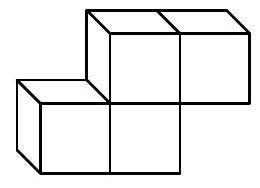
Answer: Yes.
Solution: It is possible to put two blocks together to form a new block that covers an area of shape
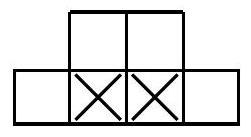
whereby the part marked with crosses has two layers.
From two such new blocks, one can build figure
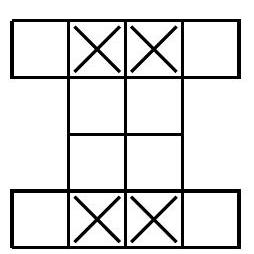
Taking two such figures, turning one of them upside down and rotating 90 degrees, leads to a $4 \times 4 \times 2$ block. Finally, two such blocks together form the desired cube.
Problem 15. Some $1 \times 2$ dominoes, each covering two adjacent unit squares, are placed on a board of size $n \times n$ so that no two of them touch (not even at a corner). Given that the total area covered by the dominoes is 2008 , find the least possible value of $n$.
Answer: 77
Solution: Following the pattern from the figure, we have space for
$$
6+18+30+\ldots+150=\frac{156 \cdot 13}{2}=1014
$$
dominoes, giving the area $2028>2008$.
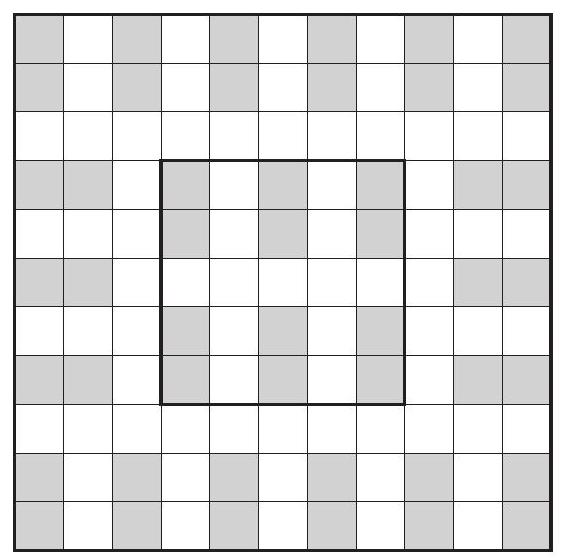
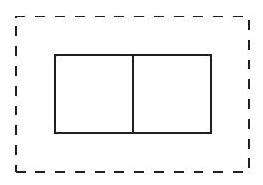
The square $76 \times 76$ is not enough. If it was, consider the "circumferences" of the 1004 dominoes of size $2 \times 3$, see figure; they should fit inside $77 \times 77$ square without overlapping. But $6 \cdot 1004=6024>5929=77 \cdot 77$.
Problem 16. Let $A B C D$ be a parallelogram. The circle with diameter $A C$ intersects the line $B D$ at points $P$ and $Q$. The perpendicular to the line $A C$ passing through the point $C$ intersects the lines $A B$ and $A D$ at points $X$ and $Y$, respectively. Prove that the points $P, Q, X$ and $Y$ lie on the same circle.
Solution: If the lines $B D$ and $X Y$ are parallel the statement is trivial. Let $M$ be the intersection point of $B D$ and $X Y$.
By Intercept Theorem $M B / M D=M C / M Y$ and $M B / M D=M X / M C$, hence $M C^{2}=M X \cdot M Y$. By the circle property $M C^{2}=M P \cdot M Q$ (line $M C$ is tangent and line $M P$ is secant to the circle). Therefore we have $M X \cdot M Y=M P \cdot M Q$ and the quadrilateral $P Q Y X$ is inscribed.
Problem 17. Assume that $a, b, c$ and $d$ are the sides of a quadrilateral inscribed in a given circle. Prove that the product $(a b+c d)(a c+b d)(a d+b c)$ acquires its maximum when the quadrilateral is a square.
Solution: Let $A B C D$ be the quadrilateral, and let $A B=a, B C=b, C D=c, A D=d, A C=e, B D=f$. Ptolemy's Theorem gives $a c+b d=e f$. Since the area of triangle $A B C$ is $a b e / 4 R$, where $R$ is the circumradius, and similarly the area of triangle $A C D$, the product $(a b+c d) e$ equals $4 R$ times the area of quadrilateral $A B C D$. Similarly, this is also the value of the product $f(a d+b c)$, so $(a b+c d)(a c+b d)(a d+b c)$ is maximal when the quadrilateral has maximal area. Since the area of the quadrilateral is equal to $\frac{1}{2} e f \sin u$, where $u$ is one of the angles between the diagonals $A C$ and $B D$, it is maximal when all the factors of the product $d e \sin u$ are maximal. The diagonals $d$ and $e$ are maximal when they are diagonals of the circle, and $\sin u$ is maximal when $u=90^{\circ}$. Thus, $(a b+c d)(a c+b d)(a d+b c)$ is maximal when $A B C D$ is a square.
Problem 18. Let $A B$ be a diameter of a circle $S$, and let $L$ be the tangent at $A$. Furthermore, let $c$ be a fixed, positive real, and consider all pairs of points $X$ and $Y$ lying on $L$, on opposite sides of $A$, such that $|A X| \cdot|A Y|=c$. The lines $B X$ and $B Y$ intersect $S$ at points $P$ and $Q$, respectively. Show that all the lines $P Q$ pass through a common point.
Solution: Let $S$ be the unit circle in the $x y$-plane with origin $O$, put $A=(1,0), B=(-1,0)$, take $L$ as the line $x=1$, and suppose $X=(1,2 p)$ and $Y=(1,-2 q)$, where $p$ and $q$ are positive real numbers with $p q=\frac{c}{4}$. If $\alpha=\angle A B P$ and $\beta=\angle A B Q$, then $\tan \alpha=p$ and $\tan \beta=q$.
Let $P Q$ intersect the $x$-axis in the point $R$. By the Inscribed Angle Theorem, $\angle R O P=2 \alpha$ and $\angle R O Q=2 \beta$. The triangle $O P Q$ is isosceles, from which $\angle O P Q=\angle O Q P=90^{\circ}-\alpha-\beta$, and $\angle O R P=90^{\circ}-\alpha+\beta$. The Law of Sines gives
$$
\frac{O R}{\sin \angle O P R}=\frac{O P}{\sin \angle O R P}
$$
which implies
$$
\begin{aligned}
O R & =\frac{\sin \angle O P R}{\sin \angle O R P}=\frac{\sin \left(90^{\circ}-\alpha-\beta\right)}{\sin \left(90^{\circ}-\alpha+\beta\right)}=\frac{\cos (\alpha+\beta)}{\cos (\alpha-\beta)} \\
& =\frac{\cos \alpha \cos \beta-\sin \alpha \sin \beta}{\cos \alpha \cos \beta+\sin \alpha \sin \beta}=\frac{1-\tan \alpha \tan \beta}{1+\tan \alpha \tan \beta} \\
& =\frac{1-p q}{1+p q}=\frac{1-\frac{c}{4}}{1+\frac{c}{4}}=\frac{4-c}{4+c} .
\end{aligned}
$$
Hence the point $R$ lies on all lines $P Q$.
Solution 2: Perform an inversion in the point $B$. Since angles are preserved under inversion, the problem transforms into the following: Let $S$ be a line, let the circle $L$ be tangent to it at point $A$, with $\infty$ as the diametrically opposite point. Consider all points $X$ and $Y$ lying on $L$, on opposite sides of $A$, such that if $\alpha=\angle A B X$ and $\beta=\angle A B Y$, then $\tan \alpha \tan \beta=\frac{c}{4}$. The lines $X \infty$ and $Y \infty$ will intersect $S$ in points $P$ and $Q$, respectively. Show that all the circles $P Q \infty$ will pass through a common point.
To prove this, draw the line through $A$ and $\infty$, and define $R$ as the point lying on this line, opposite to $\infty$, and at distance $\frac{c r}{2}$ from $A$, where $r$ is the radius of $L$. Since
$$
\tan \alpha=\frac{|A P|}{2 r}, \quad \tan \beta=\frac{|A Q|}{2 r},
$$
we have
$$
\frac{c}{4}=\tan \alpha \tan \beta=\frac{|A P||A Q|}{4 r^{2}}
$$
so that $|A P|=\frac{c r^{2}}{|A Q|}$, whence
$$
\tan \angle \infty R P=\frac{|A P|}{|A R|}=\frac{\frac{c r^{2}}{|A Q|}}{\frac{c r}{2}}=\frac{2 r}{|A Q|}=\tan \angle \infty Q P
$$
Consequently, $\infty, P, Q$, and $R$ are concyclic.
Problem 19. In a circle of diameter 1, some chords are drawn. The sum of their lengths is greater than 19. Prove that there is a diameter intersecting at least 7 chords.
Solution: For each hord consider the smallest arc subtended by it and the symmetric image of this arc accordingly to the center. The sum of lengths of all these arcs is more than $19 \cdot 2=38$. As $\frac{38}{\pi \cdot 1}>12$, there is a point on the circumference belonging to $>\frac{12}{2}$ original arcs, so it belongs to $\geq 7$ original arcs. We can take a diameter containing this point.
Problem 20. Let $M$ be a point on $B C$ and $N$ be a point on $A B$ such that $A M$ and $C N$ are angle bisectors of the triangle $A B C$. Given that
$$
\frac{\angle B N M}{\angle M N C}=\frac{\angle B M N}{\angle N M A}
$$
prove that the triangle $A B C$ is isosceles.
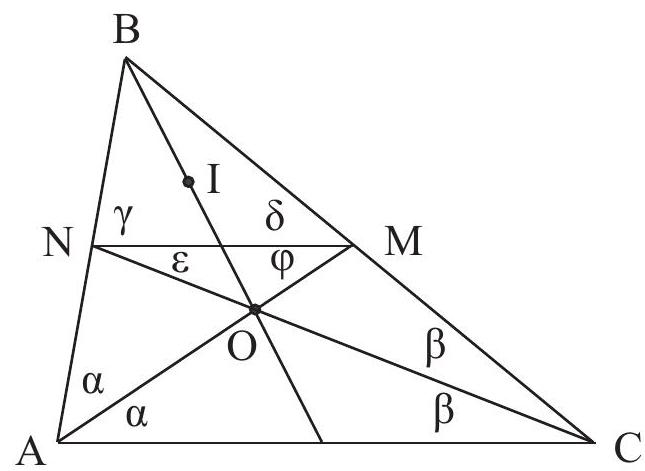
Solution: Let $O$ and $I$ be the incentres of $A B C$ and $N B M$, respectively; denote angles as in the figure. We get
$$
\alpha+\beta=\varepsilon+\varphi, \quad \gamma+\delta=2 \alpha+2 \beta, \quad \gamma=k \cdot \varepsilon, \quad \delta=k \cdot \varphi
$$
From here we get $k=2$. Therefore $\triangle N I M=\triangle N O M$, so $I O \perp N M$. In the triangle $N B M$ the bisector coincides with the altitude, so $B N=B M$. So we get
$$
\frac{A B \cdot B C}{A C+B C}=\frac{B C \cdot A B}{A B+A C}
$$
and $A B=B C$.
|