

File size: 50,835 Bytes
4f3431c | 1 2 3 4 5 6 7 8 9 10 11 12 13 14 15 16 17 18 19 20 21 22 23 24 25 26 27 28 29 30 31 32 33 34 35 36 37 38 39 40 41 42 43 44 45 46 47 48 49 50 51 52 53 54 55 56 57 58 59 60 61 62 63 64 65 66 67 68 69 70 71 72 73 74 75 76 77 78 79 80 81 82 83 84 85 86 87 88 89 90 91 92 93 94 95 96 97 98 99 100 101 102 103 104 105 106 107 108 109 110 111 112 113 114 115 116 117 118 119 120 121 122 123 124 125 126 127 128 129 130 131 132 133 134 135 136 137 138 139 140 141 142 143 144 145 146 147 148 149 150 151 152 153 154 155 156 157 158 159 160 161 162 163 164 165 166 167 168 169 170 171 172 173 174 175 176 177 178 179 180 181 182 183 184 185 186 187 188 189 190 191 192 193 194 195 196 197 198 199 200 201 202 203 204 205 206 207 208 209 210 211 212 213 214 215 216 217 218 219 220 221 222 223 224 225 226 227 228 229 230 231 232 233 234 235 236 237 238 239 240 241 242 243 244 245 246 247 248 249 250 251 252 253 254 255 256 257 258 259 260 261 262 263 264 265 266 267 268 269 270 271 272 273 274 275 276 277 278 279 280 281 282 283 284 285 286 287 288 289 290 291 292 293 294 295 296 297 298 299 300 301 302 303 304 305 306 307 308 309 310 311 312 313 314 315 316 317 318 319 320 321 322 323 324 325 326 327 328 329 330 331 332 333 334 335 336 337 338 339 340 341 342 343 344 345 346 347 348 349 350 351 352 353 354 355 356 357 358 359 360 361 362 363 364 365 366 367 368 369 370 371 372 373 374 375 376 377 378 379 380 381 382 383 384 385 386 387 388 389 390 391 392 393 394 395 396 397 398 399 400 401 402 403 404 405 406 407 408 409 410 411 412 413 414 415 416 417 418 419 420 421 422 423 424 425 426 427 428 429 430 431 432 433 434 435 436 437 438 439 440 441 442 443 444 445 446 447 448 449 450 451 452 453 454 455 456 457 458 459 460 461 462 463 464 465 466 467 468 469 470 471 472 473 474 475 476 477 478 479 480 481 482 483 484 485 486 487 488 489 490 491 492 493 494 495 496 497 498 499 500 501 502 503 504 505 506 507 508 509 510 511 512 513 514 515 516 517 518 519 520 521 522 523 524 525 526 527 528 529 530 531 532 533 534 535 536 537 538 539 540 541 542 543 544 545 546 547 548 549 550 551 552 553 554 555 556 557 558 559 560 561 562 563 564 565 566 567 568 569 570 571 572 573 574 575 576 577 578 579 580 581 582 583 584 585 586 587 588 589 590 591 592 593 594 595 596 597 598 599 600 601 602 603 604 605 606 607 608 609 610 611 612 613 614 615 616 617 618 619 620 621 622 623 624 625 626 627 628 629 630 631 632 633 634 635 636 637 638 639 640 641 642 643 644 645 646 647 648 649 650 651 652 653 654 655 656 657 658 659 660 661 662 663 664 665 666 667 668 669 670 671 672 673 674 675 676 677 678 679 680 681 682 683 684 685 686 687 688 689 690 691 692 693 694 695 696 697 698 699 700 701 702 703 704 705 706 707 708 709 710 711 712 713 714 715 716 717 718 719 720 721 722 723 724 725 726 727 728 729 730 731 732 733 734 735 736 737 738 739 740 741 742 743 744 745 746 747 748 749 750 751 752 753 754 755 756 757 758 759 760 761 762 763 764 765 766 767 768 769 770 771 772 773 774 775 776 777 778 779 780 781 782 783 784 785 786 787 788 789 790 791 792 793 794 795 796 797 798 799 800 801 802 803 804 805 806 | # Baltic Way
Problem 1. Let $n$ be a positive integer. Find all functions $f: \mathbb{R} \rightarrow \mathbb{R}$ that satisfy the equation
$$
(f(x))^{n} f(x+y)=(f(x))^{n+1}+x^{n} f(y)
$$
for all $x, y \in \mathbb{R}$.
Solution. The functions we are looking for are $f: \mathbb{R} \rightarrow \mathbb{R}, f(x)=0$ and $f: \mathbb{R} \rightarrow \mathbb{R}, f(x)=x$. For $n$ even $f: \mathbb{R} \rightarrow \mathbb{R}, f(x)=-x$ is also a solution.
Throughout the solution, $P\left(x_{0}, y_{0}\right)$ will denote the substitution of $x_{0}$ and $y_{0}$ for $x$ and $y$, respectively, in the given equation.
$P(x, 0)$ for $x \neq 0$ gives
$$
f(x)^{n+1}=f(x)^{n+1}+x^{n} f(0)
$$
and therefore
$$
f(0)=\frac{f(x)^{n+1}-f(x)^{n+1}}{x^{n}}=0 .
$$
$P(x,-x)$ for $x \neq 0$ gives
$$
0=f(x)^{n} f(0)=f(x)^{n+1}+x^{n} f(-x)
$$
and therefore
$$
f(-x)=-\frac{f(x)^{n+1}}{x^{n}}
$$
Applying this identity twice, we get
$$
f(x)=f(-(-x))=-\frac{f(-x)^{n+1}}{(-x)^{n}}=-\frac{\left(-\frac{f(x)^{n+1}}{x^{n}}\right)^{n+1}}{(-x)^{n}}=\frac{f(x)^{n^{2}+2 n+1}}{x^{n^{2}+2 n}}
$$
which after rearranging yields
$$
f(x)\left(x^{n^{2}+2 n}-f(x)^{n^{2}+2 n}\right)=0 .
$$
If there exists an $a \neq 0$ for which $f(a)=0$, then $P(a, y)$ yields
$$
0=a^{n} f(y)
$$
which means that $f(y)=0$ for all $y \in \mathbb{R}$. This is a solution to the equation for all $n$.
If instead $f(x) \neq 0$ for all $x \neq 0$, then we have
$$
x^{n^{2}+2 n}=f(x)^{n^{2}+2 n} .
$$
If $n$ is odd, then so is $n(n+2)=\left(n^{2}+2 n\right)$, meaning $f(x)=x$ for all $x \in \mathbb{R}$. This is a solution to the equation.
## Baltic Way
If $n$ is even, then so is $n(n+2)=\left(n^{2}+2 n\right)$, meaning $f(x)= \pm x$ for all $x \in \mathbb{R}$. Both $f(x)=x$ and $f(x)=-x$ are solutions to the equation. In all other cases there must exist $x, y \neq 0$ such that $f(x)=x$ and $f(y)=-y$. Then $P(x, y)$ yields
$$
x^{n} f(x+y)=x^{n+1}-x^{n} y
$$
which after dividing by $x^{n} \neq 0$ yields
$$
f(x+y)=x-y .
$$
Since $(f(x))^{2}=x^{2}$ for all $x \in \mathbb{R}$, we have $(x+y)^{2}=(x-y)^{2}$. That is $4 x y=0$ which is impossible as $x, y \neq 0$.
There are therefore no more solutions to the equation.
Problem 2. Let $a, b, c$ be the side lengths of a triangle. Prove that
$$
\sqrt[3]{\left(a^{2}+b c\right)\left(b^{2}+c a\right)\left(c^{2}+a b\right)}>\frac{a^{2}+b^{2}+c^{2}}{2} .
$$
Solution. We claim that
$$
a^{2}+b c>\frac{a^{2}+b^{2}+c^{2}}{2}
$$
which will finish the proof. Note that the claimed inequality is equivalent to
$$
\begin{aligned}
a^{2}+b c>\frac{a^{2}+b^{2}+c^{2}}{2} & \Longleftrightarrow 2 a^{2}+2 b c>a^{2}+b^{2}+c^{2} \\
& \Longleftrightarrow a^{2}>(b-c)^{2} \Longleftrightarrow a>|b-c|,
\end{aligned}
$$
which holds due to the assumption of $a, b, c$ being side lengths of a triangle.
Problem 3. Determine all infinite sequences $\left(a_{1}, a_{2}, \ldots\right)$ of positive integers satisfying
$$
a_{n+1}^{2}=1+(n+2021) a_{n}
$$
for all $n \geq 1$.

BALTIC WAY
REYKJAVÍK$\cdot$ 2021
## Baltic Way
Reykjavík, November 11th - 15th
Solutions
Solution. Clearly $\left(a_{n}\right)_{n=1}^{\infty}=(n+2019)_{n=1}^{\infty}$ is a solution. We claim that it is the only one. Assume $\left(a_{n}\right)_{n=1}^{\infty}$ is a solution. Let $\left(b_{n}\right)_{n=1}^{\infty}=\left(a_{n}-n\right)_{n=1}^{\infty}$. We claim:
1) If $b_{n}<2019$, then $2019>b_{n+1}>b_{n}$.
2) If $b_{n}>2019$, then $2019<b_{n+1}<b_{n}$.
It is clear that these claims imply that $b_{n}=2019$ for all $n$.
Let us prove the claims:
1) Clearly $a_{n}<n+2019$ implies that $a_{n+1}<(n+1)+2019$ which already proves one part of the inequality. Suppose that $b_{n+1} \leq b_{n}$. Then
$$
\left(n+1+b_{n}\right)^{2} \geq a_{n+1}^{2}=1+(n+2021)\left(n+b_{n}\right) .
$$
Expanding gives
$$
\left(n+b_{n}\right)\left(b_{n}-2019\right) \geq 0
$$
which shows that $b_{n} \geq 2019$ contradicting our assumption.
2) It follows in exactly the same way, by just reversing all the inequality signs.
Problem 4. Let $\Gamma$ be a circle in the plane and $S$ be a point on $\Gamma$. Mario and Luigi drive around the circle $\Gamma$ with their go-karts. They both start at $S$ at the same time. They both drive for exactly 6 minutes at constant speed counterclockwise around the track. During these 6 minutes, Luigi makes exactly one lap around $\Gamma$ while Mario, who is three times as fast, makes three laps.
While Mario and Luigi drive their go-karts, Princess Daisy positions herself such that she is always exactly in the middle of the chord between them. When she reaches a point she has already visited, she marks it with a banana.
How many points in the plane, apart from $S$, are marked with a banana by the end of the race?
Solution 1. Without loss of generality, we assume that $\Gamma$ is the unit circle and $S=(1,0)$. Three points are marked with bananas:
(i) After 45 seconds, Luigi has passed through an arc with a subtended angle of $45^{\circ}$ and is at the point $\left(\sqrt{2} / 2, \sqrt{2} / 2\right.$ ), whereas Mario has passed through an arc with a subtended angle of $135^{\circ}$ and is at the point $(-\sqrt{2} / 2, \sqrt{2} / 2)$. Therefore Daisy is at the point $(0, \sqrt{2} / 2)$ after 45 seconds. After 135 seconds, Mario and Luigi's positions are exactly the other way round, so the princess is again at the point $(0, \sqrt{2} / 2)$ and puts a banana there.
## Baltic Way
Reykjavík, November 11th - 15th
Solutions
(ii) Similarly, after 225 seconds and after 315 seconds, Princess Daisy is at the point $(0,-\sqrt{2} / 2)$ and puts a banana there.
(iii) After 90 seconds, Luigi is at $(0,1)$ and Mario at $(0,-1)$, so that Daisy is at the origin of the plane. After 270 seconds, Mario and Luigi's positions are exactly the other way round, hence Princess Daisy drops a banana at the point $(0,0)$.
We claim that no other point in the plane, apart from these three points and $S$, is marked with a banana. Let $t_{1}$ and $t_{2}$ be two different times when Daisy is at the same place. For $n \in\{1,2\}$ we write Luigis position at time $t_{n}$ as a complex number $z_{n}=\exp \left(i x_{n}\right)$ with $\left.x_{n} \in\right] 0,2 \pi[$. At this time, Mario is located at $z_{i}^{3}$ and Daisy at $\left(z_{i}^{3}+z_{i}\right) / 2$. According to our assumption we have $\left(z_{1}^{3}+z_{1}\right) / 2=\left(z_{2}^{3}+z_{2}\right) / 2$ or, equivalently, $\left(z_{1}-z_{2}\right)\left(z_{1}^{2}+z_{1} z_{2}+z_{2}^{2}+1\right)=0$. We have $z_{1} \neq z_{2}$, so that we must have $z_{1}^{2}+z_{1} z_{2}+z_{2}^{2}=-1$.
We proceed with an observation of the structure of $\Gamma$ as a set of complex numbers. Suppose that $z \in \Gamma \backslash\{S\}$. Then $z+1+z^{-1} \in \Gamma$ if and only if $z \in\{i,-1,-i\}$. For a proof of the observation note that $z+1+z^{-1}=z+1+\bar{z}$ is a real number for every $z \in \mathbb{C}$ with norm $|z|=1$. So it lies on the unit circle if and only if it is equal to 1 , in which case the real part of $z$ is equal to 0 , or it is equal to -1 , in which case the real part of $z$ is equal to -1 . We apply the observation to the number $z=z_{1} / z_{2}$, which satisfies the premise since $z+1+\bar{z}=-\overline{z_{1}} \cdot \overline{z_{2}} \in \Gamma$. Therefore, one of the following cases must occur.
(i) We have $z= \pm i$, that is, $z_{1}= \pm i z_{2}$. Without loss of generality we may assume $z_{2}=i z_{1}$. It follows that $-1=z_{1}^{2}+z_{1} z_{2}+z_{2}^{2}=i z_{1}^{2}$, so that $z_{1}=\exp (i \pi / 4)$ or $z_{1}=\exp (5 i \pi / 4)$. In the former case $\left(z_{1}, z_{2}\right)=(\exp (i \pi / 4), \exp (3 i \pi / 4))$, which matches case (1) above. In the latter case $\left(z_{1}, z_{2}\right)=(\exp (5 i \pi / 4), \exp (7 i \pi / 4))$, which matches case (2) above.
(ii) We have $z=-1$, that is, $z_{2}=-z_{1}$. It follows that $-1=z_{1}^{2}+z_{1} z_{2}+z_{2}^{2}=z_{1}^{2}$, so that $z_{1}=i$ or $z_{1}=-i$. This matches case (3) above.
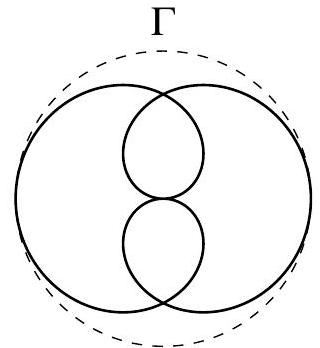
Depiction of the path Daisy takes
## Baltic Way
Reykjavík, November 11th - 15th
Solutions
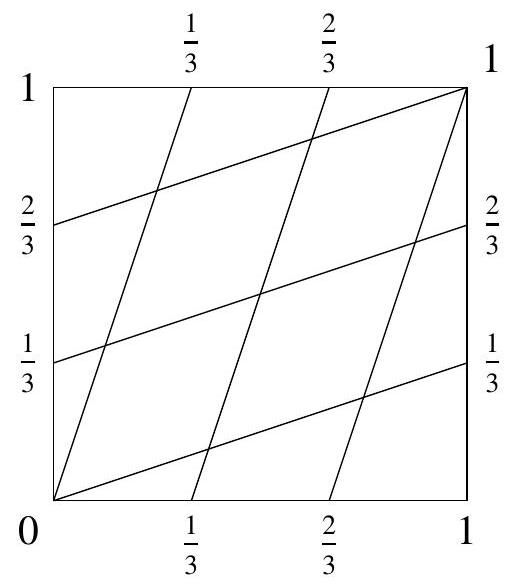
Solution 2. We represent the position of Luigi and Mario by $(t, 3 t)(\bmod 1)$, so when Luigi is at angle $t \cdot 2 \pi$, Mario is at angle $3 t \cdot 2 \pi$.
A chord (if it is not the diameter is determined by its midpoint. Therefore Daisy revisit a location only if
$$
(x, 3 x) \equiv(3 y, y) \quad(\bmod 1)
$$
for different value of $x, y(\bmod 1)$. By inspection, the three locations are visited twice.
Problem 5. Let $x, y \in \mathbb{R}$ be such that $x=y(3-y)^{2}$ and $y=x(3-x)^{2}$. Find all possible values of $x+y$.
Solution 1. The set $\{0,3,4,5,8\}$ contains all possible values for $x+y$.
A pair $(x, x) \in \mathbb{R}^{2}$ satisfies the equations if and only if $x=x(3-x)^{2}$, and it is easy to see that this cubic equation has the solution set $\{0,2,4\}$. These pairs give us 0,4 and 8 as possible values for $x+y$.
Assuming $x \neq y$ let $s$ be the sum $x+y$ and $p$ be the product $x y$. Subtracting the first equation from the second and cancelling out the term $x-y$ we get
$$
p=s^{2}-6 s+10 \text {. }
$$
Adding the two equations gives
$$
0=s\left(s^{2}-3 p\right)-6\left(s^{2}-2 p\right)+8 s .
$$
Together the equations give
$$
0=s^{3}-12 s^{2}+47 s-60=(s-3)(s-4)(s-5) \text {. }
$$
## Baltic Way
Reykjavík, November 11th - 15th
Solutions
The only possible values for $x+y$ when $x \neq y$ are therefore 3,4 and 5 . We have already seen that $x+y=4$ has a solution $x=y=2$.
Next we investigate the case $x+y=3$. Here we can simplify the given equations as $x=y x^{2}$ and $y=x y^{2}$. The number $x$ cannot be zero in this case, since otherwise $y$ and $k$ would also be zero. We can conclude that $x y=1$. The equations $x+y=3$ and $x y=1$, according to Vieta's Theorem, imply that $x$ and $y$ are the solutions of the equation $\lambda^{2}-3 \lambda+1=0$. Hence
$$
(x, y)=\left(\frac{3+\sqrt{5}}{2}, \frac{3-\sqrt{5}}{2}\right) \quad \text { or } \quad(x, y)=\left(\frac{3-\sqrt{5}}{2}, \frac{3+\sqrt{5}}{2}\right)
$$
and it is easy to verify that both pairs satisfy the equations. These pairs give us 3 as a possible value for $x+y$.
A simple calculation shows that if a pair $(x, y) \in \mathbb{R}^{2}$ satisfy the equations, then the pair (4-x,4-y) is solution to the equations. From the pairs we have just found, we can therefore construct pairs of solutions
$$
(x, y)=\left(\frac{5-\sqrt{5}}{2}, \frac{5+\sqrt{5}}{2}\right) \text { and }(x, y)=\left(\frac{5+\sqrt{5}}{2}, \frac{5-\sqrt{5}}{2}\right),
$$
which give us 5 as a possible value for $x+y$.
Solution 2. Let $f(x)=x(3-x)^{2}$. It is easy to check that if $x<0$ then $f(x)<x$. In particular $f(f(x))<f(x)<x$ in this case, so that the pair $(x, f(x))$ cannot be a solution. Similarly, $f(x)>x$ if $x>4$, so the pair $(x, f(x))$ cannot be a solution in this case either.
Suppose that $(x, y) \in \mathbb{R}^{2}$ is a solution. According to the previous remark $x \in[0,4]$, and similarly, $y \in[0,4]$. Hence we may write $x=2+2 r$ and $y=2+2 s$ with $r, s \in[-1,1]$. After substitution and simplification, the equation $x=y(3-y)^{2}$ transforms into the equation $r=4 s^{3}-3 s$. Recall the trigonometric identities for threefold angles. If $s=\cos (\alpha)$ for some $\alpha \in \mathbb{R}$, then $r=4 \cos ^{3}(\alpha)-$ $3 \cos (\alpha)=\cos (3 \alpha)$. In the same way $s=4 r^{3}-3 r=\cos (9 \alpha)$.
We can deduce that $9 \alpha=2 \pi m+\alpha$ or $9 \alpha=2 \pi l-\alpha$ for some integers $m$ and $l$. In the former case we have $8 \alpha=2 \pi m$, so that $m \in\{0,1,2,3,4\}$, and the corresponding possible pairs of solutions can be found in Figure 1. In the former case we have $10 \alpha=2 \pi l$, so that $l \in\{0,1,2,3,4,5\}$, where $l=0$ and $l=5$ result in angles that we have already considered in the first case. We consider the other options in Figure 2 taking into account the well-known identities $\cos (\pi / 5)=(1+\sqrt{5}) / 4$ and $\cos (3 \pi / 5)=(1-\sqrt{5}) / 4$.
## Baltic Way
Reykjavík, November 11th - 15th
Solutions
| $m$ | $8 \alpha$ | $\alpha$ | $r$ | $s$ | $x$ | $y$ | $x+y$ |
| :---: | :---: | :---: | :---: | :---: | :---: | :---: | :---: |
| 0 | 0 | 0 | 1 | 1 | 4 | 4 | 8 |
| 1 | $2 \pi$ | $\pi / 4$ | $\sqrt{2} / 2$ | $-\sqrt{2} / 2$ | $2+\sqrt{2}$ | $2-\sqrt{2}$ | 4 |
| 2 | $4 \pi$ | $\pi / 2$ | 0 | 0 | 2 | 2 | 4 |
| 3 | $6 \pi$ | $3 \pi / 4$ | $-\sqrt{2} / 2$ | $\sqrt{2} / 2$ | $2-\sqrt{2}$ | $2+\sqrt{2}$ | 4 |
| 4 | $8 \pi$ | $\pi$ | -1 | -1 | 0 | 0 | 0 |
Figure 1: Pairs of solutions and their sums
| $l$ | $10 \alpha$ | $\alpha$ | $r$ | $s$ | $x$ | $y$ | $x+y$ |
| :---: | :---: | :---: | :---: | :---: | :---: | :---: | :---: |
| 1 | $2 \pi$ | $\pi / 5$ | $(1+\sqrt{5}) / 4$ | $(1-\sqrt{5}) / 4$ | $(5+\sqrt{5}) / 2$ | $(5-\sqrt{5}) / 2$ | 5 |
| 2 | $4 \pi$ | $2 \pi / 5$ | $(-1+\sqrt{5}) / 4$ | $(-1-\sqrt{5}) / 4$ | $(3+\sqrt{5}) / 2$ | $(3-\sqrt{5}) / 2$ | 3 |
| 3 | $6 \pi$ | $3 \pi / 5$ | $(1-\sqrt{5}) / 4$ | $(1+\sqrt{5}) / 4$ | $(5-\sqrt{5}) / 2$ | $(5+\sqrt{5}) / 2$ | 5 |
| 4 | $8 \pi$ | $4 \pi / 5$ | $(-1-\sqrt{5}) / 4$ | $(-1+\sqrt{5}) / 4$ | $(3-\sqrt{5}) / 2$ | $(3+\sqrt{5}) / 2$ | 3 |
Figure 2: Pairs of solutions and their sums
Problem 6. Let $n$ be a positive integer and $t$ be a non-zero real number. Let $a_{1}, a_{2}, \ldots, a_{2 n-1}$ be real numbers (not necessarily distinct). Prove that there exist distinct indices $i_{1}, i_{2}, \ldots, i_{n}$ such that, for all $1 \leq k, l \leq n$, we have $a_{i_{k}}-a_{i_{l}} \neq t$.
Solution. Let $G=(V, E)$ be a graph with vertex set $V=\{1,2, \ldots, 2 n-1\}$ and edge set $E=$ $\left\{\{i, j\}:\left|a_{i}-a_{j}\right|=t\right\}$.
Note that $G$ has no odd cycles. Indeed, if $j_{1}, \ldots, j_{2 k+1}$ is a cycle, then for all $\ell=1,3,5, \ldots, 2 k-1$ the number $a_{j_{\ell}}$ differs from $a_{j_{\ell+2}}$ by $2 t$ or 0 . Hence $a_{j_{1}}$ differs from $a_{j_{2 k+1}}$ by an even multiple of $t$. Therefore there is no edge between $j_{1}$ and $j_{2 k+1}$ contradicting the assumption that $j_{1}, \ldots, j_{2 k+1}$ is a cycle.
Since $G$ has no odd cycles, it is bipartite. Therefore $V$ can be split into two disjoint sets $V_{1}, V_{2}$ such that there is no edge between any two vertices of $V_{1}$ and there are no edges between any two vertices in $V_{2}$. Since $V$ has $2 n-1$ elements, one of the sets $V_{1}, V_{2}$ has at least $n$ elements. Without loss of generality assume that $V_{1}$ has at least $n$ elements. Then for $k=1,2, \ldots, n$ simply define $i_{k}$ to be the $k$-th least element of $V_{1}$.
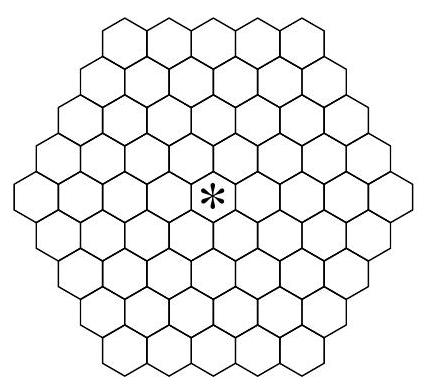
Problem 7. Let $n>2$ be an integer. Anna, Edda and Magni play a game on a hexagonal board tiled with regular hexagons, with $n$ tiles on each side. The figure shows a board with 5 tiles on each side. The central tile is marked.
## Baltic Way
Reykjavík, November 11th - 15th
Solutions
The game begins with a stone on a tile in one corner of the board. Edda and Magni are on the same team, playing against Anna, and they win if the stone is on the central tile at the end of any player's turn. Anna, Edda and Magni take turns moving the stone: Anna begins, then Edda and then Magni, and so on.
The rules for each player's turn are:
- Anna has to move the stone to an adjacent tile, in any direction.
- Edda has to move the stone straight by two tiles in any of the 6 possible directions.
- Magni has a choice of passing his turn, or moving the stone straight by three tiles in any of the 6 possible directions.
Find all $n$ for which Edda and Magni have a winning strategy.
Solution. We colour the board in three colours in such a way that no neighbouring tiles are of the same colour. We can give each hexagon a coordinate using $\overrightarrow{e_{1}}=(1,0)$ and $\overrightarrow{e_{2}}=\left(\cos \left(120^{\circ}, \sin \left(120^{\circ}\right)\right)=\right.$ $\left(\frac{-1}{2}, \frac{\sqrt{3}}{2}\right)$ as basis. Let the central tile be the origin. Then each hexagon has center at $a \cdot \overrightarrow{e_{1}}+b \cdot \overrightarrow{e_{2}},(a, b) \in$ $\mathbb{Z}^{2}$. The tuple $(a, b)$ is the coordinate for a given hexagon its neighbours are $(a+1, b),(a+1, b+1)$, $(a, b+1),(a-1, b),(a-1, b-1)$ and $(a, b-1)$. We colour the hexagon with coordinates $(a, b)$ with colour number $(a+b)(\bmod 3)$. It is clear that neighbouring hexagons do not share a colour. (In fact this is the only three colouring of a hexagonal tiling). See figure 3 .
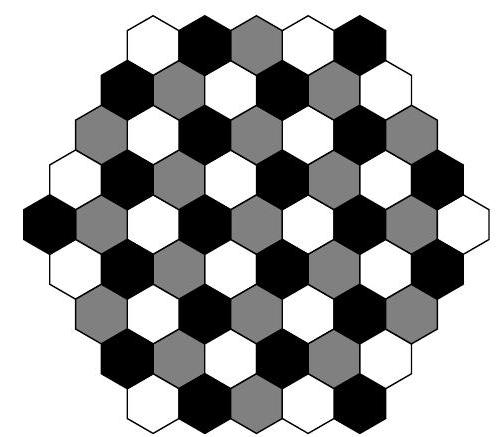
Figure 3: Three colouring of the hexagonal tiling for 5 hexagons on each side
We see that if $n \equiv 1(\bmod 3)$, the stone begins in a tile in the same colour as the central tile, let that colour be grey. By regarding a few cases, we see that whatever Anna does, Edda and Magni can end

BALTIC WAY
REYKJAVÍK$\cdot$ 2021
## Baltic Way
Reykjavík, November 11th - 15th
Solutions
their turns by getting the stone to a prescribed grey tile of the closest grey tiles. Therefore they can get the stone to the central tile.
If $n \not \equiv 1(\bmod 3)$, the stone does not begin on the same grey colour as the central tile. Say the stone begins on a white tile, and say the third colour is black. Anna can always move the stone to a grey tile that is not on the same horizontal/diagonal line as the central tile. Then Anna moves the stone to a white or black tile. After Magni moves the stone is still again on a white/black tile. Anna can continue this indefinitely, with the stone never reaching the central tile.
Problem 8. We are given a collection of $2^{2^{k}}$ coins, where $k$ is a non-negative integer. Exactly one coin is fake. We have an unlimited number of service dogs. One dog is sick but we do not know which one. A test consists of three steps: select some coins from the collection of all coins; choose a service dog; the dog smells all of the selected coins at once. A healthy dog will bark if and only if the fake coin is amongst them. Whether the sick dog will bark or not is random.
Devise a strategy to find the fake coin, using at most $2^{k}+k+2$ tests, and prove that it works.
Solution. Number the coins by $2^{k}$-digit binary numbers from $\overbrace{00 \ldots 0}^{\text {length } 2^{k}}$ to $\overbrace{11 \ldots 1}^{\text {length } 2^{k}}$. Let $A_{i}$ be the set of coins which have 0 in $i$-th position of the binary number. The first $2^{k}$ tests we perform with the help of $2^{k}$ different dogs. In the $i$-th test we determine whether the set $A_{i}$ contains the fake coin. With out loss of generality we may assume that the dogs determined that all the digits in the number of the fake coin are 0 's. Due to the possible presence of the sick dog in these tests, it means in fact that the binary number of the fake coin contains at most one 1 .
$$
\text { length } 2^{k}
$$
In the next test we let a new dog determine whether the coin $00 \ldots 0$ is genuine. If the new dog barks then the coin is really fake, for otherwise two dogs had given us a false answer. If the new dog does not bark we find a dog we have not used before to test the suspected coin.
(i) If the last two dogs disagree one of them must be sick and hence the first $k$ dogs must be healthy. length $2^{k}$
In this case the coin $\overbrace{00 \ldots 0}$ is the fake one.
(ii) If the last two dogs agree (by not barking) it follows that both of them are healthy. The reason is that if one of the last two dogs was sick and did not bark, it would mean that the first $k$ dogs were length $2^{k}$
healthy, implying that the coin $00 \ldots 0$ is fake, but then the other of the last two dogs is healthy and did not bark at the fake coin, a contradiction.

## Baltic Way
Reykjavík, November 11th - 15th
Solutions
Therefore one of the first $2^{k}$ dogs gave a wrong verdict. In this case we have $2^{k}$ possible candidates for the fake coin. We can find the fake coin using the last dog and $k$ tests using binary search.
It follows that no more than $2^{k}+k+2$ tests are needed.
Problem 9. We are given 2021 points on a plane, no three of which are collinear. Among any 5 of these points, at least 4 lie on the same circle. Is it necessarily true that at least 2020 of the points lie on the same circle?
Solution. The answer is positive.
Let us first prove a lemma that if 4 points $A, B, C, D$ all lie on circle $\Gamma$ and some two points $X, Y$ do not lie on $\Gamma$, then these 6 points are pairs of intersections of three circles, circle $\Gamma$ and two other circles. Indeed, according to the problem statement there are 4 points among $A, B, C, X, Y$ which are concyclic. These 4 points must include points $X$ and $Y$ because if one of them is not, then the other one must lie on $\Gamma$. Without loss of generality, take $A, B, X, Y$ to lie on the same circle. Similarly for points $A, C, D, X, Y$ there must be 4 points which are concyclic. Analogously, they must include points $X$ and $Y$. Point $A$ cannot be one of them because two circles cannot have more than two common points. Therefore, points $C, D, X, Y$ are concyclic which proves the lemma.
Let us first solve the problem for the case for which there exist 5 points which lie on one circle $\Gamma$. Label these points $A, B, C, D, E$. Let us assume that there exists two points which do not lie on $\Gamma$, label them $X$ and $Y$. According to the previously proven lemma, points $A, B, C, D, X, Y$ must be the pairwise intersections of 3 circles. Without loss of generality, let the intersections of $\Gamma$ with one of the other circles be $A$ and $B$ and with the other circle $C$ and $D$. Similarly, $A, B, C, E, X, Y$ must be the pairwise intersections of three circles one of which is $\Gamma$. This is not possible as none of the points $A, B, C$ lies on the circumcircle of triangle $E X Y$. This contradiction shows that at most 1 point can lie outside circle $\Gamma$, i.e. at least 2020 points lie on circle $\Gamma$.
It remains to look at the case for which no 5 points lie on the same circle. Let $A, B, C, D, E$ be arbitrary 5 points. Without loss of generality, let $A, B, C, D$ be concyclic and $E$ a point not on this circle. According to the lemma, for every other point $F$ and points $A, B, C, D, E$, the 6 points are the intersections of circle $\Gamma$ and some two other circles. But in total, there are 3 such points because one of the two circles must go through $E$ and some 2 points out of $A, B, C, D$, while the other circle must go through point $E$ and the other two points out of $A, B, C, D$. There are only three partitions of $A, B, C, D$ into two sets. There is a contradiction, as there are $2021>5+3$ points in total.
Problem 10. John has a string of paper where $n$ real numbers $a_{i} \in[0,1]$, for all $i \in\{1, \ldots, n\}$, are written in a row. Show that for any given $k<n$, he can cut the string of paper into $k$ non-empty pieces, between adjacent numbers, in such a way that the sum of the numbers on each piece does not differ from any other sum by more than 1 .
## Baltic Way
Reykjavík, November 11th - 15th
Solutions
Solution 1. Denote the sums on each piece by
$$
\begin{aligned}
& S_{1}=a_{1}+a_{2}+\ldots+a_{m_{1}}, \\
& S_{2}=a_{m_{1}+1}+a_{m_{1}+2}+\ldots+a_{m_{2}}, \\
& \quad \ldots \\
& S_{k}=a_{m_{k-1}+1}+\ldots+a_{m_{k}} .
\end{aligned}
$$
By abuse of notation $S_{i}$ will both denote the set of numbers enclosed by cuts and its sum, the meaning of which must be determined by the context.
We will start the following algorithm. During this algorithm we will move some elements to the neighbouring piece and construct new sequence of pieces $S^{\star}=\left(S_{1}^{\star}, S_{2}^{\star}, \ldots, S_{k}^{\star}\right)$. Empty pieces may appear, but we will consider that case in the end.
(1) Find $p \leq k$ such that $S_{p}$ is the piece with the maximum sum of elements.
(2) If $S_{p} \leq \min \left(S_{1}, \ldots, S_{k}\right)+1$ we are done.
(3) If $S_{p}>\min \left(S_{1}, \ldots, S_{k}\right)+1$, let $S_{q}$ be the pieces with minimum sum of elements nearest to $S_{p}$ (ties broken arbitrarily) and let $S_{h}$ be the next pieces to $S_{q}$ between $S_{p}$ and $S_{q}$ (it is non empty by the choice of $S_{q}$ ). Then either $p<q$ and then $h=q-1$ and we define $S^{\star}$ by moving the last element from $S_{h}=S_{q-1}$ to $S_{q}$, or $q<p$, and then $h=q+1$ and $S^{\star}$ is obtained by moving the first element of $S_{h}=S_{q+1}$ to $S_{q}$. If $p=h$ then set $S=S^{\star}$ and go to step (1). If $p \neq h$ then set $S=S^{\star}$ and proceed to step (2).
Note that in step (3) each number $S_{i}^{\star}$ is at most $S_{p}$ and no new piece with sum $S_{p}$ is created. Indeed, $S_{h}^{\star}<S_{h} \leq S_{p}$, and for some $j$ we have $S_{q}^{\star}=S_{q}+a_{j}<S_{p}$ since $a_{j} \in[0,1]$ and $S_{p}>$ $\min \left(S_{1}, \ldots, S_{k}\right)+1$. It is clear also that $\max \left(S_{1}, \ldots, S_{k}\right)$ does not increase during the algorithm.
Note also that in step (3) the pieces $S_{h}$ may become empty. Then, in the next iteration of the algorithm, $q=h$ will be chosen since $\min \left(S_{1}, \ldots, S_{k}\right)=S_{h}=0$ and in step (3) $S_{h}^{\star}$ will become non empty (but one of its neighbours may become empty, etc.).
Claim: In the algorithm above, Step (3) is repeated at most $k n$ times with $S_{p}$ being the same maximal pieces in $S^{\star}$ and in $S$.
Proof. Let $s_{i}$ be the number of elements in $i$-th pieces. Then the number
$$
\sum_{i=1}^{k}|i-p| s_{i}
$$
takes positive integral values and is always less than $k n$. It is clear that this number decreases during the algorithm.
## Baltic Way
Thus after at most $k n$ iteration of (3), the algorithm decreases the value of $S_{p}$ and so goes to (1). Consequently it decreases either the number of pieces with maximal sums or $\max \left(S_{1}, \ldots, S_{k}\right)$. As there are only finitely many ways to split the sum onto pieces, the algorithm eventually terminates at (2).
When the algorithm teminates, we are left with a sequence $S=\left(S_{1}, S_{2}, \ldots, S_{k}\right)$ where the piece $S_{p}$ with maximum sum is such that $S_{p} \leq \min \left(S_{1}, \ldots, S_{k}\right)+1$. If there is an empty piece $S_{h}$ in the sequence, then the sum of any piece is in $[0,1]$. We can for any empty piece create a cut in any place between numbers where there was not previously a cut, and discard the empty pieces. This is possible since the cuts are $k \leq n-1$, and $n-1$ is the number of places in between numbers. This operation will only possibly decrease the maximum sum, and still all sums will be in $[0,1]$, so all conditions are satisfied.
Solution 2. This problem can be solved by finding a certain graph having a directed path of length $k$. For real $x$ let $\left(V_{x}, E_{x}\right)$ be a directed graph having vertices $V_{x}=\{0,1, \ldots, n\}$. If $i, j \in V_{x}$ we have a directed edge $(i, j) \in V_{x}$ iff $i \leq j$ and $\sum_{l=i+1}^{j} \in[x, x+1]$.
Suppose that for some $x \in \mathbb{R}$ there exist such a graph $\left(V_{x}, E_{x}\right)$ such that there exist a path of length $k$ from vertex 0 to vertex $n$. Let $0=v_{0}, v_{1}, \ldots, v_{k}=n$ be an path of length $k$. If we cut the paper string between numbers $v_{i}$ and $v_{i}+1$ for $i \in\{1, \ldots, k-1\}$ we have that the sum of the $i$-th part is $a_{v_{i-1}+1}+\ldots+a_{v_{i}} \in[x, x+1]$. In particular the sum of the number of each piece does not differ from the sum of any other piece by more than 1 .
It is therefore evident that the statement of the problem is equivalent to the existence of a real $x$ such that there exists a path of length $k$ form vertex 0 to vertex $n$ in graph $\left(E_{x}, V_{x}\right)$.
For a real $x$ let $s_{x}$ be the least vertex in $\left(V_{x}, E_{x}\right)$ such that there exists a path of length $k$ from 0 to $s_{x}$ and let $t_{x}$ be the greatest, provided that such a path exists. It is not difficult to prove (by induction on $k$ ) that for each vertex $v \in E_{x}$ such that $s_{x} \leq v \leq t_{x}$ there exists a path of length $k$ for 0 to $v$.
Start with $x=0$. As $x$ increases both $s_{x}$ and $t_{x}$ increase. As there are only finitely many different sums formed by taking a subset of the $a_{i}$-s it follows that the graph $\left(V_{x}, E_{x}\right)$ changes at discrete values of $x$. It is not hard to see that if the graph makes one change between reals $x_{1}<x_{2}$ and $s_{x_{1}}, s_{x_{2}}, t_{x_{1}}, t_{x_{2}}$ exist then $s_{x_{1}} \leq s_{x_{2}} \leq t_{x_{1}} \leq t_{x_{2}}$.
For $s=\sum_{i=1}^{n} a_{i}+1$ it is clear that there $\left(V_{s}, E_{s}\right)$ has no edges. It is not hard to see that as $x$ increases we will eventually find a value for $x$ such that $\left(V_{x}, E_{x}\right)$ has a path of length $k$ for 0 to $n$ as desired.
Problem 11. A point $P$ lies inside a triangle $A B C$. The points $K$ and $L$ are the projections of $P$ onto $A B$ and $A C$, respectively. The point $M$ lies on the line $B C$ so that $K M=L M$, and the point $P^{\prime}$ is symmetric to $P$ with respect to $M$. Prove that $\angle B A P=\angle P^{\prime} A C$.
## Baltic Way
Reykjavík, November 11th - 15th
Solutions
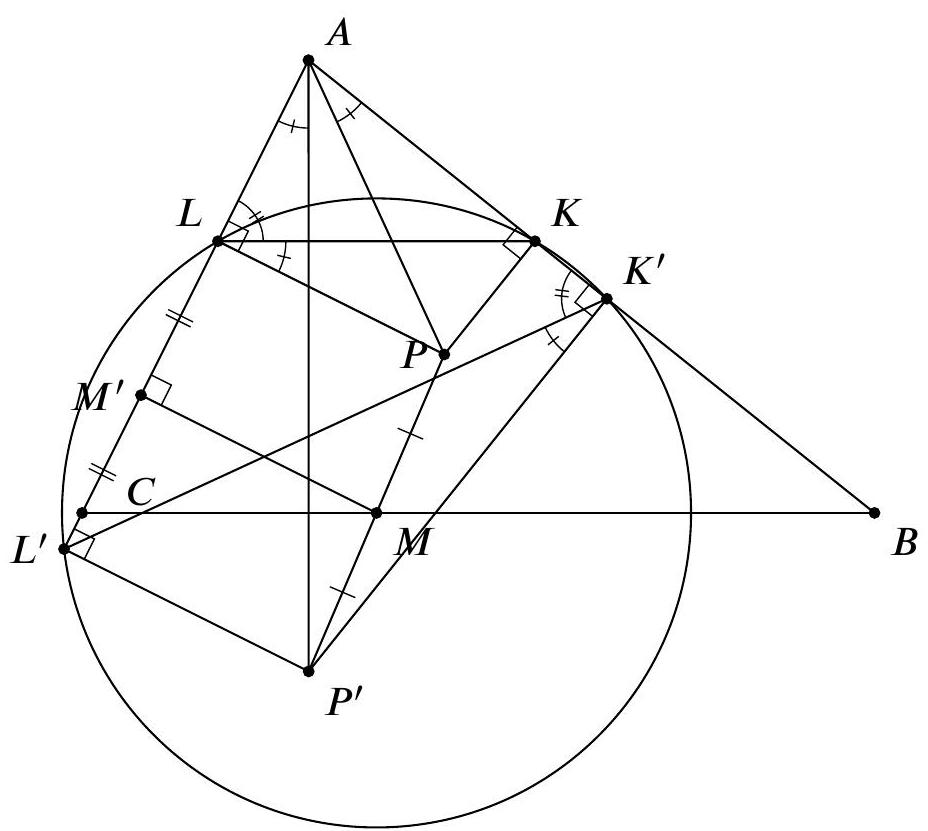
Figure 4
Solution. For points $X, Y, Z, X \neq Y$ and $Z \neq Y$ let rot $X Y Z$ denote the rotation that takes rotates line $X Y$ to line $Z Y$ modulo half turns. We consider two rotations equivalent one of them is a composition of some translation and the other rotation. It is clear that this is indeed an equivalence relation (as the Euclidean plane is Desarguean).
Let $K^{\prime}$ and $L^{\prime}$ be the projections of $P^{\prime}$ onto $A B$ and $A C$ respectively, as in figure 4 . Let $\ell$ be the perpendicular line to line $A B$ passing through $M$. From symmetries it follows that $L^{\prime}$ is the refection of $L$ over $\ell$. In particular segments $M L$ and $M L^{\prime}$ are congruent. Similarly segments $M K$ and $M K^{\prime}$ are congruent. It follows that $M$ is a center of circle passing through $L, K, L^{\prime}$ and $K^{\prime}$.
As line $P L$ is perpendicular to line $A C$ and line $P K$ is perpendicular to line $A B$ it follows that quadrilateral $A K P L$ is cyclic. Similarly quadrilateral $A K^{\prime} P L^{\prime}$ is also cyclic.
From the theorem on inscribed angles in cyclic quadrilaterals it follows that
$$
\begin{gathered}
\operatorname{rot} B A P \equiv \operatorname{rot} K A P \equiv \operatorname{rot} K L P, \\
\operatorname{rot} P^{\prime} A C \equiv \operatorname{rot} P^{\prime} A L \equiv \operatorname{rot} P^{\prime} K^{\prime} L \quad \text { and } \\
\operatorname{rot} K L L^{\prime} \equiv \operatorname{rot} K K^{\prime} L^{\prime}
\end{gathered}
$$
As $\angle P L L^{\prime}$ and $\angle K K^{\prime} P^{\prime}$ are right it follows that $\operatorname{rot} P L L^{\prime} \equiv \operatorname{rot} K K^{\prime} P^{\prime}$ modulo half turns. Now $\operatorname{rot} K L L^{\prime} \equiv \operatorname{rot} K L P+\operatorname{rot} P L L^{\prime} \quad$ and $\quad \operatorname{rot} K K^{\prime} L^{\prime} \equiv \operatorname{rot} P^{\prime} K^{\prime} L+\operatorname{rot} K K^{\prime} P$
## Baltic Way
Reykjavík, November 11th - 15th
Solutions
and $\operatorname{rot} K L L^{\prime} \equiv \operatorname{rot} K K^{\prime} L^{\prime}$ so we decuce that $\operatorname{rot} K L P \equiv \operatorname{rot} P^{\prime} K^{\prime} L$.
Putting everything together gives
$$
\operatorname{rot} B A P \equiv \operatorname{rot} P^{\prime} A L^{\prime}
$$
which gives the desired result.
Remark. This method can be applied to prove the existence of isogonal conjugates in triangles.
Problem 12. Let $I$ be the incentre of a triangle $A B C$. Let $F$ and $G$ be the projections of $A$ onto the lines $B I$ and $C I$, respectively. Rays $A F$ and $A G$ intersect the circumcircles of the triangles $C F I$ and $B G I$ for the second time at points $K$ and $L$, respectively. Prove that the line $A I$ bisects the segment $K L$.
Solution. Since $\angle I F K=90^{\circ}$, then $I K$ is the diameter of the circumcircle of $C F I$, hence also $\angle I C K=90^{\circ}$. Similarly is $I L$ the diameter of the circumcircle of $B G I$ and $\angle I B L=90^{\circ}$. Therefore are the lines $C K$ and $G L$ parallel, also $B L$ and $F K$ are parallel.
Let the lines $C K$ and $B L$ intersect at $D$, as seen in figure 5. From the above we get that $D K A L$ is a parallelogram. Note that $D$ is the excenter with respect to the vertex $A$ of the triangle $A B C$, since the lines $B L$ and $C K$ are perpendicular to the corresponding internal angle bisectors. The excenter lies on the internal angle bisector $A I$, hence $A I$ bisects the diagonal $K L$.
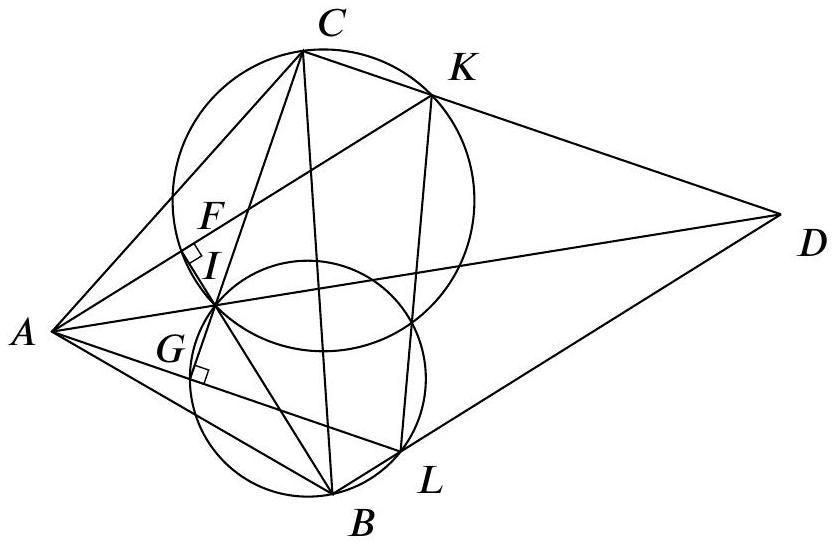
Figure 5
## Baltic Way
Problem 13. Let $D$ be the foot of the $A$-altitude of an acute triangle $A B C$. The internal bisector of the angle $D A C$ intersects $B C$ at $K$. Let $L$ be the projection of $K$ onto $A C$. Let $M$ be the intersection point of $B L$ and $A D$. Let $P$ be the intersection point of $M C$ and $D L$. Prove that $P K \perp A B$.
Solution 1. Let $X$ be a point on $B C$ such that $L X \perp A B$, as seen in figure 6. It is enough to prove that
because then $P K \| L X$ and $L X \perp A B$.
$$
\frac{D P}{P L}=\frac{D K}{K X}
$$
Applying Menelaos for triangle $B D L$ and transversal $M P C$ we get
$$
\frac{D P}{P L} \cdot \frac{L M}{M B} \cdot \frac{B C}{C D}=1
$$
and Menelaus for triangle $B L C$ and transversal $A M D$ gives
$$
\frac{B M}{M L} \cdot \frac{L A}{A C} \cdot \frac{C D}{D B}=1
$$
Multiplying these two equalities yields
$$
\frac{D P \cdot B C \cdot A L}{P L \cdot B D \cdot A C}=1
$$
Note, however, that $A L=A D=A C \sin \gamma, B D=A B \cos \beta$, and, by the sine rule, $\frac{A B}{B C}=\frac{\sin \gamma}{\sin \alpha}$, where $\alpha=\angle B A C, \beta=\angle C B A$ and $\gamma=\angle A C B$. Therefore
$$
\frac{D P}{P L}=\frac{B D \cdot A C}{B C \cdot A L}=\frac{A B \cos \beta \cdot A C}{B C \cdot A C \sin \gamma}=\frac{\sin \gamma \cos \beta}{\sin \alpha \sin \gamma}=\frac{\cos \beta}{\sin \alpha} .
$$
On the other hand, since $D K=K L, \angle K L X=\pi-\alpha$, and $\angle L X K=\frac{\pi}{2}-\beta$, we have by the sine rule
$$
\frac{D K}{K X}=\frac{L K}{K X}=\frac{\sin \left(\frac{\pi}{2}-\beta\right)}{\sin (\pi-\alpha)}=\frac{\cos \beta}{\sin \alpha} .
$$
Therefore
$$
\frac{D P}{P L}=\frac{\cos \beta}{\sin \alpha}=\frac{D K}{K X}
$$
which finishes the proof.
## Baltic Way
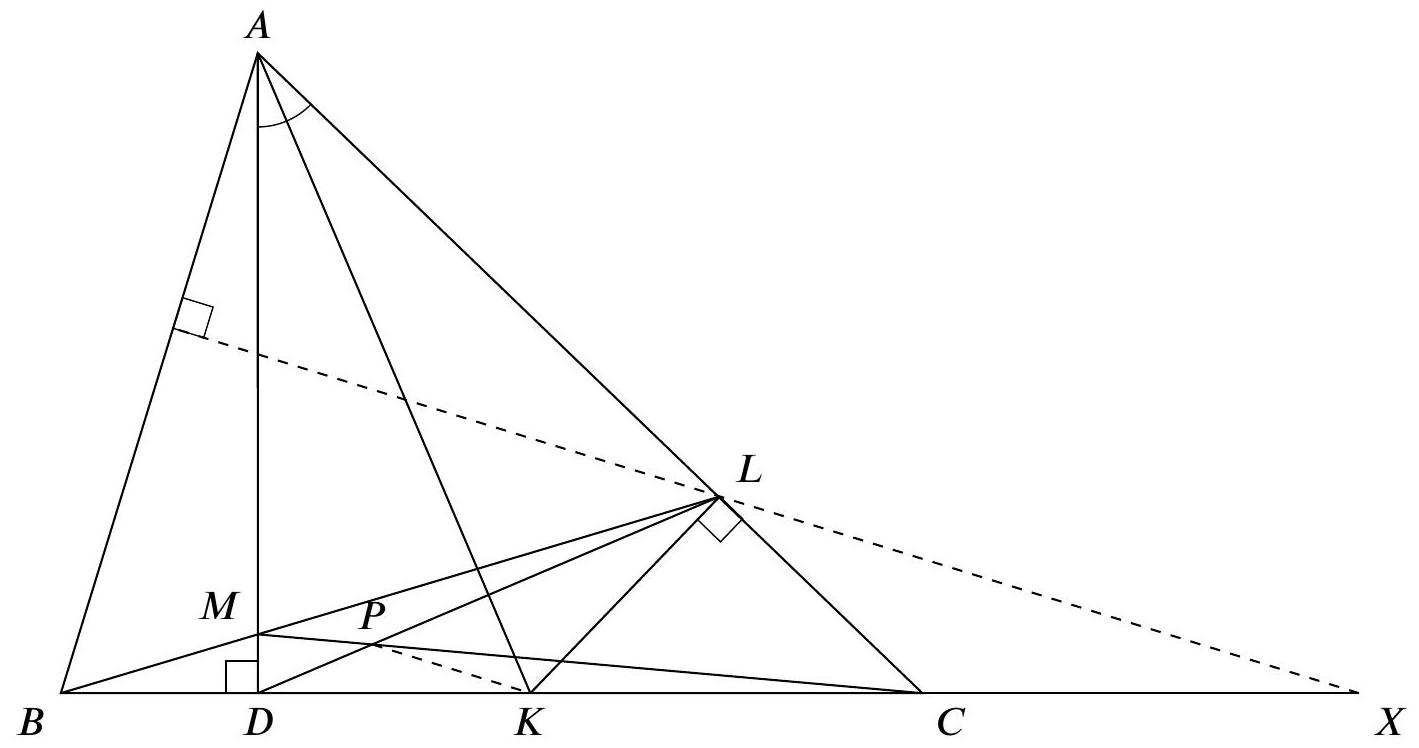
Figure 6
Solution 2. Let $\omega$ be the circle with center $K$ an radius $K D$, as in figure 7. Then $\omega$ is tangent to $A D$ and $A L$. Let $B C$ intersect $\omega$ at $D$ and $Q$. Let $B M$ intersect $\omega$ at $L$ and $R$. Let $Q P$ intersect $B L$ at $S$.
Cross-ratio chasing gives, through the projections $B L \rightarrow D$-pencil $\rightarrow \omega \rightarrow L$-pencil $\rightarrow B C \rightarrow P-$ pencil $\rightarrow B L$,
$$
\begin{aligned}
(L, R ; M, B) & =(D L, D R ; D M, D B)=(L, R ; D, Q)=(L C, L B ; L D, L Q) \\
& =(C, B ; D, Q)=(P C, P B ; P D, P Q)=(M, B ; L, S)=(L, S ; M, B),
\end{aligned}
$$
therefore $R=S$.
It is clear now that $P$ lies on the polar lines of both $A$ and $B$ with respect to $\omega$, therefore $A B$ is the polar line of $P$. This implies that $P K \perp A B$.
Problem 14. Let $A B C$ be a triangle with circumcircle $\Gamma$ and circumcentre $O$. Denote by $M$ the midpoint of $B C$. The point $D$ is the reflection of $A$ over $B C$, and the point $E$ is the intersection of $\Gamma$ and the ray $M D$. Let $S$ be the circumcentre of the triangle $A D E$. Prove that the points $A, E, M, O$, and $S$ lie on the same circle.
Solution. First we prove that $A, M, E, S$ are concyclic. Note that $B C$ is the perpendicular bisector of $A D$, so $S$ lies on $B C$. Let $X$ be the intersection of $A D$ and $B C$ as in figure 8 . Then, using directed
## Baltic Way
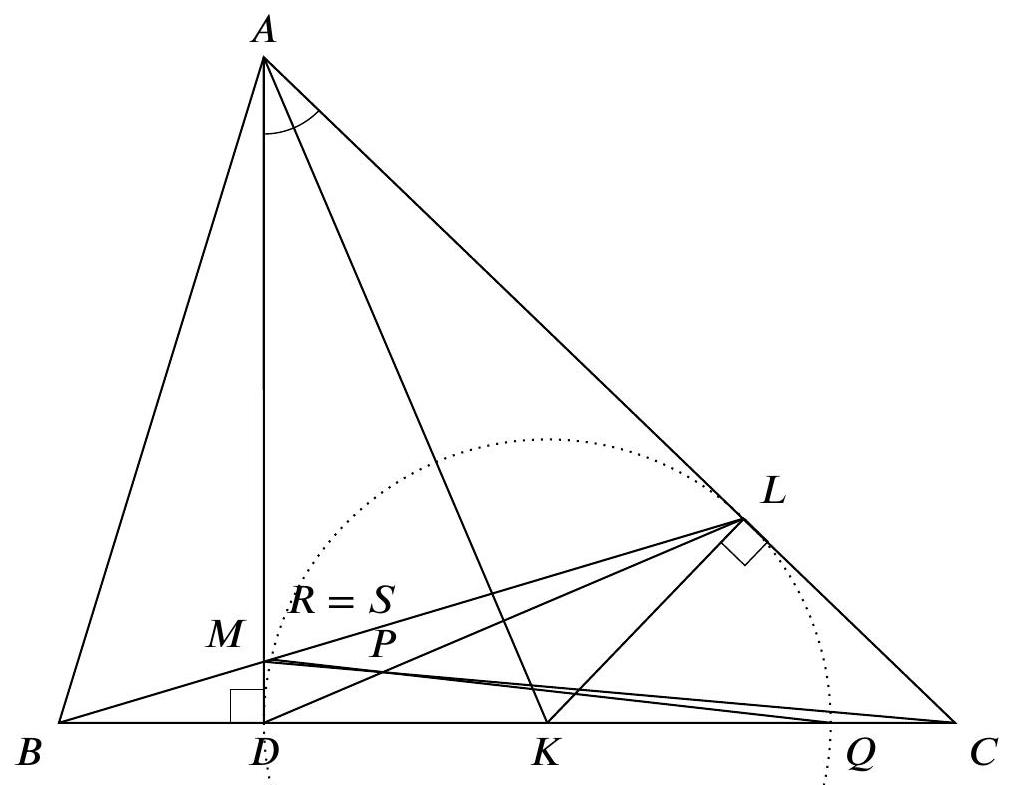
Figure 7
## Baltic Way
Reykjavík, November 11th - 15th
Solutions
angles,
$$
\begin{aligned}
\angle E M S & =\angle D M X \\
& =90^{\circ}-\angle X D M \\
& =90^{\circ}-\angle A D E \\
& =\angle S E A \\
& =\angle E A S,
\end{aligned}
$$
so $A M E S$ is cyclic as claimed.
Now we prove that $A, M, E, O$ are concyclic. Let $F$ be the reflection of $D$ over $M$. Then $F$ lies on the same side of $B C$ as $A$ and satisfies $F C B \cong D B C \cong A B C$, so $F$ must be the point such that $A F C B$ is an isosceles trapezoid. In particular, $F$ lies on $\Gamma$. Consequently,
$$
\angle O A E=90^{\circ}-\angle E F A=90^{\circ}-\angle E M B=\angle O M B+\angle B M E=\angle O M E \text {, }
$$
so $A M E O$ is also cyclic as claimed.
Thus $A, E, M, O, S$ are concyclic, as desired.
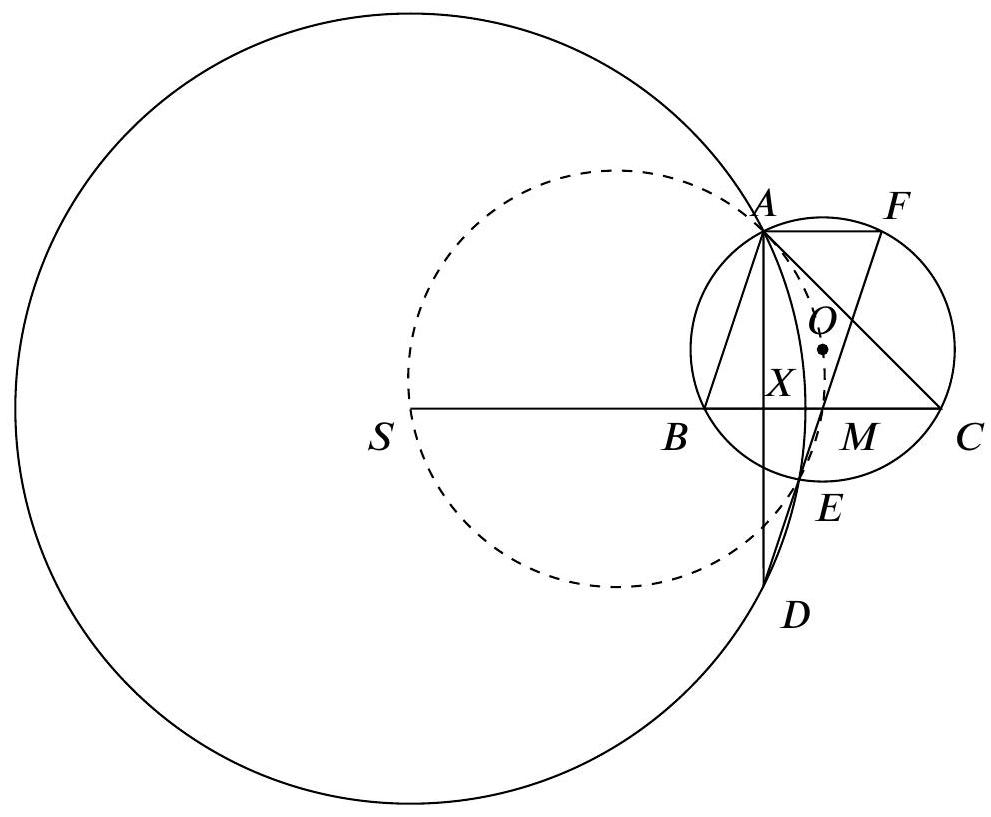
Figure 8
## Baltic Way
Problem 15. For which positive integers $n \geq 4$ does there exist a convex $n$-gon with side lengths $1,2, \ldots, n$ (in some order) and with all of its sides tangent to the same circle?
Solution. It exists if $n=4 k$ or $n=4 k+1$ where $k$ is a positive integer.
Let us consider $n$-gon $P_{1} P_{2} \ldots P_{n}$. Tangent points of the inscribed circle divide each of its sides in two segments. Lengths of these segments that has a common vertex $P_{i}$ are equal. Denote the length of tangent segments that originate at point $P_{i}$ by $A_{i}$. It means that side lengths of the $n$-gon can be expressed as $P_{i} P_{i+1}=A_{i}+A_{i+1}$ for all $i=1,2, \ldots, n$ where we consider points cyclically $\left(P_{n+1}=P_{1}\right.$ and $A_{n+1}=A_{1}$ ).
We can show that the converse is true as well. That is, if we can find $n$ positive real numbers $A_{i}$, $i=1,2, \ldots, n$ such that the sequence $\left(A_{1}+A_{2}, A_{2}+A_{3}, \ldots, A_{n}+A_{1}\right)$ is a permutation of $(1,2, \ldots, n)$ then there is a circumscribed polygon $P_{1} P_{2} \ldots P_{n}$ with side lengths $1,2, \ldots, n$.
To show this we start with a circle of arbitrary radius $R$ and construct points $P_{1}, P_{2}, \ldots, P_{n}$ outside this circle so that the length of the tangent segments from $P_{i}$ to the circle are of length $A_{i}$ and the "right" tangent segment from $P_{i}$ touches the circle at the same point as the "left" tangent segment from $P_{i-1}$.
Now we almost have the $n$-gon except that possibly the "right" tangent point of $P_{1}$ does not match the "left" touching point of $P_{n}$. This can be easily fixed by adjusting the radius $R$ of the circle, using continuity.
Now we solve the problem by considering 4 cases:
(i) First let's consider the case when $n=4 k$. In this case such circumscribed $n$-gon exists. The $4 k$ segments $A_{i}$ can be of lengths
$$
\begin{array}{r}
A_{1}=\frac{1}{2}, A_{2}=\frac{1}{2}, A_{3}=\frac{3}{2}, A_{4}=\frac{3}{2}, \ldots, A_{2 k-1}=\frac{2 k-1}{2}, A_{2 k}=\frac{2 k-1}{2}, \\
A_{2 k+1}=\frac{2 k+1}{2}, A_{2 k+2}=\frac{6 k-1}{2}, A_{2 k+3}=\frac{2 k-1}{2}, A_{2 k+4}=\frac{6 k-3}{2}, \ldots, \\
A_{4 k-1}=\frac{3}{2}, A_{4 k}=\frac{4 k+1}{2} .
\end{array}
$$
One can see that the values of the sums of the consecutive elements $A_{1}+A_{2}, A_{2}+A_{3}, \ldots, A_{4 k-1}+$ $A_{4 k}, A_{4 k}+A_{4 k+1}$ are exactly $1,2, \ldots, 2 k, 4 k, 4 k-1, \ldots, 2 k+1$, respectively.
(ii) In the case $n=4 k+1$ the construction is similar, we can choose $4 k+1$ segments of length
$$
\begin{aligned}
& A_{1}=\frac{1}{2}, \quad A_{2}=\frac{1}{2}, \quad A_{3}=\frac{5}{2}, \quad A_{4}=\frac{5}{2}, \ldots, \\
& A_{2 k+1}=\frac{4 k+1}{2}, \quad A_{2 k+2}=\frac{4 k+1}{2}, \quad A_{2 k+3}=\frac{4 k-1}{2}, \\
& A_{2 k+4}=\frac{4 k-3}{2}, \quad A_{2 k+5}=\frac{4 k-5}{2}, \quad \ldots, A_{4 k+1}=\frac{3}{2}
\end{aligned}
$$
## Baltic Way
In this case the values of the sums of consecutive elements $A_{1}+A_{2}, A_{2}+A_{3}, \ldots, A_{4 k-1}+A_{4 k}$, $A_{4 k}+A_{4 k+1}$ are $1,3,5, \ldots, 4 k+1,4 k, 4 k-2, \ldots, 2$, respectively.
(iii) In case when $n=4 k+2$ such a polygon does not exist. To prove this we note that in case if the number of the sides of the circumscribed polygon is even then the sum of the odd numbered sides is equal to the sum of the even numbered sides. It is evident as two segments of equal length that originate from the same vertex contribute to different sums. But the total sum of the side lengths is an odd number what means that it is impossible to split the sides on two parts with equal sum of lengths.
(iv) In case $n=4 k+3$ such a polygon also does not exist. In this case we can express $A_{1}$ as
$$
\begin{aligned}
A_{1} & =\left(A_{1}+A_{2}+\ldots+A_{n}\right)-\left(A_{2}+A_{3}\right)-\left(A_{4}+A_{5}\right)-\ldots-\left(A_{4 k+2}+A_{4 k+3}\right)= \\
& =\frac{P_{1} P_{2}+P_{2} P_{3}+\cdots+P_{4 k+3} P_{1}}{2}-P_{2} P_{3}-P_{4} P_{5}-\ldots-P_{4 k+2} P_{4 k+3}
\end{aligned}
$$
As the sum of the length of the sides is an even number then we conclude that $A_{1}$ is a positive integer. The same is true for all $A_{2}, A_{3}, \ldots$ as well. But now we have a contradiction as the side of length 1 cannot be split in two parts, each of which has positive integer length.
Problem 16. Show that no non-zero integers $a, b, x, y$ satisfy
$$
\left\{\begin{array}{l}
a x-b y=16, \\
a y+b x=1 .
\end{array}\right.
$$
Solution. If we use the Diophantus sum of squares equality
$$
(a x-b y)^{2}+(a y+b x)^{2}=\left(a^{2}+b^{2}\right)\left(x^{2}+y^{2}\right)
$$
then we can see that for a system
$$
\left\{\begin{array}{l}
a x-b y=s \\
a y+b x=t
\end{array}\right.
$$
to have a solution in positive integers the number $s^{2}+t^{2}$ must be a composite number.
The number corresponding to the equation, $16^{2}+1^{2}=257$, is a prime number. This shows that no solution can exist in non-zero integers, as it would give a factorisation of the prime with each factor $>1$.

## Baltic Way
Reykjavík, November 11th - 15th
Solutions
Remark. Note that $(a+b i)(x+y i)=(a x-b y)+(a y+b x) i$. Finding a solution to the system of equations is therefore equivalent to finding a factorization of $s+t i$ in Gaussian integers $\mathbb{Z}[i]$ with non-negative real and imaginary component. It is known that the Gaussian integers form a Euclidean domain and hence a unique factorization domain. The form for primes in $\mathbb{Z}[i]$ has been thoroughly studied.
Problem 17. Distinct positive integers $a, b, c, d$ satisfy
$$
\left\{\begin{array}{l}
a \mid b^{2}+c^{2}+d^{2}, \\
b \mid a^{2}+c^{2}+d^{2}, \\
c \mid a^{2}+b^{2}+d^{2}, \\
d \mid a^{2}+b^{2}+c^{2},
\end{array}\right.
$$
and none of them is larger than the product of the three others. What is the largest possible number of primes among them?
Solution. At first we note that the given condition is equivalent to $a, b, c, d \mid a^{2}+b^{2}+c^{2}+d^{2}$.
It is possible that three of the given numbers are primes, for example for $a=2, b=3, c=13$ and $d=26$. In this case $2^{2}+3^{2}+13^{2}+26^{2}=13 \cdot 66$ which is divisible by all four given numbers. Furthermore we will show that it is impossible that all four of them are primes.
Let us assume that $a, b, c$ and $d$ are primes. As the sum $a^{2}+b^{2}+c^{2}+d^{2}$ is divisible by each of them then it is divisible also by their product $a b c d$. If one of the primes is equal to 2 , then we obtain a contradiction: the sum of four squares is odd, but its divisor $a b c d$ is even. Therefore all four primes are odd, and $a^{2}+b^{2}+c^{2}+d^{2}=0(\bmod 4)$. Hence $a^{2}+b^{2}+c^{2}+d^{2}$ is divisible by $4 a b c d$ which leads to a contradiction as it is easy to see that $a^{2}+b^{2}+c^{2}+d^{2}<4 a b c d$. Indeed, this is equivalent to
$$
\frac{a}{b c d}+\frac{b}{a c d}+\frac{c}{a b d}+\frac{d}{a b c}<4
$$
which is true as none of the numbers exceed the product of three three other and equality can hold only for the largest of the four.
Problem 18. Find all integer triples $(a, b, c)$ satisfying the equation
$$
5 a^{2}+9 b^{2}=13 c^{2}
$$
## Baltic Way
Solutions
Solution. Observe that $(a, b, c)=(0,0,0)$ is a solution. Assume that the equation has a solution $\left(a_{0}, b_{0}, c_{0}\right) \neq(0,0,0)$. Let $d=\operatorname{gcd}\left(a_{0}, b_{0}, c_{0}\right)>0$. Let $(a, b, c)=\left(a_{0} / d, b_{0} / d, c_{0} / d\right)$. Then $\operatorname{gcd}(a, b, c)$ $=1$. From $5 a_{0}{ }^{2}+9 b_{0}{ }^{2}=13 c_{0}{ }^{2}$ it follows that:
$$
5 a^{2}+9 b^{2}=5\left(\frac{a_{0}}{d}\right)^{2}+9\left(\frac{b_{0}}{d}\right)^{2}=\frac{5 a_{0}{ }^{2}+9 b_{0}{ }^{2}}{d^{2}}=\frac{13 c_{0}{ }^{2}}{d^{2}}=13\left(\frac{c_{0}}{d}\right)^{2}=13 c^{2}
$$
hence $(a, b, c)$ is also a solution.
As $\left(a_{0}, b_{0}, c_{0}\right) \neq(0,0,0)$ it follows that $(a, b, c) \neq(0,0,0)$. Consider the equation modulo 5. It follows that $4 b^{2} \equiv 5 a^{2}+9 b^{2}=13 c^{2} \equiv 3 c^{2}(\bmod 5)$, that is $4 b^{2} \equiv 3 c^{2}(\bmod 5)$. Multiplying by 4 gives:
$$
b^{2} \equiv 16 b^{2}=4 \cdot 4 b^{2} \equiv 4 \cdot 3 c^{2}=12 c^{2} \equiv 2 \cdot c^{2} \quad(\bmod 5)
$$
If $5 \mid c$ then $2 c^{2} \equiv 2 \cdot 0^{2}=0(\bmod 5)$ and therefore $a^{2} \equiv 0(\bmod 5)$, that is $5 \mid b^{2}$. As 5 is prime it follows that $5 \mid b$. Hence 5 divides $b$ and $c$. It follows that $5^{2} \mid 13 c^{2}-9 b^{2}=5 a^{2}$. Consequently 5 divides $a^{2}$. As 5 is prime, $5 \mid a$. This means that 5 divides $a, b$ and $c$ contradicting the fact that $\operatorname{gcd}(a, b, c)=1$. We conclude that $5 \mid c$ does not hold.
As $5 \mid c$ does not hold and 5 is a prime it follows that $c$ and 5 are relative prime. Therefore there exists $x \in \mathbb{Z}$ such that $c \cdot x \equiv 1(\bmod 5)$. Multiplying by $x^{2}$ gives:
$$
(b \cdot x)^{2}=b^{2} \cdot x^{2} \equiv 2 \cdot c^{2} \cdot x^{2}=2 \cdot(c \cdot x)^{2} \equiv 2 \cdot 1^{2}=2
$$
That is $y^{2} \equiv 2(\bmod 5)$ where $y=b \cdot x$. As $y^{2} \equiv 2(\bmod 5)$ it follows that $y$ and 5 are relative prime. By Fermat's little theorem it follows that $y^{4} \equiv 1(\bmod 5)$. Hence:
$$
1 \equiv y^{4}=\left(y^{2}\right)^{2} \equiv 2^{2}=4 \quad(\bmod 5)
$$
but $1 \not \equiv 4(\bmod 5)$ so we have a contradiction. We conclude that the equation $5 a^{2}+9 b^{2}=13 c^{2}$ has no solution besides the solution $(a, b, c)=(0,0,0)$.
Problem 19. Find all polynomials $p$ with integer coefficients such that the number $p(a)-p(b)$ is divisible by $a+b$ for all integers $a, b$, provided that $a+b \neq 0$.
Solution. The polynomials we are looking for are those whose every odd-degree term has zero coefficient.
Let $P(x)=P_{0}(x)+P_{1}(x)$, where $P_{0}$ and $P_{1}$ are polynomials whose all non-zero terms have either even or odd degree, respectively.
Then we can write $P_{0}(x)=Q\left(x^{2}\right)$, where polynomial $Q$ is obtained from polynomial $P_{0}$ by dividing degrees of all non-zero terms by 2 . Now, for any integers $a, b$ the number $P_{0}(a)-P_{0}(b)=Q\left(a^{2}\right)-Q\left(b^{2}\right)$

BALTIC WAY
REYKJAVÍK$\cdot$ 2021
## Baltic Way
Reykjavík, November 11th - 15th
Solutions
is divisible by $a^{2}-b^{2}$, and hence also by $a+b$. Thus, if every odd-degree term of $P$ has zero coefficient, then the condition of the problem is satisfied.
On the other hand, if polynomial $P$ satisfies the condition of the problem, then also $P-P_{0}=P_{1}$ must satisfy it. Note that for every real $x, P_{1}(-x)=-P_{1}(x)$, i.e. $P_{1}$ is an odd function. By substituting $b$ by $-b$ in the condition of the problem we obtain that $a-b \mid P_{1}(a)+P_{1}(b)$ holds for any distinct integers $a$ and $b$. Since also $a-b \mid P_{1}(a)-P_{1}(b)$, then for any integers $a$, $b$ we have $a-b \mid 2 P_{1}(a)$. But for any $a$ there exists such $b$ that $|a-b|>2 P_{1}(a)$. From this we conclude that $P_{1}(a)=0$ for any integer $a$. Altogether we have $P=P_{0}$, i.e. coefficients of all odd-degree terms are zero.
Problem 20. Let $n \geq 2$ be an integer. Given numbers $a_{1}, a_{2}, \ldots, a_{n} \in\{1,2,3, \ldots, 2 n\}$ such that $\operatorname{lcm}\left(a_{i}, a_{j}\right)>2 n$ for all $1 \leq i<j \leq n$, prove that
$$
a_{1} a_{2} \cdots a_{n} \mid(n+1)(n+2) \cdots(2 n-1)(2 n) .
$$
Solution. For every $i=1,2, \ldots, n$ let $b_{i}=\max \left\{k \cdot a_{i} \mid k \in \mathbb{Z}, k \cdot a_{i} \leq 2 n\right\}$, that is $b_{i}$ is the greatest multiple of $a_{i}$ in $\{1,2, \ldots, 2 n\}$. It is clear that $b_{i} \in\{n+1, n+2, \ldots, 2 n\}$ because if $b_{i} \leq n$ then $2 b_{i} \leq 2 n$ is a greater multiple of $a_{i}$.
If $1 \leq i<j \leq n$ then $a_{i}+b_{j}$ because else $b_{j} \leq 2 n$ would be a common multiple of $a_{i}$ and $a_{j}$ smaller than their least common multiple $\operatorname{lcm}\left(a_{i}, a_{j}\right)>2 n$. In particular $b_{i} \neq b_{j}$. It follows that the map $\{1,2, \ldots, n\} \rightarrow\{n+1, n+2, \ldots, 2 n\}, i \mapsto b_{i}$ is injective. As both sets $\{1,2, \ldots, n\}$ and $\{n+1, n+2, \ldots, 2 n\}$ have the same finite cardinality it follows that the map is also a surjection and hence a bijection. In particular $b_{1} b_{2} \cdots b_{n}=(n+1)(n+2) \cdots(2 n)$ by associativity and commutativity.
As each $a_{i} \mid b_{i}$ it follows that
$$
a_{1} a_{2} \cdots a_{n} \mid b_{1} b_{2} \cdots b_{n}=(n+1)(n+2) \cdots(2 n)
$$
as desired.
|