

File size: 9,375 Bytes
00fbf41 | 1 2 3 4 5 | {"year": "2014", "tier": "T3", "problem_label": "1", "problem_type": null, "exam": "Benelux_MO", "problem": "Find the smallest possible value of the expression\n\n$$\n\\left\\lfloor\\frac{a+b+c}{d}\\right\\rfloor+\\left\\lfloor\\frac{b+c+d}{a}\\right\\rfloor+\\left\\lfloor\\frac{c+d+a}{b}\\right\\rfloor+\\left\\lfloor\\frac{d+a+b}{c}\\right\\rfloor,\n$$\n\nin which $a, b, c$ and $d$ vary over the set of positive integers.\n(Here $\\lfloor x\\rfloor$ denotes the biggest integer which is smaller than or equal to $x$.)\n\n#", "solution": "The answer is 9 .\nNotice that $\\lfloor x\\rfloor>x-1$ for all $x \\in \\mathbb{R}$. Therefore the given expression is strictly greater than\n\n$$\n\\frac{a+b+c}{d}+\\frac{b+c+d}{a}+\\frac{c+d+a}{b}+\\frac{d+a+b}{c}-4,\n$$\n\nwhich can be rewritten as\n\n$$\n\\left(\\frac{a}{b}+\\frac{b}{a}\\right)+\\left(\\frac{a}{c}+\\frac{c}{a}\\right)+\\left(\\frac{a}{d}+\\frac{d}{a}\\right)+\\left(\\frac{b}{c}+\\frac{c}{b}\\right)+\\left(\\frac{b}{d}+\\frac{d}{b}\\right)+\\left(\\frac{c}{d}+\\frac{d}{c}\\right)-4 .\n$$\n\nSince $t+\\frac{1}{t} \\geq 2$ for $t>0$, we get that $6 \\cdot 2-4=8$ is a strict lower bound for the given expression; since it takes integral values only, we actually get that 9 is a lower bound. It remains to check that 9 can be attained; this happens for $a=b=c=5$ and $d=4$.\n\n#", "metadata": {"resource_path": "Benelux_MO/segmented/Benelux_en-olympiad_en-bxmo-problems-2014-zz.jsonl", "problem_match": "# Problem 1", "solution_match": "# Solution\n"}}
{"year": "2014", "tier": "T3", "problem_label": "2", "problem_type": null, "exam": "Benelux_MO", "problem": "Let $k \\geq 1$ be an integer.\nWe consider $4 k$ chips, $2 k$ of which are red and $2 k$ of which are blue. A sequence of those $4 k$ chips can be transformed into another sequence by a so-called move, consisting of interchanging a number (possibly one) of consecutive red chips with an equal number of consecutive blue chips. For example, we can move from $r \\underline{b b b r} \\underline{r} \\underline{b} b$ to $r \\underline{r} \\underline{b} b \\underline{b b b} b$ where $r$ denotes a red chip and $b$ denotes a blue chip.\n\nDetermine the smallest number $n$ (as a function of $k$ ) such that starting from any initial sequence of the $4 k$ chips, we need at most $n$ moves to reach the state in which the first $2 k$ chips are red.\n\n#", "solution": "The answer is $n=k$.\nWe will first show that $n \\geq k$. Let us count the number $C$ of times a red chip is directly to the right of a blue chip. In the final position this number equals 0 . In the position brbrbr $\\cdots b r$ this number equals $2 k$. We claim that any move reduces this number by at most 2 . Denote by $R$ the group of red chips and by $B$ the group of blue chips that are interchanged. Any reduction in $C$ must involve a red chip getting rid of its blue left neighbour or a blue chip getting rid of its red right neighbour. This can only happen with the leftmost chip of $R$ (if its left neighbour is blue) and the rightmost chip of $B$ (if its right neighbour is red), but not with the rightmost chip of $R$ (and its right neighbour) or the leftmost chip of $B$ (and its left neighbour). Hence $C$ is reduced by at most 2 in any move. Therefore the number of moves necessary to change $b r b r b r \\cdots b r$ into the final position is at least $\\frac{2 k}{2}=k$.\nWe will now show that $n \\leq k$, i.e. that it is always possible to perform at most $k$ moves in order to reach the state in which the first $2 k$ chips are red. Consider the first $2 k$ chips. If at most $k$ of these chips are blue, we can perform one move for each chip, switching it with one of the red chips of the last $2 k$ chips. So then we are done in at most $k$ moves. Now suppose that of the first $2 k$ chips, at least $k+1$ are blue. Then at most $k-1$ chips are red. Hence it is possible to perform at most $k-1$ moves to reach the situation in which the last $2 k$ chips are red. We then perform one final move, switching the first $2 k$ chips and the last $2 k$ chips, ending in the situation in which the first $2 k$ chips are red. Thus, it is always possible to reach the situation in which the first $2 k$ chips are red in at most $k$ steps, hence $n \\leq k$.\nWe have now shown that $n \\geq k$ and $n \\leq k$, hence $n=k$ as claimed.\n\n#", "metadata": {"resource_path": "Benelux_MO/segmented/Benelux_en-olympiad_en-bxmo-problems-2014-zz.jsonl", "problem_match": "# Problem 2", "solution_match": "# Solution\n"}}
{"year": "2014", "tier": "T3", "problem_label": "3", "problem_type": null, "exam": "Benelux_MO", "problem": "Find all positive integers $n>1$ with the following property:\nfor each two positive divisors $k, \\ell<n$ of $n$, at least one of the numbers $2 k-\\ell$ and $2 \\ell-k$ is a (not necessarily positive) divisor of $n$ as well.\n\n#", "solution": "If $n$ is prime, then $n$ has the desired property: if $k, \\ell<n$ are positive divisors of a prime $n$, we have $k=\\ell=1$, in which case $2 k-\\ell=1$ is a divisor of $n$ as well.\n\nAssume now that a composite number $n$ has the desired property. Let $p$ be its smallest prime divisor and let $m=n / p$; then $m \\geq p \\geq 2$. Choosing $(k, \\ell)=(1, m)$, we see that at least one of $2 m-1$ and $m-2$ must divide $n$. However, $m<2 m-1<2 m \\leq n$; since $m$ and $n$ are the two biggest positive divisors of $n$, we conclude that $2 m-1$ cannot divide $n$. Therefore $n$ must be divisble by $m-2$. It follows that $m-2 \\mid m p-p(m-2)=2 p$, hence $m-2 \\in\\{1,2, p, 2 p\\}$.\nWe deal with each case separately.\n\n- If $m-2=1$ we have $m=3$. As $p \\leq m$, we have $p \\in\\{2,3\\}$, hence $n=6$ or $n=9$.\n- If $m-2=2$ we have $m=4$, hence $n$ is even and $p=2$, so $n=8$.\n- If $m-2=p$, we may assume that $p>2$ (since we already discussed the case $m-2=2$ ). We have $m=p+2$, hence $n=p(p+2)$. Applying the condition in the problem to the pair $(k, \\ell)=(1, p)$, we get that $p-2$ or $2 p-1$ divides $n$. If $p-2$ divides $n$, we must have $p=3$ since $p$ is the smallest prime divisor of $n$. If $2 p-1$ divides $n$, we must have $p+2=2 p-1$, since $p+2 \\leq 2 p-1<p(p+2)$ and $p+2$ and $p(p+2)$ are the biggest positive divisors of $n$. Therefore $p=3$ in both cases, and we get $n=15$ as a candidate.\n- If finally $m-2=2 p$ we have $m=2 p+2$, so $n$ is even. Hence $p=2$ and $n=12$.\n\nWe conclude that if a composite number $n$ satisfies the condition in the problem statement, then $n \\in\\{6,8,9,12,15\\}$. Choosing $(k, \\ell)=(1,2)$ shows that $n=8$ does not work; choosing $(k, \\ell)=(3,6)$ shows that 12 is not a solution. It is easy to check that $n=6, n=9$ and $n=15$ have the desired property by checking the condition for all possible pairs $(k, \\ell)$.\nWe conclude that the solutions are given by the prime numbers, $n=6, n=9$ and $n=15$.\n\n#", "metadata": {"resource_path": "Benelux_MO/segmented/Benelux_en-olympiad_en-bxmo-problems-2014-zz.jsonl", "problem_match": "# Problem 3", "solution_match": "# Solution\n"}}
{"year": "2014", "tier": "T3", "problem_label": "4", "problem_type": null, "exam": "Benelux_MO", "problem": "Let $A B C D$ be a square. Consider a variable point $P$ inside the square for which $\\angle B A P \\geq 60^{\\circ}$. Let $Q$ be the intersection of the line $A D$ and the perpendicular to $B P$ in $P$. Let $R$ be the intersection of the line $B Q$ and the perpendicular to $B P$ from $C$.\n(a) Prove that $|B P| \\geq|B R|$.\n(b) For which point(s) $P$ does the inequality in (a) become an equality?\n\n#", "solution": "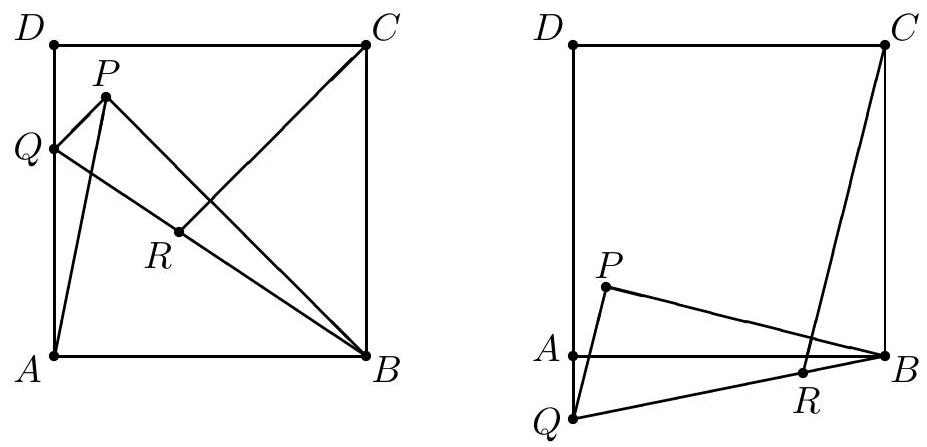\n\nWe claim that $\\triangle A B P$ and $\\triangle R C B$ are similar triangles. Indeed, if we denote the intersection of $B P$ and $C R$ by $S$, then $\\angle R C B=\\angle S C B=90^{\\circ}-\\angle S B C=90^{\\circ}-\\angle P B C=\\angle A B P$. Moreover, the right angles in $P$ and $A$ imply that $A$ and $P$ lie on the circle with diameter $[B Q]$, so either $A B P Q$ or $A Q B P$ is a cyclic, convex quadrilateral. In either case, $A$ and $Q$ lie on the same side of $B P$, so $\\angle P A B=\\angle P Q B$. Since $C R$ and $P Q$ are perpendicular to $B P$, these lines are parallel and hence $\\angle P Q B=\\angle C R B$. Together with $\\angle P A B=\\angle P Q B$ and $\\angle R C B=\\angle A B P$, this implies the claim that $\\triangle A B P \\sim \\triangle R C B$.\nThis similarity yields the equality $|A P| /|B R|=|B P| /|B C|$. Since $\\angle B A P \\geq 60^{\\circ}$, we get\n\n$$\n\\begin{aligned}\n0 \\leq & (|A B|-|A P|)^{2}=|A B|^{2}+|A P|^{2}-2 \\cdot|A B| \\cdot|A P| \\\\\n& =|B P|^{2}+2(\\cos \\angle B A P-1) \\cdot|A B| \\cdot|A P| \\\\\n& \\leq|B P|^{2}-|A B| \\cdot|A P|=|B P|^{2}-|B R| \\cdot|B P| .\n\\end{aligned}\n$$\n\nThis implies that $|B P| \\geq|B R|$, as desired.\nIn order for equality to occur, one needs equality in each of the inequalities considered above: $|A B|=|A P|$ and $\\angle B A P=60^{\\circ}$. Hence there is exactly one point $P$ for which we have equality; this is the unique point inside the square such that $\\triangle A B P$ is equilateral.", "metadata": {"resource_path": "Benelux_MO/segmented/Benelux_en-olympiad_en-bxmo-problems-2014-zz.jsonl", "problem_match": "# Problem 4", "solution_match": "# Solution\n"}}
|