

File size: 9,116 Bytes
707439b | 1 2 3 4 5 6 7 8 9 10 11 12 13 14 15 16 17 18 19 20 21 22 23 24 25 26 27 28 29 30 31 32 33 34 35 36 37 38 39 40 41 42 43 44 45 46 47 48 49 50 51 52 53 54 55 56 57 58 59 60 61 62 63 64 65 66 67 68 69 70 71 72 73 74 75 76 77 78 79 80 81 82 83 84 85 86 87 88 89 90 91 92 93 94 95 96 97 98 99 100 101 102 103 104 105 106 107 108 109 110 111 112 113 114 115 116 117 118 119 120 121 122 123 124 125 126 127 128 129 130 131 132 133 134 135 136 137 | # The $27^{\text {th }}$ Nordic Mathematical Contest
Monday, 8 April 2013
## Solution
Each problem is worth 5 points.
PRoblem 1. Let $\left(a_{n}\right)_{n \geq 1}$ be a sequence with $a_{1}=1$ and
$$
a_{n+1}=\left\lfloor a_{n}+\sqrt{a_{n}}+\frac{1}{2}\right\rfloor
$$
for all $n \geq 1$, where $\lfloor x\rfloor$ denotes the greatest integer less than or equal to $x$. Find all $n \leq 2013$ such that $a_{n}$ is a perfect square.
Solution. We will show by induction that $a_{n}=1+\left\lfloor\frac{n}{2}\right\rfloor\left\lfloor\frac{n+1}{2}\right\rfloor$, which is equivalent to $a_{2 m}=1+m^{2}$ and $a_{2 m+1}=1+m(m+1)$. Clearly this is true for $a_{1}$. If $a_{2 m+1}=1+m(m+1)$ then
$$
a_{2 m+2}=\left\lfloor m^{2}+m+1+\sqrt{m^{2}+m+1}+\frac{1}{2}\right\rfloor
$$
and since $m+\frac{1}{2}<\sqrt{m^{2}+m+1}<m+1$ (easily seen by squaring), we get $a_{2 m+2}=\left(m^{2}+m+1\right)+(m+1)=1+(m+1)^{2}$.
And if $a_{2 m}=1+m^{2}$ then
$$
a_{2 m+1}=\left\lfloor m^{2}+1+\sqrt{m^{2}+1}+\frac{1}{2}\right\rfloor
$$
and here $m<\sqrt{m^{2}+1}<m+\frac{1}{2}$, so $a_{2 m+1}=\left(m^{2}+1\right)+m=1+m(m+1)$.
If $m \geq 1$ then $m^{2}<1+m^{2}<(m+1)^{2}$ and $m^{2}<m^{2}+m+1<(m+1)^{2}$, so $a_{n}$ cannot be a perfect square if $n>1$. Therefore $a_{1}=1$ is the only perfect square in the sequence.
Problem 2. In a football tournament there are $n$ teams, with $n \geq 4$, and each pair of teams meets exactly once. Suppose that, at the end of the tournament, the final scores form an arithmetic sequence where each team scores 1 more point than the following team on the scoreboard. Determine the maximum possible score of the lowest scoring team, assuming usual scoring for football games (where the winner of a game gets 3 points, the loser 0 points, and if there is a tie both teams get 1 point).
Solution. Note that the total number of games equals the number of different pairings, that is, $n(n-1) / 2$. Suppose the lowest scoring team ends with $k$ points. Then the total score for all teams is
$$
k+(k+1)+\cdots+(k+n-1)=n k+\frac{(n-1) n}{2}
$$
Some games must end in a tie, for otherwise, all team scores would be a multiple of 3 and cannot be 1 point apart. Since the total score of a tie is only 2 points compared to 3 points if one of the teams wins, we therefore know that
$$
n k+\frac{(n-1) n}{2}<3 \cdot \frac{n(n-1)}{2}
$$
so $n k<n(n-1)$, and hence $k<n-1$. It follows that the lowest scoring team can score no more than $n-2$ points.
We now show by induction that it is indeed possible for the lowest scoring team to score $n-2$ points.
The following scoreboard shows this is possible for $n=4$ :
| - | 3 | 1 | 1 | 5 |
| :---: | :---: | :---: | :---: | :---: |
| 0 | - | 1 | 3 | 4 |
| 1 | 1 | - | 1 | 3 |
| 1 | 0 | 1 | - | 2 |
Now suppose we have a scoreboard for $n$ teams labelled $T_{n-2}, \ldots, T_{2 n-3}$, where team $T_{i}$ scores $i$ points. Keep the results among these teams unchanged while adding one more team.
Write $n=3 q+r$ with $r \in\{1,-1,0\}$, and let the new team tie with just one of the original teams, lose against $q$ teams, and win against the rest of them. The new team thus wins $n-1-q$ games, and gets $1+3(n-1-q)=3 n-2-3 q=2 n-2+r$ points.
Moreover, we arrange for the $q$ teams which win against the new team to form an arithmetic sequence $T_{j}, T_{j+3}, \ldots, T_{j+3(q-1)}=T_{j+n-r-3}$, so that each of them, itself having gained three points, fills the slot vacated by the next one.
(i) If $r=1$, then let the new team tie with team $T_{n-2}$ and lose to each of the teams $T_{n-1}, T_{n+2}, \ldots, T_{n-1+n-r-3}=T_{2 n-5}$.
Team $T_{n-2}$ now has $n-1$ points and takes the place vacated by $T_{n-1}$. At the other end, $T_{2 n-5}$ now has $2 n-2$ points, just one more than the previous top team $T_{2 n-3}$. And the new team has $2 n-2+r=2 n-1$ points, becoming the new top team. The teams now have all scores from $n-1$ up to $2 n-1$.
(ii) If $r=-1$, then let the new team tie with team $T_{2 n-3}$ and lose to each of the teams $T_{n-2}, T_{n+1}, \ldots, T_{n-2+n-r-3}=T_{2 n-4}$.
The old top team $T_{2 n-3}$ now has $2 n-2$ points, and its former place is filled by the new team, which gets $2 n-2+r=2 n-3$ points. $T_{2 n-4}$ now has $2 n-1$ points and is the new top team. So again we have all scores ranging from $n-1$ up to $2 n-1$.
(iii) If $r=0$, then let the new team tie with team $T_{n-2}$ and lose to teams $T_{n-1}, T_{n+2}, \ldots, T_{n-1+n-r-3}=T_{2 n-4}$.
Team $T_{n-2}$ now has $n-1$ points and fills the slot vacated by $T_{n-1}$. At the top end, $T_{2 n-4}$ now has $2 n-1$ points, while the new team has $2 n-2+r=2 n-2$ points, and yet again we have all scores from $n-1$ to $2 n-1$.
This concludes the proof.
Problem 3. Define a sequence $\left(n_{k}\right)_{k \geq 0}$ by $n_{0}=n_{1}=1$, and $n_{2 k}=n_{k}+n_{k-1}$ and $n_{2 k+1}=n_{k}$ for $k \geq 1$. Let further $q_{k}=n_{k} / n_{k-1}$ for each $k \geq 1$. Show that every positive rational number is present exactly once in the sequence $\left(q_{k}\right)_{k \geq 1}$.
Solution. Clearly, all the numbers $n_{k}$ are positive integers. Moreover,
$$
q_{2 k}=\frac{n_{2 k}}{n_{2 k-1}}=\frac{n_{k}+n_{k-1}}{n_{k-1}}=q_{k}+1
$$
and similarly,
$$
\frac{1}{q_{2 k+1}}=\frac{n_{2 k}}{n_{2 k+1}}=\frac{n_{k}+n_{k-1}}{n_{k}}=\frac{1}{q_{k}}+1
$$
In particular, $q_{k}>1$ when $k$ is even, and $q_{k}<1$ when $k \geq 3$ is odd.
We will show the following by induction on $t=2,3,4, \ldots$ :
Claim: Every rational number $r / s$ where $r$, s are positive integers with $\operatorname{gcd}(r, s)=$ 1 and $r+s \leq t$ occurs precisely once among the numbers $q_{k}$.
The claim is clearly true for $t=2$, since then $r / s=1 / 1=1$ is the only possibility, and $q_{1}$ is the only occurrence of 1 in the sequence.
Now, assume that $u \geq 3$ and that the claim holds for $t=u-1$. Let $r$ and $s$ be positive integers with $\operatorname{gcd}(r, s)=1$ and $r+s=u$.
First, assume that $r>s$. We know that $r / s=q_{m}$ is only possible if $m$ is even. But
$$
\frac{r}{s}=q_{2 k} \Leftrightarrow \frac{r-s}{s}=q_{k}
$$
by (1), and moreover, the latter equality holds for precisely one $k$ according to the induction hypothesis, since $\operatorname{gcd}(r-s, s)=1$ and $(r-s)+s=r \leq t$.
Next, assume that $r<s$. We know that $r / s=q_{m}$ is only possible if $m$ is odd. But
$$
\frac{r}{s}=q_{2 k+1} \Leftrightarrow \frac{s}{r}=\frac{1}{q_{2 k+1}} \Leftrightarrow \frac{s-r}{r}=\frac{1}{q_{k}}
$$
by (2), and moreover, the latter equality holds for precisely one $k$ according to the induction hypothesis, since $\operatorname{gcd}(s-r, r)=1$ and $(s-r)+r=s \leq t$.
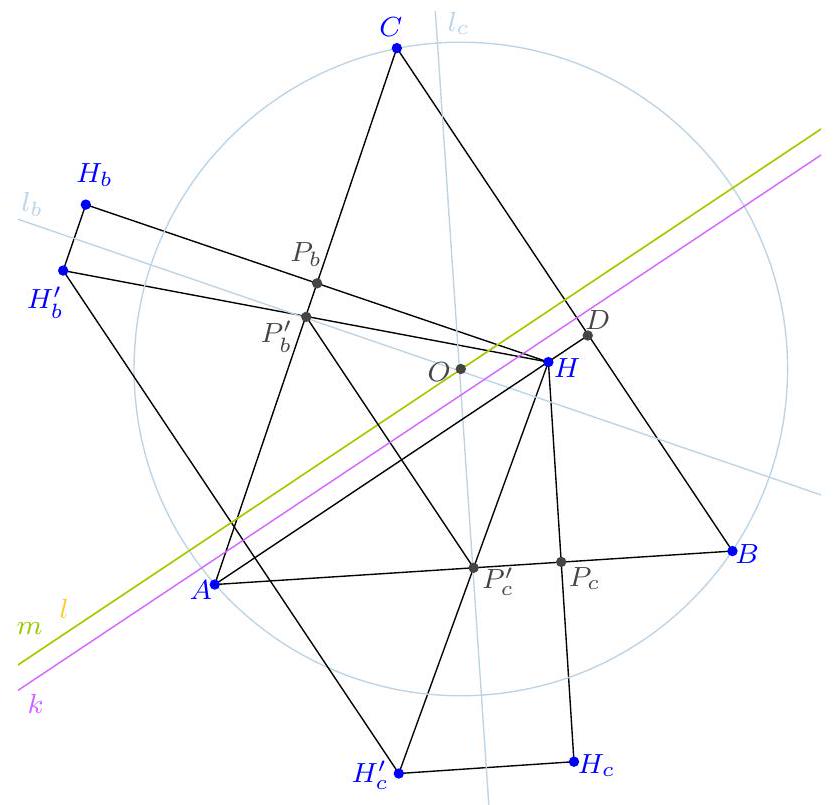
Problem 4. Let $A B C$ be an acute angled triangle, and $H$ a point in its interior. Let the reflections of $H$ through the sides $A B$ and $A C$ be called $H_{c}$ and $H_{b}$, respectively, and let the reflections of $H$ through the midpoints of these same sides be called $H_{c}^{\prime}$ and $H_{b}^{\prime}$, respectively. Show that the four points $H_{b}, H_{b}^{\prime}, H_{c}$, and $H_{c}^{\prime}$ are concyclic if and only if at least two of them coincide or $H$ lies on the altitude from $A$ in triangle $A B C$.
Solution. If at least two of the four points $H_{b}, H_{b}^{\prime}, H_{c}$, and $H_{c}^{\prime}$ coincide, all four are obviously concyclic. Therefore we may assume that these four points are distinct.
Let $P_{b}$ denote the midpoint of segment $H H_{b}, P_{b}^{\prime}$ the midpoint of segment $H H_{b}^{\prime}, P_{c}$ the midpoint of segment $H H_{c}$, and $P_{c}^{\prime}$ the midpoint of segment $H H_{c}^{\prime}$.
The triangle $H H_{b} H_{b}^{\prime}$ being right-angled in $H_{b}$, it follows that the perpendicular bisector $\ell_{b}$ of the side $H_{b} H_{b}^{\prime}$ goes through the point $P_{b}^{\prime}$. Since the segments $P_{b} P_{b}^{\prime}$ and $H_{b} H_{b}^{\prime}$ are parallel and $P_{b}^{\prime}$ is the midpoint of the side $A C$, we then conclude that $\ell_{b}$ also goes through the circumcentre $O$ of triangle $A B C$.
Similarly the perpendicular bisector $\ell_{c}$ of the segment $H_{c} H_{c}^{\prime}$ also goes through $O$. Hence the four points $H_{b}, H_{b}^{\prime}, H_{c}$, and $H_{c}^{\prime}$ are concyclic if and only if also the perpendicular bisector $\ell$ of the segment $H_{b}^{\prime} H_{c}^{\prime}$ goes through the point $O$. Since $H_{b}^{\prime} H_{c}^{\prime}\left\|P_{b}^{\prime} P_{c}^{\prime}\right\| B C$, this is the case if and only if $\ell$ is the perpendicular bisector $m$ of the segment $B C$.
Let $k$ denote the perpendicular bisector of the segment $P_{b}^{\prime} P_{c}^{\prime}$. Since the lines $\ell$ and $m$ are obtained from $k$ by similarities of ratio 2 and centres $H$ and $A$, respectively, they coincide if and only if $H A$ is parallel to $m$. Thus $H_{b}, H_{b}^{\prime}, H_{c}$, and $H_{c}^{\prime}$ are concyclic if and only if $H$ lies on the altitude from $A$ in triangle $A B C$.
Click here to experiment with the figure in GeoGebra.
|