

File size: 35,381 Bytes
802d9fe | 1 2 3 4 5 6 7 8 9 10 11 12 13 14 15 16 17 18 19 20 21 22 23 24 25 26 27 28 29 30 31 32 33 34 35 36 37 38 39 40 41 42 43 44 45 46 47 48 49 50 51 52 53 54 55 56 57 58 59 60 61 62 63 64 65 66 67 68 69 70 71 72 73 74 75 76 77 78 79 80 81 82 83 84 85 86 87 88 89 90 91 92 93 94 95 96 97 98 99 100 101 102 103 104 105 106 107 108 109 110 111 112 113 114 115 116 117 118 119 120 121 122 123 124 125 126 127 128 129 130 131 132 133 134 135 136 137 138 139 140 141 142 143 144 145 146 147 148 149 150 151 152 153 154 155 156 157 158 159 160 161 162 163 164 165 166 167 168 169 170 171 172 173 174 175 176 177 178 179 180 181 182 183 184 185 186 187 188 189 190 191 192 193 194 195 196 197 198 199 200 201 202 203 204 205 206 207 208 209 210 211 212 213 214 215 216 217 218 219 220 221 222 223 224 225 226 227 228 229 230 231 232 233 234 235 236 237 238 239 240 241 242 243 244 245 246 247 248 249 250 251 252 253 254 255 256 257 258 259 260 261 262 263 264 265 266 267 268 269 270 271 272 273 274 275 276 277 278 279 280 281 282 283 284 285 286 287 288 289 290 291 292 293 294 295 296 297 298 299 300 301 302 303 304 305 306 307 308 309 310 311 312 313 314 315 316 317 318 319 320 321 322 323 324 325 326 327 328 329 330 331 332 333 334 335 336 337 338 339 340 341 342 343 344 345 346 347 348 349 350 351 352 353 354 355 356 357 358 359 360 361 362 363 364 365 366 367 368 369 370 371 372 373 374 375 376 377 378 379 380 381 382 383 384 385 386 387 388 389 390 391 392 393 394 395 396 397 398 399 400 401 402 403 404 405 406 407 408 409 410 411 412 413 414 415 416 417 418 419 420 421 422 423 424 425 426 427 428 429 430 431 432 433 434 435 436 437 438 439 440 441 442 443 444 445 446 447 448 449 450 451 452 453 454 455 456 457 458 459 460 461 462 463 464 465 466 467 468 469 470 471 472 473 474 475 476 477 478 479 480 481 482 483 484 485 486 487 488 489 490 491 492 493 494 495 496 497 498 499 500 501 502 503 504 505 506 507 508 509 510 511 512 513 514 515 516 517 518 519 520 521 522 523 524 525 526 527 528 529 530 531 532 533 534 535 536 537 538 539 540 541 542 543 544 545 546 547 548 549 550 551 552 553 554 555 556 557 558 559 560 561 562 563 564 565 566 567 568 569 570 571 572 573 574 575 576 577 578 579 580 581 582 583 584 585 586 587 588 589 590 591 592 593 594 595 596 597 598 599 600 601 602 603 604 605 606 607 608 609 610 611 612 613 614 615 616 617 618 619 620 621 622 623 624 625 626 627 628 629 630 631 632 633 634 635 636 637 638 639 | # 2016
65th Czech and Slovak<br>Mathematical Olympiad
Translated into English by
Pavel Calábek, Martin Panák
## First Round of the 65th Czech and Slovak Mathematical Olympiad Problems for the take-home part (October 2015)

1. Some objects are in each of four rooms. Let $n \geqslant 2$ be an integer. We move one $n$-th of objects from the first room to the second one. Then we move one $n$-th of (the new number of) objects from the second room to the third one. Then we move similarly objects from the third room to the fourth one and from the fourth room to the first one. (We move the whole units of objects only.) Finally the same number of the objects is in every room. Find the minimum possible number of the objects in the second room. For which $n$ does the minimum come?
(Vojtech Bálint, Michal Rolínek)
Solution. Let us compute backwards. Firstly we find the number of the objects in two rooms before the move. Let $a$ and $b$ be number of the objects in the rooms $A$ and $B$ before the move. This number after the move we denote by $a^{\prime}$ and $b^{\prime}$. By the conditions
$$
a^{\prime}=\frac{n-1}{n} a, \quad b^{\prime}=b+\frac{1}{n} a
$$
holds. From the first equation and an identity $a+b=a^{\prime}+b^{\prime}$ we obtain
$$
a=\frac{n}{n-1} a^{\prime}, \quad b=b^{\prime}-\frac{1}{n-1} a^{\prime}
$$
Now let $M$ be the final number of the objects in every room after the fourth move. By this identity we can compute the initial number of objects in every room in terms of $M$ and $n$ :
Finally: $\quad M \quad M \quad M \quad M \quad M$
| before $4 \rightarrow 1:$ | $\frac{n-2}{n-1} M$, | $M$, | $M$, | $\frac{n}{n-1} M ;$ |
| :--- | ---: | ---: | ---: | ---: |
| before $3 \rightarrow 4:$ | $\frac{n-2}{n-1} M$, | $M$, | $\frac{n}{n-1} M$, | $M ;$ |
| before $2 \rightarrow 3:$ | $\frac{n-2}{n-1} M$, | $\frac{n}{n-1} M$, | $M$, | $M ;$ |
| before $1 \rightarrow 2:$ | $\frac{n(n-2)}{(n-1)^{2}} M$, | $\frac{(n-1)^{2}+1}{(n-1)^{2}} M$, | $M$, | $M$. |
Since the number of objects in the first room was positive, $n \geqslant 3$ holds. Now we can easily find the minimum of
$$
V_{2}=\frac{(n-1)^{2}+1}{(n-1)^{2}} M
$$
The difference between numerator and denominator is 1 , so the fraction is irreducible. Since $V_{2}$ is integer it must be $M=k(n-1)^{2}$ for proper $k$, therefore $V_{2}=k\left((n-1)^{2}+1\right)$. For $n \geqslant 3$ we can estimate $(n-1)^{2}+1 \geqslant 5$, so $V_{2} \geqslant 5$ too. Using $n=3, k=1$ and $M=4$ we obtain $V_{2}=5$ and we can easily check that the quadruple $(3,5,4,4)$ satisfies the problem: it transforms to quadruple $(2,6,4,4)$, then $(2,4,6,4)$, after that $(2,4,4,6)$ and finally $(4,4,4,4)$. So the minimal numbers of objects in the second room is 5 and we can obtain it only for $n=3$ because for $n \geqslant 4$ is $V_{2} \geqslant 3^{2}+1=10$.
2. Find the least real $m$ such that there exist reals $a$ and $b$ for which the inequality
$$
\left|x^{2}+a x+b\right| \leqslant m
$$
holds for all $x \in\langle 0,2\rangle$.
(Leo Boček)
Solution. Notice that no negative number $m$ satisfies the problem evidently (absolute value is non-negative number).
Now we interpret the problem geometrically. A graph of some function $y=$ $x^{2}+a x+b$ lies in a horizontal strip between lines $y=+m$ and $y=-m$ and in the interval $\langle 0,2\rangle$. Our aim is to find the closest strip which contains the graph of such quadratic function in the interval $\langle 0,2\rangle$.
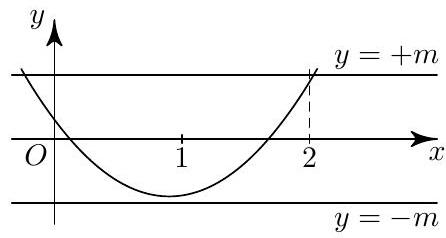
Fig. 1
The function
$$
f(x)=(x-1)^{2}-\frac{1}{2}=x^{2}-2 x+\frac{1}{2},
$$
seems to be a good candidate for such the closest strip. Such function has $a=-2$, $b=\frac{1}{2}$ and it satisfies (to be shown bellow) inequalities $-\frac{1}{2} \leqslant f(x) \leqslant \frac{1}{2}$.
Really, this inequalities are equivalent to the inequalities $0 \leqslant(x-1)^{2} \leqslant 1$, which are evidently fulfilled for $x \in\langle 0,2\rangle$. Quadratic function $f(x)=x^{2}-2 x+\frac{1}{2}$ thus satisfies the conditions of the problem for $m=\frac{1}{2}$.
In the second part of the solution we will show that there is no quadratic function satisfying the problem for any $m<\frac{1}{2}$.
The crucial fact will be that at least one from differences $f(0)-f(1)$ and $f(2)-$ $f(1)$ is greater or equal to 1 for an arbitrary function $f(x)=x^{2}+a x+b$. This fact
will imply that width of the closest strip will be greater or equal to 1 an this will exclude the values $m<\frac{1}{2}$. For $f(0)-f(1) \geqslant 1$ we obtain the desired estimate $2 m \geqslant 1$ easily from the well-known triangle inequality $|a-b| \leqslant|a|+|b|$ :
$$
1 \leqslant|f(0)-f(1)| \leqslant|f(0)|+|f(1)| \leqslant 2 m \text {. }
$$
Similarly we estimate for $f(0)-f(1) \geqslant 1$.
Now it remains to verify at least one from inequalities $f(0)-f(1) \geqslant 1$ and $f(2)-f(1) \geqslant 1$ for arbitrary $f(x)=x^{2}+a x+b$. The values
$$
f(0)=b, \quad f(1)=1+a+b, \quad f(2)=4+2 a+b
$$
yields
$$
\begin{aligned}
& f(0)-f(1)=-1-a \geqslant 1 \quad \Leftrightarrow \quad a \leqslant-2, \\
& f(2)-f(1)=3+a \geqslant 1 \quad \Leftrightarrow \quad a \geqslant-2 .
\end{aligned}
$$
So at least one from inequalities $f(0)-f(1) \geqslant 1$ and $f(2)-f(1) \geqslant 1$ is true (regardless of the choice $a, b$ ).
Conclusion. The desired minimal value of $m$ is $\frac{1}{2}$.
3. Let $A B C$ be a right-angled triangle with a hypotenuse $A B$ and longer leg $B C$. Let $D$ be a foot of an altitude from the vertex $C$. Circle $k$ with the center $D$ and the radius $C D$ intersects the leg $B C$ in a point $Q$ and line $A B$ in points $E$ and $F(E \neq F)$, where $F$ is a point on the hypotenuse $A B$. Segment $Q E$ intersects the leg $A C$ in a point $P$. Prove that $P E=Q F$.
(Jaroslav Švrček)
Solution. The circle $k$ is the Thales' circle with the diameter $E F$ and the center $D$. A triangle $E F C$ is the isosceles right-angled triangle, so $E C=E F$. We will show that triangles $E P C$ and $F Q C$ are congruent, which will prove the statement of the problem.

Fig. 2
Angles $C E Q$ and $C F Q$ are congruent as they are inscribed angles subtended the chord $C Q$ of the circle $k$. Both angles $E C F$ and $A C B$ are congruent (right angles), so their remaining non-overlapping parts (angles $E C F=E C P$ and $A C B=F C Q$ ) are also congruent. This proves, that triangles $E P C$ and $F Q C$ are congruent by $A-S-A$.
4. Nela and Jane choose positive integer $k$ and then play a game with a $9 \times 9$ table. Nela selects in every of her moves one empty unit square and she writes 0 to it. Jane writes 1 to some empty (unit) square in every her move. Furthermore $k$ Jane's moves follows each Nela's move and Nela starts. If sum of numbers in each row and each column is odd anytime during the game, Jane wins. If girls fill out the whole table (without Jane's win), Nela wins. Find the least $k$ such that Jane has the winning strategy.
(Michal Rolínek)
Solution. Let us show at first that Jane wins for $k=3$. Let us assume $3 \times 3$ squares $A_{1}, A_{2}$ and $A_{3}$ (see the picture). We will call the $3 \times 3$ square covered if just one 1 is in each its row and column. If Jane covers squares $A_{1}, A_{2}$ and $A_{3}$ without writing to other squares, she wins, because sums in all rows and columns are odd number 1.
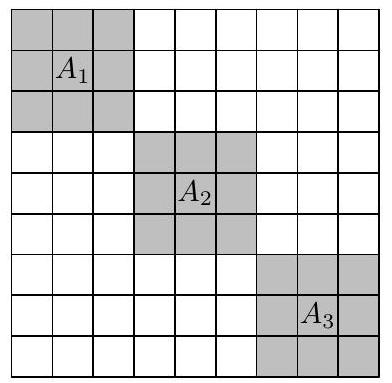
Fig. 3
It is obvious that if at most one 0 (and no 1 ) is written in any $3 \times 3$ square after Nela's move, Jane can cover this square because of $k=3$. Jane has the following strategy: If Nela writes 0 to any uncovered square $A_{1}, A_{2}$ or $A_{3}$, Jane covers it immediately. In the opposite case Jane covers any of the uncovered $3 \times 3$ squares. Jane thus wins after three her triples of moves.
We will show that Nela has winning strategy for $k \in\{1,2\}$. Let us realize that if Jane has some winning move, just 8 rows and 8 columns have odd sum before Jane's move, and the winning Jane's move is writing 1 to the intersection of the only one "even" row with the only one "even" column. This implies that if Jane has winning move, this move is unique.
Now it is obvious Nela's winning strategy for $k=1$. If Jane has winning move after her move, Nela writes 0 to this square and Jane looses her unique chance for win. In the opposite case Nela writes 0 to some empty square. This move doesn't change parity of sums in rows and columns and Jane still hasn't winning move. This strategy allows Nela to fill out whole table without giving Jane chance to win.
In the case $k=2$ Nela will use the same strategy as for $k=1$. This strategy doesn't give Jane chance to win in her first move. In the second move Jane can't win because after that move the table contains even number of 1 's which excludes possibility to be odd number 1's in every of (odd number) nine rows.
Conclusion. The least value $k$, for which Jane has winning strategy, is $k=3$.
5. Let $A B C$ be a triangle with the shortest side $B C$. Let $X, Y, K, L$ be a points on sides $A B, A C$ and on ray's opposite to rays $B C, C B$ respectively such that $B X=B K=B C=C Y=C L$. Line $K X$ intersects line $L Y$ in a point $M$. Prove that centroid of a triangle KLM coincides with incentre of the triangle $A B C$.
(Tomáš Jurík)
Solution. Since $A B C$ is an external angle of the isosceles triangle $X K B$ with the apex $B$ (see the picture), a line $K X$ is parallel to a bisectrix of the angle $A B C$.

Fig. 4
The ratio $L B: L K=2: 3$ yields, that the bisectrix of $A B C$ meets the centroid of the triangle $K L M$. If we denote $L L_{1}$ its median and $L_{2}$ its intersection with the bisectrix of $A B C$ then we obtain
$$
\frac{L L_{2}}{L L_{1}}=\frac{L B}{L K}=\frac{2}{3}
$$
from similarity of the triangles $\triangle L B L_{2} \sim \triangle L K L_{1}$ (by $A-A$ ). So the point $L_{2}$ divides the median $L L_{1}$ in the same ratio as the centroid an therefore it is the centroid of the triangle $K L M$.
If follows from the symmetry of the problem, that bisectrix of the angle $B C A$ meets the centroid of the triangle $K L M$. And the fact, that intersection of the bisectrices is the incentre, proves the claim of the problem.
6. A product
$$
1 \cdot 2 \cdot 3 \cdot \ldots \cdot n
$$
is written on a blackboard. For which positive integers $n \geqslant 2$ can we append the exclamation mark to some factors and change it to factorials in such a way that the final product will be a square?
(Michal Rolínek)
Solution. Let us denote $v_{p}(n)$ the highest power of a prime $p$ which divides positive integer $n$. This function has obviously the following properties:
- For all primes $p$ and positive integers $n$ is $v_{p}(n)$ non-negative integer.
- For all positive integers $m, n$ and all primes $p$ is $v_{p}(m n)=v_{p}(m)+v_{p}(n)$.
- For all primes $p$ is $v_{p}(p !)=v_{p}(p)=1$.
- For all primes $p$ is $v_{p}((p+1) !)=1, v_{p}(p+1)=0$.
- For all primes $p$ and all positive integers $n<p$ is $v_{p}(n !)=v_{p}(n)=0$.
- Positive integer $n$ is a square if and only if $v_{p}(n)$ is even (including zero) for all primes $p$.
Let us denote $S=n$ ! the initial value of the product on the table and $S^{\prime}$ its final value after adding factorials. We can easy to see from the properties of $v_{p}$ that for $n$ is equal to any prime $p$ we obtain $v_{p}(S)=v_{p}(p !)=1$ and $v_{p}\left(S^{\prime}\right)=1$, because adding factorials does not change the amount of the prime $p(=n)$ in the final product on the blackboard. The number $v_{p}\left(S^{\prime}\right)$ is then odd and therefore $S^{\prime}$ is not a square.
Let us assume that $n$ is a composite number (so $n \geqslant 4$ ) in whole of the following part. We will show that we can add factorials in such a way that the final product
$$
S^{\prime}=f_{1} \cdot f_{2} \cdot f_{3} \cdot \ldots \cdot f_{n}
$$
will be a square, where $f_{k}$ is either $k$ or $k$ ! for all $k$. It is equivalent to $v_{p}\left(S^{\prime}\right)$ is even for all primes $p$. Since $n$ is not a prime, only primes less than $n$ occur in the product $S^{\prime}$. As every such primes $p$ are not in factors $f_{1}, f_{2}, \ldots, f_{p-1}$ and the prime $p$ occurs in $f_{p}$ only once, the final power $v_{p}\left(S^{\prime}\right)$ is the same as in a "reduced" product
$$
p \cdot f_{p+1} \cdot f_{p+2} \cdot \ldots \cdot f_{n}
$$
How can we provide that every prime $p<n$ will occur in the corresponding product (1) with even power? Since in the second factor $f_{p+1}$ from (1) occurs the prime $p$ either once (in the case $f_{p+1}=(p+1)$ !) or the prime $p$ does not occure (if $f_{p+1}=p+1$ ), we can provide "good" occurrence of $p$ by choice of $f_{p+1}$ independently on succeeding values $f_{p+2}, \ldots, f_{n}$.*
Foregoing analysis gives us construction of the required choice of factorials. Initially we choose $f_{k} \in\{k, k !\}$ arbitrarily for all $k \leqslant n$ such that $k-1$ is not a prime. The other $f_{k}$, it is $f_{p+1}$, where $p$ is arbitrary prime less than $n$, will be chosen "backwards", from the biggest such prime $p$ to the smallest prime $p=2 .^{* *}$ For the biggest unchosen $f_{p+1}$ we find parity of $v_{p}\left(f_{p+2} \ldots f_{n}\right)$, in odd case we choose $f_{p+1}=p+1$, in even case we choose $f_{p+1}=(p+1)$ ! and so on.
This finishes the construction of $S^{\prime}$ and solution of the problem too.
Conclusion. Desired $n \geqslant 2$ are all composite numbers.[^0]
## First Round of the 65th Czech and Slovak Mathematical Olympiad (December 8th, 2015)

1. Nice prime is a prime equal to the difference of two cubes of positive integers. Find last digits of all nice primes.
(Patrik Bak, Michal Rolínek)
Solution. Firstly, let us note that $5^{3}-4^{3}=61,2^{3}-1^{3}=7$ and $3^{3}-2^{3}=19$ are nice primes, so 1, 7 and 9 belong to desired digits. We show that they are all desired digits.
Let $p=m^{3}-n^{3}$ be a nice prime, where $m>n$ are positive integers. Second factor in rewriting
$$
p=m^{3}-n^{3}=(m-n)\left(m^{2}+m n+n^{2}\right),
$$
is greater than 1 , thus the first one is 1 and therefore $m=n+1$. After substitution we obtain
$$
p=3 n^{2}+3 n+1 \text {. }
$$
An estimate $3 n^{2}+3 n+1>6$ gives that the prime $p$ is odd and greater that 5 . This excludes $0,2,4,5,6$ a 8 as the last digits and 3 stays the only remaining digit to exclude.
It is sufficient to find remainders of the numbers $3 n^{2}+3 n+1$ after division by 5. For remainders $0,1,2,3$ and 4 of $n$ we obtain remainders $1,2,4,2,1$ of (1) which ones really exclude the last digit 3 .
Answer. The last digits of the nice primes are 1,7 and 9 .
2. Positive real numbers $a, b, c, d$ satisfy equalities
$$
a=c+\frac{1}{d} \quad \text { and } \quad b=d+\frac{1}{c} .
$$
Prove an inequality $a b \geqslant 4$ and find a minimum of $a b+c d . \quad$ (Jaromír Šimša)
Solution. To prove the inequality $a b \geqslant 4$ we substitute from the equalities. We so obtain an estimate
$$
a b=\left(c+\frac{1}{d}\right)\left(d+\frac{1}{c}\right)=c d+1+1+\frac{1}{c d} \geqslant 4,
$$
where we use in the last inequality well-known fact that $x+1 / x \geqslant 2$ holds for all positive reals $x=c d>0$.
To find the minimum we use similar way. Substitution for $a$ and $b$ yields
$$
a b+c d=\left(2+c d+\frac{1}{c d}\right)+c d=2+2 c d+\frac{1}{c d}
$$
Now we use an inequality $x+y \geqslant 2 \sqrt{x y}$ which holds true for any non-negative reals $x, y$. The choice $x=2 c d, y=1 / c d$ follows
$$
2 c d+\frac{1}{c d} \geqslant 2 \sqrt{2}
$$
Now we see that $a b+c d \geqslant 2(1+\sqrt{2})$. To prove that it is the desired minimum we find some $a, b, c, d$ such that they makes an equality in the inequality.
The equality comes in the use inequality if and only if $x=y$, it is $2 c d=1 / c d$. It is true e.g. for $c=1, d=\sqrt{2} / 2$ and for that values we find $a=1+\sqrt{2}, b=1+\sqrt{2} / 2$. Such quadruple satisfies the desired equalities and it holds $a b+c d=2(1+\sqrt{2})$ too.
3. For a trapezoid $A B C D(A B \| C D)$ it holds $B C=A B+C D$. Prove that
(i) there is a point of a circle with diameter $B C$ on the leg $A D$,
(ii) there is a point of a circle with diameter $A D$ on the leg $B C$.
(Josef Tkadlec)
Solution. (i) Let $M, N$ be the centers of the legs $B C, A D$. We show that the point $N$ lies on the circle with diameter $B C$.
A well-known identity yields
$$
M N=\frac{A B+C D}{2}=\frac{1}{2} B C .
$$
It means that the point $N$ has the same distance from the center $M$ of the circle with diameter $B C$ as radius of that circle. So point $M$ lies on that circle.
(ii) With respect to the given condition we can find a point $E$ on the legs $B C$ such that $|B E|=|A B|$ and $|E C|=|C D|$ (Fig. 1). We show that $\angle A E D=90^{\circ}$ and so the point $E$ is the desired point on the Thales' circle with diameter $A D$.

Fig. 1
The triangles $A B E, E C D$ are isosceles and the lines $A B$ and $C D$ are parallel, thus the fact follows:
$$
\begin{aligned}
\angle A E D & =180^{\circ}-\angle A E B-\angle C E D= \\
& =\frac{1}{2}\left(\left(180^{\circ}-2 \angle A E B\right)+\left(180^{\circ}-2 \angle C E D\right)\right)= \\
& =\frac{1}{2}(\angle A B E+\angle D C E)=90^{\circ} .
\end{aligned}
$$
So we finished the second part.
Remark. If we start from proof that the triangle $A E D$ is right-angled one, we will become conscious of fact that its mutually perpendicular axes of sides $A E$ and $E D$ meet the center $N$ of its circumscribed circle. It means that a triangle $B C N$ is right-angled one too, so the circle with diameter $B C$ meets the center $N$ of the side $A D$.
## Second Round of the 65th Czech and Slovak Mathematical Olympiad (January 12th, 2016)

1. There are different positive integers written on the board. Their (arithmetic) mean is a decimal number, with the decimal part exactly 0,2016. What is the least possible value of the mean?
(Patrik Bak)
Solution. Let $s$ be the sum, $n$ the number and $p$ the integer part of the mean of the numbers on the board. Then we can write
$$
\frac{s}{n}=p+\frac{2016}{10000}=p+\frac{126}{625}
$$
which gives
$$
625(s-p n)=126 n \text {. }
$$
Numbers 126 and 625 are coprime, thus $625 \mid n$. Therefore $n \geqslant 625$.
The numbers on the board are different, that is
$p=\frac{s}{n}-\frac{126}{625} \geqslant \frac{1+2+\cdots+n}{n}-\frac{126}{625}=\frac{n(n+1) / 2}{n}-\frac{126}{625} \geqslant \frac{625+1}{2}-\frac{126}{625}>312$.
The integer $p$ is thus at least 313 and the value of the mean at least 313,2016 .
This value can be attained by numbers $1,2, \ldots, 624$ and 751 . We get
$$
\frac{1+2+\cdots+624+751}{625}=\frac{312 \cdot 625+751}{625}=313+\frac{126}{625}=313,2016 .
$$
2. On the unit square $A B C D$ is given point $E$ on $C D$ in such a way, that $|\angle B A E|=$ $60^{\circ}$. Further let $X$ be an arbitrary inner point of the segment $A E$. Finally let $Y$ be the intersection of a line, perpendicular to $B X$ and containing $X$, with the line $B C$. What is the least possible length of $B Y$ ?
(Michal Rolínek)
Solution. Let us consider the Thales circle over $B Y$, which is circumscribed to $B Y X$. This circle contains $X$ and touches $A B$ in $B$. Of all such circles is the one which touches $A E$ (and it has to be in $X$ ) obviously the one with the least diameter (let us call the circle $k$ ). This circle is thus inscribed to the equilateral triangle $A A^{\prime} F$ where $A^{\prime}$ is the image of $\mathrm{A}$ in the point symmetry with respect to $B$ and $F$ lies on the half line $B C$ (see Fig. 1; there you can see one of the circles with smaller diameter than $k$ as well). The center of $k$ is the center of mass of the triangle $A A^{\prime} F$, equilateral triangle with sides of length 2 , thus the diameter of $k$ is $B Y=\frac{2}{3} \sqrt{3}$ and the corresponding $X$ is a center of $A F$, that is it belongs to the segment $A E$, since $|A X|=1<|A E|$.
Answer. The least possible length of $B Y$ is $\frac{2}{3} \sqrt{3}$.
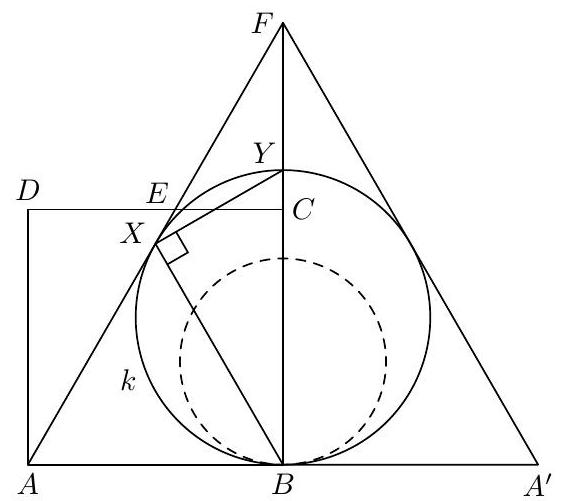
Fig. 1
3. In how many ways can you partition the set $\{1,2, \ldots, 12\}$ into six mutually disjoint two-element sets in such a way that the two elements in any set are coprime?
(Martin Panák)
Solution. No two even numbers can be in the same set (pair). Let us call partitions of $\{1,2, \ldots, 12\}$ with this property, that is one even and one odd number in each pair, even-odd partitions. The only further limitations are, that 6 nor 12 cannot be paired with 3 or 9 , and 10 cannot be paired with 5 .
That means, that odd numbers 1,7 and 11 can be paired with numbers $2,4,6$, 8, 10, 12, numbers 3 and 9 with 2, 4, 8, 10 and number 5 can be paired with 2, 4, 6, 8,12 . We cannot use the product rule directly, we distinguish two cases: 5 is paired with 6 or 12 , in the second one 5 is paired with one of 2,4 , and 8 . The possible pairings are $2 \cdot 4 \cdot 3 \cdot 3 \cdot 2 \cdot 1=144$ in the first case, $3 \cdot 3 \cdot 2 \cdot 3 \cdot 2 \cdot 1=108$ in the second case. Together $144+108=252$ pairings.
4. Find the least real $m$, for which there exists real $a, b$ such, that
$$
\left|x^{2}+a x+b\right| \leqslant m\left(x^{2}+1\right)
$$
holds for any $x \in\langle-1,1\rangle$.
Solution. Let us assume that $a, b, m$ satisfy the condition:
$$
\forall x \in\langle-1,1\rangle:|f(x)| \leqslant m\left(x^{2}+1\right), \quad \text { kde } \quad f(x)=x^{2}+a x+b .
$$
Firstly we prove that at least one of the $f(1)-f(0) \geqslant 0$ and $f(-1)-f(0) \geqslant 0$ holds: for arbitrary $f(x)=x^{2}+a x+b$ there is
$$
f(0)=b, \quad f(1)=1+a+b, \quad f(-1)=1-a+b
$$
and
$$
\max (f(1)-f(0), f(-1)-f(0))=\max (1+a, 1-a)=1+|a| \geqslant 1
$$
Our assumption means $|f(1)| \leqslant 2 m,|f(-1)| \leqslant 2 m$ a $|f(0)| \leqslant m$. Consequently
$$
1 \leqslant 1+|a|=f(1)-f(0) \leqslant|f(1)|+|f(0)| \leqslant 2 m+m=3 m,
$$
or
$$
1 \leqslant 1+|a|=f(-1)-f(0) \leqslant|f(-1)|+|f(0)| \leqslant 2 m+m=3 m .
$$
In both cases we get $m \geqslant \frac{1}{3}$.
We show, that $m=\frac{1}{3}$ fulfills the problem conditions. For this $m$ either (1) or (2) is equality, that is $a=0,-f(0)=|f(0)|$ and $|f(0)|=m=\frac{1}{3}$, thus $b=f(0)=-\frac{1}{3}$.
We will verify, that the function $f(x)=x^{2}-\frac{1}{3}$ pro $m=\frac{1}{3}$ satisfies the conditions of the problem: The inequality $\left|x^{2}-\frac{1}{3}\right| \leqslant \frac{1}{3}\left(x^{2}+1\right)$ is equivalent with the inequalities
$$
-\frac{1}{3}\left(x^{2}+1\right) \leqslant x^{2}-\frac{1}{3} \leqslant \frac{1}{3}\left(x^{2}+1\right) \quad \text { or } \quad-x^{2}-1 \leqslant 3 x^{2}-1 \leqslant x^{2}+1
$$
which are equivalent to $0 \leqslant x^{2} \leqslant 1$, which is evidently fulfilled on $\langle-1,1\rangle$.
Answer. The thought $m$ is $\frac{1}{3}$.
Final Round of the 65th Czech and Slovak
Mathematical Olympiad
(April 4-5, 2016)
$\mathbb{N} / /(2)$
1. Let $p>3$ be a prime. Find the number of ordered sextuples $(a, b, c, d, e, f)$ of positive integers, whose sum is $3 p$, and all the fractions
$$
\frac{a+b}{c+d}, \quad \frac{b+c}{d+e}, \quad \frac{c+d}{e+f}, \quad \frac{d+e}{f+a}, \quad \frac{e+f}{a+b}
$$
are integers.
(Jaromír Šimša, Jaroslav Švrček)
Solution. Taking the product of the 1st, the 3rd and the 5th fractions reveals that their value has to be 1 , that is
$$
a+b=c+d=e+f=p .
$$
the form of the second and of the fourth fraction implies
$$
f+a \mid d+e \text { and } d+e \mid b+c \text {. }
$$
that is first $f+a$ is at most the arithmetic mean of its multiples,
$$
f+a \leqslant \frac{1}{3}((f+a)+(d+e)+(b+c))=p,
$$
and
$$
f+a \mid(f+a)+(d+e)+(b+c)=3 p .
$$
Thus $f+a$ divides $3 p$ and is in the interval $\langle 2, p\rangle$. Consequently either $f+a=p$ or $f+a=3$. We deal separately with these cases.
(i) Let $f+a=p$. Because of (3) there is $f+a=d+e=b+c=p$, which together with (1) gives $p-1$ solutions of the form
$$
(a, b, c, d, e, f)=(a, p-a, a, p-a, a, p-a), \quad \text { where } a \in\{1,2, \ldots, p-1\}
$$
(ii) Let $f+a=3$. Then $\{a, f\}=\{1,2\}$.
Firstly let $a=1$ and $f=2$. According to (1) then $b=p-1$ and $e=p-2$, and (2) has the form
$$
3 \mid d+(p-2) \text { and } d+(p-2) \mid(p-1)+c \text {. }
$$
In analyzing (4) we distinguish between $d=1$ and $d \geqslant 2$.
If $d=1$ then $c=p-1$ and (4) reads
$$
3 \mid p-1 \quad \text { a } \quad p-1 \mid 2(p-1) .
$$
While the right relation always holds, the left one holds only for $p=3 q+1$ ( $q$ is a suitable positive integer). For such prime numbers we get considering (1) solutions
$$
(a, b, c, d, e, f)=(1, p-1, p-1,1, p-2,2) .
$$
If $d \geqslant 2$ we show first, that the right relation in (4) is satisfied if and only if $d+(p-2)=(p-1)+c$ or $d=c+1 . d \geqslant 2$ namely implies $c=p-d \leqslant p-2$, thus
$$
d+(p-2) \geqslant p \quad \text { and } \quad(p-1)+c \leqslant 2 p-3<2 p
$$
and $d+(p-2)=(p-1)+c$. From $c+d=p$ and $d=c+1$ we get $c=\frac{1}{2}(p-1)$ a $d=\frac{1}{2}(p+1)$. Since $d+(p-2)=\frac{3}{2}(p-1)$, the left relation in (4) is fulfilled and
$$
(a, b, c, d, e, f)=\left(1, p-1, \frac{1}{2}(p-1), \frac{1}{2}(p+1), p-2,2\right) .
$$
is a solution.
Finally $a=2$ and $f=1$. In this case $b=p-2$ a $e=p-1$, and (2) reads
$$
3 \mid d+(p-1) \text { and } d+(p-1) \mid(p-2)+c .
$$
Because
$$
d+(p-1) \geqslant p \quad \text { and } \quad(p-2)+c<2 p
$$
the right relation in (5) holds if and only if $d+(p-1)=(p-2)+c$, that is iff $c=d+1$. Together with $c+d=p$ we get $c=\frac{1}{2}(p+1)$ and $d=\frac{1}{2}(p-1)$, thus the right relation in (5) holds as well, and the last solution is
$$
(a, b, c, d, e, f)=\left(2, p-2, \frac{1}{2}(p+1), \frac{1}{2}(p-1), p-1,1\right) .
$$
Conclusion. All the solutions found are apparently mutually different and their number depends on $p$ modulo $3(p>3)$ : If $p=3 q+1$ then there are $p+2$ sextuples, if $p=3 q+2$, there are $p+1$ sextuples.
2. Let $r$ and $r_{a}$ be the radii of inscribed circle and excircle opposite $A$ of the triangle $A B C$. Show, that if
$$
r+r_{a}=|B C|
$$
then the triangle is right-angled.
(Michal Rolínek)
Solution. Let us use the standard notation of the inner angles of the triangle $A B C$, further let $I$ be the incenter and $I_{a}$ be the excenter (of the excircle opposite $A$ ) and let $D$ and $E$ be in order the touching points of the thought circles. Since the bisectors $B I$ and $B I_{a}$ of the supplementary angles are perpendicular to each other (as well as $C I$ and $C I_{a}$ ), the points $B, C, I$ a $I_{a}$ lie on the circle with the diameter $I I_{a}$.
Thus $D$ and $E$, the orthogonal projections of $I$ and $I_{a}$ onto the secant $B C$, are point reflections of each other with respect to the center of $B C$.
The right triangles $B I D$ and $I_{a} B E$ are obviously similar and
$$
|B D|:|I D|=\left|I_{a} E\right|:|B E| \quad \text { or } \quad|B D| \cdot|B E|=|I D| \cdot\left|I_{a} E\right|
$$
considering the mentioned point reflection also
$$
|B D|+|B E|=|B D|+|C D|=|B C|=r+r_{a}=|I D|+\left|I_{a} E\right| \text {. }
$$

Fig. 1
The two equations imply that a pairs $\left(|I D|,\left|E I_{a}\right|\right)$ and $(|B D|,|B E|)$ are roots of the same quadratic equation, that is $|I D|=|B D|$ or $|I D|=|B E|$.
$|I D|=|B D|$ means the right-angled triangle $B I D$ is isosceles, which is $\beta=90^{\circ}$. Similarly, if $|I D|=|B E|$ that is $|I D|=|C D|$ ( $D$ and $E$ are point reflections in the mentioned reflection) means the right triangle $C I D$ is isosceles, that is $\gamma=90^{\circ}$.
In both cases the triangle $A B C$ is right-angled.
3. Mathematics clubs are very popular in certain city. Any two of them have at least one common member. Prove, that one can distribute rulers and compasses to the citizens in such a way that only one citizen gets both (compass and ruler) and any club has to his disposal both, compass and ruler, from its members.
(Josef Tkadlec)
Solution. Let us consider the club $K$ with the least number of its members (in case there is more such clubs, we take any). We give to one of it's members (let us call him Jacob) both, a compass and a ruler. Each of the other members of the club will get a compass. Any other citizen will get a ruler. We show, that this distribution comply with the conditions of the problem: Any club, which has Jacob as its member, has certainly both instruments.
If there is a club, where Jacob does not belong, then it has at least one common member with the club $K$, that is there is at least a compass at disposal in the club. If
there were no ruler in the club, it would mean that it is a "subclub" of $K$ and therefore has at least one member (Jacob) less than $K$, which is a contradiction with the choice of $K$. The described distribution really satisfies the conditions of the problem.
4. For positive $a, b, c$ it holds
$$
(a+c)\left(b^{2}+a c\right)=4 a .
$$
Find the maximal possible value of $b+c$ and find all triples $(a, b, c)$, for which the value is attained.
(Michal Rolínek)
Solution. We use the well know inequality $a^{2}+b^{2} \geqslant 2 a b$ to adjust the given one:
$$
4 a=(a+c)\left(b^{2}+a c\right)=a\left(b^{2}+c^{2}\right)+c\left(a^{2}+b^{2}\right) \geqslant a\left(b^{2}+c^{2}\right)+2 a b c=a(b+c)^{2} .
$$
We can see, that $b+c \leqslant 2$, and also that the equality holds if and only if $0<a=b<2$ a $c=2-b>0$. Thats it.
5. There is $|B C|=1$ in a triangle $A B C$ and there is a unique point $D$ on $B C$ such that $|D A|^{2}=|D B| \cdot|D C|$. Find all possible values of the perimeter of $A B C$.
(Patrik Bak)
Solution. Let us denote by $E$ the second intersection of $A D$ with the circumcircle $k$. The power of $D$ with respect to $k$ gives $|D B| \cdot|D C|=|D A| \cdot|D E|$, which together with the given condition $|D A|^{2}=|D B| \cdot|D C|$ yields $|D A|=|D E|$. That is $E$ lie the image $p$ of the line $B C$ in the homothety with center $A$ and a coefficient 2 (Fig.1).
Vice versa, to any intersection of a line $p$ with the circle $k$ we reconstruct the point $D$ on $B C$, which fulfills $|D A|^{2}=|D B| \cdot|D C|$.
If the reconstruction have to be unique, the line $p$ has to touch $p$ in $E$.
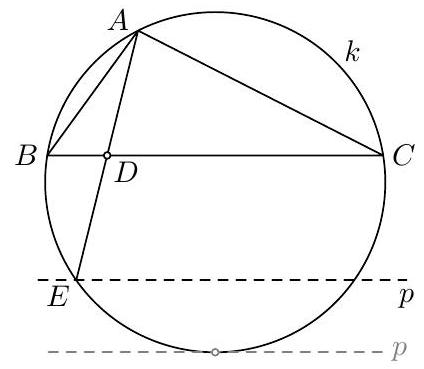
Fig. 2
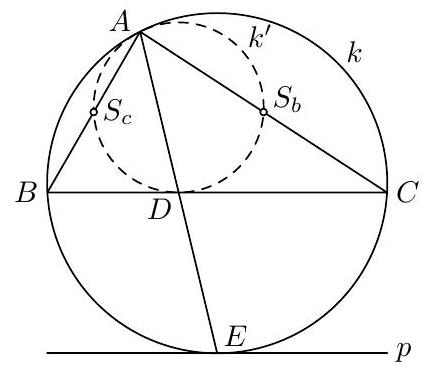
Fig. 3
Let us denote $S_{b}$ and $S_{c}$ in order the centers of $A C$ and $A B$. The homothety with the center $A$ and a coefficient $\frac{1}{2}$ sends $A, B, C, E$ (lying on the circle $k$ ) to $A, S_{c}$, $S_{b}, D$ which lie on the circle $k^{\prime}$ (Fig. 2), while the image of $p$ is the tangent $B C$ of $k^{\prime}$ in $D$. The powers of $B$ and $C$ with respect to $k^{\prime}$ give $|B D|^{2}=|B A| \cdot\left|B S_{c}\right|=\frac{1}{2}|B A|^{2}$ and $|C D|^{2}=|C A| \cdot\left|C S_{b}\right|=\frac{1}{2}|C A|^{2}$. All together for the perimeter of $A B C$ :
$$
|B C|+|A B|+|A C|=|B C|+\sqrt{2}(|B D|+|C D|)=|B C|+\sqrt{2} \cdot|B C|=1+\sqrt{2},
$$
which is the only possible value.
6. There is a figure of prince on a field of a $6 \times 6$ square chessboard. The prince can in one move jump either horizontally or vertically. The lengths of the jumps are alternately either one or two fields, and the jump on the next field is the first one. Decide, whether one can chose the initial field for the prince, so that the prince visits in an appropriate sequence of 35 jumps every field of the chessboard.
(Peter Novotný)
Solution. Let us suppose, the appropriate sequence exists and let us enumerate the fields of the chessboard as follows:
| 1 | 2 | 3 | 4 | 1 | 2 |
| :--- | :--- | :--- | :--- | :--- | :--- |
| 2 | 3 | 4 | 1 | 2 | 3 |
| 3 | 4 | 1 | 2 | 3 | 4 |
| 4 | 1 | 2 | 3 | 4 | 1 |
| 1 | 2 | 3 | 4 | 1 | 2 |
| 2 | 3 | 4 | 1 | 2 | 3 |
The length one moves go from odd to even number and vice versa. The length two moves go from even to a different even number or from odd to a different odd number. If we denote $P_{1}, P_{2}, \ldots, P_{36}$ the numbers of visited fields, then it follows, that among $P_{2}, P_{3}, P_{4}, P_{5}$ is each number (from 1 to 4 ) exactly once ( $P_{2}$ and $P_{3}$ are different numbers with the same parity, and $P_{4}, P_{5}$ as well, only the parity is different). from the same reasons is any of the four numbers among $P_{4 k+2}, P_{4 k+3}$, $P_{4 k+4}, P_{4 k+5}$ for arbitrary $k \in\{0,1, \ldots, 7\}$. Between the numbers $P_{2}, P_{3}, \ldots, P_{33}$ is thus any of the numbers 1 to 4 exactly eight times.
The number 4 is on the chessboard just eight times, thus no from $P_{1}, P_{34}, P_{35}$, $P_{36}$ can be 4 . The numbers $P_{34}$ and $P_{35}$ have the same parity and are different (they are the length two move apart) The number 4 is not among them, therefore both must be odd. Then $P_{36}$ has to be even and $P_{1}$ as well. Thus it has to be number 2 .
The initial field $\left(P_{1}\right)$ thus has to be one of the coloured fields on the left chessboard. One can repeat the arguments for the numbering of the right chessboard (just a rotation of the left one). Since no field has number 2 on both chessboard, we came to the contradiction. The initial field cannot be chosen.
| $\mathbf{1}$ | $\mathbf{2}$ | 3 | 4 | 1 | $\mathbf{2}$ |
| :--- | :--- | :--- | :--- | :--- | :--- |
| $\mathbf{2}$ | 3 | 4 | 1 | $\mathbf{2}$ | 3 |
| 3 | 4 | 1 | $\mathbf{2}$ | 3 | 4 |
| 4 | 1 | $\mathbf{2}$ | 3 | 4 | 1 |
| 1 | $\mathbf{2}$ | 3 | 4 | 1 | $\mathbf{2}$ |
| $\mathbf{2}$ | 3 | 4 | 1 | $\mathbf{2}$ | 3 |
| $\mathbf{2}$ | 3 | 4 | 1 | $\mathbf{2}$ | 3 |
| :--- | :--- | :--- | :--- | :--- | :--- |
| 1 | $\mathbf{2}$ | 3 | 4 | 1 | $\mathbf{2}$ |
| 4 | 1 | $\mathbf{2}$ | 3 | 4 | 1 |
| 3 | 4 | 1 | $\mathbf{2}$ | 3 | 4 |
| $\mathbf{2}$ | 3 | 4 | 1 | $\mathbf{2}$ | 3 |
| 1 | $\mathbf{2}$ | 3 | 4 | 1 | $\mathbf{2}$ |
[^0]: * It is correct also for a prime $p=n-1$, where a factor $f_{p+1}=f_{n}$ is the last factor in (1); in this case we choose $f_{n}=n$ !.
** The choice of $f_{3}$ will be the last, it corresponds to the smallest prime $p=2$.
|