

File size: 10,657 Bytes
a67ef7c | 1 2 3 4 5 6 7 8 9 10 11 12 13 14 15 16 17 18 19 20 21 22 23 24 25 26 27 28 29 30 31 32 33 34 35 36 37 38 39 40 41 42 43 44 45 46 47 48 49 50 51 52 53 54 55 56 57 58 59 60 61 62 63 64 65 66 67 68 69 70 71 72 73 74 75 76 77 78 79 80 81 82 83 84 85 86 87 88 89 90 91 92 93 94 95 96 97 98 99 100 101 102 103 104 105 106 107 108 109 110 111 112 113 114 115 116 117 118 119 120 121 122 123 124 125 126 127 128 129 130 131 132 133 134 135 136 137 138 139 140 141 142 143 144 145 146 147 148 149 150 151 152 153 154 155 156 157 158 159 160 161 162 163 164 165 166 167 168 169 170 171 172 173 174 175 176 177 178 179 180 181 182 183 184 185 186 187 188 189 190 191 192 193 194 195 196 197 198 199 200 201 202 203 204 205 206 207 208 209 210 211 212 213 214 215 216 217 218 219 220 221 222 223 224 225 226 227 228 229 230 231 232 233 234 235 236 237 238 239 240 241 242 243 244 245 246 247 248 249 250 251 252 253 254 255 256 257 258 259 260 261 262 263 264 265 266 267 268 269 | # APMO 1989 - Problems and Solutions
## Problem 1
Let $x_{1}, x_{2}, \ldots, x_{n}$ be positive real numbers, and let
$$
S=x_{1}+x_{2}+\cdots+x_{n}
$$
Prove that
$$
\left(1+x_{1}\right)\left(1+x_{2}\right) \cdots\left(1+x_{n}\right) \leq 1+S+\frac{S^{2}}{2!}+\frac{S^{3}}{3!}+\cdots+\frac{S^{n}}{n!}
$$
## Solution 1
Let $\sigma_{k}$ be the $k$ th symmetric polynomial, namely
$$
\sigma_{k}=\sum_{\substack{|S|=k \\ S \subseteq\{1,2, \ldots, n\}}} \prod_{i \in S} x_{i},
$$
and more explicitly
$$
\sigma_{1}=S, \quad \sigma_{2}=x_{1} x_{2}+x_{1} x_{3}+\cdots+x_{n-1} x_{n}, \quad \text { and so on. }
$$
Then
$$
\left(1+x_{1}\right)\left(1+x_{2}\right) \cdots\left(1+x_{n}\right)=1+\sigma_{1}+\sigma_{2}+\cdots+\sigma_{n}
$$
The expansion of
$$
S^{k}=\left(x_{1}+x_{2}+\cdots+x_{n}\right)^{k}=\underbrace{\left(x_{1}+x_{2}+\cdots+x_{n}\right)\left(x_{1}+x_{2}+\cdots+x_{n}\right) \cdots\left(x_{1}+x_{2}+\cdots+x_{n}\right)}_{k \text { times }}
$$
has at least $k$ ! occurrences of $\prod_{i \in S} x_{i}$ for each subset $S$ with $k$ indices from $\{1,2, \ldots, n\}$. In fact, if $\pi$ is a permutation of $S$, we can choose each $x_{\pi(i)}$ from the $i$ th factor of $\left(x_{1}+x_{2}+\cdots+x_{n}\right)^{k}$. Then each term appears at least $k$ ! times, and
$$
S^{k} \geq k!\sigma_{k} \Longleftrightarrow \sigma_{k} \leq \frac{S^{k}}{k!}
$$
Summing the obtained inequalities for $k=1,2, \ldots, n$ yields the result.
## Solution 2
By AM-GM,
$$
\left(1+x_{1}\right)\left(1+x_{2}\right) \cdots\left(1+x_{n}\right) \leq\left(\frac{\left(1+x_{1}\right)+\left(1+x_{2}\right)+\cdots+\left(1+x_{n}\right)}{n}\right)^{n}=\left(1+\frac{S}{n}\right)^{n}
$$
By the binomial theorem,
$$
\left(1+\frac{S}{n}\right)^{n}=\sum_{k=0}^{n}\binom{n}{k}\left(\frac{S}{n}\right)^{k}=\sum_{k=0}^{n} \frac{1}{k!} \frac{n(n-1) \ldots(n-k+1)}{n^{k}} S^{k} \leq \sum_{k=0}^{n} \frac{S^{k}}{k!}
$$
and the result follows.
Comment: Maclaurin's inequality states that
$$
\frac{\sigma_{1}}{n} \geq \sqrt{\frac{\sigma_{2}}{\binom{n}{2}}} \geq \cdots \geq \sqrt[k]{\frac{\sigma_{k}}{\binom{n}{k}}} \geq \cdots \geq \sqrt[n]{\frac{\sigma_{n}}{\binom{n}{n}}}
$$
Then $\sigma_{k} \leq\binom{ n}{k} \frac{S^{k}}{n^{k}}=\frac{1}{k!} \frac{n(n-1) \ldots(n-k+1)}{n^{k}} S^{k} \leq \frac{S^{k}}{k!}$.
## Problem 2
Prove that the equation
$$
6\left(6 a^{2}+3 b^{2}+c^{2}\right)=5 n^{2}
$$
has no solutions in integers except $a=b=c=n=0$.
## Solution
We can suppose without loss of generality that $a, b, c, n \geq 0$. Let $(a, b, c, n)$ be a solution with minimum sum $a+b+c+n$. Suppose, for the sake of contradiction, that $a+b+c+n>0$. Since 6 divides $5 n^{2}, n$ is a multiple of 6 . Let $n=6 n_{0}$. Then the equation reduces to
$$
6 a^{2}+3 b^{2}+c^{2}=30 n_{0}^{2}
$$
The number $c$ is a multiple of 3 , so let $c=3 c_{0}$. The equation now reduces to
$$
2 a^{2}+b^{2}+3 c_{0}^{2}=10 n_{0}^{2}
$$
Now look at the equation modulo 8:
$$
b^{2}+3 c_{0}^{2} \equiv 2\left(n_{0}^{2}-a^{2}\right) \quad(\bmod 8)
$$
Integers $b$ and $c_{0}$ have the same parity. Either way, since $x^{2}$ is congruent to 0 or 1 modulo 4 , $b^{2}+3 c_{0}^{2}$ is a multiple of 4 , so $n_{0}^{2}-a^{2}=\left(n_{0}-a\right)\left(n_{0}+a\right)$ is even, and therefore also a multiple of 4 , since $n_{0}-a$ and $n_{0}+a$ have the same parity. Hence $2\left(n_{0}^{2}-a^{2}\right)$ is a multiple of 8 , and
$$
b^{2}+3 c_{0}^{2} \equiv 0 \quad(\bmod 8)
$$
If $b$ and $c_{0}$ are both odd, $b^{2}+3 c_{0}^{2} \equiv 4(\bmod 8)$, which is impossible. Then $b$ and $c_{0}$ are both even. Let $b=2 b_{0}$ and $c_{0}=2 c_{1}$, and we find
$$
a^{2}+2 b_{0}^{2}+6 c_{1}^{2}=5 n_{0}^{2}
$$
Look at the last equation modulo 8:
$$
a^{2}+3 n_{0}^{2} \equiv 2\left(c_{1}^{2}-b_{0}^{2}\right) \quad(\bmod 8)
$$
A similar argument shows that $a$ and $n_{0}$ are both even.
We have proven that $a, b, c, n$ are all even. Then, dividing the original equation by 4 we find
$$
6\left(6(a / 2)^{2}+3(b / 2)^{2}+(c / 2)^{2}\right)=5(n / 2)^{2}
$$
and we find that $(a / 2, b / 2, c / 2, n / 2)$ is a new solution with smaller sum. This is a contradiction, and the only solution is $(a, b, c, n)=(0,0,0,0)$.
## Problem 3
Let $A_{1}, A_{2}, A_{3}$ be three points in the plane, and for convenience,let $A_{4}=A_{1}, A_{5}=A_{2}$. For $n=1,2$, and 3 , suppose that $B_{n}$ is the midpoint of $A_{n} A_{n+1}$, and suppose that $C_{n}$ is the midpoint of $A_{n} B_{n}$. Suppose that $A_{n} C_{n+1}$ and $B_{n} A_{n+2}$ meet at $D_{n}$, and that $A_{n} B_{n+1}$ and $C_{n} A_{n+2}$ meet at $E_{n}$. Calculate the ratio of the area of triangle $D_{1} D_{2} D_{3}$ to the area of triangle $E_{1} E_{2} E_{3}$.
Answer: $\frac{25}{49}$.
Solution
Let $G$ be the centroid of triangle $A B C$, and also the intersection point of $A_{1} B_{2}, A_{2} B_{3}$, and $A_{3} B_{1}$ 。
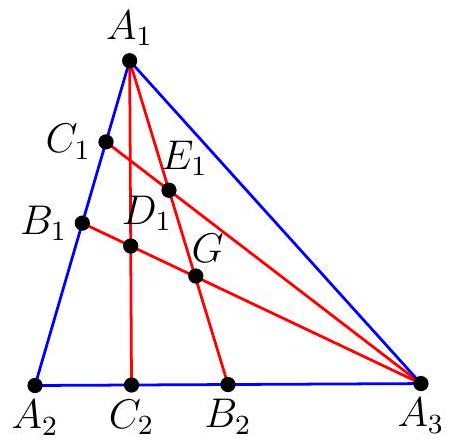
By Menelao's theorem on triangle $B_{1} A_{2} A_{3}$ and line $A_{1} D_{1} C_{2}$,
$$
\frac{A_{1} B_{1}}{A_{1} A_{2}} \cdot \frac{D_{1} A_{3}}{D_{1} B_{1}} \cdot \frac{C_{2} A_{2}}{C_{2} A_{3}}=1 \Longleftrightarrow \frac{D_{1} A_{3}}{D_{1} B_{1}}=2 \cdot 3=6 \Longleftrightarrow \frac{D_{1} B_{1}}{A_{3} B_{1}}=\frac{1}{7}
$$
Since $A_{3} G=\frac{2}{3} A_{3} B_{1}$, if $A_{3} B_{1}=21 t$ then $G A_{3}=14 t, D_{1} B_{1}=\frac{21 t}{7}=3 t, A_{3} D_{1}=18 t$, and $G D_{1}=A_{3} D_{1}-A_{3} G=18 t-14 t=4 t$, and
$$
\frac{G D_{1}}{G A_{3}}=\frac{4}{14}=\frac{2}{7}
$$
Similar results hold for the other medians, therefore $D_{1} D_{2} D_{3}$ and $A_{1} A_{2} A_{3}$ are homothetic with center $G$ and ratio $-\frac{2}{7}$.
By Menelao's theorem on triangle $A_{1} A_{2} B_{2}$ and line $C_{1} E_{1} A_{3}$,
$$
\frac{C_{1} A_{1}}{C_{1} A_{2}} \cdot \frac{E_{1} B_{2}}{E_{1} A_{1}} \cdot \frac{A_{3} A_{2}}{A_{3} B_{2}}=1 \Longleftrightarrow \frac{E_{1} B_{2}}{E_{1} A_{1}}=3 \cdot \frac{1}{2}=\frac{3}{2} \Longleftrightarrow \frac{A_{1} E_{1}}{A_{1} B_{2}}=\frac{2}{5}
$$
If $A_{1} B_{2}=15 u$, then $A_{1} G=\frac{2}{3} \cdot 15 u=10 u$ and $G E_{1}=A_{1} G-A_{1} E_{1}=10 u-\frac{2}{5} \cdot 15 u=4 u$, and
$$
\frac{G E_{1}}{G A_{1}}=\frac{4}{10}=\frac{2}{5}
$$
Similar results hold for the other medians, therefore $E_{1} E_{2} E_{3}$ and $A_{1} A_{2} A_{3}$ are homothetic with center $G$ and ratio $\frac{2}{5}$.
Then $D_{1} D_{2} D_{3}$ and $E_{1} E_{2} E_{3}$ are homothetic with center $G$ and ratio $-\frac{2}{7}: \frac{2}{5}=-\frac{5}{7}$, and the ratio of their area is $\left(\frac{5}{7}\right)^{2}=\frac{25}{49}$.
## Problem 4
Let $S$ be a set consisting of $m$ pairs $(a, b)$ of positive integers with the property that $1 \leq a<$ $b \leq n$. Show that there are at least
$$
4 m \frac{\left(m-\frac{n^{2}}{4}\right)}{3 n}
$$
triples $(a, b, c)$ such that $(a, b),(a, c)$, and $(b, c)$ belong to $S$.
## Solution
Call a triple $(a, b, c)$ good if and only if $(a, b),(a, c)$, and $(b, c)$ all belong to $S$. For $i$ in $\{1,2, \ldots, n\}$, let $d_{i}$ be the number of pairs in $S$ that contain $i$, and let $D_{i}$ be the set of numbers paired with $i$ in $S$ (so $\left|D_{i}\right|=d_{i}$ ). Consider a pair $(i, j) \in S$. Our goal is to estimate the number of integers $k$ such that any permutation of $\{i, j, k\}$ is good, that is, $\left|D_{i} \cap D_{j}\right|$. Note that $i \notin D_{i}$ and $j \notin D_{j}$, so $i, j \notin D_{i} \cap D_{j}$; thus any $k \in D_{i} \cap D_{j}$ is different from both $i$ and $j$, and $\{i, j, k\}$ has three elements as required. Now, since $D_{i} \cup D_{j} \subseteq\{1,2, \ldots, n\}$,
$$
\left|D_{i} \cap D_{j}\right|=\left|D_{i}\right|+\left|D_{j}\right|-\left|D_{i} \cup D_{j}\right| \leq d_{i}+d_{j}-n
$$
Summing all the results, and having in mind that each good triple is counted three times (one for each two of the three numbers), the number of good triples $T$ is at least
$$
T \geq \frac{1}{3} \sum_{(i, j) \in S}\left(d_{i}+d_{j}-n\right)
$$
Each term $d_{i}$ appears each time $i$ is in a pair from $S$, that is, $d_{i}$ times; there are $m$ pairs in $S$, so $n$ is subtracted $m$ times. By the Cauchy-Schwartz inequality
$$
T \geq \frac{1}{3}\left(\sum_{i=1}^{n} d_{i}^{2}-m n\right) \geq \frac{1}{3}\left(\frac{\left(\sum_{i=1}^{n} d_{i}\right)^{2}}{n}-m n\right) .
$$
Finally, the sum $\sum_{i=1}^{n} d_{i}$ is $2 m$, since $d_{i}$ counts the number of pairs containing $i$, and each pair $(i, j)$ is counted twice: once in $d_{i}$ and once in $d_{j}$. Therefore
$$
T \geq \frac{1}{3}\left(\frac{(2 m)^{2}}{n}-m n\right)=4 m \frac{\left(m-\frac{n^{2}}{4}\right)}{3 n} .
$$
Comment: This is a celebrated graph theory fact named Goodman's bound, after A. M. Goodman's method published in 1959. The generalized version of the problem is still studied to this day.
## Problem 5
Determine all functions $f$ from the reals to the reals for which
(1) $f(x)$ is strictly increasing,
(2) $f(x)+g(x)=2 x$ for all real $x$, where $g(x)$ is the composition inverse function to $f(x)$.
(Note: $f$ and $g$ are said to be composition inverses if $f(g(x))=x$ and $g(f(x))=x$ for all real x.)
Answer: $f(x)=x+c, c \in \mathbb{R}$ constant.
## Solution
Denote by $f_{n}$ the $n$th iterate of $f$, that is, $f_{n}(x)=\underbrace{f(f(\ldots f}_{n \text { times }}(x)))$.
Plug $x \rightarrow f_{n+1}(x)$ in (2): since $g\left(f_{n+1}(x)\right)=g\left(f\left(f_{n}(x)\right)\right)=f_{n}(x)$,
$$
f_{n+2}(x)+f_{n}(x)=2 f_{n+1}(x)
$$
that is,
$$
f_{n+2}(x)-f_{n+1}(x)=f_{n+1}(x)-f_{n}(x)
$$
Therefore $f_{n}(x)-f_{n-1}(x)$ does not depend on $n$, and is equal to $f(x)-x$. Summing the corresponding results for smaller values of $n$ we find
$$
f_{n}(x)-x=n(f(x)-x) .
$$
Since $g$ has the same properties as $f$,
$$
g_{n}(x)-x=n(g(x)-x)=-n(f(x)-x) .
$$
Finally, $g$ is also increasing, because since $f$ is increasing $g(x)>g(y) \Longrightarrow f(g(x))>$ $f(g(y)) \Longrightarrow x>y$. An induction proves that $f_{n}$ and $g_{n}$ are also increasing functions.
Let $x>y$ be real numbers. Since $f_{n}$ and $g_{n}$ are increasing,
$$
x+n(f(x)-x)>y+n(f(y)-y) \Longleftrightarrow n[(f(x)-x)-(f(y)-y)]>y-x
$$
and
$$
x-n(f(x)-x)>y-n(f(y)-y) \Longleftrightarrow n[(f(x)-x)-(f(y)-y)]<x-y
$$
Summing it up,
$$
|n[(f(x)-x)-(f(y)-y)]|<x-y \quad \text { for all } n \in \mathbb{Z}_{>0}
$$
Suppose that $a=f(x)-x$ and $b=f(y)-y$ are distinct. Then, for all positive integers $n$,
$$
|n(a-b)|<x-y
$$
which is false for a sufficiently large $n$. Hence $a=b$, and $f(x)-x$ is a constant $c$ for all $x \in \mathbb{R}$, that is, $f(x)=x+c$.
It is immediate that $f(x)=x+c$ satisfies the problem, as $g(x)=x-c$.
|