

File size: 12,271 Bytes
a67ef7c | 1 2 3 4 5 6 7 8 9 10 11 12 13 14 15 16 17 18 19 20 21 22 23 24 25 26 27 28 29 30 31 32 33 34 35 36 37 38 39 40 41 42 43 44 45 46 47 48 49 50 51 52 53 54 55 56 57 58 59 60 61 62 63 64 65 66 67 68 69 70 71 72 73 74 75 76 77 78 79 80 81 82 83 84 85 86 87 88 89 90 91 92 93 94 95 96 97 98 99 100 101 102 103 104 105 106 107 108 109 110 111 112 113 114 115 116 117 118 119 120 121 122 123 124 125 126 127 128 129 130 131 132 133 134 135 136 137 138 139 140 141 142 143 144 145 146 147 148 149 150 151 152 153 154 155 156 157 158 159 160 161 162 163 164 165 166 167 168 169 170 171 172 173 174 175 176 177 178 179 180 181 182 183 184 185 186 187 188 189 190 191 192 193 194 195 196 197 198 199 200 201 202 203 204 205 206 207 208 209 210 211 212 213 214 215 216 217 218 219 220 221 222 223 224 225 226 227 228 229 230 231 232 233 | # Solutions
Note: The points to be awarded for each part of the solution are indicated on the right side.
Problem 1.
$$
\begin{gathered}
1=\frac{1 \times 2}{2} \\
1+\frac{1}{3}=\frac{2 \times 2}{3} \\
1+\frac{1}{3}+\frac{1}{6}+\ldots+\frac{1}{r_{n}}=\frac{n<2}{n+1}
\end{gathered}
$$
which is easily shown by induction.
(up to 3 points)
Now 5 is the sum of the reciprocals of these numbers where the last, $1993006=$
$1996 \times 1997$ $\frac{1996 \times 1997}{2}=8996$. Thus we have
$$
\begin{gathered}
S=\frac{1}{2}\left(\frac{2}{1}+\frac{3}{2}+\ldots+\frac{1997}{1996}\right) \\
=\frac{1}{2}\left(1996+\left(1+\frac{1}{2}+\ldots+\frac{1}{1996}\right)\right)
\end{gathered}
$$
(ap to 3 points)
$$
\therefore \frac{1}{2}(1996+6)
$$
$$
=1001
$$
P'roblem 2. Note that $2^{n+2}=2\left(2^{n-1}+1\right)$ so that $n$ is of the form 2 r with r odd. We will consider two cases.
i) $n=2 p$ with $p$ prime. $2 p \mid 2^{2 p}+2$, implies that $p!2^{2 n-1}+1$ and hence, hence $p \mid 2^{40-2}-1$. On the
 follows that $p \mid 2^{d}-1$. But $d \mid p-1$ and $d \mid 4 p-2=4(p-1)+2$. Fence $d \mid 2$ and since $p-1,4 p-2$ are even $d=2$. Then $p=3$ and $n=6<100$.
(up to 2 points)
ii) $n=2 p q$ where $p, q$ are odd primes, $p<q$ and $p q<\frac{1997}{2}$. Now $n!2 r+2$ impites that $p i 2^{n-1}$ +1 and therefore that $\mathrm{p}^{\prime} 2^{2 \mathrm{~m}-2} . .1=2^{4 \mathrm{~m}-2}-1$. Once again by Femat's theorern we have pl $2^{n-1}$ 1 which implies that $\mathrm{p}-1 / 4 \mathrm{pq}$-2. The same holds tole for q so that
$$
q-1 \mid 4 p q-2
$$
Both $p-1$ and $q-1$ are thus multiples of 2 but not of 4 su that $p \equiv q \equiv 3$ (mod 4).
( points)
laking $p=3$, we huve $4 p q-2=12 q-2$. Now from (1) we have
$$
12=\frac{12 q-12}{q-1}<\frac{12 q-2}{q-1}=\frac{12(q-1)+10}{q-1}=12+\frac{10}{q-1} \leq 1
$$
if $q \geq 11$, and clearly $\frac{12 q-?}{q-1}=13$ if $q=11$. But this gives $n=2(3)(11)=66<100$. Furthermore $(p, \varphi)=:(3,7)$ does not salisty (1).
Taking $p=7$ we observe that $4 \mathrm{pq}-2=28 \mathrm{q}-2$, and from (1) we have
$$
28<\frac{28 q-2}{q-1}=\frac{28(q-1)+26}{q-1}=28+\frac{26}{q-1} \leq 2
$$
if $q \geq 27$ and clearly $\frac{28 q-2}{q-1}=29$ if $q=27$. But 27 is not prime and the cases $(p, q)=(7$. 11), (7,19) and (7,23) do not satisfy (1).
Taking $p=11$, then $4 p q-2=44 q-2$, and
$$
44<\frac{44 q-2}{y-1} \text { and } \frac{44 q-2}{q-1} \leq 45 \text { if } q \geq 43 .
$$
Now clearly $\frac{44 q-2}{q-1}=45$ when $q=43$. In this case we have $n:=2 p q=2(11)(43)=946$.
Furthermore, $\frac{2^{44 x}+2}{946}$ is incieed an integer. The cases $(p, q)=(11,19),(11,23)$ and 111,31$)$ do not satisfy (1).
(2 points)
[Aditionally for completeness, if $p=19$ then $4 p y-2=76 q-2$ and $76<\frac{76 q-2}{4-1}=77$ if $q$ $\geqq 75$. Now 75 is not prime and for the cases $(p, 4)=(19,23),(19,31),(19,43)$ and $(19,47), q$ -1 is not a divisor of $74=2 \times 37$.
Similarly, if $p=23$ then $4 \mathrm{pq}-2=92 \mathrm{q}-2$ and $92<\frac{92 q-2}{q-\Gamma} \leq 93$ if $q \geq 91$ and $\frac{92 q-2}{q-1}=93$ if $q=91$. But 91 is not prime and of the cases $(p, q)=(23,31),(23,43)$, when q $=31$ all of the conditions are satisfied. But, $n=2 p q=1426$ is not a solution because $\frac{2^{1426}+2}{1+20}$
is not an integer.
No other pairs of F, q yield numbers within the required range.]
(1) point)
## Problem 3.
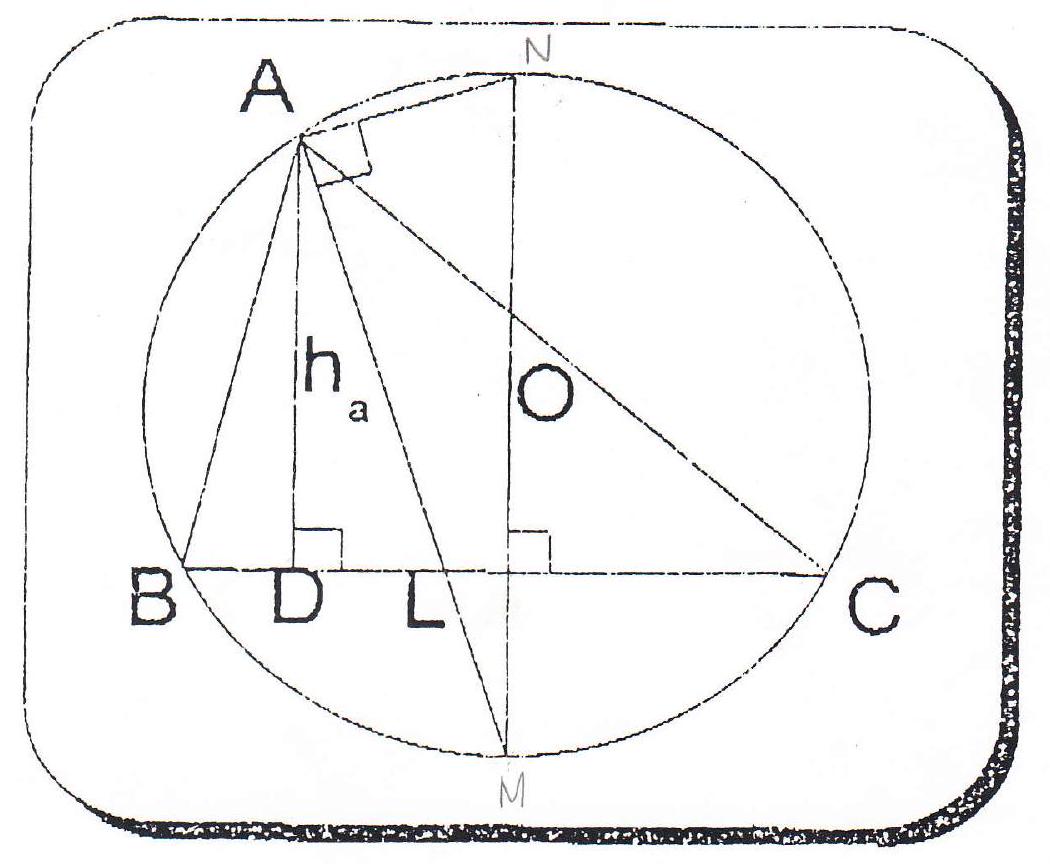
$\angle A L D=\frac{1}{2}(\overparen{M C}+\widehat{A B})$
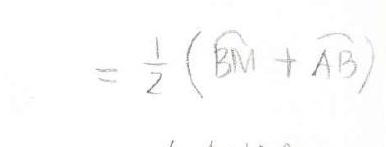
$\angle \triangle N M$
It is known (see Geometry Revisited) or easily derivable that
$$
m_{a}^{2}=(A L)^{2}=b c\left(1-\left(\frac{a}{b+c}\right)^{2}\right)
$$
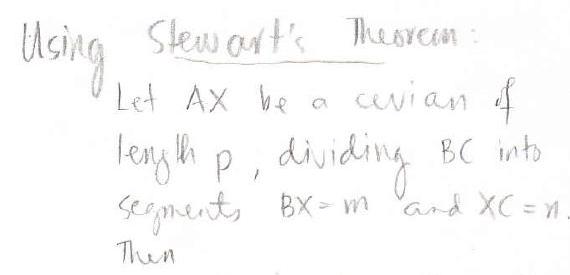
(1 point)
From $\triangle$ ADL a MAN we have
$$
\begin{gathered}
\frac{A D}{A L}=\frac{4 M}{M N} \Rightarrow \\
h_{a} \cdot 2 R=A L \cdot A M=m_{a} \cdot M a \\
h_{a}=\frac{2(A B C)}{a}
\end{gathered}
$$
$$
\begin{gathered}
\frac{2(A B C)}{a} \cdot 2 R=m_{a} M_{a} \\
\frac{\frac{u b c}{d} \cdot 4 R}{a}=m_{a} M_{a} \\
b c=m_{a} M_{u}
\end{gathered}
$$
So that
$$
l_{a}=\frac{m_{a}^{2}}{m_{a} I_{a}}=1-(b+c)^{2}
$$
with similar expressions for $l_{b}$ and $l_{c}$.
(2 points)
$\therefore$ Given that $\sin A=\frac{t^{2}}{2 k}$, etc. the expression we are working with becomes
$$
\begin{aligned}
& \frac{l_{a}}{\sin ^{2} \cdot A}+\frac{l_{b}}{\sin ^{2} A}+\frac{l_{b}}{\sin ^{2} C^{2}}=\frac{4 R^{2}}{a^{2}}\left(1-\left(\frac{b^{2}}{b+c}\right)^{2}\right)+\frac{4 R^{2}}{b^{2}}\left(1-\left(\frac{b}{a+c}\right)^{2}\right)+\frac{4 R^{2}}{c^{2}}\left(1-\left(\frac{i}{a-b}\right)^{2}\right) \\
& =4 R^{2}\left[\left(\frac{1}{a^{2}}-\frac{1}{(b+c)^{2}}\right)+\left(\frac{1}{b^{2}}-\frac{1}{(a+c)^{2}}\right)+\left(\frac{1}{c^{2}}-\frac{1}{(a+b)^{2}}\right)\right] \\
& \geq 4 R^{2}\left[\frac{1}{a^{2}}-\frac{1}{4 b c}+\frac{1}{b^{2}}-\frac{1}{4 a c}+\frac{1}{c^{2}}-\frac{1}{4 a b}\right] \\
& =2 \mathrm{R}^{2}\left[\left(\frac{1}{a^{2}}+\frac{1}{b^{2}}\right)+\left(\frac{1}{a^{2}}+\frac{1}{c^{2}}\right)+\left(\frac{1}{b^{2}}+\frac{1}{c^{2}}\right)-\frac{1}{2 a b}-\frac{1}{2 a c}-\frac{1}{2 b c}\right] \\
& 2\left[\frac{2}{a b}+\frac{2}{a c}+\frac{2}{b c}-\frac{1}{2 a b}-\frac{1}{2 a c}-\frac{1}{2 b c}\right] \\
& =2 R^{2}\left[2 \frac{3}{2 b}+\frac{3}{2 a c}+\frac{3}{2 b c}\right] \\
& =3 R^{2}\left[\frac{1}{a b}+\frac{1}{a c}+\frac{1}{b c}\right]=3 R^{2}\left[\frac{a+b+c}{a b c}\right]
\end{aligned}
$$
But $a b c=f R(.4 B C)$ so that this last expression becomes
$$
\frac{3 R(a+b+c)}{4(A B C)}=\frac{3 R \cdot 2 s}{4 s r}=3 \cdot \frac{\beta}{2 r}=3
$$
since $R \geq 2 r$. All of the inequalitics are equalities iff $a=b=c$.
(1 point)
## Problem 4.
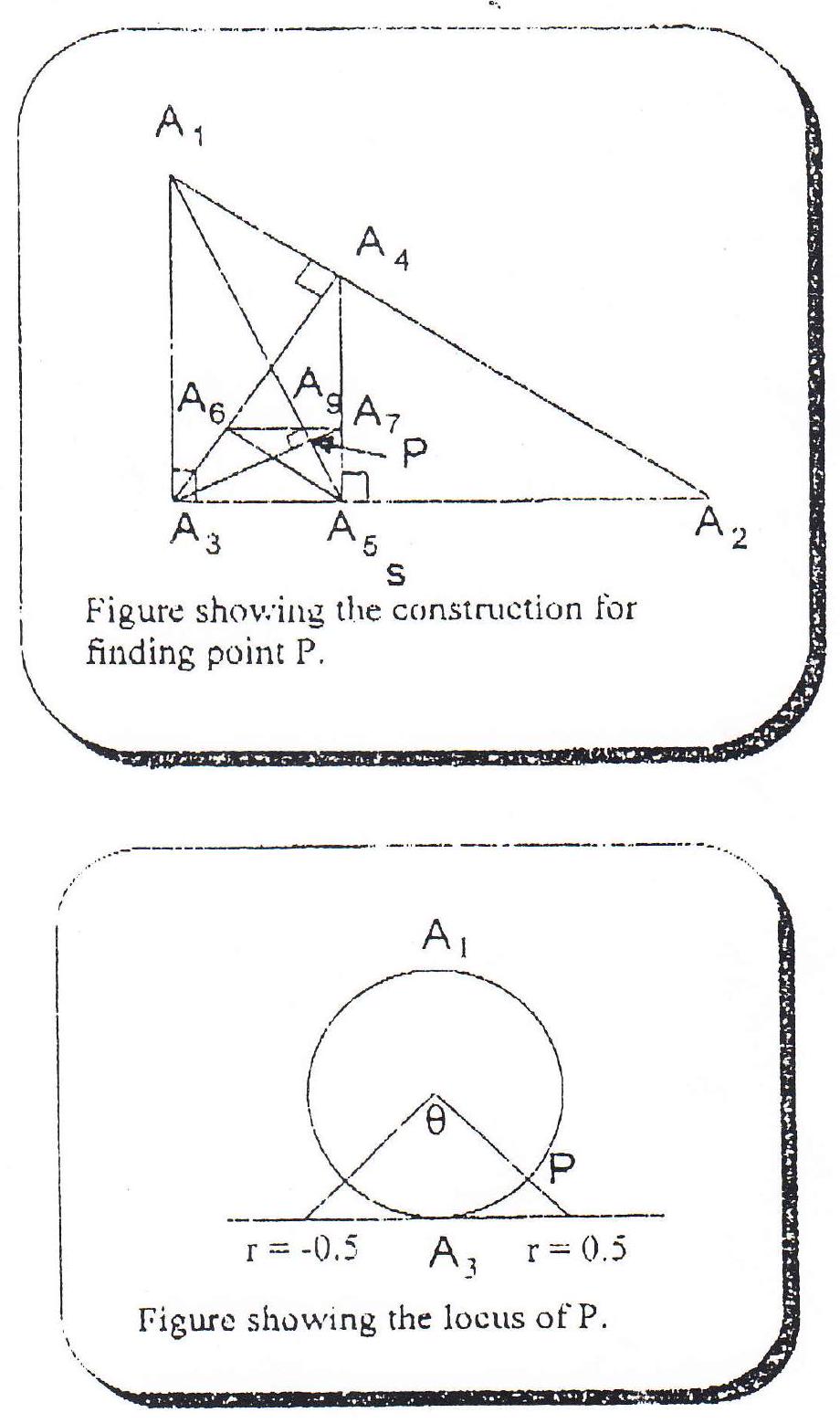
- (a) Consider the gequence of triangles on the plane 4 . $42,4, A_{2}, 4,4,4,4,4, \ldots$ It is easy to see that any pair of them are similar. Let's prove that triangles $A_{1} A_{3} A_{5}$ and $A_{3} A$; are similar.
Triangles $A_{2} A_{3} A_{4}$ and $A_{4} A_{4} A_{6}$ are similar and their altitudes are $A_{4} A_{5}$ and $A_{6}, A_{0}$, then
$$
\frac{A_{2} A_{3}}{A_{4}}=\frac{A_{4} A_{5}}{A_{6} A_{7}} .
$$
Triangles $A A_{*} A_{s}$ and $A_{s} A_{*} A$ - are similar. then
$$
\frac{A+A_{5}}{A_{0} A_{7}}=\frac{A 3 A s}{A_{5} A_{7}}
$$
Now we can conclude that
$$
\frac{A_{1} A_{3}}{A_{3} A_{s}}=\frac{A_{3} A_{s}}{A_{4}}
$$
and triangles $A, A: A$ and $A ; A: A-$ are similar.
 $\triangle \quad A \cdot A_{s} A_{1}=\triangle \quad A-A_{3} P=\triangle \quad A_{A} A_{1}$, so triangle $A-A, P$ has a righr angle at $P$ and lines $A_{1} A_{5}$ and $A A^{A}$ - are perpendicular. In the same way lines $A A_{2}$. and $A$ are perpendicular and lines $A, A y$ and $A_{-1} A_{11}$ are perpendicular, hence $A_{1}, A_{3}, A_{9}$ are collinear and $A_{-}, A_{1 i} . A_{j}$ are collincar. It follows that triangle $A_{l A} A_{2} A_{;}$and $A_{0} A_{10} A_{l \mid}$ are homothetic and the center of homothety is P . Moreover, all
 an interior point to any of these triangles and there is no other point distinct from $P$ that is interior to any of these triangles. So this is the point we are looking for.
$$
\text { (up to }+ \text { points) }
$$
(b) Since $\triangle \quad A_{1} P A_{3} 90^{\prime \prime}$ then $P$ lies on the circle with diameter $A_{i}, A_{3}$. Let $A_{i} A_{3}=1, A_{2} A_{2}=s, A_{3} A_{3}$ $=r$ and let $A_{i} A_{2} A_{3}$ be clockwise. Triangles $A_{1} A_{2} A_{3}$ and $A_{3} A_{+} A_{5}$ are similar, thus $A_{2} A_{5}: r=s: 1$, and so $A_{2} A_{5}=r s$. Besides $A_{3} A_{y}=r \sqrt{1+s^{2}}$ (Pythagoras), and area of triangle $A_{1} A_{2} A_{3}=$ $\frac{1}{2} r \sqrt{1+s^{2}} \cdot \sqrt{1+s^{2}}=\frac{1}{2} s \cdot 1$. Thus $r=\frac{s}{1+s^{2}}$. By the arithmetic-geometric mean $\frac{s}{1+s^{2}} \leq \frac{1}{2}$, thus $r \leq \frac{1}{4}$ and the set of all possible values of $r$ consists of two real intervals $\left[-\frac{1}{2}, 0\right)$ and $\left(0, \frac{1}{2}\right]$. $\triangle A_{2} A_{1} P$ takes the maximum value when $r= \pm$ thus the locus of $P$
consists of two continuous arcs from the circle with dianeter $4, A_{i}$ with two extreme positions corresponding to $r=-\frac{1}{2}$ and $r=\frac{1}{2}$.
(up to 3 points)
## Problem 5.
A redistribution can be written as $\left(x_{1}, x_{2}, \cdots, x_{n}\right)$ where $x_{1}$ denotes the number of objects transferred from $A_{i}$ to $A_{i+1}$. Our objective is to minimize the function
$F\left(x_{1}, x_{2}, \cdots, x_{n}\right)=\sum_{i=1}^{n}\left|x_{1}\right|$
After redistribution we should have at each $A_{i}, a_{i}-x_{1}+x_{i-1}=N$ for $i \in\{1,2, \ldots, n\}$ where $x_{0}$ means $x_{n}$.
(1 point)
Solving this system of linear equations we obtain:
$x_{i}=x_{1}-\left[(i-1) N-a_{2}-a_{3}-\ldots-a_{i}\right]$
for $i \in\{1,2, \ldots, n\}$.
Hence
$$
\begin{aligned}
F\left(x_{1}, x_{2}, \ldots, x_{n}\right)= & \left|x_{1}\right|+\left|x_{1}-\left(N-a_{2}\right)\right|+\left|x_{1}-2 N-a_{2}-a_{3}\right| \\
& +\ldots+\left|x_{1}-\left[(n-1) N-a_{2}-a_{3}-\ldots-a_{n}\right]\right|
\end{aligned}
$$
Basically the problem reduces to find the minimum of $F(x)=\sum_{i=1}^{n}\left|x-\alpha_{i}\right|$ where $\alpha_{i}=(i-1) N-\sum_{j=2}^{i} a_{j}$.
(up to. 3 points)
First rearrange $\alpha_{1}, \alpha_{2}, \ldots, \alpha_{n}$ in non decreasing order. Collecting terms which are equal to one another we write the ordered sequence $\beta_{1}<\beta_{2}<\cdots<\beta_{m}$, each $\beta_{i}$ occurs $k_{i}$ times in the family $\left\{\alpha_{1}, \alpha_{2}, \cdots, \alpha_{n}\right\}$. Thus $k_{1}+k_{2}+\cdots+k_{m}=n$.
Consider the intervals $\left(-\infty, \beta_{1}\right],\left[\begin{array}{l}\beta_{1}, \beta_{2}\end{array}\right], \cdots,\left[\begin{array}{cc}\beta_{m-1}, \beta_{m}\end{array}\right],\left[\begin{array}{l}\left.\beta_{m}, \infty\right) \\ \end{array}\right.$ the graph of $F(x)=\sum_{i=1}^{n}\left|x-\alpha_{i}\right|=\sum_{i=1}^{m} k_{i}\left|x-\beta_{i}\right|$ is a continuos piece wise linear graph define in the following way:
$$
F(x)=\left\{\begin{array}{c}
k_{1}\left(\beta_{1}-x\right)+k_{2}\left(\beta_{2}-x\right)+\cdots+k_{m}\left(\beta_{m}-x\right) \text { if } \mathrm{x} \in\left(-\infty, \beta_{1}\right] \\
k_{1}\left(x-\beta_{1}\right)+k_{2}\left(\beta_{2}-x\right)+\cdots+k_{m}\left(\beta_{m}-x\right) \text { if } \mathrm{x} \in\left[\beta_{1}, \beta_{2}\right] \\
\vdots \\
\left.k_{1}\left(x-\beta_{1}\right)+k_{2}\left(x-\beta_{2}\right)+\cdots+k_{m}\right)\left(x-\beta_{m}\right) \text { if } \mathrm{x} \in\left[\beta_{m}, \infty\right)
\end{array}\right.
$$
The slopes of each line segment on each interval are respectively: $S_{0}=-k_{1}-k_{2}-k_{3}-\cdots-k_{m}$
$S_{1}=k_{1}-k_{2}-k_{3}-\cdots-k_{m}$
$S_{2}=k_{1}+k_{2}-k_{3}-\cdots-k_{m}$
$S_{m}=k_{1}+k_{2}+k_{3}+\cdots+k_{m}$
Note that this sequence of increasing numbers goes from a negative to a positive number, hence for some $t \geq 1$ there is an
$$
S_{t}=0 \text { or } S_{t-1}<0<S_{t}
$$
In the first case the minimum occurs at $x=\beta_{t}$ or $\beta_{t+1}$ and in the second case the minimum occurs at $x=\beta_{t}$
(Up to 7 points)
We can rephrase the computations above in terms of $\alpha_{1}, \alpha_{2}, \cdots, \alpha_{n}$ rather than $\beta_{1}, \beta_{2}, \cdots, \beta_{m}$. After rearranging the $\alpha^{\prime} s$ in non decreasing order, pick $x=\alpha \quad$ if $n$ is odd and take $x=\alpha$ or $\alpha \quad$ if $n$ is even.
$$
\frac{n+1}{2} \quad \frac{n}{2} \quad \frac{n}{2}+1
$$
If no justification is given for the choice of $x$, give up to 4 points.
|