

File size: 21,264 Bytes
a67ef7c | 1 2 3 4 5 6 7 8 9 10 11 12 13 14 15 16 17 18 19 20 21 22 23 24 25 26 27 28 29 30 31 32 33 34 35 36 37 38 39 40 41 42 43 44 45 46 47 48 49 50 51 52 53 54 55 56 57 58 59 60 61 62 63 64 65 66 67 68 69 70 71 72 73 74 75 76 77 78 79 80 81 82 83 84 85 86 87 88 89 90 91 92 93 94 95 96 97 98 99 100 101 102 103 104 105 106 107 108 109 110 111 112 113 114 115 116 117 118 119 120 121 122 123 124 125 126 127 128 129 130 131 132 133 134 135 136 137 138 139 140 141 142 143 144 145 146 147 148 149 150 151 152 153 154 155 156 157 158 159 160 161 162 163 164 165 166 167 168 169 170 171 172 173 174 175 176 177 178 179 180 181 182 183 184 185 186 187 188 189 190 191 192 193 194 195 196 197 198 199 200 201 202 203 204 205 206 207 208 209 210 211 212 213 214 215 216 217 218 219 220 221 222 223 224 225 226 227 228 229 230 231 232 233 234 235 236 237 238 239 240 241 242 243 244 245 246 247 248 249 250 251 252 253 254 255 256 257 258 259 260 261 262 263 264 265 266 267 268 269 270 271 272 273 274 275 276 277 278 279 280 281 282 283 284 285 286 287 288 289 290 291 292 293 | # APMO 2024 - Problems and Solutions
## Problem 1
Let $A B C$ be an acute triangle. Let $D$ be a point on side $A B$ and $E$ be a point on side $A C$ such that lines $B C$ and $D E$ are parallel. Let $X$ be an interior point of $B C E D$. Suppose rays $D X$ and $E X$ meet side $B C$ at points $P$ and $Q$, respectively such that both $P$ and $Q$ lie between $B$ and $C$. Suppose that the circumcircles of triangles $B Q X$ and $C P X$ intersect at a point $Y \neq X$. Prove that points $A, X$, and $Y$ are collinear.
## Solution 1
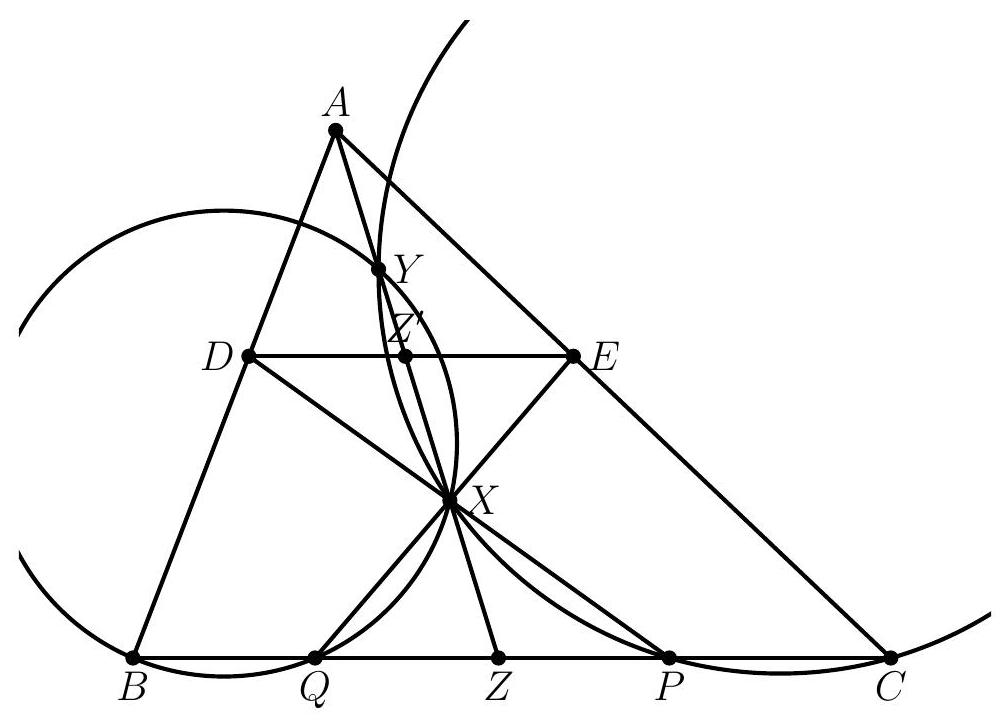
Let $\ell$ be the radical axis of circles $B Q X$ and $C P X$. Since $X$ and $Y$ are on $\ell$, it is sufficient to show that $A$ is on $\ell$. Let line $A X$ intersect segments $B C$ and $D E$ at $Z$ and $Z^{\prime}$, respectively. Then it is sufficient to show that $Z$ is on $\ell$. By $B C \| D E$, we obtain
$$
\frac{B Z}{Z C}=\frac{D Z^{\prime}}{Z^{\prime} E}=\frac{P Z}{Z Q},
$$
thus $B Z \cdot Q Z=C Z \cdot P Z$, which implies that $Z$ is on $\ell$.
## Solution 2
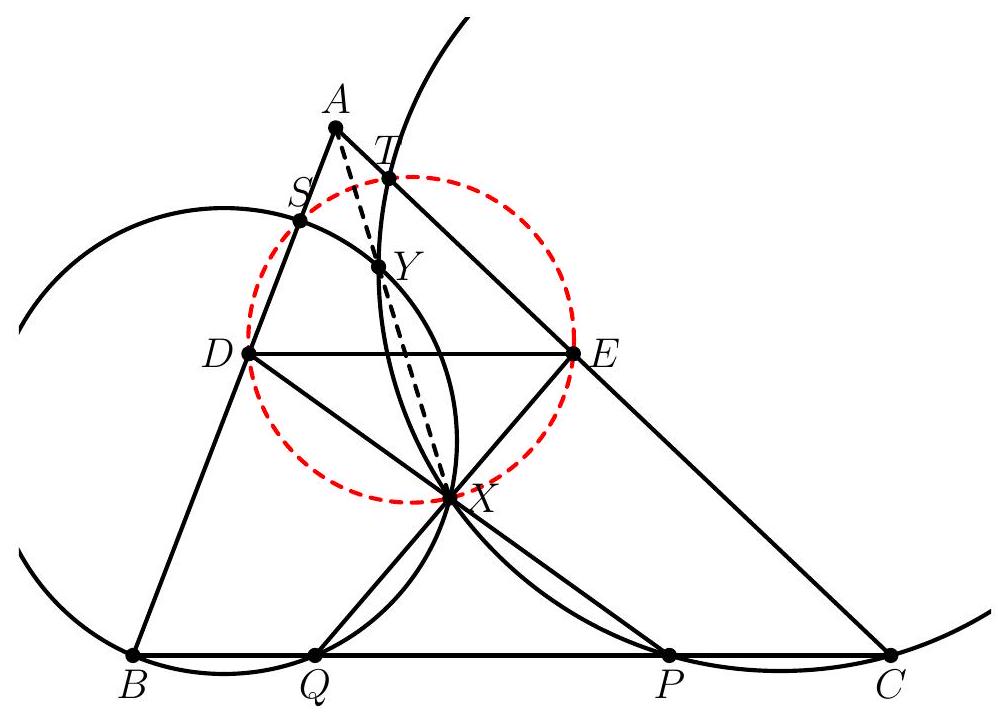
Let circle $B Q X$ intersect line $A B$ at a point $S$ which is different from $B$. Then $\angle D E X=$ $\angle X Q C=\angle B S X$, thus $S$ is on circle $D E X$. Similarly, let circle $C P X$ intersect line $A C$ at a point $T$ which is different from $C$. Then $T$ is on circle $D E X$. The power of $A$ with respect to the circle $D E X$ is $A S \cdot A D=A T \cdot A E$. Since $\frac{A D}{A B}=\frac{A E}{A C}, A S \cdot A B=A T \cdot A C$. Then $A$ is in the radical axis of circles $B Q X$ and $C P X$, which implies that three points $A, X$ and $Y$ are collinear.
## Solution 3
Consider the (direct) homothety that takes triangle $A D E$ to triangle $A B C$, and let $Y^{\prime}$ be the image of $Y$ under this homothety; in other words, let $Y^{\prime}$ be the intersection of the line parallel to $B Y$ through $D$ and the line parallel to $C Y$ through $E$.
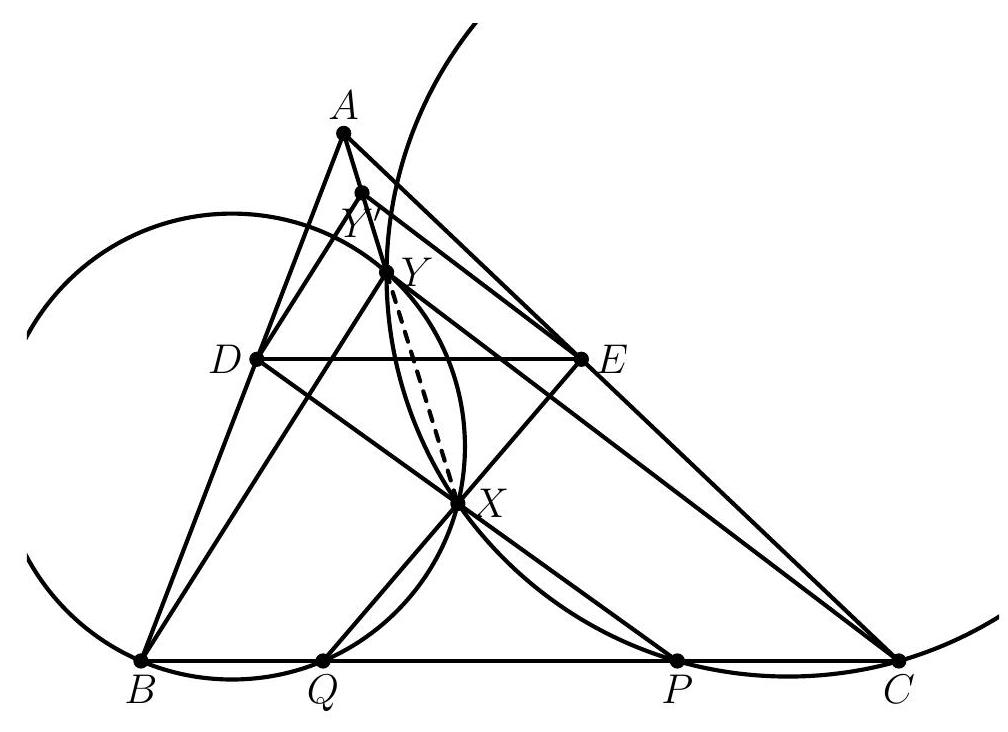
The homothety implies that $A, Y$, and $Y^{\prime}$ are collinear, and that $\angle D Y^{\prime} E=\angle B Y C$. Since $B Q X Y$ and $C P X Y$ are cyclic,
$\angle D Y^{\prime} E=\angle B Y C=\angle B Y X+\angle X Y C=\angle X Q P+\angle X P Q=180^{\circ}-\angle P X Q=180^{\circ}-\angle D X E$,
which implies that $D Y^{\prime} E X$ is cyclic. Therefore
$$
\angle D Y^{\prime} X=\angle D E X=\angle P Q X=\angle B Y X
$$
which, combined with $D Y^{\prime} \| B Y$, implies $Y^{\prime} X \| Y X$. This proves that $X, Y$, and $Y^{\prime}$ are collinear, which in turn shows that $A, X$, and $Y$ are collinear.
## Problem 2
Consider a $100 \times 100$ table, and identify the cell in row $a$ and column $b, 1 \leq a, b \leq 100$, with the ordered pair $(a, b)$. Let $k$ be an integer such that $51 \leq k \leq 99$. A $k$-knight is a piece that moves one cell vertically or horizontally and $k$ cells to the other direction; that is, it moves from $(a, b)$ to $(c, d)$ such that $(|a-c|,|b-d|)$ is either $(1, k)$ or $(k, 1)$. The $k$-knight starts at cell $(1,1)$, and performs several moves. A sequence of moves is a sequence of cells $\left(x_{0}, y_{0}\right)=(1,1)$, $\left(x_{1}, y_{1}\right),\left(x_{2}, y_{2}\right), \ldots,\left(x_{n}, y_{n}\right)$ such that, for all $i=1,2, \ldots, n, 1 \leq x_{i}, y_{i} \leq 100$ and the $k$-knight can move from $\left(x_{i-1}, y_{i-1}\right)$ to $\left(x_{i}, y_{i}\right)$. In this case, each cell $\left(x_{i}, y_{i}\right)$ is said to be reachable. For each $k$, find $L(k)$, the number of reachable cells.
Answer: $L(k)=\left\{\begin{array}{ll}100^{2}-(2 k-100)^{2} & \text { if } k \text { is even } \\ \frac{100^{2}-(2 k-100)^{2}}{2} & \text { if } k \text { is odd }\end{array}\right.$.
## Solution
Cell $(x, y)$ is directly reachable from another cell if and only if $x-k \geq 1$ or $x+k \leq 100$ or $y-k \geq 1$ or $y+k \leq 100$, that is, $x \geq k+1$ or $x \leq 100-k$ or $y \geq k+1$ or $y \leq 100-k(*)$. Therefore the cells $(x, y)$ for which $101-k \leq x \leq k$ and $101-k \leq y \leq k$ are unreachable. Let $S$ be this set of unreachable cells in this square, namely the square of cells $(x, y), 101-k \leq x, y \leq k$. If condition $(*)$ is valid for both $(x, y)$ and $(x \pm 2, y \pm 2)$ then one can move from $(x, y)$ to $(x \pm 2, y \pm 2)$, if they are both in the table, with two moves: either $x \leq 50$ or $x \geq 51$; the same is true for $y$. In the first case, move $(x, y) \rightarrow(x+k, y \pm 1) \rightarrow(x, y \pm 2)$ or $(x, y) \rightarrow$ $(x \pm 1, y+k) \rightarrow(x \pm 2, y)$. In the second case, move $(x, y) \rightarrow(x-k, y \pm 1) \rightarrow(x, y \pm 2)$ or $(x, y) \rightarrow(x \pm 1, y-k) \rightarrow(x \pm 2, y)$.
Hence if the table is colored in two colors like a chessboard, if $k \leq 50$, cells with the same color as $(1,1)$ are reachable. Moreover, if $k$ is even, every other move changes the color of the occupied cell, and all cells are potentially reachable; otherwise, only cells with the same color as $(1,1)$ can be visited. Therefore, if $k$ is even then the reachable cells consists of all cells except the center square defined by $101-k \leq x \leq k$ and $101-k \leq y \leq k$, that is, $L(k)=100^{2}-(2 k-100)^{2}$; if $k$ is odd, then only half of the cells are reachable: the ones with the same color as $(1,1)$, and $L(k)=\frac{1}{2}\left(100^{2}-(2 k-100)^{2}\right)$.
## Problem 3
Let $n$ be a positive integer and $a_{1}, a_{2}, \ldots, a_{n}$ be positive real numbers. Prove that
$$
\sum_{i=1}^{n} \frac{1}{2^{i}}\left(\frac{2}{1+a_{i}}\right)^{2^{i}} \geq \frac{2}{1+a_{1} a_{2} \ldots a_{n}}-\frac{1}{2^{n}}
$$
## Solution
We first prove the following lemma:
Lemma 1. For $k$ positive integer and $x, y>0$,
$$
\left(\frac{2}{1+x}\right)^{2^{k}}+\left(\frac{2}{1+y}\right)^{2^{k}} \geq 2\left(\frac{2}{1+x y}\right)^{2^{k-1}}
$$
The proof goes by induction. For $k=1$, we have
$$
\left(\frac{2}{1+x}\right)^{2}+\left(\frac{2}{1+y}\right)^{2} \geq 2\left(\frac{2}{1+x y}\right)
$$
which reduces to
$$
x y(x-y)^{2}+(x y-1)^{2} \geq 0 .
$$
For $k>1$, by the inequality $2\left(A^{2}+B^{2}\right) \geq(A+B)^{2}$ applied at $A=\left(\frac{2}{1+x}\right)^{2^{k-1}}$ and $B=\left(\frac{2}{1+y}\right)^{2^{k-1}}$ followed by the induction hypothesis
$$
\begin{aligned}
2\left(\left(\frac{2}{1+x}\right)^{2^{k}}+\left(\frac{2}{1+y}\right)^{2^{k}}\right) & \geq\left(\left(\frac{2}{1+x}\right)^{2^{k-1}}+\left(\frac{2}{1+y}\right)^{2^{k-1}}\right)^{2} \\
& \geq\left(2\left(\frac{2}{1+x y}\right)^{2^{k-2}}\right)^{2}=4\left(\frac{2}{1+x y}\right)^{2^{k-1}}
\end{aligned}
$$
from which the lemma follows.
The problem now can be deduced from summing the following applications of the lemma, multiplied by the appropriate factor:
$$
\begin{aligned}
\frac{1}{2^{n}}\left(\frac{2}{1+a_{n}}\right)^{2^{n}}+\frac{1}{2^{n}}\left(\frac{2}{1+1}\right)^{2^{n}} & \geq \frac{1}{2^{n-1}}\left(\frac{2}{1+a_{n} \cdot 1}\right)^{2^{n-1}} \\
\frac{1}{2^{n-1}}\left(\frac{2}{1+a_{n-1}}\right)^{2^{n-1}}+\frac{1}{2^{n-1}}\left(\frac{2}{1+a_{n}}\right)^{2^{n-1}} & \geq \frac{1}{2^{n-2}}\left(\frac{2}{1+a_{n-1} a_{n}}\right)^{2^{n-2}} \\
\frac{1}{2^{n-2}}\left(\frac{2}{1+a_{n-2}}\right)^{2^{n-2}}+\frac{1}{2^{n-2}}\left(\frac{2}{1+a_{n-1} a_{n}}\right)^{2^{n-2}} & \geq \frac{1}{2^{n-3}}\left(\frac{2}{1+a_{n-2} a_{n-1} a_{n}}\right)^{2^{n-3}} \\
\ldots & )^{2^{k}} \\
\frac{1}{2^{k}}\left(\frac{2}{1+a_{k}}\right)^{2^{k}}+\frac{1}{2^{k}}\left(\frac{2}{1+a_{k+1} \ldots a_{n-1} a_{n}}\right)^{2^{k-1}} & \geq \frac{1}{2^{k-1}}\left(\frac{2}{1+a_{k} \ldots a_{n-2} a_{n-1} a_{n}}\right)^{2} \\
\frac{1}{2}\left(\frac{2}{1+a_{1}}\right)^{2}+\frac{1}{2}\left(\frac{2}{1+a_{2} \ldots a_{n-1} a_{n}}\right)^{2} & \geq \frac{2}{1+a_{1} \ldots a_{n-2} a_{n-1} a_{n}}
\end{aligned}
$$
Comment: Equality occurs if and only if $a_{1}=a_{2}=\cdots=a_{n}=1$.
Comment: The main motivation for the lemma is trying to "telescope" the sum
$$
\frac{1}{2^{n}}+\sum_{i=1}^{n} \frac{1}{2^{i}}\left(\frac{2}{1+a_{i}}\right)^{2^{i}}
$$
that is,
$$
\frac{1}{2}\left(\frac{2}{1+a_{1}}\right)^{2}+\cdots+\frac{1}{2^{n-1}}\left(\frac{2}{1+a_{n-1}}\right)^{2^{n-1}}+\frac{1}{2^{n}}\left(\frac{2}{1+a_{n}}\right)^{2^{n}}+\frac{1}{2^{n}}\left(\frac{2}{1+1}\right)^{2^{n}}
$$
to obtain an expression larger than or equal to
$$
\frac{2}{1+a_{1} a_{2} \ldots a_{n}}
$$
It seems reasonable to obtain a inequality that can be applied from right to left, decreases the exponent of the factor $1 / 2^{k}$ by 1 , and multiplies the variables in the denominator. Given that, the lemma is quite natural:
$$
\frac{1}{2^{k}}\left(\frac{2}{1+x}\right)^{2^{k}}+\frac{1}{2^{k}}\left(\frac{2}{1+y}\right)^{2^{k}} \geq \frac{1}{2^{k-1}}\left(\frac{2}{1+x y}\right)^{2^{i-1}}
$$
or
$$
\left(\frac{2}{1+x}\right)^{2^{k}}+\left(\frac{2}{1+y}\right)^{2^{k}} \geq 2\left(\frac{2}{1+x y}\right)^{2^{k-1}}
$$
## Problem 4
Prove that for every positive integer $t$ there is a unique permutation $a_{0}, a_{1}, \ldots, a_{t-1}$ of $0,1, \ldots, t-$ 1 such that, for every $0 \leq i \leq t-1$, the binomial coefficient $\binom{t+i}{2 a_{i}}$ is odd and $2 a_{i} \neq t+i$.
## Solution
We constantly make use of Kummer's theorem which, in particular, implies that $\binom{n}{k}$ is odd if and only if $k$ and $n-k$ have ones in different positions in binary. In other words, if $S(x)$ is the set of positions of the digits 1 of $x$ in binary (in which the digit multiplied by $2^{i}$ is in position $i),\binom{n}{k}$ is odd if and only if $S(k) \subseteq S(n)$. Moreover, if we set $k<n, S(k)$ is a proper subset of $S(n)$, that is, $|S(k)|<|S(n)|$.
We start with a lemma that guides us how the permutation should be set.
## Lemma 1.
$$
\sum_{i=0}^{t-1}|S(t+i)|=t+\sum_{i=0}^{t-1}|S(2 i)|
$$
The proof is just realizing that $S(2 i)=\{1+x, x \in S(i)\}$ and $S(2 i+1)=\{0\} \cup\{1+x, x \in S(i)\}$, because $2 i$ in binary is $i$ followed by a zero and $2 i+1$ in binary is $i$ followed by a one. Therefore
$$
\begin{aligned}
\sum_{i=0}^{t-1}|S(t+i)| & =\sum_{i=0}^{2 t-1}|S(i)|-\sum_{i=0}^{t-1}|S(i)|=\sum_{i=0}^{t-1}|S(2 i)|+\sum_{i=0}^{t-1}|S(2 i+1)|-\sum_{i=0}^{t-1}|S(i)| \\
& =\sum_{i=0}^{t-1}|S(i)|+\sum_{i=0}^{t-1}(1+|S(i)|)-\sum_{i=0}^{t-1}|S(i)|=t+\sum_{i=0}^{t-1}|S(i)|=t+\sum_{i=0}^{t-1}|S(2 i)|
\end{aligned}
$$
The lemma has an immediate corollary: since $t+i>2 a_{i}$ and $\binom{t+i}{2 a_{i}}$ is odd for all $i, 0 \leq i \leq t-1$, $S\left(2 a_{i}\right) \subset S(t+i)$ with $\left|S\left(2 a_{i}\right)\right| \leq|S(t+i)|-1$. Since the sum of $\left|S\left(2 a_{i}\right)\right|$ is $t$ less than the sum of $|S(t+i)|$, and there are $t$ values of $i$, equality must occur, that is, $\left|S\left(2 a_{i}\right)\right|=|S(t+i)|-1$, which in conjunction with $S\left(2 a_{i}\right) \subset S(t+i)$ means that $t+i-2 a_{i}=2^{k_{i}}$ for every $i, 0 \leq i \leq t-1$, $k_{i} \in S(t+i)$ (more precisely, $\left\{k_{i}\right\}=S(t+i) \backslash S\left(2 a_{i}\right)$.)
In particular, for $t+i$ odd, this means that $t+i-2 a_{i}=1$, because the only odd power of 2 is 1. Then $a_{i}=\frac{t+i-1}{2}$ for $t+i$ odd, which takes up all the numbers greater than or equal to $\frac{t-1}{2}$. Now we need to distribute the numbers that are smaller than $\frac{t-1}{2}$ (call these numbers small). If $t+i$ is even then by Lucas' Theorem $\binom{t+i}{2 a_{i}} \equiv\binom{\frac{t+i}{2}}{a_{i}}(\bmod 2)$, so we pair numbers from $\lceil t / 2\rceil$ to $t-1$ (call these numbers big) with the small numbers.
Say that a set $A$ is paired with another set $B$ whenever $|A|=|B|$ and there exists a bijection $\pi: A \rightarrow B$ such that $S(a) \subset S(\pi(a))$ and $|S(a)|=|S(\pi(a))|-1$; we also say that $a$ and $\pi(a)$ are paired. We prove by induction in $t$ that $A_{t}=\{0,1,2, \ldots,\lfloor t / 2\rfloor-1\}$ (the set of small numbers) and $B_{t}=\{\lceil t / 2\rceil, \ldots, t-2, t-1\}$ (the set of big numbers) can be uniquely paired.
The claim is immediate for $t=1$ and $t=2$. For $t>2$, there is exactly one power of two in $B_{t}$, since $t / 2 \leq 2^{a}<t \Longleftrightarrow a=\left\lceil\log _{2}(t / 2)\right\rceil$. Let $2^{a}$ be this power of two. Then, since $2^{a} \geq t / 2$, no number in $A_{t}$ has a one in position $a$ in binary. Since for every number $x, 2^{a} \leq x<t, a \in S(x)$ and $a \notin S(y)$ for all $y \in A_{t}, x$ can only be paired with $x-2^{a}$, since $S(x)$ needs to be stripped of exactly one position. This takes cares of $x \in B_{t}, 2^{a} \leq x<t$, and $y \in A_{t}, 0 \leq y<t-2^{a}$.
Now we need to pair the numbers from $A^{\prime}=\left\{t-2^{a}, t-2^{a}+1, \ldots,\lfloor t / 2\rfloor-1\right\} \subset A$ with the numbers from $B^{\prime}=\left\{\lceil t / 2\rceil,\lceil t / 2\rceil+1, \ldots, 2^{a}-1\right\} \subset B$. In order to pair these $t-2\left(t-2^{a}\right)=$ $2^{a+1}-t<t$ numbers, we use the induction hypothesis and a bijection between $A^{\prime} \cup B^{\prime}$ and $B_{2^{a+1}-t} \cup A_{2^{a+1}-t}$. Let $S=S\left(2^{a}-1\right)=\{0,1,2, \ldots, a-1\}$. Then take a pair $x, y, x \in A_{2^{a+1}-t}$ and $y \in B_{2^{a+1}-t}$ and biject it with $2^{a}-1-x \in B^{\prime}$ and $2^{a}-1-y \in A^{\prime}$. In fact,
$$
0 \leq x \leq\left\lfloor\frac{2^{a+1}-t}{2}\right\rfloor-1=2^{a}-\left\lceil\frac{t}{2}\right\rceil-1 \Longleftrightarrow\left\lceil\frac{t}{2}\right\rceil \leq 2^{a}-1-x \leq 2^{a}-1
$$
and
$$
\left\lceil\frac{2^{a+1}-t}{2}\right\rceil=2^{a}-\left\lfloor\frac{t}{2}\right\rfloor \leq y \leq 2^{a+1}-t-1 \Longleftrightarrow t-2^{a} \leq 2^{a}-1-y \leq\left\lfloor\frac{t}{2}\right\rfloor-1
$$
Moreover, $S\left(2^{a}-1-x\right)=S \backslash S(x)$ and $S\left(2^{a}-1-y\right)=S \backslash S(y)$ are complements with respect to $S$, and $S(x) \subset S(y)$ and $|S(x)|=|S(y)|-1$ implies $S\left(2^{a}-1-y\right) \subset S\left(2^{a}-1-x\right)$ and $\left|S\left(2^{a}-1-y\right)\right|=\left|S\left(2^{a}-1-x\right)\right|-1$. Therefore a pairing between $A^{\prime}$ and $B^{\prime}$ corresponds to a pairing between $A_{2^{a+1}-t}$ and $B_{2^{a+1}-t}$. Since the latter pairing is unique, the former pairing is also unique, and the result follows.
We illustrate the bijection by showing the case $t=23$ :
$$
A_{23}=\{0,1,2, \ldots, 10\}, \quad B_{23}=\{12,13,14, \ldots, 22\}
$$
The pairing is
$$
\left(\begin{array}{ccccccccccc}
12 & 13 & 14 & 15 & 16 & 17 & 18 & 19 & 20 & 21 & 22 \\
8 & 9 & 10 & 7 & 0 & 1 & 2 & 3 & 4 & 5 & 6
\end{array}\right)
$$
in which the bijection is between
$$
\left(\begin{array}{cccc}
12 & 13 & 14 & 15 \\
8 & 9 & 10 & 7
\end{array}\right) \quad \text { and } \quad\left(\begin{array}{llll}
3 & 2 & 1 & 0 \\
7 & 6 & 5 & 8
\end{array}\right) \rightarrow\left(\begin{array}{llll}
5 & 6 & 7 & 8 \\
1 & 2 & 3 & 0
\end{array}\right) .
$$
## Problem 5
Line $\ell$ intersects sides $B C$ and $A D$ of cyclic quadrilateral $A B C D$ in its interior points $R$ and $S$ respectively, and intersects ray $D C$ beyond point $C$ at $Q$, and ray $B A$ beyond point $A$ at $P$. Circumcircles of the triangles $Q C R$ and $Q D S$ intersect at $N \neq Q$, while circumcircles of the triangles $P A S$ and $P B R$ intersect at $M \neq P$. Let lines $M P$ and $N Q$ meet at point $X$, lines $A B$ and $C D$ meet at point $K$ and lines $B C$ and $A D$ meet at point $L$. Prove that point $X$ lies on line $K L$.
## Solution 1
We start with the following lemma.
Lemma 1. Points $M, N, P, Q$ are concyclic.
Point $M$ is the Miquel point of lines $A P=A B, P S=\ell, A S=A D$, and $B R=B C$, and point $N$ is the Miquel point of lines $C Q=C D, R C=B C, Q R=\ell$, and $D S=A D$. Both points $M$ and $N$ are on the circumcircle of the triangle determined by the common lines $A D, \ell$, and $B C$, which is $L R S$.
Then, since quadrilaterals $Q N R C, P M A S$, and $A B C D$ are all cyclic, using directed angles (modulo $180^{\circ}$ )
$$
\begin{aligned}
\measuredangle N M P & =\measuredangle N M S+\measuredangle S M P=\measuredangle N R S+\measuredangle S A P=\measuredangle N R Q+\measuredangle D A B=\measuredangle N R Q+\measuredangle D C B \\
& =\measuredangle N R Q+\measuredangle Q C R=\measuredangle N R Q+\measuredangle Q N R=\measuredangle N Q R=\measuredangle N Q P,
\end{aligned}
$$
which implies that $M N Q P$ is a cyclic quadrilateral.
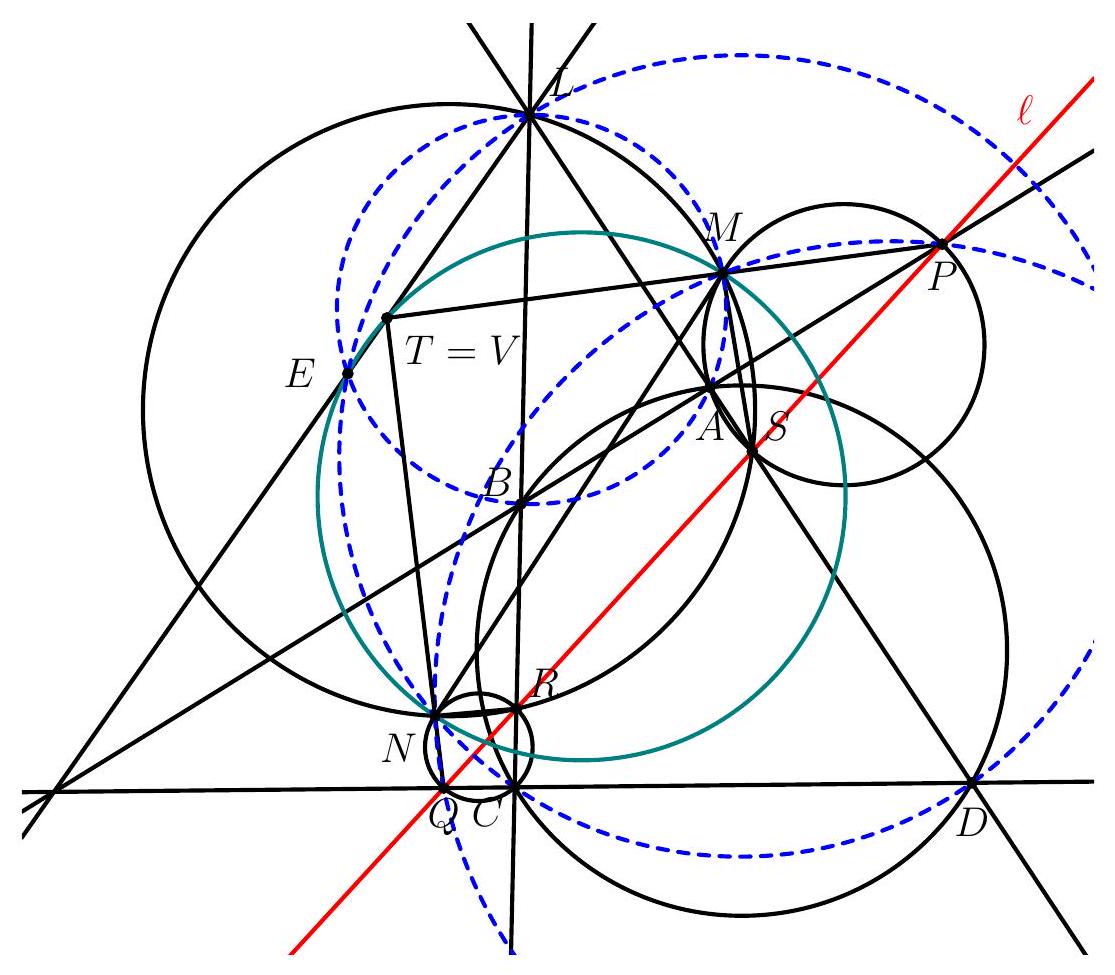
Let $E$ be the Miquel point of $A B C D$ (that is, of lines $A B, B C, C D, D A$ ). It is well known that $E$ lies in the line $t$ connecting the intersections of the opposite lines of $A B C D$. Let lines $N Q$ and $t$ meet at $T$. If $T \neq E$, using directed angles, looking at the circumcircles of $L A B$ (which contains, by definition, $E$ and $M$ ), $A P S$ (which also contains $M$ ), and $M N Q P$,
$$
\measuredangle T E M=\measuredangle L E M=\measuredangle L A M=\measuredangle S A M=\measuredangle S P M=\measuredangle Q P M=\measuredangle Q N M=\measuredangle T N M,
$$
that is, $T$ lies in the circumcircle $\omega$ of $E M N$. If $T=E$, the same computation shows that $\measuredangle L E M=\measuredangle E N M$, which means that $t$ is tangent to $\omega$.
Now let lines $M P$ and $t$ meet at $V$. An analogous computation shows, by looking at the circumcircles of $L C D$ (which contains $E$ and $N$ ), $C Q R$, and $M N Q P$, that $V$ lies in $\omega$ as well, and that if $V=E$ then $t$ is tangent to $\omega$.
Therefore, since $\omega$ meet $t$ at $T, V$, and $E$, either $T=V$ if both $T \neq E$ and $V \neq E$ or $T=V=E$. At any rate, the intersection of lines $M P$ and $N Q$ lies in $t$.
## Solution 2
Barycentric coordinates are a viable way to solve the problem, but even the solution we have found had some clever computations. Here is an outline of this solution.
Lemma 2. Denote by $\operatorname{pow}_{\omega} X$ the power of point $X$ with respect to circle $\omega$. Let $\Gamma_{1}$ and $\Gamma_{2}$ be circles with different centers. Considering $A B C$ as the reference triangle in barycentric coordinates, the radical axis of $\Gamma_{1}$ and $\Gamma_{2}$ is given by
$$
\left(\operatorname{pow}_{\Gamma_{1}} A-\operatorname{pow}_{\Gamma_{2}} A\right) x+\left(\operatorname{pow}_{\Gamma_{1}} B-\operatorname{pow}_{\Gamma_{2}} B\right) y+\left(\operatorname{pow}_{\Gamma_{1}} C-\operatorname{pow}_{\Gamma_{2}} C\right) z=0
$$
Proof: Let $\Gamma_{i}$ have the equation $\Gamma_{i}(x, y, z)=-a^{2} y z-b^{2} z x-c^{2} x y+(x+y+z)\left(r_{i} x+s_{i} y+t_{i} z\right)$. Then $\operatorname{pow}_{\Gamma_{i}} P=\Gamma_{i}(P)$. In particular, $\operatorname{pow}_{\Gamma_{i}} A=\Gamma_{i}(1,0,0)=r_{i}$ and, similarly, $\operatorname{pow}_{\Gamma_{i}} B=s_{i}$ and $\operatorname{pow}_{\Gamma_{i}} C=t_{i}$.
Finally, the radical axis is
$$
\begin{aligned}
& \operatorname{pow}_{\Gamma_{1}} P=\operatorname{pow}_{\Gamma_{2}} P \\
\Longleftrightarrow & \Gamma_{1}(x, y, z)=\Gamma_{2}(x, y, z) \\
\Longleftrightarrow & r_{1} x+s_{1} y+t_{1} z=r_{2} x+s_{2} y+t_{2} z \\
\Longleftrightarrow & \left(\operatorname{pow}_{\Gamma_{1}} A-\operatorname{pow}_{\Gamma_{2}} A\right) x+\left(\operatorname{pow}_{\Gamma_{1}} B-\operatorname{pow}_{\Gamma_{2}} B\right) y+\left(\operatorname{pow}_{\Gamma_{1}} C-\operatorname{pow}_{\Gamma_{2}} C\right) z=0 .
\end{aligned}
$$
We still use the Miquel point $E$ of $A B C D$. Notice that the problem is equivalent to proving that lines $M P, N Q$, and $E K$ are concurrent. The main idea is writing these three lines as radical axes. In fact, by definition of points $M, N$, and $E$ :
- $M P$ is the radical axis of the circumcircles of $P A S$ and $P B R$;
- $N Q$ is the radical axis of the circumcircles of $Q C R$ and $Q D S$;
- $E K$ is the radical axis of the circumcircles of $K B C$ and $K A D$.
Looking at these facts and the diagram, it makes sense to take triangle $K Q P$ the reference triangle. Because of that, we do not really need to draw circles nor even points $M$ and $N$, as all powers can be computed directly from points in lines $K P, K Q$, and $P Q$.
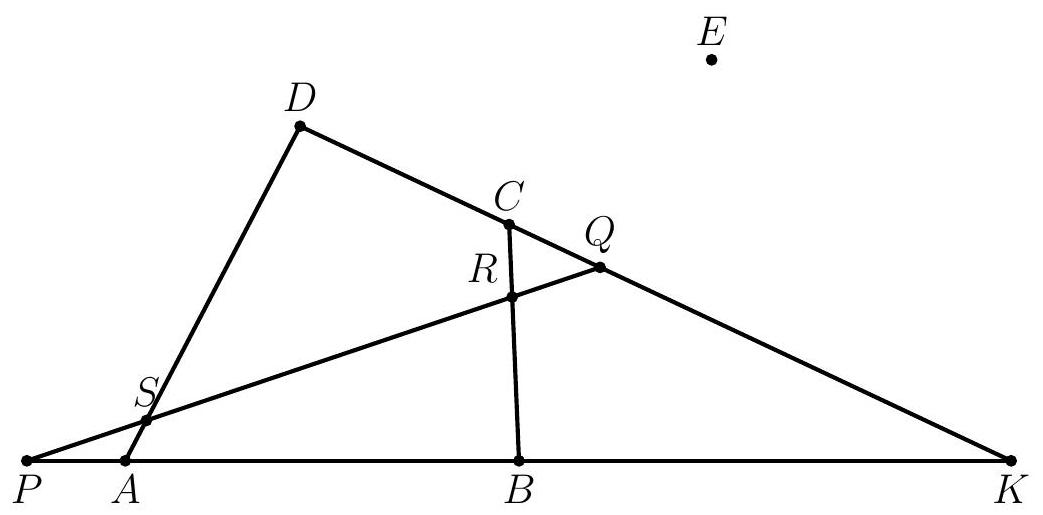
Associate $P$ with the $x$-coordinate, $Q$ with the $y$-coordinate, and $K$ with the $z$-coordinate. Applying the lemma, the equations of lines $P M, Q N$, and $E K$ are
- MP: $(K A \cdot K P-K B \cdot K P) x+(Q S \cdot Q P-Q R \cdot Q P) y=0$
- $N Q:(K C \cdot K Q-K D \cdot K Q) x+(P R \cdot P Q-P S \cdot P Q) z=0$
- MP: $(-Q C \cdot Q K+Q D \cdot Q K) y+(P B \cdot P K-P A \cdot P K) z=0$
These equations simplify to
- $M P:(A B \cdot K P) x+(P Q \cdot R S) y=0$
- $N Q:(-C D \cdot K Q) x+(P Q \cdot R S) z=0$
- $M P:(C D \cdot K Q) y+(A B \cdot K P) z=0$
Now, if $u=A B \cdot K P, v=P Q \cdot R S$, and $w=C D \cdot K Q$, it suffices to show that
$$
\left|\begin{array}{ccc}
u & v & 0 \\
-w & 0 & v \\
0 & w & u
\end{array}\right|=0
$$
which is a straightforward computation.
|