

File size: 12,318 Bytes
27875a3 | 1 2 3 4 5 6 7 8 9 10 11 12 13 14 15 16 17 18 19 20 21 22 23 24 25 26 27 28 29 30 31 32 33 34 35 36 37 38 39 40 41 42 43 44 45 46 47 48 49 50 51 52 53 54 55 56 57 58 59 60 61 62 63 64 65 66 67 68 69 70 71 72 73 74 75 76 77 78 79 80 81 82 83 84 85 86 87 88 89 90 91 92 93 94 95 96 97 98 99 100 101 102 103 104 105 106 107 108 109 110 111 112 113 114 115 116 117 118 119 120 121 122 123 124 125 126 127 128 129 130 131 132 133 134 135 136 137 138 139 140 141 142 143 144 145 146 147 148 149 150 151 152 153 154 155 156 157 158 159 160 161 162 163 164 165 166 167 168 169 170 171 172 173 174 175 176 177 178 179 180 181 182 183 184 185 186 187 188 189 190 191 192 193 194 195 196 197 198 199 200 201 202 203 204 205 206 207 208 209 210 211 212 213 214 215 216 217 218 219 220 221 222 223 224 225 226 227 228 229 230 231 232 233 234 235 236 237 238 239 240 241 242 243 244 245 246 247 248 249 250 251 252 253 254 255 256 257 258 259 260 261 262 | # Problems and Solutions: INMO-2015
1. Let $A B C$ be a right-angled triangle with $\angle B=90^{\circ}$. Let $B D$ be the altitude from $B$ on to $A C$. Let $P, Q$ and $I$ be the incentres of triangles $A B D, C B D$ and $A B C$ respectively. Show that the circumcentre of of the triangle $P I Q$ lies on the hypotenuse $A C$.
Solution: We begin with the following lemma:
Lemma: Let $X Y Z$ be a triangle with $\angle X Y Z=90+\alpha$. Construct an isosceles triangle $X E Z$, externally on the side $X Z$, with base angle $\alpha$. Then $E$ is the circumcentre of $\triangle X Y Z$.
Proof of the Lemma: Draw $E D \perp$ $X Z$. Then $D E$ is the perpendicular bisector of $X Z$. We also observe that $\angle X E D=\angle Z E D=90-\alpha$. Observe that $E$ is on the perpendicular bisector of $X Z$. Construct the circumcircle of $X Y Z$. Draw perpendicular bisector of $X Y$ and let it meet $D E$ in $F$. Then $F$ is the circumcentre of $\triangle X Y Z$. Join $X F$. Then $\angle X F D=90-\alpha$. But we know
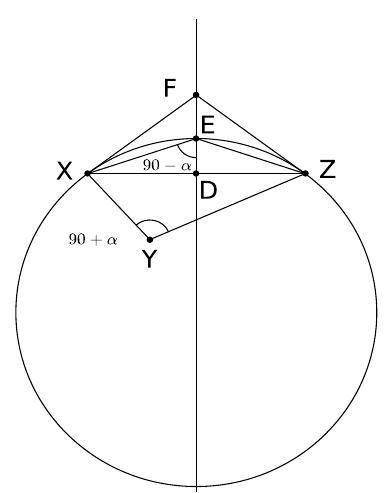
that $\angle X E D=90-\alpha$. Hence $E=F$. Let $r_{1}, r_{2}$ and $r$ be the inradii of the triangles $A B D, C B D$ and $A B C$ respectively. Join $P D$ and $D Q$. Observe that $\angle P D Q=90^{\circ}$. Hence
$$
P Q^{2}=P D^{2}+D Q^{2}=2 r_{1}^{2}+2 r_{2}^{2}
$$
Let $s_{1}=(A B+B D+D A) / 2$. Observe that $B D=c a / b$ and $A D=$ $\sqrt{A B^{2}-B D^{2}}=\sqrt{c^{2}-\left(\frac{c a}{b}\right)^{2}}=c^{2} / b$. This gives $s_{1}=c s / b$. But $r_{1}=$ $s_{1}-c=(c / b)(s-b)=c r / b$. Similarly, $r_{2}=a r / b$. Hence
$$
P Q^{2}=2 r^{2}\left(\frac{c^{2}+a^{2}}{b^{2}}\right)=2 r^{2}
$$
Consider $\triangle P I Q$. Observe that $\angle P I Q=90+(B / 2)=135$. Hence $P Q$ subtends $90^{\circ}$ on the circumference of the circumcircle of $\triangle P I Q$. But we have seen that $\angle P D Q=90^{\circ}$. Now construct a circle with $P Q$ as diameter. Let it cut $A C$ again in $K$. It follows that $\angle P K Q=90^{\circ}$ and the points $P, D, K, Q$ are concyclic. We also notice $\angle K P Q=\angle K D Q=45^{\circ}$
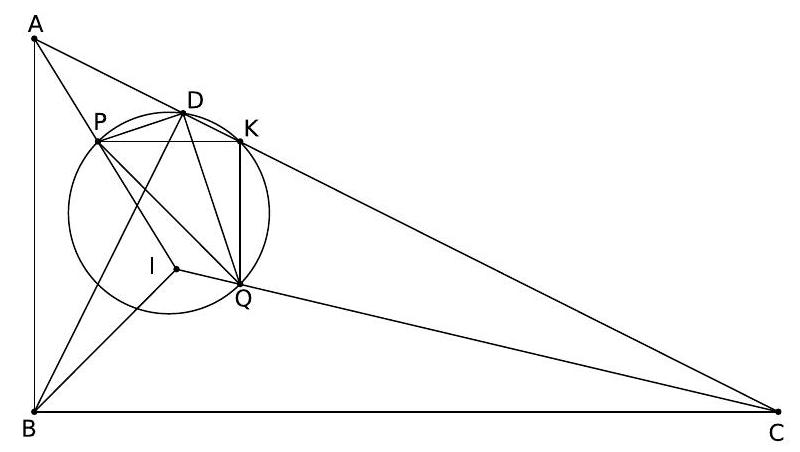
and $\angle P Q K=\angle P D A=45^{\circ}$.
Thus $P K Q$ is an isosceles right-angled triangle with $K P=K Q$. Therfore $K P^{2}+K Q^{2}=P Q^{2}=2 r^{2}$ and hence $K P=K Q=r$.
Now $\angle P I Q=90+45$ and $\angle P K Q=2 \times 45^{\circ}=90^{\circ}$ with $K P=K Q=r$.
Hence $K$ is the circumcentre of $\triangle P I Q$.
(Incidentally, This also shows that $K I=r$ and hence $K$ is the point of contact of the incircle of $\triangle A B C$ with $A C$.)
Solution 2: Here we use computation to prove that the point of contact $K$ of the incircle with $A C$ is the circumcentre of $\triangle P I Q$. We show that $K P=K Q=r$. Let $r_{1}$ and $r_{2}$ be the inradii of triangles $A B D$ and $C B D$ respectively. Draw $P L \perp A C$ and $Q M \perp A C$. If $s_{1}$ is the semiperimeter of $\triangle A B D$, then $A L=s_{1}-B D$.
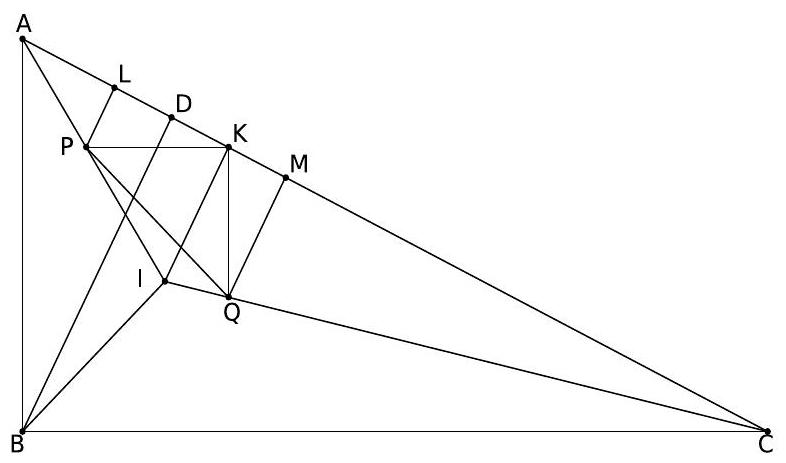
But
$$
s_{1}=\frac{A B+B D+D A}{2}, \quad B D=\frac{c a}{b}, \quad A D=\frac{c^{2}}{b}
$$
Hence $s_{1}=c s / b$. This gives $r_{1}=s_{1}-c=c r / b, A L=s_{1}-B D=c(s-a) / b$. Hence $K L=A K-A L=(s-a)-\frac{c(s-a)}{b}=\frac{(b-c)(s-a)}{b}$. We observe that $2 r^{2}=\frac{(c+a-b)^{2}}{2}=\frac{c^{2}+a^{2}+b^{2}-2 b c-2 a b+2 c a}{2}=\left(b^{2}-b a-b c+a c\right)=(b-c)(b-a)$.
This gives
$$
\begin{aligned}
(s-a)(b-c)=(s-b+b-a) & (b-c)=r(b-c)+(b-a)(b-c) \\
& =r(b-c)+2 r^{2}=r(b-c+c+a-b)=r a
\end{aligned}
$$
Thus $K L=r a / b$. Finally,
$$
K P^{2}=K L^{2}+L P^{2}=\frac{r^{2} a^{2}}{b^{2}}+\frac{r^{2}+c^{2}}{b^{2}}=r^{2}
$$
Thus $K P=r$. Similarly, $K Q=r$. This gives $K P=K I=K Q=r$ and therefore $K$ is the circumcentre of $\triangle K I Q$.
(Incidentally, this also shows that $K L=c a / b=r_{2}$ and $K M=r_{1}$.)
2. For any natural number $n>1$, write the infinite decimal expansion of $1 / n$ (for example, we write $1 / 2=0.4 \overline{9}$ as its infinite decimal expansion, not 0.5 ). Determine the length of the non-periodic part of the (infinite) decimal expansion of $1 / n$.
Solution: For any prime $p$, let $\nu_{p}(n)$ be the maximum power of $p$ dividing $n$; ie $p^{\nu_{p}(n)}$ divides $n$ but not higher power. Let $r$ be the
length of the non-periodic part of the infinite decimal expansion of $1 / n$.
Write
$$
\frac{1}{n}=0 . a_{1} a_{2} \cdots a_{r} \overline{b_{1} b_{2} \cdots b_{s}}
$$
We show that $r=\max \left(\nu_{2}(n), \nu_{5}(n)\right)$.
Let $a$ and $b$ be the numbers $a_{1} a_{2} \cdots a_{r}$ and $b=b_{1} b_{2} \cdots b_{s}$ respectively. (Here $a_{1}$ and $b_{1}$ can be both 0.) Then
$$
\frac{1}{n}=\frac{1}{10^{r}}\left(a+\sum_{k \geq 1} \frac{b}{\left(10^{s}\right)^{k}}\right)=\frac{1}{10^{r}}\left(a+\frac{b}{10^{s}-1}\right)
$$
Thus we get $10^{r}\left(10^{s}-1\right)=n\left(\left(10^{s}-1\right) a+b\right)$. It shows that $r \geq$ $\max \left(\nu_{2}(n), \nu_{5}(n)\right)$. Suppose $r>\max \left(\nu_{2}(n), \nu_{5}(n)\right)$. Then 10 divides $b-a$. Hence the last digits of $a$ and $b$ are equal: $a_{r}=b_{s}$. This means
$$
\frac{1}{n}=0 . a_{1} a_{2} \cdots a_{r-1} \overline{b_{s} b_{1} b_{2} \cdots b_{s-1}}
$$
This contradicts the definition of $r$. Therefore $r=\max \left(\nu_{2}(n), \nu_{5}(n)\right)$.
3. Find all real functions $f$ from $\mathbb{R} \rightarrow \mathbb{R}$ satisfying the relation
$$
f\left(x^{2}+y f(x)\right)=x f(x+y)
$$
Solution: Put $x=0$ and we get $f(y f(0))=0$. If $f(0) \neq 0$, then $y f(0)$ takes all real values when $y$ varies over real line. We get $f(x) \equiv 0$. Suppose $f(0)=0$. Taking $y=-x$, we get $f\left(x^{2}-x f(x)\right)=0$ for all real $x$.
Suppose there exists $x_{0} \neq 0$ in $\mathbb{R}$ such that $f\left(x_{0}\right)=0$. Putting $x=x_{0}$ in the given relation we get
$$
f\left(x_{0}^{2}\right)=x_{0} f\left(x_{0}+y\right)
$$
for all $y \in \mathbb{R}$. Now the left side is a constant and hence it follows that $f$ is a constant function. But the only constant function which satisfies the equation is identically zero function, which is already obtained. Hence we may consider the case where $f(x) \neq 0$ for all $x \neq 0$.
Since $f\left(x^{2}-x f(x)\right)=0$, we conclude that $x^{2}-x f(x)=0$ for all $x \neq 0$. This implies that $f(x)=x$ for all $x \neq 0$. Since $f(0)=0$, we conclude that $f(x)=x$ for all $x \in R$.
Thus we have two functions: $f(x) \equiv 0$ and $f(x)=x$ for all $x \in \mathbb{R}$.
4. There are four basket-ball players $A, B, C, D$. Initially, the ball is with $A$. The ball is always passed from one person to a different person. In how many ways can the ball come back to $A$ after seven passes? (For example $A \rightarrow C \rightarrow B \rightarrow D \rightarrow A \rightarrow B \rightarrow C \rightarrow A$ and
$A \rightarrow D \rightarrow A \rightarrow D \rightarrow C \rightarrow A \rightarrow B \rightarrow A$ are two ways in which the ball can come back to $A$ after seven passes.)
Solution: Let $x_{n}$ be the number of ways in which $A$ can get back the ball after $n$ passes. Let $y_{n}$ be the number of ways in which the ball goes back to a fixed person other than $A$ after $n$ passes. Then
$$
x_{n}=3 y_{n-1} \text {, }
$$
and
$$
y_{n}=x_{n-1}+2 y_{n-1}
$$
We also have $x_{1}=0, x_{2}=3, y_{1}=1$ and $y_{2}=2$.
Eliminating $y_{n}$ and $y_{n-1}$, we get $x_{n+1}=3 x_{n-1}+2 x_{n}$. Thus
$$
\begin{aligned}
& x_{3}=3 x_{1}+2 x_{2}=2 \times 3=6 \\
& x_{4}=3 x_{2}+2 x_{3}=(3 \times 3)+(2 \times 6)=9+12=21 \\
& x_{5}=3 x_{3}+2 x_{4}=(3 \times 6)+(2 \times 21)=18+42=60 \\
& x_{6}=3 x_{4}+2 x_{5}=(3 \times 21)+(2 \times 60)=63+120=183 \\
& x_{7}=3 x_{5}+2 x_{6}=(3 \times 60)+(2 \times 183)=180+366=546
\end{aligned}
$$
Alternate solution: Since the ball goes back to one of the other 3 persons, we have
$$
x_{n}+3 y_{n}=3^{n}
$$
since there are $3^{n}$ ways of passing the ball in $n$ passes. Using $x_{n}=$ $3 y_{n-1}$, we obtain
$$
x_{n-1}+x_{n}=3^{n-1}
$$
with $x_{1}=0$. Thus
$$
\begin{array}{r}
x_{7}=3^{6}-x_{6}=3^{6}-3^{5}+x_{5}=3^{6}-3^{5}+3^{4}-x_{4}=3^{6}-3^{5}+3^{4}-3^{3}+x_{3} \\
=3^{6}-3^{5}+3^{4}-3^{3}+3^{2}-x_{2}=3^{6}-3^{5}+3^{4}-3^{3}+3^{2}-3 \\
=\left(2 \times 3^{5}\right)+\left(2 \times 3^{3}\right)+(2 \times 3)=486+54+6=546
\end{array}
$$
5. Let $A B C D$ be a convex quadrilateral. Let the diagonals $A C$ and $B D$ intersect in $P$. Let $P E, P F, P G$ and $P H$ be the altitudes from $P$ on to the sides $A B, B C, C D$ and $D A$ respectively. Show that $A B C D$ has an incircle if and only if
$$
\frac{1}{P E}+\frac{1}{P G}=\frac{1}{P F}+\frac{1}{P H}
$$
Solution: Let $A P=p, B P=q, C P=r, D P=s ; A B=a, B C=b$, $C D=c$ and $D A=d$. Let $\angle A P B=\angle C P D=\theta$. Then $\angle B P C=\angle D P A=$ $\pi-\theta$. Let us also write $P E=h_{1}, P F=h_{2}, P G=h_{3}$ and $P H=h_{4}$.
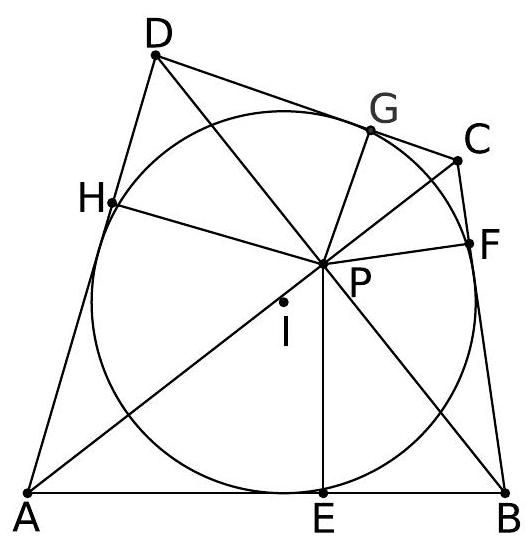
## Observe that
$$
h_{1} a=p q \sin \theta, \quad h_{2} b=q r \sin \theta, \quad h_{3} c=r s \sin \theta, \quad h_{4} d=s p \sin \theta
$$
Hence
$$
\frac{1}{h_{1}}+\frac{1}{h_{3}}=\frac{1}{h_{2}}+\frac{1}{h_{4}}
$$
is equivalent to
$$
\frac{a}{p q}+\frac{c}{r s}=\frac{b}{q r}+\frac{d}{s p}
$$
This is the same as
$$
a r s+c p q=b s p+d q r
$$
Thus we have to prove that $a+c=b+d$ if and only if $a r s+c p q=b s p+d q r$. Now we can write $a+c=b+d$ as
$$
a^{2}+c^{2}+2 a c=b^{2}+d^{2}+2 b d
$$
But we know that
$$
\begin{aligned}
& a^{2}=p^{2}+q^{2}-2 p q \cos \theta, \quad c^{2}=r^{2}+s^{2}-2 r s \cos \theta \\
& b^{2}=q^{2}+r^{2}+2 q r \cos \theta, \quad d^{2}=p^{2}+s^{2}+2 p s \cos \theta
\end{aligned}
$$
Hence $a+c=b+d$ is equivalent to
$$
-p q \cos \theta+-r s \cos \theta+a c=p s \cos \theta+q r \cos \theta+b d
$$
Similarly, by squaring ars $+c p q=b s p+d q r$ we can show that it is equivalent to
$$
-p q \cos \theta+-r s \cos \theta+a c=p s \cos \theta+q r \cos \theta+b d
$$
We conclude that $a+c=b+d$ is equivalent to $c p q+a r s=b p s+d q r$. Hence $A B C D$ has an in circle if and only if
$$
\frac{1}{h_{1}}+\frac{1}{h_{3}}=\frac{1}{h_{2}}+\frac{1}{h_{4}}
$$
6. From a set of 11 square integers, show that one can choose 6 numbers $a^{2}, b^{2}, c^{2}, d^{2}, e^{2}, f^{2}$ such that
$$
a^{2}+b^{2}+c^{2} \equiv d^{2}+e^{2}+f^{2} \quad(\bmod 12)
$$
Solution: The first observation is that we can find 5 pairs of squares such that the two numbers in a pair have the same parity. We can see this as follows:
| Odd numbers | Even numbers | Odd pairs | Even pairs | Total pairs |
| :---: | :---: | :---: | :---: | :---: |
| 0 | 11 | 0 | 5 | 5 |
| 1 | 10 | 0 | 5 | 5 |
| 2 | 9 | 1 | 4 | 5 |
| 3 | 8 | 1 | 4 | 5 |
| 4 | 7 | 2 | 3 | 5 |
| 5 | 6 | 2 | 3 | 5 |
| 6 | 5 | 3 | 2 | 5 |
| 7 | 4 | 3 | 2 | 5 |
| 8 | 3 | 4 | 1 | 5 |
| 9 | 2 | 4 | 1 | 5 |
| 10 | 1 | 5 | 0 | 5 |
| 11 | 0 | 5 | 0 | 5 |
Let us take such 5 pairs: say $\left(x_{1}^{2}, y_{1}^{2}\right),\left(x_{2}^{2}, y_{2}^{2}\right), \ldots,\left(x_{5}^{2}, y_{5}^{2}\right)$. Then $x_{j}^{2}-y_{j}^{2}$ is divisible by 4 for $1 \leq j \leq 5$. Let $r_{j}$ be the remainder when $x_{j}^{2}-y_{j}^{2}$ is divisible by $3,1 \leq j \leq 3$. We have 5 remainders $r_{1}, r_{2}, r_{3}, r_{4}, r_{5}$. But these can be 0,1 or 2 . Hence either one of the remainders occur 3 times or each of the remainders occur once. If, for example $r_{1}=r_{2}=r_{3}$, then 3 divides $r_{1}+r_{2}+r_{3}$; if $r_{1}=0, r_{2}=1$ and $r_{3}=2$, then again 3 divides $r_{1}+r_{2}+r_{3}$. Thus we can always find three remainders whose sum is divisible by 3 . This means we can find 3 pairs, say, $\left(x_{1}^{2}, y_{1}^{2}\right),\left(x_{2}^{2}, y_{2}^{2}\right),\left(x_{3}^{2}, y_{3}^{2}\right)$ such that 3 divides $\left(x_{1}^{2}-y_{1}^{2}\right)+\left(x_{2}^{2}-y_{2}^{2}\right)+\left(x_{3}^{2}-y_{3}^{2}\right)$. Since each difference is divisible by 4 , we conclude that we can find 6 numbers $a^{2}, b^{2}, c^{2}, d^{2}, e^{2}, f^{2}$ such that
$$
a^{2}+b^{2}+c^{2} \equiv d^{2}+e^{2}+f^{2} \quad(\bmod 12)
$$
|