

File size: 13,255 Bytes
a67ef7c | 1 2 3 4 5 6 7 8 9 10 11 12 13 14 15 16 17 18 19 20 21 22 23 24 25 26 27 28 29 30 31 32 33 34 35 36 37 38 39 40 41 42 43 44 45 46 47 48 49 50 51 52 53 54 55 56 57 58 59 60 61 62 63 64 65 66 67 68 69 70 71 72 73 74 75 76 77 78 79 80 81 82 83 84 85 86 87 88 89 90 91 92 93 94 95 96 97 98 99 100 101 102 103 104 105 106 107 108 109 110 111 112 113 114 115 116 117 118 119 120 121 122 123 124 125 126 127 128 129 130 131 132 133 134 135 136 137 138 139 140 141 142 143 144 145 146 147 148 149 150 151 152 153 154 155 156 157 158 159 160 161 162 163 164 165 166 167 168 169 170 171 172 173 174 175 176 177 178 179 180 181 182 | # APMO 1991 - Problems and Solutions
## Problem 1
Let $G$ be the centroid of triangle $A B C$ and $M$ be the midpoint of $B C$. Let $X$ be on $A B$ and $Y$ on $A C$ such that the points $X, Y$, and $G$ are collinear and $X Y$ and $B C$ are parallel. Suppose that $X C$ and $G B$ intersect at $Q$ and $Y B$ and $G C$ intersect at $P$. Show that triangle $M P Q$ is similar to triangle $A B C$.
## Solution 1
Let $R$ be the midpoint of $A C$; so $B R$ is a median and contains the centroid $G$.
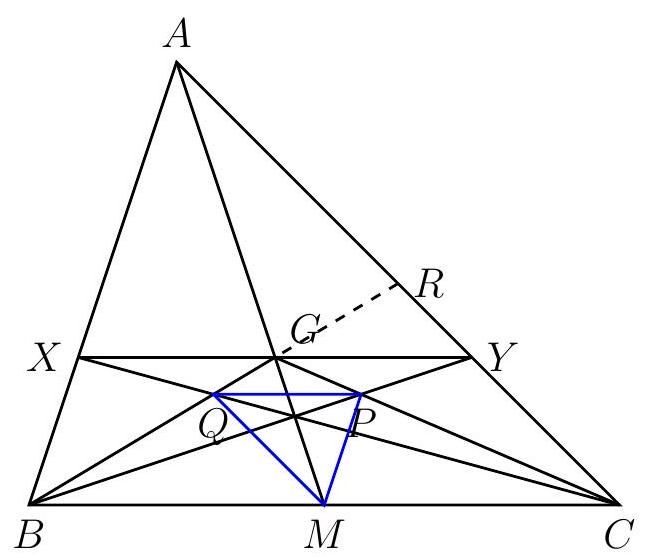
It is well known that $\frac{A G}{A M}=\frac{2}{3}$; thus the ratio of the similarity between $A X Y$ and $A B C$ is $\frac{2}{3}$. Hence $G X=\frac{1}{2} X Y=\frac{1}{3} B C$.
Now look at the similarity between triangles $Q B C$ and $Q G X$ :
$$
\frac{Q G}{Q B}=\frac{G X}{B C}=\frac{1}{3} \Longrightarrow Q B=3 Q G \Longrightarrow Q B=\frac{3}{4} B G=\frac{3}{4} \cdot \frac{2}{3} B R=\frac{1}{2} B R .
$$
Finally, since $\frac{B M}{B C}=\frac{B Q}{B R}, M Q$ is a midline in $B C R$. Therefore $M Q=\frac{1}{2} C R=\frac{1}{4} A C$ and $M Q \| A C$. Similarly, $M P=\frac{1}{4} A B$ and $M P \| A B$. This is sufficient to establish that $M P Q$ and $A B C$ are similar (with similarity ratio $\frac{1}{4}$ ).
## Solution 2
Let $S$ and $R$ be the midpoints of $A B$ and $A C$, respectively. Since $G$ is the centroid, it lies in the medians $B R$ and $C S$.
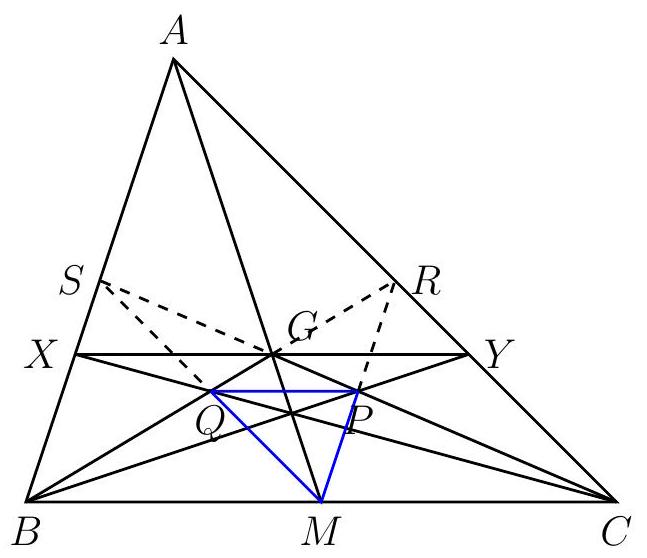
Due to the similarity between triangles $Q B C$ and $Q G X$ (which is true because $G X \| B C$ ), there is an inverse homothety with center $Q$ and ratio $-\frac{X G}{B C}=\frac{X Y}{2 B C}$ that takes $B$ to $G$ and $C$ to $X$. This homothety takes the midpoint $M$ of $B C$ to the midpoint $K$ of $G X$.
Now consider the homothety that takes $B$ to $X$ and $C$ to $G$. This new homothety, with ratio $\frac{X Y}{2 B C}$, also takes $M$ to $K$. Hence lines $B X$ (which contains side $A B$ ), $C G$ (which contains the median $C S$ ), and $M K$ have a common point, which is $S$. Thus $Q$ lies on midline $M S$.
The same reasoning proves that $P$ lies on midline $M R$. Since all homothety ratios are the same, $\frac{M Q}{M S}=\frac{M P}{M R}$, which shows that $M P Q$ is similar to $M R S$, which in turn is similar to $A B C$, and we are done.
## Problem 2
Suppose there are 997 points given in a plane. If every two points are joined by a line segment with its midpoint coloured in red, show that there are at least 1991 red points in the plane. Can you find a special case with exactly 1991 red points?
## Solution
Embed the points in the cartesian plane such that no two points have the same $y$-coordinate. Let $P_{1}, P_{2}, \ldots, P_{997}$ be the points and $y_{1}<y_{2}<\ldots<y_{997}$ be their respective $y$-coordinates. Then the $y$-coordinate of the midpoint of $P_{i} P_{i+1}, i=1,2, \ldots, 996$ is $\frac{y_{i}+y_{i+1}}{2}$ and the $y$-coordinate of the midpoint of $P_{i} P_{i+2}, i=1,2, \ldots, 995$ is $\frac{y_{i}+y_{i+2}}{2}$. Since
$$
\frac{y_{1}+y_{2}}{2}<\frac{y_{1}+y_{3}}{2}<\frac{y_{2}+y_{3}}{2}<\frac{y_{2}+y_{4}}{2}<\cdots<\frac{y_{995}+y_{997}}{2}<\frac{y_{996}+y_{997}}{2}
$$
there are at least $996+995=1991$ distinct midpoints, and therefore at least 1991 red points. The equality case happens if we take $P_{i}=(0,2 i), i=1,2, \ldots, 997$. The midpoints are $(0, i+j)$, $1 \leq i<j \leq 997$, which are the points $(0, k)$ with $1+2=3 \leq k \leq 996+997=1993$, a total of $1993-3+1=1991$ red points.
## Problem 3
Let $a_{1}, a_{2}, \ldots, a_{n}, b_{1}, b_{2}, \ldots, b_{n}$ be positive real numbers such that $a_{1}+a_{2}+\cdots+a_{n}=b_{1}+b_{2}+$ $\cdots+b_{n}$. Show that
$$
\frac{a_{1}^{2}}{a_{1}+b_{1}}+\frac{a_{2}^{2}}{a_{2}+b_{2}}+\cdots+\frac{a_{n}^{2}}{a_{n}+b_{n}} \geq \frac{a_{1}+a_{2}+\cdots+a_{n}}{2}
$$
## Solution
By the Cauchy-Schwartz inequality,
$$
\left(\frac{a_{1}^{2}}{a_{1}+b_{1}}+\frac{a_{2}^{2}}{a_{2}+b_{2}}+\cdots+\frac{a_{n}^{2}}{a_{n}+b_{n}}\right)\left(\left(a_{1}+b_{1}\right)+\left(a_{2}+b_{2}\right)+\cdots+\left(a_{n}+b_{n}\right)\right) \geq\left(a_{1}+a_{2}+\cdots+a_{n}\right)^{2} .
$$
Since $\left(\left(a_{1}+b_{1}\right)+\left(a_{2}+b_{2}\right)+\cdots+\left(a_{n}+b_{n}\right)\right)=2\left(a_{1}+a_{2}+\cdots+a_{n}\right)$,
$$
\frac{a_{1}^{2}}{a_{1}+b_{1}}+\frac{a_{2}^{2}}{a_{2}+b_{2}}+\cdots+\frac{a_{n}^{2}}{a_{n}+b_{n}} \geq \frac{\left(a_{1}+a_{2}+\cdots+a_{n}\right)^{2}}{2\left(a_{1}+a_{2}+\cdots+a_{n}\right)}=\frac{a_{1}+a_{2}+\cdots+a_{n}}{2}
$$
## Problem 4
During a break, $n$ children at school sit in a circle around their teacher to play a game. The teacher walks clockwise close to the children and hands out candies to some of them according to the following rule. He selects one child and gives him a candy, then he skips the next child and gives a candy to the next one, then he skips 2 and gives a candy to the next one, then he skips 3, and soon. Determine the values of $n$ for which eventually, perhaps after many rounds, all children will have at least one candy each.
Answer: All powers of 2 .
## Solution 1
Number the children from 0 to $n-1$. Then the teacher hands candy to children in positions $f(x)=1+2+\cdots+x \bmod n=\frac{x(x+1)}{2} \bmod n$. Our task is to find the range of $f: \mathbb{Z}_{n} \rightarrow \mathbb{Z}_{n}$, and to verify whether the range is $\mathbb{Z}_{n}$, that is, whether $f$ is a bijection.
If $n=2^{a} m, m>1$ odd, look at $f(x)$ modulo $m$. Since $m$ is odd, $m|f(x) \Longleftrightarrow m| x(x+1)$. Then, for instance, $f(x) \equiv 0(\bmod m)$ for $x=0$ and $x=m-1$. This means that $f(x)$ is not a bijection modulo $m$, and there exists $t$ such that $f(x) \not \equiv t(\bmod m)$ for all $x$. By the Chinese Remainder Theorem,
$$
f(x) \equiv t \quad(\bmod n) \Longleftrightarrow \begin{cases}f(x) \equiv t & \left(\bmod 2^{a}\right) \\ f(x) \equiv t & (\bmod m)\end{cases}
$$
Therefore, $f$ is not a bijection modulo $n$.
If $n=2^{a}$, then
$$
f(x)-f(y)=\frac{1}{2}(x(x+1)-y(y+1))=\frac{1}{2}\left(x^{2}-y^{2}+x-y\right)=\frac{(x-y)(x+y+1)}{2} .
$$
and
$$
f(x) \equiv f(y) \quad\left(\bmod 2^{a}\right) \Longleftrightarrow(x-y)(x+y+1) \equiv 0 \quad\left(\bmod 2^{a+1}\right)
$$
If $x$ and $y$ have the same parity, $x+y+1$ is odd and $(*)$ is equivalent to $x \equiv y\left(\bmod 2^{a+1}\right)$. If $x$ and $y$ have different parity,
$$
(*) \Longleftrightarrow x+y+1 \equiv 0 \quad\left(\bmod 2^{a+1}\right)
$$
However, $1 \leq x+y+1 \leq 2\left(2^{a}-1\right)+1=2^{a+1}-1$, so $x+y+1$ is not a multiple of $2^{a+1}$. Therefore $f$ is a bijection if $n$ is a power of 2 .
## Solution 2
We give a full description of $a_{n}$, the size of the range of $f$.
Since congruences modulo $n$ are defined, via Chinese Remainder Theorem, by congruences modulo $p^{\alpha}$ for all prime divisors $p$ of $n$ and $\alpha$ being the number of factors $p$ in the factorization of $n, a_{n}=\prod_{p^{\alpha} \| n} a_{p^{\alpha}}$.
Refer to the first solution to check the case $p=2: a_{2^{\alpha}}=2^{\alpha}$.
For an odd prime $p$,
$$
f(x)=\frac{x(x+1)}{2}=\frac{(2 x+1)^{2}-1}{8}
$$
and since $p$ is odd, there is a bijection between the range of $f$ and the quadratic residues modulo $p^{\alpha}$, namely $t \mapsto 8 t+1$. So $a_{p^{\alpha}}$ is the number of quadratic residues modulo $p^{\alpha}$.
Let $g$ be a primitive root of $p^{\alpha}$. Then there are $\frac{1}{2} \phi\left(p^{\alpha}\right)=\frac{p-1}{2} \cdot p^{\alpha-1}$ quadratic residues that are coprime with $p: 1, g^{2}, g^{4}, \ldots, g^{\phi\left(p^{n}\right)-2}$. If $p$ divides a quadratic residue $k p$, that is, $x^{2} \equiv k p$ $\left(\bmod p^{\alpha}\right), \alpha \geq 2$, then $p$ divides $x$ and, therefore, also $k$. Hence $p^{2}$ divides this quadratic residue, and these quadratic residues are $p^{2}$ times each quadratic residue of $p^{\alpha-2}$. Thus
$$
a_{p^{\alpha}}=\frac{p-1}{2} \cdot p^{\alpha-1}+a_{p^{\alpha}-2} .
$$
Since $a_{p}=\frac{p-1}{2}+1$ and $a_{p^{2}}=\frac{p-1}{2} \cdot p+1$, telescoping yields
$$
a_{p^{2 t}}=\frac{p-1}{2}\left(p^{2 t-1}+p^{2 t-3}+\cdots+p\right)+1=\frac{p\left(p^{2 t}-1\right)}{2(p+1)}+1
$$
and
$$
a_{p^{2 t-1}}=\frac{p-1}{2}\left(p^{2 t-2}+p^{2 t-4}+\cdots+1\right)+1=\frac{p^{2 t}-1}{2(p+1)}+1
$$
Now the problem is immediate: if $n$ is divisible by an odd prime $p, a_{p^{\alpha}}<p^{\alpha}$ for all $\alpha$, and since $a_{t} \leq t$ for all $t, a_{n}<n$.
## Problem 5
Given are two tangent circles and a point $P$ on their common tangent perpendicular to the lines joining their centres. Construct with ruler and compass all the circles that are tangent to these two circles and pass through the point $P$.
## Solution
Throughout this problem, we will assume that the given circles are externally tangent, since the problem does not have a solution otherwise.
Let $\Gamma_{1}$ and $\Gamma_{2}$ be the given circles and $T$ be their tangency point. Suppose $\omega$ is a circle that is tangent to $\Gamma_{1}$ and $\Gamma_{2}$ and passes through $P$.
Now invert about point $P$, with radius $P T$. Let any line through $P$ that cuts $\Gamma_{1}$ do so at points $X$ and $Y$. The power of $P$ with respect to $\Gamma_{1}$ is $P T^{2}=P X \cdot P Y$, so $X$ and $Y$ are swapped by this inversion. Therefore $\Gamma_{1}$ is mapped to itself in this inversion. The same applies to $\Gamma_{2}$. Since circle $\omega$ passes through $P$, it is mapped to a line tangent to the images of $\Gamma_{1}$ (itself) and $\Gamma_{2}$ (also itself), that is, a common tangent line. This common tangent cannot be $P T$, as $P T$ is also mapped to itself. Since $\Gamma_{1}$ and $\Gamma_{2}$ have exactly other two common tangent lines, there are two solutions: the inverses of the tangent lines.
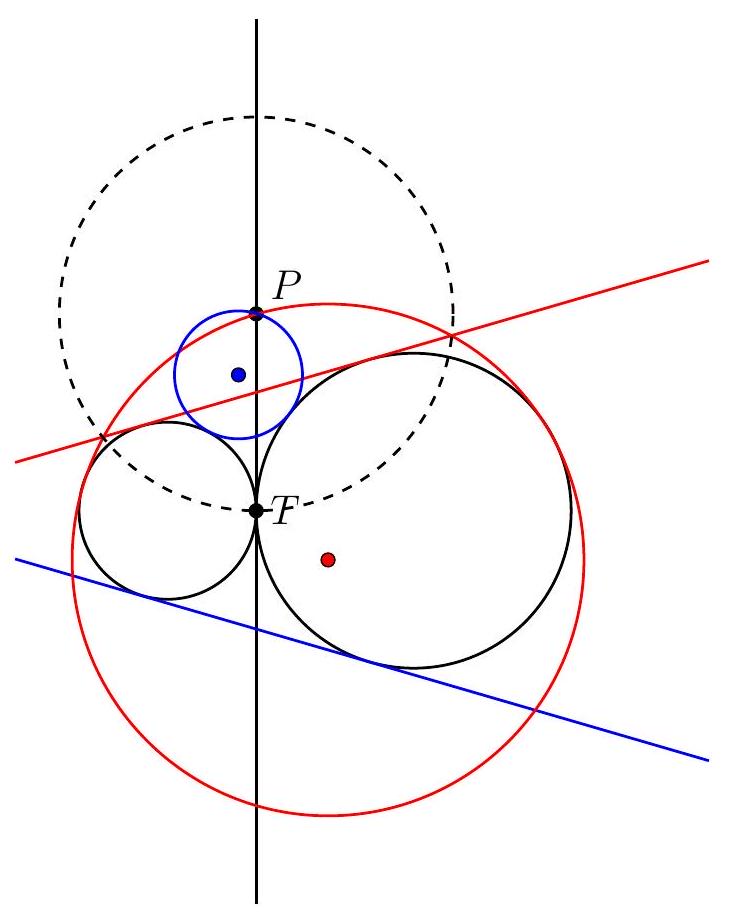
We proceed with the construction with the aid of some macro constructions that will be detailed later.
Step 1. Draw the common tangents to $\Gamma_{1}$ and $\Gamma_{2}$.
Step 2. For each common tangent $t$, draw the projection $P_{t}$ of $P$ onto $t$.
Step 3. Find the inverse $P_{1}$ of $P_{t}$ with respect to the circle with center $P$ and radius $P T$.
Step 4. $\omega_{t}$ is the circle with diameter $P P_{1}$.
Let's work out the details for steps 1 and 3 . Steps 2 and 4 are immediate.
Step 1. In this particular case in which $\Gamma_{1}$ and $\Gamma_{2}$ are externally tangent, there is a small shortcut:
- Draw the circle with diameter on the two centers $O_{1}$ of $\Gamma_{1}$ and $O_{2}$ of $\Gamma_{2}$, and find its center $O$.
- Let this circle meet common tangent line $O P$ at points $Q, R$. The required lines are the perpendicular to $O Q$ at $Q$ and the perpendicular to $O R$ at $R$.
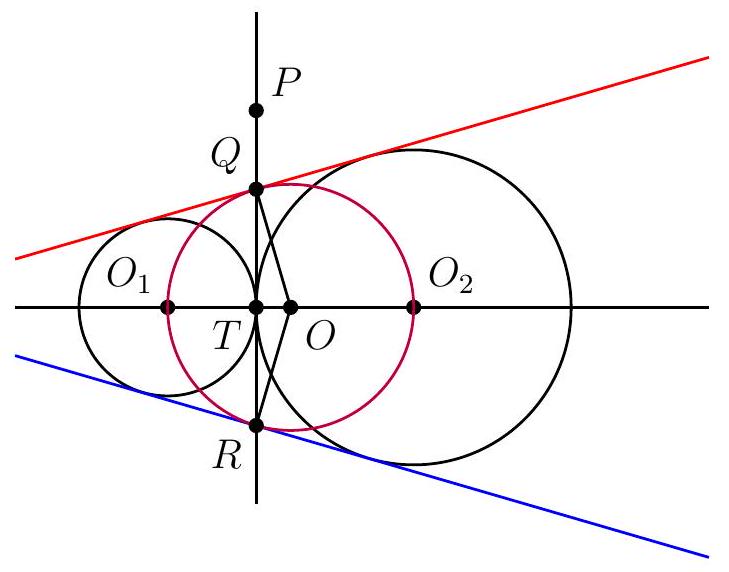
Let's show why this construction works. Let $R_{i}$ be the radius of circle $\Gamma_{i}$ and suppose without loss of generality that $R_{1} \leq R_{2}$. Note that $O Q=\frac{1}{2} O_{1} O_{2}=\frac{R_{1}+R_{2}}{2}, O T=O O_{1}-R_{1}=\frac{R_{2}-R_{1}}{2}$, so
$$
\sin \angle T Q O=\frac{O T}{O Q}=\frac{R_{2}-R_{1}}{R_{1}+R_{2}}
$$
which is also the sine of the angle between $O_{1} O_{2}$ and the common tangent lines.
Let $t$ be the perpendicular to $O Q$ through $Q$. Then $\angle\left(t, O_{1} O_{2}\right)=\angle(O Q, Q T)=\angle T Q O$, and $t$ is parallel to a common tangent line. Since
$$
d(O, t)=O Q=\frac{R_{1}+R_{2}}{2}=\frac{d\left(O_{1}, t\right)+d\left(O_{2}, t\right)}{2}
$$
and $O$ is the midpoint of $O_{1} O_{2}, O$ is also at the same distance from $t$ and the common tangent line, so these two lines coincide.
Step 3. Finding the inverse of a point $X$ given the inversion circle $\Omega$ with center $O$ is a well known procedure, but we describe it here for the sake of completeness.
- If $X$ lies in $\Omega$, then its inverse is $X$.
- If $X$ lies in the interior of $\Omega$, draw ray $O X$, then the perpendicular line $\ell$ to $O X$ at $X$. Let $\ell$ meet $\Omega$ at a point $Y$. The inverse of $X$ is the intersection $X^{\prime}$ of $O X$ and the line perpendicular to $O Y$ at $Y$. This is because $O Y X^{\prime}$ is a right triangle with altitude $Y X$, and therefore $O X \cdot O X^{\prime}=O Y^{2}$.
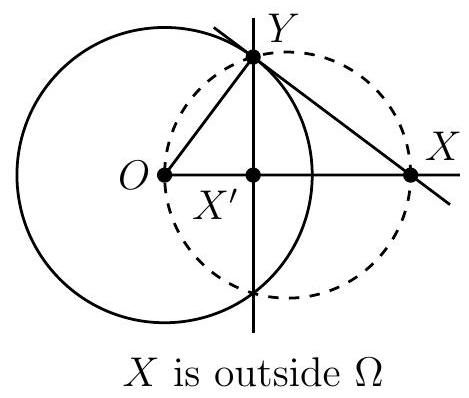
- If $X$ is in the exterior of $\Omega$, draw ray $O X$ and one of the tangent lines $\ell$ from $X$ to $\Omega$ (just connect $X$ to one of the intersections of $\Omega$ and the circle with diameter $O X$ ). Let $\ell$ touch $\Omega$ at a point $Y$. The inverse of $X$ is the projection $X^{\prime}$ of $Y$ onto $O X$. This is because $O Y X^{\prime}$ is a right triangle with altitude $Y X^{\prime}$, and therefore $O X \cdot O X^{\prime}=O Y^{2}$.
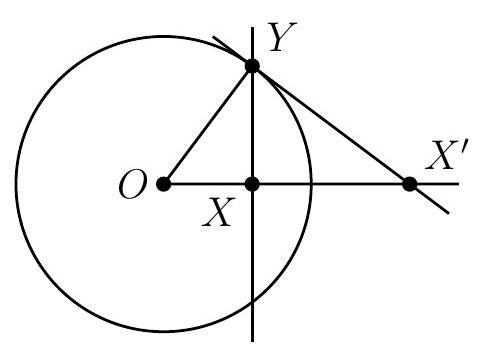
$X$ is inside $\Omega$
|