

File size: 7,333 Bytes
a67ef7c | 1 2 3 4 5 6 7 8 9 10 11 12 13 14 15 16 17 18 19 20 21 22 23 24 25 26 27 28 29 30 31 32 33 34 35 36 37 38 39 40 41 42 43 44 45 46 47 48 49 50 51 52 53 54 55 56 57 58 59 60 61 62 63 64 65 66 67 68 69 70 71 72 73 74 75 76 77 78 79 80 81 82 83 84 85 86 87 88 89 90 91 92 93 94 95 96 97 98 99 100 101 102 103 104 105 106 107 108 109 110 111 112 113 114 115 116 117 118 119 120 121 122 123 124 125 126 127 128 129 130 131 132 133 134 135 136 137 138 139 140 141 142 143 144 145 146 147 148 149 150 151 152 153 154 155 156 157 158 159 160 161 162 163 164 165 166 167 168 169 170 171 172 173 174 | # APMO 1993 - Problems and Solutions
## Problem 1
Let $A B C D$ be a quadrilateral such that all sides have equal length and angle $\angle A B C$ is 60 degrees. Let $\ell$ be a line passing through $D$ and not intersecting the quadrilateral (except at $D)$. Let $E$ and $F$ be the points of intersection of $\ell$ with $A B$ and $B C$ respectively. Let $M$ be the point of intersection of $C E$ and $A F$.
Prove that $C A^{2}=C M \times C E$.
## Solution
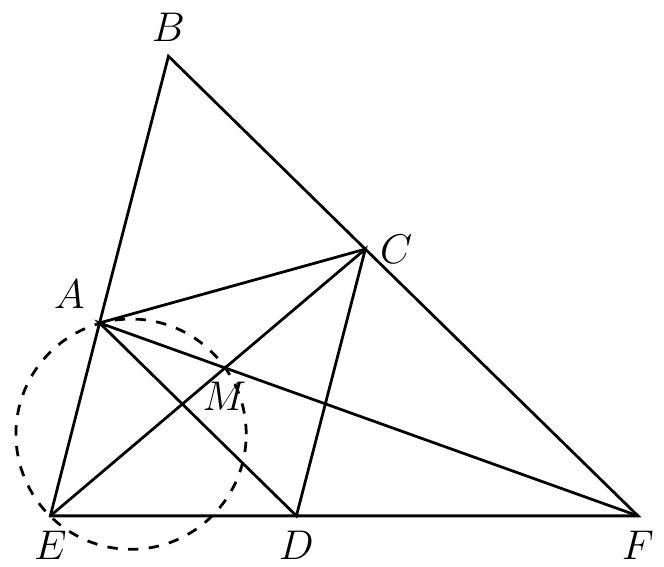
Triangles $A E D$ and $C D F$ are similar, because $A D \| C F$ and $A E \| C D$. Thus, since $A B C$ and $A C D$ are equilateral triangles,
$$
\frac{A E}{C D}=\frac{A D}{C F} \Longleftrightarrow \frac{A E}{A C}=\frac{A C}{C F}
$$
The last equality combined with
$$
\angle E A C=180^{\circ}-\angle B A C=120^{\circ}=\angle A C F
$$
shows that triangles $E A C$ and $A C F$ are also similar. Therefore $\angle C A M=\angle C A F=\angle A E C$, which implies that line $A C$ is tangent to the circumcircle of $A M E$. By the power of a point, $C A^{2}=C M \cdot C E$, and we are done.
## Problem 2
Find the total number of different integer values the function
$$
f(x)=[x]+[2 x]+\left[\frac{5 x}{3}\right]+[3 x]+[4 x]
$$
takes for real numbers $x$ with $0 \leq x \leq 100$.
Note: $[t]$ is the largest integer that does not exceed $t$.
Answer: 734.
## Solution
Note that, since $[x+n]=[x]+n$ for any integer $n$,
$$
f(x+3)=[x+3]+[2(x+3)]+\left[\frac{5(x+3)}{3}\right]+[3(x+3)]+[4(x+3)]=f(x)+35,
$$
one only needs to investigate the interval $[0,3)$.
The numbers in this interval at which at least one of the real numbers $x, 2 x, \frac{5 x}{3}, 3 x, 4 x$ is an integer are
- $0,1,2$ for $x$;
- $\frac{n}{2}, 0 \leq n \leq 5$ for $2 x$;
- $\frac{3 n}{5}, 0 \leq n \leq 4$ for $\frac{5 x}{3}$;
- $\frac{n}{3}, 0 \leq n \leq 8$ for $3 x$;
- $\frac{n}{4}, 0 \leq n \leq 11$ for $4 x$.
Of these numbers there are
- 3 integers $(0,1,2)$;
- 3 irreducible fractions with 2 as denominator (the numerators are $1,3,5$ );
- 6 irreducible fractions with 3 as denominator (the numerators are $1,2,4,5,7,8$ );
- 6 irreducible fractions with 4 as denominator (the numerators are $1,3,5,7,9,11,13,15$ );
- 4 irreducible fractions with 5 as denominator (the numerators are 3,6,9,12).
Therefore $f(x)$ increases 22 times per interval. Since $100=33 \cdot 3+1$, there are $33 \cdot 22$ changes of value in $[0,99)$. Finally, there are 8 more changes in [99,100]: 99, 100, $99 \frac{1}{2}, 99 \frac{1}{3}, 99 \frac{2}{3}, 99 \frac{1}{4}$, $99 \frac{3}{4}, 99 \frac{3}{5}$.
The total is then $33 \cdot 22+8=734$.
Comment: A more careful inspection shows that the range of $f$ are the numbers congruent modulo 35 to one of
$$
0,1,2,4,5,6,7,11,12,13,14,16,17,18,19,23,24,25,26,28,29,30
$$
in the interval $[0, f(100)]=[0,1166]$. Since $1166 \equiv 11(\bmod 35)$, this comprises 33 cycles plus the 8 numbers in the previous list.
## Problem 3
Let
$$
f(x)=a_{n} x^{n}+a_{n-1} x^{n-1}+\cdots+a_{0} \quad \text { and } \quad g(x)=c_{n+1} x^{n+1}+c_{n} x^{n}+\cdots+c_{0}
$$
be non-zero polynomials with real coefficients such that $g(x)=(x+r) f(x)$ for some real number $r$. If $a=\max \left(\left|a_{n}\right|, \ldots,\left|a_{0}\right|\right)$ and $c=\max \left(\left|c_{n+1}\right|, \ldots,\left|c_{0}\right|\right)$, prove that $\frac{a}{c} \leq n+1$.
## Solution
Expanding $(x+r) f(x)$, we find that $c_{n+1}=a_{n}, c_{k}=a_{k-1}+r a_{k}$ for $k=1,2, \ldots, n$, and $c_{0}=r a_{0}$. Consider three cases:
- $r=0$. Then $c_{0}=0$ and $c_{k}=a_{k-1}$ for $k=1,2, \ldots, n$, and $a=c \Longrightarrow \frac{a}{c}=1 \leq n+1$.
- $|r| \geq 1$. Then
$$
\begin{gathered}
\left|a_{0}\right|=\left|\frac{c_{0}}{r}\right| \leq c \\
\left|a_{1}\right|=\left|\frac{c_{1}-a_{0}}{r}\right| \leq\left|c_{1}\right|+\left|a_{0}\right| \leq 2 c
\end{gathered}
$$
and inductively if $\left|a_{k}\right| \leq(k+1) c$
$$
\left|a_{k+1}\right|=\left|\frac{c_{k+1}-a_{k}}{r}\right| \leq\left|c_{k+1}\right|+\left|a_{k}\right| \leq c+(k+1) c=(k+2) c
$$
Therefore, $\left|a_{k}\right| \leq(k+1) c \leq(n+1) c$ for all $k$, and $a \leq(n+1) c \Longleftrightarrow \frac{a}{c} \leq n+1$.
- $0<|r|<1$. Now work backwards: $\left|a_{n}\right|=\left|c_{n+1}\right| \leq c$,
$$
\left|a_{n-1}\right|=\left|c_{n}-r a_{n}\right| \leq\left|c_{n}\right|+\left|r a_{n}\right|<c+c=2 c,
$$
and inductively if $\left|a_{n-k}\right| \leq(k+1) c$
$$
\left|a_{n-k-1}\right|=\left|c_{n-k}-r a_{n-k}\right| \leq\left|c_{n-k}\right|+\left|r a_{n-k}\right|<c+(k+1) c=(k+2) c .
$$
Therefore, $\left|a_{n-k}\right| \leq(k+1) c \leq(n+1) c$ for all $k$, and $a \leq(n+1) c$ again.
## Problem 4
Determine all positive integers $n$ for which the equation
$$
x^{n}+(2+x)^{n}+(2-x)^{n}=0
$$
has an integer as a solution.
## Answer: $n=1$.
## Solution
If $n$ is even, $x^{n}+(2+x)^{n}+(2-x)^{n}>0$, so $n$ is odd.
For $n=1$, the equation reduces to $x+(2+x)+(2-x)=0$, which has the unique solution $x=-4$.
For $n>1$, notice that $x$ is even, because $x, 2-x$, and $2+x$ have all the same parity. Let $x=2 y$, so the equation reduces to
$$
y^{n}+(1+y)^{n}+(1-y)^{n}=0 .
$$
Looking at this equation modulo 2 yields that $y+(1+y)+(1-y)=y+2$ is even, so $y$ is even. Using the factorization
$$
a^{n}+b^{n}=(a+b)\left(a^{n-1}-a^{n-2} b+\cdots+b^{n-1}\right) \quad \text { for } n \text { odd, }
$$
which has a sum of $n$ terms as the second factor, the equation is now equivalent to
$$
y^{n}+(1+y+1-y)\left((1+y)^{n-1}-(1+y)^{n-2}(1-y)+\cdots+(1-y)^{n-1}\right)=0
$$
or
$$
y^{n}=-2\left((1+y)^{n-1}-(1+y)^{n-2}(1-y)+\cdots+(1-y)^{n-1}\right) .
$$
Each of the $n$ terms in the second factor is odd, and $n$ is odd, so the second factor is odd. Therefore, $y^{n}$ has only one factor 2 , which is a contradiction to the fact that, $y$ being even, $y^{n}$ has at least $n>1$ factors 2 . Hence there are no solutions if $n>1$.
## Problem 5
Let $P_{1}, P_{2}, \ldots, P_{1993}=P_{0}$ be distinct points in the $x y$-plane with the following properties:
(i) both coordinates of $P_{i}$ are integers, for $i=1,2, \ldots, 1993$;
(ii) there is no point other than $P_{i}$ and $P_{i+1}$ on the line segment joining $P_{i}$ with $P_{i+1}$ whose coordinates are both integers, for $i=0,1, \ldots, 1992$.
Prove that for some $i, 0 \leq i \leq 1992$, there exists a point $Q$ with coordinates $\left(q_{x}, q_{y}\right)$ on the line segment joining $P_{i}$ with $P_{i+1}$ such that both $2 q_{x}$ and $2 q_{y}$ are odd integers.
## Solution
Call a point $(x, y) \in \mathbb{Z}^{2}$ even or odd according to the parity of $x+y$. Since there are an odd number of points, there are two points $P_{i}=(a, b)$ and $P_{i+1}=(c, d), 0 \leq i \leq 1992$ with the same parity. This implies that $a+b+c+d$ is even. We claim that the midpoint of $P_{i} P_{i+1}$ is the desired point $Q$.
In fact, since $a+b+c+d=(a+c)+(b+d)$ is even, $a$ and $c$ have the same parity if and only if $b$ and $d$ also have the same parity. If both happen then the midpoint of $P_{i} P_{i+1}, Q=\left(\frac{a+c}{2}, \frac{b+d}{2}\right)$, has integer coordinates, which violates condition (ii). Then $a$ and $c$, as well as $b$ and $d$, have different parities, and $2 q_{x}=a+c$ and $2 q_{y}=b+d$ are both odd integers.
|