

File size: 12,161 Bytes
a67ef7c | 1 2 3 4 5 6 7 8 9 10 11 12 13 14 15 16 17 18 19 20 21 22 23 24 25 26 27 28 29 30 31 32 33 34 35 36 37 38 39 40 41 42 43 44 45 46 47 48 49 50 51 52 53 54 55 56 57 58 59 60 61 62 63 64 65 66 67 68 69 70 71 72 73 74 75 76 77 78 79 80 81 82 83 84 85 86 87 88 89 90 91 92 93 94 95 96 97 98 99 100 101 102 103 104 105 106 107 108 109 110 111 112 113 114 115 116 117 118 119 120 121 122 123 124 125 126 127 128 129 130 131 132 133 134 135 136 137 138 139 140 141 142 143 144 145 146 147 148 149 150 151 152 153 154 155 156 157 158 159 160 161 162 163 164 165 166 167 168 169 170 171 172 173 174 175 176 177 178 179 180 181 182 183 184 185 186 187 188 189 190 191 192 193 194 195 196 197 198 199 200 201 202 203 204 205 206 207 208 209 210 211 212 213 214 215 216 217 218 219 220 221 222 223 224 225 226 227 228 229 230 231 232 233 234 235 236 237 238 239 240 241 242 243 244 245 246 247 248 249 250 251 252 253 254 255 256 257 258 259 260 261 262 263 264 265 266 267 268 269 270 271 272 273 274 275 276 277 278 279 280 281 282 283 284 285 286 287 288 289 290 291 292 293 294 295 296 297 298 299 300 301 302 303 | # XVII APMO - March, 2005
## Problems and Solutions
Problem 1. Prove that for every irrational real number $a$, there are irrational real numbers $b$ and $b^{\prime}$ so that $a+b$ and $a b^{\prime}$ are both rational while $a b$ and $a+b^{\prime}$ are both irrational.
(Solution) Let $a$ be an irrational number. If $a^{2}$ is irrational, we let $b=-a$. Then, $a+b=0$ is rational and $a b=-a^{2}$ is irrational. If $a^{2}$ is rational, we let $b=a^{2}-a$. Then, $a+b=a^{2}$ is rational and $a b=a^{2}(a-1)$. Since
$$
a=\frac{a b}{a^{2}}+1
$$
is irrational, so is $a b$.
Now, we let $b^{\prime}=\frac{1}{a}$ or $b^{\prime}=\frac{2}{a}$. Then $a b^{\prime}=1$ or 2 , which is rational. Note that
$$
a+b^{\prime}=\frac{a^{2}+1}{a} \quad \text { or } \quad a+b^{\prime}=\frac{a^{2}+2}{a} .
$$
Since,
$$
\frac{a^{2}+2}{a}-\frac{a^{2}+1}{a}=\frac{1}{a}
$$
at least one of them is irrational.
Problem 2. Let $a, b$ and $c$ be positive real numbers such that $a b c=8$. Prove that
$$
\frac{a^{2}}{\sqrt{\left(1+a^{3}\right)\left(1+b^{3}\right)}}+\frac{b^{2}}{\sqrt{\left(1+b^{3}\right)\left(1+c^{3}\right)}}+\frac{c^{2}}{\sqrt{\left(1+c^{3}\right)\left(1+a^{3}\right)}} \geq \frac{4}{3} .
$$
(Solution) Observe that
$$
\frac{1}{\sqrt{1+x^{3}}} \geq \frac{2}{2+x^{2}}
$$
In fact, this is equivalent to $\left(2+x^{2}\right)^{2} \geq 4\left(1+x^{3}\right)$, or $x^{2}(x-2)^{2} \geq 0$. Notice that equality holds in (1) if and only if $x=2$.
We substitute $x$ by $a, b, c$ in (1), respectively, to find
$$
\begin{gathered}
\frac{a^{2}}{\sqrt{\left(1+a^{3}\right)\left(1+b^{3}\right)}}+\frac{b^{2}}{\sqrt{\left(1+b^{3}\right)\left(1+c^{3}\right)}}+\frac{c^{2}}{\sqrt{\left(1+c^{3}\right)\left(1+a^{3}\right)}} \\
\geq \frac{4 a^{2}}{\left(2+a^{2}\right)\left(2+b^{2}\right)}+\frac{4 b^{2}}{\left(2+b^{2}\right)\left(2+c^{2}\right)}+\frac{4 c^{2}}{\left(2+c^{2}\right)\left(2+a^{2}\right)}
\end{gathered}
$$
We combine the terms on the right hand side of (2) to obtain
$$
\text { Left hand side of }(2) \geq \frac{2 S(a, b, c)}{36+S(a, b, c)}=\frac{2}{1+36 / S(a, b, c)}
$$
where $S(a, b, c):=2\left(a^{2}+b^{2}+c^{2}\right)+(a b)^{2}+(b c)^{2}+(c a)^{2}$. By AM-GM inequality, we have
$$
\begin{aligned}
a^{2}+b^{2}+c^{2} & \geq 3 \sqrt[3]{(a b c)^{2}}=12 \\
(a b)^{2}+(b c)^{2}+(c a)^{2} & \geq 3 \sqrt[3]{(a b c)^{4}}=48
\end{aligned}
$$
Note that the equalities holds if and only if $a=b=c=2$. The above inequalities yield
$$
S(a, b, c)=2\left(a^{2}+b^{2}+c^{2}\right)+(a b)^{2}+(b c)^{2}+(c a)^{2} \geq 72
$$
Therefore
$$
\frac{2}{1+36 / S(a, b, c)} \geq \frac{2}{1+36 / 72}=\frac{4}{3}
$$
which is the required inequality.
Problem 3. Prove that there exists a triangle which can be cut into 2005 congruent triangles.
(Solution) Suppose that one side of a triangle has length $n$. Then it can be cut into $n^{2}$ congruent triangles which are similar to the original one and whose corresponding sides to the side of length $n$ have lengths 1 .
Since $2005=5 \times 401$ where 5 and 401 are primes and both primes are of the type $4 k+1$, it is representable as a sum of two integer squares. Indeed, it is easy to see that
$$
\begin{aligned}
2005 & =5 \times 401=\left(2^{2}+1\right)\left(20^{2}+1\right) \\
& =40^{2}+20^{2}+2^{2}+1 \\
& =(40-1)^{2}+2 \times 40+20^{2}+2^{2} \\
& =39^{2}+22^{2}
\end{aligned}
$$
Let $A B C$ be a right-angled triangle with the legs $A B$ and $B C$ having lengths 39 and 22 , respectively. We draw the altitude $B K$, which divides $A B C$ into two similar triangles. Now we divide $A B K$ into $39^{2}$ congruent triangles as described above and $B C K$ into $22^{2}$ congruent triangles. Since $A B K$ is similar to $B K C$, all 2005 triangles will be congruent.
Problem 4. In a small town, there are $n \times n$ houses indexed by $(i, j)$ for $1 \leq i, j \leq n$ with $(1,1)$ being the house at the top left corner, where $i$ and $j$ are the row and column indices, respectively. At time 0 , a fire breaks out at the house indexed by $(1, c)$, where $c \leq \frac{n}{2}$. During each subsequent time interval $[t, t+1]$, the fire fighters defend a house which is not yet on fire while the fire spreads to all undefended neighbors of each house which was on fire at time $t$. Once a house is defended, it remains so all the time. The process ends when the fire can no longer spread. At most how many houses can be saved by the fire fighters? A house indexed by $(i, j)$ is a neighbor of a house indexed by $(k, \ell)$ if $|i-k|+|j-\ell|=1$.
(Solution) At most $n^{2}+c^{2}-n c-c$ houses can be saved. This can be achieved under the following order of defending:
$$
\begin{gathered}
(2, c),(2, c+1) ;(3, c-1),(3, c+2) ;(4, c-2),(4, c+3) ; \ldots \\
(c+1,1),(c+1,2 c) ;(c+1,2 c+1), \ldots,(c+1, n)
\end{gathered}
$$
Under this strategy, there are
2 columns (column numbers $c, c+1$ ) at which $n-1$ houses are saved
2 columns (column numbers $c-1, c+2$ ) at which $n-2$ houses are saved
...
2 columns (column numbers $1,2 c$ ) at which $n-c$ houses are saved
$n-2 c$ columns (column numbers $n-2 c+1, \ldots, n$ ) at which $n-c$ houses are saved
Adding all these we obtain :
$$
2[(n-1)+(n-2)+\cdots+(n-c)]+(n-2 c)(n-c)=n^{2}+c^{2}-c n-c
$$
We say that a house indexed by $(i, j)$ is at level $t$ if $|i-1|+|j-c|=t$. Let $d(t)$ be the number of houses at level $t$ defended by time $t$, and $p(t)$ be the number of houses at levels greater than $t$ defended by time $t$. It is clear that
$$
p(t)+\sum_{i=1}^{t} d(i) \leq t \text { and } p(t+1)+d(t+1) \leq p(t)+1
$$
Let $s(t)$ be the number of houses at level $t$ which are not burning at time $t$. We prove that
$$
s(t) \leq t-p(t) \leq t
$$
for $1 \leq t \leq n-1$ by induction. It is obvious when $t=1$. Assume that it is true for $t=k$. The union of the neighbors of any $k-p(k)+1$ houses at level $k+1$ contains at least $k-p(k)+1$ vertices at level $k$. Since $s(k) \leq k-p(k)$, one of these houses at level $k$ is burning. Therefore, at most $k-p(k)$ houses at level $k+1$ have no neighbor burning. Hence we have
$$
\begin{aligned}
s(k+1) & \leq k-p(k)+d(k+1) \\
& =(k+1)-(p(k)+1-d(k+1)) \\
& \leq(k+1)-p(k+1)
\end{aligned}
$$
We now prove that the strategy given above is optimal. Since
$$
\sum_{t=1}^{n-1} s(t) \leq\binom{ n}{2}
$$
the maximum number of houses at levels less than or equal to $n-1$, that can be saved under any strategy is at most $\binom{n}{2}$, which is realized by the strategy above. Moreover, at levels bigger than $n-1$, every house is saved under the strategy above.
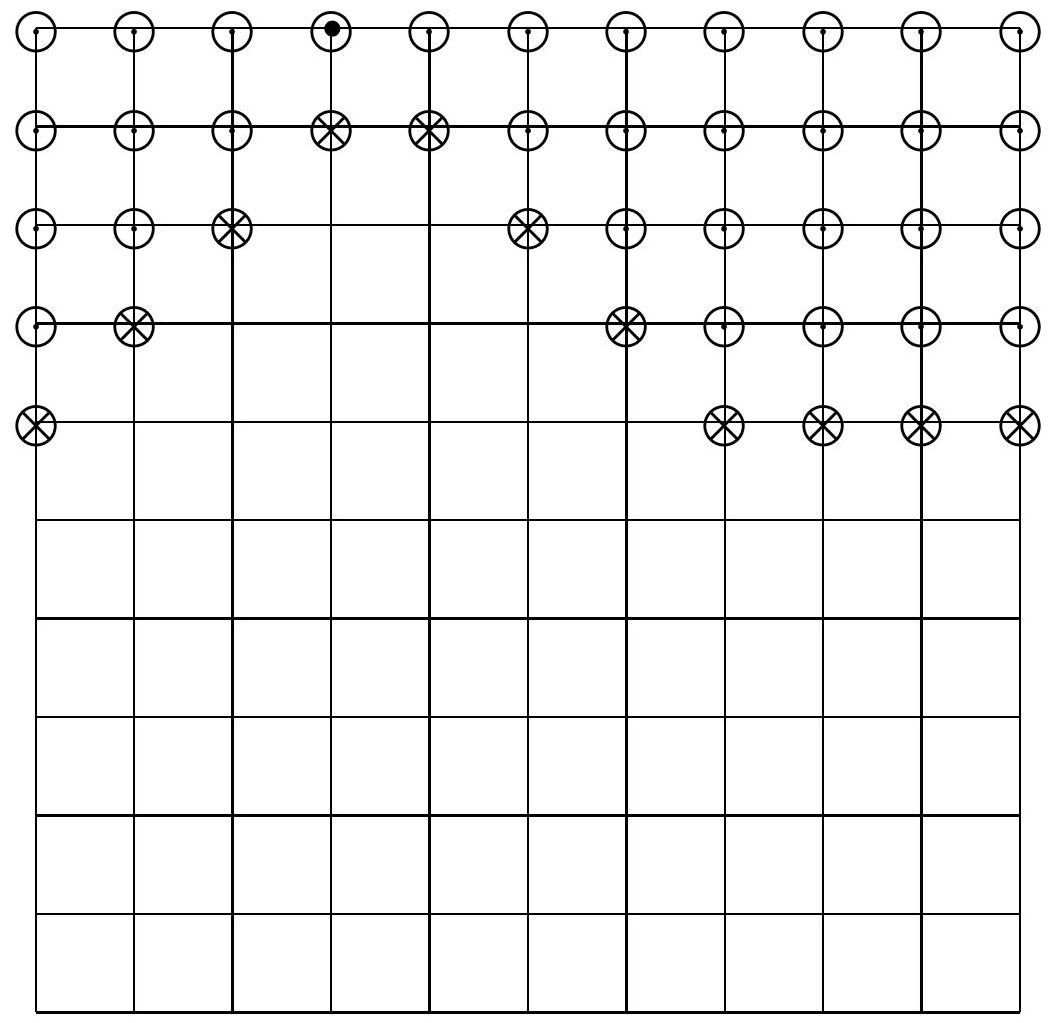
The following is an example when $n=11$ and $c=4$. The houses with $\bigcirc$ mark are burned. The houses with $\otimes$ mark are blocked ones and hence those and the houses below them are saved.
Problem 5. In a triangle $A B C$, points $M$ and $N$ are on sides $A B$ and $A C$, respectively, such that $M B=B C=C N$. Let $R$ and $r$ denote the circumradius and the inradius of the triangle $A B C$, respectively. Express the ratio $M N / B C$ in terms of $R$ and $r$.
(Solution) Let $\omega, O$ and $I$ be the circumcircle, the circumcenter and the incenter of $A B C$, respectively. Let $D$ be the point of intersection of the line $B I$ and the circle $\omega$ such that $D \neq B$. Then $D$ is the midpoint of the arc $A C$. Hence $O D \perp C N$ and $O D=R$.
We first show that triangles $M N C$ and $I O D$ are similar. Because $B C=B M$, the line $B I$ (the bisector of $\angle M B C$ ) is perpendicular to the line $C M$. Because $O D \perp C N$ and $I D \perp M C$, it follows that
$$
\angle O D I=\angle N C M
$$
Let $\angle A B C=2 \beta$. In the triangle $B C M$, we have
$$
\frac{C M}{N C}=\frac{C M}{B C}=2 \sin \beta
$$
Since $\angle D I C=\angle D C I$, we have $I D=C D=A D$. Let $E$ be the point of intersection of the line $D O$ and the circle $\omega$ such that $E \neq D$. Then $D E$ is a diameter of $\omega$ and $\angle D E C=\angle D B C=\beta$. Thus we have
$$
\frac{D I}{O D}=\frac{C D}{O D}=\frac{2 R \sin \beta}{R}=2 \sin \beta .
$$
Combining equations (8), (9), and (10) shows that triangles $M N C$ and $I O D$ are similar. It follows that
$$
\frac{M N}{B C}=\frac{M N}{N C}=\frac{I O}{O D}=\frac{I O}{R} .
$$
The well-known Euler's formula states that
$$
O I^{2}=R^{2}-2 R r .
$$
Therefore,
$$
\frac{M N}{B C}=\sqrt{1-\frac{2 r}{R}}
$$
(Alternative Solution) Let $a$ (resp., $b, c$ ) be the length of $B C$ (resp., $A C, A B$ ). Let $\alpha$ (resp., $\beta, \gamma$ ) denote the angle $\angle B A C$ (resp., $\angle A B C, \angle A C B$ ). By introducing coordinates $B=(0,0), C=(a, 0)$, it is immediate that the coordinates of $M$ and $N$ are
$$
M=(a \cos \beta, a \sin \beta), \quad N=(a-a \cos \gamma, a \sin \gamma)
$$
respectively. Therefore,
$$
\begin{aligned}
(M N / B C)^{2} & =\left[(a-a \cos \gamma-a \cos \beta)^{2}+(a \sin \gamma-a \sin \beta)^{2}\right] / a^{2} \\
& =(1-\cos \gamma-\cos \beta)^{2}+(\sin \gamma-\sin \beta)^{2} \\
& =3-2 \cos \gamma-2 \cos \beta+2(\cos \gamma \cos \beta-\sin \gamma \sin \beta) \\
& =3-2 \cos \gamma-2 \cos \beta+2 \cos (\gamma+\beta) \\
& =3-2 \cos \gamma-2 \cos \beta-2 \cos \alpha \\
& =3-2(\cos \gamma+\cos \beta+\cos \alpha) .
\end{aligned}
$$
Now we claim
$$
\cos \gamma+\cos \beta+\cos \alpha=\frac{r}{R}+1
$$
From
$$
\begin{aligned}
& a=b \cos \gamma+c \cos \beta \\
& b=c \cos \alpha+a \cos \gamma \\
& c=a \cos \beta+b \cos \alpha
\end{aligned}
$$
we get
$$
a(1+\cos \alpha)+b(1+\cos \beta)+c(1+\cos \gamma)=(a+b+c)(\cos \alpha+\cos \beta+\cos \gamma)
$$
Thus
$$
\begin{aligned}
& \cos \alpha+\cos \beta+\cos \gamma \\
& =\frac{1}{a+b+c}(a(1+\cos \alpha)+b(1+\cos \beta)+c(1+\cos \gamma)) \\
& =\frac{1}{a+b+c}\left(a\left(1+\frac{b^{2}+c^{2}-a^{2}}{2 b c}\right)+b\left(1+\frac{a^{2}+c^{2}-b^{2}}{2 a c}\right)+c\left(1+\frac{a^{2}+b^{2}-c^{2}}{2 a b}\right)\right) \\
& =\frac{1}{a+b+c}\left(a+b+c+\frac{a^{2}\left(b^{2}+c^{2}-a^{2}\right)+b^{2}\left(a^{2}+c^{2}-b^{2}\right)+c^{2}\left(a^{2}+b^{2}-c^{2}\right)}{2 a b c}\right) \\
& =1+\frac{2 a^{2} b^{2}+2 b^{2} c^{2}+2 c^{2} a^{2}-a^{4}-b^{4}-c^{4}}{2 a b c(a+b+c)}
\end{aligned}
$$
On the other hand, from $R=\frac{a}{2 \sin \alpha}$ it follows that
$$
\begin{aligned}
R^{2} & =\frac{a^{2}}{4\left(1-\cos ^{2} \alpha\right)}=\frac{a^{2}}{4\left(1-\left(\frac{b^{2}+c^{2}-a^{2}}{2 b c}\right)^{2}\right)} \\
& =\frac{a^{2} b^{2} c^{2}}{2 a^{2} b^{2}+2 b^{2} c^{2}+2 c^{2} a^{2}-a^{4}-b^{4}-c^{4}}
\end{aligned}
$$
Also from $\frac{1}{2}(a+b+c) r=\frac{1}{2} b c \sin \alpha$, it follows that
$$
\begin{aligned}
r^{2} & =\frac{b^{2} c^{2}\left(1-\cos ^{2} \alpha\right)}{(a+b+c)^{2}}=\frac{b^{2} c^{2}\left(1-\left(\frac{b^{2}+c^{2}-a^{2}}{2 b c}\right)^{2}\right)}{(a+b+c)^{2}} \\
& =\frac{2 a^{2} b^{2}+2 b^{2} c^{2}+2 c^{2} a^{2}-a^{4}-b^{4}-c^{4}}{4(a+b+c)^{2}}
\end{aligned}
$$
Combining (19), (20) and (21), we get (16) as desired.
Finally, by (15) and (16) we have
$$
\frac{M N}{B C}=\sqrt{1-\frac{2 r}{R}}
$$
Another proof of (16) from R.A. Johnson's "Advanced Euclidean Geometry" ${ }^{1}$ :
Construct the perpendicular bisectors $O D, O E, O F$, where $D, E, F$ are the midpoints of $B C, C A, A B$, respectively. By Ptolemy's Theorem applied to the cyclic quadrilateral $O E A F$, we get
$$
\frac{a}{2} \cdot R=\frac{b}{2} \cdot O F+\frac{c}{2} \cdot O E
$$
Similarly
$$
\frac{b}{2} \cdot R=\frac{c}{2} \cdot O D+\frac{a}{2} \cdot O F, \quad \frac{c}{2} \cdot R=\frac{a}{2} \cdot O E+\frac{b}{2} \cdot O D .
$$
Adding, we get
$$
s R=O D \cdot \frac{b+c}{2}+O E \cdot \frac{c+a}{2}+O F \cdot \frac{a+b}{2}
$$
where $s$ is the semiperimeter. But also, the area of triangle $O B C$ is $O D \cdot \frac{a}{2}$, and adding similar formulas for the areas of triangles $O C A$ and $O A B$ gives
$$
r s=\triangle A B C=O D \cdot \frac{a}{2}+O E \cdot \frac{b}{2}+O F \cdot \frac{c}{2}
$$
Adding (23) and (24) gives $s(R+r)=s(O D+O E+O F)$, or
$$
O D+O E+O F=R+r .
$$
Since $O D=R \cos A$ etc., (16) follows.
[^0]
[^0]: ${ }^{1}$ This proof was introduced to the coordinating country by Professor Bill Sands of Canada.
|