

File size: 16,108 Bytes
a67ef7c | 1 2 3 4 5 6 7 8 9 10 11 12 13 14 15 16 17 18 19 20 21 22 23 24 25 26 27 28 29 30 31 32 33 34 35 36 37 38 39 40 41 42 43 44 45 46 47 48 49 50 51 52 53 54 55 56 57 58 59 60 61 62 63 64 65 66 67 68 69 70 71 72 73 74 75 76 77 78 79 80 81 82 83 84 85 86 87 88 89 90 91 92 93 94 95 96 97 98 99 100 101 102 103 104 105 106 107 108 109 110 111 112 113 114 115 116 117 118 119 120 121 122 123 124 125 126 127 128 129 130 131 132 133 134 135 136 137 138 139 140 141 142 143 144 145 146 147 148 149 150 151 152 153 154 155 156 157 158 159 160 161 162 163 164 165 166 167 168 169 170 171 172 173 174 175 176 177 178 179 180 181 182 183 184 185 186 187 188 189 190 191 192 193 194 195 196 197 198 199 200 201 202 203 204 205 206 207 208 209 210 211 212 213 214 215 216 217 218 219 220 221 222 223 224 225 226 227 228 229 230 231 232 233 234 235 236 237 238 239 240 241 242 243 244 245 246 247 248 249 250 251 252 253 254 255 256 257 258 259 260 261 262 263 264 265 266 267 268 269 270 271 272 273 274 275 276 277 278 279 280 281 282 283 284 285 286 287 288 289 290 291 292 293 294 295 296 297 298 299 300 301 302 303 304 305 306 307 308 309 310 311 312 313 314 315 316 317 318 319 320 321 322 323 324 325 326 | # XIX Asian Pacific Mathematics Olympiad

Problem 1. Let $S$ be a set of 9 distinct integers all of whose prime factors are at most 3. Prove that $S$ contains 3 distinct integers such that their product is a perfect cube.
Solution. Without loss of generality, we may assume that $S$ contains only positive integers. Let
$$
S=\left\{2^{a_{i}} 3^{b_{i}} \mid a_{i}, b_{i} \in \mathbb{Z}, a_{i}, b_{i} \geq 0,1 \leq i \leq 9\right\}
$$
It suffices to show that there are $1 \leq i_{1}, i_{2}, i_{3} \leq 9$ such that
$$
a_{i_{1}}+a_{i_{2}}+a_{i_{3}} \equiv b_{i_{1}}+b_{i_{2}}+b_{i_{3}} \equiv 0 \quad(\bmod 3) .
$$
For $n=2^{a} 3^{b} \in S$, let's call $(a(\bmod 3), b(\bmod 3))$ the type of $n$. Then there are 9 possible types:
$$
(0,0),(0,1),(0,2),(1,0),(1,1),(1,2),(2,0),(2,1),(2,2)
$$
Let $N(i, j)$ be the number of integers in $S$ of type $(i, j)$. We obtain 3 distinct integers whose product is a perfect cube when
(1) $N(i, j) \geq 3$ for some $i, j$, or
(2) $N(i, 0) N(i, 1) N(i, 2) \neq 0$ for some $i=0,1,2$, or
(3) $N(0, j) N(1, j) N(2, j) \neq 0$ for some $j=0,1,2$, or
(4) $N\left(i_{1}, j_{1}\right) N\left(i_{2}, j_{2}\right) N\left(i_{3}, j_{3}\right) \neq 0$, where $\left\{i_{1}, i_{2}, i_{3}\right\}=\left\{j_{1}, j_{2}, j_{3}\right\}=\{0,1,2\}$.
Assume that none of the conditions (1) (3) holds. Since $N(i, j) \leq 2$ for all $(i, j)$, there are at least five $N(i, j)$ 's that are nonzero. Furthermore, among those nonzero $N(i, j)$ 's, no three have the same $i$ nor the same $j$. Using these facts, one may easily conclude that the condition (4) should hold. (For example, if one places each nonzero $N(i, j)$ in the $(i, j)$-th box of a regular $3 \times 3$ array of boxes whose rows and columns are indexed by 0,1 and 2 , then one can always find three boxes, occupied by at least one nonzero $N(i, j)$, whose rows and columns are all distinct. This implies (4).)
Second solution. Up to $(\dagger)$, we do the same as above and get 9 possible types:
$$
(a(\bmod 3), b(\bmod 3))=(0,0),(0,1),(0,2),(1,0),(1,1),(1,2),(2,0),(2,1),(2,2)
$$
for $n=2^{a} 3^{b} \in S$.
Note that (i) among any 5 integers, there exist 3 whose sum is $0(\bmod 3)$, and that (ii) if $i, j, k \in\{0,1,2\}$, then $i+j+k \equiv 0(\bmod 3)$ if and only if $i=j=k$ or $\{i, j, k\}=\{0,1,2\}$.
Let's define
$T$ : the set of types of the integers in $S$;
$N(i)$ : the number of integers in $S$ of the type $(i, \cdot)$;
$M(i)$ : the number of integers $j \in\{0,1,2\}$ such that $(i, j) \in T$.
If $N(i) \geq 5$ for some $i$, the result follows from (i). Otherwise, for some permutation $(i, j, k)$ of $(0,1,2)$,
$$
N(i) \geq 3, \quad N(j) \geq 3, \quad N(k) \geq 1
$$
If $M(i)$ or $M(j)$ is 1 or 3 , the result follows from (ii). Otherwise $M(i)=M(j)=2$. Then either
$$
(i, x),(i, y),(j, x),(j, y) \in T \quad \text { or } \quad(i, x),(i, y),(j, x),(j, z) \in T
$$
for some permutation $(x, y, z)$ of $(0,1,2)$. Since $N(k) \geq 1$, at least one of $(k, x),(k, y)$ and $(k, z)$ contained in $T$. Therefore, in any case, the result follows from (ii). (For example, if $(k, y) \in T$, then take $(i, y),(j, y),(k, y)$ or $(i, x),(j, z),(k, y)$ from T.)
Problem 2. Let $A B C$ be an acute angled triangle with $\angle B A C=60^{\circ}$ and $A B>A C$. Let $I$ be the incenter, and $H$ the orthocenter of the triangle $A B C$. Prove that
$$
2 \angle A H I=3 \angle A B C .
$$
Solution. Let $D$ be the intersection point of the lines $A H$ and $B C$. Let $K$ be the intersection point of the circumcircle $O$ of the triangle $A B C$ and the line $A H$. Let the line through $I$ perpendicular to $B C$ meet $B C$ and the minor arc $B C$ of the circumcircle $O$ at $E$ and $N$, respectively. We have
$\angle B I C=180^{\circ}-(\angle I B C+\angle I C B)=180^{\circ}-\frac{1}{2}(\angle A B C+\angle A C B)=90^{\circ}+\frac{1}{2} \angle B A C=120^{\circ}$
and also $\angle B N C=180^{\circ}-\angle B A C=120^{\circ}=\angle B I C$. Since $I N \perp B C$, the quadrilateral $B I C N$ is a kite and thus $I E=E N$.
Now, since $H$ is the orthocenter of the triangle $A B C, H D=D K$. Also because $E D \perp I N$ and $E D \perp H K$, we conclude that $I H K N$ is an isosceles trapezoid with $I H=N K$.
Hence
$$
\angle A H I=180^{\circ}-\angle I H K=180^{\circ}-\angle A K N=\angle A B N .
$$
Since $I E=E N$ and $B E \perp I N$, the triangles $I B E$ and $N B E$ are congruent. Therefore
$$
\angle N B E=\angle I B E=\angle I B C=\angle I B A=\frac{1}{2} \angle A B C
$$
and thus
$$
\angle A H I=\angle A B N=\frac{3}{2} \angle A B C .
$$
Second solution. Let $P, Q$ and $R$ be the intersection points of $B H, C H$ and $A H$ with $A C, A B$ and $B C$, respectively. Then we have $\angle I B H=\angle I C H$. Indeed,
$$
\angle I B H=\angle A B P-\angle A B I=30^{\circ}-\frac{1}{2} \angle A B C
$$
and
$$
\angle I C H=\angle A C I-\angle A C H=\frac{1}{2} \angle A C B-30^{\circ}=30^{\circ}-\frac{1}{2} \angle A B C,
$$
because $\angle A B H=\angle A C H=30^{\circ}$ and $\angle A C B+\angle A B C=120^{\circ}$. (Note that $\angle A B P>\angle A B I$ and $\angle A C I>\angle A C H$ because $A B$ is the longest side of the triangle $A B C$ under the given conditions.) Therefore BIHC is a cyclic quadrilateral and thus
$$
\angle B H I=\angle B C I=\frac{1}{2} \angle A C B .
$$
On the other hand,
$$
\angle B H R=90^{\circ}-\angle H B R=90^{\circ}-(\angle A B C-\angle A B H)=120^{\circ}-\angle A B C
$$
Therefore,
$$
\begin{aligned}
\angle A H I & =180^{\circ}-\angle B H I-\angle B H R=60^{\circ}-\frac{1}{2} \angle A C B+\angle A B C \\
& =60^{\circ}-\frac{1}{2}\left(120^{\circ}-\angle A B C\right)+\angle A B C=\frac{3}{2} \angle A B C .
\end{aligned}
$$
Problem 3. Consider $n$ disks $C_{1}, C_{2}, \ldots, C_{n}$ in a plane such that for each $1 \leq i<n$, the center of $C_{i}$ is on the circumference of $C_{i+1}$, and the center of $C_{n}$ is on the circumference of $C_{1}$. Define the score of such an arrangement of $n$ disks to be the number of pairs $(i, j)$ for which $C_{i}$ properly contains $C_{j}$. Determine the maximum possible score.
Solution. The answer is $(n-1)(n-2) / 2$.
Let's call a set of $n$ disks satisfying the given conditions an $n$-configuration. For an $n$ configuration $\mathcal{C}=\left\{C_{1}, \ldots, C_{n}\right\}$, let $S_{\mathcal{C}}=\left\{(i, j) \mid C_{i}\right.$ properly contains $\left.C_{j}\right\}$. So, the score of an $n$-configuration $\mathcal{C}$ is $\left|S_{\mathcal{C}}\right|$.
We'll show that (i) there is an $n$-configuration $\mathcal{C}$ for which $\left|S_{\mathcal{C}}\right|=(n-1)(n-2) / 2$, and that (ii) $\left|S_{\mathcal{C}}\right| \leq(n-1)(n-2) / 2$ for any $n$-configuration $\mathcal{C}$.
Let $C_{1}$ be any disk. Then for $i=2, \ldots, n-1$, take $C_{i}$ inside $C_{i-1}$ so that the circumference of $C_{i}$ contains the center of $C_{i-1}$. Finally, let $C_{n}$ be a disk whose center is on the circumference of $C_{1}$ and whose circumference contains the center of $C_{n-1}$. This gives $S_{\mathcal{C}}=\{(i, j) \mid 1 \leq i<j \leq n-1\}$ of size $(n-1)(n-2) / 2$, which proves (i).
For any $n$-configuration $\mathcal{C}, S_{\mathcal{C}}$ must satisfy the following properties:
(1) $(i, i) \notin S_{\mathcal{C}}$,
(2) $(i+1, i) \notin S_{\mathcal{C}},(1, n) \notin S_{\mathcal{C}}$,
(3) if $(i, j),(j, k) \in S_{\mathcal{C}}$, then $(i, k) \in S_{\mathcal{C}}$,
(4) if $(i, j) \in S_{\mathcal{C}}$, then $(j, i) \notin S_{\mathcal{C}}$.
Now we show that a set $G$ of ordered pairs of integers between 1 and $n$, satisfying the conditions $(1) \sim(4)$, can have no more than $(n-1)(n-2) / 2$ elements. Suppose that there exists a set $G$ that satisfies the conditions (1) $\sim(4)$, and has more than $(n-1)(n-2) / 2$ elements. Let $n$ be the least positive integer with which there exists such a set $G$. Note that $G$ must have $(i, i+1)$ for some $1 \leq i \leq n$ or $(n, 1)$, since otherwise $G$ can have at most
$$
\binom{n}{2}-n=\frac{n(n-3)}{2}<\frac{(n-1)(n-2)}{2}
$$
elements. Without loss of generality we may assume that $(n, 1) \in G$. Then $(1, n-1) \notin G$, since otherwise the condition (3) yields $(n, n-1) \in G$ contradicting the condition (2). Now let $G^{\prime}=\{(i, j) \in G \mid 1 \leq i, j \leq n-1\}$, then $G^{\prime}$ satisfies the conditions (1) (4), with $n-1$.
We now claim that $\left|G-G^{\prime}\right| \leq n-2$ :
Suppose that $\left|G-G^{\prime}\right|>n-2$, then $\left|G-G^{\prime}\right|=n-1$ and hence for each $1 \leq i \leq n-1$, either $(i, n)$ or $(n, i)$ must be in $G$. We already know that $(n, 1) \in G$ and $(n-1, n) \in G$ (because $(n, n-1) \notin G$ ) and this implies that $(n, n-2) \notin G$ and $(n-2, n) \in G$. If we keep doing this process, we obtain $(1, n) \in G$, which is a contradiction.
Since $\left|G-G^{\prime}\right| \leq n-2$, we obtain
$$
\left|G^{\prime}\right| \geq \frac{(n-1)(n-2)}{2}-(n-2)=\frac{(n-2)(n-3)}{2}
$$
This, however, contradicts the minimality of $n$, and hence proves (ii).
Problem 4. Let $x, y$ and $z$ be positive real numbers such that $\sqrt{x}+\sqrt{y}+\sqrt{z}=1$. Prove that
$$
\frac{x^{2}+y z}{\sqrt{2 x^{2}(y+z)}}+\frac{y^{2}+z x}{\sqrt{2 y^{2}(z+x)}}+\frac{z^{2}+x y}{\sqrt{2 z^{2}(x+y)}} \geq 1
$$
Solution. We first note that
$$
\begin{aligned}
\frac{x^{2}+y z}{\sqrt{2 x^{2}(y+z)}} & =\frac{x^{2}-x(y+z)+y z}{\sqrt{2 x^{2}(y+z)}}+\frac{x(y+z)}{\sqrt{2 x^{2}(y+z)}} \\
& =\frac{(x-y)(x-z)}{\sqrt{2 x^{2}(y+z)}}+\sqrt{\frac{y+z}{2}} \\
& \geq \frac{(x-y)(x-z)}{\sqrt{2 x^{2}(y+z)}}+\frac{\sqrt{y}+\sqrt{z}}{2} .
\end{aligned}
$$
Similarly, we have
$$
\begin{aligned}
& \frac{y^{2}+z x}{\sqrt{2 y^{2}(z+x)}} \geq \frac{(y-z)(y-x)}{\sqrt{2 y^{2}(z+x)}}+\frac{\sqrt{z}+\sqrt{x}}{2}, \\
& \frac{z^{2}+x y}{\sqrt{2 z^{2}(x+y)}} \geq \frac{(z-x)(z-y)}{\sqrt{2 z^{2}(x+y)}}+\frac{\sqrt{x}+\sqrt{y}}{2} .
\end{aligned}
$$
We now add (1) (3) to get
$$
\begin{aligned}
& \frac{x^{2}+y z}{\sqrt{2 x^{2}(y+z)}}+\frac{y^{2}+z x}{\sqrt{2 y^{2}(z+x)}}+\frac{z^{2}+x y}{\sqrt{2 z^{2}(x+y)}} \\
& \geq \frac{(x-y)(x-z)}{\sqrt{2 x^{2}(y+z)}}+\frac{(y-z)(y-x)}{\sqrt{2 y^{2}(z+x)}}+\frac{(z-x)(z-y)}{\sqrt{2 z^{2}(x+y)}}+\sqrt{x}+\sqrt{y}+\sqrt{z} \\
& =\frac{(x-y)(x-z)}{\sqrt{2 x^{2}(y+z)}}+\frac{(y-z)(y-x)}{\sqrt{2 y^{2}(z+x)}}+\frac{(z-x)(z-y)}{\sqrt{2 z^{2}(x+y)}}+1 .
\end{aligned}
$$
Thus, it suffices to show that
$$
\frac{(x-y)(x-z)}{\sqrt{2 x^{2}(y+z)}}+\frac{(y-z)(y-x)}{\sqrt{2 y^{2}(z+x)}}+\frac{(z-x)(z-y)}{\sqrt{2 z^{2}(x+y)}} \geq 0 .
$$
Now, assume without loss of generality, that $x \geq y \geq z$. Then we have
$$
\frac{(x-y)(x-z)}{\sqrt{2 x^{2}(y+z)}} \geq 0
$$
and
$$
\begin{aligned}
& \frac{(z-x)(z-y)}{\sqrt{2 z^{2}(x+y)}}+\frac{(y-z)(y-x)}{\sqrt{2 y^{2}(z+x)}}=\frac{(y-z)(x-z)}{\sqrt{2 z^{2}(x+y)}}-\frac{(y-z)(x-y)}{\sqrt{2 y^{2}(z+x)}} \\
& \geq \frac{(y-z)(x-y)}{\sqrt{2 z^{2}(x+y)}}-\frac{(y-z)(x-y)}{\sqrt{2 y^{2}(z+x)}}=(y-z)(x-y)\left(\frac{1}{\sqrt{2 z^{2}(x+y)}}-\frac{1}{\sqrt{2 y^{2}(z+x)}}\right)
\end{aligned}
$$
The last quantity is non-negative due to the fact that
$$
y^{2}(z+x)=y^{2} z+y^{2} x \geq y z^{2}+z^{2} x=z^{2}(x+y)
$$
This completes the proof.
Second solution. By Cauchy-Schwarz inequality,
$$
\begin{aligned}
& \left(\frac{x^{2}}{\sqrt{2 x^{2}(y+z)}}+\frac{y^{2}}{\sqrt{2 y^{2}(z+x)}}+\frac{z^{2}}{\sqrt{2 z^{2}(x+y)}}\right) \\
& \quad \times(\sqrt{2(y+z)}+\sqrt{2(z+x)}+\sqrt{2(x+y)}) \geq(\sqrt{x}+\sqrt{y}+\sqrt{z})^{2}=1
\end{aligned}
$$
and
$$
\begin{aligned}
& \left(\frac{y z}{\sqrt{2 x^{2}(y+z)}}+\frac{z x}{\sqrt{2 y^{2}(z+x)}}+\frac{x y}{\sqrt{2 z^{2}(x+y)}}\right) \\
& \quad \times(\sqrt{2(y+z)}+\sqrt{2(z+x)}+\sqrt{2(x+y)}) \geq\left(\sqrt{\frac{y z}{x}}+\sqrt{\frac{z x}{y}}+\sqrt{\frac{x y}{z}}\right)^{2}
\end{aligned}
$$
We now combine (5) and (6) to find
$$
\begin{aligned}
& \left(\frac{x^{2}+y z}{\sqrt{2 x^{2}(y+z)}}+\frac{y^{2}+z x}{\sqrt{2 y^{2}(z+x)}}+\frac{z^{2}+x y}{\sqrt{2 z^{2}(x+y)}}\right) \\
& \quad \times(\sqrt{2(x+y)}+\sqrt{2(y+z)}+\sqrt{2(z+x)}) \\
& \geq 1+\left(\sqrt{\frac{y z}{x}}+\sqrt{\frac{z x}{y}}+\sqrt{\frac{x y}{z}}\right)^{2} \geq 2\left(\sqrt{\frac{y z}{x}}+\sqrt{\frac{z x}{y}}+\sqrt{\frac{x y}{z}}\right) .
\end{aligned}
$$
Thus, it suffices to show that
$$
2\left(\sqrt{\frac{y z}{x}}+\sqrt{\frac{z x}{y}}+\sqrt{\frac{x y}{z}}\right) \geq \sqrt{2(y+z)}+\sqrt{2(z+x)}+\sqrt{2(x+y)}
$$
Consider the following inequality using AM-GM inequality
$$
\left[\sqrt{\frac{y z}{x}}+\left(\frac{1}{2} \sqrt{\frac{z x}{y}}+\frac{1}{2} \sqrt{\frac{x y}{z}}\right)\right]^{2} \geq 4 \sqrt{\frac{y z}{x}}\left(\frac{1}{2} \sqrt{\frac{z x}{y}}+\frac{1}{2} \sqrt{\frac{x y}{z}}\right)=2(y+z)
$$
or equivalently
$$
\sqrt{\frac{y z}{x}}+\left(\frac{1}{2} \sqrt{\frac{z x}{y}}+\frac{1}{2} \sqrt{\frac{x y}{z}}\right) \geq \sqrt{2(y+z)} .
$$
Similarly, we have
$$
\begin{aligned}
& \sqrt{\frac{z x}{y}}+\left(\frac{1}{2} \sqrt{\frac{x y}{z}}+\frac{1}{2} \sqrt{\frac{y z}{x}}\right) \geq \sqrt{2(z+x)} \\
& \sqrt{\frac{x y}{z}}+\left(\frac{1}{2} \sqrt{\frac{y z}{x}}+\frac{1}{2} \sqrt{\frac{z x}{y}}\right) \geq \sqrt{2(x+y)}
\end{aligned}
$$
Adding the last three inequalities, we get
$$
2\left(\sqrt{\frac{y z}{x}}+\sqrt{\frac{z x}{y}}+\sqrt{\frac{x y}{z}}\right) \geq \sqrt{2(y+z)}+\sqrt{2(z+x)}+\sqrt{2(x+y)} .
$$
This completes the proof.
Problem 5. A regular $(5 \times 5)$-array of lights is defective, so that toggling the switch for one light causes each adjacent light in the same row and in the same column as well as the light itself to change state, from on to off, or from off to on. Initially all the lights are switched off. After a certain number of toggles, exactly one light is switched on. Find all the possible positions of this light.
Solution. We assign the following first labels to the 25 positions of the lights:
| 1 | 1 | 0 | 1 | 1 |
| :--- | :--- | :--- | :--- | :--- |
| 0 | 0 | 0 | 0 | 0 |
| 1 | 1 | 0 | 1 | 1 |
| 0 | 0 | 0 | 0 | 0 |
| 1 | 1 | 0 | 1 | 1 |
For each on-off combination of lights in the array, define its first value to be the sum of the first labels of those positions at which the lights are switched on. It is easy to check that toggling any switch always leads to an on-off combination of lights whose first value has the same parity(the remainder when divided by 2) as that of the previous on-off combination.
The $90^{\circ}$ rotation of the first labels gives us another labels (let us call it the second labels) which also makes the parity of the second value(the sum of the second labels of those positions at which the lights are switched on) invariant under toggling.
| 1 | 0 | 1 | 0 | 1 |
| :--- | :--- | :--- | :--- | :--- |
| 1 | 0 | 1 | 0 | 1 |
| 0 | 0 | 0 | 0 | 0 |
| 1 | 0 | 1 | 0 | 1 |
| 1 | 0 | 1 | 0 | 1 |
Since the parity of the first and the second values of the initial status is 0 , after certain number of toggles the parity must remain unchanged with respect to the first labels and the second labels as well. Therefore, if exactly one light is on after some number of toggles, the label of that position must be 0 with respect to both labels. Hence according to the above pictures, the possible positions are the ones marked with $*_{i}$ 's in the following picture:
| | | | | |
| :--- | :--- | :--- | :--- | :--- |
| | $*_{2}$ | | $*_{1}$ | |
| | | $*_{0}$ | | |
| | $*_{3}$ | | $*_{4}$ | |
| | | | | |
Now we demonstrate that all five positions are possible:
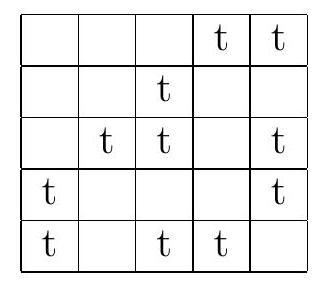
Toggling the positions checked by t (the order of toggling is irrelevant) in the first picture makes the center $\left(*_{0}\right)$ the only position with light on and the second picture makes the position $*_{1}$ the only position with light on. The other $*_{i}$ 's can be obtained by rotating the second picture appropriately.
| | t | | t | |
| :---: | :---: | :---: | :---: | :---: |
| t | t | | t | t |
| | t | | | |
| | | t | t | t |
| | | | t | |
|