

File size: 11,606 Bytes
a67ef7c | 1 2 3 4 5 6 7 8 9 10 11 12 13 14 15 16 17 18 19 20 21 22 23 24 25 26 27 28 29 30 31 32 33 34 35 36 37 38 39 40 41 42 43 44 45 46 47 48 49 50 51 52 53 54 55 56 57 58 59 60 61 62 63 64 65 66 67 68 69 70 71 72 73 74 75 76 77 78 79 80 81 82 83 84 85 86 87 88 89 90 91 92 93 94 95 96 97 98 99 100 101 102 103 104 105 106 107 108 109 110 111 112 113 114 115 116 117 118 119 120 121 122 123 124 125 126 127 128 129 130 131 132 133 134 135 136 137 138 139 140 141 142 143 144 145 146 147 148 149 150 151 152 153 154 155 156 157 158 159 160 161 162 163 164 165 166 167 168 169 170 171 172 173 174 175 176 177 178 179 180 181 182 183 184 185 186 187 188 189 190 191 192 193 194 195 196 197 198 199 200 201 202 203 204 205 206 207 208 209 210 211 212 213 214 215 216 217 218 219 220 221 222 223 224 225 226 227 228 229 | # XX Asian Pacific Mathematics Olympiad APMO:
March, 2008
Problem 1. Let $A B C$ be a triangle with $\angle A<60^{\circ}$. Let $X$ and $Y$ be the points on the sides $A B$ and $A C$, respectively, such that $C A+A X=C B+B X$ and $B A+A Y=B C+C Y$. Let $P$ be the point in the plane such that the lines $P X$ and $P Y$ are perpendicular to $A B$ and $A C$, respectively. Prove that $\angle B P C<120^{\circ}$.
(Solution) Let $I$ be the incenter of $\triangle A B C$, and let the feet of the perpendiculars from $I$ to $A B$ and to $A C$ be $D$ and $E$, respectively. (Without loss of generality, we may assume that $A C$ is the longest side. Then $X$ lies on the line segment $A D$. Although $P$ may or may not lie inside $\triangle A B C$, the proof below works for both cases. Note that $P$ is on the line perpendicular to $A B$ passing through $X$.) Let $O$ be the midpoint of $I P$, and let the feet of the perpendiculars from $O$ to $A B$ and to $A C$ be $M$ and $N$, respectively. Then $M$ and $N$ are the midpoints of $D X$ and $E Y$, respectively.
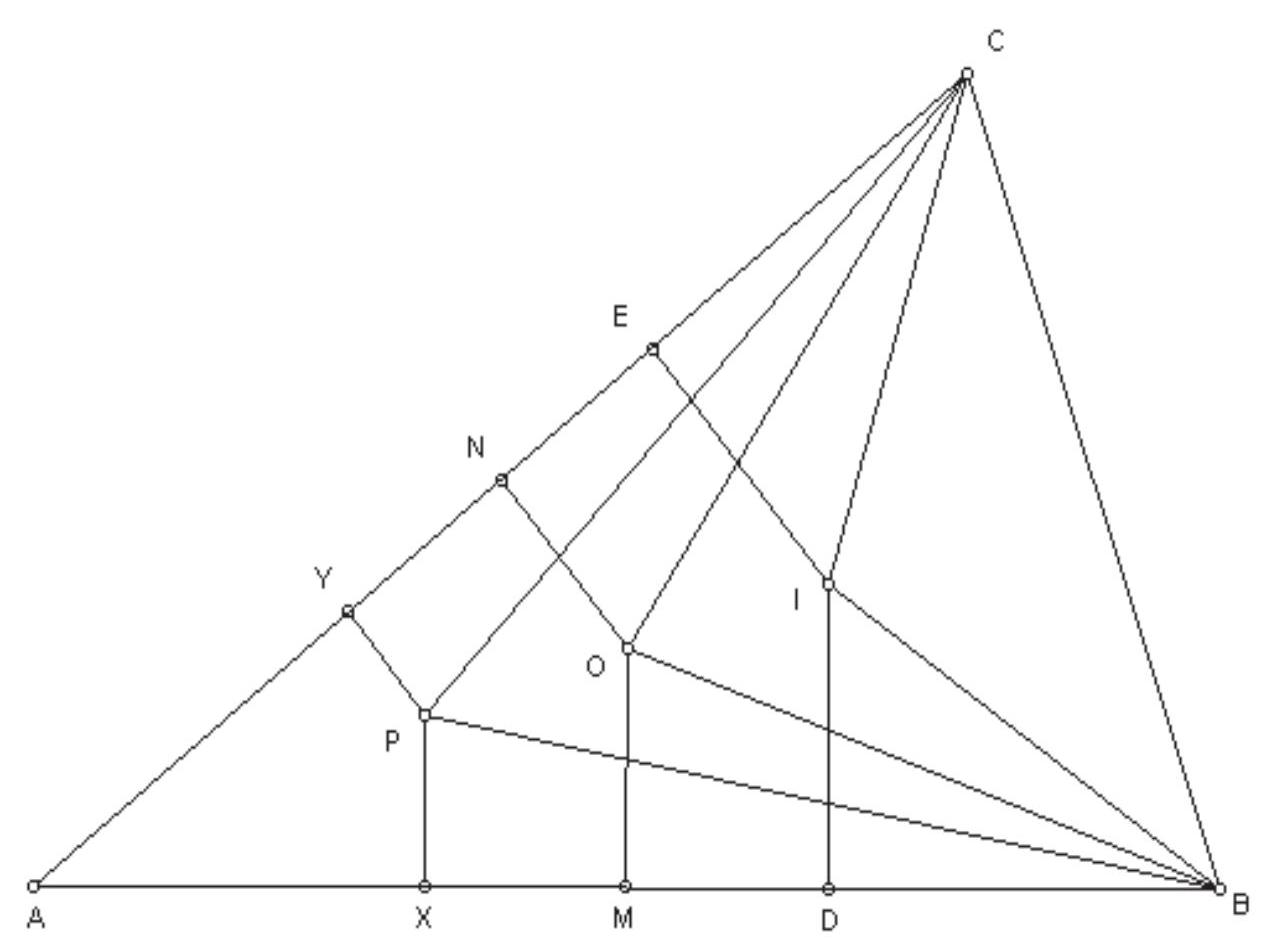
The conditions on the points $X$ and $Y$ yield the equations
$$
A X=\frac{A B+B C-C A}{2} \quad \text { and } \quad A Y=\frac{B C+C A-A B}{2} .
$$
From $A D=A E=\frac{C A+A B-B C}{2}$, we obtain
$$
B D=A B-A D=A B-\frac{C A+A B-B C}{2}=\frac{A B+B C-C A}{2}=A X .
$$
Since $M$ is the midpoint of $D X$, it follows that $M$ is the midpoint of $A B$. Similarly, $N$ is the midpoint of $A C$. Therefore, the perpendicular bisectors of $A B$ and $A C$ meet at $O$, that is, $O$ is the circumcenter of $\triangle A B C$. Since $\angle B A C<60^{\circ}, O$ lies on the same side of $B C$ as the point $A$ and
$$
\angle B O C=2 \angle B A C
$$
We can compute $\angle B I C$ as follows:
$$
\begin{aligned}
\angle B I C & =180^{\circ}-\angle I B C-\angle I C B=180^{\circ}-\frac{1}{2} \angle A B C-\frac{1}{2} \angle A C B \\
& =180^{\circ}-\frac{1}{2}(\angle A B C+\angle A C B)=180^{\circ}-\frac{1}{2}\left(180^{\circ}-\angle B A C\right)=90^{\circ}+\frac{1}{2} \angle B A C
\end{aligned}
$$
It follows from $\angle B A C<60^{\circ}$ that
$$
2 \angle B A C<90^{\circ}+\frac{1}{2} \angle B A C, \quad \text { i.e., } \quad \angle B O C<\angle B I C \text {. }
$$
From this it follows that $I$ lies inside the circumcircle of the isosceles triangle $B O C$ because $O$ and $I$ lie on the same side of $B C$. However, as $O$ is the midpoint of $I P, P$ must lie outside the circumcircle of triangle $B O C$ and on the same side of $B C$ as $O$. Therefore
$$
\angle B P C<\angle B O C=2 \angle B A C<120^{\circ} .
$$
Remark. If one assumes that $\angle A$ is smaller than the other two, then it is clear that the line $P X$ (or the line perpendicular to $A B$ at $X$ if $P=X$ ) runs through the excenter $I_{C}$ of the excircle tangent to the side $A B$. Since $2 \angle A C I_{C}=\angle A C B$ and $B C<A C$, we have $2 \angle P C B>\angle C$. Similarly, $2 \angle P B C>\angle B$. Therefore,
$$
\angle B P C=180^{\circ}-(\angle P B C+\angle P C B)<180^{\circ}-\left(\frac{\angle B+\angle C}{2}\right)=90+\frac{\angle A}{2}<120^{\circ}
$$
In this way, a special case of the problem can be easily proved.
Problem 2. Students in a class form groups each of which contains exactly three members such that any two distinct groups have at most one member in common. Prove that, when the class size is 46 , there is a set of 10 students in which no group is properly contained.
(Solution) We let $C$ be the set of all 46 students in the class and let
$$
s:=\max \{|S|: S \subseteq C \text { such that } S \text { contains no group properly }\}
$$
Then it suffices to prove that $s \geq 10$. (If $|S|=s>10$, we may choose a subset of $S$ consisting of 10 students.)
Suppose that $s \leq 9$ and let $S$ be a set of size $s$ in which no group is properly contained. Take any student, say $v$, from outside $S$. Because of the maximality of $s$, there should be a group containing the student $v$ and two other students in $S$. The number of ways to choose two students from $S$ is
$$
\binom{s}{2} \leq\binom{ 9}{2}=36
$$
On the other hand, there are at least $37=46-9$ students outside of $S$. Thus, among those 37 students outside, there is at least one student, say $u$, who does not belong to any group containing two students in $S$ and one outside. This is because no two distinct groups have two members in common. But then, $S$ can be enlarged by including $u$, which is a contradiction.
Remark. One may choose a subset $S$ of $C$ that contains no group properly. Then, assuming $|S|<10$, prove that there is a student outside $S$, say $u$, who does not belong to any group containing two students in $S$. After enlarging $S$ by including $u$, prove that the enlarged $S$ still contains no group properly.
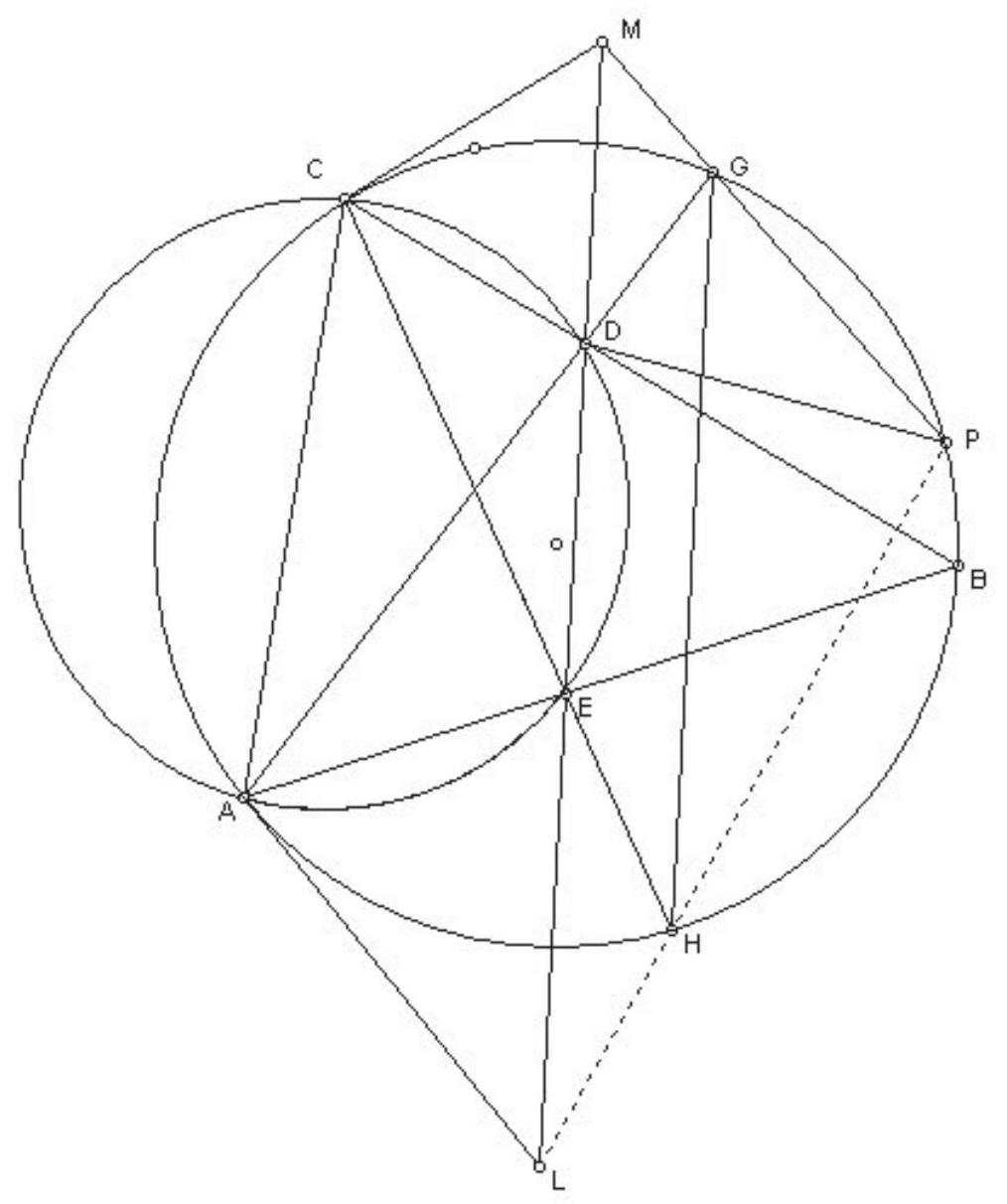
Problem 3. Let $\Gamma$ be the circumcircle of a triangle $A B C$. A circle passing through points $A$ and $C$ meets the sides $B C$ and $B A$ at $D$ and $E$, respectively. The lines $A D$ and $C E$ meet $\Gamma$ again at $G$ and $H$, respectively. The tangent lines of $\Gamma$ at $A$ and $C$ meet the line $D E$ at $L$ and $M$, respectively. Prove that the lines $L H$ and $M G$ meet at $\Gamma$.
(Solution) Let $M G$ meet $\Gamma$ at $P$. Since $\angle M C D=\angle C A E$ and $\angle M D C=\angle C A E$, we have $M C=M D$. Thus
$$
M D^{2}=M C^{2}=M G \cdot M P
$$
and hence $M D$ is tangent to the circumcircle of $\triangle D G P$. Therefore $\angle D G P=\angle E D P$.
Let $\Gamma^{\prime}$ be the circumcircle of $\triangle B D E$. If $B=P$, then, since $\angle B G D=\angle B D E$, the tangent lines of $\Gamma^{\prime}$ and $\Gamma$ at $B$ should coincide, that is $\Gamma^{\prime}$ is tangent to $\Gamma$ from inside. Let $B \neq P$. If $P$ lies in the same side of the line $B C$ as $G$, then we have
$$
\angle E D P+\angle A B P=180^{\circ}
$$
because $\angle D G P+\angle A B P=180^{\circ}$. That is, the quadrilateral $B P D E$ is cyclic, and hence $P$ is on the intersection of $\Gamma^{\prime}$ with $\Gamma$.
Otherwise,
$$
\angle E D P=\angle D G P=\angle A G P=\angle A B P=\angle E B P .
$$
Therefore the quadrilateral $P B D E$ is cyclic, and hence $P$ again is on the intersection of $\Gamma^{\prime}$ with $\Gamma$.
Similarly, if $L H$ meets $\Gamma$ at $Q$, we either have $Q=B$, in which case $\Gamma^{\prime}$ is tangent to $\Gamma$ from inside, or $Q \neq B$. In the latter case, $Q$ is on the intersection of $\Gamma^{\prime}$ with $\Gamma$. In either case, we have $P=Q$.
Problem 4. Consider the function $f: \mathbb{N}_{0} \rightarrow \mathbb{N}_{0}$, where $\mathbb{N}_{0}$ is the set of all non-negative integers, defined by the following conditions:
(i) $f(0)=0$,
(ii) $f(2 n)=2 f(n)$ and
(iii) $f(2 n+1)=n+2 f(n)$ for all $n \geq 0$.
(a) Determine the three sets $L:=\{n \mid f(n)<f(n+1)\}, E:=\{n \mid f(n)=f(n+1)\}$, and $G:=\{n \mid f(n)>f(n+1)\}$.
(b) For each $k \geq 0$, find a formula for $a_{k}:=\max \left\{f(n): 0 \leq n \leq 2^{k}\right\}$ in terms of $k$.
(Solution) (a) Let
$$
L_{1}:=\{2 k: k>0\}, \quad E_{1}:=\{0\} \cup\{4 k+1: k \geq 0\}, \quad \text { and } G_{1}:=\{4 k+3: k \geq 0\} .
$$
We will show that $L_{1}=L, E_{1}=E$, and $G_{1}=G$. It suffices to verify that $L_{1} \subseteq E, E_{1} \subseteq E$, and $G_{1} \subseteq G$ because $L_{1}, E_{1}$, and $G_{1}$ are mutually disjoint and $L_{1} \cup E_{1} \cup G_{1}=\mathbb{N}_{0}$.
Firstly, if $k>0$, then $f(2 k)-f(2 k+1)=-k<0$ and therefore $L_{1} \subseteq L$.
Secondly, $f(0)=0$ and
$$
\begin{aligned}
& f(4 k+1)=2 k+2 f(2 k)=2 k+4 f(k) \\
& f(4 k+2)=2 f(2 k+1)=2(k+2 f(k))=2 k+4 f(k)
\end{aligned}
$$
for all $k \geq 0$. Thus, $E_{1} \subseteq E$.
Lastly, in order to prove $G_{1} \subset G$, we claim that $f(n+1)-f(n) \leq n$ for all $n$. (In fact, one can prove a stronger inequality : $f(n+1)-f(n) \leq n / 2$.) This is clearly true for even $n$ from the definition since for $n=2 t$,
$$
f(2 t+1)-f(2 t)=t \leq n
$$
If $n=2 t+1$ is odd, then (assuming inductively that the result holds for all nonnegative $m<n$ ), we have
$$
\begin{aligned}
f(n+1)-f(n) & =f(2 t+2)-f(2 t+1)=2 f(t+1)-t-2 f(t) \\
& =2(f(t+1)-f(t))-t \leq 2 t-t=t<n .
\end{aligned}
$$
For all $k \geq 0$,
$$
\begin{aligned}
& f(4 k+4)-f(4 k+3)=f(2(2 k+2))-f(2(2 k+1)+1) \\
& =4 f(k+1)-(2 k+1+2 f(2 k+1))=4 f(k+1)-(2 k+1+2 k+4 f(k)) \\
& =4(f(k+1)-f(k))-(4 k+1) \leq 4 k-(4 k+1)<0 .
\end{aligned}
$$
This proves $G_{1} \subseteq G$.
(b) Note that $a_{0}=a_{1}=f(1)=0$. Let $k \geq 2$ and let $N_{k}=\left\{0,1,2, \ldots, 2^{k}\right\}$. First we claim that the maximum $a_{k}$ occurs at the largest number in $G \cap N_{k}$, that is, $a_{k}=f\left(2^{k}-1\right)$. We use mathematical induction on $k$ to prove the claim. Note that $a_{2}=f(3)=f\left(2^{2}-1\right)$.
Now let $k \geq 3$. For every even number $2 t$ with $2^{k-1}+1<2 t \leq 2^{k}$,
$$
f(2 t)=2 f(t) \leq 2 a_{k-1}=2 f\left(2^{k-1}-1\right)
$$
by induction hypothesis. For every odd number $2 t+1$ with $2^{k-1}+1 \leq 2 t+1<2^{k}$,
$$
\begin{aligned}
f(2 t+1) & =t+2 f(t) \leq 2^{k-1}-1+2 f(t) \\
& \leq 2^{k-1}-1+2 a_{k-1}=2^{k-1}-1+2 f\left(2^{k-1}-1\right)
\end{aligned}
$$
again by induction hypothesis. Combining ( $\dagger$ ), ( $\ddagger$ ) and
$$
f\left(2^{k}-1\right)=f\left(2\left(2^{k-1}-1\right)+1\right)=2^{k-1}-1+2 f\left(2^{k-1}-1\right)
$$
we may conclude that $a_{k}=f\left(2^{k}-1\right)$ as desired.
Furthermore, we obtain
$$
a_{k}=2 a_{k-1}+2^{k-1}-1
$$
for all $k \geq 3$. Note that this recursive formula for $a_{k}$ also holds for $k \geq 0,1$ and 2 . Unwinding this recursive formula, we finally get
$$
\begin{aligned}
a_{k} & =2 a_{k-1}+2^{k-1}-1=2\left(2 a_{k-2}+2^{k-2}-1\right)+2^{k-1}-1 \\
& =2^{2} a_{k-2}+2 \cdot 2^{k-1}-2-1=2^{2}\left(2 a_{k-3}+2^{k-3}-1\right)+2 \cdot 2^{k-1}-2-1 \\
& =2^{3} a_{k-3}+3 \cdot 2^{k-1}-2^{2}-2-1 \\
& \vdots \\
& =2^{k} a_{0}+k 2^{k-1}-2^{k-1}-2^{k-2}-\ldots-2-1 \\
& =k 2^{k-1}-2^{k}+1 \quad \text { for all } k \geq 0 .
\end{aligned}
$$
Problem 5. Let $a, b, c$ be integers satisfying $0<a<c-1$ and $1<b<c$. For each $k$, $0 \leq k \leq a$, let $r_{k}, 0 \leq r_{k}<c$, be the remainder of $k b$ when divided by $c$. Prove that the two sets $\left\{r_{0}, r_{1}, r_{2}, \ldots, r_{a}\right\}$ and $\{0,1,2, \ldots, a\}$ are different.
(Solution) Suppose that two sets are equal. Then $\operatorname{gcd}(b, c)=1$ and the polynomial
$$
f(x):=\left(1+x^{b}+x^{2 b}+\cdots+x^{a b}\right)-\left(1+x+x^{2}+\cdots+x^{a-1}+x^{a}\right)
$$
is divisible by $x^{c}-1$. (This is because: $m=n+c q \Longrightarrow x^{m}-x^{n}=x^{n+c q}-x^{n}=x^{n}\left(x^{c q}-1\right)$ and $\left(x^{c q}-1\right)=\left(x^{c}-1\right)\left(\left(x^{c}\right)^{q-1}+\left(x^{c}\right)^{q-2}+\cdots+1\right)$.) From
$$
f(x)=\frac{x^{(a+1) b}-1}{x^{b}-1}-\frac{x^{a+1}-1}{x-1}=\frac{F(x)}{(x-1)\left(x^{b}-1\right)}
$$
where $F(x)=x^{a b+b+1}+x^{b}+x^{a+1}-x^{a b+b}-x^{a+b+1}-x$, we have
$$
F(x) \equiv 0 \quad\left(\bmod x^{c}-1\right)
$$
Since $x^{c} \equiv 1\left(\bmod x^{c}-1\right)$, we may conclude that
$$
\{a b+b+1, b, a+1\} \equiv\{a b+b, a+b+1,1\} \quad(\bmod c)
$$
Thus,
$$
b \equiv a b+b, a+b+1 \text { or } 1(\bmod c)
$$
But neither $b \equiv 1(\bmod c)$ nor $b \equiv a+b+1(\bmod c)$ are possible by the given conditions. Therefore, $b \equiv a b+b(\bmod c)$. But this is also impossible because $\operatorname{gcd}(b, c)=1$.
|