

File size: 15,023 Bytes
a67ef7c | 1 2 3 4 5 6 7 8 9 10 11 12 13 14 15 16 17 18 19 20 21 22 23 24 25 26 27 28 29 30 31 32 33 34 35 36 37 38 39 40 41 42 43 44 45 46 47 48 49 50 51 52 53 54 55 56 57 58 59 60 61 62 63 64 65 66 67 68 69 70 71 72 73 74 75 76 77 78 79 80 81 82 83 84 85 86 87 88 89 90 91 92 93 94 95 96 97 98 99 100 101 102 103 104 105 106 107 108 109 110 111 112 113 114 115 116 117 118 119 120 121 122 123 124 125 126 127 128 129 130 131 132 133 134 135 136 137 138 139 140 141 142 143 144 145 146 147 148 149 150 151 152 153 154 155 156 157 158 159 160 161 162 163 164 165 166 167 168 169 170 171 172 173 174 175 176 177 178 179 180 181 182 183 184 185 186 187 188 189 190 191 192 193 194 195 196 197 198 199 200 201 202 203 204 205 206 207 208 209 210 211 212 213 214 215 216 217 218 219 220 221 222 223 224 225 226 227 228 229 230 231 232 233 234 235 236 237 238 239 | # XXI Asian Pacific Mathematics Olympiad

March, 2009
Problem 1. Consider the following operation on positive real numbers written on a blackboard:
Choose a number $r$ written on the blackboard, erase that number, and then write a pair of positive real numbers $a$ and $b$ satisfying the condition $2 r^{2}=a b$ on the board.
Assume that you start out with just one positive real number $r$ on the blackboard, and apply this operation $k^{2}-1$ times to end up with $k^{2}$ positive real numbers, not necessarily distinct. Show that there exists a number on the board which does not exceed $k r$.
(Solution) Using AM-GM inequality, we obtain
$$
\frac{1}{r^{2}}=\frac{2}{a b}=\frac{2 a b}{a^{2} b^{2}} \leq \frac{a^{2}+b^{2}}{a^{2} b^{2}} \leq \frac{1}{a^{2}}+\frac{1}{b^{2}}
$$
Consequently, if we let $S_{\ell}$ be the sum of the squares of the reciprocals of the numbers written on the board after $\ell$ operations, then $S_{\ell}$ increases as $\ell$ increases, that is,
$$
S_{0} \leq S_{1} \leq \cdots \leq S_{k^{2}-1}
$$
Therefore if we let $s$ be the smallest real number written on the board after $k^{2}-1$ operations, then $\frac{1}{s^{2}} \geq \frac{1}{t^{2}}$ for any number $t$ among $k^{2}$ numbers on the board and hence
$$
k^{2} \times \frac{1}{s^{2}} \geq S_{k^{2}-1} \geq S_{0}=\frac{1}{r^{2}}
$$
which implies that $s \leq k r$ as desired.
Remark. The nature of the problem does not change at all if the numbers on the board are restricted to be positive integers. But that may mislead some contestants to think the problem is a number theoretic problem rather than a combinatorial problem.
Problem 2. Let $a_{1}, a_{2}, a_{3}, a_{4}, a_{5}$ be real numbers satisfying the following equations:
$$
\frac{a_{1}}{k^{2}+1}+\frac{a_{2}}{k^{2}+2}+\frac{a_{3}}{k^{2}+3}+\frac{a_{4}}{k^{2}+4}+\frac{a_{5}}{k^{2}+5}=\frac{1}{k^{2}} \text { for } k=1,2,3,4,5
$$
Find the value of $\frac{a_{1}}{37}+\frac{a_{2}}{38}+\frac{a_{3}}{39}+\frac{a_{4}}{40}+\frac{a_{5}}{41}$. (Express the value in a single fraction.)
(Solution) Let $R(x):=\frac{a_{1}}{x^{2}+1}+\frac{a_{2}}{x^{2}+2}+\frac{a_{3}}{x^{2}+3}+\frac{a_{4}}{x^{2}+4}+\frac{a_{5}}{x^{2}+5}$. Then $R( \pm 1)=1$, $R( \pm 2)=\frac{1}{4}, R( \pm 3)=\frac{1}{9}, R( \pm 4)=\frac{1}{16}, R( \pm 5)=\frac{1}{25}$ and $R(6)$ is the value to be found. Let's put $P(x):=\left(x^{2}+1\right)\left(x^{2}+2\right)\left(x^{2}+3\right)\left(x^{2}+4\right)\left(x^{2}+5\right)$ and $Q(x):=R(x) P(x)$. Then for $k= \pm 1, \pm 2, \pm 3, \pm 4, \pm 5$, we get $Q(k)=R(k) P(k)=\frac{P(k)}{k^{2}}$, that is, $P(k)-k^{2} Q(k)=0$. Since $P(x)-x^{2} Q(x)$ is a polynomial of degree 10 with roots $\pm 1, \pm 2, \pm 3, \pm 4, \pm 5$, we get
$$
P(x)-x^{2} Q(x)=A\left(x^{2}-1\right)\left(x^{2}-4\right)\left(x^{2}-9\right)\left(x^{2}-16\right)\left(x^{2}-25\right)
$$
Putting $x=0$, we get $A=\frac{P(0)}{(-1)(-4)(-9)(-16)(-25)}=-\frac{1}{120}$. Finally, dividing both sides of $(*)$ by $P(x)$ yields
$$
1-x^{2} R(x)=1-x^{2} \frac{Q(x)}{P(x)}=-\frac{1}{120} \cdot \frac{\left(x^{2}-1\right)\left(x^{2}-4\right)\left(x^{2}-9\right)\left(x^{2}-16\right)\left(x^{2}-25\right)}{\left(x^{2}+1\right)\left(x^{2}+2\right)\left(x^{2}+3\right)\left(x^{2}+4\right)\left(x^{2}+5\right)}
$$
and hence that
$$
1-36 R(6)=-\frac{35 \times 32 \times 27 \times 20 \times 11}{120 \times 37 \times 38 \times 39 \times 40 \times 41}=-\frac{3 \times 7 \times 11}{13 \times 19 \times 37 \times 41}=-\frac{231}{374699}
$$
which implies $R(6)=\frac{187465}{6744582}$.
Remark. We can get $a_{1}=\frac{1105}{72}, a_{2}=-\frac{2673}{40}, a_{3}=\frac{1862}{15}, a_{4}=-\frac{1885}{18}, a_{5}=\frac{1323}{40}$ by solving the given system of linear equations, which is extremely messy and takes a lot of time.
Problem 3. Let three circles $\Gamma_{1}, \Gamma_{2}, \Gamma_{3}$, which are non-overlapping and mutually external, be given in the plane. For each point $P$ in the plane, outside the three circles, construct six points $A_{1}, B_{1}, A_{2}, B_{2}, A_{3}, B_{3}$ as follows: For each $i=1,2,3, A_{i}, B_{i}$ are distinct points on the circle $\Gamma_{i}$ such that the lines $P A_{i}$ and $P B_{i}$ are both tangents to $\Gamma_{i}$. Call the point $P$ exceptional if, from the construction, three lines $A_{1} B_{1}, A_{2} B_{2}, A_{3} B_{3}$ are concurrent. Show that every exceptional point of the plane, if exists, lies on the same circle.
(Solution) Let $O_{i}$ be the center and $r_{i}$ the radius of circle $\Gamma_{i}$ for each $i=1,2,3$. Let $P$ be an exceptional point, and let the three corresponding lines $A_{1} B_{1}, A_{2} B_{2}, A_{3} B_{3}$ concur at $Q$. Construct the circle with diameter $P Q$. Call the circle $\Gamma$, its center $O$ and its radius $r$. We now claim that all exceptional points lie on $\Gamma$.
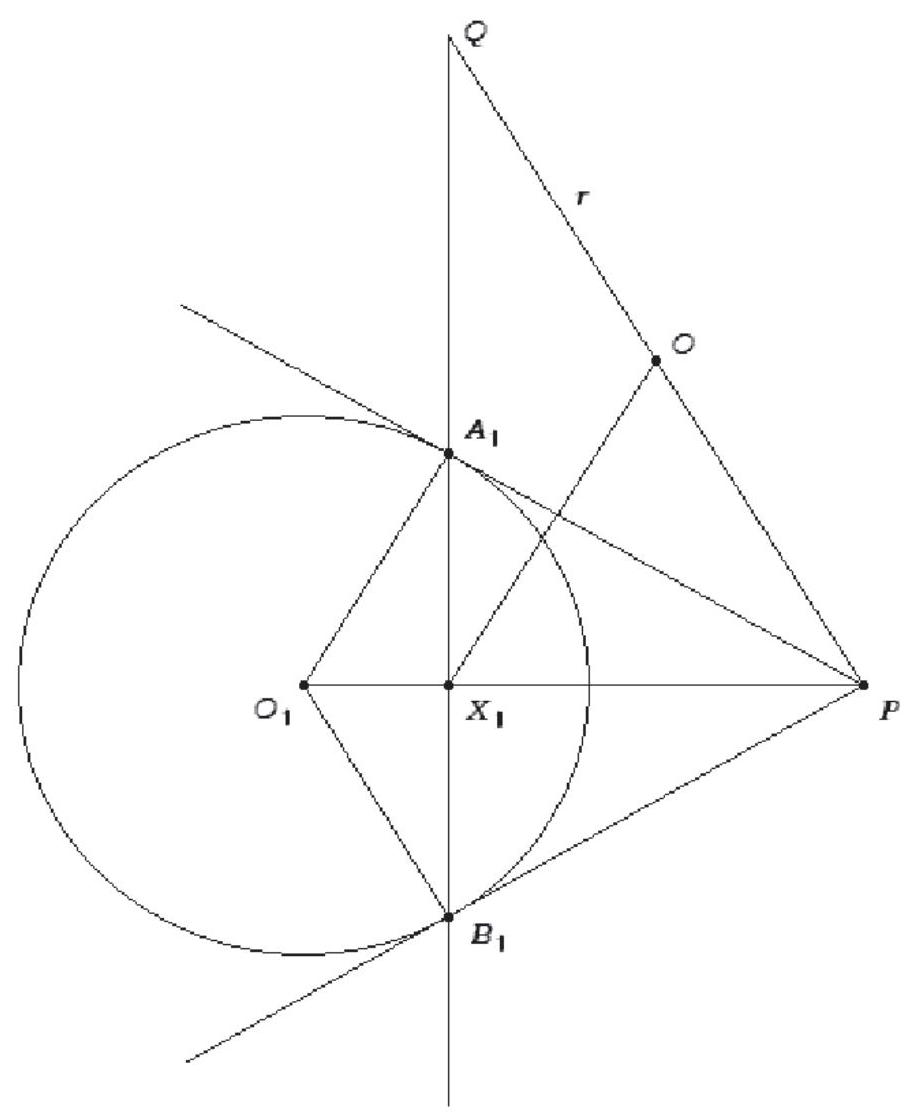
Let $P O_{1}$ intersect $A_{1} B_{1}$ in $X_{1}$. As $P O_{1} \perp A_{1} B_{1}$, we see that $X_{1}$ lies on $\Gamma$. As $P A_{1}$ is a tangent to $\Gamma_{1}$, triangle $P A_{1} O_{1}$ is right-angled and similar to triangle $A_{1} X_{1} O_{1}$. It follows that
$$
\frac{O_{1} X_{1}}{O_{1} A_{1}}=\frac{O_{1} A_{1}}{O_{1} P}, \quad \text { i.e., } \quad O_{1} X_{1} \cdot O_{1} P=O_{1} A_{1}^{2}=r_{1}^{2}
$$
On the other hand, $O_{1} X_{1} \cdot O_{1} P$ is also the power of $O_{1}$ with respect to $\Gamma$, so that
$$
r_{1}^{2}=O_{1} X_{1} \cdot O_{1} P=\left(O_{1} O-r\right)\left(O_{1} O+r\right)=O_{1} O^{2}-r^{2}
$$
and hence
$$
r^{2}=O O_{1}^{2}-r_{1}^{2}=\left(O O_{1}-r_{1}\right)\left(O O_{1}+r_{1}\right)
$$
Thus, $r^{2}$ is the power of $O$ with respect to $\Gamma_{1}$. By the same token, $r^{2}$ is also the power of $O$ with respect to $\Gamma_{2}$ and $\Gamma_{3}$. Hence $O$ must be the radical center of the three given circles. Since $r$, as the square root of the power of $O$ with respect to the three given circles, does not depend on $P$, it follows that all exceptional points lie on $\Gamma$.
Remark. In the event of the radical point being at infinity (and hence the three radical axes being parallel), there are no exceptional points in the plane, which is consistent with the statement of the problem.
Problem 4. Prove that for any positive integer $k$, there exists an arithmetic sequence
$$
\frac{a_{1}}{b_{1}}, \quad \frac{a_{2}}{b_{2}}, \ldots, \quad \frac{a_{k}}{b_{k}}
$$
of rational numbers, where $a_{i}, b_{i}$ are relatively prime positive integers for each $i=1,2, \ldots, k$, such that the positive integers $a_{1}, b_{1}, a_{2}, b_{2}, \ldots, a_{k}, b_{k}$ are all distinct.
(Solution) For $k=1$, there is nothing to prove. Henceforth assume $k \geq 2$.
Let $p_{1}, p_{2}, \ldots, p_{k}$ be $k$ distinct primes such that
$$
k<p_{k}<\cdots<p_{2}<p_{1}
$$
and let $N=p_{1} p_{2} \cdots p_{k}$. By Chinese Remainder Theorem, there exists a positive integer $x$ satisfying
$$
x \equiv-i \quad\left(\bmod p_{i}\right)
$$
for all $i=1,2, \ldots, k$ and $x>N^{2}$. Consider the following sequence:
$$
\frac{x+1}{N}, \frac{x+2}{N}, \quad, \ldots, \frac{x+k}{N}
$$
This sequence is obviously an arithmetic sequence of positive rational numbers of length $k$. For each $i=1,2, \ldots, k$, the numerator $x+i$ is divisible by $p_{i}$ but not by $p_{j}$ for $j \neq i$, for otherwise $p_{j}$ divides $|i-j|$, which is not possible because $p_{j}>k>|i-j|$. Let
$$
a_{i}:=\frac{x+i}{p_{i}}, \quad b_{i}:=\frac{N}{p_{i}} \quad \text { for all } i=1,2, \ldots, k
$$
Then
$$
\frac{x+i}{N}=\frac{a_{i}}{b_{i}}, \quad \operatorname{gcd}\left(a_{i}, b_{i}\right)=1 \quad \text { for all } i=1,2, \ldots, k
$$
and all $b_{i}$ 's are distinct from each other. Moreover, $x>N^{2}$ implies
$$
a_{i}=\frac{x+i}{p_{i}}>\frac{N^{2}}{p_{i}}>N>\frac{N}{p_{j}}=b_{j} \quad \text { for all } i, j=1,2, \ldots, k
$$
and hence all $a_{i}$ 's are distinct from $b_{i}$ 's. It only remains to show that all $a_{i}$ 's are distinct from each other. This follows from
$$
a_{j}=\frac{x+j}{p_{j}}>\frac{x+i}{p_{j}}>\frac{x+i}{p_{i}}=a_{i} \quad \text { for all } i<j
$$
by our choice of $p_{1}, p_{2}, \ldots, p_{k}$. Thus, the arithmetic sequence
$$
\frac{a_{1}}{b_{1}}, \quad \frac{a_{2}}{b_{2}}, \ldots, \quad \frac{a_{k}}{b_{k}}
$$
of positive rational numbers satisfies the conditions of the problem.
Remark. Here is a much easier solution :
For any positive integer $k \geq 2$, consider the sequence
$$
\frac{(k!)^{2}+1}{k!}, \frac{(k!)^{2}+2}{k!}, \ldots, \frac{(k!)^{2}+k}{k!}
$$
Note that $\operatorname{gcd}\left(k!,(k!)^{2}+i\right)=i$ for all $i=1,2, \ldots, k$. So, taking
$$
a_{i}:=\frac{(k!)^{2}+i}{i}, \quad b_{i}:=\frac{k!}{i} \quad \text { for all } i=1,2, \ldots, k
$$
we have $\operatorname{gcd}\left(a_{i}, b_{i}\right)=1$ and
$$
a_{i}=\frac{(k!)^{2}+i}{i}>a_{j}=\frac{(k!)^{2}+j}{j}>b_{i}=\frac{k!}{i}>b_{j}=\frac{k!}{j}
$$
for any $1 \leq i<j \leq k$. Therefore this sequence satisfies every condition given in the problem.
Problem 5. Larry and Rob are two robots travelling in one car from Argovia to Zillis. Both robots have control over the steering and steer according to the following algorithm: Larry makes a $90^{\circ}$ left turn after every $\ell$ kilometer driving from start; Rob makes a $90^{\circ}$ right turn after every $r$ kilometer driving from start, where $\ell$ and $r$ are relatively prime positive integers. In the event of both turns occurring simultaneously, the car will keep going without changing direction. Assume that the ground is flat and the car can move in any direction.
Let the car start from Argovia facing towards Zillis. For which choices of the pair $(\ell, r)$ is the car guaranteed to reach Zillis, regardless of how far it is from Argovia?
(Solution) Let Zillis be $d$ kilometers away from Argovia, where $d$ is a positive real number. For simplicity, we will position Argovia at $(0,0)$ and Zillis at $(d, 0)$, so that the car starts out facing east. We will investigate how the car moves around in the period of travelling the first $\ell r$ kilometers, the second $\ell r$ kilometers, ..., and so on. We call each period of travelling $\ell r$ kilometers a section. It is clear that the car will have identical behavior in every section except the direction of the car at the beginning.
Case 1: $\underline{\ell-r \equiv 2(\bmod 4)}$. After the first section, the car has made $\ell-1$ right turns and $r-1$ left turns, which is a net of $2(\equiv \ell-r(\bmod 4))$ right turns. Let the displacement vector for the first section be $(x, y)$. Since the car has rotated $180^{\circ}$, the displacement vector for the second section will be $(-x,-y)$, which will take the car back to $(0,0)$ facing east again. We now have our original situation, and the car has certainly never travelled further than lr kilometers from Argovia. So, the car cannot reach Zillis if it is further apart from Argovia.
Case 2: $\ell-r \equiv 1(\bmod 4)$. After the first section, the car has made a net of 1 right turn. Let the displacement vector for the first section again be $(x, y)$. This time the car has rotated $90^{\circ}$ clockwise. We can see that the displacements for the second, third and fourth section will be $(y,-x),(-x,-y)$ and $(-y, x)$, respectively, so after four sections the car is back at $(0,0)$ facing east. Since the car has certainly never travelled further than $2 \ell r$ kilometers from Argovia, the car cannot reach Zillis if it is further apart from Argovia.
Case 3: $\quad \ell-r \equiv 3(\bmod 4)$. An argument similar to that in Case 2 (switching the roles of left and right) shows that the car cannot reach Zillis if it is further apart from Argovia.
Case 4: $\quad \ell \equiv r(\bmod 4)$. The car makes a net turn of $0^{\circ}$ after each section, so it must be facing east. We are going to show that, after traversing the first section, the car will be at $(1,0)$. It will be useful to interpret the Cartesian plane as the complex plane, i.e. writing $x+i y$ for $(x, y)$, where $i=\sqrt{-1}$. We will denote the $k$-th kilometer of movement by $m_{k-1}$,
which takes values from the set $\{1, i,-1,-i\}$, depending on the direction. We then just have to show that
$$
\sum_{k=0}^{\ell r-1} m_{k}=1
$$
which implies that the car will get to Zillis no matter how far it is apart from Argovia.
Case $4 \mathrm{a}: \underline{\ell \equiv r \equiv 1(\bmod 4)}$. First note that for $k=0,1, \ldots, \ell r-1$,
$$
m_{k}=i^{\lfloor k / \ell\rfloor}(-i)^{\lfloor k / r\rfloor}
$$
since $\lfloor k / \ell\rfloor$ and $\lfloor k / r\rfloor$ are the exact numbers of left and right turns before the $(k+1)$ st kilometer, respectively. Let $a_{k}(\equiv k(\bmod \ell))$ and $b_{k}(\equiv k(\bmod r))$ be the remainders of $k$ when divided by $\ell$ and $r$, respectively. Then, since
$$
a_{k}=k-\left\lfloor\frac{k}{\ell}\right\rfloor \ell \equiv k-\left\lfloor\frac{k}{\ell}\right\rfloor \quad(\bmod 4) \quad \text { and } \quad b_{k}=k-\left\lfloor\frac{k}{r}\right\rfloor r \equiv k-\left\lfloor\frac{k}{r}\right\rfloor \quad(\bmod 4),
$$
we have $\lfloor k / \ell\rfloor \equiv k-a_{k}(\bmod 4)$ and $\lfloor k / r\rfloor \equiv k-b_{k}(\bmod 4)$. We therefore have
$$
m_{k}=i^{k-a_{k}}(-i)^{k-b_{k}}=\left(-i^{2}\right)^{k} i^{-a_{k}}(-i)^{-b_{k}}=(-i)^{a_{k}} i^{b_{k}} .
$$
As $\ell$ and $r$ are relatively prime, by Chinese Remainder Theorem, there is a bijection between pairs $\left(a_{k}, b_{k}\right)=(k(\bmod \ell), k(\bmod r))$ and the numbers $k=0,1,2, \ldots, \ell r-1$. Hence
$$
\sum_{k=0}^{\ell r-1} m_{k}=\sum_{k=0}^{\ell r-1}(-i)^{a_{k}} i^{b_{k}}=\left(\sum_{k=0}^{\ell-1}(-i)^{a_{k}}\right)\left(\sum_{k=0}^{r-1} i^{b_{k}}\right)=1 \times 1=1
$$
as required because $\ell \equiv r \equiv 1(\bmod 4)$.
Case $4 \mathrm{~b}: \underline{\ell \equiv r \equiv 3(\bmod 4)}$. In this case, we get
$$
m_{k}=i^{a_{k}}(-i)^{b_{k}}
$$
where $a_{k}(\equiv k(\bmod \ell))$ and $b_{k}(\equiv k(\bmod r))$ for $k=0,1, \ldots, \ell r-1$. Then we can proceed analogously to Case 4a to obtain
$$
\sum_{k=0}^{\ell r-1} m_{k}=\sum_{k=0}^{\ell r-1}(-i)^{a_{k}} i^{b_{k}}=\left(\sum_{k=0}^{\ell-1}(-i)^{a_{k}}\right)\left(\sum_{k=0}^{r-1} i^{b_{k}}\right)=i \times(-i)=1
$$
as required because $\ell \equiv r \equiv 3(\bmod 4)$.
Now clearly the car traverses through all points between $(0,0)$ and $(1,0)$ during the first section and, in fact, covers all points between $(n-1,0)$ and $(n, 0)$ during the $n$-th section. Hence it will eventually reach $(d, 0)$ for any positive $d$.
To summarize: $(\ell, r)$ satisfies the required conditions if and only if
$$
\ell \equiv r \equiv 1 \quad \text { or } \quad \ell \equiv r \equiv 3 \quad(\bmod 4)
$$
Remark. In case $\operatorname{gcd}(\ell, r)=d \neq 1$, the answer is :
$$
\frac{\ell}{d} \equiv \frac{r}{d} \equiv 1 \quad \text { or } \quad \frac{\ell}{d} \equiv \frac{r}{d} \equiv 3 \quad(\bmod 4)
$$
|