

File size: 8,512 Bytes
a67ef7c | 1 2 3 4 5 6 7 8 9 10 11 12 13 14 15 16 17 18 19 20 21 22 23 24 25 26 27 28 29 30 31 32 33 34 35 36 37 38 39 40 41 42 43 44 45 46 47 48 49 50 51 52 53 54 55 56 57 58 59 60 61 62 63 64 65 66 67 68 69 70 71 72 73 74 75 76 77 78 79 80 81 82 83 84 85 86 87 88 89 90 91 92 93 94 95 96 97 98 99 100 101 102 103 104 105 106 107 108 109 110 111 112 113 114 115 116 117 118 119 120 121 122 123 124 125 126 127 128 129 130 131 132 133 134 135 136 137 138 139 140 141 142 143 | # Solutions of APMO 2013
Problem 1. Let $A B C$ be an acute triangle with altitudes $A D, B E$ and $C F$, and let $O$ be the center of its circumcircle. Show that the segments $O A, O F, O B, O D, O C, O E$ dissect the triangle $A B C$ into three pairs of triangles that have equal areas.
Solution. Let $M$ and $N$ be midpoints of sides $B C$ and $A C$, respectively. Notice that $\angle M O C=\frac{1}{2} \angle B O C=\angle E A B, \angle O M C=90^{\circ}=\angle A E B$, so triangles $O M C$ and $A E B$ are similar and we get $\frac{O M}{A E}=\frac{O C}{A B}$. For triangles $O N A$ and $B D A$ we also have $\frac{O N}{B D}=\frac{O A}{B A}$. Then $\frac{O M}{A E}=\frac{O N}{B D}$ or $B D \cdot O M=A E \cdot O N$.
Denote by $S(\Phi)$ the area of the figure $\Phi$. So, we see that $S(O B D)=\frac{1}{2} B D \cdot O M=$ $\frac{1}{2} A E \cdot O N=S(O A E)$. Analogously, $S(O C D)=S(O A F)$ and $S(O C E)=S(O B F)$.
Alternative solution. Let $R$ be the circumradius of triangle $A B C$, and as usual write $A, B, C$ for angles $\angle C A B, \angle A B C, \angle B C A$ respectively, and $a, b, c$ for sides $B C, C A, A B$ respectively. Then the area of triangle $O C D$ is
$$
S(O C D)=\frac{1}{2} \cdot O C \cdot C D \cdot \sin (\angle O C D)=\frac{1}{2} R \cdot C D \cdot \sin (\angle O C D)
$$
Now $C D=b \cos C$, and
$$
\angle O C D=\frac{180^{\circ}-2 A}{2}=90^{\circ}-A
$$
(since triangle $O B C$ is isosceles, and $\angle B O C=2 A$ ). So
$$
S(O C D)=\frac{1}{2} R b \cos C \sin \left(90^{\circ}-A\right)=\frac{1}{2} R b \cos C \cos A
$$
A similar calculation gives
$$
\begin{aligned}
S(O A F) & =\frac{1}{2} O A \cdot A F \cdot \sin (\angle O A F) \\
& =\frac{1}{2} R \cdot(b \cos A) \sin \left(90^{\circ}-C\right) \\
& =\frac{1}{2} R b \cos A \cos C
\end{aligned}
$$
so $O C D$ and $O A F$ have the same area. In the same way we find that $O B D$ and $O A E$ have the same area, as do $O C E$ and $O B F$.
Problem 2. Determine all positive integers $n$ for which $\frac{n^{2}+1}{[\sqrt{n}]^{2}+2}$ is an integer. Here $[r]$ denotes the greatest integer less than or equal to $r$.
Solution. We will show that there are no positive integers $n$ satisfying the condition of the problem.
Let $m=[\sqrt{n}]$ and $a=n-m^{2}$. We have $m \geq 1$ since $n \geq 1$. From $n^{2}+1=\left(m^{2}+a\right)^{2}+1 \equiv$ $(a-2)^{2}+1\left(\bmod \left(m^{2}+2\right)\right)$, it follows that the condition of the problem is equivalent to the fact that $(a-2)^{2}+1$ is divisible by $m^{2}+2$. Since we have
$$
0<(a-2)^{2}+1 \leq \max \left\{2^{2},(2 m-2)^{2}\right\}+1 \leq 4 m^{2}+1<4\left(m^{2}+2\right)
$$
we see that $(a-2)^{2}+1=k\left(m^{2}+2\right)$ must hold with $k=1,2$ or 3 . We will show that none of these can occur.
Case 1. When $k=1$. We get $(a-2)^{2}-m^{2}=1$, and this implies that $a-2= \pm 1, m=0$ must hold, but this contradicts with fact $m \geq 1$.
Case 2. When $k=2$. We have $(a-2)^{2}+1=2\left(m^{2}+2\right)$ in this case, but any perfect square is congruent to $0,1,4 \bmod 8$, and therefore, we have $(a-2)^{2}+1 \equiv 1,2,5(\bmod 8)$, while $2\left(m^{2}+2\right) \equiv 4,6(\bmod 8)$. Thus, this case cannot occur either.
Case 3. When $k=3$. We have $(a-2)^{2}+1=3\left(m^{2}+2\right)$ in this case. Since any perfect square is congruent to 0 or $1 \bmod 3$, we have $(a-2)^{2}+1 \equiv 1,2(\bmod 3)$, while $3\left(m^{2}+2\right) \equiv 0$ $(\bmod 3)$, which shows that this case cannot occur either.
Problem 3. For $2 k$ real numbers $a_{1}, a_{2}, \ldots, a_{k}, b_{1}, b_{2}, \ldots, b_{k}$ define the sequence of numbers $X_{n}$ by
$$
X_{n}=\sum_{i=1}^{k}\left[a_{i} n+b_{i}\right] \quad(n=1,2, \ldots)
$$
If the sequence $X_{n}$ forms an arithmetic progression, show that $\sum_{i=1}^{k} a_{i}$ must be an integer. Here $[r]$ denotes the greatest integer less than or equal to $r$.
Solution. Let us write $A=\sum_{i=1}^{k} a_{i}$ and $B=\sum_{i=1}^{k} b_{i}$. Summing the corresponding terms of the following inequalities over $i$,
$$
a_{i} n+b_{i}-1<\left[a_{i} n+b_{i}\right] \leq a_{i} n+b_{i}
$$
we obtain $A n+B-k<X_{n}<A n+B$. Now suppose that $\left\{X_{n}\right\}$ is an arithmetic progression with the common difference $d$, then we have $n d=X_{n+1}-X_{1}$ and $A+B-k<X_{1} \leq A+B$ Combining with the inequalities obtained above, we get
$$
A(n+1)+B-k<n d+X_{1}<A(n+1)+B,
$$
or
$$
A n-k \leq A n+\left(A+B-X_{1}\right)-k<n d<A n+\left(A+B-X_{1}\right)<A n+k,
$$
from which we conclude that $|A-d|<\frac{k}{n}$ must hold. Since this inequality holds for any positive integer $n$, we must have $A=d$. Since $\left\{X_{n}\right\}$ is a sequence of integers, $d$ must be an integer also, and thus we conclude that $A$ is also an integer.
Problem 4. Let $a$ and $b$ be positive integers, and let $A$ and $B$ be finite sets of integers satisfying:
(i) $A$ and $B$ are disjoint;
(ii) if an integer $i$ belongs either to $A$ or to $B$, then $i+a$ belongs to $A$ or $i-b$ belongs to $B$.
Prove that $a|A|=b|B|$. (Here $|X|$ denotes the number of elements in the set $X$.)
Solution. Let $A^{*}=\{n-a: n \in A\}$ and $B^{*}=\{n+b: n \in B\}$. Then, by (ii), $A \cup B \subseteq A^{*} \cup B^{*}$ and by (i),
$$
|A \cup B| \leq\left|A^{*} \cup B^{*}\right| \leq\left|A^{*}\right|+\left|B^{*}\right|=|A|+|B|=|A \cup B|
$$
Thus, $A \cup B=A^{*} \cup B^{*}$ and $A^{*}$ and $B^{*}$ have no element in common. For each finite set $X$ of integers, let $\sum(X)=\sum_{x \in X} x$. Then
$$
\begin{aligned}
\sum(A)+\sum(B) & =\sum(A \cup B) \\
& =\sum\left(A^{*} \cup B^{*}\right)=\sum\left(A^{*}\right)+\sum\left(B^{*}\right) \\
& =\sum(A)-a|A|+\sum(B)+b|B|
\end{aligned}
$$
which implies $a|A|=b|B|$.
Alternative solution. Let us construct a directed graph whose vertices are labelled by the members of $A \cup B$ and such that there is an edge from $i$ to $j$ iff $j \in A$ and $j=i+a$ or $j \in B$ and $j=i-b$. From (ii), each vertex has out-degree $\geq 1$ and, from (i), each vertex has in-degree $\leq 1$. Since the sum of the out-degrees equals the sum of the in-degrees, each vertex has in-degree and out-degree equal to 1. This is only possible if the graph is the union of disjoint cycles, say $G_{1}, G_{2}, \ldots, G_{n}$. Let $\left|A_{k}\right|$ be the number of elements of $A$ in $G_{k}$ and $\left|B_{k}\right|$ be the number of elements of $B$ in $G_{k}$. The cycle $G_{k}$ will involve increasing vertex labels by $a$ a total of $\left|A_{k}\right|$ times and decreasing them by $b$ a total of $\left|B_{k}\right|$ times. Since it is a cycle, we have $a\left|A_{k}\right|=b\left|B_{k}\right|$. Summing over all cycles gives the result.
Problem 5. Let $A B C D$ be a quadrilateral inscribed in a circle $\omega$, and let $P$ be a point on the extension of $A C$ such that $P B$ and $P D$ are tangent to $\omega$. The tangent at $C$ intersects $P D$ at $Q$ and the line $A D$ at $R$. Let $E$ be the second point of intersection between $A Q$ and $\omega$. Prove that $B, E, R$ are collinear.
Solution. To show $B, E, R$ are collinear, it is equivalent to show the lines $A D, B E, C Q$ are concurrent. Let $C Q$ intersect $A D$ at $R$ and $B E$ intersect $A D$ at $R^{\prime}$. We shall show $R D / R A=R^{\prime} D / R^{\prime} A$ so that $R=R^{\prime}$.
Since $\triangle P A D$ is similar to $\triangle P D C$ and $\triangle P A B$ is similar to $\triangle P B C$, we have $A D / D C=$ $P A / P D=P A / P B=A B / B C$. Hence, $A B \cdot D C=B C \cdot A D$. By Ptolemy's theorem, $A B \cdot D C=B C \cdot A D=\frac{1}{2} C A \cdot D B$. Similarly $C A \cdot E D=C E \cdot A D=\frac{1}{2} A E \cdot D C$.
Thus
$$
\frac{D B}{A B}=\frac{2 D C}{C A}
$$
and
$$
\frac{D C}{C A}=\frac{2 E D}{A E}
$$
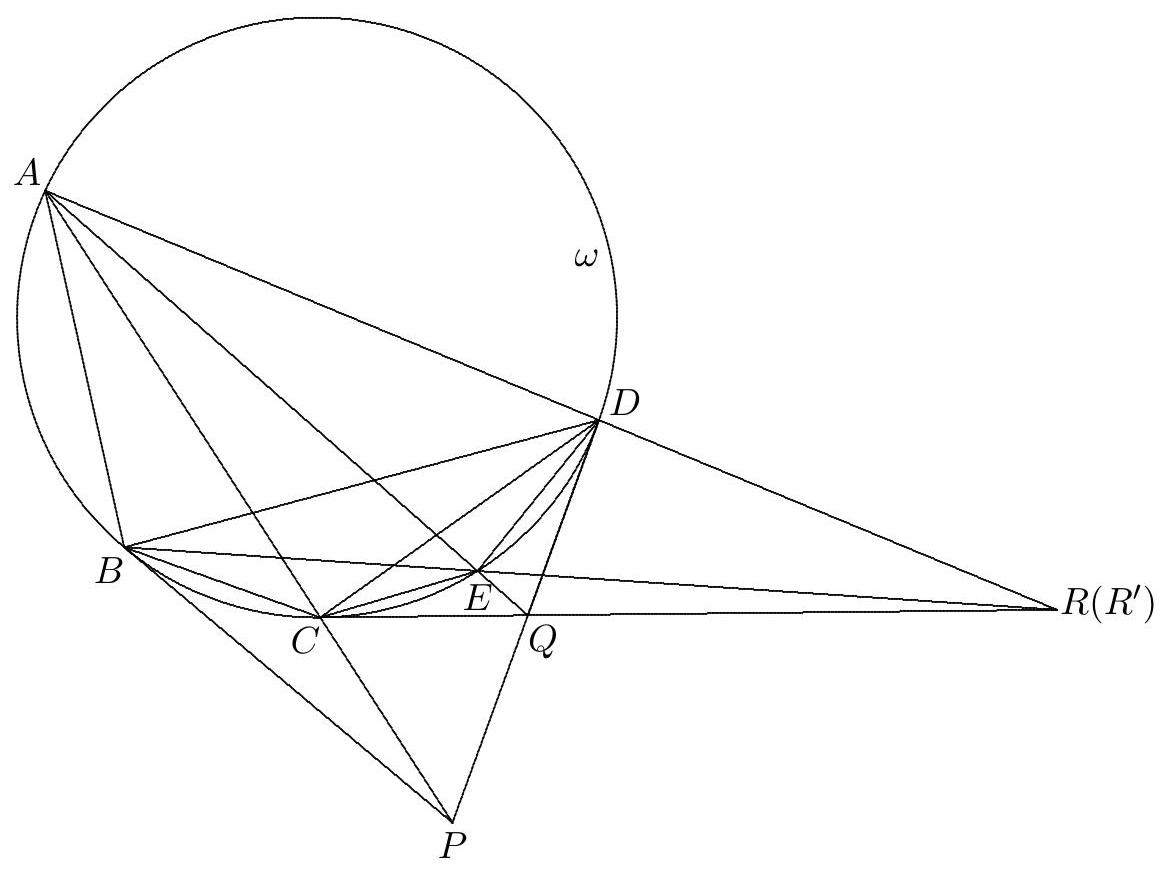
Since the triangles $R D C$ and $R C A$ are similar, we have $\frac{R D}{R C}=\frac{D C}{C A}=\frac{R C}{R A}$. Thus using (4)
$$
\frac{R D}{R A}=\frac{R D \cdot R A}{R A^{2}}=\left(\frac{R C}{R A}\right)^{2}=\left(\frac{D C}{C A}\right)^{2}=\left(\frac{2 E D}{A E}\right)^{2}
$$
Using the similar triangles $A B R^{\prime}$ and $E D R^{\prime}$, we have $R^{\prime} D / R^{\prime} B=E D / A B$. Using the similar triangles $D B R^{\prime}$ and $E A R^{\prime}$ we have $R^{\prime} A / R^{\prime} B=E A / D B$. Thus using (3) and (4),
$$
\frac{R^{\prime} D}{R^{\prime} A}=\frac{E D \cdot D B}{E A \cdot A B}=\left(\frac{2 E D}{A E}\right)^{2}
$$
It follows from (5) and (6) that $R=R^{\prime}$.
|