

File size: 18,952 Bytes
a67ef7c | 1 2 3 4 5 6 7 8 9 10 11 12 13 14 15 16 17 18 19 20 21 22 23 24 25 26 27 28 29 30 31 32 33 34 35 36 37 38 39 40 41 42 43 44 45 46 47 48 49 50 51 52 53 54 55 56 57 58 59 60 61 62 63 64 65 66 67 68 69 70 71 72 73 74 75 76 77 78 79 80 81 82 83 84 85 86 87 88 89 90 91 92 93 94 95 96 97 98 99 100 101 102 103 104 105 106 107 108 109 110 111 112 113 114 115 116 117 118 119 120 121 122 123 124 125 126 127 128 129 130 131 132 133 134 135 136 137 138 139 140 141 142 143 144 145 146 147 148 149 150 151 152 153 154 155 156 157 158 159 160 161 162 163 164 165 166 167 168 169 170 171 172 173 174 175 176 177 178 179 180 181 182 183 184 185 186 187 188 189 190 191 192 193 194 195 196 197 198 199 200 201 202 203 204 205 206 207 208 209 210 211 212 213 214 215 216 217 218 219 220 221 222 223 224 225 226 227 228 229 230 231 232 233 234 235 236 237 238 239 240 241 242 243 244 245 246 247 248 | # Solutions of APMO 2015
Problem 1. Let $A B C$ be a triangle, and let $D$ be a point on side $B C$. A line through $D$ intersects side $A B$ at $X$ and ray $A C$ at $Y$. The circumcircle of triangle $B X D$ intersects the circumcircle $\omega$ of triangle $A B C$ again at point $Z \neq B$. The lines $Z D$ and $Z Y$ intersect $\omega$ again at $V$ and $W$, respectively. Prove that $A B=V W$.
Solution. Suppose $X Y$ intersects $\omega$ at points $P$ and $Q$, where $Q$ lies between $X$ and $Y$. We will show that $V$ and $W$ are the reflections of $A$ and $B$ with respect to the perpendicular bisector of $P Q$. From this, it follows that $A V W B$ is an isosceles trapezoid and hence $A B=V W$.
First, note that
$$
\angle B Z D=\angle A X Y=\angle A P Q+\angle B A P=\angle A P Q+\angle B Z P,
$$
so $\angle A P Q=\angle P Z V=\angle P Q V$, and hence $V$ is the reflection of $A$ with respect to the perpendicular bisector of $P Q$.
Now, suppose $W^{\prime}$ is the reflection of $B$ with respect to the perpendicular bisector of $P Q$, and let $Z^{\prime}$ be the intersection of $Y W^{\prime}$ and $\omega$. It suffices to show that $B, X, D, Z^{\prime}$ are concyclic. Note that
$$
\angle Y D C=\angle P D B=\angle P C B+\angle Q P C=\angle W^{\prime} P Q+\angle Q P C=\angle W^{\prime} P C=\angle Y Z^{\prime} C .
$$
So $D, C, Y, Z^{\prime}$ are concyclic. Next, $\angle B Z^{\prime} D=\angle C Z^{\prime} B-\angle C Z^{\prime} D=180^{\circ}-\angle B X D$ and due to the previous concyclicity we are done.
Alternative solution 1. Using cyclic quadrilaterals $B X D Z$ and $A B Z V$ in turn, we have $\angle Z D Y=\angle Z B A=\angle Z C Y$. So $Z D C Y$ is cyclic.
Using cyclic quadrilaterals $A B Z C$ and $Z D C Y$ in turn, we have $\angle A Z B=\angle A C B=\angle W Z V$ (or $180^{\circ}-\angle W Z V$ if $Z$ lies between $W$ and $C$ ).
So $A B=V W$ because they subtend equal (or supplementary) angles in $\omega$.
Alternative solution 2. Using cyclic quadrilaterals $B X D Z$ and $A B Z V$ in turn, we have $\angle Z D Y=\angle Z B A=\angle Z C Y$. So $Z D C Y$ is cyclic.
Using cyclic quadrilaterals $B X D Z$ and $A B Z V$ in turn, we have $\angle D X A=\angle V Z B=$ $180^{\circ}-B A V$. So $X D \| A V$.
Using cyclic quadrilaterals $Z D C Y$ and $B C W Z$ in turn, we have $\angle Y D C=\angle Y Z C=$ $\angle W B C$. So $X D \| B W$.
Hence $B W \| A V$ which implies that $A V W B$ is an isosceles trapezium with $A B=V W$.
Problem 2. Let $S=\{2,3,4, \ldots\}$ denote the set of integers that are greater than or equal to 2 . Does there exist a function $f: S \rightarrow S$ such that
$$
f(a) f(b)=f\left(a^{2} b^{2}\right) \text { for all } a, b \in S \text { with } a \neq b ?
$$
Solution. We prove that there is no such function. For arbitrary elements $a$ and $b$ of $S$, choose an integer $c$ that is greater than both of them. Since $b c>a$ and $c>b$, we have
$$
f\left(a^{4} b^{4} c^{4}\right)=f\left(a^{2}\right) f\left(b^{2} c^{2}\right)=f\left(a^{2}\right) f(b) f(c)
$$
Furthermore, since $a c>b$ and $c>a$, we have
$$
f\left(a^{4} b^{4} c^{4}\right)=f\left(b^{2}\right) f\left(a^{2} c^{2}\right)=f\left(b^{2}\right) f(a) f(c)
$$
Comparing these two equations, we find that for all elements $a$ and $b$ of $S$,
$$
f\left(a^{2}\right) f(b)=f\left(b^{2}\right) f(a) \quad \Longrightarrow \quad \frac{f\left(a^{2}\right)}{f(a)}=\frac{f\left(b^{2}\right)}{f(b)} .
$$
It follows that there exists a positive rational number $k$ such that
$$
f\left(a^{2}\right)=k f(a), \quad \text { for all } a \in S
$$
Substituting this into the functional equation yields
$$
f(a b)=\frac{f(a) f(b)}{k}, \quad \text { for all } a, b \in S \text { with } a \neq b .
$$
Now combine the functional equation with equations (1) and (2) to obtain
$$
f(a) f\left(a^{2}\right)=f\left(a^{6}\right)=\frac{f(a) f\left(a^{5}\right)}{k}=\frac{f(a) f(a) f\left(a^{4}\right)}{k^{2}}=\frac{f(a) f(a) f\left(a^{2}\right)}{k}, \quad \text { for all } a \in S .
$$
It follows that $f(a)=k$ for all $a \in S$. Substituting $a=2$ and $b=3$ into the functional equation yields $k=1$, however $1 \notin S$ and hence we have no solutions.
Problem 3. A sequence of real numbers $a_{0}, a_{1}, \ldots$ is said to be good if the following three conditions hold.
(i) The value of $a_{0}$ is a positive integer.
(ii) For each non-negative integer $i$ we have $a_{i+1}=2 a_{i}+1$ or $a_{i+1}=\frac{a_{i}}{a_{i}+2}$.
(iii) There exists a positive integer $k$ such that $a_{k}=2014$.
Find the smallest positive integer $n$ such that there exists a good sequence $a_{0}, a_{1}, \ldots$ of real numbers with the property that $a_{n}=2014$.
Answer: 60.
Solution. Note that
$$
a_{i+1}+1=2\left(a_{i}+1\right) \text { or } a_{i+1}+1=\frac{a_{i}+a_{i}+2}{a_{i}+2}=\frac{2\left(a_{i}+1\right)}{a_{i}+2} .
$$
Hence
$$
\frac{1}{a_{i+1}+1}=\frac{1}{2} \cdot \frac{1}{a_{i}+1} \text { or } \frac{1}{a_{i+1}+1}=\frac{a_{i}+2}{2\left(a_{i}+1\right)}=\frac{1}{2} \cdot \frac{1}{a_{i}+1}+\frac{1}{2} .
$$
Therefore,
$$
\frac{1}{a_{k}+1}=\frac{1}{2^{k}} \cdot \frac{1}{a_{0}+1}+\sum_{i=1}^{k} \frac{\varepsilon_{i}}{2^{k-i+1}}
$$
where $\varepsilon_{i}=0$ or 1 . Multiplying both sides by $2^{k}\left(a_{k}+1\right)$ and putting $a_{k}=2014$, we get
$$
2^{k}=\frac{2015}{a_{0}+1}+2015 \cdot\left(\sum_{i=1}^{k} \varepsilon_{i} \cdot 2^{i-1}\right)
$$
where $\varepsilon_{i}=0$ or 1 . Since $\operatorname{gcd}(2,2015)=1$, we have $a_{0}+1=2015$ and $a_{0}=2014$. Therefore,
$$
2^{k}-1=2015 \cdot\left(\sum_{i=1}^{k} \varepsilon_{i} \cdot 2^{i-1}\right)
$$
where $\varepsilon_{i}=0$ or 1 . We now need to find the smallest $k$ such that $2015 \mid 2^{k}-1$. Since $2015=$ $5 \cdot 13 \cdot 31$, from the Fermat little theorem we obtain $5\left|2^{4}-1,13\right| 2^{12}-1$ and $31 \mid 2^{30}-1$. We also have $\operatorname{lcm}[4,12,30]=60$, hence $5\left|2^{60}-1,13\right| 2^{60}-1$ and $31 \mid 2^{60}-1$, which gives $2015 \mid 2^{60}-1$.
But $5 \nmid 2^{30}-1$ and so $k=60$ is the smallest positive integer such that $2015 \mid 2^{k}-1$. To conclude, the smallest positive integer $k$ such that $a_{k}=2014$ is when $k=60$.
Alternative solution 1. Clearly all members of the sequence are positive rational numbers. For each positive integer $i$, we have $a_{i}=\frac{a_{i+1}-1}{2}$ or $a_{i}=\frac{2 a_{i+1}}{1-a_{i+1}}$. Since $a_{i}>0$ we deduce that
$$
a_{i}=\left\{\begin{array}{cl}
\frac{a_{i+1}-1}{2} & \text { if } a_{i+1}>1 \\
\frac{2 a_{i+1}}{1-a_{i+1}} & \text { if } a_{i+1}<1
\end{array}\right.
$$
Thus $a_{i}$ is uniquely determined from $a_{i+1}$. Hence starting from $a_{k}=2014$, we simply run the sequence backwards until we reach a positive integer. We compute as follows.
$$
\begin{aligned}
& \frac{2014}{1}, \frac{2013}{2}, \frac{2011}{4}, \frac{2007}{8}, \frac{1999}{16}, \frac{1983}{32}, \frac{1951}{64}, \frac{1887}{128}, \frac{1759}{256}, \frac{1503}{512}, \frac{991}{1024}, \frac{1982}{33}, \frac{1949}{66}, \frac{1883}{132}, \frac{1751}{264}, \frac{1487}{528}, \frac{959}{1056}, \frac{1918}{97}, \frac{1821}{194}, \frac{1627}{388}, \\
& \frac{1239}{776}, \frac{463}{1552}, \frac{926}{1089}, \frac{1852}{163}, \frac{1689}{326}, \frac{1363}{652}, \frac{711}{1304}, \frac{1422}{593}, \frac{829}{1186}, \frac{1658}{357}, \frac{1301}{714}, \frac{587}{1428}, \frac{1174}{841}, \frac{333}{1682}, \frac{666}{1349}, \frac{1332}{683}, \frac{649}{1366}, \frac{1298}{717}, \frac{581}{1434}, \frac{1162}{853}, \\
& \frac{309}{1706}, \frac{618}{1397}, \frac{1236}{779}, \frac{457}{1558}, \frac{914}{1101}, \frac{1828}{187}, \frac{1641}{374}, \frac{1267}{748}, \frac{519}{1496}, \frac{1038}{977}, \frac{61}{1954}, \frac{122}{1893}, \frac{244}{1771}, \frac{488}{1527}, \frac{976}{1039}, \frac{1952}{63}, \frac{1889}{126}, \frac{1763}{252}, \frac{1511}{504}, \frac{1007}{1008}, \frac{2014}{1}
\end{aligned}
$$
There are 61 terms in the above list. Thus $k=60$.
Alternative solution 1 is quite computationally intensive. Calculating the first few terms indicates some patterns that are easy to prove. This is shown in the next solution.
Alternative solution 2. Start with $a_{k}=\frac{m_{0}}{n_{0}}$ where $m_{0}=2014$ and $n_{0}=1$ as in alternative solution 1. By inverting the sequence as in alternative solution 1, we have $a_{k-i}=\frac{m_{i}}{n_{i}}$ for $i \geq 0$ where
$$
\left(m_{i+1}, n_{i+1}\right)= \begin{cases}\left(m_{i}-n_{i}, 2 n_{i}\right) & \text { if } m_{i}>n_{i} \\ \left(2 m_{i}, n_{i}-m_{i}\right) & \text { if } m_{i}<n_{i}\end{cases}
$$
Easy inductions show that $m_{i}+n_{i}=2015,1 \leq m_{i}, n_{i} \leq 2014$ and $\operatorname{gcd}\left(m_{i}, n_{i}\right)=1$ for $i \geq 0$. Since $a_{0} \in \mathbb{N}^{+}$and $\operatorname{gcd}\left(m_{k}, n_{k}\right)=1$, we require $n_{k}=1$. An easy induction shows that $\left(m_{i}, n_{i}\right) \equiv\left(-2^{i}, 2^{i}\right)(\bmod 2015)$ for $i=0,1, \ldots, k$.
Thus $2^{k} \equiv 1(\bmod 2015)$. As in the official solution, the smallest such $k$ is $k=60$. This yields $n_{k} \equiv 1(\bmod 2015)$. But since $1 \leq n_{k}, m_{k} \leq 2014$, it follows that $a_{0}$ is an integer.
Problem 4. Let $n$ be a positive integer. Consider $2 n$ distinct lines on the plane, no two of which are parallel. Of the $2 n$ lines, $n$ are colored blue, the other $n$ are colored red. Let $\mathcal{B}$ be the set of all points on the plane that lie on at least one blue line, and $\mathcal{R}$ the set of all points on the plane that lie on at least one red line. Prove that there exists a circle that intersects $\mathcal{B}$ in exactly $2 n-1$ points, and also intersects $\mathcal{R}$ in exactly $2 n-1$ points.
Solution. Consider a line $\ell$ on the plane and a point $P$ on it such that $\ell$ is not parallel to any of the $2 n$ lines. Rotate $\ell$ about $P$ counterclockwise until it is parallel to one of the $2 n$ lines. Take note of that line and keep rotating until all the $2 n$ lines are met. The $2 n$ lines are now ordered according to which line is met before or after. Say the lines are in order $\ell_{1}, \ldots, \ell_{2 n}$. Clearly there must be $k \in\{1, \ldots, 2 n-1\}$ such that $\ell_{k}$ and $\ell_{k+1}$ are of different colors.
Now we set up a system of $X-$ and $Y$ - axes on the plane. Consider the two angular bisectors of $\ell_{k}$ and $\ell_{k+1}$. If we rotate $\ell_{k+1}$ counterclockwise, the line will be parallel to one of the bisectors before the other. Let the bisector that is parallel to the rotation of $\ell_{k+1}$ first be the $X$-axis, and the other the $Y$-axis. From now on, we will be using the directed angle notation: for lines $s$ and $s^{\prime}$, we define $\angle\left(s, s^{\prime}\right)$ to be a real number in $[0, \pi)$ denoting the angle in radians such that when $s$ is rotated counterclockwise by $\angle\left(s, s^{\prime}\right)$ radian, it becomes parallel to $s^{\prime}$. Using this
notation, we notice that there is no $i=1, \ldots, 2 n$ such that $\angle\left(X, l_{i}\right)$ is between $\angle\left(X, \ell_{k}\right)$ and $\angle\left(X, \ell_{k+1}\right)$.
Because the $2 n$ lines are distinct, the set $S$ of all the intersections between $\ell_{i}$ and $\ell_{j}(i \neq j)$ is a finite set of points. Consider a rectangle with two opposite vertices lying on $\ell_{k}$ and the other two lying on $\ell_{k+1}$. With respect to the origin (the intersection of $\ell_{k}$ and $\ell_{k+1}$ ), we can enlarge the rectangle as much as we want, while all the vertices remain on the lines. Thus, there is one of these rectangles $R$ which contains all the points in $S$ in its interior. Since each side of $R$ is parallel to either $X$ - or $Y$ - axis, $R$ is a part of the four lines $x= \pm a, y= \pm b$. where $a, b>0$.
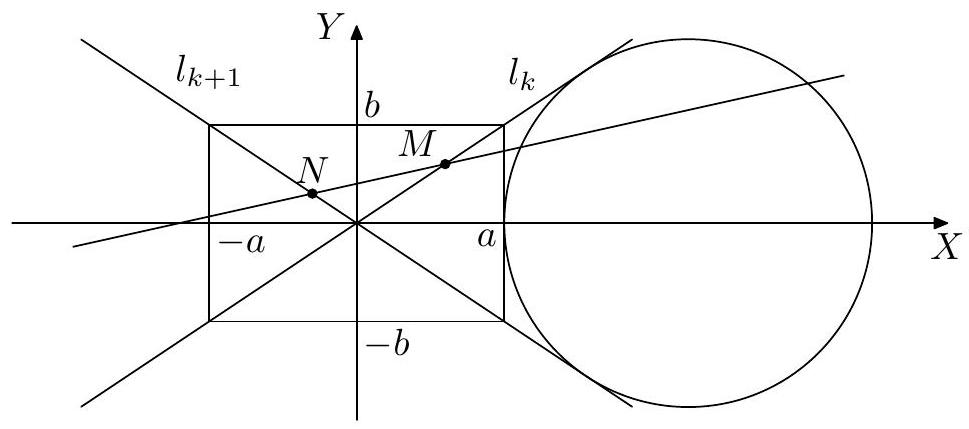
Consider the circle $\mathcal{C}$ tangent to the right of the $x=a$ side of the rectangle, and to both $\ell_{k}$ and $\ell_{k+1}$. We claim that this circle intersects $\mathcal{B}$ in exactly $2 n-1$ points, and also intersects $\mathcal{R}$ in exactly $2 n-1$ points. Since $\mathcal{C}$ is tangent to both $\ell_{k}$ and $\ell_{k+1}$ and the two lines have different colors, it is enough to show that $\mathcal{C}$ intersects with each of the other $2 n-2$ lines in exactly 2 points. Note that no two lines intersect on the circle because all the intersections between lines are in $S$ which is in the interior of $R$.
Consider any line $L$ among these $2 n-2$ lines. Let $L$ intersect with $\ell_{k}$ and $\ell_{k+1}$ at the points $M$ and $N$, respectively ( $M$ and $N$ are not necessarily distinct). Notice that both $M$ and $N$ must be inside $R$. There are two cases:
(i) $L$ intersects $R$ on the $x=-a$ side once and another time on $x=a$ side;
(ii) $L$ intersects $y=-b$ and $y=b$ sides.
However, if (ii) happens, $\angle\left(\ell_{k}, L\right)$ and $\angle\left(L, \ell_{k+1}\right)$ would be both positive, and then $\angle(X, L)$ would be between $\angle\left(X, \ell_{k}\right)$ and $\angle\left(X, \ell_{k+1}\right)$, a contradiction. Thus, only (i) can happen. Then $L$ intersects $\mathcal{C}$ in exactly two points, and we are done.
Alternative solution. By rotating the diagram we can ensure that no line is vertical. Let $\ell_{1}, \ell_{2}, \ldots, \ell_{2 n}$ be the lines listed in order of increasing gradient. Then there is a $k$ such that lines $\ell_{k}$ and $\ell_{k+1}$ are oppositely coloured. By rotating our coordinate system and cyclicly relabelling our lines we can ensure that $\ell_{1}, \ell_{2}, \ldots, \ell_{2 n}$ are listed in order of increasing gradient, $\ell_{1}$ and $\ell_{2 n}$ are oppositely coloured, and no line is vertical.
Let $\mathcal{D}$ be a circle centred at the origin and of sufficiently large radius so that
- All intersection points of all pairs of lines lie strictly inside $\mathcal{D}$; and
- Each line $\ell_{i}$ intersects $\mathcal{D}$ in two points $A_{i}$ and $B_{i}$ say, such that $A_{i}$ is on the right semicircle (the part of the circle in the positive $x$ half plane) and $B_{i}$ is on the left semicircle.
Note that the anticlockwise order of the points $A_{i}, B_{i}$ around $\mathcal{D}$ is $A_{1}, A_{2}, \ldots, A_{n}, B_{1}, B_{2}, \ldots, B_{n}$.
(If $A_{i+1}$ occurred before $A_{i}$ then rays $r_{i}$ and $r_{i+1}$ (as defined below) would intersect outside $\mathcal{D}$.)
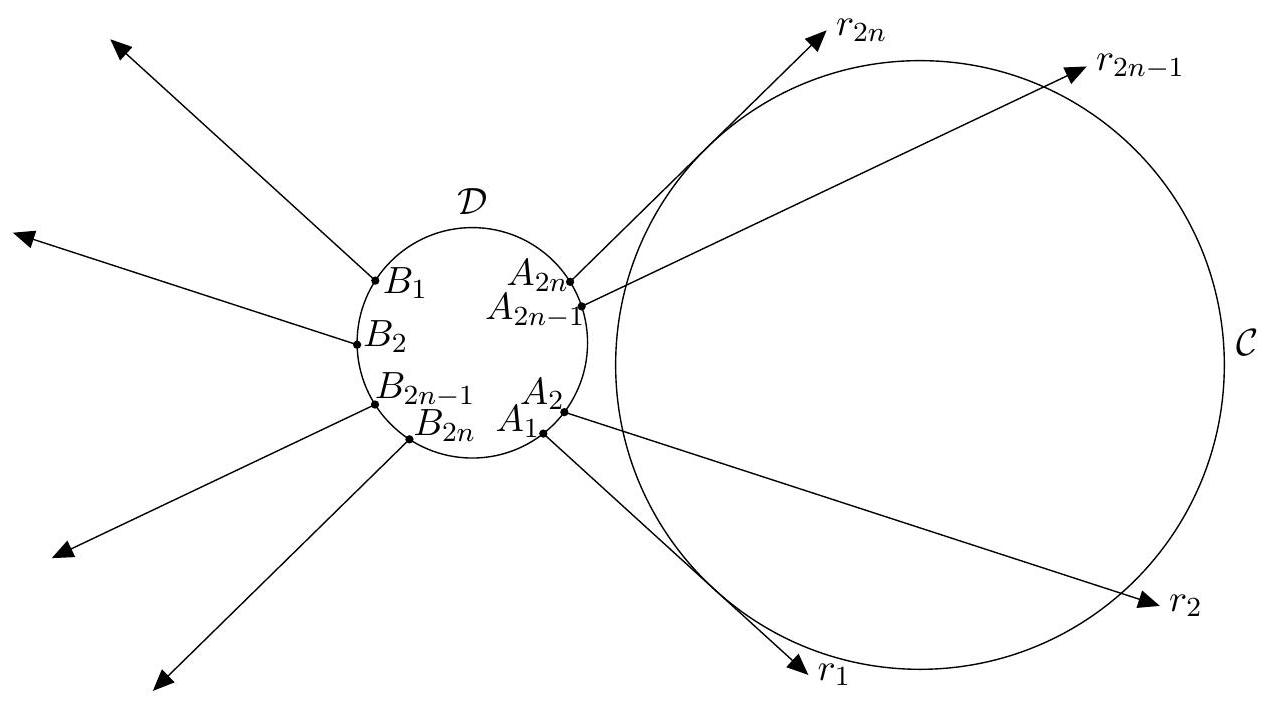
For each $i$, let $r_{i}$ be the ray that is the part of the line $\ell_{i}$ starting from point $A_{i}$ and that extends to the right. Let $\mathcal{C}$ be any circle tangent to $r_{1}$ and $r_{2 n}$, that lies entirely to the right of $\mathcal{D}$. Then $\mathcal{C}$ intersects each of $r_{2}, r_{3}, \ldots, r_{2 n-1}$ twice and is tangent to $r_{1}$ and $r_{2 n}$. Thus $\mathcal{C}$ has the required properties.
Problem 5. Determine all sequences $a_{0}, a_{1}, a_{2}, \ldots$ of positive integers with $a_{0} \geq 2015$ such that for all integers $n \geq 1$ :
(i) $a_{n+2}$ is divisible by $a_{n}$;
(ii) $\left|s_{n+1}-(n+1) a_{n}\right|=1$, where $s_{n+1}=a_{n+1}-a_{n}+a_{n-1}-\cdots+(-1)^{n+1} a_{0}$.
Answer: There are two families of answers:
(a) $a_{n}=c(n+2) n$ ! for all $n \geq 1$ and $a_{0}=c+1$ for some integer $c \geq 2014$, and
(b) $a_{n}=c(n+2) n$ ! for all $n \geq 1$ and $a_{0}=c-1$ for some integer $c \geq 2016$.
Solution. Let $\left\{a_{n}\right\}_{n=0}^{\infty}$ be a sequence of positive integers satisfying the given conditions. We can rewrite (ii) as $s_{n+1}=(n+1) a_{n}+h_{n}$, where $h_{n} \in\{-1,1\}$. Substituting $n$ with $n-1$ yields $s_{n}=n a_{n-1}+h_{n-1}$, where $h_{n-1} \in\{-1,1\}$. Note that $a_{n+1}=s_{n+1}+s_{n}$, therefore there exists $\delta_{n} \in\{-2,0,2\}$ such that
$$
a_{n+1}=(n+1) a_{n}+n a_{n-1}+\delta_{n}
$$
We also have $\left|s_{2}-2 a_{1}\right|=1$, which yields $a_{0}=3 a_{1}-a_{2} \pm 1 \leq 3 a_{1}$, and therefore $a_{1} \geq \frac{a_{0}}{3} \geq 671$. Substituting $n=2$ in (1), we find that $a_{3}=3 a_{2}+2 a_{1}+\delta_{2}$. Since $a_{1} \mid a_{3}$, we have $a_{1} \mid 3 a_{2}+\delta_{2}$, and therefore $a_{2} \geq 223$. Using (1), we obtain that $a_{n} \geq 223$ for all $n \geq 0$.
Lemma 1: For $n \geq 4$, we have $a_{n+2}=(n+1)(n+4) a_{n}$.
Proof. For $n \geq 3$ we have
$$
a_{n}=n a_{n-1}+(n-1) a_{n-2}+\delta_{n-1}>n a_{n-1}+3 .
$$
By applying (2) with $n$ substituted by $n-1$ we have for $n \geq 4$,
$$
a_{n}=n a_{n-1}+(n-1) a_{n-2}+\delta_{n-1}<n a_{n-1}+\left(a_{n-1}-3\right)+\delta_{n-1}<(n+1) a_{n-1}
$$
Using (1) to write $a_{n+2}$ in terms of $a_{n}$ and $a_{n-1}$ along with (2), we obtain that for $n \geq 3$,
$$
\begin{aligned}
a_{n+2} & =(n+3)(n+1) a_{n}+(n+2) n a_{n-1}+(n+2) \delta_{n}+\delta_{n+1} \\
& <(n+3)(n+1) a_{n}+(n+2) n a_{n-1}+3(n+2) \\
& <\left(n^{2}+5 n+5\right) a_{n} .
\end{aligned}
$$
Also for $n \geq 4$,
$$
\begin{aligned}
a_{n+2} & =(n+3)(n+1) a_{n}+(n+2) n a_{n-1}+(n+2) \delta_{n}+\delta_{n+1} \\
& >(n+3)(n+1) a_{n}+n a_{n} \\
& =\left(n^{2}+5 n+3\right) a_{n} .
\end{aligned}
$$
Since $a_{n} \mid a_{n+2}$, we obtain that $a_{n+2}=\left(n^{2}+5 n+4\right) a_{n}=(n+1)(n+4) a_{n}$, as desired.
Lemma 2: For $n \geq 4$, we have $a_{n+1}=\frac{(n+1)(n+3)}{n+2} a_{n}$.
Proof. Using the recurrence $a_{n+3}=(n+3) a_{n+2}+(n+2) a_{n+1}+\delta_{n+2}$ and writing $a_{n+3}$, $a_{n+2}$ in terms of $a_{n+1}, a_{n}$ according to Lemma 1 we obtain
$$
(n+2)(n+4) a_{n+1}=(n+3)(n+1)(n+4) a_{n}+\delta_{n+2} .
$$
Hence $n+4 \mid \delta_{n+2}$, which yields $\delta_{n+2}=0$ and $a_{n+1}=\frac{(n+1)(n+3)}{n+2} a_{n}$, as desired.
Suppose there exists $n \geq 1$ such that $a_{n+1} \neq \frac{(n+1)(n+3)}{n+2} a_{n}$. By Lemma 2, there exist a greatest integer $1 \leq m \leq 3$ with this property. Then $a_{m+2}=\frac{(m+2)(m+4)}{m+3} a_{m+1}$. If $\delta_{m+1}=0$, we have $a_{m+1}=\frac{(m+1)(m+3)}{m+2} a_{m}$, which contradicts our choice of $m$. Thus $\delta_{m+1} \neq 0$.
Clearly $m+3 \mid a_{m+1}$. Write $a_{m+1}=(m+3) k$ and $a_{m+2}=(m+2)(m+4) k$. Then $(m+$ 1) $a_{m}+\delta_{m+1}=a_{m+2}-(m+2) a_{m+1}=(m+2) k$. So, $a_{m} \mid(m+2) k-\delta_{m+1}$. But $a_{m}$ also divides $a_{m+2}=(m+2)(m+4) k$. Combining the two divisibility conditions, we obtain $a_{m} \mid(m+4) \delta_{m+1}$. Since $\delta_{m+1} \neq 0$, we have $a_{m} \mid 2 m+8 \leq 14$, which contradicts the previous result that $a_{n} \geq 223$ for all nonnegative integers $n$.
So, $a_{n+1}=\frac{(n+1)(n+3)}{n+2} a_{n}$ for $n \geq 1$. Substituting $n=1$ yields $3 \mid a_{1}$. Letting $a_{1}=3 c$, we have by induction that $a_{n}=n!(n+2) c$ for $n \geq 1$. Since $\left|s_{2}-2 a_{1}\right|=1$, we then get $a_{0}=c \pm 1$, yielding the two families of solutions. By noting that $(n+2) n!=n!+(n+1)!$, we have $s_{n+1}=c(n+2)!+(-1)^{n}\left(c-a_{0}\right)$. Hence both families of solutions satisfy the given conditions.
|