

File size: 14,479 Bytes
eebb93b | 1 2 3 4 5 6 7 8 9 10 11 12 13 14 15 16 17 18 19 20 21 22 23 24 25 26 27 28 29 30 31 32 33 34 35 36 37 38 39 40 41 42 43 44 45 46 47 48 49 50 51 52 53 54 55 56 57 58 59 60 61 62 63 64 65 66 67 68 69 70 71 72 73 74 75 76 77 78 79 80 81 82 83 84 85 86 87 88 89 90 91 92 93 94 95 96 97 98 99 100 101 102 103 104 105 106 107 108 109 110 111 112 113 114 115 116 117 118 119 120 121 122 123 124 125 126 127 128 129 130 131 132 133 134 135 136 137 138 139 140 141 142 143 144 145 146 147 148 149 150 151 152 153 154 155 156 157 158 159 160 161 162 163 164 165 166 167 168 169 170 171 172 173 174 175 176 177 178 179 180 181 182 183 184 185 186 187 188 189 190 191 192 193 194 195 196 197 198 199 200 201 202 203 204 205 206 207 208 209 210 211 212 213 214 215 216 217 218 219 220 221 222 223 224 225 226 227 228 229 230 231 232 233 234 235 236 237 238 239 240 241 242 243 244 245 246 247 248 249 250 251 252 253 254 255 | # TSTST 2014 Solution Notes
## Lincoln, Nebraska
## Evan Chen《陳誼廷》
15 April 2024
This is a compilation of solutions for the 2014 TSTST. The ideas of the solution are a mix of my own work, the solutions provided by the competition organizers, and solutions found by the community. However, all the writing is maintained by me.
These notes will tend to be a bit more advanced and terse than the "official" solutions from the organizers. In particular, if a theorem or technique is not known to beginners but is still considered "standard", then I often prefer to use this theory anyways, rather than try to work around or conceal it. For example, in geometry problems I typically use directed angles without further comment, rather than awkwardly work around configuration issues. Similarly, sentences like "let $\mathbb{R}$ denote the set of real numbers" are typically omitted entirely.
Corrections and comments are welcome!
## Contents
0 Problems ..... 2
1 Solutions to Day 1 ..... 3
1.1 TSTST 2014/1 ..... 3
1.2 TSTST 2014/2 ..... 4
1.3 TSTST 2014/3 ..... 5
2 Solutions to Day 2 ..... 6
2.1 TSTST 2014/4 ..... 6
2.2 TSTST 2014/5 ..... 7
2.3 TSTST 2014/6 ..... 8
## §0 Problems
1. Let $\leftarrow$ denote the left arrow key on a standard keyboard. If one opens a text editor and types the keys "ab $\leftarrow \mathrm{cd} \leftarrow \leftarrow \mathrm{e} \leftarrow \leftarrow \mathrm{f}$ ", the result is "faecdb". We say that a string $B$ is reachable from a string $A$ if it is possible to insert some amount of $\leftarrow$ 's in $A$, such that typing the resulting characters produces $B$. So, our example shows that "faecdb" is reachable from "abcdef".
Prove that for any two strings $A$ and $B, A$ is reachable from $B$ if and only if $B$ is reachable from $A$.
2. Consider a convex pentagon circumscribed about a circle. We name the lines that connect vertices of the pentagon with the opposite points of tangency with the circle gergonnians.
(a) Prove that if four gergonnians are concurrent, then all five of them are concurrent.
(b) Prove that if there is a triple of gergonnians that are concurrent, then there is another triple of gergonnians that are concurrent.
3. Find all polynomials $P(x)$ with real coefficients that satisfy
$$
P(x \sqrt{2})=P\left(x+\sqrt{1-x^{2}}\right)
$$
for all real numbers $x$ with $|x| \leq 1$.
4. Let $P(x)$ and $Q(x)$ be arbitrary polynomials with real coefficients, with $P \neq 0$, and let $d=\operatorname{deg} P$. Prove that there exist polynomials $A(x)$ and $B(x)$, not both zero, such that $\max \{\operatorname{deg} A, \operatorname{deg} B\} \leq d / 2$ and $P(x) \mid A(x)+Q(x) \cdot B(x)$.
5. Find the maximum number $E$ such that the following holds: there is an edge-colored graph with 60 vertices and $E$ edges, with each edge colored either red or blue, such that in that coloring, there is no monochromatic cycles of length 3 and no monochromatic cycles of length 5 .
6. Suppose we have distinct positive integers $a, b, c, d$ and an odd prime $p$ not dividing any of them, and an integer $M$ such that if one considers the infinite sequence
$$
\begin{gathered}
c a-d b \\
c a^{2}-d b^{2} \\
c a^{3}-d b^{3} \\
c a^{4}-d b^{4}
\end{gathered}
$$
and looks at the highest power of $p$ that divides each of them, these powers are not all zero, and are all at most $M$. Prove that there exists some $T$ (which may depend on $a, b, c, d, p, M)$ such that whenever $p$ divides an element of this sequence, the maximum power of $p$ that divides that element is exactly $p^{T}$.
## §1 Solutions to Day 1
## §1.1 TSTST 2014/1
Available online at https://aops.com/community/p3549404.
## Problem statement
Let $\leftarrow$ denote the left arrow key on a standard keyboard. If one opens a text editor and types the keys "ab $\leftarrow \mathrm{cd} \leftarrow \leftarrow \mathrm{e} \leftarrow \leftarrow \mathrm{f}$ ", the result is "faecdb". We say that a string $B$ is reachable from a string $A$ if it is possible to insert some amount of $\leftarrow$ 's in $A$, such that typing the resulting characters produces $B$. So, our example shows that "faecdb" is reachable from "abcdef".
Prove that for any two strings $A$ and $B, A$ is reachable from $B$ if and only if $B$ is reachable from $A$.
Obviously $A$ and $B$ should have the same multiset of characters, and we focus only on that situation.
Claim - If $A=123 \ldots n$ and $B=\sigma(1) \sigma(2) \ldots \sigma(n)$ is a permutation of $A$, then $B$ is reachable if and only if it is $\mathbf{2 1 3}$-avoiding, i.e. there are no indices $i<j<k$ such that $\sigma(j)<\sigma(i)<\sigma(k)$.
Proof. This is clearly necessary. To see its sufficient, one can just type $B$ inductively: after typing $k$, the only way to get stuck is if $k+1$ is to the right of $k$ and there is some character in the way; this gives a 213 pattern.
Claim - A permutation $\sigma$ on $\{1, \ldots, n\}$ is 213 -avoiding if and only if the inverse $\sigma^{-1}$ is.
Proof. Suppose $i<j<k$ and $\sigma(j)<\sigma(i)<\sigma(k)$. Let $i^{\prime}=\sigma(j), j^{\prime}=\sigma(i), k^{\prime}=\sigma(k)$; then $i^{\prime}<j^{\prime}<k^{\prime}$ and $\sigma^{-1}\left(j^{\prime}\right)<\sigma^{-1}\left(i^{\prime}\right)<\sigma^{-1}\left(k^{\prime}\right)$.
This essentially finishes the problem. Suppose $B$ is reachable from $A$. By using the typing pattern, we get some permutation $\sigma:\{1, \ldots, n\}$ such that the $i$ th character of $A$ is the $\sigma(i)$ th character of $B$, and which is 213 -avoiding by the claim. (The permutation is unique if $A$ has all distinct characters, but there could be multiple if $A$ has repeated ones.) Then $\sigma^{-1}$ is 213 -avoiding too and gives us a way to change $B$ into $A$.
## §1.2 TSTST 2014/2
Available online at https://aops.com/community/p3549405.
## Problem statement
Consider a convex pentagon circumscribed about a circle. We name the lines that connect vertices of the pentagon with the opposite points of tangency with the circle gergonnians.
(a) Prove that if four gergonnians are concurrent, then all five of them are concurrent.
(b) Prove that if there is a triple of gergonnians that are concurrent, then there is another triple of gergonnians that are concurrent.
This problem is insta-killed by taking a homography sending the concurrency point (in either part) to the center of the circle while fixing the incircle. Alternatively, one may send any four of the tangency points to a rectangle.
Here are the details. Let $A B C D E$ be a pentagon with gergonnians $\overline{A V}, \overline{B W}, \overline{C X}$, $\overline{D Y}, \overline{E Z}$. We prove the following lemma, which (up to a suitable permutation of point names) solves both parts (a) and (b).
## Lemma
The gergonnians $\overline{A V}, \overline{C X}, \overline{D Y}$ are concurrent if and only if the gergonnians $\overline{A V}$, $\overline{B W}, \overline{E Z}$ are concurrent.
Proof. We prove the first set implies the second (the converse direction being identical). Suppose $\overline{A V}, \overline{C X}, \overline{D Y}$ intersect at $P$ and take a homography fixing the circle and moving $P$ to its center.
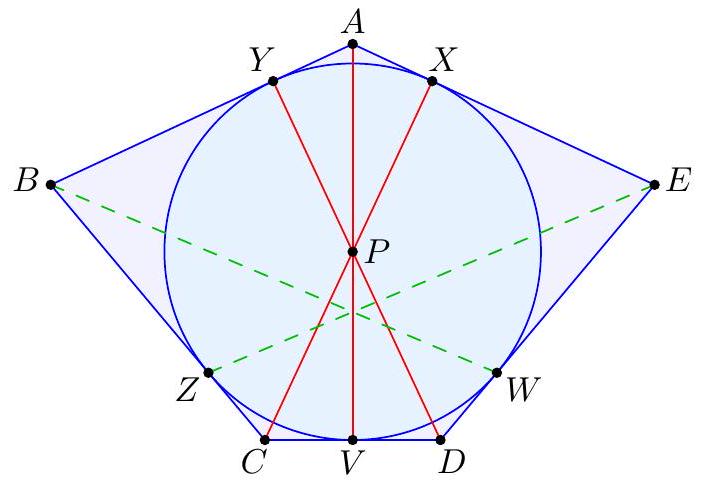
Then $X$ and $Y$ are symmetric around $\overline{A P V}$ by hypothesis. Since $D=\overline{V V} \cap \overline{P Y}$, $C=\overline{V V} \cap \overline{P X}$, it follows that $C$ and $D$, and hence $Z$ and $W$, are also symmetric around $\overline{A P V}$. Consequently $B$ and $E$ are symmetric too. So $\overline{B W}$ and $\overline{E Z}$ meet on $\overline{A V}$.
## §1.3 TSTST 2014/3
Available online at https://aops.com/community/p3549407.
## Problem statement
Find all polynomials $P(x)$ with real coefficients that satisfy
$$
P(x \sqrt{2})=P\left(x+\sqrt{1-x^{2}}\right)
$$
for all real numbers $x$ with $|x| \leq 1$.
The answer is any polynomial of the form $P(x)=f(U(x / \sqrt{2}))$, where $f \in \mathbb{R}[x]$ and $U$ is the unique polynomial satisfying $U(\cos \theta)=\cos (8 \theta)$.
Let $Q(x)=P(x \sqrt{2})$, then the condition reads
$$
Q(\cos \theta)=Q\left(\frac{1}{\sqrt{2}}(\cos \theta+\sin \theta)\right)=Q\left(\cos \left(\theta-45^{\circ}\right)\right) \quad \forall 0 \leq \theta \leq 180^{\circ} .
$$
We call a polynomial good if it satisfies this functional equation.
## Lemma
The minimal (by degree) good nonconstant polynomial is $U$.
Proof. Since $U$ works, it suffices to show that $\operatorname{deg} Q \geq 8$. Note that:
$$
\begin{aligned}
Q\left(\cos 136^{\circ}\right) & =Q\left(\cos 91^{\circ}\right)=Q\left(\cos 46^{\circ}\right)=Q\left(\cos 1^{\circ}\right)=Q\left(\cos -44^{\circ}\right) \\
& =Q\left(\cos 44^{\circ}\right)=Q\left(\cos 89^{\circ}\right)=Q\left(\cos 134^{\circ}\right)=Q\left(\cos 179^{\circ}\right)
\end{aligned}
$$
Hence $Q$ is equal at eight distinct values (not nine since $\cos -44^{\circ}=\cos 44^{\circ}$ is repeated), so $\operatorname{deg} Q \geq 8$ (unless $Q$ is constant).
Now, we claim $Q(x) \equiv f(U(x))$ for some $f \in \mathbb{R}[x]$. Indeed, if $Q$ is good, then by minimality the quotient $Q \bmod U$ must be constant, so $Q(x)=\widetilde{Q}(x) \cdot U(x)+c$ for some constant $c$, but then $\widetilde{Q}(x)$ is good too and we finish iteratively.
## §2 Solutions to Day 2
## §2.1 TSTST 2014/4
Available online at https://aops.com/community/p3549409.
## Problem statement
Let $P(x)$ and $Q(x)$ be arbitrary polynomials with real coefficients, with $P \neq 0$, and let $d=\operatorname{deg} P$. Prove that there exist polynomials $A(x)$ and $B(x)$, not both zero, such that $\max \{\operatorname{deg} A, \operatorname{deg} B\} \leq d / 2$ and $P(x) \mid A(x)+Q(x) \cdot B(x)$.
Let $V$ be the vector space of real polynomials with degree at most $d / 2$. Consider maps of linear spaces
$$
\begin{aligned}
V^{\oplus 2} & \rightarrow \mathbb{R}[x] /(P(x)) \\
\text { by } \quad(A, B) & \mapsto A+Q B \quad(\bmod P) .
\end{aligned}
$$
The domain has dimension
$$
2(\lfloor d / 2\rfloor+1)
$$
while the codomain has dimension $d$. For dimension reasons it has nontrivial kernel.
## §2.2 TSTST 2014/5
Available online at https://aops.com/community/p3549412.
## Problem statement
Find the maximum number $E$ such that the following holds: there is an edge-colored graph with 60 vertices and $E$ edges, with each edge colored either red or blue, such that in that coloring, there is no monochromatic cycles of length 3 and no monochromatic cycles of length 5 .
The answer is $E=30^{2}+2 \cdot 15^{2}=6 \cdot 15^{2}=1350$.
First, we prove $E \leq 1350$. Observe that:
Claim - $G$ contains no $K_{5}$.
Proof. It's a standard fact that the only triangle-free two-coloring of the edges of $K_{5}$ is the union of two monochromatic $C_{5}$ 's.
Hence by Turán theorem we have $E \leq\binom{ 4}{2} \cdot 15^{2}=1350$.
To show this is achievable, take a red $K_{30,30}$, and on each side draw a blue $K_{15,15}$. This graph has no monochromatic odd cycles at all as desired.
## §2.3 TSTST 2014/6
Available online at https://aops.com/community/p3549417.
## Problem statement
Suppose we have distinct positive integers $a, b, c, d$ and an odd prime $p$ not dividing any of them, and an integer $M$ such that if one considers the infinite sequence
$$
\begin{gathered}
c a-d b \\
c a^{2}-d b^{2} \\
c a^{3}-d b^{3} \\
c a^{4}-d b^{4}
\end{gathered}
$$
and looks at the highest power of $p$ that divides each of them, these powers are not all zero, and are all at most $M$. Prove that there exists some $T$ (which may depend on $a, b, c, d, p, M)$ such that whenever $p$ divides an element of this sequence, the maximum power of $p$ that divides that element is exactly $p^{T}$.
By orders, the indices of terms divisible by $p$ is an arithmetic subsequence of $\mathbb{N}$ : say they are $\kappa, \kappa+\lambda, \kappa+2 \lambda, \ldots$, where $\lambda$ is the order of $a / b$. That means we want
$$
\nu_{p}\left(c a^{\kappa+n \lambda}-d b^{\kappa+n \lambda}\right)=\nu_{p}\left(\left(\frac{a^{\lambda}}{b^{\lambda}}\right)^{n}-\frac{d a^{\kappa}}{c b^{\kappa}}\right)
$$
to be constant. Thus, we have reduced the problem to the following proposition:
## Proposition
Let $p$ be an odd prime. Let $x, y \in \mathbb{Q}_{>0}$ such that $x \equiv y \equiv 1(\bmod p)$. If the sequence $\nu_{p}\left(x^{n}-y\right)$ of positive integers is nonconstant, then it is unbounded.
For this it would be sufficient to prove the following claim.
Claim - Let $p$ be an odd prime. Let $x, y \in \mathbb{Q}>0$ such that $x \equiv y \equiv 1(\bmod p)$. Suppose $m$ and $n$ are positive integers such that
$$
d=\nu_{p}\left(x^{n}-y\right)<\nu_{p}\left(x^{m}-y\right)=e .
$$
Then there exists $\ell$ such that $\nu_{p}\left(x^{\ell}-y\right) \geq e+1$.
Proof. First, note that $\nu_{p}\left(x^{m}-x^{n}\right)=\nu_{p}\left(\left(x^{m}-y\right)-\left(x^{n}-y\right)\right)=d$ and so by exponent lifting we can find some $k$ such that
$$
\nu_{p}\left(x^{k}-1\right)=e
$$
namely $k=p^{e-d}|m-n|$. (In fact, one could also choose more carefully $k=p^{e-d} \cdot \operatorname{gcd}(m-$ $\left.n, p^{\infty}\right)$, so that $k$ is a power of $p$.)
Suppose we set $x^{k}=p^{e} u+1$ and $x^{m}=p^{e} v+y$ where $u, v \in \mathbb{Q}$ aren't divisible by $p$. Now for any integer $1 \leq r \leq p-1$ we consider
$$
\begin{aligned}
x^{k r+m}-y & =\left(p^{e} u+1\right)^{r} \cdot\left(p^{e} v+y\right)-y \\
& =p^{e}(v+y u \cdot r)+p^{2 e}(\ldots)
\end{aligned}
$$
By selecting $r$ with $r \equiv-v / u(\bmod p)$, we ensure $p^{e+1} \mid x^{k r+m}-y$, hence $\ell=k r+m$ is as desired.
Remark. One way to motivate the proof of the claim is as follows. Suppose we are given $\nu_{p}\left(x^{m}-y\right)=e$, and we wish to find $\ell$ such that $\nu_{p}\left(x^{\ell}-y\right)>e$. Then, it is necessary (albeit insufficient) that
$$
x^{\ell-m} \equiv 1 \quad\left(\bmod p^{e}\right) \text { but } x^{\ell-m} \not \equiv 1 \quad\left(\bmod p^{e+1}\right)
$$
In particular, we need $\nu_{p}\left(x^{\ell-m}-1\right)=e$ exactly. So the $k$ in the claim must exist if we are going to succeed.
On the other hand, if $k$ is some integer for which $\nu_{p}\left(x^{k}-1\right)=e$, then by choosing $\ell-m$ to be some multiple of $k$ with no extra factors of $p$, we hope that we can get $\nu_{p}\left(x^{\ell}-y\right)=e+1$. That's why we write $\ell=k r+m$ and see what happens when we expand.
|