

File size: 21,006 Bytes
eebb93b | 1 2 3 4 5 6 7 8 9 10 11 12 13 14 15 16 17 18 19 20 21 22 23 24 25 26 27 28 29 30 31 32 33 34 35 36 37 38 39 40 41 42 43 44 45 46 47 48 49 50 51 52 53 54 55 56 57 58 59 60 61 62 63 64 65 66 67 68 69 70 71 72 73 74 75 76 77 78 79 80 81 82 83 84 85 86 87 88 89 90 91 92 93 94 95 96 97 98 99 100 101 102 103 104 105 106 107 108 109 110 111 112 113 114 115 116 117 118 119 120 121 122 123 124 125 126 127 128 129 130 131 132 133 134 135 136 137 138 139 140 141 142 143 144 145 146 147 148 149 150 151 152 153 154 155 156 157 158 159 160 161 162 163 164 165 166 167 168 169 170 171 172 173 174 175 176 177 178 179 180 181 182 183 184 185 186 187 188 189 190 191 192 193 194 195 196 197 198 199 200 201 202 203 204 205 206 207 208 209 210 211 212 213 214 215 216 217 218 219 220 221 222 223 224 225 226 227 228 229 230 231 232 233 234 235 236 237 238 239 240 241 242 243 244 245 246 247 248 249 250 251 252 253 254 255 256 257 258 259 260 261 262 263 264 265 266 267 268 269 270 271 272 273 274 275 276 277 278 279 | # USA TSTST 2016 Solutions <br> United States of America - TST Selection Test <br> Evan Chen《陳誼廷》 <br> $58^{\text {th }}$ IMO 2017 Brazil and $6^{\text {th }}$ EGMO 2017 Switzerland
## Contents
0 Problems ..... 2
1 Solutions to Day 1 ..... 3
1.1 TSTST 2016/1, proposed by Victor Wang ..... 3
1.2 TSTST 2016/2, proposed by Evan Chen ..... 4
1.3 TSTST 2016/3, proposed by Yang Liu ..... 6
2 Solutions to Day 2 ..... 8
2.1 TSTST 2016/4, proposed by Linus Hamilton ..... 8
2.2 TSTST 2016/5, proposed by Linus Hamilton, Cynthia Stoner ..... 9
2.3 TSTST 2016/6, proposed by Danielle Wang ..... 10
## §0 Problems
1. Let $A=A(x, y)$ and $B=B(x, y)$ be two-variable polynomials with real coefficients. Suppose that $A(x, y) / B(x, y)$ is a polynomial in $x$ for infinitely many values of $y$, and a polynomial in $y$ for infinitely many values of $x$. Prove that $B$ divides $A$, meaning there exists a third polynomial $C$ with real coefficients such that $A=B \cdot C$.
2. Let $A B C$ be a scalene triangle with orthocenter $H$ and circumcenter $O$ and denote by $M, N$ the midpoints of $\overline{A H}, \overline{B C}$. Suppose the circle $\gamma$ with diameter $\overline{A H}$ meets the circumcircle of $A B C$ at $G \neq A$, and meets line $\overline{A N}$ at $Q \neq A$. The tangent to $\gamma$ at $G$ meets line $O M$ at $P$. Show that the circumcircles of $\triangle G N Q$ and $\triangle M B C$ intersect on $\overline{P N}$.
3. Decide whether or not there exists a nonconstant polynomial $Q(x)$ with integer coefficients with the following property: for every positive integer $n>2$, the numbers
$$
Q(0), Q(1), Q(2), \ldots, Q(n-1)
$$
produce at most $0.499 n$ distinct residues when taken modulo $n$.
4. Prove that if $n$ and $k$ are positive integers satisfying $\varphi^{k}(n)=1$, then $n \leq 3^{k}$. (Here $\varphi^{k}$ denotes $k$ applications of the Euler phi function.)
5. In the coordinate plane are finitely many walls, which are disjoint line segments, none of which are parallel to either axis. A bulldozer starts at an arbitrary point and moves in the $+x$ direction. Every time it hits a wall, it turns at a right angle to its path, away from the wall, and continues moving. (Thus the bulldozer always moves parallel to the axes.)
Prove that it is impossible for the bulldozer to hit both sides of every wall.
6. Let $A B C$ be a triangle with incenter $I$, and whose incircle is tangent to $\overline{B C}, \overline{C A}$, $\overline{A B}$ at $D, E, F$, respectively. Let $K$ be the foot of the altitude from $D$ to $\overline{E F}$. Suppose that the circumcircle of $\triangle A I B$ meets the incircle at two distinct points $C_{1}$ and $C_{2}$, while the circumcircle of $\triangle A I C$ meets the incircle at two distinct points $B_{1}$ and $B_{2}$. Prove that the radical axis of the circumcircles of $\triangle B B_{1} B_{2}$ and $\triangle C C_{1} C_{2}$ passes through the midpoint $M$ of $\overline{D K}$.
## §1 Solutions to Day 1
## §1.1 TSTST 2016/1, proposed by Victor Wang
Available online at https://aops.com/community/p6575197.
## Problem statement
Let $A=A(x, y)$ and $B=B(x, y)$ be two-variable polynomials with real coefficients. Suppose that $A(x, y) / B(x, y)$ is a polynomial in $x$ for infinitely many values of $y$, and a polynomial in $y$ for infinitely many values of $x$. Prove that $B$ divides $A$, meaning there exists a third polynomial $C$ with real coefficients such that $A=B \cdot C$.
This is essentially an application of the division algorithm, but the details require significant care.
First, we claim that $A / B$ can be written as a polynomial in $x$ whose coefficients are rational functions in $y$. To see this, use the division algorithm to get
$$
A=Q \cdot B+R \quad Q, R \in(\mathbb{R}(y))[x]
$$
where $Q$ and $R$ are polynomials in $x$ whose coefficients are rational functions in $y$, and moreover $\operatorname{deg}_{x} B>\operatorname{deg}_{x} R$.
Now, we claim that $R \equiv 0$. Indeed, we have by hypothesis that for infinitely many values of $y_{0}$ that $B\left(x, y_{0}\right)$ divides $A\left(x, y_{0}\right)$, which means $B\left(x, y_{0}\right) \mid R\left(x, y_{0}\right)$ as polynomials in $\mathbb{R}[x]$. Now, we have $\operatorname{deg}_{x} B\left(x, y_{0}\right)>\operatorname{deg}_{x} R\left(x, y_{0}\right)$ outside of finitely many values of $y_{0}$ (but not all of them!); this means for infinitely many $y_{0}$ we have $R\left(x, y_{0}\right) \equiv 0$. So each coefficient of $x^{i}$ (in $\left.\mathbb{R}(y)\right)$ has infinitely many roots, hence is a zero polynomial.
Consequently, we are able to write $A / B=F(x, y) / M(y)$ where $F \in \mathbb{R}[x, y]$ and $M \in \mathbb{R}[y]$ are each polynomials. Repeating the same argument now gives
$$
\frac{A}{B}=\frac{F(x, y)}{M(y)}=\frac{G(x, y)}{N(x)}
$$
Now, by unique factorization of polynomials in $\mathbb{R}[x, y]$, we can discuss GCD's. So, we tacitly assume $\operatorname{gcd}(F, M)=\operatorname{gcd}(G, N)=(1)$. Also, we obviously have $\operatorname{gcd}(M, N)=(1)$. But $F \cdot N=G \cdot M$, so $M \mid F \cdot N$, thus we conclude $M$ is the constant polynomial. This implies the result.
Remark. This fact does not generalize to arbitrary functions that are separately polynomial: see e.g. http://aops.com/community/c6h523650p2978180.
## §1.2 TSTST 2016/2, proposed by Evan Chen
Available online at https://aops.com/community/p6575204.
## Problem statement
Let $A B C$ be a scalene triangle with orthocenter $H$ and circumcenter $O$ and denote by $M, N$ the midpoints of $\overline{A H}, \overline{B C}$. Suppose the circle $\gamma$ with diameter $\overline{A H}$ meets the circumcircle of $A B C$ at $G \neq A$, and meets line $\overline{A N}$ at $Q \neq A$. The tangent to $\gamma$ at $G$ meets line $O M$ at $P$. Show that the circumcircles of $\triangle G N Q$ and $\triangle M B C$ intersect on $\overline{P N}$.
We present two solutions, one using essentially only power of a point, and the other more involved.
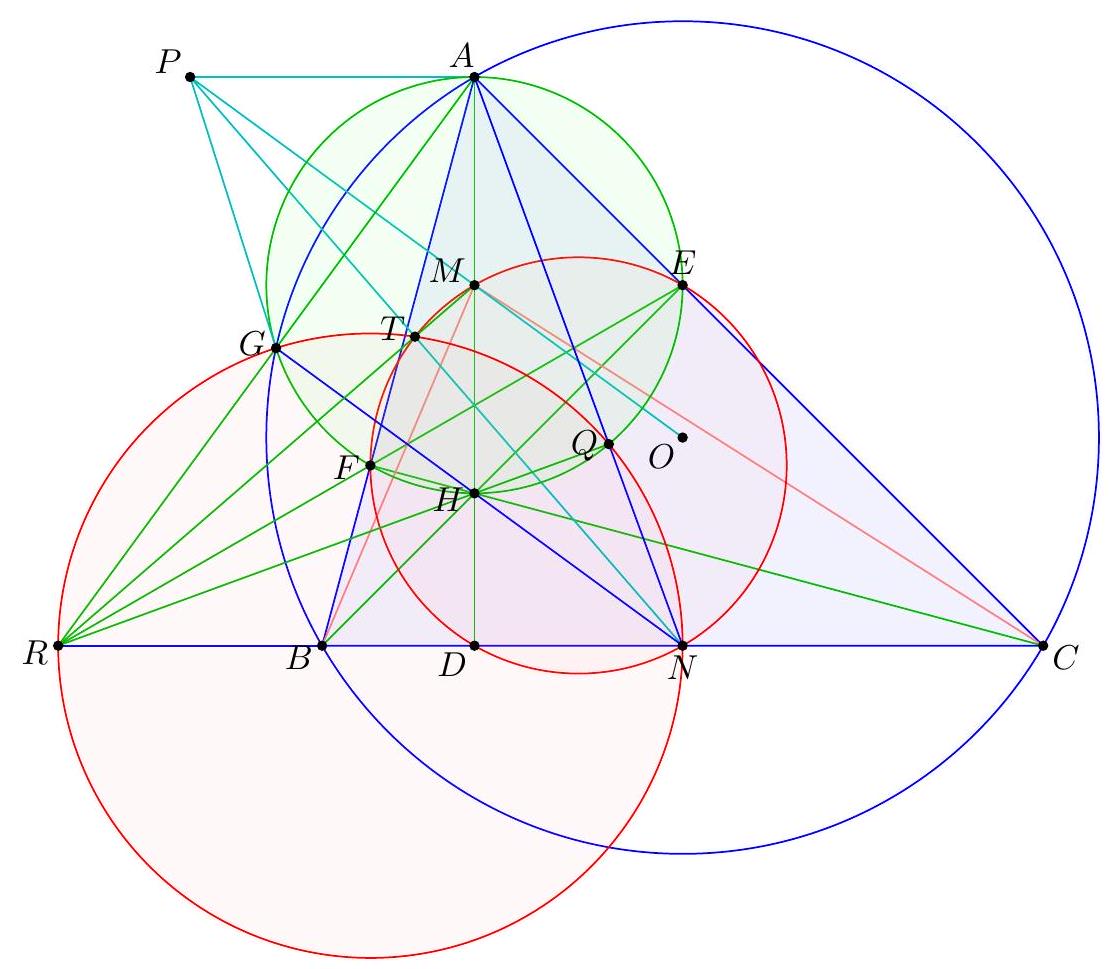
【 First solution (found by contestants). Denote by $\triangle D E F$ the orthic triangle. Observe $\overline{P A}$ and $\overline{P G}$ are tangents to $\gamma$, since $\overline{O M}$ is the perpendicular bisector of $\overline{A G}$. Also note that $\overline{A G}, \overline{E F}, \overline{B C}$ are concurrent at some point $R$ by radical axis on $(A B C), \gamma$, (BFEC).
Now, consider circles (PAGM), (MFDNE), and (MBC). We already saw the point $R$ satisfies
$$
R A \cdot R G=R E \cdot R F=R B \cdot R C
$$
and hence has equal powers to all three circles; but since the circles at $M$ already, they must actually be coaxial. Assume they meet again at $T \in \overline{R M}$, say. Then $\angle P T M$ and $\angle M T N$ are both right angles, hence $T$ lies on $\overline{P N}$.
Finally $H$ is the orthocenter of $\triangle A R N$, and thus the circle with diameter $\overline{R N}$ passes through $G, Q, N$.
『 Alternate solution (by proposer). Let $L$ be diametrically opposite $A$ on the circumcircle. Denote by $\triangle D E F$ the orthic triangle. Let $X=\overline{A H} \cap \overline{E F}$. Finally, let $T$ be the second intersection of (MFDNE) and (MBC).
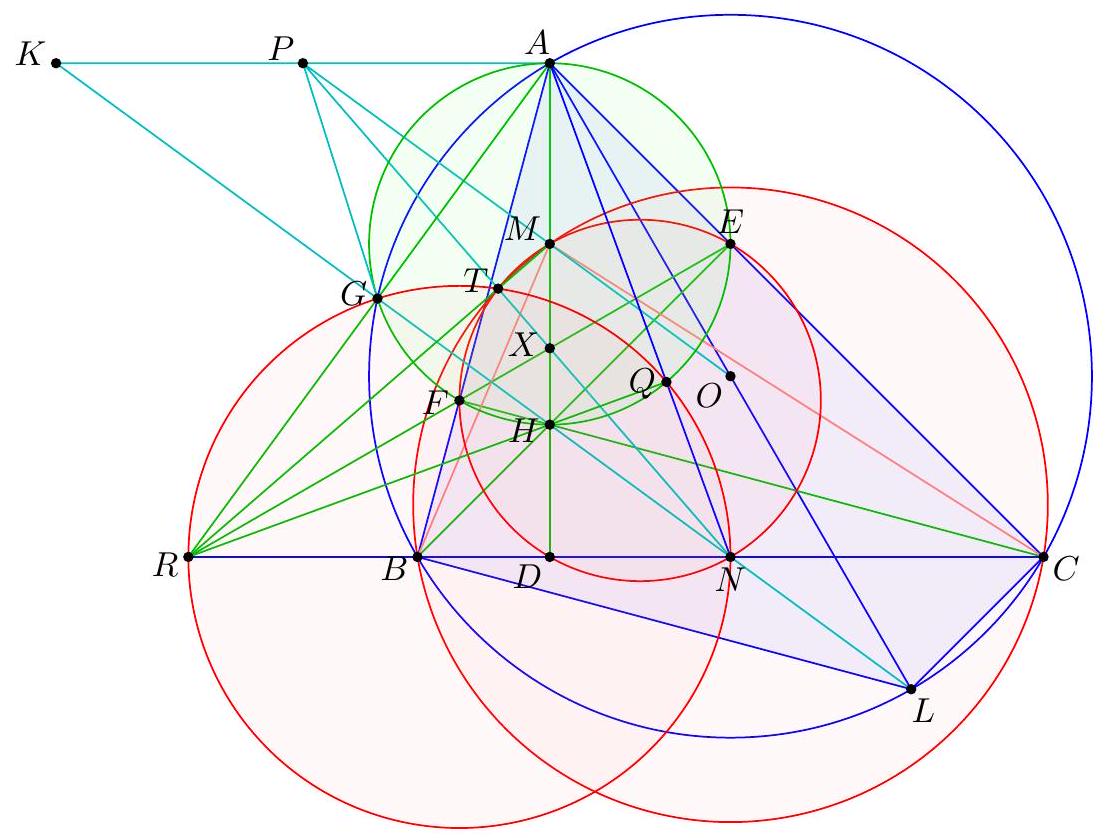
We begin with a few easy observations. First, points $H, G, N, L$ are collinear and $\angle A G L=90^{\circ}$. Also, $Q$ is the foot from $H$ to $\overline{A N}$. Consequently, lines $A G, E F, H Q$, $B C, T M$ concur at a point $R$ (radical axis). Moreover, we already know $\angle M T N=90^{\circ}$. This implies $T$ lies on the circle with diameter $\overline{R N}$, which is exactly the circumcircle of $\triangle G Q N$.
Note by Brokard's Theorem on $A F H E$, the point $X$ is the orthocenter of $\triangle M B C$. But $\angle M T N=90^{\circ}$ already, and $N$ is the midpoint of $\overline{B C}$. Consequently, points $T, X$, $N$ are collinear.
Finally, we claim $P, X, N$ are collinear, which solves the problem. Note $P=\overline{G G} \cap \overline{A A}$. Set $K=\overline{H N L} \cap \overline{A P}$. Then by noting
$$
-1=(D, X ; A, H) \stackrel{N}{=}(\infty, \overline{N X} \cap \overline{A K} ; A, K)
$$
we see that $\overline{N X}$ bisects segment $\overline{A K}$, as desired. (A more projective finish is to show that $\overline{P X N}$ is the polar of $R$ to $\gamma$ ).
Remark. The original problem proposal reads as follows:
Let $A B C$ be a triangle with orthocenter $H$ and circumcenter $O$ and denote by $M, N$ the midpoints of $\overline{A H}, \overline{B C}$. Suppose ray $O M$ meets the line parallel to $\overline{B C}$ through $A$ at $P$. Prove that the line through the circumcenter of $\triangle M B C$ and the midpoint of $\overline{O H}$ is parallel to $\overline{N P}$.
The points $G$ and $Q$ were added to the picture later to prevent the problem from being immediate by coordinates.
## §1.3 TSTST 2016/3, proposed by Yang Liu
Available online at https://aops.com/community/p6575217.
## Problem statement
Decide whether or not there exists a nonconstant polynomial $Q(x)$ with integer coefficients with the following property: for every positive integer $n>2$, the numbers
$$
Q(0), Q(1), Q(2), \ldots, Q(n-1)
$$
produce at most $0.499 n$ distinct residues when taken modulo $n$.
We claim that
$$
Q(x)=420\left(x^{2}-1\right)^{2}
$$
works. Clearly, it suffices to prove the result when $n=4$ and when $n$ is an odd prime $p$. The case $n=4$ is trivial, so assume now $n=p$ is an odd prime.
First, we prove the following easy claim.
Claim - For any odd prime $p$, there are at least $\frac{1}{2}(p-3)$ values of $a$ for which $\left(\frac{1-a^{2}}{p}\right)=+1$.
Proof. Note that if $k \neq 0$ and $k^{2} \neq-1$, then $a=\frac{1-k^{2}}{k^{2}+1}$ works.
Remark. The above identity comes from starting with the equation $1-a^{2}=b^{2}$, and writing it as $\left(\frac{1}{b}\right)^{2}-\left(\frac{a}{b}\right)^{2}=1$. Then solve $\frac{1}{b}-\frac{a}{b}=k$ and $\frac{1}{b}+\frac{a}{b}=1 / k$ for $a$.
Let $F(x)=\left(x^{2}-1\right)^{2}$. The range of $F$ modulo $p$ is contained within the $\frac{1}{2}(p+1)$ quadratic residues modulo $p$. On the other hand, if for some $t$ neither of $1 \pm t$ is a quadratic residue, then $t^{2}$ is omitted from the range of $F$ as well. Call such a value of $t$ useful, and let $N$ be the number of useful residues. We aim to show $N \geq \frac{1}{4} p-2$.
We compute a lower bound on the number $N$ of useful $t$ by writing
$$
\begin{aligned}
N & =\frac{1}{4}\left(\sum_{t}\left[\left(1-\left(\frac{1-t}{p}\right)\right)\left(1-\left(\frac{1+t}{p}\right)\right)\right]-\left(1-\left(\frac{2}{p}\right)\right)-\left(1-\left(\frac{-2}{p}\right)\right)\right) \\
& \geq \frac{1}{4} \sum_{t}\left[\left(1-\left(\frac{1-t}{p}\right)\right)\left(1-\left(\frac{1+t}{p}\right)\right)\right]-1 \\
& =\frac{1}{4}\left(p+\sum_{t}\left(\frac{1-t^{2}}{p}\right)\right)-1 \\
& \geq \frac{1}{4}\left(p+(+1) \cdot \frac{1}{2}(p-3)+0 \cdot 2+(-1) \cdot\left((p-2)-\frac{1}{2}(p-3)\right)\right)-1 \\
& \geq \frac{1}{4}(p-5) .
\end{aligned}
$$
Thus, the range of $F$ has size at most
$$
\frac{1}{2}(p+1)-\frac{1}{2} N \leq \frac{3}{8}(p+3) .
$$
This is less than $0.499 p$ for any $p \geq 11$.
Remark. In fact, the computation above is essentially an equality. There are only two points where terms are dropped: one, when $p \equiv 3(\bmod 4)$ there are no $k^{2}=-1$ in the lemma, and secondly, the terms $1-(2 / p)$ and $1-(-2 / p)$ are dropped in the initial estimate for $N$. With suitable modifications, one can show that in fact, the range of $F$ is exactly equal to
$$
\frac{1}{2}(p+1)-\frac{1}{2} N=\left\{\begin{array}{lll}
\frac{1}{8}(3 p+5) & p \equiv 1 & (\bmod 8) \\
\frac{1}{8}(3 p+7) & p \equiv 3 & (\bmod 8) \\
\frac{1}{8}(3 p+9) & p \equiv 5 & (\bmod 8) \\
\frac{1}{8}(3 p+3) & p \equiv 7 & (\bmod 8)
\end{array}\right.
$$
## §2 Solutions to Day 2
## §2.1 TSTST 2016/4, proposed by Linus Hamilton
Available online at https://aops.com/community/p6580534.
## Problem statement
Prove that if $n$ and $k$ are positive integers satisfying $\varphi^{k}(n)=1$, then $n \leq 3^{k}$. (Here $\varphi^{k}$ denotes $k$ applications of the Euler phi function.)
The main observation is that the exponent of 2 decreases by at most 1 with each application of $\varphi$. This will give us the desired estimate.
Define the weight function $w$ on positive integers as follows: it satisfies
$$
\begin{aligned}
w(a b) & =w(a)+w(b) \\
w(2) & =1 ; \quad \text { and } \\
w(p) & =w(p-1) \quad \text { for any prime } p>2
\end{aligned}
$$
By induction, we see that $w(n)$ counts the powers of 2 that are produced as $\varphi$ is repeatedly applied to $n$. In particular, $k \geq w(n)$.
From $w(2)=1$, it suffices to prove that $w(p) \geq \log _{3} p$ for every $p>2$. We use strong induction and note that
$$
w(p)=w(2)+w\left(\frac{p-1}{2}\right) \geq 1+\log _{3}(p-1)-\log _{3} 2 \geq \log _{3} p
$$
for any $p>2$. This solves the problem.
Remark. One can motivate this solution through small cases $2^{x} 3^{y}$ like $2^{x} 17^{w}, 2^{x} 3^{y} 7^{z}$, $2^{x} 11^{t}$ 。
Moreover, the stronger bound
$$
n \leq 2 \cdot 3^{k-1}
$$
is true and best possible.
## §2.2 TSTST 2016/5, proposed by Linus Hamilton, Cynthia Stoner
Available online at https://aops.com/community/p6580545.
## Problem statement
In the coordinate plane are finitely many walls, which are disjoint line segments, none of which are parallel to either axis. A bulldozer starts at an arbitrary point and moves in the $+x$ direction. Every time it hits a wall, it turns at a right angle to its path, away from the wall, and continues moving. (Thus the bulldozer always moves parallel to the axes.)
Prove that it is impossible for the bulldozer to hit both sides of every wall.
We say a wall $v$ is above another wall $w$ if some point on $v$ is directly above a point on $w$. (This relation is anti-symmetric, as walls do not intersect).
The critical claim is as follows:
Claim - There exists a lowest wall, i.e. a wall not above any other walls.
Proof. Assume not. Then we get a directed cycle of some length $n \geq 3$ : it's possible to construct a series of points $P_{i}, Q_{i}$, for $i=1, \ldots, n$ (indices modulo $n$ ), such that the point $Q_{i}$ is directly above $P_{i+1}$ for each $i$, the segment $\overline{Q_{i} P_{i+1}}$ does not intersect any wall in its interior, and finally each segment $\overline{P_{i} Q_{i}}$ is contained inside a wall. This gives us a broken line on $2 n$ vertices which is not self-intersecting.
Now consider the leftmost vertical segment $\overline{Q_{i} P_{i+1}}$ and the rightmost vertical segment $\overline{Q_{j} P_{j+1}}$. The broken line gives a path from $P_{i+1}$ to $Q_{j}$, as well as a path from $P_{j+1}$ to $Q_{i}$. These clearly must intersect, contradiction.
Remark. This claim is Iran TST 2010.
Thus if the bulldozer eventually moves upwards indefinitely, it may never hit the bottom side of the lowest wall. Similarly, if the bulldozer eventually moves downwards indefinitely, it may never hit the upper side of the highest wall.
## §2.3 TSTST 2016/6, proposed by Danielle Wang
Available online at https://aops.com/community/p6580553.
## Problem statement
Let $A B C$ be a triangle with incenter $I$, and whose incircle is tangent to $\overline{B C}, \overline{C A}$, $\overline{A B}$ at $D, E, F$, respectively. Let $K$ be the foot of the altitude from $D$ to $\overline{E F}$. Suppose that the circumcircle of $\triangle A I B$ meets the incircle at two distinct points $C_{1}$ and $C_{2}$, while the circumcircle of $\triangle A I C$ meets the incircle at two distinct points $B_{1}$ and $B_{2}$. Prove that the radical axis of the circumcircles of $\triangle B B_{1} B_{2}$ and $\triangle C C_{1} C_{2}$ passes through the midpoint $M$ of $\overline{D K}$.
\I First solution (Allen Liu). Let $X, Y, Z$ be midpoints of $E F, F D, D E$, and let $G$ be the Gergonne point. By radical axis on $(A E I F),(D E F),(A I C)$ we see that $B_{1}$, $X, B_{2}$ are collinear. Likewise, $B_{1}, Z, B_{2}$ are collinear, so lines $B_{1} B_{2}$ and $X Z$ coincide. Similarly, lines $C_{1} C_{2}$ and $X Y$ coincide. In particular lines $B_{1} B_{2}$ and $C_{1} C_{2}$ meet at $X$.
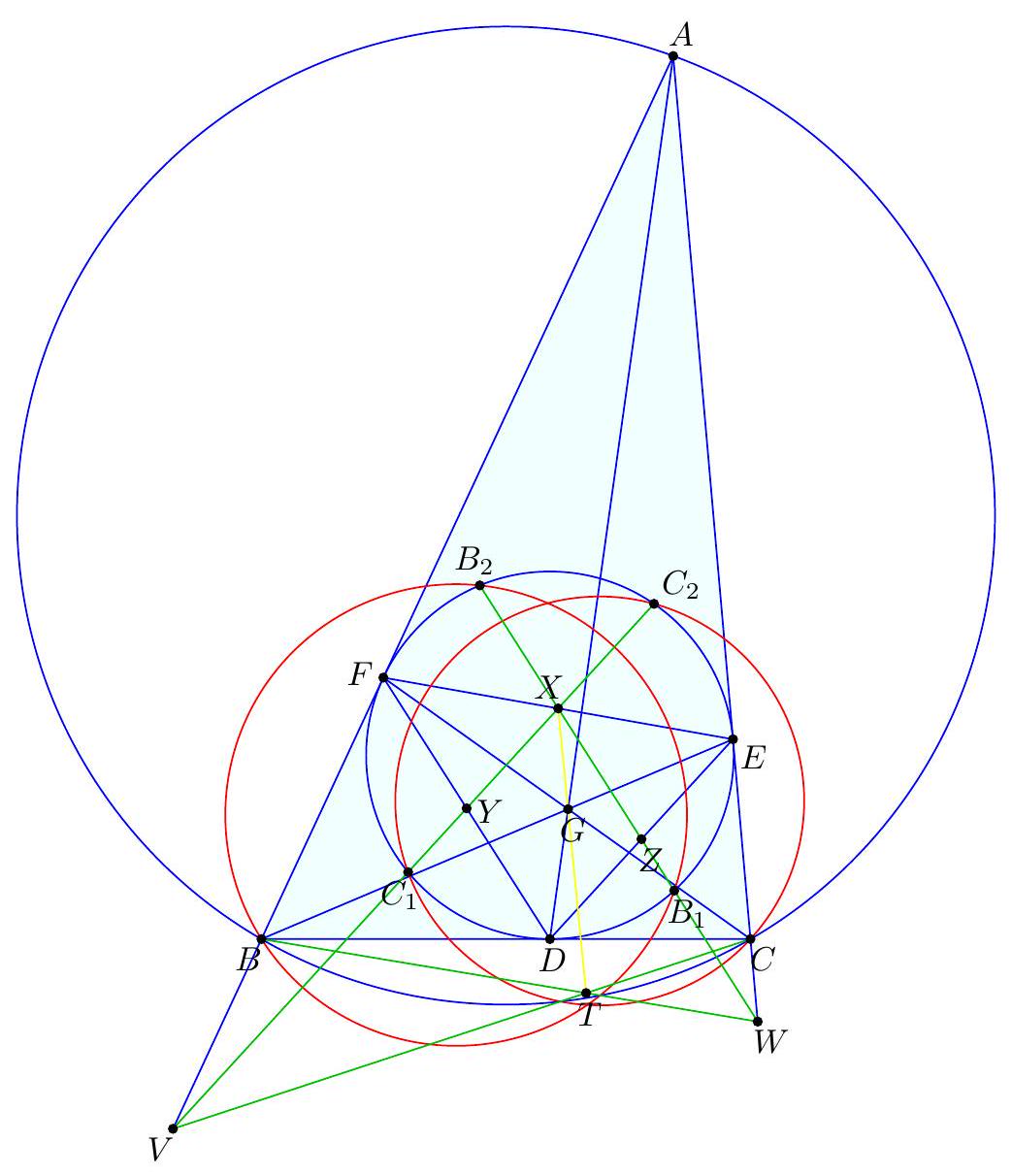
Note $G$ is the symmedian point of $D E F$, so it is well-known that $X G$ passes through the midpoint of $D K$. So we just have to prove $G$ lies on the radical axis.
First, note that $\triangle D E F$ is the cevian triangle of the Gergonne point $G$. Set $V=$ $\overline{X Y} \cap \overline{A B}, W=\overline{X Z} \cap \overline{A C}$, and $T=\overline{B W} \cap \overline{C V}$.
We begin with the following completely projective claim.
Claim - The points $X, G, T$ are collinear.
Proof. It suffices to view $\triangle X Y Z$ as any cevian triangle of $\triangle D E F$ (which is likewise any cevian triangle of $\triangle A B C)$. Then
- By Cevian Nest on $\triangle A B C$, it follows that $\overline{A X}, \overline{B Y}, \overline{C Z}$ are concurrent.
- Hence $\triangle B Y V$ and $\triangle C Z W$ are perspective.
- Hence $\triangle B Z W$ and $\triangle C Y V$ are perspective too.
- Hence we deduce by Desargues theorem that $T, X$, and $\overline{B Z} \cap \overline{C Y}$ are collinear.
- Finally, the Cevian Nest theorem applied on $\triangle G B C$ (which has cevian triangles $\triangle D F E, \triangle X Z Y$ ) we deduce $G, X$, and $\overline{B Z} \cap \overline{C Y}$, proving the claim.
One could also proceed by using barycentric coordinates on $\triangle D E F$.
Remark (Eric Shen). The first four bullets can be replaced by non-projective means: one can check that $\overline{B Z} \cap \overline{C Y}$ is the radical center of $(B I C),\left(B B_{1} B_{2}\right),\left(C C_{1} C_{2}\right)$ and therefore it lies on line $\overline{X T}$.
Now, we contend point $V$ is the radical center $\left(C C_{1} C_{2}\right),(A B C)$ and $(D E F)$. To see this, let $V^{\prime}=\overline{E D} \cap \overline{A B}$; then $\left(F V^{\prime} ; A B\right)$ is harmonic, and $V$ is the midpoint of $\overline{F V^{\prime}}$, and thus $V A \cdot V B=V F^{2}=V C_{1} \cdot V C_{2}$.
So in fact $\overline{C V}$ is the radical axis of $(A B C)$ and $\left(C C_{1} C_{2}\right)$.
Similarly, $\overline{B W}$ is the radical axis of $(A B C)$ and $\left(B B_{1} B_{2}\right)$. Thus $T$ is the radical center of $(A B C),\left(B B_{1} B_{2}\right),\left(C C_{1} C_{2}\right)$.
This completes the proof, as now $\overline{X T}$ is the desired radical axis.
『 Second solution (Evan Chen). As before, we just have to prove $G$ lies on the radical axis.
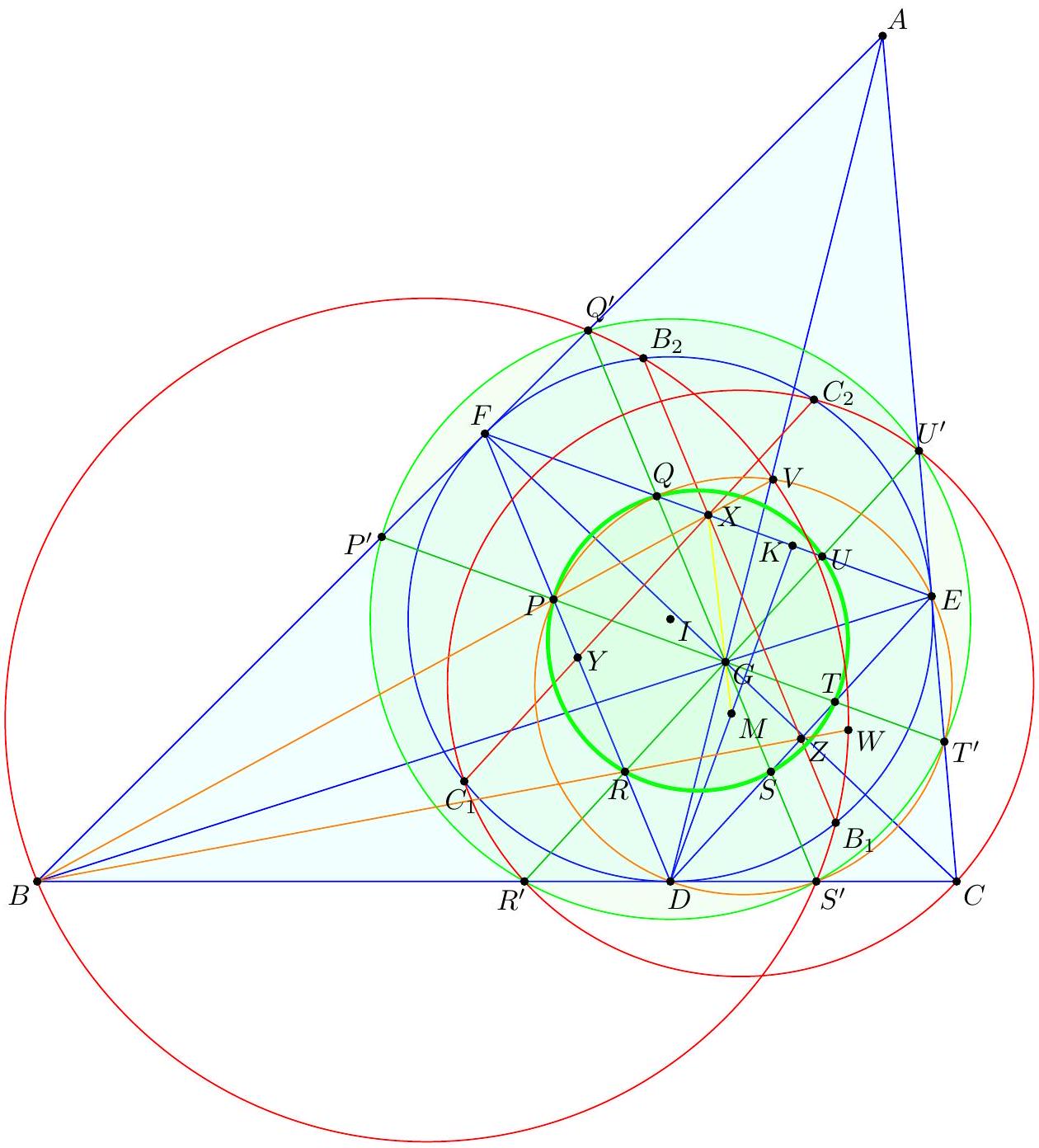
Construct parallelograms $G P F Q, G R D S, G T U E$ such that $P, R \in D F, S, T \in D E$, $Q, U \in E F$. As $F G$ bisects $P Q$ and is isogonal to $F Z$, we find $P Q E D$, hence $P Q R U$, is cyclic. Repeating the same logic and noticing $P R, S T, Q U$ not concurrent, all six points $P Q R S T U$ are cyclic. Moreover, since $P Q$ bisects $G F$, we see that a dilation with factor 2 at $G$ sends $P Q$ to $P^{\prime}, Q^{\prime} \in A B$, say, with $F$ the midpoint of $P^{\prime} Q^{\prime}$. Define $R^{\prime}, S^{\prime} \in B C$ similarly now and $T^{\prime}, U^{\prime} \in C A$.
Note that $E Q P D S^{\prime}$ is in cyclic too, as $\measuredangle D S^{\prime} Q=\measuredangle D R S=\measuredangle D E F$. By homothety through $B$, points $B, P, X$ are collinear; assume they meet ( $\left.E Q P D S^{\prime}\right)$ again at $V$. Thus $E V Q P D S^{\prime}$ is cyclic, and now
$$
\measuredangle B V S^{\prime}=\measuredangle P V S^{\prime}=\measuredangle P Q S=\measuredangle P T S=\measuredangle F E D=\measuredangle X E Z=\measuredangle X V Z
$$
hence $V$ lies on $\left(B Q^{\prime} S^{\prime}\right)$.
Since $F B \| Q P$, we get $E V F B$ is cyclic too, so $X V \cdot X B=X E \cdot X F$ now; thus $X$ lies on the radical axis of $\left(B S^{\prime} Q^{\prime}\right)$ and $(D E F)$. By the same argument with $W \in B Z$, we get $Z$ lies on the radical axis too. Thus the radical axis of $\left(B S^{\prime} Q^{\prime}\right)$ and ( $D E F$ ) must be line $X Z$, which coincides with $B_{1} B_{2}$; so $\left(B B_{1} B_{2}\right)=\left(B S^{\prime} Q^{\prime}\right)$.
Analogously, $\left(C C_{1} C_{2}\right)=\left(C R^{\prime} U^{\prime}\right)$. Since $G=Q^{\prime} S^{\prime} \cap R^{\prime} U^{\prime}$, we need only prove that $Q^{\prime} R^{\prime} S^{\prime} U^{\prime}$ is cyclic. But $Q R S U$ is cyclic, so we are done.
The circle ( $P Q R S T U$ ) is called the Lemoine circle of $A B C$.
|