

File size: 9,251 Bytes
5b52f82 | 1 2 3 4 5 6 7 8 9 10 11 12 13 14 15 16 17 18 19 20 21 22 23 24 25 26 27 28 29 30 31 32 33 34 35 36 37 38 39 40 41 42 43 44 45 46 47 48 49 50 51 52 53 54 55 56 57 58 59 60 61 62 63 64 65 66 67 68 69 70 71 72 73 74 75 76 77 78 79 80 81 82 83 84 85 86 87 88 89 90 91 92 93 94 95 96 97 98 99 100 101 102 103 104 105 106 107 108 109 110 111 112 113 114 115 116 117 118 119 120 121 122 123 124 125 126 127 128 129 130 131 132 133 134 135 136 137 138 139 140 141 142 143 144 145 146 147 148 149 150 151 152 153 154 155 156 157 | Problem 1. Let $n(n \geq 1)$ be an integer. Consider the equation
$$
2 \cdot\left\lfloor\frac{1}{2 x}\right\rfloor-n+1=(n+1)(1-n x)
$$
where $x$ is the unknown real variable.
(a) Solve the equation for $n=8$.
(b) Prove that there exists an integer $n$ for which the equation has at least 2021 solutions. (For any real number $y$ by $\lfloor y\rfloor$ we denote the largest integer $m$ such that $m \leq y$.)
Solution. Let $k=\left[\frac{1}{2 x}\right], k \in \mathbb{Z}$.
(a) For $n=8$, the equation becomes
$$
k=\left[\frac{1}{2 x}\right]=8-36 x \Rightarrow x \neq 0 \text { and } x=\frac{8-k}{36}
$$
Since $x \neq 0$, we have $k \neq 8$, and the last relation implies $k=\left[\frac{1}{2 x}\right]=\left[\frac{18}{8-k}\right]$. Checking signs, we see that $0<k<8$. By direct verification, we find the solutions $k=3$ (hence $x=\frac{5}{36}$ and $k=4$ (hence $x=\frac{1}{9}$ ).
(b) From the given equation we have $x \neq 0$ and $x=\frac{2(n-k)}{n(n+1)}$. Therefore, $k \neq n$ and $k=\left[\frac{1}{2 x}\right]=\left[\frac{n(n+1)}{4(n-k)}\right]$. Again, checking signs we see that $0 \leq k<n$. The last equation implies
$$
\begin{gathered}
k \leq \frac{n(n+1)}{4(n-k)}<k+1 \Rightarrow\left\{\begin{array}{l}
(2 k-n)^{2}+n \geq 0 \\
(2 k+1-n)^{2}<n+1
\end{array} \Rightarrow\right. \\
\quad \Rightarrow \frac{n-1-\sqrt{n+1}}{2}<k<\frac{n-1+\sqrt{n+1}}{2}
\end{gathered}
$$
Conversely, if $k \in \mathbb{Z}$ satisfies (2) and $0<k<n$, then $x=\frac{2(n-k)}{n(n+1}$ is a solution to the given equation. It remains to note that choosing $n$ such that $\sqrt{n+1}>2021$ ensures that there exist at least 2021 integer values of $k$ which satisfy (2).
Problem 2. For any set $A=\left\{x_{1}, x_{2}, x_{3}, x_{4}, x_{5}\right\}$ of five distinct positive integers denote by $S_{A}$ the sum of its elements, and denote by $T_{A}$ the number of triples $(i, j, k)$ with $1 \leqslant i<j<k \leqslant 5$ for which $x_{i}+x_{j}+x_{k}$ divides $S_{A}$.
Find the largest possible value of $T_{A}$.
Solution. We will prove that the maximum value that $T_{A}$ can attain is 4 . Let $A=$ $\left\{x_{1}, x_{2}, x_{3}, x_{4}, x_{5}\right\}$ be a set of five positive integers such that $x_{1}<x_{2}<x_{3}<x_{4}<x_{5}$. Call a triple $(i, j, k)$ with $1 \leqslant i<j<k \leqslant 5$ good if $x_{i}+x_{j}+x_{k}$ divides $S_{A}$. None of the triples $(3,4,5),(2,4,5),(1,4,5),(2,3,5),(1,3,5)$ is good, since, for example
$$
x_{5}+x_{3}+x_{1}\left|S_{A} \Rightarrow x_{5}+x_{3}+x_{1}\right| x_{2}+x_{4}
$$
which is impossible since $x_{5}>x_{4}$ and $x_{3}>x_{2}$. Analogously we can show that any triple of form $(x, y, 5)$ where $y>2$ isn't good.
By above, the number of good triples can be at most 5 and only triples $(1,2,5),(2,3,4)$, $(1,3,4),(1,2,4),(1,2,3)$ can be good. But if triples $(1,2,5)$ and $(2,3,4)$ are simultaneously good we have that:
$$
x_{1}+x_{2}+x_{5} \mid x_{3}+x_{4} \Rightarrow x_{5}<x_{3}+x_{4}
$$
and
$$
x_{2}+x_{3}+x_{4} \mid x_{1}+x_{5} \Rightarrow x_{2}+x_{3}+x_{4} \leqslant x_{1}+x_{5} \stackrel{(1)}{<} x_{1}+x_{3}+x_{4}<x_{2}+x_{3}+x_{4},
$$
which is impossible. Therefore, $T_{A} \leqslant 4$.
Alternatively, one can prove the statement above by adding up the two inequalities $x_{1}+x_{2}+x_{4}<x_{3}+x_{4}$ and $x_{2}+x_{3}+x_{4}<x_{1}+x_{5}$ that are derived from the divisibilities.
To show that $T_{A}=4$ is possible, consider the numbers $1,2,3,4,494$. This works because $6|498,7| 497,8 \mid 496$, and $9 \mid 495$.
Remark. The motivation for construction is to realize that if we choose $x_{1}, x_{2}, x_{3}, x_{4}$ we can get all the conditions $x_{5}$ must satisfy. Let $S=x_{1}+x_{2}+x_{3}+x_{4}$. Now we have to choose $x_{5}$ such that
$$
S-x_{i} \mid x_{i}+x_{5} \text {, i.e. } x_{5} \equiv-x_{i} \quad \bmod \left(S-x_{i}\right) \forall i \in\{1,2,3,4\}
$$
By the Chinese Remainder Theorem it is obvious that if $S-x_{1}, S-x_{2}, S-x_{3}, S-x_{4}$ are pairwise coprime, such $x_{5}$ must exist. To make all these numbers pairwise coprime it's natural to take $x_{1}, x_{2}, x_{3}, x_{4}$ to be all odd and then solve mod 3 issues. Fortunately it can be seen that $1,5,7,11$ easily works because $13,17,19,23$ are pairwise coprime.
However, even without the knowledge of this theorem it makes sense intuitively that this system must have a solution for some $x_{1}, x_{2}, x_{3}, x_{4}$. By taking $\left(x_{1}, x_{2}, x_{3}, x_{4}\right)=$ $(1,2,3,4)$ we get pretty simple system which can be solved by hand rather easily.
Problem 3. Let $A B C$ be an acute scalene triangle with circumcenter $O$. Let $D$ be the foot of the altitude from $A$ to the side $B C$. The lines $B C$ and $A O$ intersect at $E$. Let $s$ be the line through $E$ perpendicular to $A O$. The line $s$ intersects $A B$ and $A C$ at $K$ and $L$, respectively. Denote by $\omega$ the circumcircle of triangle $A K L$. Line $A D$ intersects $\omega$ again at $X$.
Prove that $\omega$ and the circumcircles of triangles $A B C$ and $D E X$ have a common point.
## Solution.
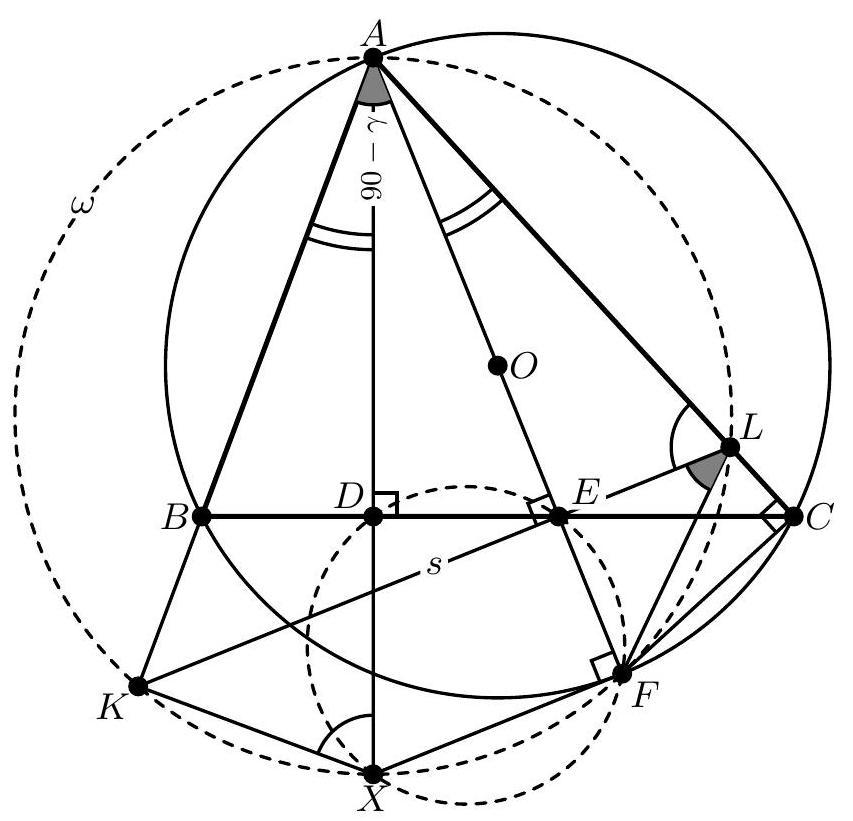
Let us denote angles of triangle $A B C$ with $\alpha, \beta, \gamma$ in a standard way. By basic anglechasing we have
$$
\angle B A D=90^{\circ}-\beta=\angle O A C \text { and } \angle C A D=\angle B A O=90^{\circ}-\gamma
$$
Using the fact that lines $A E$ and $A X$ are isogonal with respect to $\angle K A L$ we can conclude that $X$ is an $A$-antipode on $\omega$. (This fact can be purely angle-chased: we have
$$
\angle K A X+\angle A X K=\angle K A X+\angle A L K=90^{\circ}-\beta+\beta=90^{\circ}
$$
which implies $\angle A K X=90^{\circ}$ ). Now let $F$ be the projection of $X$ on the line $A E$. Using that $A X$ is a diameter of $\omega$ and $\angle E D X=90^{\circ}$ it's clear that $F$ is the intersection point of $\omega$ and the circumcircle of triangle $D E X$. Now it suffices to show that $A B F C$ is cyclic. We have $\angle K L F=\angle K A F=90^{\circ}-\gamma$ and from $\angle F E L=90^{\circ}$ we have that $\angle E F L=\gamma=\angle E C L$ so quadrilateral $E F C L$ is cyclic. Next, we have
$$
\angle A F C=\angle E F C=180^{\circ}-\angle E L C=\angle E L A=\beta
$$
(where last equality holds because of $\angle A E L=90^{\circ}$ and $\angle E A L=90^{\circ}-\beta$ ).
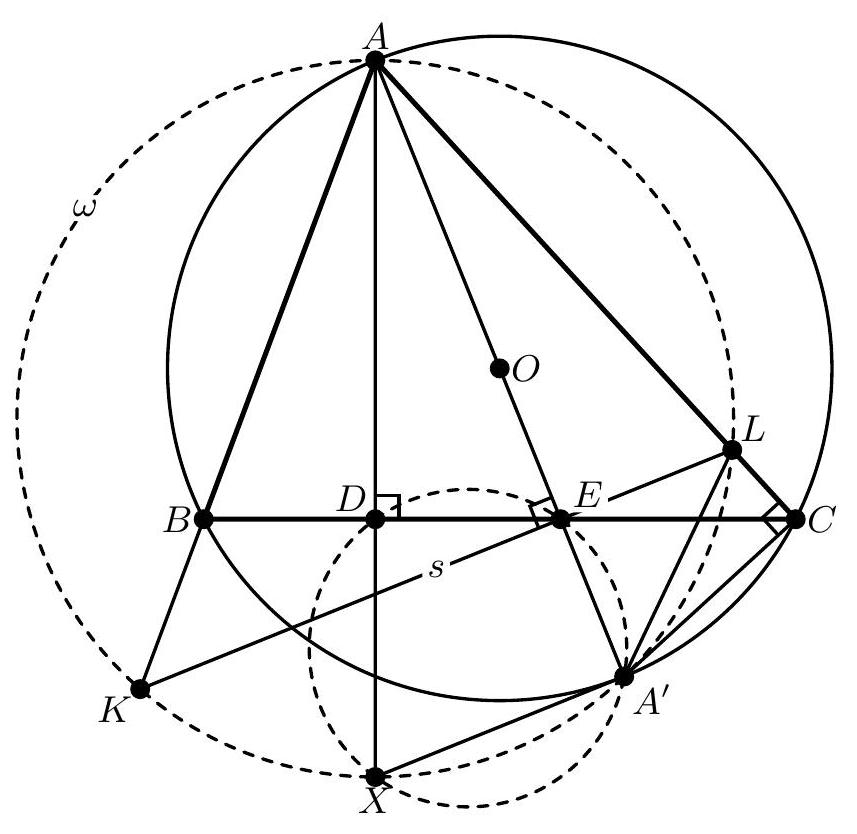
Solution 2. We have $\angle B A D=90^{\circ}-\beta=\angle O A C$ and that $A X$ is the diameter of $\omega$. Also we note that
$$
\angle A L K=\beta, \angle K L C=180^{\circ}-\beta=\angle K B C
$$
so $B K C L$ is cyclic. Let $A O$ intersect circumcircle of $A B C$ again at $A^{\prime}$. We will show that $A^{\prime}$ is the desired concurrence point. Obviously $A A^{\prime}$ is the diameter of circumcircle of triangle $A B C$ so $\angle A^{\prime} C A=90^{\circ}$ which implies that $A^{\prime} C L E$ is cyclic. From power of point $E$ we have that $E K \cdot E L=E B \cdot E C=E A \cdot E A^{\prime}$ so we can conclude that $A^{\prime} \in \omega$. Now using the fact that $A X$ is a diameter of $\omega$ implies $\angle A X A^{\prime}=90^{\circ}$ we have that $D X A^{\prime} E$ is cyclic because of $\angle E D X=90^{\circ}$ which finishes the proof. $\square$
Problem 4. Let $M$ be a subset of the set of 2021 integers $\{1,2,3, \ldots, 2021\}$ such that for any three elements (not necessarily distinct) $a, b, c$ of $M$ we have $|a+b-c|>10$. Determine the largest possible number of elements of $M$.
Solution. The set $M=\{1016,1017, \ldots, 2021\}$ has 1006 elements and satisfies the required property, since $a, b, c \in M$ implies that $a+b-c \geqslant 1016+1016-2021=11$. We will show that this is optimal.
Suppose $M$ satisfies the condition in the problem. Let $k$ be the minimal element of $M$. Then $k=|k+k-k|>10 \Rightarrow k \geqslant 11$. Note also that for every $m$, the integers $m, m+k-10$ cannot both belong to $M$, since $k+m-(m+k-10)=10$.
Claim 1: $M$ contains at most $k-10$ out of any $2 k-20$ consecutive integers.
Proof: We can partition the set $\{m, m+1, \ldots, m+2 k-21\}$ into $k-10$ pairs as follows:
$$
\{m, m+k-10\},\{m+1, m+k-9\}, \ldots,\{m+k-11, m+2 k-21\}
$$
It remains to note that $M$ can contain at most one element of each pair.
Claim 2: $M$ contains at most $[(t+k-10) / 2]$ out of any $t$ consecutive integers.
Proof: Write $t=q(2 k-20)+r$ with $r \in\{0,1,2 \ldots, 2 k-21\}$. From the set of the first $q(2 k-20)$ integers, by Claim 1 at most $q(k-10)$ can belong to $M$. Also by claim 1, it follows that from the last $r$ integers, at $\operatorname{most} \min \{r, k-10\}$ can belong to $M$.
Thus,
- If $r \leqslant k-10$, then at most
$$
q(k-10)+r=\frac{t+r}{2} \leqslant \frac{t+k-10}{2} \text { integers belong to } M
$$
- If $r>k-10$, then at most
$$
q(k-10)+k-10=\frac{t-r+2(k-10)}{2} \leqslant \frac{t+k-10}{2} \text { integers belong to } M
$$
By Claim 2, the number of elements of $M$ amongst $k+1, k+2, \ldots, 2021$ is at most
$$
\left[\frac{(2021-k)+(k-10)}{2}\right]=1005
$$
Since amongst $\{1,2, \ldots, k\}$ only $k$ belongs to $M$, we conclude that $M$ has at most 1006 elements as claimed.
|