

File size: 8,522 Bytes
5b52f82 | 1 2 3 4 5 6 7 8 9 10 11 12 13 14 15 16 17 18 19 20 21 22 23 24 25 26 27 28 29 30 31 32 33 34 35 36 37 38 39 40 41 42 43 44 45 46 47 48 49 50 51 52 53 54 55 56 57 58 59 60 61 62 63 64 65 66 67 68 69 70 71 72 73 74 75 76 77 78 79 80 81 82 83 84 85 86 87 88 89 90 91 92 93 94 95 96 97 98 99 100 101 102 103 104 105 106 107 108 109 110 111 112 113 114 115 116 117 118 119 120 121 122 123 124 125 126 127 128 129 130 131 132 133 134 135 136 137 138 139 140 141 142 143 144 145 146 147 148 149 150 151 152 153 154 155 156 157 158 159 160 | 
Solutions of JBMO 2012
Wednesday, June 27, 2012
# Problem 1
Let $a, b$ and $c$ be positive real numbers such that $a+b+c=1$. Prove that
$$
\frac{a}{b}+\frac{b}{a}+\frac{b}{c}+\frac{c}{b}+\frac{c}{a}+\frac{a}{c}+6 \geq 2 \sqrt{2}\left(\sqrt{\frac{1-a}{a}}+\sqrt{\frac{1-b}{b}}+\sqrt{\frac{1-c}{c}}\right)
$$
When does equality hold?
## Solution
Replacing $1-a, 1-b, 1-c$ with $b+c, c+a, a+b$ respectively on the right hand side, the given inequality becomes

and equivalently
$$
\left(\frac{b+c}{a}-2 \sqrt{2} \sqrt{\frac{b+c}{a}}+2\right)+\left(\frac{c+a}{b}-2 \sqrt{2} \sqrt{\frac{c+a}{b}}+2\right)+\left(\frac{a+b}{c}-2 \sqrt{2} \sqrt{\frac{a+b}{c}}+2\right) \geq 0
$$
which can be written as
$$
\left(\sqrt{\frac{b+c}{a}}-\sqrt{2}\right)^{2}+\left(\sqrt{\frac{c+a}{b}}-\sqrt{2}\right)^{2}+\left(\sqrt{\frac{a+b}{c}}-\sqrt{2}\right)^{2} \geq 0
$$
which is true.
The equality holds if and only if
$$
\frac{b+c}{a}=\frac{c+a}{b}=\frac{a+b}{c}
$$
which together with the given condition $a+b+c=1$ gives $a=b=c=\frac{1}{3}$.
## Problem 2
Let the circles $k_{1}$ and $k_{2}$ intersect at two distinct points $A$ and $B$, and let $t$ be a common tangent of $k_{1}$ and $k_{2}$, that touches $k_{1}$ and $k_{2}$ at $M$ and $N$, respectively. If $t \perp A M$ and $M N=2 A M$, evaluate $\angle N M B$.
## Solution 1
Let $P$ be the symmetric of $A$ with respect to $M$ (Figure 1). Then $A M=M P$ and $t \perp A P$, hence the triangle $A P N$ is isosceles with $A P$ as its base, so $\angle N A P=\angle N P A$. We have $\angle B A P=\angle B A M=\angle B M N$ and $\angle B A N=\angle B N M$.
Thus we have
$$
180^{\circ}-\angle N B M=\angle B N M+\angle B M N=\angle B A N+\angle B A P=\angle N A P=\angle N P A
$$
so the quadrangle $M B N P$ is cyclic (since the points $B$ and $P$ lie on different sides of $M N$ ). Hence $\angle A P B=\angle M P B=\angle M N B$ and the triangles $A P B$ and $M N B$ are congruent ( $M N=2 A M=A M+M P=A P$ ). From that we get $A B=M B$, i.e. the triangle $A M B$ is isosceles, and since $t$ is tangent to $k_{1}$ and perpendicular to $A M$, the centre of $k_{1}$ is on $A M$, hence $A M B$ is a right-angled triangle. From the last two statements we infer $\angle A M B=45^{\circ}$, and so $\angle N M B=90^{\circ}-\angle A M B=45^{\circ}$.
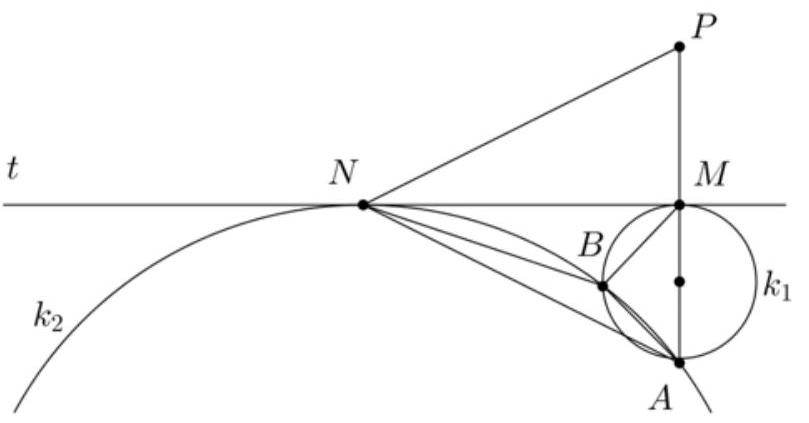
Figure 1
## Solution 2
Let $C$ be the common point of $M N, A B$ (Figure 2). Then $C N^{2}=C B \cdot C A$ and $C M^{2}=C B \cdot C A$. So $C M=C N$. But $M N=2 A M$, so $C M=C N=A M$, thus the right triangle $A C M$ is isosceles, hence $\angle N M B=\angle C M B=\angle B C M=45^{\circ}$.
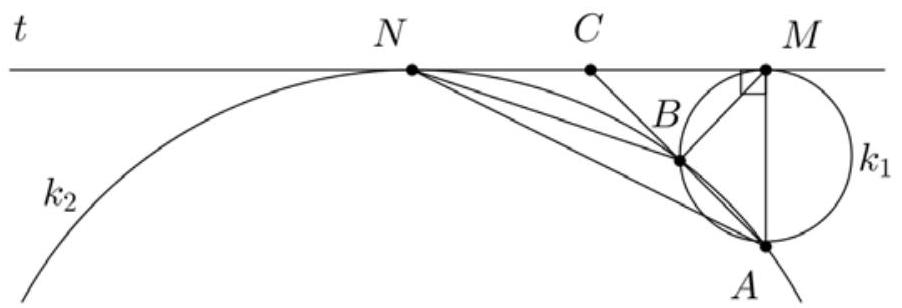
Figure 2
## Problem 3
On a board there are $n$ nails each two connected by a string. Each string is colored in one of $n$ given distinct colors. For each three distinct colors, there exist three nails connected with strings in these three colors. Can $n$ be
a) 6 ?
b) 7 ?
Solution. (a) The answer is no.
Suppose it is possible. Consider some color, say blue. Each blue string is the side of 4 triangles formed with vertices on the given points. As there exist $\binom{5}{2}=\frac{5 \cdot 4}{2}=10$ pairs of colors other than blue, and for any such pair of colors together with the blue color there exists a triangle with strings in these colors, we conclude that there exist at least 3 blue strings (otherwise the number of triangles with a blue string as a side would be at most $2 \cdot 4=8$, a contradiction). The same is true for any color, so altogether there exist at least $6 \cdot 3=18$ strings, while we have just $\binom{6}{2}=\frac{6 \cdot 5}{2}=15$ of them.
(b) The answer is yes
Put the nails at the vertices of a regular 7-gon and color each one of its sides in a different color. Now color each diagonal in the color of the unique side parallel to it. It can be checked directly that each triple of colors appears in some triangle (because of symmetry, it is enough to check only the triples containing the first color).
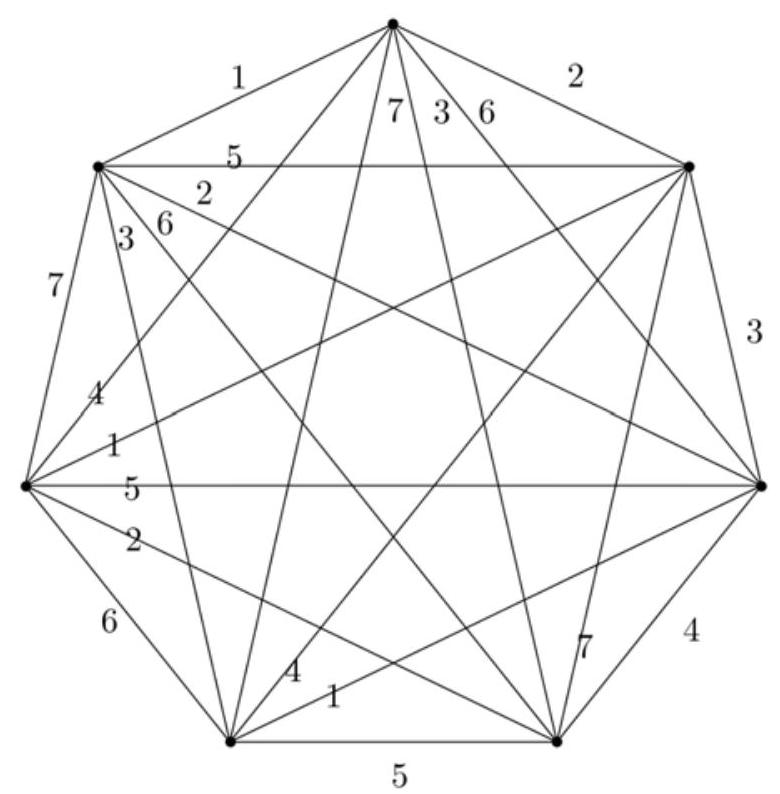
Remark. The argument in (a) can be applied to any even n. The argument in (b) can be applied to any odd $n=2 k+1$ as follows: first number the nails as $0,1,2 \ldots, 2 k$ and similarly number the colors as $0,1,2 \ldots, 2 k$. Then connect nail $x$ with nail $y$ by a string of color $x+y(\bmod n)$. For each triple of colors $(p, q, r)$ there are vertices $x, y, z$ connected by these three colors. Indeed, we need to solve $(\bmod n)$ the system
$$
(*)(x+y \equiv p, x+z \equiv q, y+z \equiv r)
$$
Adding all three, we get $2(x+y+z) \equiv p+q+r$ and multiplying by $k+1$ we get $x+y+z \equiv(k+1)(p+q+r)$. We can now find $x, y, z$ from the identities $(*)$.
## Problem 4
Find all positive integers $x, y, z$ and $t$ such that
$$
2^{x} \cdot 3^{y}+5^{z}=7^{t}
$$
## Solution
Reducing modulo 3 we get $5^{z} \equiv 1$, therefore $z$ is even, $z=2 c, c \in \mathbb{N}$.
Next we prove that $t$ is even:
Obviously, $t \geq 2$. Let us suppose that $t$ is odd, say $t=2 d+1, d \in \mathbb{N}$. The equation becomes $2^{x} \cdot 3^{y}+25^{c}=7 \cdot 49^{d}$. If $x \geq 2$, reducing modulo 4 we get $1 \equiv 3$, a contradiction. And if $x=1$, we have $2 \cdot 3^{y}+25^{c}=7 \cdot 49^{d}$ and reducing modulo 24 we obtain
$$
2 \cdot 3^{y}+1 \equiv 7 \Rightarrow 24 \mid 2\left(3^{y}-3\right) \text {, i.e. } 4 \mid 3^{y-1}-1
$$
which means that $y-1$ is even. Then $y=2 b+1, b \in \mathbb{N}$. We obtain $6 \cdot 9^{b}+25^{c}=7 \cdot 49^{d}$, and reducing modulo 5 we get $(-1)^{b} \equiv 2 \cdot(-1)^{d}$, which is false for all $b, d \in \mathbb{N}$. Hence $t$ is even, $t=2 d, d \in \mathbb{N}$, as claimed.
Now the equation can be written as
$$
2^{x} \cdot 3^{y}+25^{d}=49^{d} \Leftrightarrow 2^{x} \cdot 3^{y}=\left(7^{d}-5^{c}\right)\left(7^{d}+5^{c}\right)
$$
As $\operatorname{gcd}\left(7^{d}-5^{c}, 7^{d}+5^{c}\right)=2$ and $7^{d}+5^{c}>2$, there exist exactly three possibilities:
(1) $\left\{\begin{array}{l}7^{\mathrm{d}}-5^{\mathrm{d}}=2^{\mathrm{x-1}} \\ 7^{\mathrm{d}}+5^{\mathrm{d}}=2 \cdot 3^{y}\end{array} ;\right.$
(2) $\left\{\begin{array}{l}7^{\mathrm{d}}-5^{\mathrm{d}}=2 \cdot 3^{\mathrm{y}} \\ 7^{\mathrm{d}}+5^{\mathrm{d}}=2^{\mathrm{x-1}}\end{array}\right.$;
(3) $\left\{\begin{array}{l}7^{d}-5^{d}=2 \\ 7^{d}+5^{d}=2^{x-1} \cdot 3^{y}\end{array}\right.$
## Case (1)
We have $7^{d}=2^{x-2}+3^{y}$ and reducing modulo 3 , we get $2^{x-2} \equiv 1(\bmod 3)$, hence $x-2$ is even, i.e. $x=2 a+2, a \in \mathbb{N}$, where $a>0$, since $a=0$ would mean $3^{y}+1=7^{d}$, which is impossible (even $=$ odd).
We obtain
$$
7^{d}-5^{d}=2 \cdot 4^{a} \stackrel{\bmod 4}{\Rightarrow} 7^{d} \equiv 1(\bmod 4) \Rightarrow d=2 e, e \in \mathbb{N}
$$
Then we have
$$
49^{e}-5^{d}=2 \cdot 4^{a} \stackrel{\bmod 8}{\Rightarrow} 5^{c} \equiv 1(\bmod 8) \Rightarrow c=2 f, f \in \mathbb{N}
$$
We obtain $49^{e}-25^{f}=2 \cdot 4^{a} \stackrel{\text { mod } 3}{\Rightarrow} 0 \equiv 2(\bmod 3)$, false. In conclusion, in this case there are no solutions to the equation.
## Case (2)
From $2^{x-1}=7^{d}+5^{c} \geq 12$ we obtain $x \geq 5$. Then $7^{d}+5^{c} \equiv 0(\bmod 4)$, i.e. $3^{d}+1 \equiv 0(\bmod 4)$, hence $d$ is odd. As $7^{d}=5^{c}+2 \cdot 3^{y} \geq 11$, we get $d \geq 2$, hence $d=2 e+1, e \in \mathbb{N}$.
As in the previous case, from $7^{d}=2^{x-2}+3^{y}$ reducing modulo 3 we obtain $x=2 a+2$ with $a \geq 2$ (because $x \geq 5$ ). We get $7^{d}=4^{a}+3^{y}$ i.e. $7 \cdot 49^{e}=4^{a}+3^{y}$, hence, reducing modulo 8 we obtain $7 \equiv 3^{y}$ which is false, because $3^{y}$ is congruent either to 1 (if $y$ is even) or to 3 (if $y$ is odd). In conclusion, in this case there are no solutions to the equation.
## Case (3)
From $7^{d}=5^{c}+2$ it follows that the last digit of $7^{d}$ is 7 , hence $d=4 k+1, k \in \mathbb{N}$.
If $c \geq 2$, from $7^{4 k+1}=5^{c}+2$ reducing modulo 25 we obtain $7 \equiv 2(\bmod 25)$ which is false. For $c=1$ we get $d=1$ and the solution $x=3, y=1, z=t=2$.
|