

File size: 9,426 Bytes
5b52f82 | 1 2 3 4 5 6 7 8 9 10 11 12 13 14 15 16 17 18 19 20 21 22 23 24 25 26 27 28 29 30 31 32 33 34 35 36 37 38 39 40 41 42 43 44 45 46 47 48 49 50 51 52 53 54 55 56 57 58 59 60 61 62 63 64 65 66 67 68 69 70 71 72 73 74 75 76 77 78 79 80 81 82 83 84 85 86 87 88 89 90 91 92 93 94 95 96 97 98 99 100 101 102 103 104 105 106 107 108 109 110 111 112 113 114 115 116 117 118 119 120 121 122 123 124 125 126 127 128 129 130 131 132 133 134 135 136 137 138 139 140 141 142 143 144 145 146 147 148 149 150 151 152 153 154 155 156 157 158 159 160 161 162 163 164 165 166 167 168 169 170 171 172 173 174 175 176 177 178 179 180 181 182 183 184 185 186 187 188 189 190 191 192 193 194 195 196 197 198 199 200 201 202 203 204 205 206 207 208 209 210 211 212 213 214 215 216 217 218 219 220 221 222 223 224 225 226 227 228 229 230 231 232 233 234 235 236 237 238 239 240 241 242 243 244 245 246 247 248 249 | Problem 1. Find all triples $(a, b, c)$ of real numbers such that the following system holds:
$$
\left\{\begin{array}{l}
a+b+c=\frac{1}{a}+\frac{1}{b}+\frac{1}{c} \\
a^{2}+b^{2}+c^{2}=\frac{1}{a^{2}}+\frac{1}{b^{2}}+\frac{1}{c^{2}}
\end{array}\right.
$$
Solution. First of all if $(a, b, c)$ is a solution of the system then also $(-a,-b,-c)$ is a solution. Hence we can suppose that $a b c>0$. From the first condition we have
$$
a+b+c=\frac{a b+b c+c a}{a b c}
$$
Now, from the first condition and the second condition we get
$$
(a+b+c)^{2}-\left(a^{2}+b^{2}+c^{2}\right)=\left(\frac{1}{a}+\frac{1}{b}+\frac{1}{c}\right)^{2}-\left(\frac{1}{a^{2}}+\frac{1}{b^{2}}+\frac{1}{c^{2}}\right)
$$
The last one simplifies to
$$
a b+b c+c a=\frac{a+b+c}{a b c}
$$
First we show that $a+b+c$ and $a b+b c+c a$ are different from 0 . Suppose on contrary then from relation (1) or (2) we have $a+b+c=a b+b c+c a=0$. But then we would have
$$
a^{2}+b^{2}+c^{2}=(a+b+c)^{2}-2(a b+b c+c a)=0
$$
which means that $a=b=c=0$. This is not possible since $a, b, c$ should be different from 0 . Now multiplying (1) and (2) we have
$$
(a+b+c)(a b+b c+c a)=\frac{(a+b+c)(a b+b c+c a)}{(a b c)^{2}}
$$
Since $a+b+c$ and $a b+b c+c a$ are different from 0 , we get $(a b c)^{2}=1$ and using the fact that $a b c>0$ we obtain that $a b c=1$. So relations (1) and (2) transform to
$$
a+b+c=a b+b c+c a .
$$
Therefore,
$$
(a-1)(b-1)(c-1)=a b c-a b-b c-c a+a+b+c-1=0 \text {. }
$$
This means that at least one of the numbers $a, b, c$ is equal to 1 . Suppose that $c=1$ then relations (1) and (2) transform to $a+b+1=a b+a+b \Rightarrow a b=1$. Taking $a=t$ then we have $b=\frac{1}{t}$. We can now verify that any triple $(a, b, c)=\left(t, \frac{1}{t}, 1\right)$ satisfies both conditions. $t \in \mathbb{R} \backslash\{0\}$. From the initial observation any triple $(a, b, c)=\left(t, \frac{1}{t},-1\right)$ satisfies both conditions. $t \in \mathbb{R} \backslash\{0\}$. So, all triples that satisfy both conditions are $(a, b, c)=\left(t, \frac{1}{t}, 1\right),\left(t, \frac{1}{t},-1\right)$ and all permutations for any $t \in \mathbb{R} \backslash\{0\}$.
Comment by PSC. After finding that $a b c=1$ and
$$
a+b+c=a b+b c+c a
$$
we can avoid the trick considering $(a-1)(b-1)(c-1)$ as follows. By the Vieta's relations we have that $a, b, c$ are roots of the polynomial
$$
P(x)=x^{3}-s x^{2}+s x-1
$$
which has one root equal to 1 . Then, we can conclude as in the above solution.
Problem 2. Let $\triangle A B C$ be a right-angled triangle with $\angle B A C=90^{\circ}$ and let $E$ be the foot of the perpendicular from $A$ on $B C$. Let $Z \neq A$ be a point on the line $A B$ with $A B=B Z$. Let (c) be the circumcircle of the triangle $\triangle A E Z$. Let $D$ be the second point of intersection of $(c)$ with $Z C$ and let $F$ be the antidiametric point of $D$ with respect to (c). Let $P$ be the point of intersection of the lines $F E$ and $C Z$. If the tangent to (c) at $Z$ meets $P A$ at $T$, prove that the points $T, E, B, Z$ are concyclic.
Solution. We will first show that $P A$ is tangent to $(c)$ at $A$.
Since $E, D, Z, A$ are concyclic, then $\angle E D C=\angle E A Z=\angle E A B$. Since also the triangles $\triangle A B C$ and $\triangle E B A$ are similar, then $\angle E A B=\angle B C A$, therefore $\angle E D C=\angle B C A$.
Since $\angle F E D=90^{\circ}$, then $\angle P E D=90^{\circ}$ and so
$$
\angle E P D=90^{\circ}-\angle E D C=90^{\circ}-\angle B C A=\angle E A C
$$
Therefore the points $E, A, C, P$ are concyclic. It follows that $\angle C P A=90^{\circ}$ and therefore the triangle $\angle P A Z$ is right-angled. Since also $B$ is the midpoint of $A Z$, then $P B=A B=B Z$ and so $\angle Z P B=$ $\angle P Z B$.
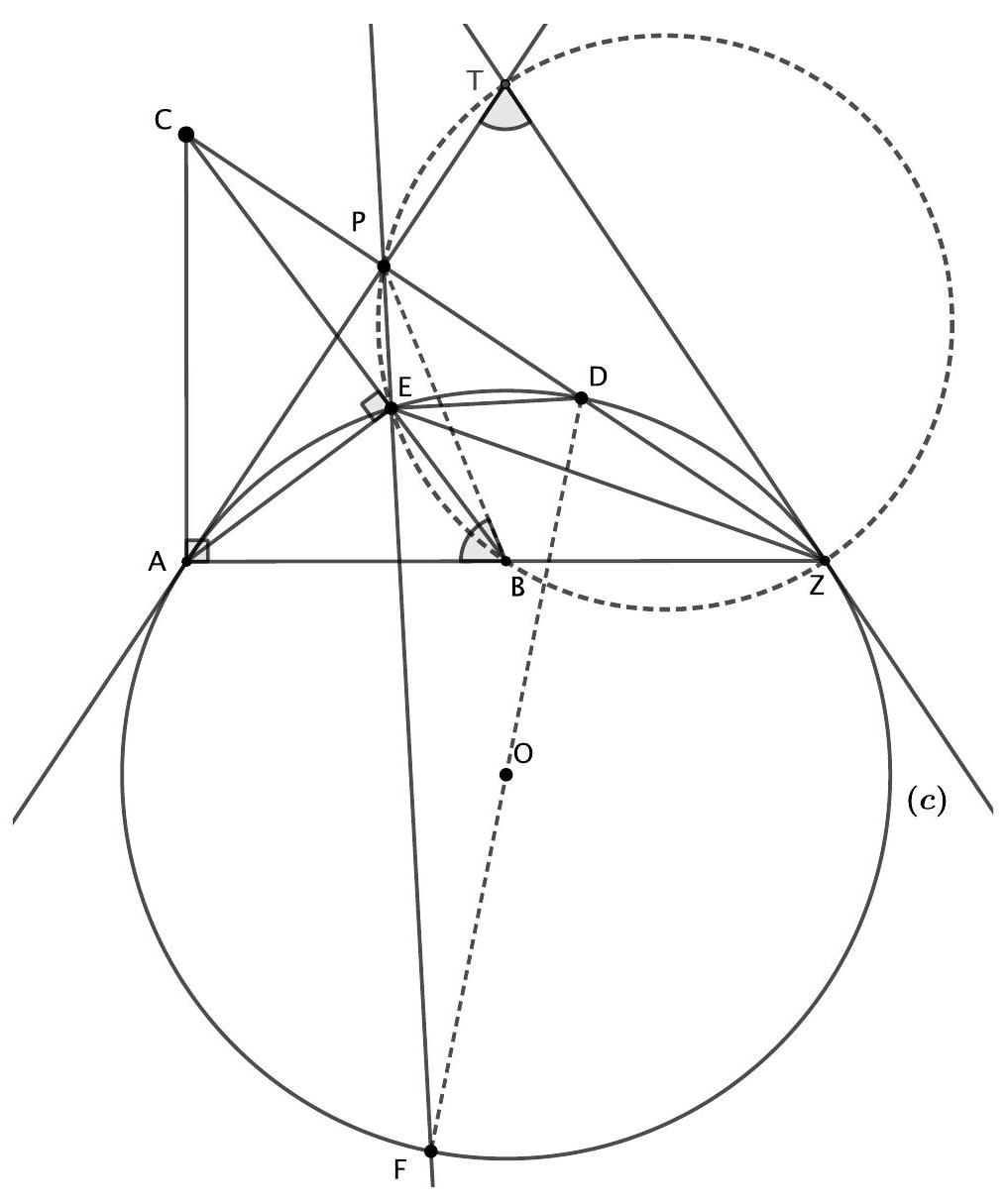
Furthermore, $\angle E P D=\angle E A C=\angle C B A=\angle E B A$ from which it follows that the points $P, E, B, Z$ are also concyclic.
Now observe that
$$
\angle P A E=\angle P C E=\angle Z P B-\angle P B E=\angle P Z B-\angle P Z E=\angle E Z B
$$
Therefore $P A$ is tangent to $(c)$ at $A$ as claimed.
It now follows that $T A=T Z$. Therefore
$$
\begin{aligned}
\angle P T Z & =180^{\circ}-2(\angle T A B)=180^{\circ}-2(\angle P A E+\angle E A B)=180^{\circ}-2(\angle E C P+\angle A C B) \\
& =180^{\circ}-2\left(90^{\circ}-\angle P Z B\right)=2(\angle P Z B)=\angle P Z B+\angle B P Z=\angle P B A .
\end{aligned}
$$
Thus $T, P, B, Z$ are concyclic, and since $P, E, B, Z$ are also concyclic then $T, E, B, Z$ are concyclic as required.
Problem 3. Alice and Bob play the following game: Alice picks a set $A=\{1,2, \ldots, n\}$ for some natural number $n \geqslant 2$. Then starting with Bob, they alternatively choose one number from the set $A$, according to the following conditions: initially Bob chooses any number he wants, afterwards the number chosen at each step should be distinct from all the already chosen numbers, and should differ by 1 from an already chosen number. The game ends when all numbers from the set $A$ are chosen. Alice wins if the sum of all of the numbers that she has chosen is composite. Otherwise Bob wins. Decide which player has a winning strategy.
Solution. To say that Alice has a winning strategy means that she can find a number $n$ to form the set A, so that she can respond appropriately to all choices of Bob and always get at the end a composite number for the sum of her choices. If such $n$ does not exist, this would mean that Bob has a winning strategy instead.
Alice can try first to check the small values of $n$. Indeed, this gives the following winning strategy for her: she initially picks $n=8$ and responds to all possible choices made by Bob as in the list below (in each row the choices of Bob and Alice are given alternatively, starting with Bob):
$\begin{array}{llllllll}1 & 2 & 3 & 4 & 5 & 6 & 7 & 8\end{array}$
$\begin{array}{llllllll}2 & 3 & 1 & 4 & 5 & 6 & 7 & 8\end{array}$
$\begin{array}{llllllll}2 & 3 & 4 & 1 & 5 & 6 & 7 & 8\end{array}$
$\begin{array}{llllllll}3 & 2 & 1 & 4 & 5 & 6 & 7 & 8\end{array}$
$\begin{array}{llllllll}3 & 2 & 4 & 5 & 1 & 6 & 7 & 8\end{array}$
$\begin{array}{llllllll}3 & 2 & 4 & 5 & 6 & 1 & 7 & 8\end{array}$
$\begin{array}{llllllll}4 & 5 & 3 & 6 & 2 & 1 & 7 & 8\end{array}$
$\begin{array}{llllllll}4 & 5 & 3 & 6 & 7 & 8 & 2 & 1\end{array}$
$\begin{array}{llllllll}4 & 5 & 6 & 7 & 3 & 2 & 1 & 8\end{array}$
$\begin{array}{llllllll}4 & 5 & 6 & 7 & 3 & 2 & 8 & 1\end{array}$
$\begin{array}{llllllll}4 & 5 & 6 & 7 & 8 & 3 & 2 & 1\end{array}$
$\begin{array}{llllllll}5 & 4 & 3 & 2 & 1 & 6 & 7 & 8\end{array}$
$\begin{array}{llllllll}5 & 4 & 3 & 2 & 6 & 7 & 1 & 8\end{array}$
$\begin{array}{llllllll}5 & 4 & 3 & 2 & 6 & 7 & 8 & 1\end{array}$
$\begin{array}{llllllll}5 & 4 & 6 & 3 & 2 & 1 & 7 & 8\end{array}$
$\begin{array}{llllllll}5 & 4 & 6 & 3 & 7 & 8 & 2 & 1\end{array}$
$\begin{array}{llllllll}6 & 7 & 5 & 4 & 3 & 8 & 2 & 1\end{array}$
$\begin{array}{llllllll}6 & 7 & 5 & 4 & 8 & 3 & 2 & 1\end{array}$
$\begin{array}{llllllll}6 & 7 & 8 & 5 & 4 & 3 & 2 & 1\end{array}$
$\begin{array}{llllllll}7 & 6 & 8 & 5 & 4 & 3 & 2 & 1\end{array}$
$\begin{array}{llllllll}7 & 6 & 5 & 8 & 4 & 3 & 2 & 1\end{array}$
$\begin{array}{llllllll}8 & 7 & 6 & 5 & 4 & 3 & 2 & 1\end{array}$
In all cases, Alice's sum is either an even number greater than 2 , or else 15 or 21 , thus Alice always wins.
Problem 4. Find all pairs $(p, q)$ of prime numbers such that
$$
1+\frac{p^{q}-q^{p}}{p+q}
$$
is a prime number.
Solution. It is clear that $p \neq q$. We set
$$
1+\frac{p^{q}-q^{p}}{p+q}=r
$$
and we have that
$$
p^{q}-q^{p}=(r-1)(p+q)
$$
From Fermat's Little Theorem we have
$$
p^{q}-q^{p} \equiv-q \quad(\bmod p)
$$
Since we also have that
$$
(r-1)(p+q) \equiv-r q-q \quad(\bmod p)
$$
from (3) we get that
$$
r q \equiv 0 \quad(\bmod p) \Rightarrow p \mid q r
$$
hence $p \mid r$, which means that $p=r$. Therefore, (3) takes the form
$$
p^{q}-q^{p}=(p-1)(p+q)
$$
We will prove that $p=2$. Indeed, if $p$ is odd, then from Fermat's Little Theorem we have
$$
p^{q}-q^{p} \equiv p \quad(\bmod q)
$$
and since
$$
(p-1)(p+q) \equiv p(p-1) \quad(\bmod q)
$$
we have
$$
p(p-2) \equiv 0 \quad(\bmod q) \Rightarrow q|p(p-2) \Rightarrow q| p-2 \Rightarrow q \leq p-2<p
$$
Now, from (4) we have
$$
p^{q}-q^{p} \equiv 0 \quad(\bmod p-1) \Rightarrow 1-q^{p} \equiv 0 \quad(\bmod p-1) \Rightarrow q^{p} \equiv 1 \quad(\bmod p-1)
$$
Clearly $\operatorname{gcd}(q, p-1)=1$ and if we set $k=\operatorname{ord}_{p-1}(q)$, it is well-known that $k \mid p$ and $k<p$, therefore $k=1$. It follows that
$$
q \equiv 1 \quad(\bmod p-1) \Rightarrow p-1 \mid q-1 \Rightarrow p-1 \leq q-1 \Rightarrow p \leq q
$$
a contradiction.
Therefore, $p=2$ and (4) transforms to
$$
2^{q}=q^{2}+q+2
$$
We can easily check by induction that for every positive integer $n \geq 6$ we have $2^{n}>n^{2}+n+2$. This means that $q \leq 5$ and the only solution is for $q=5$. Hence the only pair which satisfy the condition is $(p, q)=(2,5)$.
Comment by the PSC. From the problem condition, we get that $p^{q}$ should be bigger than $q^{p}$, which gives
$$
q \ln p>p \ln q \Longleftrightarrow \frac{\ln p}{p}>\frac{\ln q}{q}
$$
The function $\frac{\ln x}{x}$ is decreasing for $x>e$, thus if $p$ and $q$ are odd primes, we obtain $q>p$.
|