

File size: 9,488 Bytes
5b52f82 | 1 2 3 4 5 6 7 8 9 10 11 12 13 14 15 16 17 18 19 20 21 22 23 24 25 26 27 28 29 30 31 32 33 34 35 36 37 38 39 40 41 42 43 44 45 46 47 48 49 50 51 52 53 54 55 56 57 58 59 60 61 62 63 64 65 66 67 68 69 70 71 72 73 74 75 76 77 78 79 80 81 82 83 84 85 86 87 88 89 90 91 92 93 94 95 96 97 98 99 100 101 102 103 104 105 106 107 108 109 110 111 112 113 114 115 116 117 118 119 120 121 122 123 124 125 126 127 128 129 130 131 132 133 134 135 136 137 138 139 140 141 142 143 144 145 146 147 148 149 150 151 152 153 154 155 156 157 158 159 160 161 162 163 164 165 166 167 168 169 170 171 172 173 174 175 176 177 178 179 180 181 182 183 184 185 186 187 188 189 190 191 192 193 194 195 196 | # Problems and Solutions
Problem 1. Find all prime numbers $p$ for which there exist positive integers $x, y$ and $z$ such that the number
$$
x^{p}+y^{p}+z^{p}-x-y-z
$$
is a product of exactly three distinct prime numbers.
Solution. Let $A=x^{p}+y^{p}+z^{p}-x-y-z$. For $p=2$, we take $x=y=4$ and $z=3$. Then $A=30=2 \cdot 3 \cdot 5$. For $p=3$ we can take $x=3$ and $y=2$ and $z=1$. Then again $A=30=2 \cdot 3 \cdot 5$. For $p=5$ we can take $x=2$ and $y=1$ and $z=1$. Again $A=30=2 \cdot 3 \cdot 5$.
Assume now that $p \geqslant 7$. Working modulo 2 and modulo 3 we see that $A$ is divisible by both 2 and 3. Moreover, by Fermat's Little Theorem, we have
$$
x^{p}+y^{p}+z^{p}-x-y-z \equiv x+y+z-x-y-z=0 \bmod p \text {. }
$$
Therefore, by the given condition, we have to solve the equation
$$
x^{p}+y^{p}+z^{p}-x-y-z=6 p
$$
If one of the numbers $x, y$ and $z$ is bigger than or equal to 2 , let's say $x \geqslant 2$, then
$$
6 p \geqslant x^{p}-x=x\left(x^{p-1}-1\right) \geqslant 2\left(2^{p-1}-1\right)=2^{p}-2
$$
It is easy to check by induction that $2^{n}-2>6 n$ for all natural numbers $n \geqslant 6$. This contradiction shows that there are no more values of $p$ which satisfy the required property.
Remark. There are a couple of other ways to prove that $2^{p}-2>6 p$ for $p \geqslant 7$. For example, we can use the Binomial Theorem as follows:
$$
2^{p}-2 \geqslant 1+p+\frac{p(p-1)}{2}+\frac{p(p-1)(p-2)}{6}-2 \geqslant 1+p+3 p+5 p-2>6 p
$$
We can also use Bernoulli's Inequality as follows:
$$
2^{p}-2=8(1+1)^{p-3}-2 \geqslant 8(1+(p-3))-2=8 p-18>6 p
$$
The last inequality is true for $p \geqslant 11$. For $p=7$ we can see directly that $2^{p}-2>6 p$.
One can also use calculus to show that $f(x)=2^{x}-6 x$ is increasing for $x \geqslant 5$.
Problem 2. Let $a, b$ be two distinct real numbers and let $c$ be a positive real number such that
$$
a^{4}-2019 a=b^{4}-2019 b=c .
$$
Prove that $-\sqrt{c}<a b<0$.
Solution. Firstly, we see that
$$
2019(a-b)=a^{4}-b^{4}=(a-b)(a+b)\left(a^{2}+b^{2}\right)
$$
Since $a \neq b$, we get $(a+b)\left(a^{2}+b^{2}\right)=2019$, so $a+b \neq 0$. Thus
$$
\begin{aligned}
2 c & =a^{4}-2019 a+b^{4}-2019 b \\
& =a^{4}+b^{4}-2019(a+b) \\
& =a^{4}+b^{4}-(a+b)^{2}\left(a^{2}+b^{2}\right) \\
& =-2 a b\left(a^{2}+a b+b^{2}\right)
\end{aligned}
$$
Hence $a b\left(a^{2}+a b+b^{2}\right)=-c<0$. Note that
$$
a^{2}+a b+b^{2}=\frac{1}{2}\left(a^{2}+b^{2}+(a+b)^{2}\right)>0
$$
thus $a b<0$. Finally, $a^{2}+a b+b^{2}=(a+b)^{2}-a b>-a b$ (the equality does not occur since $a+b \neq 0$ ). So
$$
-c=a b\left(a^{2}+a b+b^{2}\right)<-(a b)^{2} \Longrightarrow(a b)^{2}<c \Rightarrow-\sqrt{c}<a b<\sqrt{c}
$$
Therefore, we have $-\sqrt{c}<a b<0$.
Remark. We can get $c=-a b\left(a^{2}+a b+b^{2}\right)$ in several other ways. For example using that,
$$
(a-b) c=a\left(b^{4}-2019 b\right)-b\left(a^{4}-2019 a\right)=a b\left(b^{3}-a^{3}\right)=a b(b-a)\left(a^{2}+a b+b^{2}\right)
$$
We can also divide $f(x)=x^{4}-2019 x-c$ by $(x-a)(x-b)$ and look at the constant term of the remainder.
Alternative Solution. By Descartes' Rule of Signs, the polynomial $p(x)=x^{4}-2019 x-c$ has exactly one positive root and exactly one negative root. So $a, b$ must be its two real roots. Since one of them is positive and the other is negative, then $a b<0$. Let $r \pm i s$ be the two non-real roots of $p(x)$.
By Vieta, we have
$$
\begin{gathered}
a b\left(r^{2}+s^{2}\right)=-c, \\
a+b+2 r=0 \\
a b+2 a r+2 b r+r^{2}+s^{2}=0 .
\end{gathered}
$$
Using (2) and (3), we have
$$
r^{2}+s^{2}=-2 r(a+b)-a b=(a+b)^{2}-a b \geqslant-a b
$$
If in the last inequality we actually have an equality, then $a+b=0$. Then (2) gives $r=0$ and (3) gives $s^{2}=-a b$. Thus the roots of $p(x)$ are $a,-a, i a,-i a$. This would give that $p(x)=x^{4}+a^{4}$, a contradiction.
So the inequality in (4) is strict and now from (1) we get
$$
c=-\left(r^{2}+s^{2}\right) a b>(a b)^{2}
$$
which gives that $a b>-\sqrt{c}$.
Remark. One can get that $x^{4}-2019 x-c$ has only two real roots by showing (e.g. by calculus) that it is initially decreasing and then increasing.
Also, instead of Vieta one can also proceed by factorising the polynomial as:
$$
x^{4}-2019 x-c=\left(x^{2}-(a+b) x+a b\right)\left(x^{2}+(a+b) x-\frac{c}{a b}\right) .
$$
Since the second quadratic has no real roots, its discriminant is negative which gives that $c>(a b)^{2}$.
Problem 3. Triangle $A B C$ is such that $A B<A C$. The perpendicular bisector of side $B C$ intersects lines $A B$ and $A C$ at points $P$ and $Q$, respectively. Let $H$ be the orthocentre of triangle $A B C$, and let $M$ and $N$ be the midpoints of segments $B C$ and $P Q$, respectively. Prove that lines $H M$ and $A N$ meet on the circumcircle of $A B C$.
Solution. We have
$$
\angle A P Q=\angle B P M=90^{\circ}-\angle M B P=90^{\circ}-\angle C B A=\angle H C B
$$
and
$$
\angle A Q P=\angle M Q C=90^{\circ}-\angle Q C M=90^{\circ}-\angle A C B=\angle C B H
$$
From these two equalities, we see that the triangles $A P Q$ and $H C B$ are similar. Moreover, since $M$ and $N$ are the midpoints of the segments $B C$ and $P Q$ respectively, then the triangles $A Q N$ and $H B M$ are also similar. Therefore, we have $\angle A N Q=\angle H M B$.
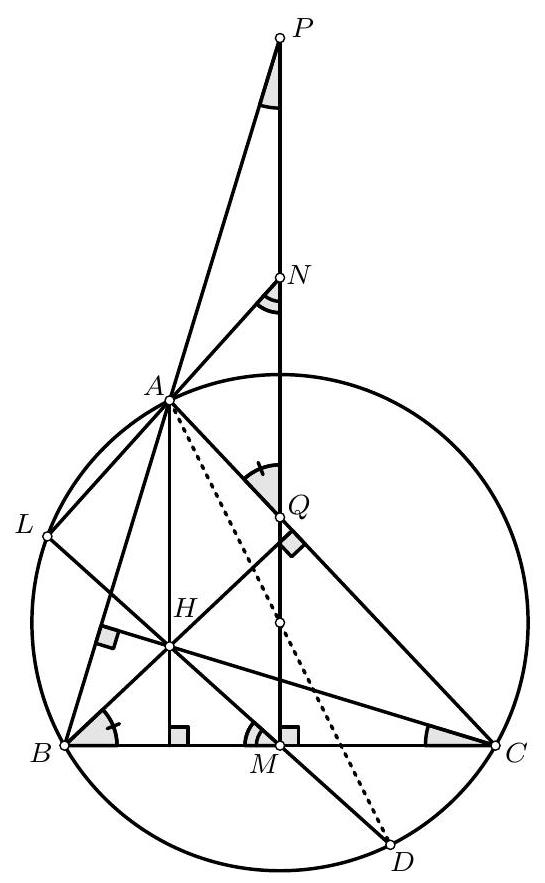
Let $L$ be the intersection of $A N$ and $H M$. We have
$$
\angle M L N=180^{\circ}-\angle L N M-\angle N M L=180^{\circ}-\angle L M B-\angle N M L=180^{\circ}-\angle N M B=90^{\circ} .
$$
Now let $D$ be the point on the circumcircle of $A B C$ diametrically oposite to $A$. It is known that $D$ is also the relfection of point $H$ over the point $M$. Therefore, we have that $D$ belongs on $M H$ and that $\angle D L A=\angle M L A=\angle M L N=90^{\circ}$. But, as $D A$ is the diameter of the circumcirle of $A B C$, the condition that $\angle D L A=90^{\circ}$ is enough to conclude that $L$ belongs on the circumcircle of $A B C$.
Remark. There is a spiral similarity mapping $A Q P$ to $H B C$. Since the similarity maps $A N$ to $H M$, it also maps $A H$ to $N M$, and since these two lines are parallel, the centre of the similarity is $L=A N \cap H M$. Since the similarity maps $B C$ to $Q P$, its centre belongs on the circumcircle of $B C X$, where $X=B Q \cap P C$. But $X$ is the reflection of $A$ on $Q M$ and so it must belong on the circumcircle of $A B C$. Hence so must $L$.
Remark. Students have also submitted correct proofs using radical axes, harmonic quadruples, coordinate geometry and complex numbers.
Problem 4. A $5 \times 100$ table is divided into 500 unit square cells, where $n$ of them are coloured black and the rest are coloured white. Two unit square cells are called adjacent if they share a common side. Each of the unit square cells has at most two adjacent black unit square cells. Find the largest possible value of $n$.
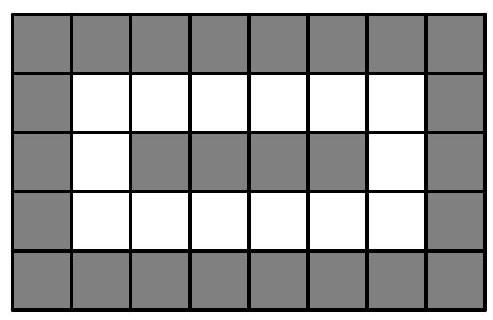
Solution. If we colour all the cells along all edges of the board together with the entire middle row except the second and the last-but-one cell, the condition is satisfied and there are 302 black cells. The figure below exhibits this colouring for the $5 \times 8$ case.
We can cover the table by one fragment like the first one on the figure below, 24 fragments like the middle one, and one fragment like the third one.
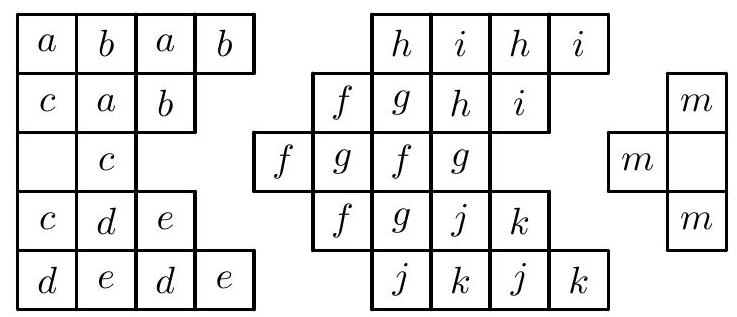
In each fragment, among the cells with the same letter, there are at most two coloured black, so the total number of coloured cells is at most $(5+24 \cdot 6+1) \cdot 2+2=302$.
Alternative Solution. Consider the cells adjacent to all cells of the second and fourth row. Counting multiplicity, each cell in the first and fifth row is counted once, each cell in the third row twice, while each cell in the second and fourth row is also counted twice apart from their first and last cells which are counted only once.
So there are 204 cells counted once and 296 cells counted twice. Those cells contain, counting multiplicity, at most 400 black cells. Suppose $a$ of the cells have multiplicity one and $b$ of them have multiplicity 2 . Then $a+2 b \leqslant 400$ and $a \leqslant 204$. Thus
$$
2 a+2 b \leqslant 400+a \leqslant 604
$$
and so $a+b \leqslant 302$ as required.
Remark. The alternative solution shows that if we have equality, then all cells in the perimeter of the table except perhaps the two cells of the third row must be coloured black. No other cell in the second or fourth row can be coloured black as this will give a cell in the first or fifth row with at least three neighbouring black cells. For similar reasons we cannot colour black the second and last-but-one cell of the third row. So we must colour black all other cells of the third row and therefore the colouring is unique.
Alternative Solution. Suppose we have $a$ black corner cells, $b$ black side cells, and $c$ black interior cells. Let $N$ be the number of pairs of cells $\left(c_{1}, c_{2}\right)$ such that $c_{1}$ is black and $c_{2}$ is neighbour of $c_{1}$. Then $N=2 a+3 b+4 c$ and $N \leqslant 1000$. Since also $a \leqslant 4$ and $b \leqslant 202$ we get
$$
1000 \geqslant 4(a+b+c)-2 a-b \geqslant 4(a+b+c)-210
$$
giving $a+b+c \leqslant 302.5$.
|