| {"year": "2011", "tier": "T3", "problem_label": "1", "problem_type": null, "exam": "Benelux_MO", "problem": "An ordered pair of integers $(m, n)$ with $1<m<n$ is said to be a Benelux couple if the following two conditions hold: $m$ has the same prime divisors as $n$, and $m+1$ has the same prime divisors as $n+1$.\n(a) Find three Benelux couples $(m, n)$ with $m \\leqslant 14$.\n(b) Prove that there exist infinitely many Benelux couples.\n\n#", "solution": "(a) It is possible to see that $(2,8),(6,48)$ and $(14,224)$ are Benelux couples.\n(b) Let $k \\geqslant 2$ be an integer and $m=2^{k}-2$. Define $n=m(m+2)=2^{k}\\left(2^{k}-2\\right)$. Since $m$ is even, $m$ and $n$ have the same prime factors. Also, $n+1=m(m+2)+1=(m+1)^{2}$, so $m+1$ and $n+1$ have the same prime factors, too. We have thus obtained a Benelux couple $\\left(2^{k}-2,2^{k}\\left(2^{k}-2\\right)\\right)$ for each $k \\geqslant 2$.\n\n#", "metadata": {"resource_path": "Benelux_MO/segmented/Benelux_en-olympiad_en-bxmo-problems-2011-zz.jsonl", "problem_match": "# Problem 1", "solution_match": "# Solution\n"}} |
| {"year": "2011", "tier": "T3", "problem_label": "2", "problem_type": null, "exam": "Benelux_MO", "problem": "Let $A B C$ be a triangle with incentre $I$. The angle bisectors $A I, B I$ and $C I$ meet $[B C],[C A]$ and $[A B]$ at $D, E$ and $F$, respectively. The perpendicular bisector of $[A D]$ intersects the lines $B I$ and $C I$ at $M$ and $N$, respectively. Show that $A, I, M$ and $N$ lie on a circle.\n\n#", "solution": "The quadrilateral $A M D B$ is cyclic. Indeed, $M$ is the intersection of the line $B I$, which bisects the angle $\\widehat{A B D}$ in $A B D$ and the perpendicular bisector of $[A D]$. By uniqueness of this intersection point, it follows that $M$ lies on the circumcircle of $A B D$, and thence $A M D B$ is cyclic. Analogously, $A N D C$ is cyclic.\nMoreover, $M N B C$ is cyclic, for $\\widehat{N M I}=90^{\\circ}-\\widehat{E I A}$. Indeed, $A$ and $I$ lie on either side of the midpoint of $[A D]$, for $\\widehat{B D A}=\\widehat{C A D}+\\widehat{B C A}>\\widehat{B A D}$. But\n\n$$\n\\widehat{E I A}=180^{\\circ}-\\frac{1}{2} \\widehat{B A C}-\\widehat{B E A}=180^{\\circ}-\\frac{1}{2} \\widehat{B A C}-\\left(\\frac{1}{2} \\widehat{C B A}+\\widehat{B C A}\\right)=90^{\\circ}-\\frac{1}{2} \\widehat{B C A}\n$$\n\nIt follows that $\\widehat{N M I}=\\widehat{B C I}$, which implies that $M N B C$ is cyclic, as the points $I$ and $D$ lie on the same side of $M N$.\n\nThere are now two ways of completing the proof:\n\n#", "metadata": {"resource_path": "Benelux_MO/segmented/Benelux_en-olympiad_en-bxmo-problems-2011-zz.jsonl", "problem_match": "# Problem 2", "solution_match": "# Solution\n"}} |
| {"year": "2011", "tier": "T3", "problem_label": "2", "problem_type": null, "exam": "Benelux_MO", "problem": "Let $A B C$ be a triangle with incentre $I$. The angle bisectors $A I, B I$ and $C I$ meet $[B C],[C A]$ and $[A B]$ at $D, E$ and $F$, respectively. The perpendicular bisector of $[A D]$ intersects the lines $B I$ and $C I$ at $M$ and $N$, respectively. Show that $A, I, M$ and $N$ lie on a circle.\n\n#", "solution": "(using $A M D B$ and $M N B C$ )\n\nSince $A M D B$ is cyclic, $\\widehat{M A I}=\\widehat{M A D}=\\widehat{M B D}$, as, by construction, $B$ and $M$ lie on either side of $A D$. Moreover, $\\widehat{M B D}=\\widehat{M B C}=\\widehat{M N C}$ for $M N B C$ is cyclic. Thus $\\widehat{M A I}=\\widehat{M N I}$, so $A M I N$ is cyclic, for $M$ and $N$ lie on either side of $A D$.\n\n#", "metadata": {"resource_path": "Benelux_MO/segmented/Benelux_en-olympiad_en-bxmo-problems-2011-zz.jsonl", "problem_match": "# Problem 2", "solution_match": "# Solution 1"}} |
| {"year": "2011", "tier": "T3", "problem_label": "2", "problem_type": null, "exam": "Benelux_MO", "problem": "Let $A B C$ be a triangle with incentre $I$. The angle bisectors $A I, B I$ and $C I$ meet $[B C],[C A]$ and $[A B]$ at $D, E$ and $F$, respectively. The perpendicular bisector of $[A D]$ intersects the lines $B I$ and $C I$ at $M$ and $N$, respectively. Show that $A, I, M$ and $N$ lie on a circle.\n\n#", "solution": "(using $A M D B$ and $A N D C$ )\n\nSince $A M D B$ and $A N D C$ are cylic, $\\widehat{A M I}+\\widehat{A N I}=\\widehat{A M B}+\\widehat{A N C}=\\widehat{A D B}+\\widehat{A D C}=180^{\\circ}$, because $B$ and $M$, and $C$ and $N$ lie on either side of $A D$. Hence $A M I N$ is cyclic, for $M$ and $N$ lie on either side of $A D$.\n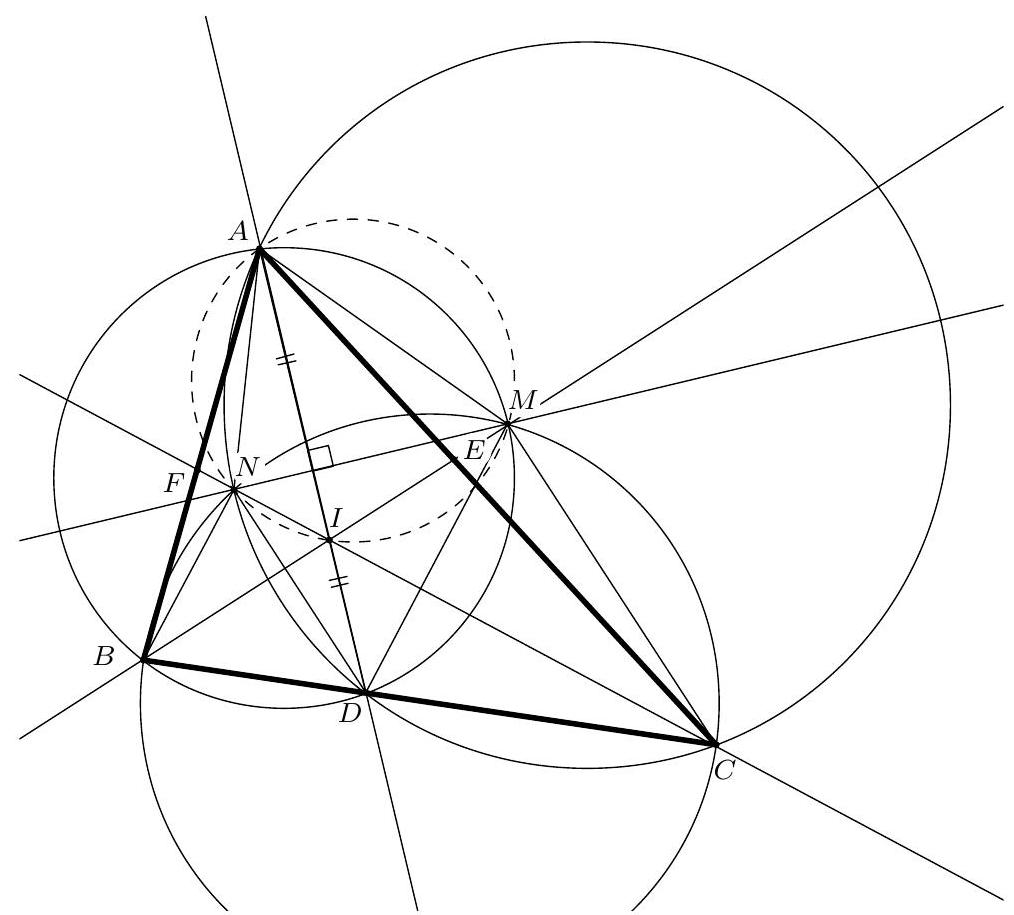\n\nRemark. It is moreover true that $B M \\perp D N$ and $C N \\perp D M$. Indeed, symmetry implies that the image $J$ of $I$ under reflection in $M N$ lies on the circumcircle of $D M N$. Moreover, $D I$ is a height of $D M N$, so the fact that $I$ and $J$ are equidistant from the side $[M N]$ implies that $I$ is the orthocentre of $D M N$. This implies the claim.\n\n#", "metadata": {"resource_path": "Benelux_MO/segmented/Benelux_en-olympiad_en-bxmo-problems-2011-zz.jsonl", "problem_match": "# Problem 2", "solution_match": "# Solution 2"}} |
| {"year": "2011", "tier": "T3", "problem_label": "3", "problem_type": null, "exam": "Benelux_MO", "problem": "If $k$ is an integer, let $\\mathrm{c}(k)$ denote the largest cube that is less than or equal to $k$. Find all positive integers $p$ for which the following sequence is bounded:\n\n$$\na_{0}=p \\quad \\text { and } \\quad a_{n+1}=3 a_{n}-2 c\\left(a_{n}\\right) \\quad \\text { for } n \\geqslant 0\n$$\n\n#", "solution": "Since $\\mathrm{c}\\left(a_{n}\\right) \\leqslant a_{n}$ for all $n \\in \\mathbb{N}, a_{n+1} \\geqslant a_{n}$ with equality if and only if $\\mathrm{c}\\left(a_{n}\\right)=a_{n}$. Hence the sequence is bounded if and only if it is eventually constant, which is if and only if $a_{n}$ is a perfect cube, for some $n \\geqslant 0$. In particular, the sequence is bounded if $p$ is a perfect cube.\n\nWe now claim that, if $a_{n}$ is not a cube for some $n$, then neither is $a_{n+1}$. Indeed, if $a_{n}$ is not a cube, $q^{3}<a_{n}<(q+1)^{3}$ for some $q \\in \\mathbb{N}$, so that $\\mathrm{c}\\left(a_{n}\\right)=q^{3}$. Suppose to the contrary that $a_{n+1}$ is a cube. Then\n\n$$\na_{n+1}=3 a_{n}-2 \\mathrm{c}\\left(a_{n}\\right)<3(q+1)^{3}-2 q^{3}=q^{3}+9 q^{2}+9 q+3<q^{3}+9 q^{2}+27 q+27=(q+3)^{3}\n$$\n\nAlso, since $\\mathrm{c}\\left(a_{n}\\right)<a_{n}, a_{n+1}>a_{n}>q^{3}$, so $q^{3}<a_{n+1}<(q+3)^{3}$. It follows that the only possible values of $a_{n+1}$ are $(q+1)^{3}$ and $(q+2)^{3}$. However, in both of these cases,\n\n$$\n\\begin{aligned}\n& 3 a_{n}-2 q^{3}=a_{n+1}=(q+1)^{3} \\Longleftrightarrow 3 a_{n}=3\\left(q^{3}+q^{2}+q\\right)+1 \\\\\n& 3 a_{n}-2 q^{3}=a_{n+1}=(q+2)^{3} \\Longleftrightarrow 3 a_{n}=3\\left(q^{3}+2 q^{2}+4 q\\right)+8\n\\end{aligned}\n$$\n\na contradiction modulo 3 . This proves that, if $a_{n}$ is not a cube, then neither is $a_{n+1}$. Hence, if $p$ is not a perfect cube, $a_{n}$ is not a cube for any $n \\in \\mathbb{N}$, and the sequence is not bounded. We conclude that the sequence is bounded if and only if $p$ is a perfect cube.\n\n#", "metadata": {"resource_path": "Benelux_MO/segmented/Benelux_en-olympiad_en-bxmo-problems-2011-zz.jsonl", "problem_match": "# Problem 3", "solution_match": "# Solution\n"}} |
| {"year": "2011", "tier": "T3", "problem_label": "4", "problem_type": null, "exam": "Benelux_MO", "problem": "Abby and Brian play the following game: They first choose a positive integer $N$. Then they write numbers on a blackboard in turn. Abby starts by writing a 1. Thereafter, when one of them has written the number $n$, the other writes down either $n+1$ or $2 n$, provided that the number is not greater than $N$. The player who writes $N$ on the blackboard wins.\n(a) Determine which player has a winning strategy if $N=2011$.\n(b) Find the number of positive integers $N \\leqslant 2011$ for which Brian has a winning strategy.\n\n#", "solution": "(a) Abby has a winning strategy for odd $N$ : Observe that, whenever any player writes down an odd number, the other player has to write down an even number. By adding 1 to that number, the first player can write down another odd number. Since Abby starts the game by writing down an odd number, she can force Brian to write down even numbers only. Since $N$ is odd, Abby will win the game. In particular, Abby has a winning strategy if $N=2011$.\n(b) - Let $N=4 k$. If any player is forced to write down a number $m \\in\\{k+1, k+2, \\ldots, 2 k\\}$, the other player wins the game by writing down $2 m \\in\\{2 k+2,2 k+4, \\ldots, 4 k\\}$, for the players will have to write down the remaining numbers one after the other. Since there is an even number of numbers remaining, the latter player wins. This implies that the player who can write down $k$, i.e. has a winning strategy for $N=k$, wins the game for $N=4 k$.\n\n- Similarly, let $N=4 k+2$. If any player is forced to write down a number $m \\in\\{k+1, k+2, \\ldots, 2 k+1\\}$, the other player wins the game by writing down $2 m \\in\\{2 k+2,2 k+4, \\ldots, 4 k+2\\}$, as in the previous case. Analogously, this implies that the player who has a winning strategy for $N=k$ wins the game for $N=4 k+2$.\n\nSince Abby wins the game for $N=1,3$, while Brian wins the game for $N=2$, Brian wins the game for $N=8,10$, as well, and thus for $N=32,34,40,42$, too. Then Brian wins the game for a further 8 values of $N$ between 128 and 170, and thence for a further 16 values between 512 and 682 , and for no other values with $N \\leqslant 2011$. Hence Brian has a winning strategy for precisely 31 values of $N$ with $N \\leqslant 2011$.", "metadata": {"resource_path": "Benelux_MO/segmented/Benelux_en-olympiad_en-bxmo-problems-2011-zz.jsonl", "problem_match": "# Problem 4", "solution_match": "# Solution\n"}} |
|
|


