| {"year": "2018", "tier": "T3", "problem_label": "1", "problem_type": null, "exam": "Benelux_MO", "problem": "(a) Determine the minimal value of\n\n$$\n\\left(x+\\frac{1}{y}\\right)\\left(x+\\frac{1}{y}-2018\\right)+\\left(y+\\frac{1}{x}\\right)\\left(y+\\frac{1}{x}-2018\\right)\n$$\n\nwhere $x$ and $y$ vary over the positive reals.\n(b) Determine the minimal value of\n\n$$\n\\left(x+\\frac{1}{y}\\right)\\left(x+\\frac{1}{y}+2018\\right)+\\left(y+\\frac{1}{x}\\right)\\left(y+\\frac{1}{x}+2018\\right)\n$$\n\nwhere $x$ and $y$ vary over the positive reals.\n(Pierre Haas, Luxembourg)\n\n#", "solution": "", "metadata": {"resource_path": "Benelux_MO/segmented/Benelux_en-olympiad_en-bxmo-problems-2018-zz.jsonl", "problem_match": "# Problem 1", "solution_match": "# Solution\n"}} |
| {"year": "2018", "tier": "T3", "problem_label": "1", "problem_type": null, "exam": "Benelux_MO", "problem": "(a) Determine the minimal value of\n\n$$\n\\left(x+\\frac{1}{y}\\right)\\left(x+\\frac{1}{y}-2018\\right)+\\left(y+\\frac{1}{x}\\right)\\left(y+\\frac{1}{x}-2018\\right)\n$$\n\nwhere $x$ and $y$ vary over the positive reals.\n(b) Determine the minimal value of\n\n$$\n\\left(x+\\frac{1}{y}\\right)\\left(x+\\frac{1}{y}+2018\\right)+\\left(y+\\frac{1}{x}\\right)\\left(y+\\frac{1}{x}+2018\\right)\n$$\n\nwhere $x$ and $y$ vary over the positive reals.\n(Pierre Haas, Luxembourg)\n\n#", "solution": ". By the inequality between arithmetic and quadratic means,\n\n$$\n\\left(x+\\frac{1}{y}\\right)^{2}+\\left(y+\\frac{1}{x}\\right)^{2} \\geqslant \\frac{1}{2}\\left(x+\\frac{1}{y}+y+\\frac{1}{x}\\right)^{2}\n$$\n\nwith equality if and only if $x+1 / y=y+1 / x$, which holds if $x=y$. It follows that\n\n$$\n\\left(x+\\frac{1}{y}\\right)\\left(x+\\frac{1}{y} \\pm 2018\\right)+\\left(y+\\frac{1}{x}\\right)\\left(y+\\frac{1}{x} \\pm 2018\\right) \\geqslant \\frac{1}{2}\\left(x+\\frac{1}{y}+y+\\frac{1}{x}\\right)^{2} \\pm 2018\\left(x+\\frac{1}{y}+y+\\frac{1}{x}\\right) .\n$$\n\nThe parabola $f(X)=\\frac{1}{2} X^{2} \\pm 2018 X$ attains its minimal value at $X=\\mp 2018$, and increases monotonically away from this minimal value. By the inequality between arithmetic and geometric means, $(x+1 / x)+(y+1 / y) \\geqslant 4$ with equality iff $x=y=1$. Hence\n(a) $\\left(x+\\frac{1}{y}\\right)\\left(x+\\frac{1}{y}-2018\\right)+\\left(y+\\frac{1}{x}\\right)\\left(y+\\frac{1}{x}-2018\\right) \\geqslant f(2018)=-\\frac{2018^{2}}{2}$,\nand equality is attained if $x=y=u$, where $u+1 / u=1009$, a quadratic equation with discriminant $1009^{2}-4>0$, and that therefore has two real solutions which are clearly positive.\n(b) $\\left(x+\\frac{1}{y}\\right)\\left(x+\\frac{1}{y}+2018\\right)+\\left(y+\\frac{1}{x}\\right)\\left(y+\\frac{1}{x}+2018\\right) \\geqslant f(4)=8080$,\nwith equality if and only if $x=y=1$.\nRemark. It is easy to see that equality is attained in the first inequality if and only if $x=y$. Indeed, if $x \\leqslant y$, then $1 / y \\leqslant 1 / x$, and so $x+1 / y \\lessgtr y+1 / x$. Thus $x+1 / y=y+1 / x$ if and only if $x=y$. This is not required for the solution.", "metadata": {"resource_path": "Benelux_MO/segmented/Benelux_en-olympiad_en-bxmo-problems-2018-zz.jsonl", "problem_match": "# Problem 1", "solution_match": "\nSolution 1"}} |
| {"year": "2018", "tier": "T3", "problem_label": "1", "problem_type": null, "exam": "Benelux_MO", "problem": "(a) Determine the minimal value of\n\n$$\n\\left(x+\\frac{1}{y}\\right)\\left(x+\\frac{1}{y}-2018\\right)+\\left(y+\\frac{1}{x}\\right)\\left(y+\\frac{1}{x}-2018\\right)\n$$\n\nwhere $x$ and $y$ vary over the positive reals.\n(b) Determine the minimal value of\n\n$$\n\\left(x+\\frac{1}{y}\\right)\\left(x+\\frac{1}{y}+2018\\right)+\\left(y+\\frac{1}{x}\\right)\\left(y+\\frac{1}{x}+2018\\right)\n$$\n\nwhere $x$ and $y$ vary over the positive reals.\n(Pierre Haas, Luxembourg)\n\n#", "solution": ". By the inequality between arithmetic and geometric means, $x / y+y / x \\geqslant 2$, and hence\n\n$$\n\\left(x+\\frac{1}{y}\\right)^{2}+\\left(y+\\frac{1}{x}\\right)^{2}=x^{2}+\\frac{1}{y^{2}}+y^{2}+\\frac{1}{x^{2}}+2\\left(\\frac{x}{y}+\\frac{y}{x}\\right) \\geqslant x^{2}+\\frac{1}{x^{2}}+y^{2}+\\frac{1}{y^{2}}+4=\\left(x+\\frac{1}{x}\\right)^{2}+\\left(y+\\frac{1}{y}\\right)^{2}\n$$\n\nwith equality if and only if $x=y$. It follows that\n\n$$\n\\left(x+\\frac{1}{y}\\right)\\left(x+\\frac{1}{y}-K\\right)+\\left(y+\\frac{1}{x}\\right)\\left(y+\\frac{1}{x}-K\\right) \\geqslant\\left[\\left(x+\\frac{1}{x}\\right)^{2}-K\\left(x+\\frac{1}{x}\\right)\\right]+\\left[\\left(y+\\frac{1}{y}\\right)^{2}-K\\left(y+\\frac{1}{y}\\right)\\right] .\n$$\n\n## BxMO 2018: Problems and Solutions\n\nNotice that the parabola $f(X)=X^{2}-K X=(X-K / 2)^{2}-K^{2} / 4$ attains its minimum value at $X=K / 2$, and increases monotonically away from this minimal value. Now $x+1 / x, y+1 / y \\geqslant 2$, so it follows that\n\n$$\n\\left(x+\\frac{1}{y}\\right)\\left(x+\\frac{1}{y}-K\\right)+\\left(y+\\frac{1}{x}\\right)\\left(y+\\frac{1}{x}-K\\right) \\geqslant\\left\\{\\begin{array}{cl}\n2 f(K / 2)=-K^{2} / 2 & \\text { if } K / 2 \\geqslant 2 \\Longleftrightarrow K \\geqslant 4 \\\\\n2 f(2)=4(2-K) & \\text { if } K / 2 \\leqslant 2 \\Longleftrightarrow K \\leqslant 4\n\\end{array}\\right.\n$$\n\nEquality is attained if (and only if)\n\n$$\nx=y=\\frac{K}{4} \\pm \\sqrt{\\frac{K^{2}}{16}-1} \\quad(\\text { if } K \\geqslant 4), \\quad x=y=1 \\quad(\\text { if } K \\leqslant 4)\n$$\n\nand so these lower bounds indeed represent the minimal values. Taking (a) $K=2018$ and (b) $K=-2018$ in this result completes the proof.", "metadata": {"resource_path": "Benelux_MO/segmented/Benelux_en-olympiad_en-bxmo-problems-2018-zz.jsonl", "problem_match": "# Problem 1", "solution_match": "\nSolution 2"}} |
| {"year": "2018", "tier": "T3", "problem_label": "1", "problem_type": null, "exam": "Benelux_MO", "problem": "(a) Determine the minimal value of\n\n$$\n\\left(x+\\frac{1}{y}\\right)\\left(x+\\frac{1}{y}-2018\\right)+\\left(y+\\frac{1}{x}\\right)\\left(y+\\frac{1}{x}-2018\\right)\n$$\n\nwhere $x$ and $y$ vary over the positive reals.\n(b) Determine the minimal value of\n\n$$\n\\left(x+\\frac{1}{y}\\right)\\left(x+\\frac{1}{y}+2018\\right)+\\left(y+\\frac{1}{x}\\right)\\left(y+\\frac{1}{x}+2018\\right)\n$$\n\nwhere $x$ and $y$ vary over the positive reals.\n(Pierre Haas, Luxembourg)\n\n#", "solution": "for part (a). Completing squares,\n\n$$\n\\begin{aligned}\n\\left(x+\\frac{1}{y}\\right)\\left(x+\\frac{1}{y}-2018\\right)+\\left(y+\\frac{1}{x}\\right)\\left(y+\\frac{1}{x}-2018\\right) & =\\left(x+\\frac{1}{y}-1009\\right)^{2}+\\left(y+\\frac{1}{x}-1009\\right)^{2}-2 \\cdot 1009^{2} \\\\\n& \\geqslant-2 \\cdot 1009^{2}\n\\end{aligned}\n$$\n\nwith equality if $x+1 / y=y+1 / x=1009$, which holds if $x=y=u$, where $u+1 / u=1009$, a quadratic equation with discriminant $1009^{2}-4>0$, and that therefore has two real solutions which are clearly positive.\n\nRemark. As in Solution 1, equality holds if and only if $x=y$, because, if $x \\lessgtr y$, then $1 / y \\lessgtr 1 / x$, and so $x+1 / y \\lessgtr y+1 / x$. Thus $x+1 / y=y+1 / x$ if and only if $x=y$. This is not required for the solution.", "metadata": {"resource_path": "Benelux_MO/segmented/Benelux_en-olympiad_en-bxmo-problems-2018-zz.jsonl", "problem_match": "# Problem 1", "solution_match": "\nSolution 3"}} |
| {"year": "2018", "tier": "T3", "problem_label": "1", "problem_type": null, "exam": "Benelux_MO", "problem": "(a) Determine the minimal value of\n\n$$\n\\left(x+\\frac{1}{y}\\right)\\left(x+\\frac{1}{y}-2018\\right)+\\left(y+\\frac{1}{x}\\right)\\left(y+\\frac{1}{x}-2018\\right)\n$$\n\nwhere $x$ and $y$ vary over the positive reals.\n(b) Determine the minimal value of\n\n$$\n\\left(x+\\frac{1}{y}\\right)\\left(x+\\frac{1}{y}+2018\\right)+\\left(y+\\frac{1}{x}\\right)\\left(y+\\frac{1}{x}+2018\\right)\n$$\n\nwhere $x$ and $y$ vary over the positive reals.\n(Pierre Haas, Luxembourg)\n\n#", "solution": "for part (b). Using the inequality between arithmetic and geometric means,\n\n$$\n\\begin{aligned}\n\\left(x+\\frac{1}{y}\\right)(x+ & \\left.\\frac{1}{y}+2018\\right)+\\left(y+\\frac{1}{x}\\right)\\left(y+\\frac{1}{x}+2018\\right) \\\\\n& =\\left(x+\\frac{1}{y}\\right)^{2}+\\left(y+\\frac{1}{x}\\right)^{2}+2018\\left[\\left(x+\\frac{1}{x}\\right)+\\left(y+\\frac{1}{y}\\right)\\right] \\geqslant 4 \\frac{x}{y}+4 \\frac{y}{x}+2018(2+2)\n\\end{aligned}\n$$\n\nBut $x / y+y / x \\geqslant 2$ by the same inequality, and hence\n\n$$\n\\left(x+\\frac{1}{y}\\right)\\left(x+\\frac{1}{y}+2018\\right)+\\left(y+\\frac{1}{x}\\right)\\left(y+\\frac{1}{x}+2018\\right) \\geqslant 8080\n$$\n\nwith equality attained if and only if $x=y=1$.\n\n## BxMO 2018: Problems and Solutions\n\n#", "metadata": {"resource_path": "Benelux_MO/segmented/Benelux_en-olympiad_en-bxmo-problems-2018-zz.jsonl", "problem_match": "# Problem 1", "solution_match": "\nSolution 4"}} |
| {"year": "2018", "tier": "T3", "problem_label": "2", "problem_type": null, "exam": "Benelux_MO", "problem": "In the land of Heptanomisma, four different coins and three different banknotes are used, and their denominations are seven different (non-zero) natural numbers. The denomination of the smallest banknote is greater than the sum of the denominations of the four different coins. A tourist has exactly one coin of each denomination and exactly one banknote of each denomination, but he cannot afford the book on numismatics he wishes to buy. However, the mathematically inclined shopkeeper offers to sell the book to the tourist at a price of his choosing, provided that he can pay this price in more than one way.\n(The tourist can pay a price in more than one way if there are two different subsets of his coins and notes, the denominations of which both add up to this price.)\n(a) Prove that the tourist can purchase the book if the denomination of each banknote is smaller than 49.\n(b) Show that the tourist may have to leave the shop empty-handed if the denomination of the largest banknote is 49.\n(Stijn Cambie, Belgium)\n\n#", "solution": "Let the denominations of the coins and notes be $C_{1}<C_{2}<C_{3}<C_{4}$ and $N_{1}<N_{2}<N_{3}$, respectively. Define $C=C_{1}+C_{2}+C_{3}+C_{4}$ to be the largest amount that can be payed with coins only. The condition of the problem is thus $C<N_{1}$.\n(a) Suppose to the contrary that, whatever the price of the book, the tourist can pay for it in no more than one way.", "metadata": {"resource_path": "Benelux_MO/segmented/Benelux_en-olympiad_en-bxmo-problems-2018-zz.jsonl", "problem_match": "# Problem 2", "solution_match": "# Solution\n"}} |
| {"year": "2018", "tier": "T3", "problem_label": "2", "problem_type": null, "exam": "Benelux_MO", "problem": "In the land of Heptanomisma, four different coins and three different banknotes are used, and their denominations are seven different (non-zero) natural numbers. The denomination of the smallest banknote is greater than the sum of the denominations of the four different coins. A tourist has exactly one coin of each denomination and exactly one banknote of each denomination, but he cannot afford the book on numismatics he wishes to buy. However, the mathematically inclined shopkeeper offers to sell the book to the tourist at a price of his choosing, provided that he can pay this price in more than one way.\n(The tourist can pay a price in more than one way if there are two different subsets of his coins and notes, the denominations of which both add up to this price.)\n(a) Prove that the tourist can purchase the book if the denomination of each banknote is smaller than 49.\n(b) Show that the tourist may have to leave the shop empty-handed if the denomination of the largest banknote is 49.\n(Stijn Cambie, Belgium)\n\n#", "solution": ". Consider the hands of one or two notes and any number of (or possibly no) coins. Each of them has one of the $N_{2}+N_{3}$ different values $v$ with $N_{1} \\leqslant v<N_{1}+N_{2}+N_{3}$, since $C<N_{1}$. There are $\\left(\\binom{3}{1}+\\binom{3}{2}\\right) \\cdot 2^{4}=96$ such hands. Hence $95=47+48>N_{2}+N_{3} \\geqslant 96$, which is a contradiction.", "metadata": {"resource_path": "Benelux_MO/segmented/Benelux_en-olympiad_en-bxmo-problems-2018-zz.jsonl", "problem_match": "# Problem 2", "solution_match": "\nSolution 1"}} |
| {"year": "2018", "tier": "T3", "problem_label": "2", "problem_type": null, "exam": "Benelux_MO", "problem": "In the land of Heptanomisma, four different coins and three different banknotes are used, and their denominations are seven different (non-zero) natural numbers. The denomination of the smallest banknote is greater than the sum of the denominations of the four different coins. A tourist has exactly one coin of each denomination and exactly one banknote of each denomination, but he cannot afford the book on numismatics he wishes to buy. However, the mathematically inclined shopkeeper offers to sell the book to the tourist at a price of his choosing, provided that he can pay this price in more than one way.\n(The tourist can pay a price in more than one way if there are two different subsets of his coins and notes, the denominations of which both add up to this price.)\n(a) Prove that the tourist can purchase the book if the denomination of each banknote is smaller than 49.\n(b) Show that the tourist may have to leave the shop empty-handed if the denomination of the largest banknote is 49.\n(Stijn Cambie, Belgium)\n\n#", "solution": ". Consider the hands of exactly one note and any number of (or possibly no) coins, as well as the hand consisting of the two smallest notes only, of value $N_{1}+N_{2}$. Each of these has one of the $N_{3}$ different values $v$ with $N_{1} \\leqslant v<N_{3}+N_{1}$, since $C<N_{1}$ and $N_{1}<N_{1}+N_{2}<N_{1}+N_{3}$. Now the number of hands considered above is $3 \\cdot 2^{4}+1=49$, so $N_{3} \\geqslant 49$, a contradiction.", "metadata": {"resource_path": "Benelux_MO/segmented/Benelux_en-olympiad_en-bxmo-problems-2018-zz.jsonl", "problem_match": "# Problem 2", "solution_match": "\nSolution 2"}} |
| {"year": "2018", "tier": "T3", "problem_label": "2", "problem_type": null, "exam": "Benelux_MO", "problem": "In the land of Heptanomisma, four different coins and three different banknotes are used, and their denominations are seven different (non-zero) natural numbers. The denomination of the smallest banknote is greater than the sum of the denominations of the four different coins. A tourist has exactly one coin of each denomination and exactly one banknote of each denomination, but he cannot afford the book on numismatics he wishes to buy. However, the mathematically inclined shopkeeper offers to sell the book to the tourist at a price of his choosing, provided that he can pay this price in more than one way.\n(The tourist can pay a price in more than one way if there are two different subsets of his coins and notes, the denominations of which both add up to this price.)\n(a) Prove that the tourist can purchase the book if the denomination of each banknote is smaller than 49.\n(b) Show that the tourist may have to leave the shop empty-handed if the denomination of the largest banknote is 49.\n(Stijn Cambie, Belgium)\n\n#", "solution": ". Consider the $3 \\cdot 2^{4}=48$ hands of exactly two notes and any number of (or possibly no) coins. Each of these has one of the $N_{3}$ different values $v$ with $N_{1}+N_{2} \\leqslant v<N_{1}+N_{2}+N_{3}$, since $C<N_{1}$. Hence $48 \\leqslant N_{3}<49$, so $N_{3}=48$. Next consider the $3 \\cdot 2^{4}=48$ hands of exactly one note and any number of coins. By the above, these cannot have a value greater than or equal to $N_{1}+N_{2}$, since these can be realised using two notes and some coins. Hence they must each have one of the $N_{2}$ different values $v$ with $N_{1} \\leqslant v<N_{1}+N_{2}$. This implies $48 \\leqslant N_{2}<N_{3}=48$, which is a contradiction.\n(b) Consider the denominations\n\n$$\nC_{1}=3, \\quad C_{2}=6, \\quad C_{3}=12, \\quad C_{4}=24, \\quad N_{1}=47, \\quad N_{2}=48, \\quad N_{3}=49\n$$\n\nThese satisfy the conditions of the problem, with $C=45<N_{1}$.", "metadata": {"resource_path": "Benelux_MO/segmented/Benelux_en-olympiad_en-bxmo-problems-2018-zz.jsonl", "problem_match": "# Problem 2", "solution_match": "\nSolution 3"}} |
| {"year": "2018", "tier": "T3", "problem_label": "2", "problem_type": null, "exam": "Benelux_MO", "problem": "In the land of Heptanomisma, four different coins and three different banknotes are used, and their denominations are seven different (non-zero) natural numbers. The denomination of the smallest banknote is greater than the sum of the denominations of the four different coins. A tourist has exactly one coin of each denomination and exactly one banknote of each denomination, but he cannot afford the book on numismatics he wishes to buy. However, the mathematically inclined shopkeeper offers to sell the book to the tourist at a price of his choosing, provided that he can pay this price in more than one way.\n(The tourist can pay a price in more than one way if there are two different subsets of his coins and notes, the denominations of which both add up to this price.)\n(a) Prove that the tourist can purchase the book if the denomination of each banknote is smaller than 49.\n(b) Show that the tourist may have to leave the shop empty-handed if the denomination of the largest banknote is 49.\n(Stijn Cambie, Belgium)\n\n#", "solution": ". Any two amounts that can be obtained using some (or possible no) coins are different, and they are multiples of 3 since each of the coin denominations is. Hence any two such amounts differ by at least 3 . Since $N_{3}-N_{1}=2$, it follows that any two hands using one note and some coins each have a different value (and the same is true for hands using more than one note, since at least one note appears at least twice in any two such\n\n## BxMO 2018: Problems and Solutions\n\nhands). Finally, $N_{3}+C<N_{1}+N_{2}$, and hence any hand using one note and some coins has a different value from any hand using two notes and some coins. Hence there is no price that the tourist can pay for in more than one way.", "metadata": {"resource_path": "Benelux_MO/segmented/Benelux_en-olympiad_en-bxmo-problems-2018-zz.jsonl", "problem_match": "# Problem 2", "solution_match": "\nSolution 1"}} |
| {"year": "2018", "tier": "T3", "problem_label": "2", "problem_type": null, "exam": "Benelux_MO", "problem": "In the land of Heptanomisma, four different coins and three different banknotes are used, and their denominations are seven different (non-zero) natural numbers. The denomination of the smallest banknote is greater than the sum of the denominations of the four different coins. A tourist has exactly one coin of each denomination and exactly one banknote of each denomination, but he cannot afford the book on numismatics he wishes to buy. However, the mathematically inclined shopkeeper offers to sell the book to the tourist at a price of his choosing, provided that he can pay this price in more than one way.\n(The tourist can pay a price in more than one way if there are two different subsets of his coins and notes, the denominations of which both add up to this price.)\n(a) Prove that the tourist can purchase the book if the denomination of each banknote is smaller than 49.\n(b) Show that the tourist may have to leave the shop empty-handed if the denomination of the largest banknote is 49.\n(Stijn Cambie, Belgium)\n\n#", "solution": ". Suppose to the contrary that there are two hands of coins and notes that sum to the same amount. Up to removing coins or notes that appear in both of these hands to obtain two smaller hands summing to the same amount, we may assume that no coin or note appears in both of these hands. Notice that all the denominations, except for $N_{1} \\equiv-1(\\bmod 3)$ and $N_{3} \\equiv 1(\\bmod 3)$, are divisible by 3 . Hence, if $N_{1}$ appears in one hand, $N_{3}$ must appear in the same hand, and vice versa. Hence these two hands are two disjoint subsets of $\\left\\{C_{1}, C_{2}, C_{3}, C_{4}, N_{2}, N_{1}+N_{3}\\right\\}=\\{3,6,12,24,48,96\\}=3\\{1,2,4,8,16,32\\}$ that sum to the same amount, which contradicts the uniqueness of the binary expansion of these two amounts. Hence there is no price that the tourist can pay for in more than one way.\n\nRemark. It is natural to ask whether there are other choices of coins and notes with $N_{3}=49$ in (b) that force the tourist to leave the shop empty-handed. It turns out that the choice in (b) is unique. The argument runs as follows: the inequality $N_{2}+N_{3} \\geqslant 96$ implies that $N_{2}=47$ or $N_{2}=48$. Further, strengthening the bound in (a), we must have\n\n$$\n\\left(N_{2}+N_{3}+C\\right)-\\left(N_{1}+N_{2}\\right)+1 \\geqslant 48 \\quad \\Longrightarrow \\quad C \\geqslant 47+N_{1}-N_{3}=N_{1}-2\n$$\n\nBut $C<N_{1}$, and so $C=N_{1}-1$ or $C=N_{1}-2$. If $N_{2}=47$, then $C=N_{1}-2$ implies $N_{1}+N_{2}=N_{3}+C$, a contradiction. Thus $C=N_{1}-1$ if $N_{2}=47$, and, similarly, $C=N_{1}-2$ if $N_{2}=48$.\n\nIn the first case, $N_{3}+C=48+N_{1}=N_{1}+N_{2}+1$ (*). Hence, by the argument in (a), all the $N_{2}=47$ values $v$ with $N_{1} \\leqslant v<N_{1}+N_{2}$ can be represented (using one note and some coins). Now $C_{1} \\neq 1$ by (*). Since $N_{1}+1$ can be represented, it follows that $N_{2}=N_{1}+1$ and hence $N_{1}=46$. Then $N_{3}=N_{2}+2=N_{1}+3$ implies that $C_{1}>3$. Considering $50=N_{1}+4$ yields $C_{1}=4$. Now $53=N_{3}+4=N_{2}+6,52=N_{2}+5=N_{1}+6$. Hence $C_{2}=6$ is not possible, so $C_{2}=5$. Then $51=N_{2}+C_{1}=N_{1}+C_{2}$, a contradiction.\n\nIn the second case, notice that $N_{2}=48$ implies, by the argument in (a), that all the $N_{2}=48$ values $v$ with $N_{1} \\leqslant v<N_{1}+N_{2}$ can be represented. Clearly, $N_{1}+1$ can only be represented if $C_{1}=1$ or $N_{2}=N_{1}+1$. In the former case, $N_{3}=N_{2}+C_{1}$, a contradiction. Hence $N_{1}=N_{2}-1=47$, and so $C=45$. Considering $N_{1}+3, \\ldots, N_{1}+12$ then successively yields $C_{1}=3, C_{2}=6, C_{3}=12$. Finally, $C_{4}=C-C_{1}-C_{2}-C_{3}=24$, completing the proof.\n\nOne might also ask about other choices of coins and notes, with different values of $N_{3}$, forcing the tourist to leave the shop empty-handed. Numerically, it is easy to tabulate all such choices of coins and notes for small $N_{3}$ :\n\n| $C_{1}$ | $C_{2}$ | $C_{3}$ | $C_{4}$ | $N_{1}$ | $N_{2}$ | $N_{3}$ |\n| :---: | :---: | :---: | :---: | :---: | :---: | :---: |\n| 3 | 6 | 12 | 24 | 47 | 48 | 49 |\n| 1 | 6 | 12 | 24 | 46 | 48 | 50 |\n| 3 | 6 | 12 | 24 | 46 | 48 | 50 |\n| 3 | 6 | 12 | 24 | 48 | 49 | 50 |\n| 3 | 6 | 12 | 25 | 48 | 49 | 50 |\n| 1 | 6 | 12 | 24 | 47 | 49 | 51 |\n| 1 | 6 | 12 | 25 | 47 | 49 | 51 |\n| 3 | 6 | 12 | 24 | 49 | 50 | 51 |\n| 3 | 6 | 12 | 25 | 49 | 50 | 51 |\n| 3 | 6 | 12 | 26 | 49 | 50 | 51 |\n| 3 | 6 | 13 | 25 | 49 | 50 | 51 |\n\n## BxMO 2018: Problems and Solutions\n\n#", "metadata": {"resource_path": "Benelux_MO/segmented/Benelux_en-olympiad_en-bxmo-problems-2018-zz.jsonl", "problem_match": "# Problem 2", "solution_match": "\nSolution 2"}} |
| {"year": "2018", "tier": "T3", "problem_label": "3", "problem_type": null, "exam": "Benelux_MO", "problem": "Let $A B C$ be a triangle with orthocentre $H$, and let $D, E$, and $F$ denote the respective midpoints of line segments $A B, A C$, and $A H$. The reflections of $B$ and $C$ in $F$ are $P$ and $Q$, respectively.\n(a) Show that lines $P E$ and $Q D$ intersect on the circumcircle of triangle $A B C$.\n(b) Prove that lines $P D$ and $Q E$ intersect on line segment $A H$.\n(Merlijn Staps, the Netherlands)\n\n#", "solution": "(a) Solution 1. Since $F$ is the midpoint of $[A H]$ and $[B P], B H P A$ is a parallelogram. Similarly, $C A Q H$ is a parallelogram, too. Let $O$ denote the circumcentre of triangle $A B C$ and let $R$ be the reflection of $A$ in $O$, so that $R$ lies on the circumcircle of $A B C$. Since $[A R]$ is a diameter of the circumcircle of $A B C, C R \\perp A C$. But $B H \\perp A C$, and so $C R \\| B H$. Similarly, $B R \\| C H$, and thus $B R C H$ is a parallelogram. Since $B H P A$ is a parallelogram, $R C P A$ is a parallelogram, too. In particular, the midpoint $E$ of its diagonal $[A C]$ lies on $[P R]$. Similarly, $D$ lies on $[Q R]$, and so $P E$ and $Q D$ meet at $R$.\n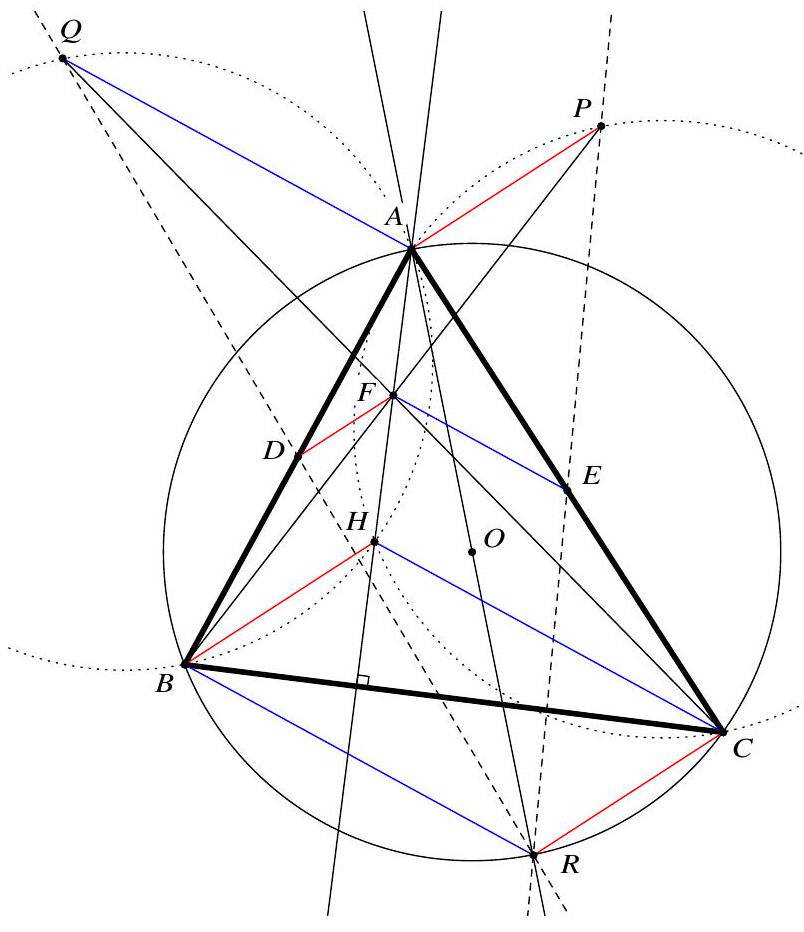\n\nRemark. Since $A P$ is parallel to the altitude $B H, A P \\perp A C$. Further, $P H \\| A B$ since $A P H B$ is a parallelogram. But $C H \\perp A B$, so $P H \\perp C H$. Hence $A P C H$ is cyclic. Similarly, $A H B Q$ is cyclic, too.", "metadata": {"resource_path": "Benelux_MO/segmented/Benelux_en-olympiad_en-bxmo-problems-2018-zz.jsonl", "problem_match": "# Problem 3", "solution_match": "# Solution\n"}} |
| {"year": "2018", "tier": "T3", "problem_label": "3", "problem_type": null, "exam": "Benelux_MO", "problem": "Let $A B C$ be a triangle with orthocentre $H$, and let $D, E$, and $F$ denote the respective midpoints of line segments $A B, A C$, and $A H$. The reflections of $B$ and $C$ in $F$ are $P$ and $Q$, respectively.\n(a) Show that lines $P E$ and $Q D$ intersect on the circumcircle of triangle $A B C$.\n(b) Prove that lines $P D$ and $Q E$ intersect on line segment $A H$.\n(Merlijn Staps, the Netherlands)\n\n#", "solution": ". Let $O$ denote the circumcentre of triangle $A B C$. By construction, $D O \\perp A B$ and $F E \\| C H \\perp A B$, and so $D O \\| E F$. Similarly, $O E \\| D F$, so $D O E F$ is a parallelogram. Since $F$ is the midpoint of $[A H]$ and $[B P], B H P A$ is a parallelogram, and so $A P\\|B H\\| D F \\| O E$ and $|A P|=|B H|=2|D F|=2|O E|$. Extending this argument, it follows that triangles $D O E$ and $Q A P$ and have pairwise parallel sides and the ratio of their sides is $1: 2$. Hence there is a homothety with ratio 2 mapping $D O E$ to $Q A P$. The centre $R$ of this homothety is the reflection of $A$ in $O$, which lies on the circumcircle of $A B C$, and also the intersection of lines $P E, Q D$, and $A O$.\n\n## BxMO 2018: Problems and Solutions", "metadata": {"resource_path": "Benelux_MO/segmented/Benelux_en-olympiad_en-bxmo-problems-2018-zz.jsonl", "problem_match": "# Problem 3", "solution_match": "\nSolution 2"}} |
| {"year": "2018", "tier": "T3", "problem_label": "3", "problem_type": null, "exam": "Benelux_MO", "problem": "Let $A B C$ be a triangle with orthocentre $H$, and let $D, E$, and $F$ denote the respective midpoints of line segments $A B, A C$, and $A H$. The reflections of $B$ and $C$ in $F$ are $P$ and $Q$, respectively.\n(a) Show that lines $P E$ and $Q D$ intersect on the circumcircle of triangle $A B C$.\n(b) Prove that lines $P D$ and $Q E$ intersect on line segment $A H$.\n(Merlijn Staps, the Netherlands)\n\n#", "solution": ". Since $F$ is the midpoint of $[B P]$ and $[C Q], B C P Q$ is a parallelogram. As $D$ and $E$ are the respective midpoints of $[A B]$ and $[A C]$, it follows that $P Q\\|B C\\| D E$ and $|P Q|=|B C|=2|D E|$. Let $R$ denote the intersection of $P E$ and $Q D$. Then $D$ and $E$ are the midpoints of $[R Q]$ and $[R P]$, respectively. In particular, $B R A Q$ is a parallelogram. But $F$ is the midpoint of $[A H]$ and $[C Q]$, so $A Q C H$ is a parallelogram. Hence $B R C H$ is a parallelogram, too, so $R$ is the reflection of $H$ in the midpoint of $[B C]$, which is well-known to lie on the circumcircle of $A B C$.", "metadata": {"resource_path": "Benelux_MO/segmented/Benelux_en-olympiad_en-bxmo-problems-2018-zz.jsonl", "problem_match": "# Problem 3", "solution_match": "\nSolution 3"}} |
| {"year": "2018", "tier": "T3", "problem_label": "3", "problem_type": null, "exam": "Benelux_MO", "problem": "Let $A B C$ be a triangle with orthocentre $H$, and let $D, E$, and $F$ denote the respective midpoints of line segments $A B, A C$, and $A H$. The reflections of $B$ and $C$ in $F$ are $P$ and $Q$, respectively.\n(a) Show that lines $P E$ and $Q D$ intersect on the circumcircle of triangle $A B C$.\n(b) Prove that lines $P D$ and $Q E$ intersect on line segment $A H$.\n(Merlijn Staps, the Netherlands)\n\n#", "solution": ". Since $F$ is the midpoint of $[B P]$ and $[C Q], B C P Q$ is a parallelogram. Let $R$ be the image of $A$ under the translation that accordingly maps $P, Q$ onto $C, B$, respectively. By construction, $A P C R$ is a parallelogram, and so the midpoint $E$ of $[A C]$ lies on its other diagonal $P R$. Similarly, $D$ lies on $Q R$, and so $R$ is the intersection of $P E$ and $Q D$. Moreover, $F$ is the midpoint of $[A H]$ and $[B P]$, so $A P B H$ is a parallelogram. Hence $C R\\|A P\\| B H \\perp A C$, so $\\angle A C R=90^{\\circ}$. Similarly, $\\angle A B R=90^{\\circ}$, so $A B R C$ is cyclic, and thus $R$ lies on the circumcircle of $A B C$, as required.", "metadata": {"resource_path": "Benelux_MO/segmented/Benelux_en-olympiad_en-bxmo-problems-2018-zz.jsonl", "problem_match": "# Problem 3", "solution_match": "\nSolution 4"}} |
| {"year": "2018", "tier": "T3", "problem_label": "3", "problem_type": null, "exam": "Benelux_MO", "problem": "Let $A B C$ be a triangle with orthocentre $H$, and let $D, E$, and $F$ denote the respective midpoints of line segments $A B, A C$, and $A H$. The reflections of $B$ and $C$ in $F$ are $P$ and $Q$, respectively.\n(a) Show that lines $P E$ and $Q D$ intersect on the circumcircle of triangle $A B C$.\n(b) Prove that lines $P D$ and $Q E$ intersect on line segment $A H$.\n(Merlijn Staps, the Netherlands)\n\n#", "solution": ". Let $M$ be the midpoint of $[B C]$. Note that triangle $P H Q$ is the reflection of triangle $B A C$ in $F$. By construction, the sides of triangle $D E M$ are parallel to those of $C B A$, and hence $D E\\|B C\\| Q P$, and, similarly, $D M \\| Q H$ and $E M \\| P H$. Hence triangles $Q H P$ and $D M E$ have pairwise parallel sides and the ratio of their sides is $2: 1$. This implies that there is homothety mapping one onto the other. Its centre is the intersection of $Q D$ and $P E$ and is also the reflection of $H$ in $M$, which is well-known to lie on the circumcircle of $A B C$.", "metadata": {"resource_path": "Benelux_MO/segmented/Benelux_en-olympiad_en-bxmo-problems-2018-zz.jsonl", "problem_match": "# Problem 3", "solution_match": "\nSolution 5"}} |
| {"year": "2018", "tier": "T3", "problem_label": "3", "problem_type": null, "exam": "Benelux_MO", "problem": "Let $A B C$ be a triangle with orthocentre $H$, and let $D, E$, and $F$ denote the respective midpoints of line segments $A B, A C$, and $A H$. The reflections of $B$ and $C$ in $F$ are $P$ and $Q$, respectively.\n(a) Show that lines $P E$ and $Q D$ intersect on the circumcircle of triangle $A B C$.\n(b) Prove that lines $P D$ and $Q E$ intersect on line segment $A H$.\n(Merlijn Staps, the Netherlands)\n\n#", "solution": ". Let $G$ be the centroid of $A B C$, and let $\\mathscr{H}$ be the well-known homothety with ratio -2 and centre $G$ that maps the nine-point circle of $A B C$ onto its circumcircle. Under $\\mathscr{H}, D \\mapsto C, E \\mapsto B$. Denote by $R$ the image of the Euler point $F$ under $\\mathscr{H}$; by construction, $R$ lies on the circumcircle of $A B C$. Further, $\\overrightarrow{D F}=\\frac{1}{2} \\overrightarrow{R C}$ and $\\overrightarrow{E F}=\\frac{1}{2} \\overrightarrow{R B}$. Hence the points of intersection of the pairs of lines $B F, R E$ and $C F, R D$ are $P$ and $Q$, respectively. This completes the proof.\n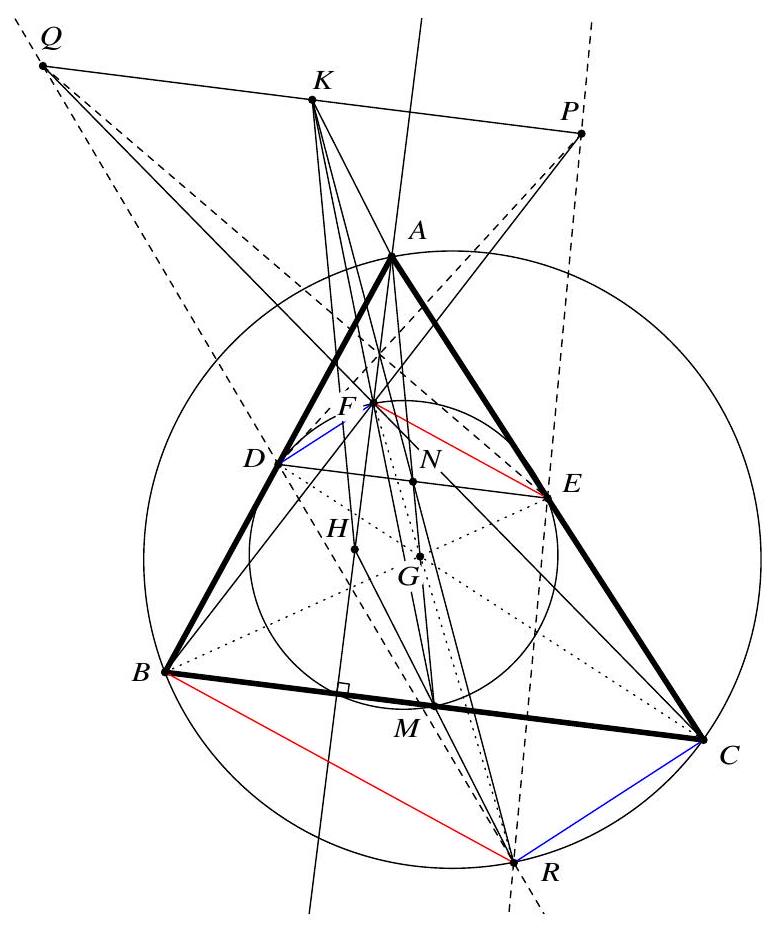\n\n## BxMO 2018: Problems and Solutions", "metadata": {"resource_path": "Benelux_MO/segmented/Benelux_en-olympiad_en-bxmo-problems-2018-zz.jsonl", "problem_match": "# Problem 3", "solution_match": "\nSolution 6"}} |
| {"year": "2018", "tier": "T3", "problem_label": "3", "problem_type": null, "exam": "Benelux_MO", "problem": "Let $A B C$ be a triangle with orthocentre $H$, and let $D, E$, and $F$ denote the respective midpoints of line segments $A B, A C$, and $A H$. The reflections of $B$ and $C$ in $F$ are $P$ and $Q$, respectively.\n(a) Show that lines $P E$ and $Q D$ intersect on the circumcircle of triangle $A B C$.\n(b) Prove that lines $P D$ and $Q E$ intersect on line segment $A H$.\n(Merlijn Staps, the Netherlands)\n\n#", "solution": ". Let $M, N, K$ denote the respective midpoints of $[B C],[D E],[P Q]$. Thus the intersection $R$ of $P E$ and $Q D$ is the reflection of $K$ in $N$. Under reflection in $F, H \\mapsto A$ and $M \\mapsto K$. Hence $A K H M$ is a parallelogram, and so $\\overrightarrow{M N}=\\frac{1}{2} \\overrightarrow{M A}=\\frac{1}{2} \\overrightarrow{H K}$. Hence the intersection of $K N$ and $H M$ is $R$, and $R$ is the reflection of $H$ in $M$, which is well-known to lie on the circumcircle of $A B C$.", "metadata": {"resource_path": "Benelux_MO/segmented/Benelux_en-olympiad_en-bxmo-problems-2018-zz.jsonl", "problem_match": "# Problem 3", "solution_match": "\nSolution 7"}} |
| {"year": "2018", "tier": "T3", "problem_label": "3", "problem_type": null, "exam": "Benelux_MO", "problem": "Let $A B C$ be a triangle with orthocentre $H$, and let $D, E$, and $F$ denote the respective midpoints of line segments $A B, A C$, and $A H$. The reflections of $B$ and $C$ in $F$ are $P$ and $Q$, respectively.\n(a) Show that lines $P E$ and $Q D$ intersect on the circumcircle of triangle $A B C$.\n(b) Prove that lines $P D$ and $Q E$ intersect on line segment $A H$.\n(Merlijn Staps, the Netherlands)\n\n#", "solution": ". Take Cartesian coordinates $B(0,0), C(1,0), A(a, b), H(a, c)$. Then the coordinates of $D, E, F, P, Q$ are successively found to be\n\n$$\nD\\left(\\frac{a}{2}, \\frac{b}{2}\\right), \\quad E\\left(\\frac{1+a}{2}, \\frac{b}{2}\\right), \\quad F\\left(a, \\frac{b+c}{2}\\right), \\quad P(2 a, b+c), \\quad Q(2 a-1, b+c)\n$$\n\nHence the coordinates of the intersection $R(x, y)$ of $Q D$ and $P E$ satisfy\n\n$$\n\\frac{y-\\frac{b}{2}}{b+c-\\frac{b}{2}}=\\frac{x-\\frac{a}{2}}{2 a-1-\\frac{a}{2}}=\\frac{x-\\frac{a+1}{2}}{2 a-\\frac{a+1}{2}} \\quad \\Longrightarrow \\quad R(1-a,-c) .\n$$\n\nHence $R$ is the reflection of $H$ in the midpoint $M\\left(\\frac{1}{2}, 0\\right)$ of $[B C]$, and so lies on the circumcircle of $A B C$.\n(b) Solution 1. Lines $A F$ and $Q E$ are medians of triangle $C A Q$, and so, by the properties of the centroid, intersect at a point $S$ of $[A F]$ such that $|A S|=2|S F|$. Similarly, lines $A F$ and $P D$ are medians of triangle $B A P$, and so intersect at the same point $S$. Hence $P D$ and $Q E$ intersect on $[A H]$.", "metadata": {"resource_path": "Benelux_MO/segmented/Benelux_en-olympiad_en-bxmo-problems-2018-zz.jsonl", "problem_match": "# Problem 3", "solution_match": "\nSolution 8"}} |
| {"year": "2018", "tier": "T3", "problem_label": "3", "problem_type": null, "exam": "Benelux_MO", "problem": "Let $A B C$ be a triangle with orthocentre $H$, and let $D, E$, and $F$ denote the respective midpoints of line segments $A B, A C$, and $A H$. The reflections of $B$ and $C$ in $F$ are $P$ and $Q$, respectively.\n(a) Show that lines $P E$ and $Q D$ intersect on the circumcircle of triangle $A B C$.\n(b) Prove that lines $P D$ and $Q E$ intersect on line segment $A H$.\n(Merlijn Staps, the Netherlands)\n\n#", "solution": ". By construction, a homothety with ratio 2 centred at $A$ maps $[D F]$ and $[E F]$ onto $[B H]$ and $[C H]$, respectively, which are mapped in turn onto $[P A]$ and $[Q A]$ under reflection in $F$ by the results of (a). The composition of these maps is a homothety with centre $S$ and ratio -2 that maps $D$ and $E$ onto $P$ and $Q$, respectively. Hence $P D$ and $Q E$ intersect at $S$. Since this homothety leaves $A H$ invariant, $S$ lies on this line. Since the homothety has negative ratio, the centre lies on the line segment $[A F]$, completing the proof.\n\nRemark. This is a projective result: triangles $D F E$ and $P A Q$ are in axial perspective (at $\\infty$ ). Hence, by Desargues' theorem, they are in central perspective, and so lines $P D, Q E$, and $A F$ are concurrent.", "metadata": {"resource_path": "Benelux_MO/segmented/Benelux_en-olympiad_en-bxmo-problems-2018-zz.jsonl", "problem_match": "# Problem 3", "solution_match": "\nSolution 2"}} |
| {"year": "2018", "tier": "T3", "problem_label": "3", "problem_type": null, "exam": "Benelux_MO", "problem": "Let $A B C$ be a triangle with orthocentre $H$, and let $D, E$, and $F$ denote the respective midpoints of line segments $A B, A C$, and $A H$. The reflections of $B$ and $C$ in $F$ are $P$ and $Q$, respectively.\n(a) Show that lines $P E$ and $Q D$ intersect on the circumcircle of triangle $A B C$.\n(b) Prove that lines $P D$ and $Q E$ intersect on line segment $A H$.\n(Merlijn Staps, the Netherlands)\n\n#", "solution": ". The intersection $S$ of $P D$ and $Q E$ is the centroid of triangle $P Q R$, where $R$ is the intersection of $P E$ and $Q D$, as in (a). Hence, if $M, N, K$ denote the respective midpoints of $[B C],[D E],[P Q]$, then, by part (a), $\\overrightarrow{K S}=2 \\overrightarrow{S N}$. Moreover, since $K$ is the reflection of $M$ in $F, d(K, A H)=d(M, A H)=2 d(N, A H)$. It follows that $S$ lies on $A H$; since $K$ and $R$ lie on either side of $A M, S$ lies on [AH].", "metadata": {"resource_path": "Benelux_MO/segmented/Benelux_en-olympiad_en-bxmo-problems-2018-zz.jsonl", "problem_match": "# Problem 3", "solution_match": "\nSolution 3"}} |
| {"year": "2018", "tier": "T3", "problem_label": "3", "problem_type": null, "exam": "Benelux_MO", "problem": "Let $A B C$ be a triangle with orthocentre $H$, and let $D, E$, and $F$ denote the respective midpoints of line segments $A B, A C$, and $A H$. The reflections of $B$ and $C$ in $F$ are $P$ and $Q$, respectively.\n(a) Show that lines $P E$ and $Q D$ intersect on the circumcircle of triangle $A B C$.\n(b) Prove that lines $P D$ and $Q E$ intersect on line segment $A H$.\n(Merlijn Staps, the Netherlands)\n\n#", "solution": ". In Cartesian coordinates and using the results of (a), the coordinates of the intersection $S\\left(x^{\\prime}, y^{\\prime}\\right)$ of $Q E$ and $P D$ satisfy\n\n$$\n\\frac{y^{\\prime}-\\frac{b}{2}}{b+c-\\frac{b}{2}}=\\frac{x^{\\prime}-\\frac{a}{2}}{2 a-\\frac{a}{2}}=\\frac{x^{\\prime}-\\frac{a+1}{2}}{2 a-1-\\frac{a+1}{2}}\n$$\n\nHence $x^{\\prime}=a$, so $S$ lies on line $A H$. Further, $y^{\\prime}=\\frac{1}{3}(2 b+c)$. Without loss of generality, $b>0$. Then $c>0$ by definition, and so $c<y^{\\prime}<b$ or $c>y^{\\prime}>b$. Hence $S$ lies on line segment $[A H]$.\n\nRemark 1. Solutions 1 and 2 for part (b) have not used the fact that $H$ is the orthocentre of triangle $A B C$, and therefore show that the result of (b) remains true if $H$ is replaced with a general point $X$. The first part of the problem is in some sense independent of $H$, too. The argument of solutions 3,5 , and 7 for part (a) can be extended to yield the following result:\n\nLet $A B C$ be a triangle, and let $X$ be a point of the plane. Let $D, E$, and $Y$ denote the respective midpoints of $[A B],[A C]$, and $[A X]$. The reflections of $B$ and $C$ in $Y$ are $P$ and $Q$, respectively. Lines $P E$ and $Q D$ intersect on the circumcircle $\\omega$ of $A B C$ if and only if $X$ lies on the reflection of $\\omega$ in $[B C]$.\n\n## BxMO 2018: Problems and Solutions\n\nRemark 2. The intersection points of $P E, Q D$ and $P D, Q E$ are not well-defined if $P, Q, D, E$ lie on a line. In the notation of the analytic solution, this happens when $\\frac{b}{2}=b+c$, i.e. $c=-\\frac{b}{2}$. Computing the coordinates of $H$ explicitly using $B H \\perp A C$ yields $c=a(1-a) / b$, and so $P, Q, D, E$ are aligned if and only if $b^{2}=2 a(a-1)$, which is the equation of a hyperbola passing through $B$ and $C$. (These triangles have an obtuse angle, so this configuration cannot appear for acute-angled triangles.)\n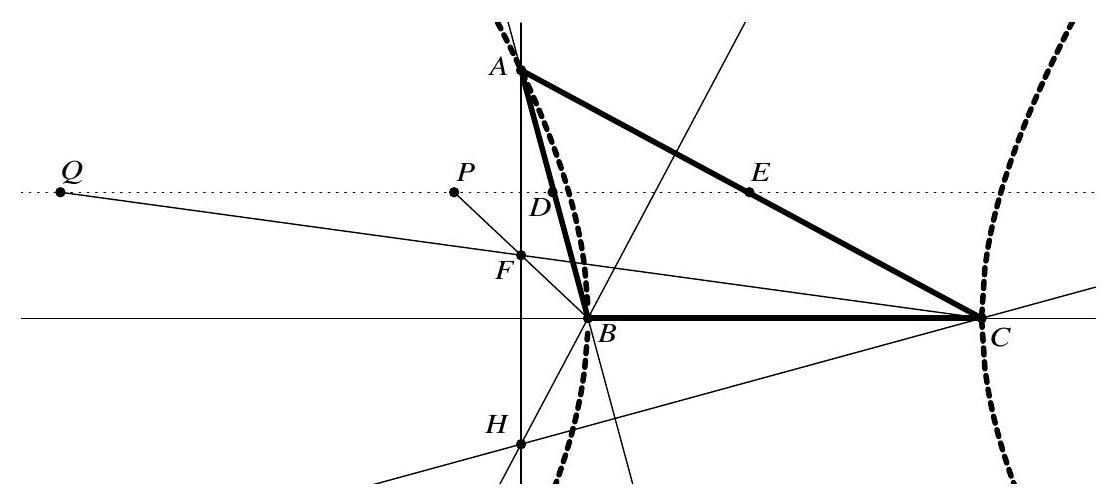\n\n## BxMO 2018: Problems and Solutions\n\n#", "metadata": {"resource_path": "Benelux_MO/segmented/Benelux_en-olympiad_en-bxmo-problems-2018-zz.jsonl", "problem_match": "# Problem 3", "solution_match": "\nSolution 4"}} |
| {"year": "2018", "tier": "T3", "problem_label": "4", "problem_type": null, "exam": "Benelux_MO", "problem": "An integer $n \\geqslant 2$ having exactly $s$ positive divisors $1=d_{1}<d_{2}<\\cdots<d_{s}=n$ is said to be good if there exists an integer $k$, with $2 \\leqslant k \\leqslant s$, such that $d_{k}>1+d_{1}+\\cdots+d_{k-1}$. An integer $n \\geqslant 2$ is said to be bad if it is not good.\n(a) Show that there are infinitely many bad integers.\n(b) Prove that, among any seven consecutive integers all greater than 2 , there are always at least four good integers.\n(c) Show that there are infinitely many sequences of seven consecutive good integers.\n(Gerhard Woeginger, Luxembourg)\n\n#", "solution": "(a) Solution 1. We note that $n=2^{m}$ has $m+1$ divisors, $d_{k}=2^{k-1}$ for $1 \\leqslant k \\leqslant m+1$. Thus\n\n$$\n1+d_{1}+\\cdots+d_{k-1}=1+\\left(2^{k-1}-1\\right)=2^{k-1}=d_{k}\n$$\n\nfor each $k \\geqslant 2$, and hence each power of 2 is a bad integer. This exhibits infinitely many bad integers.\nRemark. It is true more generally that\nIf $n=2^{r} m$, where $m$ is a product of (odd) primes each less than $2^{r+1}$, then $n$ is bad.\nThis is an immediate corollary of the previous result and the following observation:\nIf $n=2^{r} m$ is bad, where $m$ is odd, then so is $p n$ for any odd prime $p<2^{r+1}$.\nProof. Let $D_{K}>1$ be a divisor of $p n$, so $D_{K}=p$ or $D_{K}=d_{k}$ or $D_{K}=p d_{k}$, where $d_{k}>1$ is a divisor of $n$. In the first case, observe that there exists $t<r+1$ such that $2^{t}<p<2^{t+1}$ by assumption. Then $\\left\\{1,2, \\ldots, 2^{t}\\right\\} \\subseteq\\left\\{D_{1}, \\ldots, D_{K-1}\\right\\}$, and so\n\n$$\nD_{K}=p<2^{t+1}=1+\\left(1+2+\\cdots+2^{t}\\right) \\leqslant 1+D_{1}+\\cdots+D_{K-1}\n$$\n\nIn the final case, $\\left\\{1,2, \\ldots, 2^{t}, p d_{1}, \\ldots, p d_{k-1}\\right\\} \\subseteq\\left\\{D_{1}, \\ldots, D_{K-1}\\right\\}$, and so\n\n$$\n\\begin{aligned}\nD_{K} & =p d_{k} \\leqslant p\\left(1+d_{1}+\\cdots+d_{k-1}\\right)=p+p d_{1}+\\cdots+p d_{k} \\\\\n& <2^{t+1}+p d_{1}+\\cdots+p d_{k-1}=1+\\left(1+\\cdots+2^{t}\\right)+p d_{1}+\\cdots+p d_{k-1}<1+\\left(D_{1}+\\cdots+D_{K-1}\\right)\n\\end{aligned}\n$$\n\nIn the second case, $\\left\\{d_{1}, \\ldots, d_{k-1}\\right\\} \\subseteq\\left\\{D_{1}, \\ldots, D_{K-1}\\right\\}$ immediately implies the required inequality, and so $p n$ is indeed bad.\nThis result is weak, however: only 57931 (6.99\\%) of the 829157 bad numbers not larger than $10^{7}$ are of this form.", "metadata": {"resource_path": "Benelux_MO/segmented/Benelux_en-olympiad_en-bxmo-problems-2018-zz.jsonl", "problem_match": "# Problem 4", "solution_match": "# Solution\n"}} |
| {"year": "2018", "tier": "T3", "problem_label": "4", "problem_type": null, "exam": "Benelux_MO", "problem": "An integer $n \\geqslant 2$ having exactly $s$ positive divisors $1=d_{1}<d_{2}<\\cdots<d_{s}=n$ is said to be good if there exists an integer $k$, with $2 \\leqslant k \\leqslant s$, such that $d_{k}>1+d_{1}+\\cdots+d_{k-1}$. An integer $n \\geqslant 2$ is said to be bad if it is not good.\n(a) Show that there are infinitely many bad integers.\n(b) Prove that, among any seven consecutive integers all greater than 2 , there are always at least four good integers.\n(c) Show that there are infinitely many sequences of seven consecutive good integers.\n(Gerhard Woeginger, Luxembourg)\n\n#", "solution": ". We claim that $n=m$ ! is bad for each integer $m \\geqslant 2$. The proof proceeds by induction on $m$, the case $m=2$ being clear. If $D_{K}>1$ is a divisor of $m$ !, then $D_{K}=d_{k}$ or $D_{K}=q$ or $D_{K}=q d_{k}$, where $d_{k}>1$ is a divisor of $(m-1)$ ! and $q>1$ is a divisor of $m$. In the first case, $\\left\\{d_{1}, \\ldots, d_{k-1}\\right\\} \\subseteq\\left\\{D_{1}, \\ldots, D_{K-1}\\right\\}$, so, invoking the inductive hypothesis, $D_{K}=d_{k} \\leqslant 1+\\left(d_{1}+\\cdots+d_{k-1}\\right) \\leqslant 1+\\left(D_{1}+\\cdots+D_{K-1}\\right)$. In the second case, $q \\leqslant m+1$, so $1,2, \\ldots, q-1 \\mid m$ ! and $\\{1,2, \\ldots, q-1\\} \\subseteq\\left\\{D_{1}, \\ldots, D_{K-1}\\right\\}$. But $q^{2}-3 q+2 \\geqslant 0$ for $q \\geqslant 2$, and hence\n\n$$\nD_{K}=q \\leqslant \\frac{q^{2}-q+2}{2}=1+(1+\\cdots+q-1) \\leqslant 1+\\left(D_{1}+\\cdots+D_{K-1}\\right)\n$$\n\nIn the final case, $\\left\\{1,2, \\ldots, q-1, q d_{1}, \\ldots, q d_{k-1}\\right\\} \\subseteq\\left\\{D_{1}, \\ldots, D_{K-1}\\right\\}$, and so\n\n$$\nD_{K}=q d_{k} \\leqslant q\\left(1+d_{1}+\\cdots+d_{k-1}\\right) \\leqslant 1+(1+\\cdots+q-1)+\\left(q d_{1}+\\cdots+q d_{k-1}\\right)\n$$\n\nand so $D_{K} \\leqslant 1+\\left(D_{1}+\\cdots+D_{K-1}\\right)$, completing the inductive step.\n\n## BxMO 2018: Problems and Solutions\n\n(b) If $n$ is odd, then $d_{1}=1, d_{2}>2=1+d_{1}$, and $n$ is good. Among any seven consecutive positive integers, there are either four odd integers and three even ones, or four even ones and three odd ones. In the first case, these four odd integers are good. In the second case, we have to show that one of the consecutive even integers $n=2 m, n+2=2(m+1), n+4=2(m+2), n+6=2(m+3)$ is good. Notice that even integers of the form $n=2(6 \\ell \\pm 1)$, for $\\ell \\geqslant 1$, are good, since $d_{2}=2<n$ as $\\ell \\geqslant 1$, but $d_{3}>4=1+1+2$, since they are divisible by neither 3 nor 4 . But at least one $m, m+1, m+2, m+3$ is congruent to $\\pm 1(\\bmod 6)($ and larger than 1 by assumption); this completes the proof.\n(c) Solution 1. Let $n=12 q$, an even number. By part (b), $n-3, n-2=2(6 q-1), n-1, n+1, n+2=2(6 q+1), n+3$ are good integers. Take $q>29$ to be prime. Then the divisors of $n$ less than $q$ are precisely the divisors of 12 . Now $q>1+(1+2+3+4+6+12)=29$, and so $n$ is good, too. Since there are infinitely many choices of the prime $q$, there are infinitely many sequences of seven consecutive good integers.", "metadata": {"resource_path": "Benelux_MO/segmented/Benelux_en-olympiad_en-bxmo-problems-2018-zz.jsonl", "problem_match": "# Problem 4", "solution_match": "\nSolution 2"}} |
| {"year": "2018", "tier": "T3", "problem_label": "4", "problem_type": null, "exam": "Benelux_MO", "problem": "An integer $n \\geqslant 2$ having exactly $s$ positive divisors $1=d_{1}<d_{2}<\\cdots<d_{s}=n$ is said to be good if there exists an integer $k$, with $2 \\leqslant k \\leqslant s$, such that $d_{k}>1+d_{1}+\\cdots+d_{k-1}$. An integer $n \\geqslant 2$ is said to be bad if it is not good.\n(a) Show that there are infinitely many bad integers.\n(b) Prove that, among any seven consecutive integers all greater than 2 , there are always at least four good integers.\n(c) Show that there are infinitely many sequences of seven consecutive good integers.\n(Gerhard Woeginger, Luxembourg)\n\n#", "solution": ". Let $m=2^{3} \\cdot 3^{2} \\cdot 5 \\cdot 7 \\cdot 11 \\cdot 13$. For any integer $k>0$, the seven consecutive integers $m k+1, m k+2, \\ldots, m k+7$ are good. Indeed, the four odd numbers $m k+1, m k+3, m k+5, m k+7$ are good by part (b). Moreover,\n\n| $n$ | $d_{1}$ | $d_{2}$ | $d_{3}$ | $d_{4}$ | $d_{5}$ | |\n| :---: | :---: | :---: | :---: | :---: | :---: | :---: |\n| $m k+2$ | 1 | 2 | $\\geqslant 16$ | | | $\\Longrightarrow$ |\n| $m k+4$ | 1 | 2 | 4 | $\\geqslant 16$ | | $\\Longrightarrow$ |\n| $m k+6$ | 1 | 2 | 3 | 6 | $\\geqslant 16$ | $\\Longrightarrow$ |\n| $d_{4}>1+d_{1}+d_{2}$, | | | | | | |\n| $m+d_{2}+d_{3}$, | | | | | | |\n| $d_{5}>1+d_{1}+d_{2}+d_{3}+d_{4}$, | | | | | | |\n\nand so $m k+2, m k+4, m k+6$ are good integers, too. Hence there are infinitely many choices of seven consecutive good integers.\n\nRemark. This solution can also be phrased more indirectly in terms of congruence conditions modulo small remainders; the existence of infinitely many appropriate solutions is then guaranteed by the Chinese Remainder Theorem.", "metadata": {"resource_path": "Benelux_MO/segmented/Benelux_en-olympiad_en-bxmo-problems-2018-zz.jsonl", "problem_match": "# Problem 4", "solution_match": "\nSolution 2"}} |
| {"year": "2018", "tier": "T3", "problem_label": "4", "problem_type": null, "exam": "Benelux_MO", "problem": "An integer $n \\geqslant 2$ having exactly $s$ positive divisors $1=d_{1}<d_{2}<\\cdots<d_{s}=n$ is said to be good if there exists an integer $k$, with $2 \\leqslant k \\leqslant s$, such that $d_{k}>1+d_{1}+\\cdots+d_{k-1}$. An integer $n \\geqslant 2$ is said to be bad if it is not good.\n(a) Show that there are infinitely many bad integers.\n(b) Prove that, among any seven consecutive integers all greater than 2 , there are always at least four good integers.\n(c) Show that there are infinitely many sequences of seven consecutive good integers.\n(Gerhard Woeginger, Luxembourg)\n\n#", "solution": ". Let $m=29$ !. For any integer $k>0$, the seven consecutive integers $m k+1, m k+2, \\ldots, m k+7$ are good. Indeed, the divisors of these numbers are either at most 7 or at least 30 . But $30>1+(1+2+\\cdots+7)=29$, and so these seven integers are good, giving infinitely many sequences of seven consecutive good integers.\n\nRemark. The ideas underlying these different solutions can be extended to show that there are arbitrarily long runs of consecutive good integers:\n\nFor each integer $N$, there exist $N$ consecutive good integers.\nProof 1 . Let $M=2+(1+2+\\cdots+N)$, and let $m=M$ !. Any divisor of any of the $N$ consecutive integers $m+1, m+2, \\ldots, m+N$ is either at most $N$ or at least $M$. But $M>1+(1+2+\\cdots+N)$, and so these $N$ consecutive integers are good.\nProof 2. Let $2=p_{1}<p_{2}<\\cdots$ denote the prime numbers, and choose positive integers $s$ and $\\alpha_{1}, \\ldots, \\alpha_{s}$ such that $1,2, \\ldots, N$ divide $P=p_{1}^{\\alpha_{1}} p_{2}^{\\alpha_{2}} \\cdots p_{s}^{\\alpha_{s}}$. Let $\\sigma(n)$ denote the sum of the divisors of $n$. Choose an integer $t$ such that $p_{t}>\\sigma(P)$, let $m=p_{1} p_{2} \\cdots p_{t} P$. The $N$ consecutive integers $m+1, m+2, \\ldots, m+N$ are all good. Indeed, for $1 \\leqslant k \\leqslant N$, any divisor of $m+k$ is either at most $k$ or at least $p_{t+1}$. But $p_{t+1}>1+p_{t}>1+\\sigma(P)>1+\\sigma(k)$, since $k \\mid P$. This completes the proof.", "metadata": {"resource_path": "Benelux_MO/segmented/Benelux_en-olympiad_en-bxmo-problems-2018-zz.jsonl", "problem_match": "# Problem 4", "solution_match": "\nSolution 3"}} |
|
|


