| {"year": "2022", "tier": "T3", "problem_label": "1", "problem_type": null, "exam": "Benelux_MO", "problem": "Let $n \\geqslant 0$ be an integer, and let $a_{0}, a_{1}, \\ldots, a_{n}$ be real numbers. Show that there exists $k \\in\\{0,1, \\ldots, n\\}$ such that\n\n$$\na_{0}+a_{1} x+a_{2} x^{2}+\\cdots+a_{n} x^{n} \\leqslant a_{0}+a_{1}+\\cdots+a_{k}\n$$\n\nfor all real numbers $x \\in[0,1]$.\n\n#", "solution": "The case $n=0$ is trivial; for $n>0$, the proof goes by induction on $n$. We need to make one preliminary observation:\n\nClaim. For all reals $a, b, a+b x \\leqslant \\max \\{a, a+b\\}$ for all $x \\in[0,1]$.\nProof. If $b \\leqslant 0$, then $a+b x \\leqslant a$ for all $x \\in[0,1]$; otherwise, if $b>0, a+b x \\leqslant a+b$ for all $x \\in[0,1]$. This proves our claim.\n\nThis disposes of the base case $n=1$ of the induction: $a_{0}+a_{1} x \\leqslant \\max \\left\\{a_{0}, a_{0}+a_{1}\\right\\}$ for all $x \\in[0,1]$. For $n \\geqslant 2$, we note that, for all $x \\in[0,1]$,\n\n$$\n\\begin{aligned}\na_{0}+a_{1} x+\\cdots+a_{n} x^{n} & =a_{0}+x\\left(a_{1}+a_{2} x+\\cdots+a_{n} x^{n-1}\\right) \\\\\n& \\leqslant a_{0}+x\\left(a_{1}+a_{2}+\\cdots+a_{k}\\right) \\leqslant \\max \\left\\{a_{0}, a_{0}+\\left(a_{1}+\\cdots+a_{k}\\right)\\right\\},\n\\end{aligned}\n$$\n\nfor some $k \\in\\{1,2, \\ldots, n\\}$ by the inductive hypothesis and our earlier claim. This completes the proof by induction.\n\n#", "metadata": {"resource_path": "Benelux_MO/segmented/Benelux_en-olympiad_en-bxmo-problems-2022-zz.jsonl", "problem_match": "# Problem 1", "solution_match": "# Solution 1"}} |
| {"year": "2022", "tier": "T3", "problem_label": "1", "problem_type": null, "exam": "Benelux_MO", "problem": "Let $n \\geqslant 0$ be an integer, and let $a_{0}, a_{1}, \\ldots, a_{n}$ be real numbers. Show that there exists $k \\in\\{0,1, \\ldots, n\\}$ such that\n\n$$\na_{0}+a_{1} x+a_{2} x^{2}+\\cdots+a_{n} x^{n} \\leqslant a_{0}+a_{1}+\\cdots+a_{k}\n$$\n\nfor all real numbers $x \\in[0,1]$.\n\n#", "solution": "Define $s_{i}=a_{0}+a_{1}+\\cdots+a_{i}$ for $i \\in\\{0,1, \\ldots, n\\}$. Thus $a_{0}=s_{0}$ and $a_{i}=s_{i}-s_{i-1}$ for all $i \\in\\{1,2, \\ldots, n\\}$. Hence\n\n$$\n\\begin{aligned}\na_{0}+a_{1} x+a_{2} x^{2}+\\cdots+a_{n} x^{n} & =s_{0}+\\left(s_{1}-s_{0}\\right) x+\\left(s_{2}-s_{1}\\right) x^{2}+\\ldots+\\left(s_{n}-s_{n-1}\\right) x^{n} \\\\\n& =s_{0}(1-x)+s_{1}\\left(x-x^{2}\\right)+\\ldots+s_{n-1}\\left(x^{n-1}-x^{n}\\right)+s_{n} x^{n}\n\\end{aligned}\n$$\n\nNow choose $k \\in\\{0,1, \\ldots, n\\}$ such that $s_{k}=\\max \\left\\{s_{0}, s_{1}, \\ldots, s_{n}\\right\\}$. Using the inequality $x^{i-1}-x^{i} \\geqslant 0$, valid for all $i \\in\\{1,2, \\ldots, n\\}$ and all $x \\in[0,1]$, in the right-hand side above, it follows that\n\n$$\n\\begin{aligned}\na_{0}+a_{1} x+a_{2} x^{2}+\\cdots+a_{n} x^{n} \\leqslant s_{k}(1- & x)+s_{k}\\left(x-x^{2}\\right)+\\cdots+s_{k}\\left(x^{n-1}-x^{n}\\right)+s_{k} x^{n} \\\\\n& =s_{k}\\left[(1-x)+\\left(x-x^{2}\\right)+\\cdots+\\left(x^{n-1}-x^{n}\\right)+x^{n}\\right] \\\\\n& =s_{k}=a_{0}+a_{1}+\\cdots+a_{k} .\n\\end{aligned}\n$$\n\nThis completes the proof.\n\n## BxMO 2022: Problems and Solutions\n\n#", "metadata": {"resource_path": "Benelux_MO/segmented/Benelux_en-olympiad_en-bxmo-problems-2022-zz.jsonl", "problem_match": "# Problem 1", "solution_match": "# Solution 2"}} |
| {"year": "2022", "tier": "T3", "problem_label": "1", "problem_type": null, "exam": "Benelux_MO", "problem": "Let $n \\geqslant 0$ be an integer, and let $a_{0}, a_{1}, \\ldots, a_{n}$ be real numbers. Show that there exists $k \\in\\{0,1, \\ldots, n\\}$ such that\n\n$$\na_{0}+a_{1} x+a_{2} x^{2}+\\cdots+a_{n} x^{n} \\leqslant a_{0}+a_{1}+\\cdots+a_{k}\n$$\n\nfor all real numbers $x \\in[0,1]$.\n\n#", "solution": "The proof proceeds by induction on $n$. The base case $n=0$ is trivial. For $n \\geqslant 1$, since $x \\in[0,1]$, we have $x^{n} \\leqslant x^{n-1}$. Thus, if $a_{n} \\geqslant 0$, then $a_{n} x^{n} \\leqslant a_{n} x^{n-1}$, while, if $a_{n}<0$, then $a_{n} x^{n}<0$ trivially. This shows that $a_{n} x^{n} \\leqslant \\max \\left\\{0, a_{n} x^{n-1}\\right\\}$, whence\n\n$$\na_{0}+a_{1} x+\\cdots+a_{n-1} x^{n-1}+a_{n} x^{n} \\leqslant a_{0}+a_{1} x+\\cdots+\\max \\left\\{a_{n-1}, a_{n-1}+a_{n}\\right\\} x^{n-1}\n$$\n\nBy the inductive hypothesis, the polynomial of degree $n-1$ on the right-hand side is bounded above by $a_{0}+\\cdots+a_{k}$ for some $k \\in\\{0,1, \\ldots, n-2\\}$ or $a_{0}+\\cdots+a_{n-2}+\\max \\left\\{a_{n-1}, a_{n-1}+a_{n}\\right\\}$. But the latter is equal to one of $a_{0}+a_{1}+\\cdots+a_{n-1}$ or $a_{0}+a_{1}+\\cdots+a_{n}$; both are of the desired form, $a_{0}+a_{1}+\\cdots+a_{k}$ for some $k \\in\\{n-1, n\\}$. This completes the proof by induction.\n\n## BxMO 2022: Problems and Solutions\n\n#", "metadata": {"resource_path": "Benelux_MO/segmented/Benelux_en-olympiad_en-bxmo-problems-2022-zz.jsonl", "problem_match": "# Problem 1", "solution_match": "# Solution 3"}} |
| {"year": "2022", "tier": "T3", "problem_label": "2", "problem_type": null, "exam": "Benelux_MO", "problem": "Let $n$ be a positive integer. There are $n$ ants walking along a line at constant nonzero speeds. Different ants need not walk at the same speed or walk in the same direction. Whenever two or more ants collide, all the ants involved in this collision instantly change directions. (Different ants need not be moving in opposite directions when they collide, since a faster ant may catch up with a slower one that is moving in the same direction.) The ants keep walking indefinitely.\nAssuming that the total number of collisions is finite, determine the largest possible number of collisions in terms of $n$.\n\n#", "solution": "The order of the ants along the line does not change; denote by $v_{1}, v_{2}, \\ldots, v_{n}$ the respective speeds of ants $1,2, \\ldots, n$ in this order. If $v_{i-1}<v_{i}>v_{i+1}$ for some $i \\in\\{2, \\ldots, n-1\\}$, then, at each stage, ant $i$ can catch up with ants $i-1$ or $i+1$ irrespective of the latters' directions of motion, so the number of collisions is infinite. Hence, if the number of collisions is finite, then, up to switching the direction definining the order of the ants, (i) $v_{1} \\geqslant \\cdots \\geqslant v_{n}$ or (ii) $v_{1} \\geqslant \\cdots \\geqslant v_{k-1}>v_{k} \\leqslant \\cdots \\leqslant v_{n}$ for some $k \\in\\{2, \\ldots, n-1\\}$. We need the following observation:\n\nClaim. If $v_{1} \\geqslant \\cdots \\geqslant v_{m}$, then ants $m-1$ and $m$ collide at most $m-1$ times.\nProof. The proof goes by induction on $m$, the case $m=1$ being trivial. Since $v_{m-1} \\geqslant v_{m}$, ants $m-1$ and $m$ can only collide if the former is moving towards the latter. Hence, between successive collisions with ant $m$, ant $m-1$ must reverse direction by colliding with ant $m-2$. Since ants $m-1$ and $m-2$ collide at most $(m-1)-1=m-2$ times by the inductive hypothesis, ants $m$ and $m-1$ collide at most $(m-2)+1=m-1$ times.\n\nHence, in case (i), there are at most $0+1+\\cdots+(n-1)=n(n-1) / 2$ collisions. In case (ii), applying the claim to ants $1,2, \\ldots, k$ and also to ants $n, n-1, \\ldots, k$ by switching their order, the number of collisions is at most $k(k-1) / 2+(n-k+1)(n-k) / 2=n(n-1) / 2-(k-1)(n-k)<n(n-1) / 2$.\n\nNow take a coordinate $x$ along the line, and put ants at $x=1,2, \\ldots, n$ with positive initial velocities and speeds $v_{1}=\\cdots=v_{n-1}=1, v_{n}=\\varepsilon$, for some $\\varepsilon$. For $\\varepsilon=0$, collisions occur according to the pattern shown below for $n=5$, which clearly extends to all values of $n$ in such a way that ants $m$ and $m+1$ collide exactly $m$ times for $m=1,2, \\ldots, n-1$. This yield $1+2+\\cdots+(n-1)=n(n-1) / 2$ collisions in total. For all sufficiently small $\\varepsilon>0$, the number of collisions remains equal to $n(n-1) / 2$.\n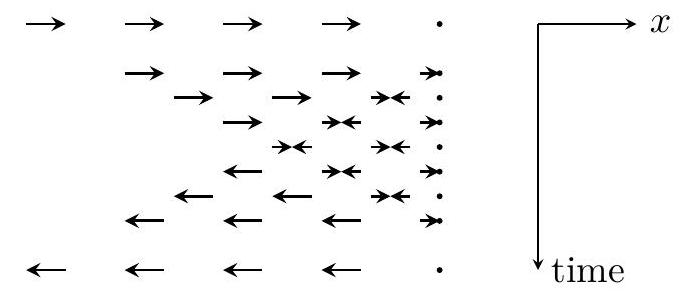\n\nThis shows that the upper bound obtained above can be attained. If the number of collisions is finite, the largest possible number of collisions is therefore indeed $n(n-1) / 2$.\n\n## BxMO 2022: Problems and Solutions\n\n#", "metadata": {"resource_path": "Benelux_MO/segmented/Benelux_en-olympiad_en-bxmo-problems-2022-zz.jsonl", "problem_match": "# Problem 2", "solution_match": "# Solution 1"}} |
| {"year": "2022", "tier": "T3", "problem_label": "2", "problem_type": null, "exam": "Benelux_MO", "problem": "Let $n$ be a positive integer. There are $n$ ants walking along a line at constant nonzero speeds. Different ants need not walk at the same speed or walk in the same direction. Whenever two or more ants collide, all the ants involved in this collision instantly change directions. (Different ants need not be moving in opposite directions when they collide, since a faster ant may catch up with a slower one that is moving in the same direction.) The ants keep walking indefinitely.\nAssuming that the total number of collisions is finite, determine the largest possible number of collisions in terms of $n$.\n\n#", "solution": "We show that there are at most $n(n-1) / 2$ collisions if the number of collisions is finite as in Solution 1.\nTo show that the upper bound of $n(n-1) / 2$ collisions can be attained, we construct, inductively, an example of $n$ ants colliding $n(n-1) / 2$ times, the speeds of the ants decrease from left to right, and after all collisions all ants move towards the left, with the possible exception of the rightmost ant. In every case, we will label the ants $1,2, \\ldots, n$ from left to right. For $n=1$ this is trivial. For $n \\geqslant 2$, we use the construction for $n-1$ ants (now labelled $2,3, \\ldots, n$ ). We add ant 1 on the left, moving towards the right, faster than all other ants (so that the speeds of the ants still decrease from left to right), and in such a way that its first collision (with ant 2) happens after all $(n-1)(n-2) / 2$ collisions of the other $n-1$ ants. Now the following events happen (in this order) for $i=1,2, \\ldots, n-2$ : ants $i$ and $i+1$ collide, after which ant $i$ moves to the left and ant $i+1$ moves to the right. These collisions do happen because the speeds of the ants decrease from left to right. Then ants $n-1$ and $n$ also collide, resulting in ant $n-1$ moving to the left. This shows that there are (at least) $(n-1)(n-2) / 2+(n-1)=n(n-1) / 2$ collisions. There are in fact no more collisions since the speeds of the ants decrease from left to right; alternatively, this follows from the upper bound proved previously. Since all ants except ant $n$ are moving towards the left after the collisions, this completes the inductive construction.\n\n## BxMO 2022: Problems and Solutions\n\n#", "metadata": {"resource_path": "Benelux_MO/segmented/Benelux_en-olympiad_en-bxmo-problems-2022-zz.jsonl", "problem_match": "# Problem 2", "solution_match": "# Solution 2"}} |
| {"year": "2022", "tier": "T3", "problem_label": "3", "problem_type": null, "exam": "Benelux_MO", "problem": "Let $A B C$ be a scalene acute triangle. Let $B_{1}$ be the point on ray $\\left[A C\\right.$ such that $\\left|A B_{1}\\right|=\\left|B B_{1}\\right|$. Let $C_{1}$ be the point on ray $\\left[A B\\right.$ such that $\\left|A C_{1}\\right|=\\left|C C_{1}\\right|$. Let $B_{2}$ and $C_{2}$ be the points on line $B C$ such that $\\left|A B_{2}\\right|=\\left|C B_{2}\\right|$ and $\\left|B C_{2}\\right|=\\left|A C_{2}\\right|$. Prove that $B_{1}, C_{1}, B_{2}, C_{2}$ are concyclic.\n\n#", "solution": "By construction, lines $B_{1} C_{2}$ and $B_{2} C_{1}$ bisect segments $[A B]$ and $[A C]$, respectively, so their intersection $O$ is the circumcentre of $A B C$. Hence $\\angle B O C=2 \\angle A$ and $\\angle C B O=\\angle O C B=90^{\\circ}-\\angle A$. Now, by construction, $\\angle O C_{1} B=90^{\\circ}-\\angle A=\\angle O C B$, so $B C_{1} C O$ is cyclic. Similarly, $B C B_{1} O$ is cyclic by construction because $\\angle O B_{1} C=180^{\\circ}-\\angle A B_{1} O=90^{\\circ}+\\angle A=180^{\\circ}-\\angle C B O$. In particular, $B C_{1} C B_{1}$ is cyclic, too.\n\nNow $\\angle B_{1} C_{1} B_{2}=\\angle B_{1} C_{1} B-\\angle B_{2} C_{1} B$ and $\\angle B_{1} C_{2} B_{2}=\\angle B_{1} C B-\\angle C B_{1} C_{2}$. But $\\angle B_{1} C_{1} B=\\angle B_{1} C B$ since $B C_{1} C B_{1}$ is cyclic and $\\angle B_{2} C_{1} B=\\angle O C_{1} B=90^{\\circ}-\\angle A=180^{\\circ}-\\angle O B_{1} C=\\angle C B_{1} C_{2}$. Hence $\\angle B_{1} C_{1} B_{2}=\\angle B_{1} C_{2} B_{2}$, so $B_{1} B_{2} C_{1} C_{2}$ is cyclic, as required.\n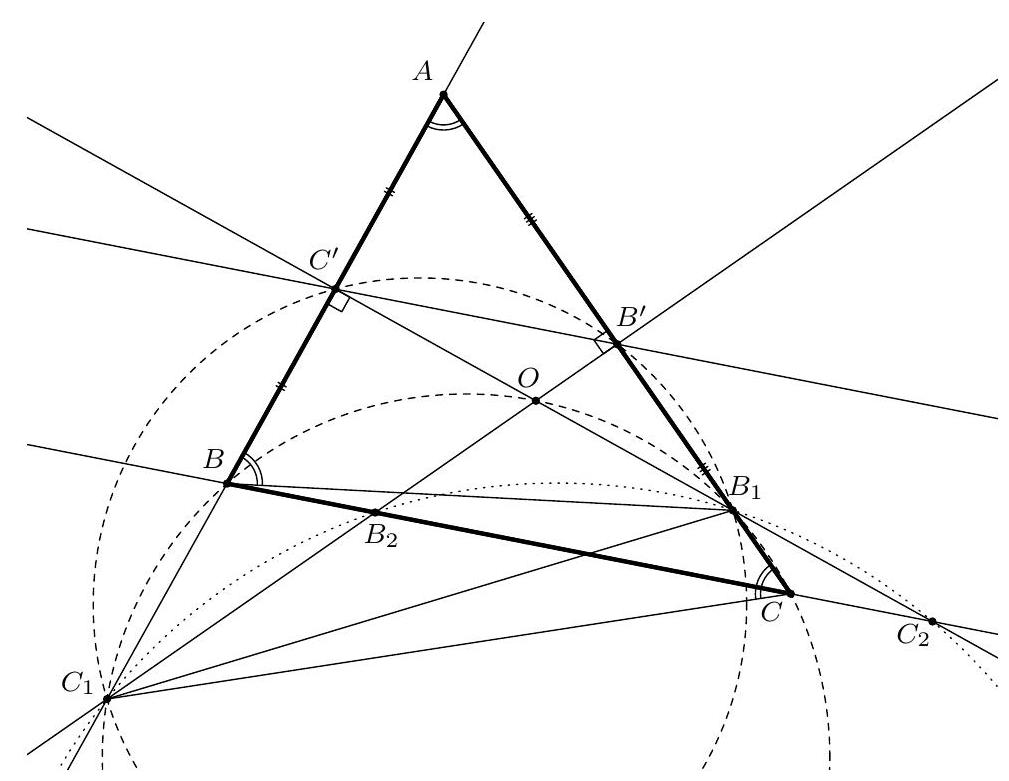\n\n#", "metadata": {"resource_path": "Benelux_MO/segmented/Benelux_en-olympiad_en-bxmo-problems-2022-zz.jsonl", "problem_match": "# Problem 3", "solution_match": "# Solution 1"}} |
| {"year": "2022", "tier": "T3", "problem_label": "3", "problem_type": null, "exam": "Benelux_MO", "problem": "Let $A B C$ be a scalene acute triangle. Let $B_{1}$ be the point on ray $\\left[A C\\right.$ such that $\\left|A B_{1}\\right|=\\left|B B_{1}\\right|$. Let $C_{1}$ be the point on ray $\\left[A B\\right.$ such that $\\left|A C_{1}\\right|=\\left|C C_{1}\\right|$. Let $B_{2}$ and $C_{2}$ be the points on line $B C$ such that $\\left|A B_{2}\\right|=\\left|C B_{2}\\right|$ and $\\left|B C_{2}\\right|=\\left|A C_{2}\\right|$. Prove that $B_{1}, C_{1}, B_{2}, C_{2}$ are concyclic.\n\n#", "solution": "The isosceles triangles $A B_{1} B$ and $A C_{1} C$ have equal base angles $\\angle B A B_{1}=\\angle C_{1} A C=\\angle A$, so are similar. In particular, $|A B| /\\left|A B_{1}\\right|=|A C| /\\left|A C_{1}\\right|$. Since $\\angle B A C=\\angle B_{1} A C_{1}=\\angle A$, it follows that triangles $A B C$ and $A B_{1} C_{1}$ are similar, too. In particular, $\\angle C B A=\\angle A B_{1} C_{1}$.\n\nBy construction, lines $B_{1} C_{2}$ and $B_{2} C_{1}$ are the respective perpendicular bisectors of $[A B]$ and $[A C]$, so meet them at their respective midpoints $C^{\\prime}$ and $B^{\\prime}$. Hence\n\n$$\n\\begin{aligned}\n\\angle B_{1} C_{2} B_{2} & =\\angle C^{\\prime} C_{2} B=90^{\\circ}-\\angle C_{2} B C^{\\prime}=90^{\\circ}-\\angle C B A=90^{\\circ}-\\angle A B_{1} C_{1}=90^{\\circ}-\\angle B^{\\prime} B_{1} C_{1} \\\\\n& =\\angle B_{1} C_{1} B^{\\prime}=\\angle B_{1} C_{1} B_{2} .\n\\end{aligned}\n$$\n\nHence $B_{1} C_{2} C_{1} B_{2}$ is cyclic, which completes the proof.\n\n## BxMO 2022: Problems and Solutions\n\n#", "metadata": {"resource_path": "Benelux_MO/segmented/Benelux_en-olympiad_en-bxmo-problems-2022-zz.jsonl", "problem_match": "# Problem 3", "solution_match": "# Solution 2"}} |
| {"year": "2022", "tier": "T3", "problem_label": "3", "problem_type": null, "exam": "Benelux_MO", "problem": "Let $A B C$ be a scalene acute triangle. Let $B_{1}$ be the point on ray $\\left[A C\\right.$ such that $\\left|A B_{1}\\right|=\\left|B B_{1}\\right|$. Let $C_{1}$ be the point on ray $\\left[A B\\right.$ such that $\\left|A C_{1}\\right|=\\left|C C_{1}\\right|$. Let $B_{2}$ and $C_{2}$ be the points on line $B C$ such that $\\left|A B_{2}\\right|=\\left|C B_{2}\\right|$ and $\\left|B C_{2}\\right|=\\left|A C_{2}\\right|$. Prove that $B_{1}, C_{1}, B_{2}, C_{2}$ are concyclic.\n\n#", "solution": "By construction, lines $B_{1} C_{2}$ and $B_{2} C_{1}$ are the respective perpendicular bisectors of $[A B]$ and $[A C]$, so meet them at their respective midpoints $C^{\\prime}$ and $B^{\\prime}$. Since $\\angle B_{1} C^{\\prime} C_{1}=90^{\\circ}=\\angle C_{1} B^{\\prime} B_{1}, B_{1} C_{1} C^{\\prime} B^{\\prime}$ is cyclic. Together with the fact that $B^{\\prime} C^{\\prime} \\| B C$ by construction, this implies\n\n$$\n\\angle B_{1} C_{2} B_{2}=\\angle C^{\\prime} C_{2} B=\\angle C_{2} C^{\\prime} B^{\\prime}=\\angle B_{1} C^{\\prime} B^{\\prime}=\\angle B_{1} C_{1} B^{\\prime}=\\angle B_{1} C_{1} B_{2},\n$$\n\nwhence $B_{1} C_{2} C_{1} B_{2}$ is cyclic. This completes the proof.\n\n# BxMO 2022: Problems and Solutions \n\n#", "metadata": {"resource_path": "Benelux_MO/segmented/Benelux_en-olympiad_en-bxmo-problems-2022-zz.jsonl", "problem_match": "# Problem 3", "solution_match": "# Solution 3"}} |
| {"year": "2022", "tier": "T3", "problem_label": "4", "problem_type": null, "exam": "Benelux_MO", "problem": "A subset $A$ of the natural numbers $\\mathbb{N}=\\{0,1,2, \\ldots\\}$ is called good if every integer $n>0$ has at most one prime divisor $p$ such that $n-p \\in A$.\n(a) Show that the set $S=\\{0,1,4,9, \\ldots\\}$ of perfect squares is good.\n(b) Find an infinite good set disjoint from $S$.\n(Two sets are disjoint if they have no common elements.)\n\n#", "solution": "(a) Suppose to the contrary that $S$ is not good, so there exists $n \\in \\mathbb{N}$ with two different prime factors $p \\neq q$ such that $n-p, n-q$ are perfect squares. In particular $n$ is not prime. Write $n-p=m^{2}$, for some $m \\in \\mathbb{N}$. As $p \\mid n$, it follows that $p \\mid m$ and hence $p^{2} \\mid m^{2}$ since $p$ is prime. Hence there exists $k \\in \\mathbb{N}$ such that $n-p=p^{2} k^{2}$. Similarly, there exists $\\ell \\in \\mathbb{N}$ such that $n-q=q^{2} \\ell^{2}$. We observe that $k, \\ell \\neq 0$ since $n$ is not prime.\nNow we have $p-q=(n-q)-(n-p)=(\\ell q-k p)(\\ell q+k p)$. Since $p-q \\neq 0, \\ell q-k p \\neq 0$, and hence $|p-q|=|k p-\\ell q||k p+\\ell q| \\geqslant|k p+\\ell q|=k p+\\ell q$. This is a contradiction however, because, since $k, \\ell \\neq 0$, it is clear that $k p+\\ell q \\geqslant p+q>|p-q|$. Hence $S$ is good.\n(b) Let $q$ be a prime, and let $Q=\\left\\{q, q^{3}, q^{5}, \\ldots\\right\\}$ be the (infinite) set of odd powers of $q$, which is disjoint from $S$. We claim that $Q$ is good. Indeed, let $n \\in \\mathbb{N}$, and let $p \\mid n$ be a prime such that $n-p \\in Q$, i.e. $n-p=q^{2 k+1}$ for some $k \\in \\mathbb{N}$. Then $p \\mid n-p$, so $p \\mid q^{2 k+1}$, and hence $p=q$. Thus $Q$ is good.\n\n#", "metadata": {"resource_path": "Benelux_MO/segmented/Benelux_en-olympiad_en-bxmo-problems-2022-zz.jsonl", "problem_match": "# Problem 4", "solution_match": "# Solution 1"}} |
| {"year": "2022", "tier": "T3", "problem_label": "4", "problem_type": null, "exam": "Benelux_MO", "problem": "A subset $A$ of the natural numbers $\\mathbb{N}=\\{0,1,2, \\ldots\\}$ is called good if every integer $n>0$ has at most one prime divisor $p$ such that $n-p \\in A$.\n(a) Show that the set $S=\\{0,1,4,9, \\ldots\\}$ of perfect squares is good.\n(b) Find an infinite good set disjoint from $S$.\n(Two sets are disjoint if they have no common elements.)\n\n#", "solution": "(a) Let $p \\mid n$ be a prime such that $n-p=p(n / p-1)=m^{2}$, for some $m \\in \\mathbb{N}$. Since $p \\mid m^{2}$ and $p$ is prime, $p^{2} \\mid m^{2}$, and hence $p \\mid n / p-1<n / p$, so $p<\\sqrt{n}$.\nNow suppose to the contrary that $S$ is not good, so there are primes $p_{1}>p_{2}$ dividing $n$ such that $n-p_{1}<n-p_{2}$ are perfect squares. Then\n\n$$\nn-p_{2} \\geqslant\\left(\\sqrt{n-p_{1}}+1\\right)^{2}>n-p_{1}+2 \\sqrt{n-p_{1}} \\quad \\Longrightarrow \\quad p_{1}>p_{2}+2 \\sqrt{n-p_{1}} \\geqslant 2+2 \\sqrt{n-p_{1}} .\n$$\n\nThe last condition implies that $p_{1}>2 \\sqrt{n-1}$. But $p_{1}<\\sqrt{n}$ by the first part, so $\\sqrt{n}>2 \\sqrt{n-1}$, which is a contradiction for $n>1$; the cases $n=0$ and $n=1$ are trivial. Thus $S$ is good.\n(b) We claim that the infinite set $P=\\{3,5,7,11, \\ldots\\}$ of odd primes, which is disjoint from $S$, is good. Indeed, let $n \\in \\mathbb{N}$ and let $p \\mid n$ be a prime such that $n-p=q$, for some odd prime $q$. Then $p \\mid n-p$, so $p \\mid q$, i.e. $p=q$, and hence $n=2 q$. Since $q$ is the only odd prime divisor of $n=2 q$, $P$ is good.\nThe set $P^{\\prime}=\\{2,3,5,7,11, \\ldots\\}$ of all primes is also good. The proof is similar: let $n \\in \\mathbb{N}$ and let $p \\mid n$ be a prime such that $n-p=q$, for some prime $q$. Then $p \\mid n-p$, so $p \\mid q$, i.e. $p=q$, and hence $n=2 q$. If $q=2$, then 2 is the only prime divisor of $n$; if $q \\neq 2$, then the only prime divisor of $n$, apart from $q$, is 2 . However, $n-2=2(q-1) \\notin P^{\\prime}$ since $q-1>1$. Hence $P^{\\prime}$ is good.\n\n# BxMO 2022: Problems and Solutions \n\n#", "metadata": {"resource_path": "Benelux_MO/segmented/Benelux_en-olympiad_en-bxmo-problems-2022-zz.jsonl", "problem_match": "# Problem 4", "solution_match": "# Solution 2"}} |
| {"year": "2022", "tier": "T3", "problem_label": "4", "problem_type": null, "exam": "Benelux_MO", "problem": "A subset $A$ of the natural numbers $\\mathbb{N}=\\{0,1,2, \\ldots\\}$ is called good if every integer $n>0$ has at most one prime divisor $p$ such that $n-p \\in A$.\n(a) Show that the set $S=\\{0,1,4,9, \\ldots\\}$ of perfect squares is good.\n(b) Find an infinite good set disjoint from $S$.\n(Two sets are disjoint if they have no common elements.)\n\n#", "solution": "(a) Suppose to the contrary that $S$ is not good, so there exists $n \\in \\mathbb{N}$ with two different prime factors $p \\neq q$ such that $n-p, n-q$ are perfect squares. Write $n-p=m^{2}$, for some $m \\in \\mathbb{N}$. As $p \\mid n$, it follows that $p \\mid m$ and hence $p^{2} \\mid m^{2}$ since $p$ is prime. Hence there exists $k \\in \\mathbb{N}$ such that $n-p=p^{2} k^{2}$. Similarly, there exists $\\ell \\in \\mathbb{N}$ such that $n-q=q^{2} \\ell^{2}$. By construction, $n$ is not prime, so $n-p, n-q \\neq 0$, whence $k, \\ell \\geqslant 1$.\nHence $p^{2} k^{2}+p=q^{2} \\ell^{2}+q$. Hence $p^{2} k^{2}<p^{2} k^{2}+p=q^{2} \\ell^{2}+q<q^{2} \\ell^{2}+2 q \\ell+1=(q \\ell+1)^{2}$. Similarly, $q^{2} \\ell^{2}<(p k+1)^{2}$, whence $q \\ell-1<p k<q \\ell+1$. It follows that $p k=q \\ell$, so $p^{2} k^{2}+p=q^{2} \\ell^{2}+q$ yields the contradiction $p=q$. Hence $S$ is good.\n(b) Let $A$ be a finite good set such that $0 \\notin A$, and let $m=\\max A$. Let $a \\geqslant 2 m+1$ be an integer. We claim that $A^{\\prime}=A \\cup\\{a\\}$ is good. Indeed, suppose to the contrary that there exist $n \\in \\mathbb{N}$ and primes $p, q \\mid n$ with $p \\neq q$ such that $n-p, n-q \\in A^{\\prime}$. If $n<a$, then $n-p, n-q \\in A$, which is a contradiction because $A$ is good. Hence $n \\geqslant a$. Now $p \\mid n-p$, so $n-p \\geqslant p$ since $0 \\notin A^{\\prime}$. Thus $p \\leqslant n / 2$ and hence $n-p \\geqslant n / 2 \\geqslant a / 2>m$. Similarly, $n-q>m$. It follows that $n-p=n-q=a$, which implies the contradiction $p=q$. Hence $A^{\\prime}$ is good.\nNow it is clear that any singleton set is good: indeed, if $A=\\{a\\}$, and $n \\in \\mathbb{N}$ has prime divisors $p, q$ such that $n-p, n-q \\in A$, then $n-p=a=n-q$, so $p=q$. Starting from the singleton $T_{1}=\\{2\\}$, we use the above construction to obtain, iteratively, good sets $T_{2}, T_{3}, \\ldots$ of $2,3, \\ldots$ elements. It is clearly possibly to ensure that they are each disjoint from $S$ by not adding a perfect square at any stage. Then $T=T_{1} \\cup T_{2} \\cup \\cdots$ is an infinite good set disjoint from $S$.", "metadata": {"resource_path": "Benelux_MO/segmented/Benelux_en-olympiad_en-bxmo-problems-2022-zz.jsonl", "problem_match": "# Problem 4", "solution_match": "# Solution 3"}} |
|
|


