| {"year": "2023", "tier": "T3", "problem_label": "1", "problem_type": null, "exam": "Benelux_MO", "problem": "Find all functions $f: \\mathbb{R} \\rightarrow \\mathbb{R}$ such that\n\n$$\n(x-y)(f(x)+f(y)) \\leqslant f\\left(x^{2}-y^{2}\\right) \\quad \\text { for all } x, y \\in \\mathbb{R}\n$$\n\n#", "solution": "Clearly, $f(x)=c x$ is a solution for each $c \\in \\mathbb{R}$ since $(x-y)(c x+c y)=c\\left(x^{2}-y^{2}\\right)$. To show that there are no other solutions, we observe that\n(1) $x=y: \\quad 0 \\leqslant f(0)$;\n$x=1, y=0: \\quad f(0)+f(1) \\leqslant f(1) \\Rightarrow f(0) \\leqslant 0$, whence $f(0)=0 ;$\n(2) $y=-x: \\quad 2 x(f(x)+f(-x)) \\leqslant f(0)=0$;\n$x \\rightarrow-x: \\quad-2 x(f(-x)+f(x)) \\leqslant 0 \\Rightarrow 2 x(f(x)+f(-x)) \\geqslant 0 ;$\nthus $2 x(f(x)+f(-x))=0$ for all $x$, so $f(-x)=-f(x)$ for all $x \\neq 0$, and hence for all $x$, since $f(0)=0$;\n(3) $x \\leftrightarrow y: \\quad(y-x)(f(y)+f(x)) \\leqslant f\\left(y^{2}-x^{2}\\right)=-f\\left(x^{2}-y^{2}\\right) \\Rightarrow(x-y)(f(x)+f(y)) \\geqslant f\\left(x^{2}-y^{2}\\right)$;\nwhich is the given inequality with the inequality sign reversed, so $(x-y)(f(x)+f(y))=f\\left(x^{2}-y^{2}\\right)$ must hold for all $x, y \\in \\mathbb{R}$;\n(4) $y \\leftrightarrow-y: \\quad(x-y)(f(x)+f(y))=f\\left(x^{2}-y^{2}\\right)=f\\left(x^{2}-(-y)^{2}\\right)=(x+y)(f(x)+f(-y))=(x+y)(f(x)-f(y))$; expanding yields $f(x) y=f(y) x$ for all $x, y \\in \\mathbb{R}$.\nTaking $y=1$ in the last result, $f(x)=f(1) x$, i.e. $f(x)=c x$, where $c=f(1)$, for all $x \\in \\mathbb{R}$. Since we have shown above that, conversely, all such functions are solutions, this completes the proof.\n\nAlternative solution. A slight variation of this argument proves that $(x-y)(f(x)+f(y))=f\\left(x^{2}-y^{2}\\right)$ must hold for all $x, y \\in \\mathbb{R}$ as above, and then reaches $f(x)=c x$ as follows:\n(4) $y= \\pm 1: \\quad(x \\mp 1)(f(x) \\pm f(1))=f\\left(x^{2}-1\\right)$ using $f(-1)=-f(1)$ from (2);\nhence $(x-1)(f(x)+f(1))=(x+1)(f(x)-f(1)) \\Rightarrow f(x)=f(1) x=c x$, where $c=f(1)$, on expanding.\n\n# BxMO 2023: Problems and Solutions \n\n#", "metadata": {"resource_path": "Benelux_MO/segmented/Benelux_en-olympiad_en-bxmo-problems-2023-zz.jsonl", "problem_match": "# Problem 1", "solution_match": "# Solution\n"}} |
| {"year": "2023", "tier": "T3", "problem_label": "2", "problem_type": null, "exam": "Benelux_MO", "problem": "Determine all integers $k \\geqslant 1$ with the following property: given $k$ different colours, if each integer is coloured in one of these $k$ colours, then there must exist integers $a_{1}<a_{2}<\\cdots<a_{2023}$ of the same colour such that the differences $a_{2}-a_{1}, a_{3}-a_{2}, \\ldots, a_{2023}-a_{2022}$ are all powers of 2 .\n\n#", "solution": "We claim that only $k=1$ and $k=2$ satisfy the required property. First, if $k \\geqslant 3$, we colour each integer with its residue class modulo 3, so that, whenever two integers have the same colour, their difference is divisible by 3 , so is not a power of 2 . This shows that no $k \\geqslant 3$ has the required property.\n\nIn the case $k=1$, the sequence defined by $a_{n}=2 n$ for $n=1,2, \\ldots, 2023$ clearly has the required property. In the case $k=2$, we call the colours \"red\" and \"blue\", and construct, for each $n \\geqslant 1$ and by induction, integers $a_{1}<a_{2}<\\cdots<a_{n}$ of the same colour such that $a_{m+1}-a_{m}$ is a power of 2 for $m=1,2, \\ldots, n-1$. The statement is trivial for $n=1$. For $n>1$, let $a_{1}<a_{2}<\\cdots<a_{n}$ be red integers (without loss of generality) having the desired property. Consider the $n+1$ integers $b_{i}=a_{n}+2^{i}$, for $i=1,2, \\ldots, n+1$. If one of these, say $b_{j}$, is red, then, as $b_{j}-a_{n}=2^{j}$, the $n+1$ red integers $a_{1}<a_{2}<\\cdots<a_{n}<b_{j}$ have the desired property. Otherwise, $b_{1}, b_{2}, \\ldots, b_{n+1}$ are all blue, and $b_{i+1}-b_{i}=\\left(a_{n}+2^{i+1}\\right)-\\left(a_{n}+2^{i}\\right)=2^{i}$ for $i=1,2, \\ldots, n$, so the $n+1$ blue integers $b_{1}<b_{2}<\\cdots<b_{n+1}$ have the desired property. This completes the inductive step and hence the proof.\n\n## BxMO 2023: Problems and Solutions\n\n#", "metadata": {"resource_path": "Benelux_MO/segmented/Benelux_en-olympiad_en-bxmo-problems-2023-zz.jsonl", "problem_match": "# Problem 2", "solution_match": "# Solution\n"}} |
| {"year": "2023", "tier": "T3", "problem_label": "3", "problem_type": null, "exam": "Benelux_MO", "problem": "Let $A B C$ be a triangle with incentre $I$ and circumcircle $\\omega$. Let $N$ denote the second point of intersection of line $A I$ and $\\omega$. The line through $I$ perpendicular to $A I$ intersects line $B C$, segment $[A B]$, and segment $[A C]$ at the points $D, E$, and $F$, respectively. The circumcircle of triangle $A E F$ meets $\\omega$ again at $P$, and lines $P N$ and $B C$ intersect at $Q$. Prove that lines $I Q$ and $D N$ intersect on $\\omega$.\n\n#", "solution": "By construction, $A P E F$ and $A P B C$ are cyclic, and so\n\n$$\n\\begin{aligned}\n\\angle B D E & =\\angle C D F=\\angle A F D-\\angle F C D=\\angle A F E-\\angle A C B=\\left(180^{\\circ}-\\angle E P A\\right)-\\left(180^{\\circ}-\\angle B P A\\right) \\\\\n& =\\angle B P A-\\angle E P A=\\angle B P E .\n\\end{aligned}\n$$\n\nHence $D B E P$ is cyclic, too. It follows that $\\angle I D P=\\angle E D P=\\angle E B P=\\angle A B P=\\angle A N P=\\angle I N P$ since $A P B N$ is cyclic, and so $P D N I$ is also cyclic. In particular, $\\angle D P N=\\angle D I N=90^{\\circ}$. Let $R$ denote the second intersection of $D P$ and $\\omega$, so $N Q \\perp D R$. Then $\\angle N P R=90^{\\circ}$, so $R N$ is a diameter of $\\omega$. It is well-known that $N$ is the midpoint of the arc $\\widehat{B C}$ not containing $A$, whence $R N \\perp B C$. Thus $D Q$ and $N Q$ are altitudes of triangle $R D N$, and so $Q$ is its orthocentre. This implies that $R Q \\perp D N$, whence, since $R N$ is a diameter of $\\omega$, the intersection $X$ of $R Q$ and $D N$ lies on $\\omega$.\n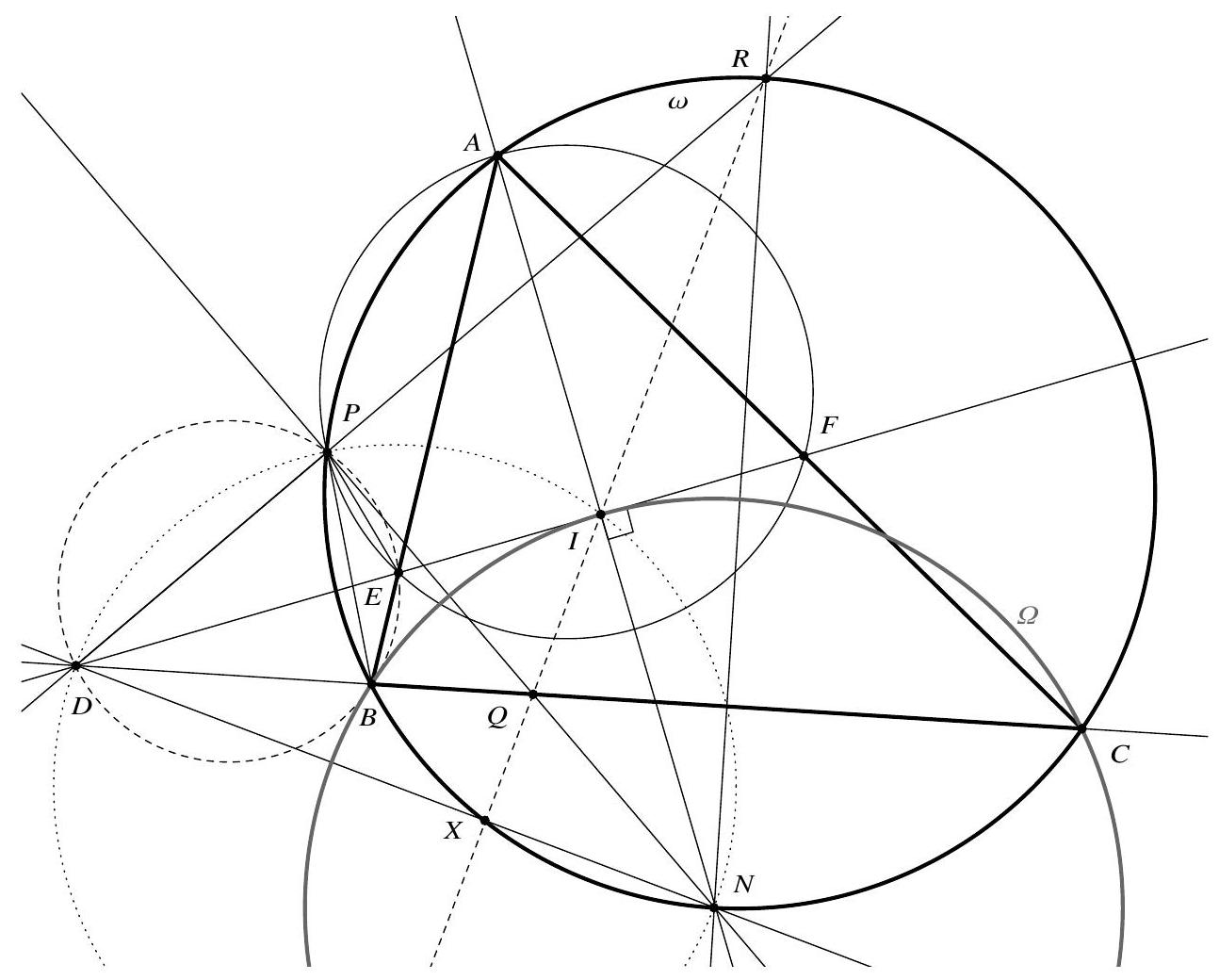\n\nIt is also well-known that $N$ is the centre of the circumcircle $\\Omega$ of triangle $B C I$. Since $D I \\perp I N$ by construction, $D I$ is tangent to $\\Omega$ at $I$. As $D$ lies on the radical axis $B C$ of $\\omega$ and $\\Omega$, it follows that $|D I|^{2}=|D B||D C|=|D X||D N|$. Hence triangles $D N I$ and $D I X$ are similar; in particular, $\\angle D X I=\\angle D I N=90^{\\circ}$. All of this shows that $R, I, Q, X$ lie on a line perpendicular to $D N$ that intersects $D N$ at $X \\in \\omega$. This completes the proof.\n\n## BxMO 2023: Problems and Solutions\n\n#", "metadata": {"resource_path": "Benelux_MO/segmented/Benelux_en-olympiad_en-bxmo-problems-2023-zz.jsonl", "problem_match": "# Problem 3", "solution_match": "# Solution 1"}} |
| {"year": "2023", "tier": "T3", "problem_label": "3", "problem_type": null, "exam": "Benelux_MO", "problem": "Let $A B C$ be a triangle with incentre $I$ and circumcircle $\\omega$. Let $N$ denote the second point of intersection of line $A I$ and $\\omega$. The line through $I$ perpendicular to $A I$ intersects line $B C$, segment $[A B]$, and segment $[A C]$ at the points $D, E$, and $F$, respectively. The circumcircle of triangle $A E F$ meets $\\omega$ again at $P$, and lines $P N$ and $B C$ intersect at $Q$. Prove that lines $I Q$ and $D N$ intersect on $\\omega$.\n\n#", "solution": "Let $K$ be the midpoint of segment [BC]. It is well-known that $N$ is the midpoint of the small arc $\\widehat{B C}$ of $\\omega$, so $B C \\perp K N$. In particular, $\\angle D K N=90^{\\circ}$. But $\\angle D I N=90^{\\circ}$ by construction, so $D I K N$ is cyclic, with circumcircle $\\Gamma$. Moreover, $\\angle P E F=180^{\\circ}-\\angle P A F=180^{\\circ}-\\angle P A B=\\angle P B C$ and $\\angle P F E=\\angle P A E=\\angle P A B=\\angle P C B$ since $A F E P$ and $A C B P$ are cyclic, so triangles $P E F$ and $P B C$ are similar. Now, by construction, $I$ is the midpoint of segment $[E F]$, so, $K$ being the midpoint of $[B C]$, triangles $P I F$ and $P K C$ are similar, too. It follows that $\\angle P I D=180^{\\circ}-\\angle P I F=180^{\\circ}-\\angle P K C=\\angle P K D$, whence $P$ lies on $\\Gamma$.\n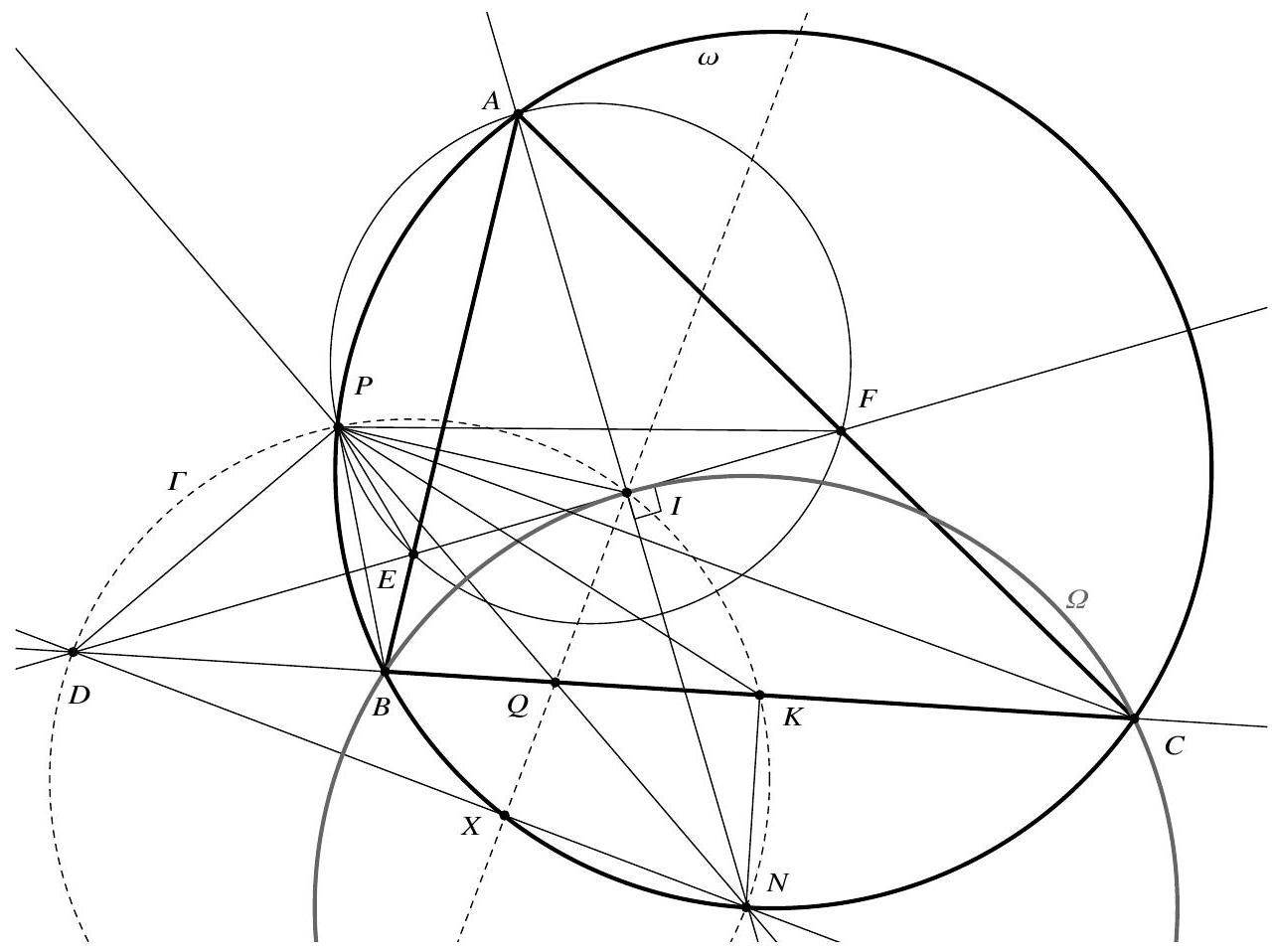\n\nLet $\\Omega$ be the circumcircle of triangle $B C I$. By construction, $Q$ lies on the radical axes $P N$ of $\\omega, \\Gamma$ and $B C$ of $\\omega, \\Omega$, so is the radical centre of $\\omega, \\Gamma, \\Omega$. In particular, $I Q$ is the radical axis of $\\Gamma, \\Omega$, so is perpendicular to the line joining the centres of $\\Gamma, \\Omega$. Now it is well-known that $N$ is the centre of $\\Omega$, and, since $\\angle D I N=90^{\\circ}$, the centre of $\\Gamma$ is the midpoint of segment $[D N]$. This shows that $I Q \\perp D N$.\n\nFinally, let $D N$ meet $\\omega$ again at $X$. Since $D I \\perp I N$ by construction and $N$ is the centre of $\\Omega, D I$ is tangent to $\\Omega$ at $I$. As $D$ lies on the radical axis $B C$ of $\\omega, \\Omega$, it follows that $|D I|^{2}=|D B||D C|=|D X||D N|$. Hence triangles $D N I$ and $D I X$ are similar; in particular, $\\angle D X I=\\angle D I N=90^{\\circ}$, i.e. $I X \\perp D N$. Since $I Q \\perp D N$, it follows that $X$ is the intersection of $I Q$ and $D N$. Since $X$ lies on $\\omega$ by construction, this completes the proof.\n\n#", "metadata": {"resource_path": "Benelux_MO/segmented/Benelux_en-olympiad_en-bxmo-problems-2023-zz.jsonl", "problem_match": "# Problem 3", "solution_match": "# Solution 2"}} |
| {"year": "2023", "tier": "T3", "problem_label": "3", "problem_type": null, "exam": "Benelux_MO", "problem": "Let $A B C$ be a triangle with incentre $I$ and circumcircle $\\omega$. Let $N$ denote the second point of intersection of line $A I$ and $\\omega$. The line through $I$ perpendicular to $A I$ intersects line $B C$, segment $[A B]$, and segment $[A C]$ at the points $D, E$, and $F$, respectively. The circumcircle of triangle $A E F$ meets $\\omega$ again at $P$, and lines $P N$ and $B C$ intersect at $Q$. Prove that lines $I Q$ and $D N$ intersect on $\\omega$.\n\n#", "solution": "Since $A P E F$ and $A P B C$ are cyclic,\n\n$$\n\\begin{aligned}\n\\angle C P F & =\\angle B P A-\\angle B P C-\\angle F P A=\\left(180^{\\circ}-\\angle B C A\\right)-\\angle B A C-\\angle F E A \\\\\n& =\\left(180^{\\circ}-\\angle B C A-\\angle B A C\\right)-\\angle B E D=\\angle C B A-\\angle B E D=\\angle C B E-\\angle B E D=\\angle B D E=\\angle C D F,\n\\end{aligned}\n$$\n\nso $D P F C$ is cyclic, too. Thence $\\angle C P D=\\angle C F D=180^{\\circ}-\\angle I F A=90^{\\circ}+\\angle I A F=90^{\\circ}+\\angle C A N=90^{\\circ}+\\angle C P N$. Hence $\\angle D P N=\\angle C P D-\\angle C P N=90^{\\circ}$. Since $\\angle D I N=90^{\\circ}$ by construction, it follows that DPIN is cyclic, with\n\n## BxMO 2023: Problems and Solutions\n\ncircumcircle $\\Gamma$. Let $J$ be the second intersection of line $I Q$ and $\\Gamma$. Moreover, it is well-known that $N$ is the centre of the circumcircle $\\Omega$ of BIC. In particular, $|N I|=|N B|$, and so, since $N I P J$ and $N B P C$ are cyclic,\n\n$$\n\\frac{|J Q|}{|J P|}=\\frac{|N Q|}{|N I|}=\\frac{|N Q|}{|N B|}=\\frac{|C Q|}{|C P|}\n$$\n\nLet $S$ now be the point of intersection of $P N$ and $\\Omega$ such that $P, N, S$ lie on line $P N$ in this order. By construction, $\\angle Q P C=\\angle N P C=\\angle N A C=\\angle B A N=\\angle B C N=\\angle Q C N$, so triangles $C Q N$ and $P C N$ are similar, whence\n\n$$\n\\frac{|C Q|}{|C P|}=\\frac{|N C|}{|N P|}=\\frac{|N Q|}{|N C|}=\\frac{|N C|+|N Q|}{|N C|+|N P|}=\\frac{|N S|+|N Q|}{|N S|+|N P|}=\\frac{|S Q|}{|S P|}\n$$\n\nCombining (1) and (2) shows that $C, J, S$ lie on a circle of Apollonius, the centre of which lies on the line through $P, Q, N, S$, so, since $|N C|=|N S|$ by construction, is $N$. In other words, $J$ lies on $\\Omega$.\n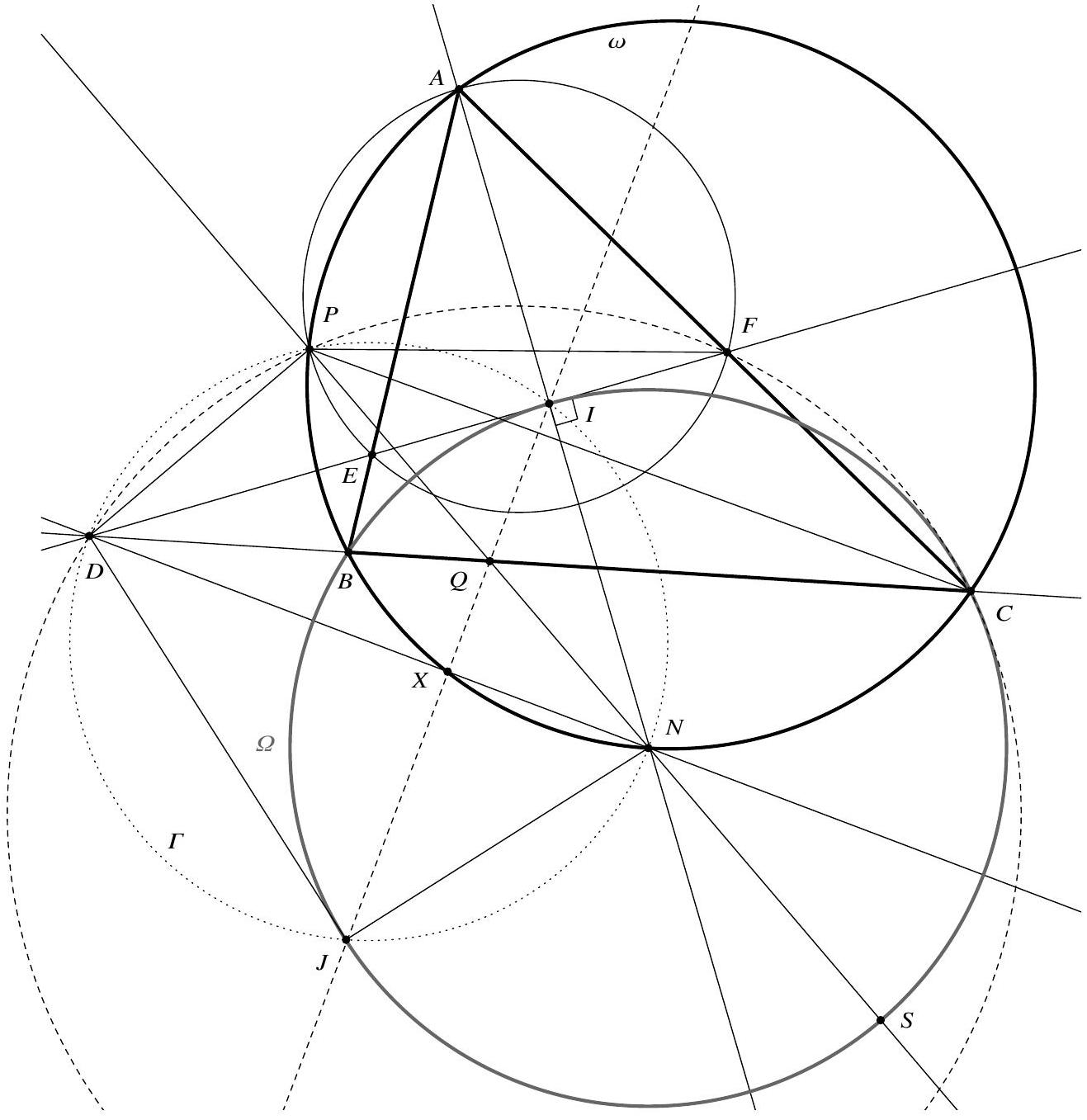\n\nIn particular, $|N I|=|N J|$. Now, by construction, $\\angle D I N=\\angle D J N=90^{\\circ}$, so the right-angled triangles $D I N$ and $D J N$ are congruent, whence $D I N J$ is a kite. In particular, $I J \\perp D N$. Since $Q$ lies on $I J$ by definition, this shows that $I Q \\perp D N$. We can now conclude as in Solution 2.\n\n#", "metadata": {"resource_path": "Benelux_MO/segmented/Benelux_en-olympiad_en-bxmo-problems-2023-zz.jsonl", "problem_match": "# Problem 3", "solution_match": "# Solution 3"}} |
| {"year": "2023", "tier": "T3", "problem_label": "3", "problem_type": null, "exam": "Benelux_MO", "problem": "Let $A B C$ be a triangle with incentre $I$ and circumcircle $\\omega$. Let $N$ denote the second point of intersection of line $A I$ and $\\omega$. The line through $I$ perpendicular to $A I$ intersects line $B C$, segment $[A B]$, and segment $[A C]$ at the points $D, E$, and $F$, respectively. The circumcircle of triangle $A E F$ meets $\\omega$ again at $P$, and lines $P N$ and $B C$ intersect at $Q$. Prove that lines $I Q$ and $D N$ intersect on $\\omega$.\n\n#", "solution": "By construction, $P$ is the Miquel point of quadrilateral $B C F E$ (and the resulting complete quadrilateral with points $A$ and $D$ added) because it is the intersection of $\\omega$ and the circumcircle of triangle $A E F$. In particular, $D B E P$ is\n\n## BxMO 2023: Problems and Solutions\n\ncyclic. It follows that $\\angle I D P=\\angle E D P=\\angle E B P=\\angle A B P=\\angle A N P=\\angle I N P$ since $A P B N$ is cyclic, and so $P D N I$ is also cyclic.\n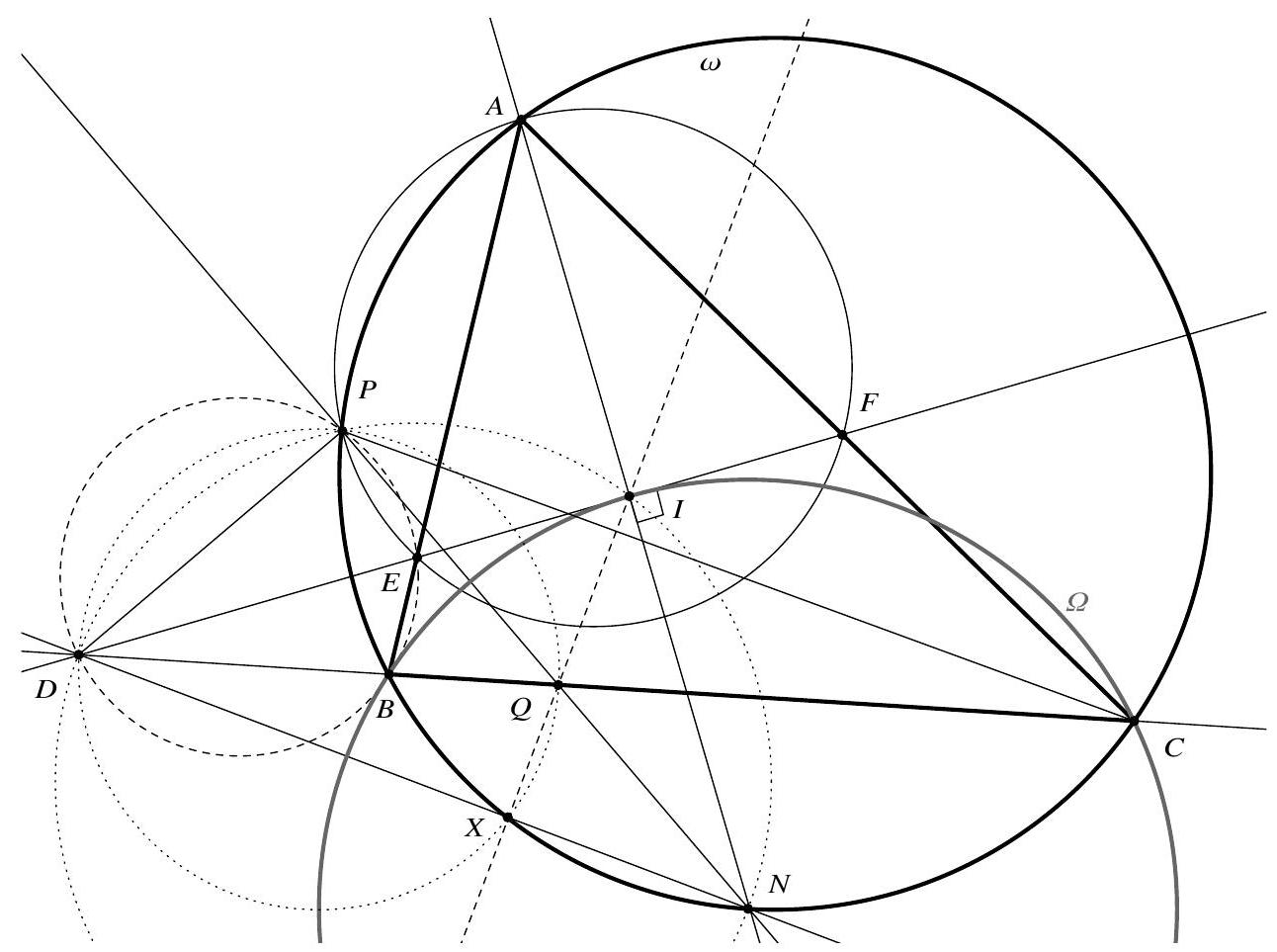\n\nNext, let $X$ be the intersection of $D N$ and $\\omega$ and let $A N$ meet $B C$ at $Y$. Then $\\angle N A C=\\angle A / 2=\\angle N C B$, so $\\angle B Y A=\\angle C+\\angle N A C=\\angle C+\\angle N C B=\\angle N C A$ and hence\n\n$$\n\\begin{aligned}\n\\angle D Q P & =\\angle N Q Y=\\angle Q Y A-\\angle Q N Y=\\angle B Y A-\\angle P N A \\\\\n& =\\angle N C A-\\angle P C A=\\angle P C N=180^{\\circ}-\\angle N X P=\\angle D X P\n\\end{aligned}\n$$\n\nThis implies that $D X Q P$ is cyclic. In particular, $Q X \\perp D N$. It now suffices to show that $I X \\perp D N$, which we do in the same way as in Solution 2.\n\n# BxMO 2023: Problems and Solutions \n\n#", "metadata": {"resource_path": "Benelux_MO/segmented/Benelux_en-olympiad_en-bxmo-problems-2023-zz.jsonl", "problem_match": "# Problem 3", "solution_match": "# Solution 4"}} |
| {"year": "2023", "tier": "T3", "problem_label": "4", "problem_type": null, "exam": "Benelux_MO", "problem": "A positive integer $n$ is friendly if every pair of neighbouring digits of $n$, written in base 10, differs by exactly 1. For example, 6787 is friendly, but 211 and 901 are not.\n\nFind all odd natural numbers $m$ for which there exists a friendly integer divisible by $64 m$.\n\n#", "solution": "Any friendly number divisible by 64 is divisible by 4 , and hence the number formed by its last two digits is a multiple of 4 , so ends in $00,04,08, \\ldots$, or 96 . A friendly number divisible by 4 must therefore end in $12,32,56$, or 76 , so cannot be divisible by 5 . In particular, if $5 \\mid \\mathrm{m}$, then there is no friendly integer divisible by 64 m .\n\nWe claim that conversely, if $m$ is odd and $5 \\nmid m$, then there exists a friendly integer divisible by $64 m$. First, we notice that $343232=64 \\cdot 5363$ is a friendly number divisible by 64 , and hence so is\n\n$$\nN_{k}=343232343232 \\cdots 343232=343232 \\cdot\\left(1+10^{6}+\\cdots+10^{6 k}\\right) \\quad \\text { for } k=0,1,2, \\ldots\n$$\n\nNow the sequence $N_{0}, N_{1}, N_{2}, \\ldots$ eventually repeats modulo $m$, i.e. there exist positive integers $k<\\ell$ such that $N_{\\ell} \\equiv N_{k}(\\bmod m)$. Hence $m \\mid N_{\\ell}-N_{k}=10^{6(k+1)} N_{\\ell-k-1}$. Since $m$ is odd and $5 \\nmid m,(10, m)=1$, so $m \\mid N_{\\ell-k-1}$. By construction, $64 \\mid N_{\\ell-k-1}$. Thus, as $m$ is odd and hence $(64, m)=1$, we conclude that $64 m \\mid N_{\\ell-k-1}$. This completes the proof.\n\nThe solution divides into two parts: (1) showing that, if $5 \\mid m$, then there is no friendly integer divisible by $64 m$; (2) showing that, if $5 \\nmid m$, then there is a friendly integer divisible by $64 m$.\n\nAlternative solution for part (1). If $5 \\mid m$, then $20 \\mid 64 m$. The last two digits of a multiple of 20 are $00,20,40,60$, or 80 , so this number is not friendly. Thus, if $m$ is odd and $5 \\mid m$, then there is no friendly integer divisible by $64 m$.\n\nAlternative solution for part (2). Notice that $N_{k}=343232 \\cdot\\left(10^{6(k+1)}-1\\right) /\\left(10^{6}-1\\right)$. Let $M=m\\left(10^{6}-1\\right)$. Since $5 \\nmid m$ and $m$ is odd, $(10, M)=1$, so, taking $k=\\varphi(M)-1$, we get $10^{6(k+1)}=10^{6 \\varphi(M)} \\equiv 1(\\bmod M)$ by the Euler-Fermat theorem, i.e. $m \\mid\\left(10^{6(k+1)}-1\\right) /\\left(10^{6}-1\\right)$, and hence $m \\mid N_{k}$.\n\nAlternative constructions of the integers $\\boldsymbol{N}_{\\boldsymbol{k}}$ for part (2). Direct calculation shows that friendly integers divisible by 64 end in $343232,543232,123456$, or 323456 , so the numbers $N_{k}$ defined in the solution of part (2) above may be replaced by, for instance,\n\n$$\n34543232 \\cdot\\left(1+10^{8}+\\cdots+10^{8 k}\\right), 5432123456 \\cdot\\left(1+10^{10}+\\cdots+10^{10 k}\\right), 54323456 \\cdot\\left(1+10^{8}+\\cdots+10^{8 k}\\right)\n$$\n\nRemark. Interestingly, friendly numbers cannot be divisible by arbitrarily high powers of 2. Direct calculation shows that the 60-digit friendly integer 101232121234323456543434343210121212323434343234565656543232 is divisible by $2^{60}$, but that there is no friendly integer divisible by $2^{61}$. The problem selection committee is not aware of a proof of this fact that eschews direct calculation.", "metadata": {"resource_path": "Benelux_MO/segmented/Benelux_en-olympiad_en-bxmo-problems-2023-zz.jsonl", "problem_match": "# Problem 4", "solution_match": "# Solution\n"}} |
|
|