| {"year": "2024", "tier": "T3", "problem_label": "1", "problem_type": null, "exam": "Benelux_MO", "problem": "(a) Let $a_{0}, a_{1}, \\ldots, a_{2024}$ be real numbers such that $\\left|a_{i+1}-a_{i}\\right| \\leqslant 1$ for $i=0,1, \\ldots, 2023$.\n\nFind the minimum possible value of\n\n$$\na_{0} a_{1}+a_{1} a_{2}+\\cdots+a_{2023} a_{2024}\n$$\n\n(b) Does there exist a real number $C$ such that\n\n$$\na_{0} a_{1}-a_{1} a_{2}+a_{2} a_{3}-a_{3} a_{4}+\\cdots+a_{2022} a_{2023}-a_{2023} a_{2024} \\geqslant C\n$$\n\nfor all real numbers $a_{0}, a_{1}, \\ldots, a_{2024}$ such that $\\left|a_{i+1}-a_{i}\\right| \\leqslant 1$ for $i=0,1, \\ldots, 2023$ ?\n\n#", "solution": "(a) The minimum value is -506 . Note that from $\\left|a_{i}-a_{i-1}\\right| \\leq 1$ it follows that\n\n$$\na_{i} a_{i-1}=\\frac{\\left(a_{i}+a_{i-1}\\right)^{2}-\\left(a_{i}-a_{i-1}\\right)^{2}}{4} \\geq-\\frac{\\left(a_{i}-a_{i-1}\\right)^{2}}{4} \\geq-\\frac{1}{4}\n$$\n\nAdding this for $i=1,2, \\ldots, 2024$, we obtain that\n\n$$\na_{0} a_{1}+a_{1} a_{2}+a_{2} a_{3}+\\ldots+a_{2023} a_{2024} \\geq 2024 \\cdot-\\frac{1}{4}=-506\n$$\n\nWe now show that this value can be attained. Indeed, for the sequence $\\left(a_{0}, a_{1}, \\ldots, a_{2024}\\right)=$ $\\left(\\frac{1}{2},-\\frac{1}{2}, \\frac{1}{2},-\\frac{1}{2}, \\frac{1}{2}, \\ldots, \\frac{1}{2}\\right)$ with alternating $\\frac{1}{2}$ 's and $-\\frac{1}{2}$ 's, each term $a_{i} a_{i-1}$ is equal to $-\\frac{1}{4}$, leading to $a_{0} a_{1}+a_{1} a_{2}+a_{2} a_{3}+\\ldots+a_{2023} a_{2024}=2024 \\cdot-\\frac{1}{4}=-506$.\n(b) No, such a $C$ does not exist. We argue by contradiction. Suppose $C$ has this property, and consider the sequence defined by $a_{0}=C$ and $a_{i}=C-1$ for $i=1,2, \\ldots, 2024$ satisfies the condition in the problem. For this sequence, we have $a_{i} a_{i+1}-a_{i+1} a_{i+2}=0$ for $i=2,4, \\ldots$, 2022, so the sum\n\n$$\na_{0} a_{1}-a_{1} a_{2}+a_{2} a_{3}-a_{3} a_{4}+a_{4} a_{5}-a_{5} a_{6}+\\ldots+a_{2022} a_{2023}-a_{2023} a_{2024}\n$$\n\nis equal to\n\n$$\na_{0} a_{1}-a_{1} a_{2}=C(C-1)-(C-1)^{2}=C-1<C,\n$$\n\ncontradiction.\n\n#", "metadata": {"resource_path": "Benelux_MO/segmented/Benelux_en-olympiad_en-bxmo-problems-2024-zz.jsonl", "problem_match": "# Problem 1", "solution_match": "# Solution 1"}} |
| {"year": "2024", "tier": "T3", "problem_label": "1", "problem_type": null, "exam": "Benelux_MO", "problem": "(a) Let $a_{0}, a_{1}, \\ldots, a_{2024}$ be real numbers such that $\\left|a_{i+1}-a_{i}\\right| \\leqslant 1$ for $i=0,1, \\ldots, 2023$.\n\nFind the minimum possible value of\n\n$$\na_{0} a_{1}+a_{1} a_{2}+\\cdots+a_{2023} a_{2024}\n$$\n\n(b) Does there exist a real number $C$ such that\n\n$$\na_{0} a_{1}-a_{1} a_{2}+a_{2} a_{3}-a_{3} a_{4}+\\cdots+a_{2022} a_{2023}-a_{2023} a_{2024} \\geqslant C\n$$\n\nfor all real numbers $a_{0}, a_{1}, \\ldots, a_{2024}$ such that $\\left|a_{i+1}-a_{i}\\right| \\leqslant 1$ for $i=0,1, \\ldots, 2023$ ?\n\n#", "solution": "We give an alternative construction for part (b). We choose a real constant $N$, from which we define $a_{i}=N+i$ for each $i=0,1, \\ldots, 2024$, which clearly satisfies the requirement $\\left|a_{i}-a_{i-1}\\right| \\leq 1$ for each $i=0,1, \\ldots, 1011$. Then, it can be seen that for each $i=0,1, \\ldots, 1011$ that\n\n$$\na_{2 i} a_{2 i+1}-a_{2 i+1} a_{2 i+2}=a_{2 i+1}\\left(a_{2 i}-a_{2 i+2}\\right)=-2(N+2 i+1) \\leqslant-2 N .\n$$\n\nFrom this, it can be concluded that\n$a_{0} a_{1}-a_{1} a_{2}+a_{2} a_{3}-a_{3} a_{4}+a_{4} a_{5}-a_{5} a_{6}+\\ldots+a_{2022} a_{2023}-a_{2023} a_{2024} \\leqslant 1012 \\cdot-2 N=-2024 N$.\nAs $N$ is a constant which can be arbitrarily chosen, there is no constant $C$ which lower bounds the given expression.\n\n## BxMO 2024: Problems and Solutions\n\n#", "metadata": {"resource_path": "Benelux_MO/segmented/Benelux_en-olympiad_en-bxmo-problems-2024-zz.jsonl", "problem_match": "# Problem 1", "solution_match": "# Solution 2"}} |
| {"year": "2024", "tier": "T3", "problem_label": "2", "problem_type": null, "exam": "Benelux_MO", "problem": "Let $n$ be a positive integer. In a coordinate grid, a path from $(0,0)$ to $(2 n, 2 n)$ consists of $4 n$ consecutive unit steps $(1,0)$ or $(0,1)$. Prove that the number of paths that divide the square with vertices $(0,0)$, $(2 n, 0),(2 n, 2 n),(0,2 n)$ into two regions with even areas is\n\n$$\n\\frac{\\binom{4 n}{2 n}+\\binom{2 n}{n}}{2}\n$$\n\n#", "solution": "Let $X$ denote the set of paths for which $A$ and $B$ have even area and let $Y$ denote the set of paths for which $A$ and $B$ both have odd area. Because $A$ and $B$ together form a square of area $4 n^{2}$, which is even, $|X|+|Y|$ equals the total number of paths from $(0,0)$ to $(2 n, 2 n)$, which is $\\binom{4 n}{2 n}$.\n\nDenoting a step to the right by $R$ and a step upwards by $U$, every path from $(0,0)$ to $(2 n, 2 n)$ can be described as a sequence of $4 n$ symbols, $2 n$ of which are $R$ and $2 n$ of which are $U$. We subdivide such a sequence into $2 n$ pairs of consecutive steps that can be $R R, U R, R U$ or $U U$. The number of possible paths for which neither $U R$ nor $R U$ occurs is $\\binom{2 n}{n}$, because out of $2 n$ pairs that can be either $R R$ or $U U$ we have to choose $n$ that will be $R R$. These $\\binom{2 n}{n}$ all belong to $X$; in fact, for these paths, $A$ and $B$ can be subdivided into $2 \\times 2$-square, making their areas divisible by 4 . Now consider the paths that contain at least one $U R$ - or $R U$-pair. If in such a path we replace the first occurrence of a $U R$ or $R U$-pair by a pair of the other type (thus replacing $U R$ by $R U$ or vice versa), the areas of $A$ and $B$ each change by 1 and therefore become even if they were odd and odd if they were even. Because this modification is clearly reversible, we conclude that we can pair up all paths that contain at least one $U R$ - or $R U$-pair into pairs of paths, one of which belongs to $X$ and one of belongs to $Y$. This implies that $|X|-\\binom{2 n}{n}=|Y|$. It follows that\n\n$$\n|X|=\\frac{|X|+|Y|}{2}+\\frac{|X|-|Y|}{2}=\\frac{\\binom{4 n}{2 n}}{2}+\\frac{\\binom{2 n}{n}}{2} .\n$$\n\n#", "metadata": {"resource_path": "Benelux_MO/segmented/Benelux_en-olympiad_en-bxmo-problems-2024-zz.jsonl", "problem_match": "# Problem 2", "solution_match": "# Solution 1"}} |
| {"year": "2024", "tier": "T3", "problem_label": "2", "problem_type": null, "exam": "Benelux_MO", "problem": "Let $n$ be a positive integer. In a coordinate grid, a path from $(0,0)$ to $(2 n, 2 n)$ consists of $4 n$ consecutive unit steps $(1,0)$ or $(0,1)$. Prove that the number of paths that divide the square with vertices $(0,0)$, $(2 n, 0),(2 n, 2 n),(0,2 n)$ into two regions with even areas is\n\n$$\n\\frac{\\binom{4 n}{2 n}+\\binom{2 n}{n}}{2}\n$$\n\n#", "solution": "Define $Z_{m, n}$ to be the number of routes from $(0,0)$ to $(2 m, 2 n)$ that divide the rectangle with vertices $(0,0),(0,2 n),(2 m, 2 n)$ and $(2 m, 0)$ into two parts of even area. We call such paths good. We claim that\n\n$$\n2 Z_{m, n}=\\binom{2 m+2 n}{2 m}+\\binom{m+n}{m}\n$$\n\nfor all $m, n$, which for $m=n$ establishes the desired result. We prove this formula by induction on $m+n$, noting first that it clearly holds when either $m$ or $n$ is zero, because $Z_{0, n}=Z_{m, 0}=1$ (there is only one path from $(0,0)$ to $(0,2 n)$ or $(2 m, 0)$, which is good). Therefore, suppose that $m, n \\geq 1$ and consider a good path from $(0,0)$ to $(2 m, 2 n)$. This path passes through exactly one of $(2 m, 2 n-2)$,\n\n## BxMO 2024: Problems and Solutions\n\n$(2 m-1,2 n-1)$ and $(2 m-2,2 n)$. If it passes through $(2 m, 2 n-2)$ then the subpath from $(0,0)$ to $(2 m, 2 n-2)$ must also be good; moreover, for each good path from $(0,0)$ to $(2 m, 2 n-2)$ there is exactly one corresponding path from $(0,0)$ to $(2 m, 2 n)$, and that path is automatically good because the new area that gets added is even. Thus, there are $Z_{m, n-1}$ good paths from $(0,0)$ to $(2 m, 2 n)$ that pass through $(2 m, 2 n-2)$. Similarly, there are $Z_{m-1, n}$ good paths from $(0,0)$ to $(2 m, 2 n)$ that pass through $(2 m-2,2 n)$. Now notice that any path from $(0,0)$ to $(2 m-1,2 n-1)$ (of which there are $\\binom{2 m+2 n-2}{2 m-1}$ ) can be extended in two ways to obtain a path from $(0,0)$ to $(2 m, 2 n)$; because the resulting areas for these paths differ by 1 , exactly one of these paths is good. All in all, we obtain the recursion\n\n$$\nZ_{m, n}=Z_{m, n-1}+Z_{m-1, n}+\\binom{2 m+2 n-2}{2 m-1}\n$$\n\nBy the inductive hypothesis, we have\n\n$$\n2 Z_{m, n-1}=\\binom{2 m+2 n-2}{2 m}+\\binom{m+n-1}{m}\n$$\n\nand\n\n$$\n2 Z_{m-1, n}=\\binom{2 m+2 n-2}{2 m-2}+\\binom{m+n-1}{m-1}\n$$\n\nTherefore, we obtain\n\n$$\n\\begin{aligned}\n2 Z_{m, n}= & 2 Z_{m, n-1}+2 Z_{m-1, n}+2\\binom{2 m+2 n-2}{2 m-1} \\\\\n= & \\binom{2 m+2 n-2}{2 m}+\\binom{m+n-1}{m}+\\binom{2 m+2 n-2}{2 m-2}+\\binom{m+n-1}{m-1} \\\\\n& +2\\binom{2 m+2 n-2}{2 m-1} .\n\\end{aligned}\n$$\n\nTo simplify the expression on the right hand side, note that we can reorganize the terms\n\n$$\n\\binom{2 m+2 n-2}{2 m}+\\binom{2 m+2 n-2}{2 m-2}+2\\binom{2 m+2 n-2}{2 m-1}\n$$\n\nas\n\n$$\n\\left(\\binom{2 m+2 n-2}{2 m}+\\binom{2 m+2 n-2}{2 m-1}\\right)+\\left(\\binom{2 m+2 n-2}{2 m-1}+\\binom{2 m+2 n-2}{2 m-2}\\right)\n$$\n\nwhich, using the addition rules for binomial coefficients, becomes\n\n$$\n\\binom{2 m+2 n-1}{2 m}+\\binom{2 m+2 n-1}{2 m-1}=\\binom{2 m+2 n}{2 m}\n$$\n\nSimilarly, we have\n\n$$\n\\binom{m+n-1}{m}+\\binom{m+n-1}{m-1}=\\binom{m+n}{m}\n$$\n\nPutting everything together, we obtain that\n\n$$\n2 Z_{m, n}=\\binom{2 m+2 n}{2 m}+\\binom{m+n}{m}\n$$\n\nwhich completes the induction.\n\n## Remark\n\nThe result from Solution 2 can also be proved using a combinatorial argument like in Solution 1.\n\n## BxMO 2024: Problems and Solutions\n\n#", "metadata": {"resource_path": "Benelux_MO/segmented/Benelux_en-olympiad_en-bxmo-problems-2024-zz.jsonl", "problem_match": "# Problem 2", "solution_match": "# Solution 2"}} |
| {"year": "2024", "tier": "T3", "problem_label": "2", "problem_type": null, "exam": "Benelux_MO", "problem": "Let $n$ be a positive integer. In a coordinate grid, a path from $(0,0)$ to $(2 n, 2 n)$ consists of $4 n$ consecutive unit steps $(1,0)$ or $(0,1)$. Prove that the number of paths that divide the square with vertices $(0,0)$, $(2 n, 0),(2 n, 2 n),(0,2 n)$ into two regions with even areas is\n\n$$\n\\frac{\\binom{4 n}{2 n}+\\binom{2 n}{n}}{2}\n$$\n\n#", "solution": "We start by proving the following lemma: for a\n\n$$\n(2 m-1,2 n-1)\n$$\n\n-grid, there are equally many paths with a region of even area (called even paths), as there are with odd area (odd paths).\n\nTo prove this, we take a path and rotate it around the center of the grid. Then a path spanning a region with area $x$ is mapped on one spanning an area $(2 m-1)(2 n-1)-x$. This gives a bijection between paths creating an even region, and creating an odd region.\n\nNow, for every path from\nto $(2 n, 2 n)$, consider all the coordinates of the grid points it visits in order. There are $\\binom{2 n}{n}$ of them which never visit a point with odd coordinates (which we call an odd point). Notice that such paths are all even.\n\nWe now construction a bijection between the remaining even paths and the odd paths. For each odd point, there are equally many even as odd paths from $(0,0)$ to that point. Define then a bijection $\\phi$ between the sets of odd paths and even paths up to this point for each point. Notice that $\\phi$ implicitly depends on the chosen odd point.\n\nNow, for an arbitrary odd path $P$, consider the first odd point it passes through. Map $P$ to another path by changing the path up to this odd point to the $\\phi$ of the path up to this point. As $\\phi$ maps between even and odd paths, the resulting path is an even path. By the definition of $\\phi$, and as each of the remaining paths goes to an odd point, this mapping defines a bijection.\n\nWe have hence found a bijection between the odd and even paths in the remaining $\\binom{4 n}{2 n}-\\binom{2 n}{n}$ paths, which yields the required result like in solution 1.\n\n## BxMO 2024: Problems and Solutions\n\n#", "metadata": {"resource_path": "Benelux_MO/segmented/Benelux_en-olympiad_en-bxmo-problems-2024-zz.jsonl", "problem_match": "# Problem 2", "solution_match": "# Solution 3"}} |
| {"year": "2024", "tier": "T3", "problem_label": "3", "problem_type": null, "exam": "Benelux_MO", "problem": "Let $A B C$ be a triangle with incentre $I$ and circumcircle $\\Omega$ such that $|A C| \\neq|B C|$. The internal angle bisector of $\\angle C A B$ intersects side [BC] in $D$, and the external angle bisectors of $\\angle A B C$ and $\\angle B C A$ intersect $\\Omega$ again in $E$ and $F$, respectively. Let $G$ be the intersection of lines $A E$ and $F I$ and let $\\Gamma$ be the circumcircle of triangle $B D I$. Show that $E$ lies on $\\Gamma$ if and only if $G$ lies on $\\Gamma$.\n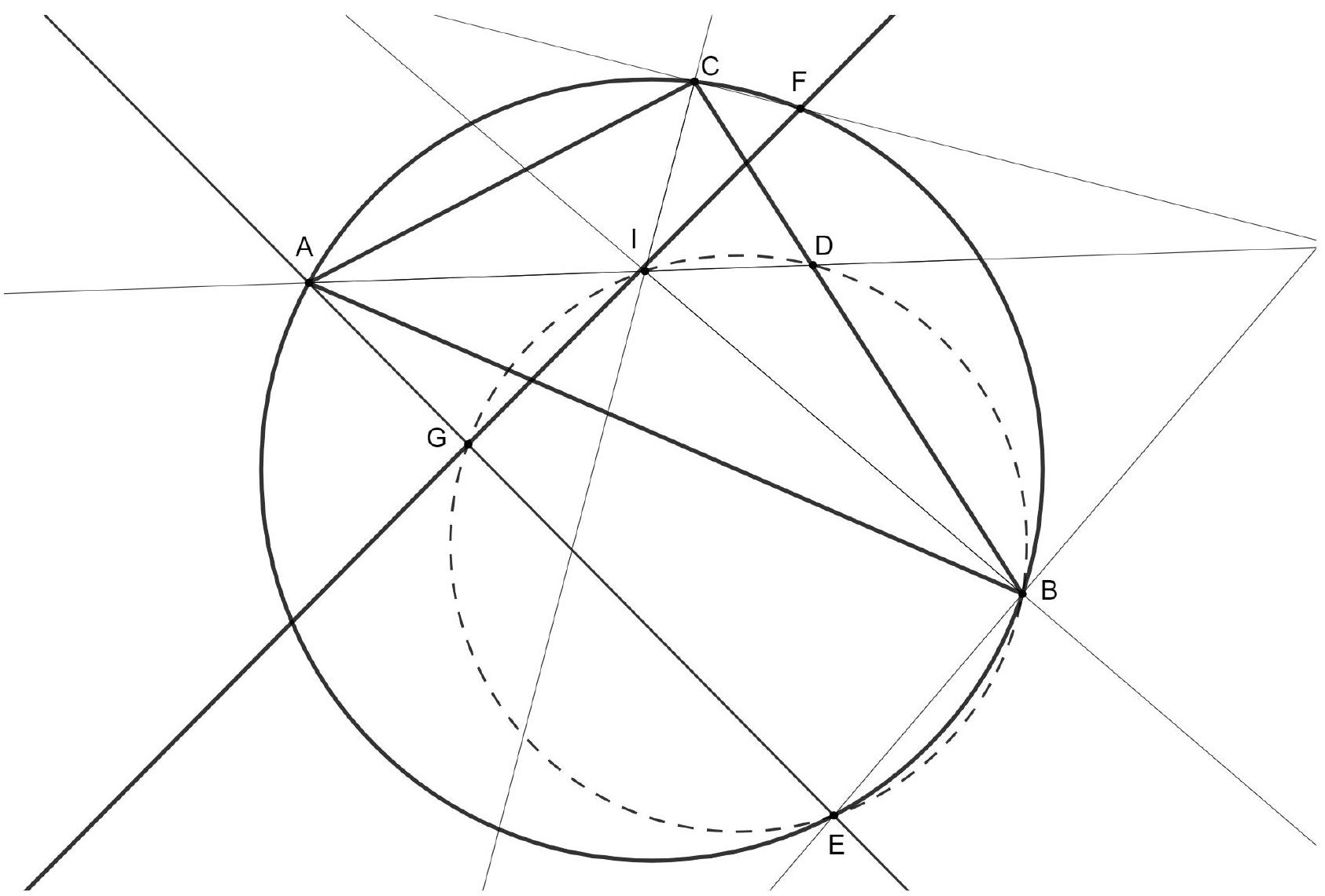", "solution": "We first notice the general fact that $E F \\perp A I$. This can be proved using the following argument. Denote $S$ for the intersection of $E F$ and $A I$. Then $\\angle B I S=(\\angle I B A+\\angle I A B)=\\frac{1}{2}(\\angle A B C+\\angle B A C)=$ $\\frac{1}{2}\\left(180^{\\circ}-\\angle B C A\\right)=\\angle B C F=\\angle B E F=\\angle B E S$. Thus $B, I, S, E$ form a cyclic quadrilateral, from which it can be concluded that $E F \\perp A I$.\n\nWe will now continue to prove the problem by doing both directions separately. Assume first that $E$ lies on $\\Gamma$. Then, as angle bisectors are perpendicular to one another, we have that $\\angle I D E=\\angle I B E=90^{\\circ}$. Then, as $E F \\perp A I$, it holds that $D$ lies on $E F$. It can then be concluded that $\\angle I D F=90^{\\circ}=\\angle I C F$ (again due to perpendicular bisectors), from which it can be concluded that $I, D, C, F$ form a cyclic quadrilateral. We can now calculate that $\\angle G I D=180^{\\circ}-\\angle F I D=180^{\\circ}-\\angle F C D=180^{\\circ}-\\angle F C B=$ $\\angle A E F=\\angle G E D$, where the second to last step follows from the fact that the arcs $B F$ and $A F$ have the\n\n## BxMO 2024: Problems and Solutions\n\nsame length, as $F$ lies on the external bisector of $\\angle A C B$. It now follows that $I, D, E, G$ form a cyclic quadrilteral, thus $G$ lies on $\\Gamma$.\n\nFor the reverse implication, assume that $G$ lies on $\\Gamma$. We can then compute that $\\angle F A D=\\angle F A S=$ $90^{\\circ}-\\angle A F S=90^{\\circ}-\\angle A F E=90^{\\circ}-\\angle A B E=\\angle A B I=\\angle I B D=\\angle I G D=\\angle F G D$, from which we can conclude that $A, G, D, F$ form a cyclic quadrilateral. Similarly to $\\angle F A D=\\angle I B D$, it holds that $\\angle G A D=\\angle I C D$. From this we can compute that $\\angle I F D=\\angle G F D=\\angle G A D=\\angle I C D$, thus $I, D, C, F$ forms a cyclic quadrilateral. Hence, $\\angle I D F=180^{\\circ}-\\angle I C F=90^{\\circ}$, so again $D=S$. We then see that $\\angle I B E=90^{\\circ}=\\angle I D E$ from which we can conclude that $I, D, E, B$ form a cyclic quadrilateral. It then follows that $E$ lies on $\\Gamma$.\n\n#", "metadata": {"resource_path": "Benelux_MO/segmented/Benelux_en-olympiad_en-bxmo-problems-2024-zz.jsonl", "problem_match": "# Problem 3", "solution_match": "\nSolution 1"}} |
| {"year": "2024", "tier": "T3", "problem_label": "3", "problem_type": null, "exam": "Benelux_MO", "problem": "Let $A B C$ be a triangle with incentre $I$ and circumcircle $\\Omega$ such that $|A C| \\neq|B C|$. The internal angle bisector of $\\angle C A B$ intersects side [BC] in $D$, and the external angle bisectors of $\\angle A B C$ and $\\angle B C A$ intersect $\\Omega$ again in $E$ and $F$, respectively. Let $G$ be the intersection of lines $A E$ and $F I$ and let $\\Gamma$ be the circumcircle of triangle $B D I$. Show that $E$ lies on $\\Gamma$ if and only if $G$ lies on $\\Gamma$.\n", "solution": "The external angle bisectors $B E$ and $C F$ meet the internal bisector $I D$ at the $A$-excentre $J$ of triangle $A B C$. If one of BEDI and CFID is cyclic, then, as BECF is cyclic, $|J D||J I|=|J E||J B|=|J C||J F|$ by power of a point, and so the other is cyclic, too. This shows that\n(1) $B E D I$ is cyclic if and only if CFID is cyclic.\n\nNext, $\\angle G A D=\\angle E A D=\\angle B A D-\\angle B A E=\\angle A / 2-\\left(180^{\\circ}-\\angle A E B-\\angle E B A\\right)$, with $\\angle A E B=\\angle A C B=$ $\\angle C$ and $\\angle E B A=\\angle E B I+\\angle I B A=90^{\\circ}+\\angle B / 2$. Hence $\\angle G A D=\\angle A / 2+\\angle B / 2+\\angle C-90^{\\circ}=\\angle C / 2=$ $\\angle I C D$. Thus, if one of $C F I D$ and $A G D F$ is cyclic, then $\\angle I C D=\\angle I F D=\\angle G F D=\\angle G A D$, and the other is cyclic, too. We have thus established that\n(2) CFID is cyclic if and only if $A G D F$ is cylic.\n\nFinally, let $A^{\\prime}$ denote the second intersection of $A I$ with $\\Omega$. Then $\\angle D A F=\\angle A^{\\prime} A F=180^{\\circ}-\\angle F C A^{\\prime}$, with $\\angle F C A^{\\prime}=\\angle F C I+\\angle I C B+\\angle B C A^{\\prime}=90^{\\circ}+\\angle C / 2+\\angle B A A^{\\prime}=90^{\\circ}+\\angle C / 2+\\angle A / 2$. It follows that $\\angle D A F=90^{\\circ}-\\angle A / 2-\\angle C / 2=\\angle B / 2=\\angle D B I$. Hence, if one of $A G D F$ and $B D I G$ is cyclic, then $\\angle D A F=\\angle D G F=\\angle D G I=\\angle D B I$, and so the other is cyclic, too. Hence\n(3) $A G D F$ is cyclic if and only if $B D I G$ is cylic.\n\nThese three equivalences prove that $B E D I$ is cyclic if and only if $B D I G$ is cyclic, i.e. $E$ lies on $\\omega$ if and only if $G$ does. This completes the proof.\n\n## BxMO 2024: Problems and Solutions\n\n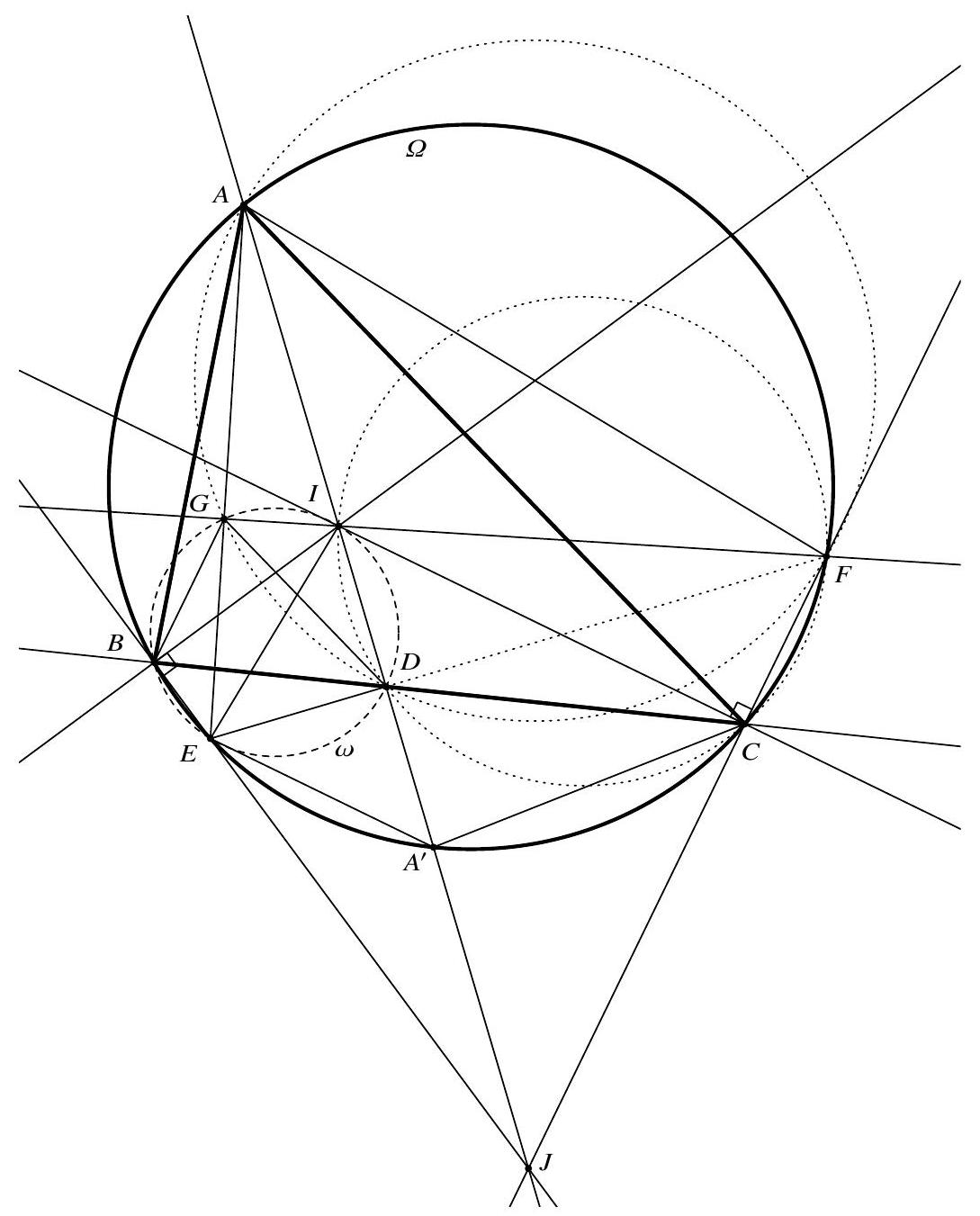\n\n#", "metadata": {"resource_path": "Benelux_MO/segmented/Benelux_en-olympiad_en-bxmo-problems-2024-zz.jsonl", "problem_match": "# Problem 3", "solution_match": "# Solution 2"}} |
| {"year": "2024", "tier": "T3", "problem_label": "3", "problem_type": null, "exam": "Benelux_MO", "problem": "Let $A B C$ be a triangle with incentre $I$ and circumcircle $\\Omega$ such that $|A C| \\neq|B C|$. The internal angle bisector of $\\angle C A B$ intersects side [BC] in $D$, and the external angle bisectors of $\\angle A B C$ and $\\angle B C A$ intersect $\\Omega$ again in $E$ and $F$, respectively. Let $G$ be the intersection of lines $A E$ and $F I$ and let $\\Gamma$ be the circumcircle of triangle $B D I$. Show that $E$ lies on $\\Gamma$ if and only if $G$ lies on $\\Gamma$.\n", "solution": "This proof only shows $E \\in \\omega \\Longrightarrow G \\in \\omega$. Note that this argument cannot be used straightforwardly to prove the converse implication.\n\nIf $B E D I$ is cyclic, let $A^{\\prime}$ be the the second intersection of $A I$ with $\\Omega$, so $\\angle I A^{\\prime} E=\\angle A A^{\\prime} E=$ $180^{\\circ}-\\angle E B A$, with $\\angle E B A=\\angle E B I+\\angle I B A=90^{\\circ}+\\angle B / 2$, so $\\angle I A^{\\prime} E=90^{\\circ}-\\angle B / 2$. But $\\angle E I A^{\\prime}=\\angle E B D$ since $E B D I$ is cyclic, with $\\angle E B D=\\angle E B I-\\angle D B I=90^{\\circ}-\\angle B / 2$. Thus $\\angle E A^{\\prime} I=\\angle E I A^{\\prime}$, so $E A^{\\prime} I$ is isosceles. Moreover, since $E B D I$ is cyclic and $\\angle E B I$ is a right angle, so is $\\angle I D E$. It follows that $D$ is the midpoint of $[A I]$. Next, the external bisectors $B E$ and $C F$ and the internal bisector $I D$ meet at the $A$-excentre $J$ of triangle $A B C$. By power of a point, since $B E D I$ and $B E C F$ are cyclic, $|J D||J I|=|J E||J B|=|J C||J F|$, so $C F I D$ is cyclic, too, with $\\angle F D I=\\angle F C I=90^{\\circ}$. We have thus shown that $\\angle A D E=\\angle F D A=90^{\\circ}$, so $D$ is the foot of the altitude from $A$ in triangle $A E F$. Moreover, all of this shows that $I$ is the reflection of $A^{\\prime}$, which is the point at which this altitude meets the circumcircle $\\Omega$ of $A E F$ again, in the side $[E F]$. Hence $I$ is the orthocentre of triangle $A E F$. By extension, $F I$ is its altitude from $F$, and $G$ is the foot of this altitude, so $\\angle E G I=90^{\\circ}=\\angle I D E=\\angle E B I$, and hence $B E D I G$ is cyclic. This shows that if $E$ lies on\n\n## BxMO 2024: Problems and Solutions\n\n$\\omega$, then so does $G$.\n\n## Remark\n\nThe equivalence $E \\in \\omega \\Longleftrightarrow G \\in \\omega$ breaks down if triangle $A B C$ is not scalene. Indeed, if $A B C$ is isosceles with $\\angle A=\\angle B$, then $F=C$ and $G$ is the intersection of $C I$ and $A E$. Angle chasing as above then shows that $\\angle G A D=\\angle C / 2=\\angle G C D$, so $A G D C$ is cyclic. Then $\\angle D G I=\\angle D G C=\\angle D A C=$ $\\angle A / 2=\\angle B / 2=\\angle D B I$, so $B D I G$ is cyclic, i.e. $G \\in \\omega$. Next, the $A$-excentre $J$ of triangle $A B C$ is the intersection of $B E, I D$, and the tangent to $\\Omega$ at $C$, which, being the external bisector of $\\angle C$, is perpendicular to $C I$. Hence, if $E \\in \\omega$, too, i.e. if $B E D I$ were cyclic, then by power of a point, $|J C|^{2}=|J E||J B|=|J D||J I|$, so the circumcircle of $C I D$ would be tangent to $J C$ at $C$, implying $\\angle C D I=\\angle I C J=90^{\\circ}$. This is not however the case, unless $\\angle B=\\angle C$ and hence $A B C$ is equilateral. This shows that the condition in the problem statement that $A B C$ is scalene cannot be dropped.\n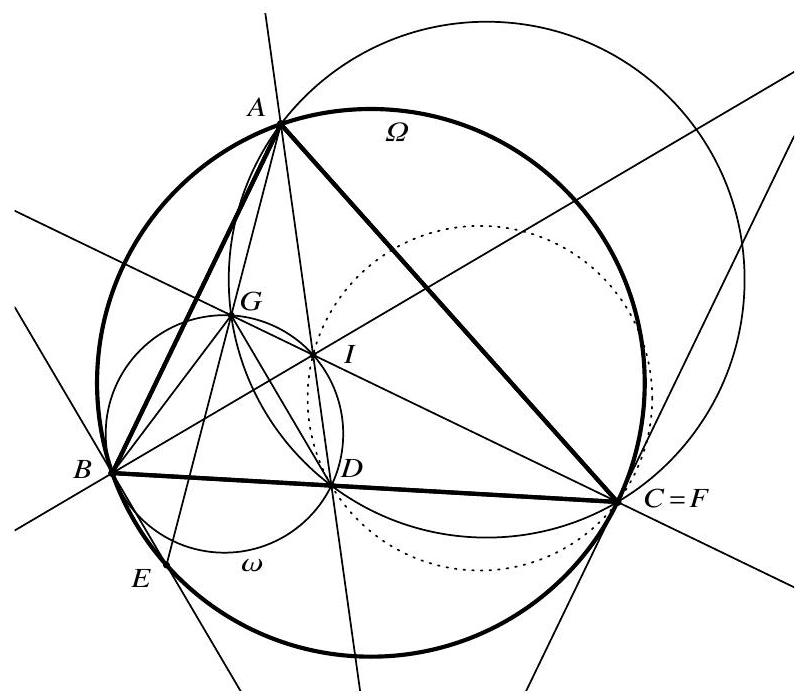\n\n## BxMO 2024: Problems and Solutions\n\n#", "metadata": {"resource_path": "Benelux_MO/segmented/Benelux_en-olympiad_en-bxmo-problems-2024-zz.jsonl", "problem_match": "# Problem 3", "solution_match": "# Solution 3"}} |
| {"year": "2024", "tier": "T3", "problem_label": "4", "problem_type": null, "exam": "Benelux_MO", "problem": "For each positive integer $n$, let $\\operatorname{rad}(n)$ denote the product of the distinct prime factors of $n$. Show that there exist integers $a, b>1$ such that $\\operatorname{gcd}(a, b)=1$ and\n\n$$\n\\operatorname{rad}(a b(a+b))<\\frac{a+b}{2024^{2024}}\n$$\n\nFor example, $\\operatorname{rad}(20)=\\operatorname{rad}\\left(2^{2} \\cdot 5\\right)=2 \\cdot 5=10$ and $\\operatorname{rad}(18)=\\operatorname{rad}\\left(2 \\cdot 3^{2}\\right)=2 \\cdot 3=6$.\n\n#", "solution": "We show that the pair $(a, b)$ of the form $a=2^{p(p-1)}, b=3^{p(p-1)}-2^{p(p-1)}$ for sufficiently larger prime number $p$ satisfies the inequality. First, notice that $\\operatorname{gcd}(a, b)=\\operatorname{gcd}(a, a+b)=1$ indeed. In addition, see that $\\operatorname{rad}(a)=2$, and $\\operatorname{rad}(a+b)=3$. Because of Euler-Fermat, as $\\phi\\left(p^{2}\\right)=p(p-1)$, it can directly be seen that $p^{2} \\mid b$. In this case, $\\operatorname{rad}(b) \\leqslant \\frac{b}{p}$. It then follows that, as rad is multiplicative for coprime numbers, that\n\n$$\n\\operatorname{rad}(a b(a+b))=\\operatorname{rad}(a) \\operatorname{rad}(b) \\operatorname{rad}(a+b) \\leqslant 2 \\cdot 3 \\cdot \\frac{b}{p} \\leqslant \\frac{6}{p}(a+b)\n$$\n\nThen, by choosing $p$ such that $\\frac{6}{p}<\\frac{1}{2024^{2024}}$, we found $a$ and $b$ satifying the inequality.\n\n#", "metadata": {"resource_path": "Benelux_MO/segmented/Benelux_en-olympiad_en-bxmo-problems-2024-zz.jsonl", "problem_match": "# Problem 4", "solution_match": "# Solution 1"}} |
| {"year": "2024", "tier": "T3", "problem_label": "4", "problem_type": null, "exam": "Benelux_MO", "problem": "For each positive integer $n$, let $\\operatorname{rad}(n)$ denote the product of the distinct prime factors of $n$. Show that there exist integers $a, b>1$ such that $\\operatorname{gcd}(a, b)=1$ and\n\n$$\n\\operatorname{rad}(a b(a+b))<\\frac{a+b}{2024^{2024}}\n$$\n\nFor example, $\\operatorname{rad}(20)=\\operatorname{rad}\\left(2^{2} \\cdot 5\\right)=2 \\cdot 5=10$ and $\\operatorname{rad}(18)=\\operatorname{rad}\\left(2 \\cdot 3^{2}\\right)=2 \\cdot 3=6$.\n\n#", "solution": "We show that the pair $(a, b)$ of the form $a=3^{2^{k}}, b=5^{2^{k}}-3^{2^{k}}$ for sufficiently large $k$ satisifies the inequality. Again, we have that $\\operatorname{gcd}(a, b)=\\operatorname{gcd}(a, a+b)=1$. Similarly to solution $1, \\operatorname{rad}(a(a+b))=$ $\\operatorname{rad}(a) \\operatorname{rad}(a+b)=3 \\cdot 5=15$. Then, we will show that $2^{k+1} \\mid b$, from which it would follow that $\\operatorname{rad}(b) \\leqslant \\frac{b}{2^{k}}$. From this, we then see that\n\n$$\n\\operatorname{rad}(a b(a+b))=\\operatorname{rad}(a(a+b)) \\operatorname{rad}(b) \\leqslant \\frac{15 b}{2^{k}} .\n$$\n\nLike in solution 1, this gives a pair $(a, b)$ satisfying the inequality for sufficiently large $k$.\nThere are various ways to show that $2^{k+1} \\mid 5^{2^{k}}-3^{2^{k}}$, for example directly by applying the Lifting-The-Exponent Lemma. For a more elementary proof, we can apply induction on $k$. The statement is clearly true for $k=0$, and if the statement holds for $k=n$, then for $k=n+1$ we see that\n\n$$\n5^{2^{k}}-3^{2^{k}}=5^{2^{n+1}}-3^{2^{n+1}}=\\left(5^{2^{n}}\\right)^{2}-\\left(3^{2^{n}}\\right)^{2}=\\left(5^{2^{n}}-3^{2^{n}}\\right)\\left(5^{2^{n}}+3^{2^{n}}\\right) .\n$$\n\nFrom the induction hypothesis, the first factor has $n+1$ factors of 2 . As the second factor is a sum of two odd numbers, the second term has at least one factor of 2 . The product thus has at least $n+2=k+1$ factors of 2 , from which the statement follows by induction.\n\n#", "metadata": {"resource_path": "Benelux_MO/segmented/Benelux_en-olympiad_en-bxmo-problems-2024-zz.jsonl", "problem_match": "# Problem 4", "solution_match": "# Solution 2"}} |
| {"year": "2024", "tier": "T3", "problem_label": "4", "problem_type": null, "exam": "Benelux_MO", "problem": "For each positive integer $n$, let $\\operatorname{rad}(n)$ denote the product of the distinct prime factors of $n$. Show that there exist integers $a, b>1$ such that $\\operatorname{gcd}(a, b)=1$ and\n\n$$\n\\operatorname{rad}(a b(a+b))<\\frac{a+b}{2024^{2024}}\n$$\n\nFor example, $\\operatorname{rad}(20)=\\operatorname{rad}\\left(2^{2} \\cdot 5\\right)=2 \\cdot 5=10$ and $\\operatorname{rad}(18)=\\operatorname{rad}\\left(2 \\cdot 3^{2}\\right)=2 \\cdot 3=6$.\n\n#", "solution": "Choose $a=\\left(4^{x}-1\\right)^{2}, b=4^{x+1}$ and $a+b=\\left(4^{x}+1\\right)^{2}$. That is, $a, b$ and $a+b$ are squares, where $b$ only contains the factor 2 . Note that $a$ and $b$ are indeed coprime. Then $\\operatorname{rad}(a b c)=2 \\operatorname{rad}\\left(16^{x}-1\\right)$.\n\nChoose then $x=5^{k}$ such that $x>2 \\cdot 2024^{2024}$. By Lifting the exponent, we know that $5^{k+1} \\mid 16^{5^{k}}-1$. This implies that $2 \\operatorname{rad}\\left(16^{x}-1\\right) \\leqslant 2\\left(16^{x}-1\\right) / 5^{k}<\\left(4^{x}+1\\right)^{2} / 2024^{2024}$.\n\nThis solution also works with Euler-Fermat, by choosing $x=\\phi\\left(5^{k+1}\\right)$ with $5^{k}>2024^{2024}$.", "metadata": {"resource_path": "Benelux_MO/segmented/Benelux_en-olympiad_en-bxmo-problems-2024-zz.jsonl", "problem_match": "# Problem 4", "solution_match": "# Solution 3"}} |
| |