| {"year": "2021", "tier": "T2", "problem_label": "1", "problem_type": null, "exam": "EGMO", "problem": "According to Anna, the number 2021 is fantabulous. She states that if any element of the set $\\{m, 2 m+1,3 m\\}$ is fantabulousfor a positive integer $m$, then they are all fantabulous. Is the number 2021 ${ }^{2021}$ fantabulous?\n(Australia, Angelo Di Pasquale)\nAnswer: Yes", "solution": "Consider the sequence of positive integers $m, 3 m, 6 m+1,12 m+3,4 m+1,2 m$. Since each number in the sequence is fantabulous if and only if the next one is, we deduce that $m$ is fantabulous if and only if $2 m$ is fantabulous.\n\nCombined with the fact that $m$ is fantabulous if and only if $2 m+1$ is fantabulous, this implies that $m>1$ is fantabulous if and only if $f(m)=\\left[\\frac{m}{2}\\right]$ is fantabulous. We can apply $f$ sufficiently many times to any positive integer $n$ to conclude that $n$ is fantabulous if and only if 1 is fantabulous. Therefore, the fact that 2021 is fantabulous implies that 1 is fantabulous, which in turn implies that $2021^{2021}$ is fantabulous.", "metadata": {"resource_path": "EGMO/segmented/en-2021-solutions.jsonl", "problem_match": "\nProblem 1.", "solution_match": "# Solution 1."}} |
| {"year": "2021", "tier": "T2", "problem_label": "1", "problem_type": null, "exam": "EGMO", "problem": "According to Anna, the number 2021 is fantabulous. She states that if any element of the set $\\{m, 2 m+1,3 m\\}$ is fantabulousfor a positive integer $m$, then they are all fantabulous. Is the number 2021 ${ }^{2021}$ fantabulous?\n(Australia, Angelo Di Pasquale)\nAnswer: Yes", "solution": "Let $m>1$ be a fantabulous number. Note that at least one of the following four cases must hold.\n\n- Case 1. The number $m$ is odd;\n\nWe have $m=2 a+1$ for some positive integer $a$, so $a<m$ is also fantabulous.\n\n- Case 2. The number $m$ is a multiple of 3;\n\nWe have $m=3 a$ for some positive integer $a$, so $a<m$ is also fantabulous.\n\n- Case 3. The number $m$ is 4 modulo 6;\n\nWe have $m=6 a-2$ for some positive integer $a$. We have the sequence of fantabulous numbers\n\n$$\n(6 a-2) \\rightarrow(12 a-3) \\rightarrow(4 a-1)\n$$\n\nso $4 a-1<m$ is also fantabulous.\n\n## - Case 4. The number $m$ is 2 modulo 6;\n\nWe have $m=6 a+2$ for some positive integer $a$. We have the sequence of fantabulous numbers\n\n$$\n(6 a+2) \\rightarrow(12 a+5) \\rightarrow(36 a+15) \\rightarrow(18 a+7) \\rightarrow(9 a+3) \\rightarrow(3 a+1)\n$$\n\nso $3 a+1<m$ is also fantabulous.\n\nIn all cases, we see that there is another fantabulous number less than $m$. Since 2021 is fantabulous, it follows that 1 is fantabulous.\n\nObserve that a number $m$ is not fantabulous if and only if all of the elements of the set $\\{m, 2 m+1,3 m\\}$ are not fantabulous. So, the argument above shows that if there exists a positive integer that is not fantabulous, then 1 would not be fantabulous either. This is a contradiction, so all positive integers are fantabulous and, in particular, $2021^{2021}$ is fantabulous.", "metadata": {"resource_path": "EGMO/segmented/en-2021-solutions.jsonl", "problem_match": "\nProblem 1.", "solution_match": "# Solution 2."}} |
| {"year": "2021", "tier": "T2", "problem_label": "1", "problem_type": null, "exam": "EGMO", "problem": "According to Anna, the number 2021 is fantabulous. She states that if any element of the set $\\{m, 2 m+1,3 m\\}$ is fantabulousfor a positive integer $m$, then they are all fantabulous. Is the number 2021 ${ }^{2021}$ fantabulous?\n(Australia, Angelo Di Pasquale)\nAnswer: Yes", "solution": "The following transformations show that $a$ is fantabulous if and only if $3 a, 3 a+1$ or $3 a+2$ are fantabulous.\n\n$$\n\\begin{aligned}\n& a \\rightarrow 3 a \\\\\n& a \\rightarrow 2 a+1 \\rightarrow 6 a+3 \\rightarrow 3 a+1 \\\\\n& a \\rightarrow 2 a+1 \\rightarrow 4 a+3 \\rightarrow 12 a+9 \\rightarrow 36 a+27 \\rightarrow 18 a+13 \\rightarrow 9 a+6 \\rightarrow 3 a+2\n\\end{aligned}\n$$\n\nThis implies that $a \\geq 3$ is fantabulous if and only if $f(a)=\\left[\\frac{a}{3}\\right]$ is fantabulous. We can use this to deduce that 1 and 2 are fantabulous from the fact that 2021 is fantabulous in the following way:\n\n$$\n2021 \\rightarrow 673 \\rightarrow 224 \\rightarrow 74 \\rightarrow 24 \\rightarrow 8 \\rightarrow 2 \\rightarrow 5 \\rightarrow 1\n$$\n\nWe can apply $f$ sufficiently many times to any positive integer $n$ to arrive at the number 1 or 2 . It follows that every positive integer is fantabulous, so $2021^{2021}$ is fantabulous.", "metadata": {"resource_path": "EGMO/segmented/en-2021-solutions.jsonl", "problem_match": "\nProblem 1.", "solution_match": "# Solution 3."}} |
| {"year": "2021", "tier": "T2", "problem_label": "2", "problem_type": null, "exam": "EGMO", "problem": "Find all functions $f: \\mathbb{Q} \\rightarrow \\mathbb{Q}$ such that the equation\n\n$$\nf(x f(x)+y)=f(y)+x^{2}\n$$\n\nholds for all rational numbers $x$ and $y$.\nHere, $\\mathbb{Q}$ denotes the set of rational numbers.\n(Slovakia, Patrik Bak)\n\nAnswer: $f(x)=x$ and $f(x)=-x$.", "solution": "Denote the equation from the statement by (1). Let $x f(x)=A$ and $x^{2}=B$. The equation (1) is of the form\n\n$$\nf(A+y)=f(y)+B\n$$\n\nAlso, if we put $y \\rightarrow-A+y$, we have $f(A-A+y)=f(-A+y)+B$. Therefore\n\n$$\nf(-A+y)=f(y)-B\n$$\n\nWe can easily show that for any integer $n$ we even have\n\n$$\nf(n A+y)=f(y)+n B\n$$\n\nIndeed, it's trivially true for $n=0$ and if this holds true for some integer $n$, then\n\n$$\nf((n+1) A+y)=f(A+y+n A)=f(n y+A)+B=f(y)+n B+B=f(y)+(n+1) B\n$$\n\nand\n\n$$\nf((n-1) A+y)=f(-A+n A+y)=f(n A+y)-B=f(y)+n B-B=f(y)+(n-1) B .\n$$\n\nSo, equation (2) follows from the induction on $n$.\nNow we can say that for any integer $k$ it holds\n\n$$\nf(n x f(x)+y)=f(y)+n x^{2}\n$$\n\nIf $y$ is given, then $f(y)+n x^{2}$ can be any rational number, since $n x^{2}$ can be any rational number. If it is supposed to be $\\frac{p}{q}$, where $q \\neq 0$, then we may take $n=p q$, and $x=\\frac{1}{q}$. Therefore $f$ is surjective on $\\mathbb{Q}$. So there's a rational number $c$ such that $f(c)=0$. Be putting $x=c$ into (1) we immediately get $c=0$, i.e. $f(0)=0$. Therefore, $f(x)=0$ if and only if $x=0$.\n\nFor any integer $n$ and for any rational $x, y$ it holds\n\n$$\nf\\left(n^{2} x f(x)+y\\right)=f(y)+n^{2} x^{2}=f(y)+(n x)^{2}=f(n x f(n x)+y)\n$$\n\nAfter taking $y=-n x f(n x)$ in (4), the right-hand side becomes 0 , therefore\n\n$$\nn^{2} x f(x)-n x f(n x)=0\n$$\n\nThis simplifies into $n f(x)=f(n x)$ for $x \\neq 0$, but it also holds for $x=0$. Therefore, for any rational number $x=\\frac{p}{q}$ we have,\n\n$$\nf(x)=f\\left(\\frac{p}{q}\\right)=f\\left(p \\cdot \\frac{1}{q}\\right)=p \\cdot f\\left(\\frac{1}{p}\\right)=p \\cdot \\frac{f\\left(q \\cdot \\frac{1}{q}\\right)}{q}=\\frac{p}{q} \\cdot f(1)=x f(1)\n$$\n\nSo, we have $f(x)=k x$, for some rational number $k$. Let's put this answer in (1) and we get $k(x k x+y)=k y+x^{2}$, thus $k^{2}=1$. Therefore $f(x)=x$ and $f(x)=-x$ are solutions.", "metadata": {"resource_path": "EGMO/segmented/en-2021-solutions.jsonl", "problem_match": "\nProblem 2.", "solution_match": "\nSolution."}} |
| {"year": "2021", "tier": "T2", "problem_label": "3", "problem_type": null, "exam": "EGMO", "problem": "Let $A B C$ be a triangle with an obtuse angle at $A$. Let $E$ and $F$ be the intersections of the external bisector of angle $A$ with the altitudes of $A B C$ through $B$ and $C$ respectively. Let $M$ and $N$ be the points on the segments $E C$ and $F B$ respectively such that $\\angle E M A=\\angle B C A$ and $\\angle A N F=\\angle A B C$. Prove that the points $E, F, N, M$ lie on a circle.", "solution": "The first solution is based on the main Lemma. We present this Lemma with two different proofs.\nLemma: Let $A B C$ be an acute triangle with $A B=B C$. Let $P$ be any point on $A C$. Line passing through $P$ perpendicular to $A B$, intersects ray $B C$ in point $T$. If the line $A T$ intersects the circumscribed circle of the triangle $A B C$ the second time at point $K$, then $\\angle A K P=\\angle A B P$.\n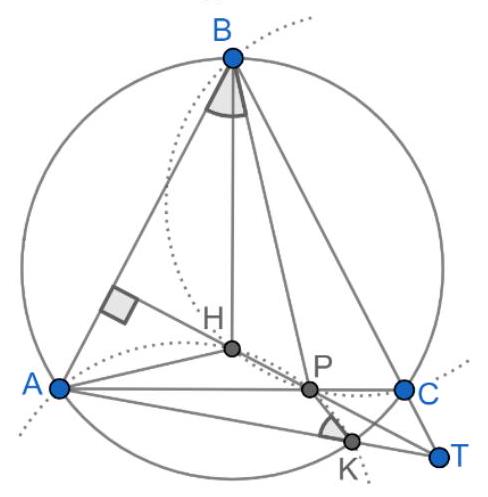\n\n## Proof 1:\n\nLet $H$ be the orthocenter of the triangle $A B P$. Then\n\n$$\n\\angle B H P=180^{\\circ}-\\angle B A C=180^{\\circ}-\\angle B C P\n$$\n\nSo $B H P C$ is cyclic. Then we get\n\n$$\nT K \\cdot T A=T C \\cdot T B=T P \\cdot T H\n$$\n\nSo, $A H P K$ is also cyclic. But then\n\n$$\n\\angle A K P=180^{\\circ}-\\angle A H P=\\angle A B P\n$$\n\nProof 2:\nConsider the symmetric points $B^{\\prime}$ and $C^{\\prime}$ of $B$ and $C$, respectively, with respect to the line $P T$. It is clear that\n\n$$\n\\mathrm{TC}^{\\prime} \\cdot T B^{\\prime}=T C \\cdot T B=T K \\cdot T A\n$$\n\nSo $B^{\\prime} C^{\\prime} K A$ is cyclic. Also, because of the symmetry we have\n\n$$\n\\angle P C^{\\prime} B^{\\prime}=\\angle P C B=\\angle P A B\n$$\n\nSo $B^{\\prime} C^{\\prime} P A$ is also cyclic. Therefore, the points $B^{\\prime}, C^{\\prime}, K, P$ and $A$ all lie on the common circle. Because of this fact and because of the symmetry again we have\n\n$$\n\\angle P K A=\\angle P B^{\\prime} A=\\angle P B A .\n$$\n\nSo, lemma is proved and now return to the problem.\n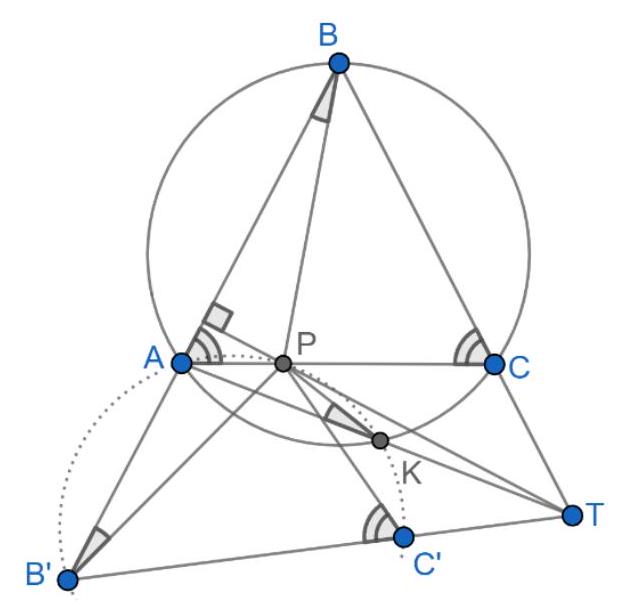\n\nLet $H$ be intersection point of the altitudes at $B$ and $C$. Denote by $M^{\\prime}$ and $N^{\\prime}$ the intersection points of the circumcircle of the triangle $H E F$ with the segments $E C$ and $F B$, respectively. We are going to show that $M=M^{\\prime}$ and $N=N^{\\prime}$ and it will prove the points $E, F, N, M$ lie on a common circle.\n\nOf course, $A$ is an orthocenter of the triangle $B C H$. Therefore $\\angle B H A=\\angle B C A, \\angle C H A=\\angle C B A$ and $\\angle H B A=\\angle H C A$. Thus\n\n$$\n\\angle H E F=\\angle H B A+\\angle E A B=\\angle H C A+\\angle F A C=\\angle H F E\n$$\n\nSo, the triangle $H E F$ is isosceles, $H E=H F$.\nBy using lemma, we get\n\n$$\n\\angle A M^{\\prime} E=\\angle A H E=\\angle A C B\n$$\n\nand\n\n$$\n\\angle A N^{\\prime} F=\\angle A H F=\\angle A B C \\text {. }\n$$\n\n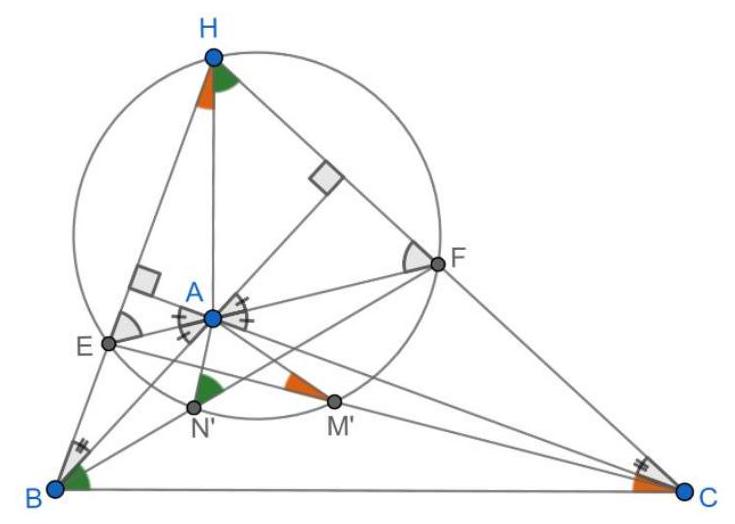\n\nTherefore $M=M^{\\prime}$ and $N=N^{\\prime}$ and we are done.", "metadata": {"resource_path": "EGMO/segmented/en-2021-solutions.jsonl", "problem_match": "\nProblem 3.", "solution_match": "# Solution 1."}} |
| {"year": "2021", "tier": "T2", "problem_label": "3", "problem_type": null, "exam": "EGMO", "problem": "Let $A B C$ be a triangle with an obtuse angle at $A$. Let $E$ and $F$ be the intersections of the external bisector of angle $A$ with the altitudes of $A B C$ through $B$ and $C$ respectively. Let $M$ and $N$ be the points on the segments $E C$ and $F B$ respectively such that $\\angle E M A=\\angle B C A$ and $\\angle A N F=\\angle A B C$. Prove that the points $E, F, N, M$ lie on a circle.", "solution": "Let $X, Y$ be projections of $B$ on $A C$, and $C$ on $A B$, respectively. Let $\\omega$ be circumcircle of $B X Y C$. Let $Z$ be intersection of $E C$ and $\\omega$ and $D$ be projection of $E$ on $B A$.\n\n$$\n\\angle M A C=\\angle A M E-\\angle M C A=\\angle X C B-\\angle X C E=\\angle Z C B=\\angle Z X B\n$$\n\nSince $B X Y C$ is cyclic $\\angle A C Y=\\angle X B A$, and since $D E X A$ is cyclic\n\n$$\n\\angle E X D=\\angle E A D=\\angle F A C\n$$\n\nTherefore, we get that the quadrangles $B Z X D$ and $C M A F$ are similar. Hence $\\angle F M C=\\angle D Z B$. Since $Z E D B$ is cyclic,\n\n$$\n\\angle D Z B=\\angle D E B=\\angle X A B .\n$$\n\nThus $\\angle F M C=\\angle X A B$. Similarly, $\\angle E N B=\\angle Y A C$. We get that $\\angle F M C=\\angle E N B$ and it implies that the points $E, F, N, M$ lie on a circle.\n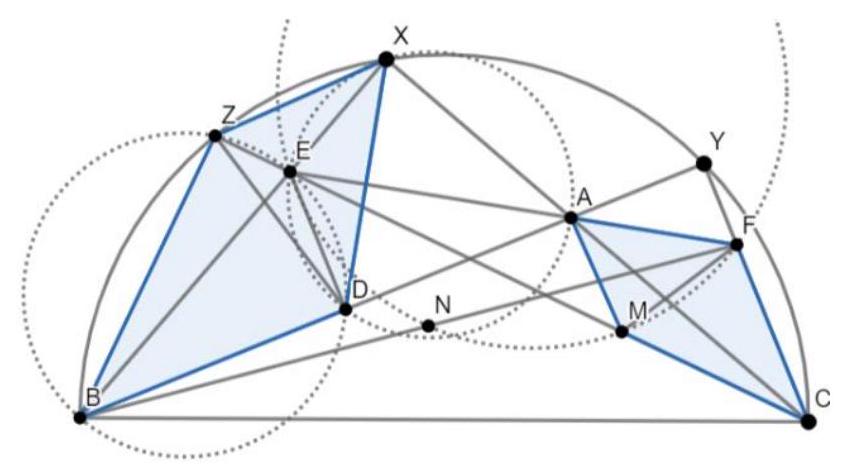", "metadata": {"resource_path": "EGMO/segmented/en-2021-solutions.jsonl", "problem_match": "\nProblem 3.", "solution_match": "# Solution 2."}} |
| {"year": "2021", "tier": "T2", "problem_label": "4", "problem_type": null, "exam": "EGMO", "problem": "Let $A B C$ be a triangle with incentre Iand let $D$ be an arbitrary point on the side $B C$. Let the line through $D$ perpendicular to $B I$ intersect $C I$ at $E$. Let the line through $D$ perpendicular to $C I$ intersect $B I$ at $F$. Prove that the reflection of $A$ in the line $E F$ lies on the line $B C$.\n(Australia, Sampson Wong)", "solution": "Let us consider the case when $I$ lies inside of triangle $E F D$. For the other cases the proof is almost the same only with the slight difference.\n\nWe are going to prove that the intersection point of the circumcircles of $A E C$ and $A F B$ (denote it by $T$ ) lies on the line $B C$ and this point is the symmetric point of $A$ with respect to $E F$. First of all we prove that $A E I F$ is cyclic, which implies that $T$ lies on the line $B C$, because\n\n$$\n\\angle A T B+\\angle A T C=\\angle A F B+\\angle A E C=\\angle A F I+\\angle A E I=180^{\\circ} .\n$$\n\n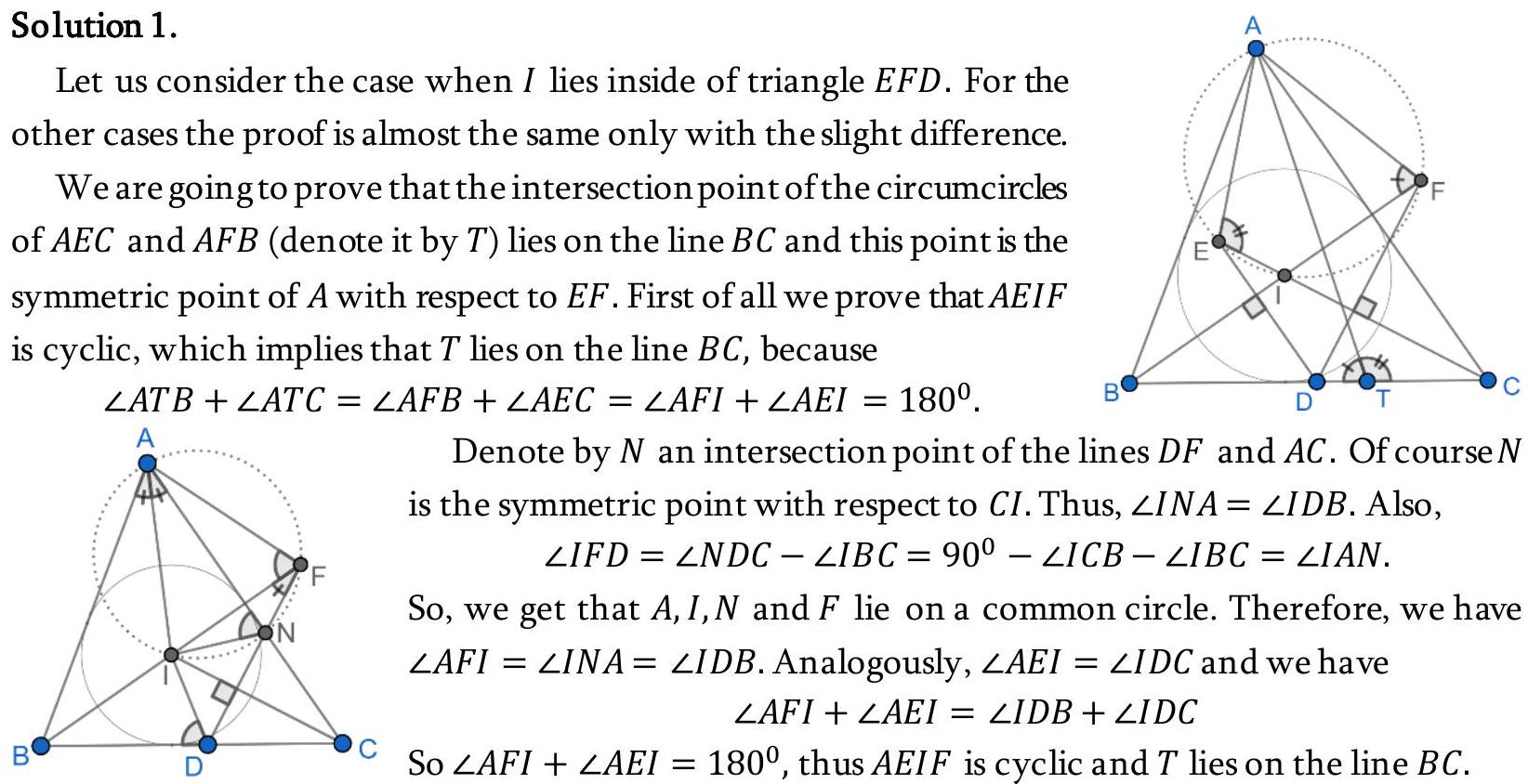\n\nDenote by $N$ an intersection point of the lines $D F$ and $A C$. Of course $N$ is the symmetric point with respect to $C I$. Thus, $\\angle I N A=\\angle I D B$. Also,\n\n$$\n\\angle I F D=\\angle N D C-\\angle I B C=90^{\\circ}-\\angle I C B-\\angle I B C=\\angle I A N .\n$$\n\nSo, we get that $A, I, N$ and $F$ lie on a common circle. Therefore, we have $\\angle A F I=\\angle I N A=\\angle I D B$. Analogously, $\\angle A E I=\\angle I D C$ and we have\n\n$$\n\\angle A F I+\\angle A E I=\\angle I D B+\\angle I D C\n$$\n\nSo $\\angle A F I+\\angle A E I=180^{\\circ}$, thus $A E I F$ is cyclic and $T$ lies on the line $B C$.\n\nBecause $E C$ bisects the angle $A C B$ and $A E T C$ is cyclic we get $E A=E T$. Because of the similar reasons we have $F A=F T$. Therefore $T$ is the symmetric point of $A$ with respect to the line $E F$ and it lies on the line $B C$.\n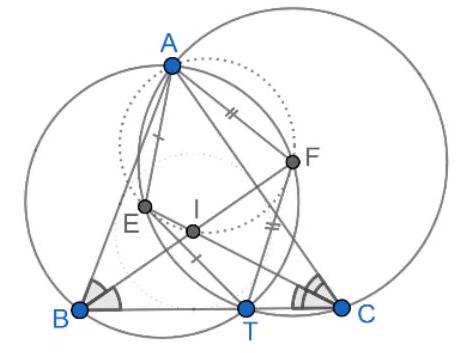", "metadata": {"resource_path": "EGMO/segmented/en-2021-solutions.jsonl", "problem_match": "\nProblem 4.", "solution_match": "# Solution 1."}} |
| {"year": "2021", "tier": "T2", "problem_label": "4", "problem_type": null, "exam": "EGMO", "problem": "Let $A B C$ be a triangle with incentre Iand let $D$ be an arbitrary point on the side $B C$. Let the line through $D$ perpendicular to $B I$ intersect $C I$ at $E$. Let the line through $D$ perpendicular to $C I$ intersect $B I$ at $F$. Prove that the reflection of $A$ in the line $E F$ lies on the line $B C$.\n(Australia, Sampson Wong)", "solution": "Like to the first solution, consider the case when $I$ lies inside of triangle $E F D$. we need to prove that $A E I F$ is cyclic. The finish of the proof is the same.\n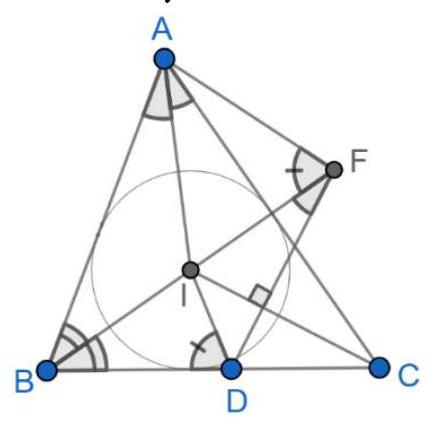\nfirst note that $\\triangle F D B \\sim \\triangle A I B$, because $\\angle F B D=\\angle A B I$, and\n\n$$\n\\angle B F D=\\angle F D C-\\angle I B C=90^{\\circ}-\\angle I C D-\\angle I B C=\\angle I A B .\n$$\n\nBecause of the similarity we have $\\frac{A B}{A F}=\\frac{B I}{B D}$. This equality of the length ratios with $\\angle I B D=\\angle A B F$ implies that $\\triangle A B F \\sim \\triangle I B D$. Therefore, we have $\\angle I D B=\\angle A F B$. Analogously, we can get $\\angle I D C=\\angle A E C$, thus\n\n$$\n\\angle A F I+\\angle A E I=\\angle I D B+\\angle I D C=180^{\\circ} .\n$$\n\nSo, $A E I F$ is cyclic and we are done.", "metadata": {"resource_path": "EGMO/segmented/en-2021-solutions.jsonl", "problem_match": "\nProblem 4.", "solution_match": "# Solution 2."}} |
| {"year": "2021", "tier": "T2", "problem_label": "5", "problem_type": null, "exam": "EGMO", "problem": "A plane has a special point $O$ called the origin. Let $P$ be a set of 2021 points in the plane, such that\n(i) no three points in $P$ lie on a line and\n(ii) no two points in $P$ lie on a line through the origin.\n\nA triangle with vertices in $P$ is fat, if $O$ is strictly inside the triangle. Find the maximum number of fat triangles.\n(Austria, Veronika Schreitter)\n\nAnswer: $2021 \\cdot 505 \\cdot 337$", "solution": "We will count minimal number of triangles that are not fat. Let $F$ set of fat triangles, and S set of triangles that are not fat. If triangle $X Y Z \\in S$, we call $X$ and $Z$ good vertices if $O Y$ is located between $O X$ and $O Z$. For $A \\in P$ let $S_{A} \\subseteq S$ be set of triangles in $S$ for which $A$ is one of the good vertex.\n\nIt is easy to see that\n\n$$\n2|S|=\\sum_{A \\in P}\\left|S_{A}\\right|\n$$\n\nFor $A \\in P$, let $R_{A} \\subset P$ and $L_{A} \\subset P$ be parts of $P \\backslash\\{A\\}$ divided by $A O$. Suppose for $A X Y \\in S$ vertex $A$ is good, then clearly $X, Y \\in R_{A}$ or $X, Y \\in L_{A}$. On the other hand, if $X, Y \\in R_{A}$ or $X, Y \\in L_{A}$ then clearly $A X Y \\in S$ and $A$ is its good vertex. Therefore,\n\n$$\n\\left|S_{A}\\right|=\\binom{\\left|R_{A}\\right|}{2}+\\binom{\\left|L_{A}\\right|}{2}\n$$\n\nIt is easy to show following identity:\n\n$$\n\\frac{x(x-1)}{2}+\\frac{y(y-1)}{2}-2 \\cdot \\frac{\\frac{x+y}{2}\\left(\\frac{x+y}{2}-1\\right)}{2}=\\frac{(x-y)^{2}}{4}\n$$\n\nBy using (2) and (3) we get\n\n$$\n\\left|S_{A}\\right| \\geq 2 \\cdot\\binom{\\frac{\\left|R_{A}\\right|+\\left|L_{A}\\right|}{2}}{2}=2 \\cdot\\binom{1010}{2}=1010 \\cdot 1009\n$$\n\nand the equality holds when $\\left|R_{A}\\right|=\\left|L_{A}\\right|=1010$. Hence\n\n$$\n|S|=\\frac{\\sum_{A \\in P}\\left|S_{A}\\right|}{2} \\geq \\frac{2021 \\cdot 1010 \\cdot 1009}{2}=2021 \\cdot 505 \\cdot 1009\n$$\n\nTherefore,\n\n$$\n|F|=\\binom{2021}{3}-|S| \\leq 2021 \\cdot 1010 \\cdot 673-2021 \\cdot 505 \\cdot 1009=2021 \\cdot 505 \\cdot 337\n$$\n\nFor configuration of points on regular 2021-gon which is centered at $O$, in equalities in (4), (5), (6) become equalities. Hence $2021 \\cdot 505 \\cdot 337$ is indeed the answer.", "metadata": {"resource_path": "EGMO/segmented/en-2021-solutions.jsonl", "problem_match": "\nProblems 5.", "solution_match": "# Solution"}} |
| {"year": "2021", "tier": "T2", "problem_label": "6", "problem_type": null, "exam": "EGMO", "problem": "Does there exist a nonnegative integer $a$ for which the equation\n\n$$\n\\left\\lfloor\\frac{m}{1}\\right\\rfloor+\\left\\lfloor\\frac{m}{2}\\right\\rfloor+\\left\\lfloor\\frac{m}{3}\\right\\rfloor+\\cdots+\\left\\lfloor\\frac{m}{m}\\right\\rfloor=n^{2}+a\n$$\n\nhas more than one million different solutions $(m, n)$ where $m$ and $n$ are positive integers? (The expression $\\lfloor x\\rfloor$ denotesthe integer part(or floor) of the real numberx. Thus $\\lfloor\\sqrt{2}\\rfloor=1,\\lfloor\\pi\\rfloor=\\left\\lfloor\\frac{22}{7}\\right\\rfloor=$ $3,\\lfloor 42\\rfloor=42$ and $\\lfloor 0\\rfloor=0)$\n\nAnswer: Yes.", "solution": "Denote the equation from the statement by (1). The left hand side of (1) depends only on $m$, and will throughout be denoted by $L(m)$. Fix an integer $q>10^{7}$ and note that for $m=q^{3}$\n\n$$\nL\\left(q^{3}\\right)=\\sum_{k=1}^{q^{3}}\\left[\\frac{q^{3}}{k}\\right] \\leq \\sum_{k=1}^{q^{3}} \\frac{q^{3}}{k} \\leq q^{3} \\cdot \\sum_{k=1}^{q^{3}} \\frac{1}{k} \\leq q^{3} \\cdot q=q^{4}\n$$\n\nIndeed, the first inequality results from $[x] \\leq x$. The second inequality can be seen (for instance) as follows. We divide the terms in the sum $\\sum_{k=1}^{q^{3}} \\frac{1}{k}$ into several groups: For $j \\geq 0$, the $j$-th group contains the $2^{j}$ consecutive terms $\\frac{1}{2^{j}}, \\ldots, \\frac{1}{2^{j+1}-1}$. Since every term in the $j$-th group is bounded by $\\frac{1}{2^{j}}$, the overall contribution of the $j$-th group to the sum is at most 1 . Since the first $q$ groups together would contain $2^{q}-1>q^{3}$ terms, the number of groups does not exceed $q$, and hence the value of the sum under consideration is indeed bounded by $q$.\n\nCall an integer $m$ special, if it satisfies $1 \\leq L(m) \\leq q^{4}$. Denote by $g(m) \\geq 1$ the largest integer whose square is bounded by $L(m)$; in other words $g^{2}(m) \\leq L(m)<(g(m)+1)^{2}$. Notethat $g(m) \\leq$ $q^{2}$ for all special $m$, which implies\n\n$$\n0 \\leq L(m)-g^{2}(m)<(g(m)+1)^{2}-g^{2}(m)=2 g(m)+1 \\leq 2 q^{2}+1\n$$\n\nFinally, we do some counting. Inequality (2) and the monotonicity of $L(m)$ imply that there exist at least $q^{3}$ special integers. Because of (3), every special integer $m$ has $0 \\leq L(m)-g^{2}(m) \\leq 2 q^{2}+1$. By averaging, at least $\\frac{q^{3}}{2 q^{2}+2}>10^{6}$ special integers must yield the same value $L(m)-g^{2}(m)$. This frequently occurring value is our choice for $\\alpha$, which yields more than $10^{6}$ solutions $(m, g(m))$ to equation (1). Hence, the answer to the problem is YES.", "metadata": {"resource_path": "EGMO/segmented/en-2021-solutions.jsonl", "problem_match": "\nProblems 6.", "solution_match": "# Solution."}} |
|
|