| {"year": "2022", "tier": "T0", "problem_label": "1", "problem_type": null, "exam": "USA_TSTST", "problem": "Let $n$ be a positive integer. Find the smallest positive integer $k$ such that for any set $S$ of $n$ points in the interior of the unit square, there exists a set of $k$ rectangles such that the following hold: - The sides of each rectangle are parallel to the sides of the unit square. - Each point in $S$ is not in the interior of any rectangle. - Each point in the interior of the unit square but not in $S$ is in the interior of at least one of the $k$ rectangles. (The interior of a polygon does not contain its boundary.)", "solution": " We claim the answer is $k=2 n+2$. The lower bound is given by picking $$ S=\\left\\{\\left(s_{1}, s_{1}\\right),\\left(s_{2}, s_{2}\\right), \\ldots,\\left(s_{n}, s_{n}\\right)\\right\\} $$ for some real numbers $0<s_{1}<s_{2}<\\cdots<s_{n}<1$. Consider the $4 n$ points $$ S^{\\prime}=S+\\{(\\varepsilon, 0),(0, \\varepsilon),(-\\varepsilon, 0),(0,-\\varepsilon)\\} \\subset(0,1)^{2} $$ for some sufficiently small $\\varepsilon>0$. The four rectangles covering each of $$ \\left(s_{1}-\\varepsilon, s_{1}\\right),\\left(s_{1}, s_{1}-\\varepsilon\\right),\\left(s_{n}+\\varepsilon, s_{n}\\right),\\left(s_{n}, s_{n}+\\varepsilon\\right) $$ cannot cover any other points in $S^{\\prime}$; all other rectangles can only cover at most 2 points in $S^{\\prime}$, giving a bound of $$ k \\geq 4+\\frac{\\left|S^{\\prime}\\right|-4}{2}=2 n+2 $$  To prove that $2 n+2$ rectangles are sufficient, assume that the number of distinct $y$-coordinates is at least the number of distinct $x$-coordinates. Let $$ 0=x_{0}<x_{1}<\\cdots<x_{m}<x_{m+1}=1 $$ where $x_{1}, \\ldots, x_{m}$ are the distinct $x$-coordinates of points in $S$, and let $Y_{i}$ be the set of $y$-coordinates of points with $x$-coordinate $x_{i}$. For each $1 \\leq i \\leq m$, include the $\\left|Y_{i}\\right|+1$ rectangles $$ \\left(x_{i-1}, x_{i+1}\\right) \\times\\left((0,1) \\backslash Y_{i}\\right) $$ in the union, and also include $\\left(0, x_{1}\\right) \\times(0,1)$ and $\\left(x_{m}, 1\\right) \\times(0,1)$; this uses $m+n+2$ rectangles.  All remaining uncovered points are between pairs of points with the same $y$-coordinate and adjacent $x$-coordinates $\\left\\{x_{i}, x_{i+1}\\right\\}$. There are at most $n-m$ such pairs by the initial assumption, so covering the points between each pair with $$ \\left(x_{i}, x_{i+1}\\right) \\times(y-\\varepsilon, y+\\varepsilon) $$ for some sufficiently small $\\varepsilon>0$ gives a total of $$ (m+n+2)+(n-m)=2 n+2 $$ rectangles.", "metadata": {"resource_path": "USA_TSTST/segmented/en-sols-TSTST-2022.jsonl"}} |
| {"year": "2022", "tier": "T0", "problem_label": "2", "problem_type": null, "exam": "USA_TSTST", "problem": "Let $A B C$ be a triangle. Let $\\theta$ be a fixed angle for which $$ \\theta<\\frac{1}{2} \\min (\\angle A, \\angle B, \\angle C) $$ Points $S_{A}$ and $T_{A}$ lie on segment $B C$ such that $\\angle B A S_{A}=\\angle T_{A} A C=\\theta$. Let $P_{A}$ and $Q_{A}$ be the feet from $B$ and $C$ to $\\overline{A S_{A}}$ and $\\overline{A T_{A}}$ respectively. Then $\\ell_{A}$ is defined as the perpendicular bisector of $\\overline{P_{A} Q_{A}}$. Define $\\ell_{B}$ and $\\ell_{C}$ analogously by repeating this construction two more times (using the same value of $\\theta$ ). Prove that $\\ell_{A}, \\ell_{B}$, and $\\ell_{C}$ are concurrent or all parallel.", "solution": " We discard the points $S_{A}$ and $T_{A}$ since they are only there to direct the angles correctly in the problem statement. 【 First solution, by author. Let $X$ be the projection from $C$ to $A P_{A}, Y$ be the projection from $B$ to $A Q_{A}$. 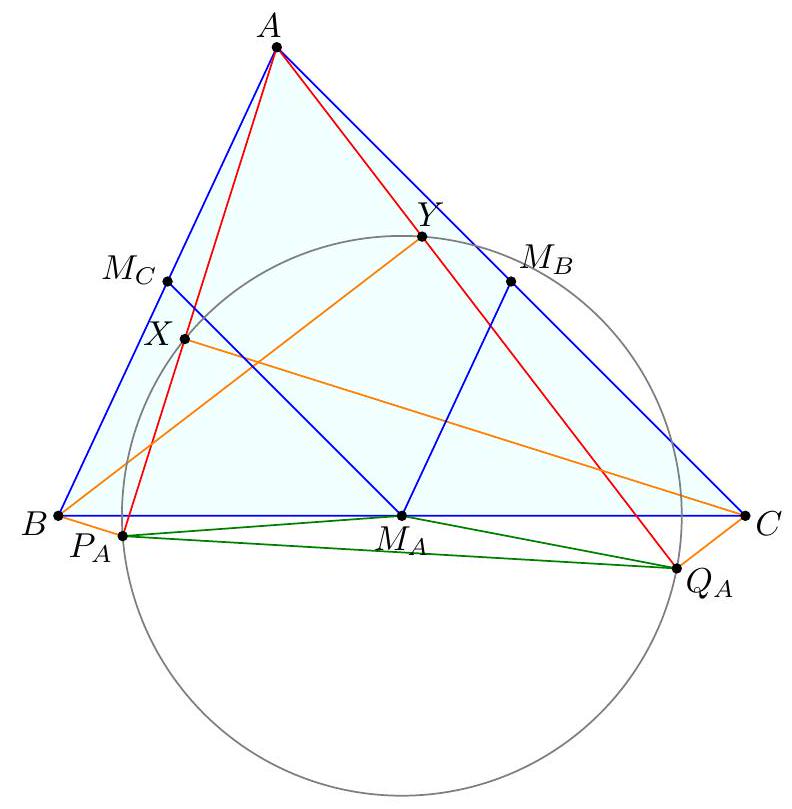 Claim - Line $\\ell_{A}$ passes through $M_{A}$, the midpoint of $B C$. Also, quadrilateral $P_{A} Q_{A} Y X$ is cyclic with circumcenter $M_{A}$. $$ A P_{A} \\cdot A X=A B \\cdot A C \\cdot \\cos \\theta \\cos (\\angle A-\\theta)=A Q_{A} \\cdot A Y $$ it follows that $P_{A}, Q_{A}, Y, X$ are concyclic by power of a point. Moreover, by projection, the perpendicular bisector of $P_{A} X$ passes through $M_{A}$, similar for $Q_{A} Y$, implying that $M_{A}$ is the center of $P_{A} Q_{A} Y X$. Hence $\\ell_{A}$ passes through $M_{A}$. $$ \\text { Claim }-\\measuredangle\\left(M_{A} M_{C}, \\ell_{A}\\right)=\\measuredangle Y P_{A} Q_{A} $$ Therefore, $$ \\frac{\\sin \\angle\\left(M_{A} M_{C}, \\ell_{A}\\right)}{\\sin \\angle\\left(\\ell_{A}, M_{A} M_{B}\\right)}=\\frac{\\sin \\angle Y P_{A} Q_{A}}{\\sin \\angle P_{A} Q_{A} X}=\\frac{Y Q_{A}}{X P_{A}}=\\frac{B C \\sin (\\angle C+\\theta)}{B C \\sin (\\angle B+\\theta)}=\\frac{\\sin (\\angle C+\\theta)}{\\sin (\\angle B+\\theta)}, $$ and we conclude by trig Ceva theorem.", "metadata": {"resource_path": "USA_TSTST/segmented/en-sols-TSTST-2022.jsonl"}} |
| {"year": "2022", "tier": "T0", "problem_label": "2", "problem_type": null, "exam": "USA_TSTST", "problem": "Let $A B C$ be a triangle. Let $\\theta$ be a fixed angle for which $$ \\theta<\\frac{1}{2} \\min (\\angle A, \\angle B, \\angle C) $$ Points $S_{A}$ and $T_{A}$ lie on segment $B C$ such that $\\angle B A S_{A}=\\angle T_{A} A C=\\theta$. Let $P_{A}$ and $Q_{A}$ be the feet from $B$ and $C$ to $\\overline{A S_{A}}$ and $\\overline{A T_{A}}$ respectively. Then $\\ell_{A}$ is defined as the perpendicular bisector of $\\overline{P_{A} Q_{A}}$. Define $\\ell_{B}$ and $\\ell_{C}$ analogously by repeating this construction two more times (using the same value of $\\theta$ ). Prove that $\\ell_{A}, \\ell_{B}$, and $\\ell_{C}$ are concurrent or all parallel.", "solution": " We discard the points $S_{A}$ and $T_{A}$ since they are only there to direct the angles correctly in the problem statement. 【 Second solution via Jacobi, by Maxim Li. Let $D$ be the foot of the $A$-altitude. Note that line $B C$ is the external angle bisector of $\\angle P_{A} D Q_{A}$. Claim - $\\left(D P_{A} Q_{A}\\right)$ passes through the midpoint $M_{A}$ of $B C$. It follows that $M_{A}$ lies on $\\ell_{A}$; we need to identify a second point. We'll use the circumcenter $O_{A}$ of $\\left(D P_{A} Q_{A}\\right)$. The perpendicular bisector of $D P_{A}$ passes through $M_{C}$; indeed, we can easily show the angle it makes with $M_{C} M_{A}$ is $90^{\\circ}-\\theta-C$, so $\\angle O_{A} M_{C} M_{A}=90-\\theta-C$, and then by analogous angle-chasing we can finish with Jacobi's theorem on $\\triangle M_{A} M_{B} M_{C}$.", "metadata": {"resource_path": "USA_TSTST/segmented/en-sols-TSTST-2022.jsonl"}} |
| {"year": "2022", "tier": "T0", "problem_label": "3", "problem_type": null, "exam": "USA_TSTST", "problem": "Determine all positive integers $N$ for which there exists a strictly increasing sequence of positive integers $s_{0}<s_{1}<s_{2}<\\cdots$ satisfying the following properties: - the sequence $s_{1}-s_{0}, s_{2}-s_{1}, s_{3}-s_{2}, \\ldots$ is periodic; and - $s_{s_{n}}-s_{s_{n-1}} \\leq N<s_{1+s_{n}}-s_{s_{n-1}}$ for all positive integers $n$.", "solution": " 【 Answer. All $N$ such that $t^{2} \\leq N<t^{2}+t$ for some positive integer $t$. Solution 1 (local). If $t^{2} \\leq N<t^{2}+t$ then the sequence $s_{n}=t n+1$ satisfies both conditions. It remains to show that no other values of $N$ work. Define $a_{n}:=s_{n}-s_{n-1}$, and let $p$ be the minimal period of $\\left\\{a_{n}\\right\\}$. For each $k \\in \\mathbb{Z}_{\\geq 0}$, let $f(k)$ be the integer such that $$ s_{f(k)}-s_{k} \\leq N<s_{f(k)+1}-s_{k} $$ Note that $f\\left(s_{n-1}\\right)=s_{n}$ for all $n$. Since $\\left\\{a_{n}\\right\\}$ is periodic with period $p, f(k+p)=f(k)+p$ for all $k$, so $k \\mapsto f(k)-k$ is periodic with period $p$. We also note that $f$ is nondecreasing: if $k<k^{\\prime}$ but $f\\left(k^{\\prime}\\right)<f(k)$ then $$ N<s_{f\\left(k^{\\prime}\\right)+1}-s_{k^{\\prime}}<s_{f(k)}-s_{k} \\leq N $$ which is absurd. We now claim that $$ \\max _{k}(f(k)-k)<p+\\min _{k}(f(k)-k) $$ Indeed, if $f\\left(k^{\\prime}\\right)-k^{\\prime} \\geq p+f(k)-k$ then we can shift $k$ and $k^{\\prime}$ so that $0 \\leq k-k^{\\prime}<p$, and it follows that $k \\leq k^{\\prime} \\leq f\\left(k^{\\prime}\\right)<f(k)$, violating the fact that $f$ is nondecreasing. Therefore $\\max _{k}(f(k)-k)<p+\\min _{k}(f(k)-k)$, so $f(k)-k$ is uniquely determined by its value modulo $p$. In particular, since $a_{n}=f\\left(s_{n-1}\\right)-s_{n-1}, a_{n}$ is also uniquely determined by its value modulo $p$, so $\\left\\{a_{n} \\bmod p\\right\\}$ also has minimal period $p$. Now work in $\\mathbb{Z} / p \\mathbb{Z}$ and consider the sequence $s_{0}, f\\left(s_{0}\\right), f\\left(f\\left(s_{0}\\right)\\right), \\ldots$. This sequence must be eventually periodic; suppose it has minimal period $p^{\\prime}$, which must be at most $p$. Then, since $$ f^{n}\\left(s_{0}\\right)-f^{n-1}\\left(s_{0}\\right)=s_{n}-s_{n-1}=a_{n} $$ and $\\left\\{a_{n} \\bmod p\\right\\}$ has minimal period $p$, we must have $p^{\\prime}=p$. Therefore the directed graph $G$ on $\\mathbb{Z} / p \\mathbb{Z}$ given by the edges $k \\rightarrow f(k)$ is simply a $p$-cycle, which implies that the map $k \\mapsto f(k)$ is a bijection on $\\mathbb{Z} / p \\mathbb{Z}$. Therefore, $f(k+1) \\neq f(k)$ for all $k$ (unless $p=1$, but in this case the following holds anyways), hence $$ f(k)<f(k+1)<\\cdots<f(k+p)=f(k)+p $$ This implies $f(k+1)=f(k)+1$ for all $k$, so $f(k)-k$ is constant, therefore $a_{n}=$ $f\\left(s_{n-1}\\right)-s_{n-1}$ is also constant. Let $a_{n} \\equiv t$. It follows that $t^{2} \\leq N<t^{2}+t$ as we wanted.", "metadata": {"resource_path": "USA_TSTST/segmented/en-sols-TSTST-2022.jsonl"}} |
| {"year": "2022", "tier": "T0", "problem_label": "3", "problem_type": null, "exam": "USA_TSTST", "problem": "Determine all positive integers $N$ for which there exists a strictly increasing sequence of positive integers $s_{0}<s_{1}<s_{2}<\\cdots$ satisfying the following properties: - the sequence $s_{1}-s_{0}, s_{2}-s_{1}, s_{3}-s_{2}, \\ldots$ is periodic; and - $s_{s_{n}}-s_{s_{n-1}} \\leq N<s_{1+s_{n}}-s_{s_{n-1}}$ for all positive integers $n$.", "solution": " 【 Answer. All $N$ such that $t^{2} \\leq N<t^{2}+t$ for some positive integer $t$. 【 Solution 2 (global). Define $\\left\\{a_{n}\\right\\}$ and $f$ as in the previous solution. We first show that $s_{i} \\not \\equiv s_{j}(\\bmod p)$ for all $i<j<i+p$. Suppose the contrary, i.e. that $s_{i} \\equiv s_{j}$ $(\\bmod p)$ for some $i, j$ with $i<j<i+p$. Then $a_{s_{i}+k}=a_{s_{j}+k}$ for all $k \\geq 0$, therefore $s_{s_{i}+k}-s_{s_{i}}=s_{s_{j}+k}-s_{s_{j}}$ for all $k \\geq 0$, therefore $$ a_{i+1}=f\\left(s_{i}\\right)-s_{i}=f\\left(s_{j}\\right)-s_{j}=a_{j+1} \\quad \\text { and } \\quad s_{i+1}=f\\left(s_{i}\\right) \\equiv f\\left(s_{j}\\right)=s_{j+1} \\quad(\\bmod p) $$ Continuing this inductively, we obtain $a_{i+k}=a_{j+k}$ for all $k$, so $\\left\\{a_{n}\\right\\}$ has period $j-i<p$, which is a contradiction. Therefore $s_{i} \\not \\equiv s_{j}(\\bmod p)$ for all $i<j<i+p$, and this implies that $\\left\\{s_{i}, \\ldots, s_{i+p-1}\\right\\}$ forms a complete residue system modulo $p$ for all $i$. Consequently we must have $s_{i+p} \\equiv s_{i}(\\bmod p)$ for all $i$. Let $T=s_{p}-s_{0}=a_{1}+\\cdots+a_{p}$. Since $\\left\\{a_{n}\\right\\}$ is periodic with period $p$, and $\\{i+1, \\ldots, i+k p\\}$ contains exactly $k$ values of each residue class modulo $p$, $$ s_{i+k p}-s_{i}=a_{i+1}+\\cdots+a_{i+k p}=k T $$ for all $i, k$. Since $p \\mid T$, it follows that $s_{s_{p}}-s_{s_{0}}=\\frac{T}{p} \\cdot T=\\frac{T^{2}}{p}$. Summing up the inequalities $$ s_{s_{n}}-s_{s_{n-1}} \\leq N<s_{s_{n}+1}-s_{s_{n-1}}=s_{s_{n}}-s_{s_{n-1}}+a_{s_{n}+1} $$ for $n \\in\\{1, \\ldots, p\\}$ then implies $$ \\frac{T^{2}}{p}=s_{s_{p}}-s_{s_{0}} \\leq N p<\\frac{T^{2}}{p}+a_{s_{1}+1}+a_{s_{2}+1}+\\cdots+a_{s_{p}+1}=\\frac{T^{2}}{p}+T $$ where the last equality holds because $\\left\\{s_{1}+1, \\ldots, s_{p}+1\\right\\}$ is a complete residue system modulo $p$. Dividing this by $p$ yields $t^{2} \\leq N<t^{2}+t$ for $t:=\\frac{T}{p} \\in \\mathbb{Z}^{+}$. Remark (Author comments). There are some similarities between this problem and IMO 2009/3, mainly that they both involve terms of the form $s_{s_{n}}$ and $s_{s_{n}+1}$ and the sequence $s_{0}, s_{1}, \\ldots$ turns out to be an arithmetic progression. Other than this, I don't think knowing about IMO 2009/3 will be that useful on this problem, since in this problem the fact that $\\left\\{s_{n+1}-s_{n}\\right\\}$ is periodic is fundamentally important. The motivation for this problem comes from the following scenario: assume we have boxes that can hold some things of total size $\\leq N$, and a sequence of things of size $a_{1}, a_{2}, \\ldots$ (where $a_{i}:=s_{i+1}-s_{i}$ ). We then greedily pack the things in a sequence of boxes, 'closing' each box when it cannot fit the next thing. The number of things we put in each box gives a sequence $b_{1}, b_{2}, \\ldots$. This problem asks when we can have $\\left\\{a_{n}\\right\\}=\\left\\{b_{n}\\right\\}$, assuming that we start with a sequence $\\left\\{a_{n}\\right\\}$ that is periodic. (Extra motivation: I first thought about this scenario when I was pasting some text repeatedly into the Notes app and noticed that the word at the end of lines are also (eventually) periodic.)", "metadata": {"resource_path": "USA_TSTST/segmented/en-sols-TSTST-2022.jsonl"}} |
| {"year": "2022", "tier": "T0", "problem_label": "4", "problem_type": null, "exam": "USA_TSTST", "problem": "A function $f: \\mathbb{N} \\rightarrow \\mathbb{N}$ has the property that for all positive integers $m$ and $n$, exactly one of the $f(n)$ numbers $$ f(m+1), f(m+2), \\ldots, f(m+f(n)) $$ is divisible by $n$. Prove that $f(n)=n$ for infinitely many positive integers $n$.", "solution": " We start with the following claim: $$ \\text { Claim - If } a \\mid b \\text { then } f(a) \\mid f(b) $$ In what follows, let $a \\geq 2$ be any positive integer. Because $f(a)$ and $f(2 a)$ are both divisible by $f(a)$, there are $a+1$ consecutive values of $f$ of which at least two divisible by $f(a)$. It follows that $f(f(a)) \\leq a$. However, we also know that exactly one of $f(2), f(3), \\ldots, f(1+f(a))$ is divisible by $a$; let this be $f(t)$. Then we have $S_{a}=\\{t, t+f(a), t+2 f(a), \\ldots\\}$. Because $a|f(t)| f(2 t)$, we know that $2 t \\in S_{a}$, so $t$ is a multiple of $f(a)$. Because $2 \\leq t \\leq 1+f(a)$, and $f(a) \\geq 2$ for $a \\geq 2$, we conclude that we must have $t=f(a)$, so $f(f(a))$ is a multiple of $a$. Together with $f(f(a)) \\leq a$, this yields $f(f(a))=a$. Because $f(f(a))=a$ also holds for $a=1$ (from the given condition for $n=1$ it immediately follows that $f(1)=1$ ), we conclude that $f(f(a))=a$ for all $a$, and hence $f$ is a bijection. Moreover, we now have that $f(a) \\mid f(b)$ implies $f(f(a)) \\mid f(f(b))$, i.e. $a \\mid b$, so $a \\mid b$ if and only if $f(a) \\mid f(b)$. Together with the fact that $f$ is a bijection, this implies that $f(n)$ has the same number of divisors of $n$. Let $p$ be a prime. Then $f(p)=q$ must be a prime as well. If $q \\neq p$, then from $f(p) \\mid f(p q)$ and $f(q) \\mid f(p q)$ it follows that $p q \\mid f(p q)$, so $f(p q)=p q$ because $f(p q)$ and $p q$ must have the same number of divisors. Therefore, for every prime number $p$ we either have that $f(p)=p$ or $f(p f(p))=p f(p)$. From here, it is easy to see that $f(n)=n$ for infinitely many $n$.", "metadata": {"resource_path": "USA_TSTST/segmented/en-sols-TSTST-2022.jsonl"}} |
| {"year": "2022", "tier": "T0", "problem_label": "5", "problem_type": null, "exam": "USA_TSTST", "problem": "Let $A_{1}, \\ldots, A_{2022}$ be the vertices of a regular 2022 -gon in the plane. Alice and Bob play a game. Alice secretly chooses a line and colors all points in the plane on one side of the line blue, and all points on the other side of the line red. Points on the line are colored blue, so every point in the plane is either red or blue. (Bob cannot see the colors of the points.) In each round, Bob chooses a point in the plane (not necessarily among $A_{1}, \\ldots$, $\\left.A_{2022}\\right)$ and Alice responds truthfully with the color of that point. What is the smallest number $Q$ for which Bob has a strategy to always determine the colors of points $A_{1}, \\ldots, A_{2022}$ in $Q$ rounds?", "solution": " The answer is 22 . To prove the lower bound, note that there are $2022 \\cdot 2021+2>2^{21}$ possible colorings. If Bob makes less than 22 queries, then he can only output $2^{21}$ possible colorings, which means he is wrong on some coloring. Now we show Bob can always win in 22 queries. A key observation is that the set of red points is convex, as is the set of blue points, so if a set of points is all the same color, then their convex hull is all the same color. ## Lemma Let $B_{0}, \\ldots, B_{k+1}$ be equally spaced points on a circular arc such that colors of $B_{0}$ and $B_{k+1}$ differ and are known. Then it is possible to determine the colors of $B_{1}$, $\\ldots, B_{k}$ in $\\left\\lceil\\log _{2} k\\right\\rceil$ queries. ## Lemma Let $B_{0}, \\ldots, B_{k+1}$ be equally spaced points on a circular arc such that colors of $B_{0}, B_{\\lceil k / 2\\rceil}, B_{k+1}$ are both red and are known. Then at least one of the following holds: all of $B_{1}, \\ldots, B_{\\lceil k / 2\\rceil}$ are red or all of $B_{\\lceil k / 2\\rceil}, \\ldots, B_{k}$ are red. Furthermore, in one query we can determine which one of the cases holds. Now the strategy is: Bob picks $A_{1}$. WLOG it is red. Now suppose Bob does not know the colors of $\\leq 2^{k}-1$ points $A_{i}, \\ldots, A_{j}$ with $j-i+1 \\leq 2^{k}-1$ and knows the rest are red. I claim Bob can win in $2 k-1$ queries. First, if $k=1$, there is one point and he wins by querying the point, so the base case holds, so assume $k>1$. Bob queries $A_{i+\\lceil(j-i+1) / 2\\rceil}$. If it is blue, he finishes in $2 \\log _{2}\\lceil(j-i+1) / 2\\rceil \\leq 2(k-1)$ queries by the first lemma, for a total of $2 k-1$ queries. If it is red, he can query one more point and learn some half of $A_{i}, \\ldots, A_{j}$ that are red by the second lemma, and then he has reduced it to the case with $\\leq 2^{k-1}-1$ points in two queries, at which point we induct.", "metadata": {"resource_path": "USA_TSTST/segmented/en-sols-TSTST-2022.jsonl"}} |
| {"year": "2022", "tier": "T0", "problem_label": "6", "problem_type": null, "exam": "USA_TSTST", "problem": "Let $O$ and $H$ be the circumcenter and orthocenter, respectively, of an acute scalene triangle $A B C$. The perpendicular bisector of $\\overline{A H}$ intersects $\\overline{A B}$ and $\\overline{A C}$ at $X_{A}$ and $Y_{A}$ respectively. Let $K_{A}$ denote the intersection of the circumcircles of triangles $O X_{A} Y_{A}$ and $B O C$ other than $O$. Define $K_{B}$ and $K_{C}$ analogously by repeating this construction two more times. Prove that $K_{A}, K_{B}, K_{C}$, and $O$ are concyclic.", "solution": " \\ First solution, by author. Let $\\odot O X_{A} Y_{A}$ intersects $A B, A C$ again at $U, V$. Then by Reim's theorem $U V C B$ are concyclic. Hence the radical axis of $\\odot O X_{A} Y_{A}, \\odot O B C$ and $\\odot(U V C B)$ are concurrent, i.e. $O K_{A}, B C, U V$ are concurrent, Denote the intersection as $K_{A}^{*}$, which is indeed the inversion of $K_{A}$ with respect to $\\odot O$. (The inversion sends $\\odot O B C$ to the line $B C$ ). Let $P_{A}, P_{B}, P_{C}$ be the circumcenters of $\\triangle O B C, \\triangle O C A, \\triangle O A B$ respectively. Claim $-K_{A}^{*}$ coincides with the intersection of $P_{B} P_{C}$ and $B C$. Finally by Desargue's theorem, it suffices to show that $A P_{A}, B P_{B}, C P_{C}$ are concurrent. Note that $$ \\begin{aligned} & d\\left(P_{A}, A B\\right)=P_{A} B \\sin \\left(90^{\\circ}+\\angle C-\\angle A\\right) \\\\ & d\\left(P_{A}, A C\\right)=P_{A} C \\sin \\left(90^{\\circ}+\\angle B-\\angle A\\right) \\end{aligned} $$ Hence the symmetric product and trig Ceva finishes the proof. 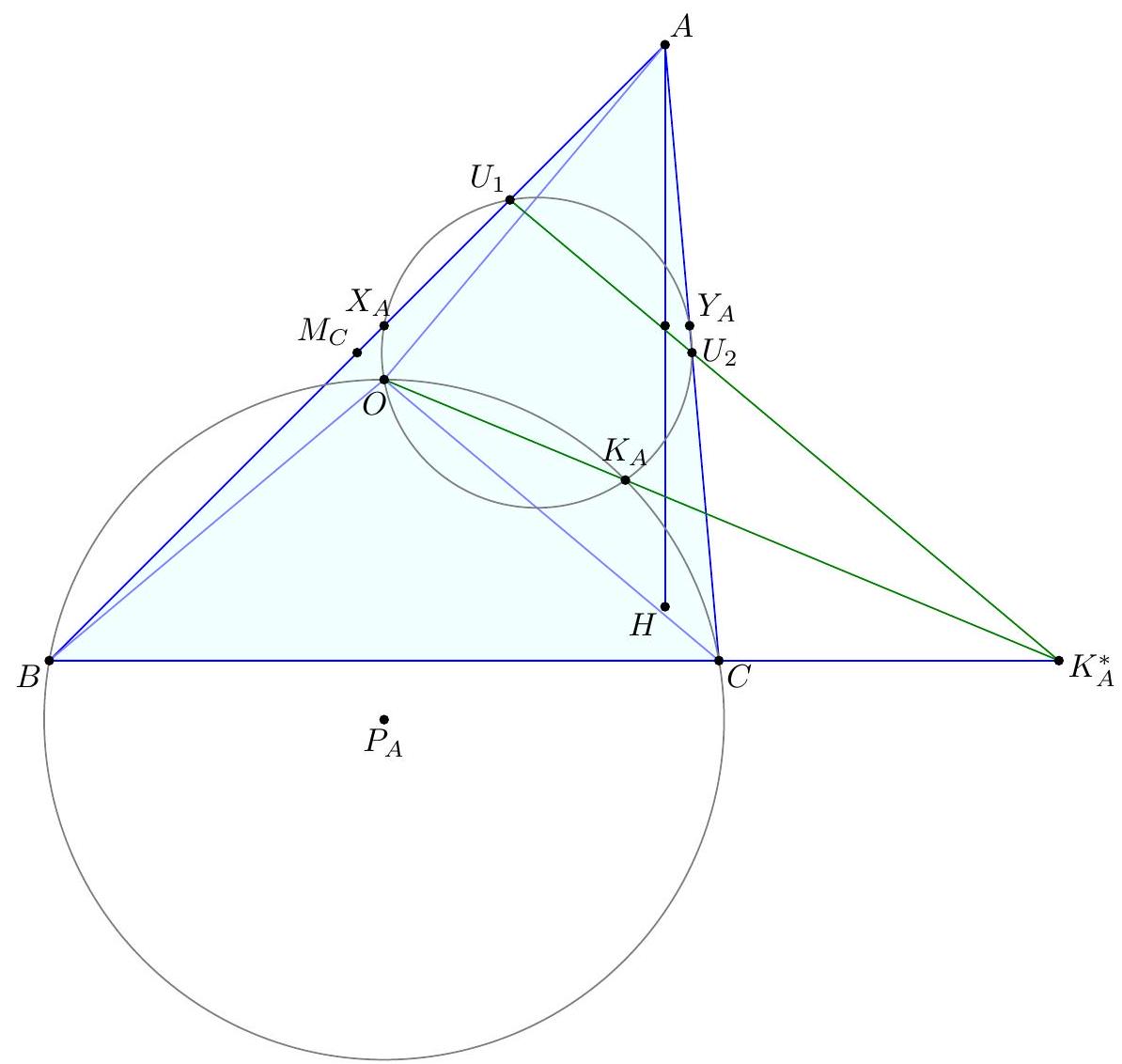", "metadata": {"resource_path": "USA_TSTST/segmented/en-sols-TSTST-2022.jsonl"}} |
| {"year": "2022", "tier": "T0", "problem_label": "6", "problem_type": null, "exam": "USA_TSTST", "problem": "Let $O$ and $H$ be the circumcenter and orthocenter, respectively, of an acute scalene triangle $A B C$. The perpendicular bisector of $\\overline{A H}$ intersects $\\overline{A B}$ and $\\overline{A C}$ at $X_{A}$ and $Y_{A}$ respectively. Let $K_{A}$ denote the intersection of the circumcircles of triangles $O X_{A} Y_{A}$ and $B O C$ other than $O$. Define $K_{B}$ and $K_{C}$ analogously by repeating this construction two more times. Prove that $K_{A}, K_{B}, K_{C}$, and $O$ are concyclic.", "solution": " I Second solution, from Jeffrey Kwan. Let $O_{A}$ be the circumcenter of $\\triangle A X_{A} Y_{A}$. The key claim is that: Claim $-O_{A} X_{A} Y_{A} O$ is cyclic. $$ \\frac{A X_{A}}{A B}=\\frac{A H / 2}{A D}=\\frac{R \\cos A}{A D} $$ and so $$ \\frac{A O}{A D}=R \\cdot \\frac{A X_{A}}{A B \\cdot R \\cos A}=\\frac{A X_{A}}{A E}=\\frac{A Y_{A}}{A F} $$ Hence $\\angle X_{A} O Y_{A}=180^{\\circ}-2 \\angle A=180^{\\circ}-\\angle X_{A} O_{A} Y_{A}$, which proves the claim. Let $P_{A}$ be the circumcenter of $\\triangle O B C$, and define $P_{B}, P_{C}$ similarly. By the claim, $A$ is the exsimilicenter of $\\left(O X_{A} Y_{A}\\right)$ and $(O B C)$, so $A P_{A}$ is the line between their two centers. In particular, $A P_{A}$ is the perpendicular bisector of $O K_{A}$. 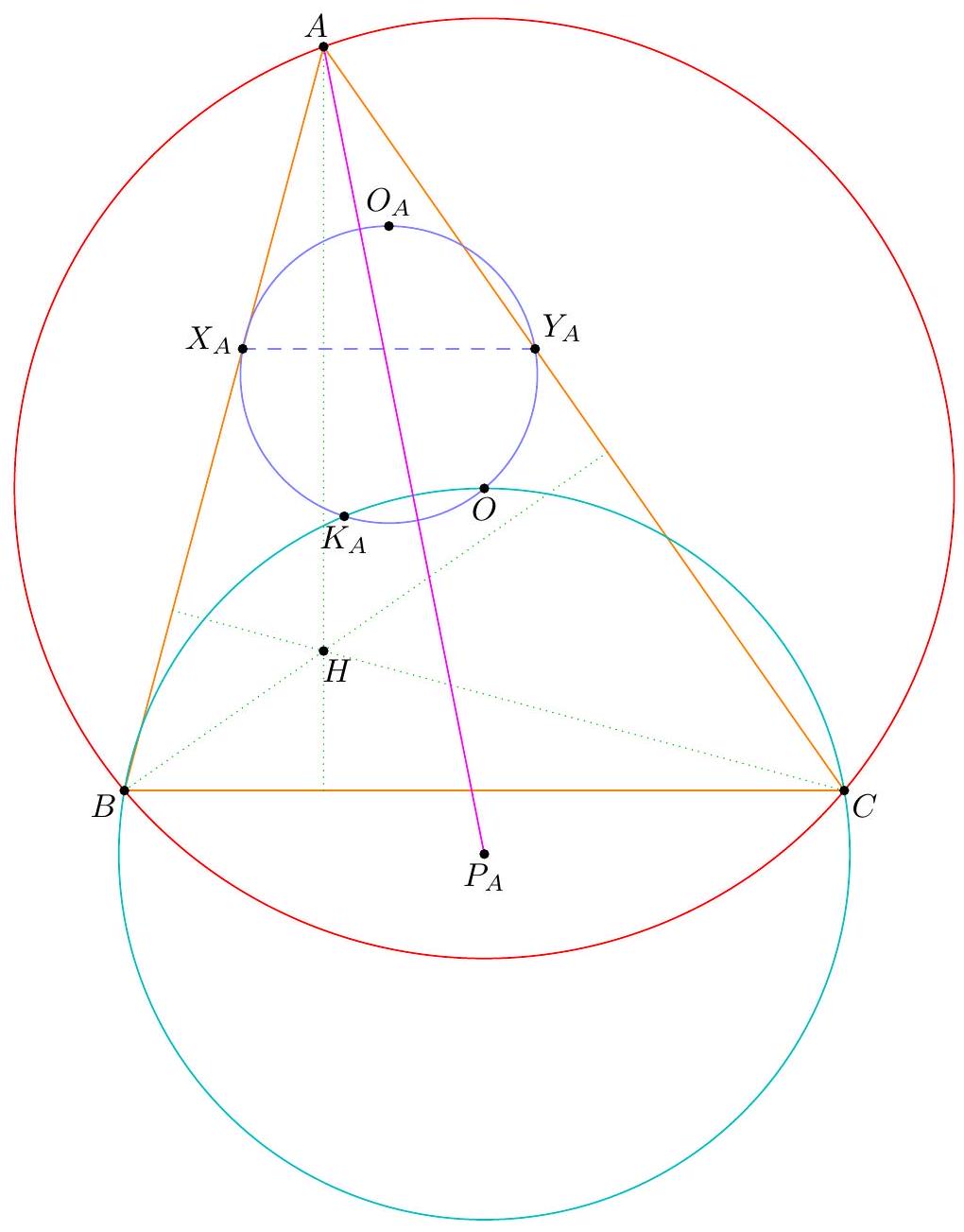 Claim $-A P_{A}, B P_{B}, C P_{C}$ concur at $T$. Now $T$ lies on the perpendicular bisectors of $O K_{A}, O K_{B}$, and $O K_{C}$. Hence $O K_{A} K_{B} K_{C}$ is cyclic with center $T$, as desired.", "metadata": {"resource_path": "USA_TSTST/segmented/en-sols-TSTST-2022.jsonl"}} |
| {"year": "2022", "tier": "T0", "problem_label": "7", "problem_type": null, "exam": "USA_TSTST", "problem": "Let $A B C D$ be a parallelogram. Point $E$ lies on segment $C D$ such that $$ 2 \\angle A E B=\\angle A D B+\\angle A C B, $$ and point $F$ lies on segment $B C$ such that $$ 2 \\angle D F A=\\angle D C A+\\angle D B A . $$ Let $K$ be the circumcenter of triangle $A B D$. Prove that $K E=K F$.", "solution": " Let the circle through $A, B$, and $E$ intersect $C D$ again at $E^{\\prime}$, and let the circle through $D$, $A$, and $F$ intersect $B C$ again at $F^{\\prime}$. Now $A B E E^{\\prime}$ and $D A F^{\\prime} F$ are cyclic quadrilaterals with two parallel sides, so they are isosceles trapezoids. From $K A=K B$, it now follows that $K E=K E^{\\prime}$, whereas from $K A=K D$ it follows that $K F=K F^{\\prime}$. Next, let the circle through $A, B$, and $E$ intersect $A C$ again at $S$. Then $$ \\angle A S B=\\angle A E B=\\frac{1}{2}(\\angle A D B+\\angle A C B)=\\frac{1}{2}(\\angle A D B+\\angle D A C)=\\frac{1}{2} \\angle A M B, $$ where $M$ is the intersection of $A C$ and $B D$. From $\\angle A S B=\\frac{1}{2} \\angle A M B$, it follows that $M S=M B$, so $S$ is the point on $M C$ such that $M S=M B=M D$. By symmetry, the circle through $A, D$, and $F$ also passes through $S$, and it follows that the line $A S$ is the radical axis of the circles $(A B E)$ and $(A D F)$. By power of a point, we now obtain $$ C E \\cdot C E^{\\prime}=C S \\cdot C A=C F \\cdot C F^{\\prime}, $$ from which it follows that $E, F, E^{\\prime}$, and $F^{\\prime}$ are concyclic. The segments $E E^{\\prime}$ and $F F^{\\prime}$ are not parallel, so their perpendicular bisectors only meet at one point, which is $K$. Hence $K E=K F$.", "metadata": {"resource_path": "USA_TSTST/segmented/en-sols-TSTST-2022.jsonl"}} |
| {"year": "2022", "tier": "T0", "problem_label": "8", "problem_type": null, "exam": "USA_TSTST", "problem": "Find all functions $f: \\mathbb{N} \\rightarrow \\mathbb{Z}$ such that $$ \\left\\lfloor\\frac{f(m n)}{n}\\right\\rfloor=f(m) $$ for all positive integers $m, n$.", "solution": " There are two families of functions that work: for each $\\alpha \\in \\mathbb{R}$ the function $f(n)=\\lfloor\\alpha n\\rfloor$, and for each $\\alpha \\in \\mathbb{R}$ the function $f(n)=\\lceil\\alpha n\\rceil-1$. (For irrational $\\alpha$ these two functions coincide.) It is straightforward to check that these functions indeed work; essentially, this follows from the identity $$ \\left\\lfloor\\frac{\\lfloor x n\\rfloor}{n}\\right\\rfloor=\\lfloor x\\rfloor $$ which holds for all positive integers $n$ and real numbers $x$. We now show that every function that works must be of one of the above forms. Let $f$ be a function that works, and define the sequence $a_{1}, a_{2}, \\ldots$ by $a_{n}=f(n!) / n!$. Applying the give condition with $(n!, n+1)$ yields $a_{n+1} \\in\\left[a_{n}, a_{n}+\\frac{1}{n!}\\right)$. It follows that the sequence $a_{1}, a_{2}, \\ldots$ is non-decreasing and bounded from above by $a_{1}+e$, so this sequence must converge to some limit $\\alpha$. If there exists a $k$ such that $a_{k}=\\alpha$, then we have $a_{\\ell}=\\alpha$ for all $\\ell>k$. For each positive integer $m$, there exists $\\ell>k$ such that $m \\mid \\ell$ !. Plugging in $m n=\\ell$ !, it then follows that $$ f(m)=\\left\\lfloor\\frac{f(\\ell!)}{\\ell!/ m}\\right\\rfloor=\\lfloor\\alpha m\\rfloor $$ for all $m$, so $f$ is of the desired form. If there does not exist a $k$ such that $a_{k}=\\alpha$, we must have $a_{k}<\\alpha$ for all $k$. For each positive integer $m$, we can now pick an $\\ell$ such that $m \\mid \\ell$ ! and $a_{\\ell}=\\alpha-x$ with $x$ arbitrarily small. It then follows from plugging in $m n=\\ell$ ! that $$ f(m)=\\left\\lfloor\\frac{f(\\ell!)}{\\ell!/ m}\\right\\rfloor=\\left\\lfloor\\frac{\\ell!(\\alpha-x)}{\\ell!/ m}\\right\\rfloor=\\lfloor\\alpha m-m x\\rfloor . $$ If $\\alpha m$ is an integer we can choose $\\ell$ such that $m x<1$, and it follows that $f(m)=\\lceil\\alpha m\\rceil-1$. If $\\alpha m$ is not an integer we can choose $\\ell$ such that $m x<\\{\\alpha m\\}$, and it also follows that $f(m)=\\lceil\\alpha m\\rceil-1$. We conclude that in this case $f$ is again of the desired form.", "metadata": {"resource_path": "USA_TSTST/segmented/en-sols-TSTST-2022.jsonl"}} |
| {"year": "2022", "tier": "T0", "problem_label": "9", "problem_type": null, "exam": "USA_TSTST", "problem": "Let $k>1$ be a fixed positive integer. Prove that if $n$ is a sufficiently large positive integer, there exists a sequence of integers with the following properties: - Each element of the sequence is between 1 and $n$, inclusive. - For any two different contiguous subsequences of the sequence with length between 2 and $k$ inclusive, the multisets of values in those two subsequences is not the same. - The sequence has length at least $0.499 n^{2}$.", "solution": " For any positive integer $n$, define an $(n, k)$-good sequence to be a finite sequence of integers each between 1 and $n$ inclusive satisfying the second property in the problem statement. The problems asks to show that, for all sufficiently large integers $n$, there is an $(n, k)$-good sequence of length at least $0.499 n^{2}$. Fix $k \\geq 2$ and consider some prime power $n=p^{m}$ with $p>k+1$. Consider some $0<g<\\frac{n}{k}-1$ with $\\operatorname{gcd}(g, n)=1$ and let $a$ be the smallest positive integer with $g^{a} \\equiv \\pm 1$ $(\\bmod n)$. Claim (Main claim) — For $k, n, g, a$ defined as above, there is an $(n, k)$-good sequence of length $a(n+2)+2$. To prove the main claim, we need some results about the structure of $\\mathbb{Z} / n \\mathbb{Z}$. Specifically, we'll first show that any nontrivial arithmetic sequence is uniquely recoverable. ## Lemma Consider any arithmetic progression of length $i \\leq k$ whose common difference is relatively prime to $n$, and let $S$ be the set of residues it takes modulo $n$. Then there exists a unique integer $0<d \\leq \\frac{n}{2}$ and a unique integer $0 \\leq a<n$ such that $$ S=\\{a, a+d, \\ldots, a+(i-1) d\\} $$ - Case $1: i$ is odd, so $i=2 j+1$ for some $j$. Then the middle term of the arithmetic progression is the average of all residues in $S$, which we can uniquely identify as some $u$ (and we know $n$ is coprime to $i$, so it is possible to average the residues). We need to show that there is only one choice of $d$, up to $\\pm$, so that $S=\\{u-$ $j d, u-(j-1) d, \\ldots, u+j d\\}$. Let $X$ be the sum of squares of the residues in $S$, so we have $$ X \\equiv(u-j d)^{2}+(u-(j-1) d)^{2}+\\cdots+(u+j d)^{2}=(2 j+1) u^{2}+d^{2} \\frac{j(j+1)(2 j+1)}{3}, $$ which therefore implies $$ 3\\left(X-(2 j+1) u^{2}\\right)(j(j+1)(2 j+1))^{-1} \\equiv d^{2} $$ thus identifying $d$ uniquely up to sign as desired. - Case 2: $i$ is even, so $i=2 j$ for some $j$. Once again we can compute the average $u$ of the residues in $S$, and we need to show that there is only one choice of $d$, up to $\\pm$, so that $S=\\{u-(2 j-1) d, u-(2 j-3) d, \\ldots, u+(2 j-1) d\\}$. Once again we compute the sum of squares $X$ of the residues in $S$, so that $X \\equiv(u-(2 j-1) d)^{2}+(u-(2 j-3) d)^{2}+\\cdots+(u+(2 j-1) d)^{2}=2 j u^{2}+\\frac{(2 j-1) 2 j(2 j+1)}{3}$ which therefore implies $$ 3\\left(X-2 j u^{2}\\right)((2 j-1) 2 j(2 j+1))^{-1} \\equiv d^{2} $$ again identifying $d$ uniquely up to sign as desired. Thus we have shown that given the set of residues an arithmetic progression takes on modulo $n$, we can recover that progression up to sign. Here we have used the fact that given $d^{2}(\\bmod n)$, it is possible to recover $d$ up to $\\operatorname{sign}$ provided that $n$ is of the form $p^{m}$ with $p \\neq 2$ and $\\operatorname{gcd}(d, n)=1$. Now, we will proceed by chaining many arithmetic sequences together. Definition. For any integer $l$ between 0 and $a-1$, inclusive, define $C_{l}$ to be the sequence $0, g^{l}, g^{l}, 2 g^{l}, 3 g^{l}, \\ldots,(n-1) g^{l},(n-1) g^{l}$ taken $(\\bmod n)$. (This is just a sequence where the $i$ th term is $(i-1) g^{l}$, except the terms $g^{l},(n-1) g^{l}$ is repeated once.) Definition. Consider the sequence $S_{n}$ of residues $\\bmod n$ defined as follows: - The first term of $S_{n}$ is 0 . - For each $0 \\leq l<a$, the next $n+2$ terms of $S_{n}$ are the terms of $C_{l}$ in order. - The next and final term of $S_{n}$ is 0 . We claim that $S_{n}$ constitutes a $k$-good string with respect to the alphabet of residues modulo $n$. We first make some initial observations about $S_{n}$. ## Lemma $S_{n}$ has the following properties: - $S_{n}$ has length $a(n+2)+2$. - If a contiguous subsequence of $S_{n}$ of length $\\leq k$ contains two of the same residue $(\\bmod n)$, those two residues occur consecutively in the subsequence. To prove the second property, consider any contiguous subsequence $S_{n}[i: i+k-1]$ of length $k$ which contains two of the same residue modulo $n$. If $S_{n}[i: i+k-1]$ is wholly contained within some $C_{l}$, it's clear that the only way $S_{n}[i: i+k-1]$ could repeat residues if it repeats one of the two consecutive values $g^{l}, g^{l}$ or $(n-1) g^{l},(n-1) g^{l}$, so assume that is not the case. Now, it must be true that $S_{n}[i: i+k-1]$ consists of one contiguous subsequence of the form $$ \\left(n-k_{1}\\right) g^{l-1},\\left(n-\\left(k_{1}-1\\right)\\right) g^{l-1}, \\ldots,(n-1) g^{l-1},(n-1) g^{l-1} $$ which are the portions of $S_{n}[i: i+k-1]$ contained in $C_{l-1}$, and then a second contiguous subsequence of the form $$ 0, g^{l}, g^{l}, 2 g^{l}, \\ldots, k_{2} g^{l} $$ which are the portions of $S_{n}[i: i+k-1]$ contained in $C_{l}$, and we obviously have $k_{2}+k_{1}=k-3$. For $S_{n}[i: i+k-1]$ to contain two of the same residue in non-consecutive positions, there would have to exist some $0<u \\leq k_{1}, 0<v \\leq k_{2}$ with $(n-u) g^{l-1} \\equiv v g^{l}$ $(\\bmod n)$, meaning that $u+g v \\equiv 0(\\bmod n)$. But we know since $k_{1}+k_{2}<k$ that $0<u+g v<k+k g<n$, so this is impossible, as desired. Now we can prove the main claim. First suppose $M$ contains some residue twice. By the last lemma there are only a few possible cases: - $M$ contains multiple copies of the residue 0 . In this case we know $M$ contains the beginning of $S_{n}$, so the corresponding contiguous subsequence is just the first $i$ terms of $S_{n}$. - $M$ contains multiple copies of multiple residues. By the last lemma and the structure of $S_{n}$, we can easily see that $M$ must contain two copies of $-g^{i-1}$ and two copies of $g^{i}$ for some $0 \\leq i<a$ that can be identified uniquely, and $M$ must contain portions of both $C_{i-1}, C_{i}$. It follows $M$ 's terms can be partitioned into two portions, the first one being $$ -i_{1} g^{i-1},-\\left(i_{1}-1\\right) g^{i-1}, \\ldots,-g^{i-1},-g^{i-1} $$ and the second one being $$ 0, g^{i}, g^{i}, 2 g^{i}, \\ldots, i_{2} g^{i} $$ for some $i_{1}$, $i_{2}$ with $i_{1}+i_{2}=i-3$, and we just need to uniquely identify $i_{1}, i_{2}$. Luckily, by dividing the residues in $M$ by $g^{i-1}$, we know we can partition $M$ 's terms into $$ -i_{1},-\\left(i_{1}-1\\right), \\ldots,-1,-1 $$ as well as $$ 0, g, g, 2 g, \\ldots, i_{2} g $$ Now since $i_{2} g \\leq k g<n-k$ and $-i_{1} \\equiv n-i_{1} \\geq n-k$ it is easy to see that $i_{1}, i_{2}$ can be identified uniquely, as desired. - $M$ contains multiple copies of only one residue $g^{i}$, for some $0 \\leq i<a$ that can be identified uniquely. Then by the last lemma $M$ must be located at the beginning of $C_{i}$ and possibly contain the last few terms of $C_{i-1}$, so $M$ must be of the form $g^{i}, g^{i}, 2 g^{i}, \\ldots, i_{1} g^{i}$, along with possibly the term 0 or the terms $0,-g^{i-1}$. So when we divide $M$ by $g^{i-1}$ we should be left with terms of the form $g, g, 2 g, \\ldots, i_{1} g$ along with possibly 0 or $0,-1$. Since $i_{1} g \\leq k g<n-k$, we can easily disambiguate these cases and uniquely identify the contiguous subsequence corresponding to $M$. - $M$ contains multiple copies of only one residue $-g^{i}$, for some $0 \\leq i<a$ that can be identified uniquely. Then by the last lemma $M$ must be located at the end of $C_{i}$ and possibly the first terms of $C_{i+1}$, so $M$ must be of the form $-g^{i},-g^{i},-2 g^{i}, \\ldots,-i_{1} g^{i}$, along with possibly the term 0 or the terms $0, g^{i+1}$. So when we divide $M$ by $g^{i-1}$ we should be left with terms of the form $-1,-1,-2, \\ldots,-i_{1}$, along with possibly 0 or $0, g$. Since $-i_{1} \\equiv n-i_{1} \\geq \\frac{n}{2}$ and $g<\\frac{n}{2}$, we can disambiguate these cases and uniquely identify the contiguous subsequence corresponding to $M$. Thus in all cases where $M$ contains a repeated residue, we can identify the unique contiguous subsequence of $S_{n}$ corresponding to $M$. When $M$ does not contain a repeated residue, it follows that $M$ cannot contain both of the $g^{i}$ terms or $(n-1) g^{i}$ terms at the beginning or end of each $C_{i}$. It follows that $M$ is either entirely contained in some $C_{i}$ or contained in the union of the end of some $C_{i}$ with the beginning of some $C_{i+1}$, meaning $M$ corresponds to a contiguous subsequence of $\\left(-g^{i}, 0, g^{i+1}\\right)$. In the first case, since each $C_{i}$ is an arithmetic progression when the repeated terms are ignored, Lemma 1 implies that we can uniquely determine the location of $M$, and in the second case, it is easy to tell which contiguous subsequence of $\\left(-g^{i}, 0, g^{i+1}\\right)$ corresponds to $M$. Therefore, in all cases, for any multiset $M$ corresponding to some contiguous subsequence of $S_{n}$ of length $i \\leq k$, we can uniquely identify the contiguous subsequence, meaning $S_{n}$ is $k$-good with respect to the alphabet of residues modulo $n$, as desired. Now we will finish the problem. We observe the following. Claim - Fix $k$ and let $p>k+1$ be a prime. Then for $n=p^{2}$ we can find a $(n, k)$-good sequence of length $\\frac{p(p-1)\\left(p^{2}+2\\right)}{2}$. We will prove a stronger statement that $g<p$. Indeed, consider any primitive root $g_{0}$ $(\\bmod p)$. Then $g_{0}+a p$ has order $p-1 \\operatorname{modulo} p$, so its order modulo $p^{2}$ is divisible by $p-1$, hence $g_{0}+a p$ is a primitive root modulo $p^{2}$ as long as $\\left(g_{0}+a p\\right)^{p-1} \\not \\equiv 1\\left(\\bmod p^{2}\\right)$. Now $$ \\left(g_{0}+a p\\right)^{p-1}=\\sum_{i} g_{0}^{p-1-i}(a p)^{i}\\binom{p-1}{i} \\equiv g_{0}^{p-1}+g_{0}^{p-2}(a p) \\quad\\left(\\bmod p^{2}\\right) $$ In particular, of the values $g_{0}, g_{0}+p, \\ldots, g_{0}+p(p-1)$, only one has order $p-1$ and the rest are primitive roots. So for each $0<g_{0}<p$ which is a primitive root modulo $p$, either $g_{0}$ is a primitive root modulo $p^{2}$ or $g_{0}$ has order $p-1$ but $g_{0}+p, g_{0}+2 p, \\ldots, g_{0}+p(p-1)$ are all primitive roots. By considering all choices of $g_{0}$, we either find a primitive root $\\left(\\bmod p^{2}\\right)$ which is between 0 and $p$, or we find that all residues $\\left(\\bmod p^{2}\\right)$ of order $p-1$ are between 0 and $p$. But if $\\operatorname{ord}_{p^{2}}(a)=p-1$ then $\\operatorname{ord}_{p^{2}}\\left(a^{-1}\\right)=p-1$, and two residues between $0, p$ cannot be inverses modulo $p^{2}$ (because with the exception of 1 , they cannot multiply to something $\\geq p^{2}+1$ ), so there is always a primitive root between $0, p$ as desired. Now for arbitrarily large $n$ we can choose $p<\\sqrt{n}$ with $\\frac{p}{\\sqrt{n}}$ arbitrarily close to 1 ; by the previous claim, we can get an $(n, k)$-good sequence of length at least $\\frac{p-1}{p} \\cdot \\frac{p^{4}}{2}$ for any constant, so for sufficiently large $n, p$ we get $(n, k)$-good sequences of length $0.499 n^{2}$.", "metadata": {"resource_path": "USA_TSTST/segmented/en-sols-TSTST-2022.jsonl"}} |
|
|


