| {"year": "2023", "tier": "T0", "problem_label": "1", "problem_type": null, "exam": "USA_TSTST", "problem": "Let $A B C$ be a triangle with centroid $G$. Points $R$ and $S$ are chosen on rays $G B$ and $G C$, respectively, such that $$ \\angle A B S=\\angle A C R=180^{\\circ}-\\angle B G C . $$ Prove that $\\angle R A S+\\angle B A C=\\angle B G C$.", "solution": " 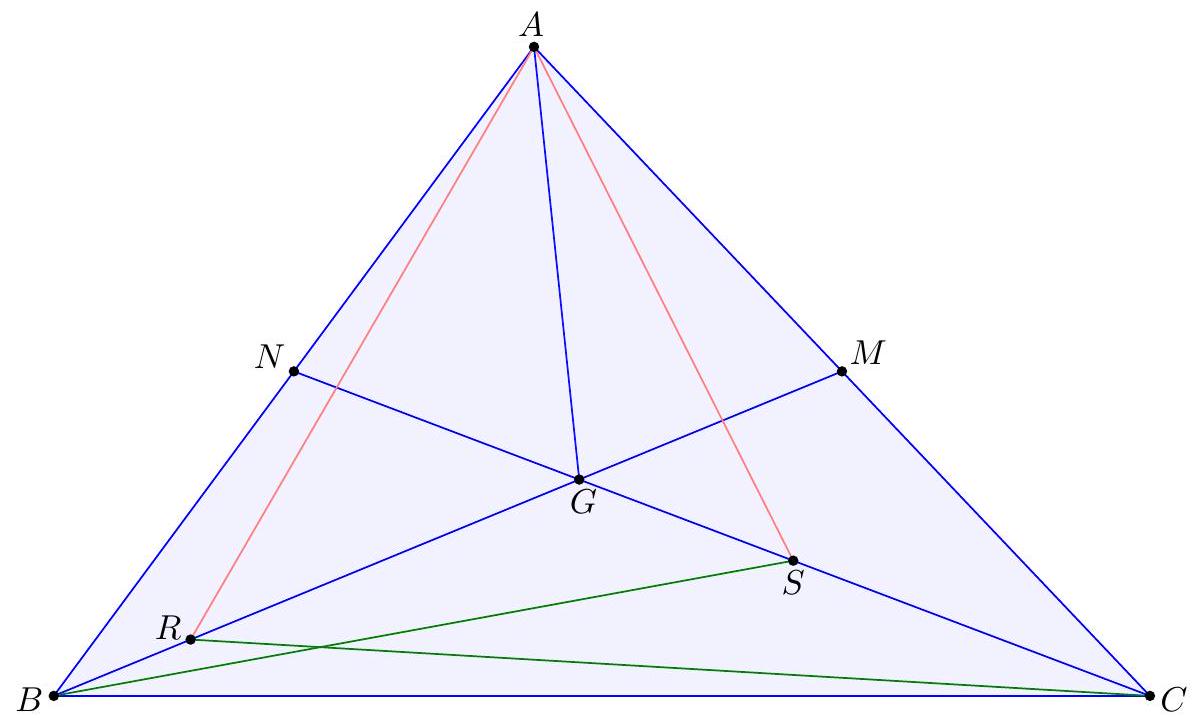 【 Solution 1 using power of a point. From the given condition that $\\measuredangle A C R=\\measuredangle C G M$, we get that $$ M A^{2}=M C^{2}=M G \\cdot M R \\Longrightarrow \\measuredangle R A C=\\measuredangle M G A $$ Analogously, $$ \\measuredangle B A S=\\measuredangle A G N $$ Hence, $$ \\measuredangle R A S+\\measuredangle B A C=\\measuredangle R A C+\\measuredangle B A S=\\measuredangle M G A+\\measuredangle A G N=\\measuredangle M G N=\\measuredangle B G C . $$", "metadata": {"resource_path": "USA_TSTST/segmented/en-sols-TSTST-2023.jsonl"}} |
| {"year": "2023", "tier": "T0", "problem_label": "1", "problem_type": null, "exam": "USA_TSTST", "problem": "Let $A B C$ be a triangle with centroid $G$. Points $R$ and $S$ are chosen on rays $G B$ and $G C$, respectively, such that $$ \\angle A B S=\\angle A C R=180^{\\circ}-\\angle B G C . $$ Prove that $\\angle R A S+\\angle B A C=\\angle B G C$.", "solution": "  ब Solution 2 using similar triangles. As before, $\\triangle M G C \\sim \\triangle M C R$ and $\\triangle N G B \\sim$ $\\triangle N B S$. We obtain $$ \\frac{|A C|}{|C R|}=\\frac{2|M C|}{|C R|}=\\frac{2|M G|}{|G C|}=\\frac{|G B|}{2|N G|}=\\frac{|B S|}{2|B N|}=\\frac{|B S|}{|A B|} $$ which together with $\\angle A C R=\\angle A B S$ yields $$ \\triangle A C R \\sim \\triangle S B A \\Longrightarrow \\measuredangle B A S=\\measuredangle C R A $$ Hence $$ \\measuredangle R A S+\\measuredangle B A C=\\measuredangle R A C+\\measuredangle B A S=\\measuredangle R A C+\\measuredangle C R A=-\\measuredangle A C R=\\measuredangle B G C, $$ which proves the statement.", "metadata": {"resource_path": "USA_TSTST/segmented/en-sols-TSTST-2023.jsonl"}} |
| {"year": "2023", "tier": "T0", "problem_label": "1", "problem_type": null, "exam": "USA_TSTST", "problem": "Let $A B C$ be a triangle with centroid $G$. Points $R$ and $S$ are chosen on rays $G B$ and $G C$, respectively, such that $$ \\angle A B S=\\angle A C R=180^{\\circ}-\\angle B G C . $$ Prove that $\\angle R A S+\\angle B A C=\\angle B G C$.", "solution": "  I Solution 3 using parallelograms. Let $M$ and $N$ be defined as above. Let $P$ be the reflection of $G$ in $M$ and let $Q$ the reflection of $G$ in $N$. Then $A G C P$ and $A G B Q$ are parallelograms. 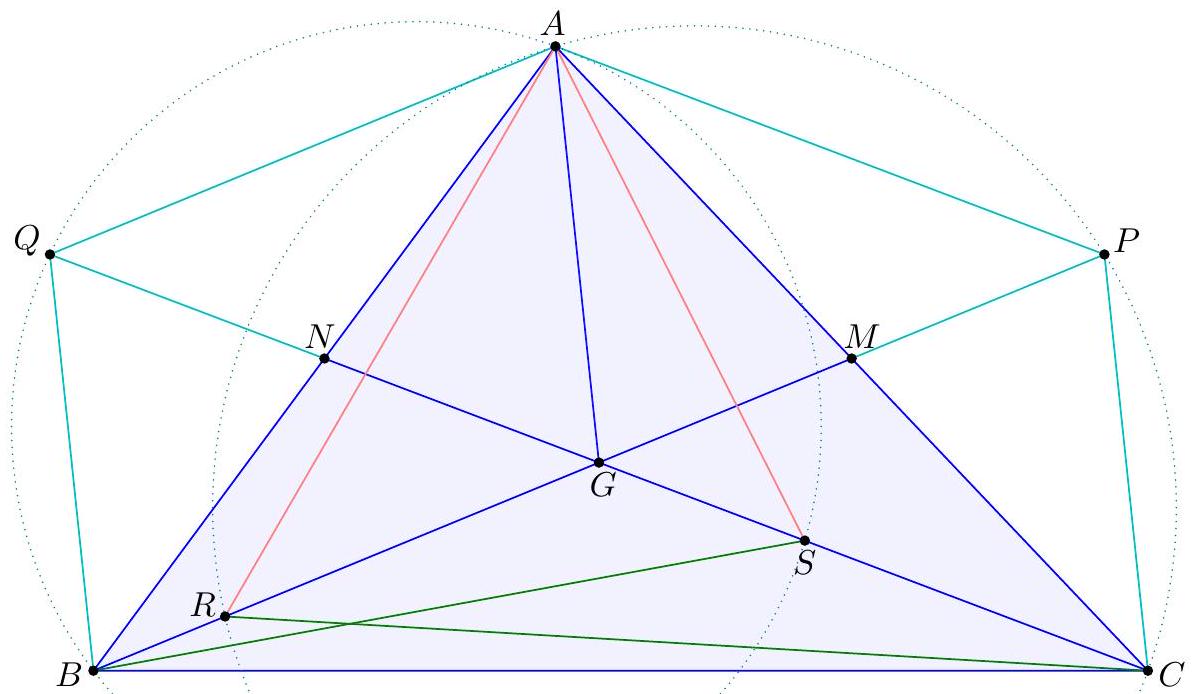 Claim - Quadrilaterals $A P C R$ and $A Q B S$ are concyclic. Thus from $\\overline{P C} \\| \\overline{G A}$ we get $$ \\measuredangle R A C=\\measuredangle R P C=\\measuredangle G P C=\\measuredangle P G A $$ and similarly $$ \\measuredangle B A S=\\measuredangle B Q S=\\measuredangle B Q G=\\measuredangle A G Q $$ We conclude that $$ \\measuredangle R A S+\\measuredangle B A C=\\measuredangle R A C+\\measuredangle B A S=\\measuredangle P G A+\\measuredangle A G Q=\\measuredangle P G Q=\\measuredangle B G C $$", "metadata": {"resource_path": "USA_TSTST/segmented/en-sols-TSTST-2023.jsonl"}} |
| {"year": "2023", "tier": "T0", "problem_label": "1", "problem_type": null, "exam": "USA_TSTST", "problem": "Let $A B C$ be a triangle with centroid $G$. Points $R$ and $S$ are chosen on rays $G B$ and $G C$, respectively, such that $$ \\angle A B S=\\angle A C R=180^{\\circ}-\\angle B G C . $$ Prove that $\\angle R A S+\\angle B A C=\\angle B G C$.", "solution": "  ब Solution 4 also using parallelograms, by Ankan Bhattacharya. Construct parallelograms $A R C K$ and $A S B L$. Since $$ \\measuredangle C A K=\\measuredangle A C R=\\measuredangle C G B=\\measuredangle C G K, $$ it follows that $A G C K$ is cyclic. Similarly, $A G B L$ is also cyclic. 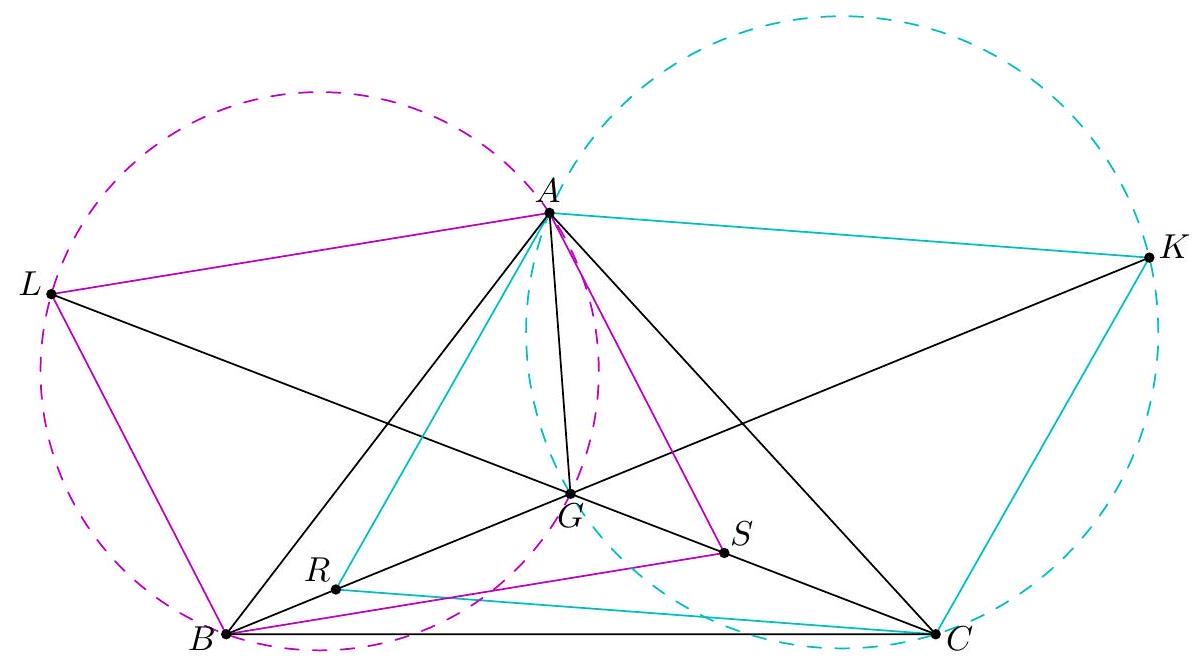 Finally, observe that $$ \\begin{aligned} \\angle R A S+\\angle B A C & =\\measuredangle B A S+\\measuredangle R A C \\\\ & =\\measuredangle A B L+\\measuredangle K C A \\\\ & =\\measuredangle A G L+\\measuredangle K G A \\\\ & =\\measuredangle K G L \\\\ & =\\angle B G C \\end{aligned} $$ as requested.", "metadata": {"resource_path": "USA_TSTST/segmented/en-sols-TSTST-2023.jsonl"}} |
| {"year": "2023", "tier": "T0", "problem_label": "1", "problem_type": null, "exam": "USA_TSTST", "problem": "Let $A B C$ be a triangle with centroid $G$. Points $R$ and $S$ are chosen on rays $G B$ and $G C$, respectively, such that $$ \\angle A B S=\\angle A C R=180^{\\circ}-\\angle B G C . $$ Prove that $\\angle R A S+\\angle B A C=\\angle B G C$.", "solution": "  『 Solution 5 using complex numbers, by Milan Haiman. Note that $\\angle R A S+\\angle B A C=$ $\\angle B A S+\\angle R A C$. We compute $\\angle B A S$ in complex numbers; then $\\angle R A C$ will then be known by symmetry. Let $a, b, c$ be points on the unit circle representing $A, B, C$ respectively. Let $g=\\frac{1}{3}(a+b+c)$ represent the centroid $G$, and let $s$ represent $S$. ## Claim - We have $$ \\frac{s-a}{b-a}=\\frac{a b-2 b c+c a}{2 a b-b c-c a} . $$ $$ s=\\frac{a+b}{2}+t(c-g) $$ for some $t \\in \\mathbb{R}$. By the given angle condition, we have that $$ \\frac{(s-b) /(b-a)}{(c-g) /(g-b)} \\in \\mathbb{R} $$ Note that $$ \\frac{s-b}{b-a}=t \\frac{c-g}{b-a}-\\frac{1}{2} $$ So, $$ t \\frac{g-b}{b-a}-\\frac{g-b}{2(c-g)} \\in \\mathbb{R} $$ Thus $$ t=\\frac{\\operatorname{Im}\\left(\\frac{g-b}{2(c-g)}\\right)}{\\operatorname{Im}\\left(\\frac{g-b}{b-a}\\right)}=\\frac{1}{2} \\cdot \\frac{\\left(\\frac{g-b}{c-g}\\right)-\\overline{\\left(\\frac{g-b}{c-g}\\right)}}{\\left(\\frac{g-b}{b-a}\\right)-\\overline{\\left(\\frac{g-b}{b-a}\\right)}} $$ Let $N$ and $D$ be the numerator and denominator of the second factor above. We want to compute $$ \\frac{s-a}{b-a}=\\frac{1}{2}+t \\frac{c-g}{b-a}=\\frac{(b-a)+2 t(c-g)}{2(b-a)}=\\frac{(b-a) D+(c-g) N}{2(b-a) D} $$ We have $$ \\begin{aligned} (c-g) N & =g-b-(c-g) \\overline{\\left(\\frac{g-b}{c-g}\\right)} \\\\ & =\\frac{a+b+c}{3}-b-\\left(c-\\frac{a+b+c}{3}\\right) \\frac{\\frac{1}{a}+\\frac{1}{b}+\\frac{1}{c}-\\frac{3}{b}}{\\frac{3}{c}-\\frac{1}{a}-\\frac{1}{b}-\\frac{1}{c}} \\\\ & =\\frac{(a+c-2 b)(2 a b-b c-c a)-(2 c-a-b)(a b+b c-2 c a)}{3(2 a b-b c-c a)} \\\\ & =\\frac{3\\left(a^{2} b+b^{2} c+c^{2} a-a b^{2}-b c^{2}-c a^{2}\\right)}{3(2 a b-b c-c a)} \\\\ & =\\frac{(a-b)(b-c)(a-c)}{2 a b-b c-c a} \\end{aligned} $$ We also compute $$ \\begin{aligned} (b-a) D & =g-b-(b-a) \\overline{\\left(\\frac{g-b}{b-a}\\right)} \\\\ & =\\frac{a+b+c}{3}-b-(b-a) \\frac{\\frac{1}{a}+\\frac{1}{b}+\\frac{1}{c}-\\frac{3}{b}}{\\frac{3}{b}-\\frac{3}{a}} \\\\ & =\\frac{(a+c-2 b) c+(a b+b c-2 c a)}{3 c} \\\\ & =\\frac{a b-b c-c a+c^{2}}{3 c} \\\\ & =\\frac{(a-c)(b-c)}{3 c} \\end{aligned} $$ So, we obtain $$ \\frac{s-a}{b-a}=\\frac{\\frac{1}{3 c}+\\frac{a-b}{2 a b-b c-c a}}{\\frac{2}{3 c}}=\\frac{2 a b-b c-c a+3 c(a-b)}{2(2 a b-b c-c a)}=\\frac{a b-2 b c+c a}{2 a b-b c-c a} $$ By symmetry, $$ \\frac{r-a}{c-a}=\\frac{a b-2 b c+c a}{2 c a-a b-b c} $$ Hence their ratio $$ \\frac{s-a}{b-a} \\div \\frac{r-a}{c-a}=\\frac{2 a b-b c-c a}{2 c a-a b-b c} $$ has argument $\\angle R A C+\\angle B A S$. We also have that $\\angle B G C$ is the argument of $$ \\frac{b-g}{c-g}=\\frac{2 b-a-c}{2 c-a-b} $$ Note that these two complex numbers are inverse-conjugates, and thus have the same argument. So we're done.", "metadata": {"resource_path": "USA_TSTST/segmented/en-sols-TSTST-2023.jsonl"}} |
| {"year": "2023", "tier": "T0", "problem_label": "2", "problem_type": null, "exam": "USA_TSTST", "problem": "Let $n \\geq m \\geq 1$ be integers. Prove that $$ \\sum_{k=m}^{n}\\left(\\frac{1}{k^{2}}+\\frac{1}{k^{3}}\\right) \\geq m \\cdot\\left(\\sum_{k=m}^{n} \\frac{1}{k^{2}}\\right)^{2} $$", "solution": " 【 First solution (authors). By Cauchy-Schwarz, we have $$ \\begin{aligned} \\sum_{k=m}^{n} \\frac{k+1}{k^{3}} & =\\sum_{k=m}^{n} \\frac{\\left(\\frac{1}{k^{2}}\\right)^{2}}{\\frac{1}{k(k+1)}} \\\\ & \\geq \\frac{\\left(\\frac{1}{m^{2}}+\\frac{1}{(m+1)^{2}}+\\cdots+\\frac{1}{n^{2}}\\right)^{2}}{\\frac{1}{m(m+1)}+\\frac{1}{(m+1)(m+2)}+\\cdots+\\frac{1}{n(n+1)}} \\\\ & =\\frac{\\left(\\frac{1}{m^{2}}+\\frac{1}{(m+1)^{2}}+\\cdots+\\frac{1}{n^{2}}\\right)^{2}}{\\frac{1}{m}-\\frac{1}{n+1}} \\\\ & >\\frac{\\left(\\sum_{k=m}^{n} \\frac{1}{k^{2}}\\right)^{2}}{\\frac{1}{m}} \\end{aligned} $$ as desired. Remark (Bound on error). Let $A=\\sum_{k=m}^{n} k^{-2}$ and $B=\\sum_{k=m}^{n} k^{-3}$. The inequality above becomes tighter for large $m$ and $n \\gg m$. If we use Lagrange's identity in place of Cauchy-Schwarz, we get $$ A+B-m A^{2}=m \\cdot \\sum_{m \\leq a<b} \\frac{(a-b)^{2}}{a^{3} b^{3}(a+1)(b+1)} $$ We can upper bound this error by $$ \\leq m \\cdot \\sum_{m \\leq a<b} \\frac{1}{a^{3}(a+1) b(b+1)}=m \\cdot \\sum_{m \\leq a} \\frac{1}{a^{3}(a+1)^{2}} \\approx m \\cdot \\frac{1}{m^{4}}=\\frac{1}{m^{3}}, $$ which is still generous as $(a-b)^{2} \\ll b^{2}$ for $b$ not much larger than $a$, so the real error is probably around $\\frac{1}{10 \\mathrm{~m}^{3}}$. This exhibits the tightness of the inequality since it implies $$ m A^{2}+O(B / m)>A+B $$ Remark (Construction commentary, from author). My motivation was to write an inequality where Titu could be applied creatively to yield a telescoping sum. This can be difficult because most of the time, such a reverse-engineered inequality will be so loose it's trivial anyways. My first attempt was the not-so-amazing inequality $$ \\frac{n^{2}+3 n}{2}=\\sum_{1}^{n} i+1=\\sum_{1}^{n} \\frac{\\frac{1}{i}}{\\frac{1}{i(i+1)}}>\\left(\\sum_{1}^{n} \\frac{1}{\\sqrt{i}}\\right)^{2} $$ which is really not surprising given that $\\sum \\frac{1}{\\sqrt{i}} \\ll \\frac{n}{\\sqrt{2}}$. The key here is that we need \"near-equality\" as dictated by the Cauchy-Schwarz equality case, i.e. the square root of the numerators should be approximately proportional to the denominators. This motivates using $\\frac{1}{i^{4}}$ as the numerator, which works like a charm. After working out the resulting statement, the LHS and RHS even share a sum, which adds to the simplicity of the problem. The final touch was to unrestrict the starting value of the sum, since this allows the strength of the estimate $\\frac{1}{i^{2}} \\approx \\frac{1}{i(i+1)}$ to be fully exploited.", "metadata": {"resource_path": "USA_TSTST/segmented/en-sols-TSTST-2023.jsonl"}} |
| {"year": "2023", "tier": "T0", "problem_label": "2", "problem_type": null, "exam": "USA_TSTST", "problem": "Let $n \\geq m \\geq 1$ be integers. Prove that $$ \\sum_{k=m}^{n}\\left(\\frac{1}{k^{2}}+\\frac{1}{k^{3}}\\right) \\geq m \\cdot\\left(\\sum_{k=m}^{n} \\frac{1}{k^{2}}\\right)^{2} $$", "solution": " 【 Second approach by inducting down, Luke Robitaille and Carl Schildkraut. Fix $n$; we'll induct downwards on $m$. For the base case of $n=m$ the result is easy, since the left side is $\\frac{m+1}{m^{3}}$ and the right side is $\\frac{m}{m^{4}}=\\frac{1}{m^{3}}$. For the inductive step, suppose we have shown the result for $m+1$. Let $$ A=\\sum_{k=m+1}^{n} \\frac{1}{k^{2}} \\quad \\text { and } \\quad B=\\sum_{k=m+1}^{n} \\frac{1}{k^{3}} $$ We know $A+B \\geq(m+1) A^{2}$, and we want to show $$ \\left(A+\\frac{1}{m^{2}}\\right)+\\left(B+\\frac{1}{m^{3}}\\right) \\geq m\\left(A+\\frac{1}{m^{2}}\\right)^{2} $$ Indeed, $$ \\begin{aligned} \\left(A+\\frac{1}{m^{2}}\\right)+\\left(B+\\frac{1}{m^{3}}\\right)-m\\left(A+\\frac{1}{m^{2}}\\right)^{2} & =A+B+\\frac{m+1}{m^{3}}-m A^{2}-\\frac{2 A}{m}-\\frac{1}{m^{3}} \\\\ & =\\left(A+B-(m+1) A^{2}\\right)+\\left(A-\\frac{1}{m}\\right)^{2} \\geq 0 \\end{aligned} $$ and we are done.", "metadata": {"resource_path": "USA_TSTST/segmented/en-sols-TSTST-2023.jsonl"}} |
| {"year": "2023", "tier": "T0", "problem_label": "2", "problem_type": null, "exam": "USA_TSTST", "problem": "Let $n \\geq m \\geq 1$ be integers. Prove that $$ \\sum_{k=m}^{n}\\left(\\frac{1}{k^{2}}+\\frac{1}{k^{3}}\\right) \\geq m \\cdot\\left(\\sum_{k=m}^{n} \\frac{1}{k^{2}}\\right)^{2} $$", "solution": " I Third approach by reducing $n \\rightarrow \\infty$, Michael Ren and Carl Schildkraut. First, we give: Claim (Reduction to $n \\rightarrow \\infty$ ) - If the problem is true when $n \\rightarrow \\infty$, it is true for all $n$. However, the region is bounded by a convex curve, and the sequence of points $(0,0)$, $\\left(\\frac{1}{m^{2}}, \\frac{1}{m^{3}}\\right),\\left(\\frac{1}{m^{2}}+\\frac{1}{(m+1)^{2}}, \\frac{1}{m^{3}}+\\frac{1}{(m+1)^{3}}\\right), \\ldots$ has successively decreasing slopes between consecutive points. Thus it suffices to check that the inequality is true when $n \\rightarrow \\infty$. Set $n=\\infty$ henceforth. Let $$ A=\\sum_{k=m}^{\\infty} \\frac{1}{k^{2}} \\text { and } B=\\sum_{k=m}^{\\infty} \\frac{1}{k^{3}} $$ we want to show $B \\geq m A^{2}-A$, which rearranges to $$ 1+4 m B \\geq(2 m A-1)^{2} $$ Write $$ C=\\sum_{k=m}^{\\infty} \\frac{1}{k^{2}(2 k-1)(2 k+1)} \\text { and } D=\\sum_{k=m}^{\\infty} \\frac{8 k^{2}-1}{k^{3}(2 k-1)^{2}(2 k+1)^{2}} $$ Then $$ \\frac{2}{2 k-1}-\\frac{2}{2 k+1}=\\frac{1}{k^{2}}+\\frac{1}{k^{2}(2 k-1)(2 k+1)} $$ and $$ \\frac{2}{(2 k-1)^{2}}-\\frac{2}{(2 k+1)^{2}}=\\frac{1}{k^{3}}+\\frac{8 k^{2}-1}{k^{3}(2 k-1)^{2}(2 k+1)^{2}}, $$ so that $$ A=\\frac{2}{2 m-1}-C \\text { and } B=\\frac{2}{(2 m-1)^{2}}-D $$ Our inequality we wish to show becomes $$ \\frac{2 m+1}{2 m-1} C \\geq D+m C^{2} $$ We in fact show two claims: Claim - We have $$ \\frac{2 m+1 / 2}{2 m-1} C \\geq D $$ $$ \\frac{2 m+1 / 2}{2 m-1} \\cdot \\frac{1}{k^{2}(2 k-1)(2 k+1)} \\geq \\frac{8 k^{2}-1}{k^{3}(2 k-1)^{2}(2 k+1)^{2}} $$ for $k \\geq m$. It suffices to show $$ \\frac{2 k+1 / 2}{2 k-1} \\cdot \\frac{1}{k^{2}(2 k-1)(2 k+1)} \\geq \\frac{8 k^{2}-1}{k^{3}(2 k-1)^{2}(2 k+1)^{2}} $$ which is equivalent to $k(2 k+1 / 2)(2 k+1) \\geq 8 k^{2}-1$. This holds for all $k \\geq 1$. ## Claim - We have $$ \\frac{1 / 2}{2 m-1} C \\geq m C^{2} $$ $$ \\frac{1}{2 m(2 m-1)}=\\sum_{k=m}^{\\infty}\\left(\\frac{1}{2 k(2 k-1)}-\\frac{1}{2(k+1)(2 k+1)}\\right)=\\sum_{k=m}^{\\infty} \\frac{4 k+1}{2 k(2 k-1)(k+1)(2 k+1)} $$ comparing term-wise with the definition of $C$ and using the inequality $k(4 k+1) \\geq 2(k+1)$ for $k \\geq 1$ gives the desired result.", "metadata": {"resource_path": "USA_TSTST/segmented/en-sols-TSTST-2023.jsonl"}} |
| {"year": "2023", "tier": "T0", "problem_label": "2", "problem_type": null, "exam": "USA_TSTST", "problem": "Let $n \\geq m \\geq 1$ be integers. Prove that $$ \\sum_{k=m}^{n}\\left(\\frac{1}{k^{2}}+\\frac{1}{k^{3}}\\right) \\geq m \\cdot\\left(\\sum_{k=m}^{n} \\frac{1}{k^{2}}\\right)^{2} $$", "solution": " 『 Fourth approach by bashing, Carl Schildkraut. With a bit more work, the third approach can be adapted to avoid the $n \\rightarrow \\infty$ reduction. Similarly to before, define $$ A=\\sum_{k=m}^{n} \\frac{1}{k^{2}} \\text { and } B=\\sum_{k=m}^{n} \\frac{1}{k^{3}} $$ we want to show $1+4 m B \\geq(2 m A-1)^{2}$. Writing $$ C=\\sum_{k=m}^{n} \\frac{1}{k^{2}(2 k-1)(2 k+1)} \\text { and } D=\\sum_{k=m}^{n} \\frac{8 k^{2}-1}{k^{3}(2 k-1)^{2}(2 k+1)^{2}} $$ We compute $$ A=\\frac{2}{2 m-1}-\\frac{2}{2 n+1}-C \\text { and } B=\\frac{2}{(2 m-1)^{2}}-\\frac{2}{(2 n+1)^{2}}-D . $$ Then, the inequality we wish to show reduces (as in the previous solution) to $$ \\frac{2 m+1}{2 m-1} C+\\frac{2(2 m+1)}{(2 m-1)(2 n+1)} \\geq D+m C^{2}+\\frac{2(2 m+1)}{(2 n+1)^{2}}+\\frac{4 m}{2 n+1} C $$ We deal first with the terms not containing the variable $n$, i.e. we show that $$ \\frac{2 m+1}{2 m-1} C \\geq D+m C^{2} $$ For this part, the two claims from the previous solution go through exactly as written above, and we have $C \\leq 1 /(2 m(2 m-1))$. We now need to show $$ \\frac{2(2 m+1)}{(2 m-1)(2 n+1)} \\geq \\frac{2(2 m+1)}{(2 n+1)^{2}}+\\frac{4 m}{2 n+1} C $$ (this is just the inequality between the remaining terms); our bound on $C$ reduces this to proving $$ \\frac{4(2 m+1)(n-m+1)}{(2 m-1)(2 n+1)^{2}} \\geq \\frac{2}{(2 m-1)(2 n+1)} $$ Expanding and writing in terms of $n$, this is equivalent to $$ n \\geq \\frac{1+2(m-1)(2 m+1)}{4 m}=m-\\frac{2 m+1}{4 m} $$ which holds for all $n \\geq m$.", "metadata": {"resource_path": "USA_TSTST/segmented/en-sols-TSTST-2023.jsonl"}} |
| {"year": "2023", "tier": "T0", "problem_label": "3", "problem_type": null, "exam": "USA_TSTST", "problem": "Find all positive integers $n$ for which it is possible to color some cells of an infinite grid of unit squares red, such that each rectangle consisting of exactly $n$ cells (and whose edges lie along the lines of the grid) contains an odd number of red cells.", "solution": " We claim that this is possible for all positive integers $n$. Call a positive integer for which such a coloring is possible good. To show that all positive integers $n$ are good we prove the following: (i) If $n$ is good and $p$ is an odd prime, then $p n$ is good; (ii) For every $k \\geq 0$, the number $n=2^{k}$ is good. Together, (i) and (ii) imply that all positive integers are good. Thus every coloring that works for $n$ automatically also works for $p n$. Claim - For each of these $k+1$ shapes, there exists a coloring with two properties: - Every rectangle with $n$ cells and shape $2^{m} \\times 2^{k-m}$ contains an odd number of red cells. - Every rectangle with $n$ cells and a different shape contains an even number of red cells. 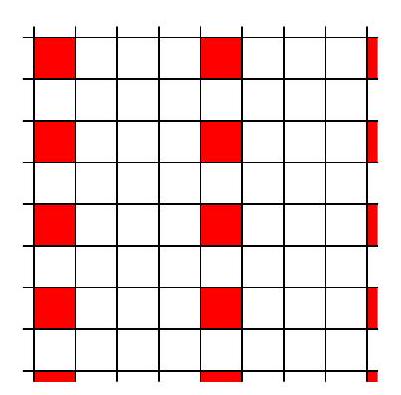 A $2^{m} \\times 2^{k-m}$ rectangle contains every possible pair $\\left(x \\bmod 2^{m}, y \\bmod 2^{k-m}\\right)$ exactly once, so such a rectangle will contain one red cell (an odd number). On the other hand, consider a $2^{\\ell} \\times 2^{k-\\ell}$ rectangle with $\\ell>m$. The set of cells this covers is $(x, y)$ where $x$ covers a range of size $2^{\\ell}$ and $y$ covers a range of size $2^{k-\\ell}$. The number of red cells is the count of $x$ with $x \\equiv 0 \\bmod 2^{m}$ multiplied by the count of $y$ with $y \\equiv 0 \\bmod 2^{k-m}$. The former number is exactly $2^{\\ell-k}$ because $2^{k}$ divides $2^{\\ell}$ (while the latter is 0 or 1) so the number of red cells is even. The $\\ell<m$ case is similar. Finally, given these $k+1$ colorings, we can add them up modulo 2, i.e. a cell will be colored red if it is red in an odd number of these $k+1$ coloring. We illustrate $n=4$ as an example; the coloring is 4 -periodic in both axes so we only show one $4 \\times 4$ cell.  This solves the problem. Remark. The final coloring can be described as follows: color $(x, y)$ red if $$ \\max \\left(0, \\min \\left(\\nu_{2}(x), k\\right)+\\min \\left(\\nu_{2}(y), k\\right)-k+1\\right) $$ is odd. Remark (Luke Robitaille). Alternatively for (i), if $n=2^{e} k$ for odd $k$ then one may dissect an $a \\times b$ rectangle with area $n$ into $k$ rectangles of area $2^{e}$, each $2^{\\nu_{2}(a)} \\times 2^{\\nu_{2}(b)}$. This gives a way to deduce the problem from (ii) without having to consider odd prime numbers. $$ f(x, y)=\\sum_{i=0}^{2^{k}-1} \\sum_{j=0}^{2^{k}-1} \\lambda_{i, j} x^{i} y^{j} $$ denote its generating function, where $f \\in \\mathbb{F}_{2}[x, y]$. For this to be valid, we need that for any $2^{p} \\times 2^{q}$ rectangle with area $n$, the sum of the coefficients of $f$ over it should be one, modulo $x^{2^{k}}=y^{2^{k}}=1$. In other words, whenever $p+q=k$, we must have $$ f(x, y)\\left(1+\\cdots+x^{2^{p}-1}\\right)\\left(1+\\cdots+y^{2^{q}-1}\\right)=\\left(1+\\cdots+x^{2^{k}-1}\\right)\\left(1+\\cdots+y^{2^{k}-1}\\right) $$ taken modulo $x^{2^{k}}=y^{2^{k}}=1$. The idea is to rewrite these expressions: because we're in characteristic 2, the given assertion is $(x+1)^{2^{k}}=(y+1)^{2^{k}}=0$, and the requested property is $$ f(x, y)(x+1)^{2^{p}-1}(y+1)^{2^{q}-1}=(x+1)^{2^{k}-1}(y+1)^{2^{k}-1} . $$ This suggests the substitution $g(x, y)=f(x+1, y+1)$ : then we can replace $(x+1, y+1) \\mapsto$ $(x, y)$ to simplify the requested property significantly: Whenever $p+q=k$, we must have $$ g(x, y) x^{2^{p}-1} y^{2^{q}-1}=x^{2^{k}-1} y^{2^{k}-1} $$ modulo $x^{2^{k}}$ and $y^{2^{k}}$. However, now the construction of $g$ is very simple: for example, the choice $$ g(x, y)=\\sum_{p+q=k} x^{2^{k}-2^{p}} y^{2^{k}-2^{q}} $$ works. The end. Remark. Unraveling the substitutions seen here, it's possible to show that this is actually the same construction provided in the first solution.", "metadata": {"resource_path": "USA_TSTST/segmented/en-sols-TSTST-2023.jsonl"}} |
| {"year": "2023", "tier": "T0", "problem_label": "4", "problem_type": null, "exam": "USA_TSTST", "problem": "Let $n \\geq 3$ be an integer and let $K_{n}$ be the complete graph on $n$ vertices. Each edge of $K_{n}$ is colored either red, green, or blue. Let $A$ denote the number of triangles in $K_{n}$ with all edges of the same color, and let $B$ denote the number of triangles in $K_{n}$ with all edges of different colors. Prove that $$ B \\leq 2 A+\\frac{n(n-1)}{3} . $$", "solution": "$ Consider all unordered pairs of different edges which share exactly one vertex (call these vees for convenience). Assign each vee a charge of +2 if its edge colors are the same, and a charge of -1 otherwise. We compute the total charge in two ways. ## 【 Total charge by summing over triangles. Note that - each monochromatic triangle has a charge of +6 , - each bichromatic triangle has a charge of 0 , and - each trichromatic triangle has a charge of -3 . Since each vee contributes to exactly one triangle, we obtain that the total charge is $6 A-3 B$. 【 Total charge by summing over vertices. We can also calculate the total charge by examining the centers of the vees. If a vertex has $a$ red edges, $b$ green edges, and $c$ blue edges, the vees centered at that vertex contribute a total charge of $$ \\begin{aligned} & 2\\left[\\binom{a}{2}+\\binom{b}{2}+\\binom{c}{2}\\right]-(a b+a c+b c) \\\\ = & \\left(a^{2}-a+b^{2}-b+c^{2}-c\\right)-(a b+a c+b c) \\\\ = & \\left(a^{2}+b^{2}+c^{2}-a b-a c-b c\\right)-(a+b+c) \\\\ = & \\left(a^{2}+b^{2}+c^{2}-a b-a c-b c\\right)-(n-1) \\\\ \\geq & -(n-1) . \\end{aligned} $$ In particular, the total charge is at least $-n(n-1)$. đ Conclusion. Thus, we obtain $$ 6 A-3 B \\geq-n(n-1) \\Longleftrightarrow B \\leq 2 A+\\frac{n(n-1)}{3} $$ as desired.", "metadata": {"resource_path": "USA_TSTST/segmented/en-sols-TSTST-2023.jsonl"}} |
| {"year": "2023", "tier": "T0", "problem_label": "5", "problem_type": null, "exam": "USA_TSTST", "problem": "Suppose $a, b$, and $c$ are three complex numbers with product 1 . Assume that none of $a, b$, and $c$ are real or have absolute value 1 . Define $$ p=(a+b+c)+\\left(\\frac{1}{a}+\\frac{1}{b}+\\frac{1}{c}\\right) \\quad \\text { and } \\quad q=\\frac{a}{b}+\\frac{b}{c}+\\frac{c}{a} . $$ Given that both $p$ and $q$ are real numbers, find all possible values of the ordered pair $(p, q)$.", "solution": " We show $(p, q)=(-3,3)$ is the only possible ordered pair. ## 【T First solution. $$ \\begin{aligned} p+3 & =3+\\sum_{\\text {cyc }}\\left(\\frac{x}{y}+\\frac{y}{x}\\right)=3+\\frac{x^{2}(y+z)+y^{2}(z+x)+z^{2}(x+y)}{x y z} \\\\ & =\\frac{(x+y+z)(x y+y z+z x)}{x y z} \\\\ q-3 & =-3+\\sum_{\\text {cyc }} \\frac{y^{2}}{z x}=\\frac{x^{3}+y^{3}+z^{3}-3 x y z}{x y z} \\\\ & =\\frac{(x+y+z)\\left(x^{2}+y^{2}+z^{2}-x y-y z-z x\\right)}{x y z} . \\end{aligned} $$ It follows that $$ \\begin{aligned} \\mathbb{R} & \\ni 3(p+3)+(q-3) \\\\ & =\\frac{(x+y+z)\\left(x^{2}+y^{2}+z^{2}+2(x y+y z+z x)\\right)}{x y z} \\\\ & =\\frac{(x+y+z)^{3}}{x y z} \\end{aligned} $$ Now, note that if $x+y+z=0$, then $p=-3, q=3$ so we are done. Scale $x, y, z$ in such a way that $x+y+z$ is nonzero and real; hence so is $x y z$. Thus, as $p+3 \\in \\mathbb{R}$, we conclude $x y+y z+z x \\in \\mathbb{R}$ as well. Hence, $x, y, z$ are the roots of a cubic with real coefficients. Thus, - either all three of $\\{x, y, z\\}$ are real (which implies $a, b, c \\in \\mathbb{R}$ ), - or two of $\\{x, y, z\\}$ are a complex conjugate pair (which implies one of $a, b, c$ has absolute value 1). Both of these were forbidden by hypothesis. Construction As we saw in the setup, $(p, q)=(-3,3)$ will occur as long as $x+y+z=0$, and no two of $x, y, z$ to share the same magnitude or are collinear with the origin. This is easy to do; for example, we could choose $(x, y, z)=(3,4 i,-(3+4 i))$. Hence $a=\\frac{3}{4 i}$, $b=-\\frac{4 i}{3+4 i}, c=-\\frac{3+4 i}{3}$ satisfies the hypotheses of the problem statement.", "metadata": {"resource_path": "USA_TSTST/segmented/en-sols-TSTST-2023.jsonl"}} |
| {"year": "2023", "tier": "T0", "problem_label": "5", "problem_type": null, "exam": "USA_TSTST", "problem": "Suppose $a, b$, and $c$ are three complex numbers with product 1 . Assume that none of $a, b$, and $c$ are real or have absolute value 1 . Define $$ p=(a+b+c)+\\left(\\frac{1}{a}+\\frac{1}{b}+\\frac{1}{c}\\right) \\quad \\text { and } \\quad q=\\frac{a}{b}+\\frac{b}{c}+\\frac{c}{a} . $$ Given that both $p$ and $q$ are real numbers, find all possible values of the ordered pair $(p, q)$.", "solution": " We show $(p, q)=(-3,3)$ is the only possible ordered pair. I Second solution, found by contestants. The main idea is to make the substitution $$ x=a+\\frac{1}{c}, \\quad y=b+\\frac{1}{a}, \\quad z=c+\\frac{1}{b} . $$ Then we can check that $$ \\begin{aligned} x+y+z & =p \\\\ x y+y z+z x & =p+q+3 \\\\ x y z & =p+2 . \\end{aligned} $$ Therefore $x, y, z$ are the roots of a cubic with real coefficients. As in the previous solution, we note that this cubic must either have all real roots, or a complex conjugate pair of roots. We also have the relation $a(y+1)=a b+a+1=x+1$, and likewise $b(z+1)=y+1, c(x+1)=z+1$. This means that if any of $x, y, z$ are equal to -1, then all are equal to -1 . Assume for the sake of contradiction that none are equal to -1 . In the case where the cubic has three real roots, $a=\\frac{x+1}{y+1}$ would be real. On the other hand, if there is a complex conjugate pair (without loss of generality, $x$ and $y$ ) then $a$ has magnitude 1. Therefore this cannot occur. We conclude that $x=y=z=-1$, so $p=-3$ and $q=3$. The solutions $(a, b, c)$ can then be parameterized as $\\left(a,-1-\\frac{1}{a},-\\frac{1}{1+a}\\right)$. To construct a solution, we need to choose a specific value of $a$ such that none of the wrong conditions hold; when $a=2 i$, say, we obtain the solution $\\left(2 i,-1+\\frac{i}{2}, \\frac{-1+2 i}{5}\\right)$.", "metadata": {"resource_path": "USA_TSTST/segmented/en-sols-TSTST-2023.jsonl"}} |
| {"year": "2023", "tier": "T0", "problem_label": "5", "problem_type": null, "exam": "USA_TSTST", "problem": "Suppose $a, b$, and $c$ are three complex numbers with product 1 . Assume that none of $a, b$, and $c$ are real or have absolute value 1 . Define $$ p=(a+b+c)+\\left(\\frac{1}{a}+\\frac{1}{b}+\\frac{1}{c}\\right) \\quad \\text { and } \\quad q=\\frac{a}{b}+\\frac{b}{c}+\\frac{c}{a} . $$ Given that both $p$ and $q$ are real numbers, find all possible values of the ordered pair $(p, q)$.", "solution": " We show $(p, q)=(-3,3)$ is the only possible ordered pair. 【 Third solution by Luke Robitaille and Daniel Zhu. The answer is $p=-3$ and $q=3$. Let's first prove that no other $(p, q)$ work. Let $e_{1}=a+b+c$ and $e_{2}=a^{-1}+b^{-1}+c^{-1}=a b+a c+b c$. Also, let $f=e_{1} e_{2}$. Note that $p=e_{1}+e_{2}$. Our main insight is to consider the quantity $q^{\\prime}=\\frac{b}{a}+\\frac{c}{b}+\\frac{a}{c}$. Note that $f=q+q^{\\prime}+3$. Also, $$ \\begin{aligned} q q^{\\prime} & =3+\\frac{a^{2}}{b c}+\\frac{b^{2}}{a c}+\\frac{c^{2}}{a b}+\\frac{b c}{a^{2}}+\\frac{a c}{b^{2}}+\\frac{a b}{c^{2}} \\\\ & =3+a^{3}+b^{3}+c^{3}+a^{-3}+b^{-3}+c^{-3} \\\\ & =9+a^{3}+b^{3}+c^{3}-3 a b c+a^{-3}+b^{-3}+c^{-3}-3 a^{-1} b^{-1} c^{-1} \\\\ & =9+e_{1}\\left(e_{1}^{2}-3 e_{2}\\right)+e_{2}\\left(e_{2}^{2}-3 e_{1}\\right) \\\\ & =9+e_{1}^{3}+e_{2}^{3}-6 e_{1} e_{2} \\\\ & =9+p\\left(p^{2}-3 f\\right)-6 f \\\\ & =p^{3}-(3 p+6) f+9 . \\end{aligned} $$ As a result, the quadratic with roots $q$ and $q^{\\prime}$ is $x^{2}-(f-3) x+\\left(p^{3}-(3 p+6) f+9\\right)$, which implies that $$ q^{2}-q f+3 q+p^{3}-(3 p+6) f+9=0 \\Longleftrightarrow(3 p+q+6) f=p^{3}+q^{2}+3 q+9 $$ At this point, two miracles occur. The first is the following claim: Claim - $f$ is not real. - $e_{1}$ and $e_{2}$ are real. Then, $a, b$, and $c$ are the roots of $x^{3}-e_{1} x^{2}+e_{2} x-1$, and since every cubic with real coefficients has at least one real root, at least one of $a, b$, and $c$ is real, contradiction. - $e_{1}$ and $e_{2}$ are conjugates. Then, the polynomial $x^{3}-\\bar{e}_{2} x^{2}+\\bar{e}_{1} x-1$, which has roots $\\bar{a}^{-1}, \\bar{b}^{-1}$, and $\\bar{c}^{-1}$, is the same as the polynomial with $a, b, c$ as roots. We conclude that the multiset $\\{a, b, c\\}$ is invariant under inversion about the unit circle, so one of $a, b$, and $c$ must lie on the unit circle. This is yet another contradiction. As a result, we know that $3 p+q+6=p^{3}+q^{2}+3 q+9=0$. The second miracle is that substituting $q=-3 p-6$ into $q^{2}+3 q+p^{3}+9=0$, we get $$ 0=p^{3}+9 p^{2}+27 p+27=(p+3)^{3} $$ so $p=-3$. Thus $q=3$. It remains to construct valid $a, b$, and $c$. To do this, let's pick some $e_{1}$, let $e_{2}=-3-e_{1}$, and let $a, b$, and $c$ be the roots of $x^{3}-e_{1} x^{2}+e_{2} x-1$. It is clear that this guarantees $p=-3$. By our above calculations, $q$ and $q^{\\prime}$ are the roots of the quadratic $x^{2}-(f-3) x+(3 f-18)$, so one of $q$ and $q^{\\prime}$ must be 3 ; by changing the order of $a, b$, and $c$ if needed, we can guarantee this to be $q$. It suffices to show that for some choice of $e_{1}$, none of $a, b$, or $c$ are real or lie on the unit circle. To do this, note that we can rewrite $x^{3}-e_{1} x^{2}+\\left(-3-e_{1}\\right) x-1=0$ as $$ e_{1}=\\frac{x^{3}-3 x-1}{x^{2}+x} $$ so all we need is a value of $e_{1}$ that is not $\\frac{x^{3}-3 x-1}{x^{2}+x}$ for any real $x$ or $x$ on the unit circle. One way to do this is to choose any nonreal $e_{1}$ with $\\left|e_{1}\\right|<1 / 2$. This clearly rules out any real $x$. Also, if $|x|=1$, by the triangle inequality $\\left|x^{3}-3 x-1\\right| \\geq|3 x|-\\left|x^{3}\\right|-|1|=1$ and $\\left|x^{2}+x\\right| \\leq 2$, so $\\left|\\frac{x^{3}-3 x-1}{x^{2}+x}\\right| \\geq \\frac{1}{2}$.", "metadata": {"resource_path": "USA_TSTST/segmented/en-sols-TSTST-2023.jsonl"}} |
| {"year": "2023", "tier": "T0", "problem_label": "6", "problem_type": null, "exam": "USA_TSTST", "problem": "Let $A B C$ be a scalene triangle and let $P$ and $Q$ be two distinct points in its interior. Suppose that the angle bisectors of $\\angle P A Q, \\angle P B Q$, and $\\angle P C Q$ are the altitudes of triangle $A B C$. Prove that the midpoint of $\\overline{P Q}$ lies on the Euler line of $A B C$.", "solution": " 『 Solution 1 (Ankit Bisain). Let $H$ be the orthocenter of $A B C$, and construct $P^{\\prime}$ using the following claim. Claim - There is a point $P^{\\prime}$ for which $$ \\measuredangle A P H+\\measuredangle A P^{\\prime} H=\\measuredangle B P H+\\measuredangle B P^{\\prime} H=\\measuredangle C P H+\\measuredangle C P^{\\prime} H=0 . $$ Now, let $X, Y$, and $Z$ be the reflections of $P$ over $\\overline{A H}, \\overline{B H}$, and $\\overline{C H}$ respectively. Additionally, let $Q^{\\prime}$ be the image of $Q$ under inversion about ( $P X Y Z$ ). 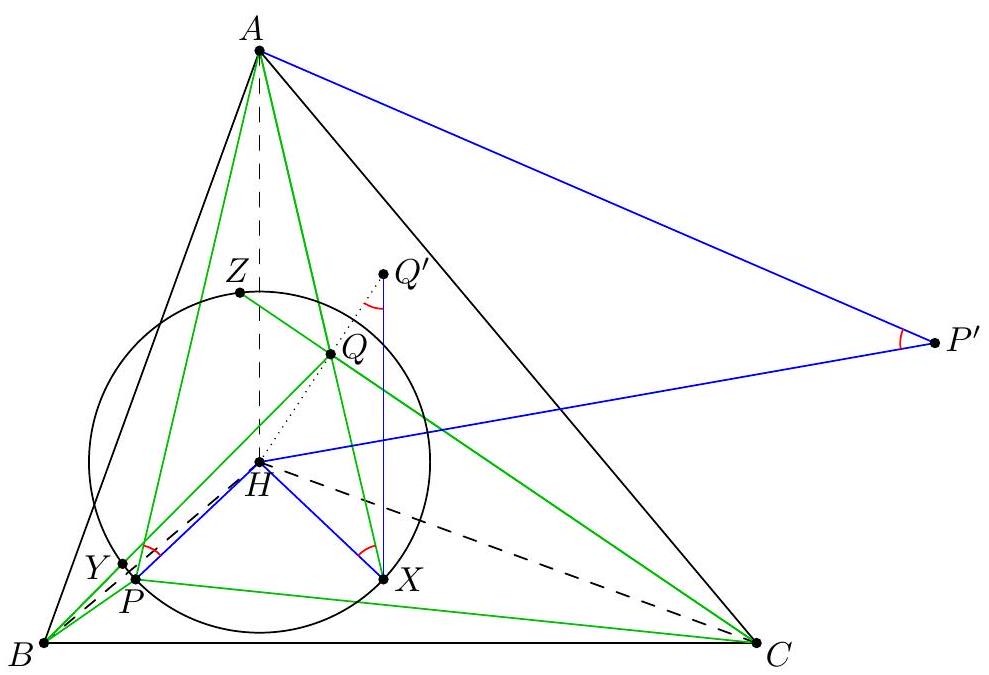 $$ \\text { Claim }-A B C P^{\\prime} \\approx X Y Z Q^{\\prime} $$ $$ \\measuredangle Y X Z=\\measuredangle Y P Z=\\measuredangle(\\overline{B H}, \\overline{C H})=-\\measuredangle B A C $$ and cyclic variants, triangles $A B C$ and $X Y Z$ are similar. Additionally, $$ \\measuredangle H Q^{\\prime} X=-\\measuredangle H X Q=-\\measuredangle H X A=\\measuredangle H P A=-\\measuredangle H P^{\\prime} A $$ and cyclic variants, so summing in pairs gives $\\measuredangle Y Q^{\\prime} Z=-\\measuredangle B P^{\\prime} C$ and cyclic variants; this implies the similarity. Claim - $Q^{\\prime}$ lies on the Euler line of triangle $X Y Z$. To finish the problem, let $G_{1}$ be the centroid of $A B C$ and $G_{2}$ be the centroid of $X Y Z$. Then with signed areas, $$ \\begin{aligned} {\\left[G_{1} H P\\right]+\\left[G_{1} H Q\\right] } & =\\frac{[A H P]+[B H P]+[C H P]}{3}+\\frac{[A H Q]+[B H Q]+[C H Q]}{3} \\\\ & =\\frac{[A H Q]-[A H X]+[B H Q]-[B H Y]+[C H Q]-[C H Z]}{3} \\\\ & =\\frac{[H Q X]+[H Q Y]+[H Q Z]}{3} \\\\ & =\\left[Q G_{2} H\\right] \\\\ & =0 \\end{aligned} $$ where the last line follows from the last claim. Therefore $\\overline{G_{1} H}$ bisects $\\overline{P Q}$, as desired.", "metadata": {"resource_path": "USA_TSTST/segmented/en-sols-TSTST-2023.jsonl"}} |
| {"year": "2023", "tier": "T0", "problem_label": "6", "problem_type": null, "exam": "USA_TSTST", "problem": "Let $A B C$ be a scalene triangle and let $P$ and $Q$ be two distinct points in its interior. Suppose that the angle bisectors of $\\angle P A Q, \\angle P B Q$, and $\\angle P C Q$ are the altitudes of triangle $A B C$. Prove that the midpoint of $\\overline{P Q}$ lies on the Euler line of $A B C$.", "solution": " Solution 2 using complex numbers (Carl Schildkraut and Milan Haiman). Let $(A B C)$ be the unit circle in the complex plane, and let $A=a, B=b, C=c$ such that $|a|=|b|=|c|=1$. Let $P=p$ and $Q=q$, and $O=0$ and $H=h=a+b+c$ be the circumcenter and orthocenter of $A B C$ respectively. The first step is to translate the given geometric conditions into a single usable equation: Claim - We have the equation $$ (p+q) \\sum_{\\mathrm{cyc}} a^{3}\\left(b^{2}-c^{2}\\right)=(\\bar{p}+\\bar{q}) a b c \\sum_{\\mathrm{cyc}}\\left(b c\\left(b^{2}-c^{2}\\right)\\right) $$ $$ \\begin{aligned} & \\frac{(p-a)(q-a)}{(h-a)^{2}}=\\frac{(p-a)(q-a)}{(b+c)^{2}} \\in \\mathbb{R} \\\\ \\Longrightarrow & \\frac{(p-a)(q-a)}{(b+c)^{2}}=\\frac{\\left(\\frac{(p-a)(q-a)}{(b+c)^{2}}\\right)}{}=\\frac{(a \\bar{p}-1)(a \\bar{q}-1) b^{2} c^{2}}{(b+c)^{2} a^{2}} \\\\ \\Longrightarrow & a^{2}(p-a)(q-a)=b^{2} c^{2}(a \\bar{p}-1)(a \\bar{q}-1) \\\\ \\Longrightarrow & a^{2} p q-a^{2} b^{2} c^{2} \\overline{p q}+\\left(a^{4}-b^{2} c^{2}\\right)=a^{3}(p+q)-a b^{2} c^{2}(\\bar{p}+\\bar{q}) . \\end{aligned} $$ Writing the symmetric conditions that $\\overline{B H}$ and $\\overline{C H}$ bisect $\\angle P B Q$ and $\\angle P C Q$ gives three equations: $$ \\begin{aligned} & a^{2} p q-a^{2} b^{2} c^{2} \\overline{p q}+\\left(a^{4}-b^{2} c^{2}\\right)=a^{3}(p+q)-a b^{2} c^{2}(\\bar{p}+\\bar{q}) \\\\ & b^{2} p q-a^{2} b^{2} c^{2} \\overline{p q}+\\left(b^{4}-c^{2} a^{2}\\right)=b^{3}(p+q)-b c^{2} a^{2}(\\bar{p}+\\bar{q}) \\end{aligned} $$ $$ c^{2} p q-a^{2} b^{2} c^{2} \\overline{p q}+\\left(c^{4}-a^{2} b^{2}\\right)=c^{3}(p+q)-c a^{2} b^{2}(\\bar{p}+\\bar{q}) $$ Now, sum $\\left(b^{2}-c^{2}\\right)$ times the first equation, $\\left(c^{2}-a^{2}\\right)$ times the second equation, and $\\left(a^{2}-b^{2}\\right)$ times the third equation. On the left side, the coefficients of $p q$ and $\\overline{p q}$ are 0 . Additionally, the coefficient of 1 (the parenthesized terms on the left sides of each equation) sum to 0 , since $$ \\sum_{\\mathrm{cyc}}\\left(a^{4}-b^{2} c^{2}\\right)\\left(b^{2}-c^{2}\\right)=\\sum_{\\mathrm{cyc}}\\left(a^{4} b^{2}-b^{4} c^{2}-a^{4} c^{2}+c^{4} b^{2}\\right) $$ This gives (1) as desired. We can then factor (1): Claim - The left-hand side of (1) factors as $$ -(p+q)(a-b)(b-c)(c-a)(a b+b c+c a) $$ while the right-hand side factors as $$ -(\\bar{p}+\\bar{q})(a-b)(b-c)(c-a)(a+b+c) $$ Consider the cyclic sum on the left as a polynomial in $a, b$, and $c$. If $a=b$, then it simplifies as $a^{3}\\left(a^{2}-c^{2}\\right)+a^{3}\\left(c^{2}-a^{2}\\right)+c^{3}\\left(a^{2}-a^{2}\\right)=0$, so $a-b$ divides this polynomial. Similarly, $a-c$ and $b-c$ divide it, so it can be written as $f(a, b, c)(a-b)(b-c)(c-a)$ for some symmetric quadratic polynomial $f$, and thus it is some linear combination of $a^{2}+b^{2}+c^{2}$ and $a b+b c+c a$. When $a=0$, the whole expression is $b^{2} c^{2}(b-c)$, so $f(0, b, c)=-b c$, which implies that $f(a, b, c)=-(a b+b c+c a)$. Similarly, consider the cyclic sum on the right as a polynomial in $a, b$, and $c$. If $a=b$, then it simplifies as $a c\\left(a^{2}-c^{2}\\right)+c a\\left(c^{2}-a^{2}\\right)+a^{2}\\left(a^{2}-a^{2}\\right)=0$, so $a-b$ divides this polynomial. Similarly, $a-c$ and $b-c$ divide it, so it can be written as $g(a, b, c)(a-b)(b-c)(c-a)$ where $g$ is a symmetric linear polynomial; hence, it is a scalar multiple of $a+b+c$. When $a=0$, the whole expression is $b c\\left(b^{2}-c^{2}\\right)$, so $g(0, b, c)=-b-c$, which implies that $g(a, b, c)=-(a+b+c)$. Since $A, B$, and $C$ are distinct, we may divide by $(a-b)(b-c)(c-a)$ to obtain $$ (p+q)(a b+b c+c a)=(\\bar{p}+\\bar{q}) a b c(a+b+c) \\Longrightarrow(p+q) \\bar{h}=(\\bar{p}+\\bar{q}) h $$ This implies that $\\frac{\\frac{p+q}{h}-0}{h-0}$ is real, so the midpoint of $\\overline{P Q}$ lies on line $\\overline{O H}$.", "metadata": {"resource_path": "USA_TSTST/segmented/en-sols-TSTST-2023.jsonl"}} |
| {"year": "2023", "tier": "T0", "problem_label": "6", "problem_type": null, "exam": "USA_TSTST", "problem": "Let $A B C$ be a scalene triangle and let $P$ and $Q$ be two distinct points in its interior. Suppose that the angle bisectors of $\\angle P A Q, \\angle P B Q$, and $\\angle P C Q$ are the altitudes of triangle $A B C$. Prove that the midpoint of $\\overline{P Q}$ lies on the Euler line of $A B C$.", "solution": " 【 Solution 3 also using complex numbers (Michael Ren). We use complex numbers as in the previous solution. The angle conditions imply that $\\frac{(a-p)(a-q)}{(b-c)^{2}}, \\frac{(b-p)(b-q)}{(c-a)^{2}}$, and $\\frac{(c-p)(c-q)}{(a-b)^{2}}$ are real numbers. Take a linear combination of these with real coefficients $X$, $Y$, and $Z$ to be determined; after expansion, we obtain $$ \\begin{aligned} & {\\left[\\frac{X}{(b-c)^{2}}+\\frac{Y}{(c-a)^{2}}+\\frac{Z}{(a-b)^{2}}\\right] p q } \\\\ - & {\\left[\\frac{a X}{(b-c)^{2}}+\\frac{b Y}{(c-a)^{2}}+\\frac{c Z}{(a-b)^{2}}\\right](p+q) } \\end{aligned} $$ $$ +\\left[\\frac{a^{2} X}{(b-c)^{2}}+\\frac{b^{2} Y}{(c-a)^{2}}+\\frac{c^{2} Z}{(a-b)^{2}}\\right] $$ which is a real number. To get something about the midpoint of $P Q$, the $p q$ coefficient should be zero, which motivates the following lemma. ## Lemma There exist real $X, Y, Z$ for which $$ \\begin{aligned} & \\frac{X}{(b-c)^{2}}+\\frac{Y}{(c-a)^{2}}+\\frac{Z}{(a-b)^{2}}=0 \\text { and } \\\\ & \\frac{a X}{(b-c)^{2}}+\\frac{b Y}{(c-a)^{2}}+\\frac{c Z}{(a-b)^{2}} \\neq 0 . \\end{aligned} $$ $$ \\begin{aligned} & \\frac{(b-a) Y}{(c-a)^{2}}+\\frac{(c-a) Z}{(a-b)^{2}} \\\\ = & \\frac{a X}{(b-c)^{2}}+\\frac{b Y}{(c-a)^{2}}+\\frac{c Z}{(a-b)^{2}}-a\\left(\\frac{X}{(b-c)^{2}}+\\frac{Y}{(c-a)^{2}}+\\frac{Z}{(a-b)^{2}}\\right) \\\\ = & 0 \\end{aligned} $$ We can easily check that $(Y, Z)=(0,0)$ is impossible, therefore $\\frac{(b-a)^{3}}{(c-a)^{3}}=-\\frac{Z}{Y}$ is real. This means $\\angle B A C=60^{\\circ}$ or $120^{\\circ}$. By symmetry, the same is true of $\\angle C B A$ and $\\angle A C B$. This is impossible because $A B C$ is scalene. With the choice of $X, Y, Z$ as in the lemma, there exist complex numbers $\\alpha$ and $\\beta$, depending only on $a, b$, and $c$, such that $\\alpha \\neq 0$ and $\\alpha(p+q)+\\beta$ is real. Therefore the midpoint of $P Q$, which corresponds to $\\frac{p+q}{2}$, lies on a fixed line. It remains to show that this line is the Euler line. First, choose $P=Q$ to be the orthocenter to show that the orthocenter lies on the line. Secondly, choose $P$ and $Q$ to be the foci of the Steiner circumellipse to show that the centroid lies on the line. (By some ellipse properties, the external angle bisector of $\\angle P A Q$ is the tangent to the circumellipse at $A$, which is the line through $A$ parallel to $B C$. Therefore these points are valid.) Therefore the fixed line of the midpoint is the Euler line.", "metadata": {"resource_path": "USA_TSTST/segmented/en-sols-TSTST-2023.jsonl"}} |
| {"year": "2023", "tier": "T0", "problem_label": "7", "problem_type": null, "exam": "USA_TSTST", "problem": "The Bank of Pittsburgh issues coins that have a heads side and a tails side. Vera has a row of 2023 such coins alternately tails-up and heads-up, with the leftmost coin tails-up. In a move, Vera may flip over one of the coins in the row, subject to the following rules: - On the first move, Vera may flip over any of the 2023 coins. - On all subsequent moves, Vera may only flip over a coin adjacent to the coin she flipped on the previous move. (We do not consider a coin to be adjacent to itself.) Determine the smallest possible number of moves Vera can make to reach a state in which every coin is heads-up.", "solution": " The answer is 4044 . In general, replacing 2023 with $4 n+3$, the answer is $8 n+4$. Bound. Observe that the first and last coins must be flipped, and so every coin is flipped at least once. Then, the $2 n+1$ even-indexed coins must be flipped at least twice, so they are flipped at least $4 n+2$ times. The $2 n+2$ odd-indexed coins must then be flipped at least $4 n+1$ times. Since there are an even number of these coins, the total flip count must be even, so they are actually flipped a total of at least $4 n+2$ times, for a total of at least $8 n+4$ flips in all. 【 Construction. For $k=0,1, \\ldots, n-1$, flip $(4 k+1,4 k+2,4 k+3,4 k+2,4 k+3,4 k+$ $4,4 k+3,4 k+4)$ in that order; then at the end, flip $4 n+1,4 n+2,4 n+3,4 n+2$. This is illustrated below for $4 n+3=15$. 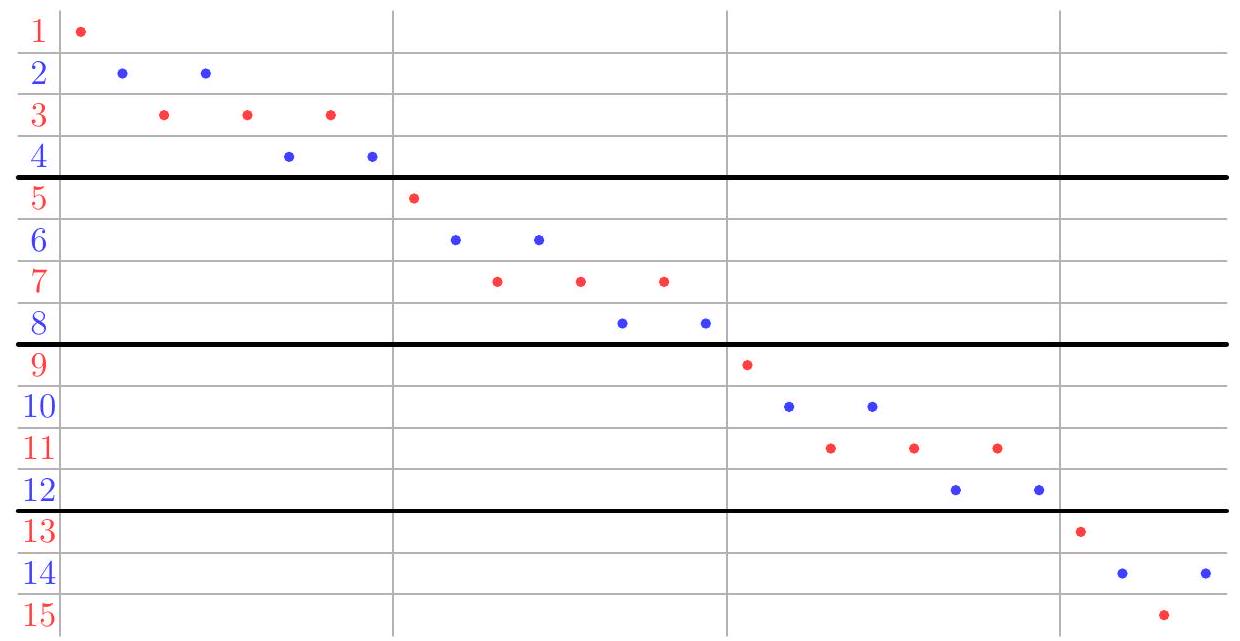 It is easy to check this works, and there are 4044 flips, as desired.", "metadata": {"resource_path": "USA_TSTST/segmented/en-sols-TSTST-2023.jsonl"}} |
| {"year": "2023", "tier": "T0", "problem_label": "8", "problem_type": null, "exam": "USA_TSTST", "problem": "Let $A B C$ be an equilateral triangle with side length 1. Points $A_{1}$ and $A_{2}$ are chosen on side $B C$, points $B_{1}$ and $B_{2}$ are chosen on side $C A$, and points $C_{1}$ and $C_{2}$ are chosen on side $A B$ such that $B A_{1}<B A_{2}, C B_{1}<C B_{2}$, and $A C_{1}<A C_{2}$. Suppose that the three line segments $B_{1} C_{2}, C_{1} A_{2}$, and $A_{1} B_{2}$ are concurrent, and the perimeters of triangles $A B_{2} C_{1}, B C_{2} A_{1}$, and $C A_{2} B_{1}$ are all equal. Find all possible values of this common perimeter.", "solution": " The only possible value of the common perimeter, denoted $p$, is 1 . 【 Synthetic approach (from author). We prove the converse of the problem first: Claim ( $p=1$ implies concurrence) - Suppose the six points are chosen so that triangles $A B_{2} C_{1}, B C_{2} A_{1}, C A_{2} B_{1}$ all have perimeter 1. Then lines $\\overline{B_{1} C_{2}}, \\overline{C_{1} A_{2}}$, and $\\overline{A_{1} B_{2}}$ are concurrent. 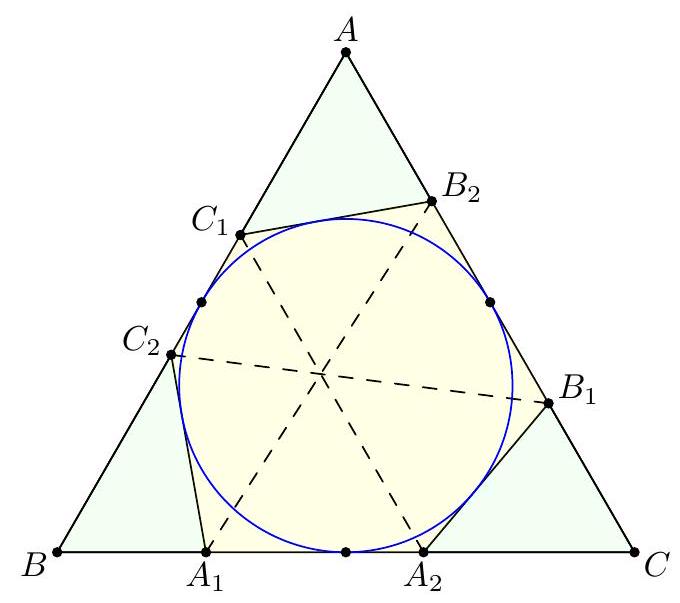 Hence the result follows by Brianchon's theorem. Now suppose $p \\neq 1$. Let $\\overline{B_{2}^{\\prime} C_{1}^{\\prime}}$ be the dilation of $\\overline{B_{2} C_{1}}$ with ratio $\\frac{1}{p}$ at center $A$, and define $C_{2}^{\\prime}, A_{1}^{\\prime}, A_{2}^{\\prime}, B_{1}^{\\prime}$ similarly. The following diagram showcases the situation $p<1$. 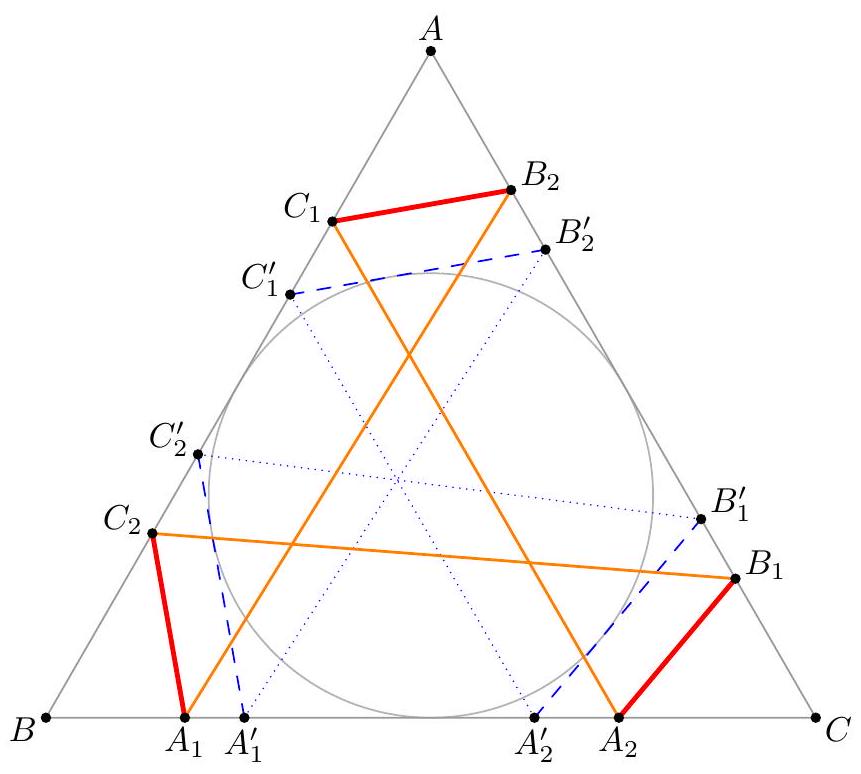 By the reasoning in the $p=1$ case, note that $\\overline{B_{1}^{\\prime} C_{2}^{\\prime}}, \\overline{C_{1}^{\\prime} A_{2}^{\\prime}}$, and $\\overline{A_{1}^{\\prime} B_{2}^{\\prime}}$ are concurrent. However, $\\overline{B_{1} C_{2}}, \\overline{C_{1} A_{2}}, \\overline{A_{1} B_{2}}$ lie in the interior of quadrilaterals $B C B_{1}^{\\prime} C_{2}^{\\prime}, C A C_{1}^{\\prime} A_{2}^{\\prime}$, and $A B A_{1}^{\\prime} B_{2}^{\\prime}$, and these quadrilaterals do not share an interior point, a contradiction. Thus $p \\geq 1$. Similarly, we can show $p \\leq 1$, and so $p=1$ is forced (and achieved if, for example, the three triangles are equilateral with side length $1 / 3$ ).", "metadata": {"resource_path": "USA_TSTST/segmented/en-sols-TSTST-2023.jsonl"}} |
| {"year": "2023", "tier": "T0", "problem_label": "8", "problem_type": null, "exam": "USA_TSTST", "problem": "Let $A B C$ be an equilateral triangle with side length 1. Points $A_{1}$ and $A_{2}$ are chosen on side $B C$, points $B_{1}$ and $B_{2}$ are chosen on side $C A$, and points $C_{1}$ and $C_{2}$ are chosen on side $A B$ such that $B A_{1}<B A_{2}, C B_{1}<C B_{2}$, and $A C_{1}<A C_{2}$. Suppose that the three line segments $B_{1} C_{2}, C_{1} A_{2}$, and $A_{1} B_{2}$ are concurrent, and the perimeters of triangles $A B_{2} C_{1}, B C_{2} A_{1}$, and $C A_{2} B_{1}$ are all equal. Find all possible values of this common perimeter.", "solution": " The only possible value of the common perimeter, denoted $p$, is 1 . 『 Barycentric solution (by Carl, Krit, Milan). We show that, if the common perimeter is 1 , then the lines concur. To do this, we use barycentric coordinates. Let $A=(1: 0: 0)$, $B=(0: 1: 0)$, and $C=(0: 0: 1)$. Let $A_{1}=\\left(0: 1-a_{1}: a_{1}\\right), A_{2}=\\left(0: a_{2}: 1-a_{2}\\right)$, $B_{1}=\\left(b_{1}: 0: 1-b_{1}\\right), B_{2}=\\left(1-b_{2}: 0: b_{2}\\right), C_{1}=\\left(1-c_{1}: c_{1}: 0\\right)$, and $C_{2}=\\left(c_{2}: 1-c_{2}: 0\\right)$. The line $B_{1} C_{2}$ is defined by the equation $$ \\operatorname{det}\\left[\\begin{array}{ccc} x & y & z \\\\ b_{1} & 0 & 1-b_{1} \\\\ c_{2} & 1-c_{2} & 0 \\end{array}\\right]=0 \\text {; } $$ i.e. $$ x\\left(-\\left(1-b_{1}\\right)\\left(1-c_{2}\\right)\\right)+y\\left(\\left(1-b_{1}\\right) c_{2}\\right)+z\\left(b_{1}\\left(1-c_{2}\\right)\\right)=0 . $$ Computing the equations for the other lines cyclically, we get that the lines $B_{1} C_{2}, C_{1} A_{2}$, and $A_{1} B_{2}$ concur if and only if $$ \\operatorname{det}\\left[\\begin{array}{ccc} -\\left(1-b_{1}\\right)\\left(1-c_{2}\\right) & \\left(1-b_{1}\\right) c_{2} & b_{1}\\left(1-c_{2}\\right) \\\\ c_{1}\\left(1-a_{2}\\right) & -\\left(1-c_{1}\\right)\\left(1-a_{2}\\right) & \\left(1-c_{1}\\right) a_{2} \\\\ \\left(1-a_{1}\\right) b_{2} & a_{1}\\left(1-b_{2}\\right) & -\\left(1-a_{1}\\right)\\left(1-b_{2}\\right) \\end{array}\\right]=0 . $$ Let this matrix be $M$. We also define the similar matrix $$ N=\\left[\\begin{array}{ccc} -\\left(1-b_{2}\\right)\\left(1-c_{1}\\right) & \\left(1-b_{2}\\right) c_{1} & b_{2}\\left(1-c_{1}\\right) \\\\ c_{2}\\left(1-a_{1}\\right) & -\\left(1-c_{2}\\right)\\left(1-a_{1}\\right) & \\left(1-c_{2}\\right) a_{1} \\\\ \\left(1-a_{2}\\right) b_{1} & a_{2}\\left(1-b_{1}\\right) & -\\left(1-a_{2}\\right)\\left(1-b_{1}\\right) \\end{array}\\right] . $$ Geometrically, det $N=0$ if and only if $B_{2}^{\\prime} C_{1}^{\\prime}, C_{2}^{\\prime} A_{1}^{\\prime}$, and $A_{2}^{\\prime} B_{1}^{\\prime}$ concur, where for a point $P$ on a side of triangle $A B C, P^{\\prime}$ denotes its reflection over that side's midpoint. Claim - We have $\\operatorname{det} M=\\operatorname{det} N$. We use the definition of the determinant as a sum over permutations. The even permutations give us the following three terms: $$ \\begin{aligned} -\\left(1-b_{1}\\right)\\left(1-c_{2}\\right)\\left(1-c_{1}\\right)\\left(1-a_{2}\\right)\\left(1-a_{1}\\right)\\left(1-b_{2}\\right) & =-\\prod_{i=1}^{2}\\left(\\left(1-a_{i}\\right)\\left(1-b_{i}\\right)\\left(1-c_{i}\\right)\\right) \\\\ \\left(1-a_{1}\\right) b_{2}\\left(1-b_{1}\\right) c_{2}\\left(1-c_{1}\\right) a_{2} & =\\left(\\left(1-a_{1}\\right)\\left(1-b_{1}\\right)\\left(1-c_{1}\\right)\\right)\\left(a_{2} b_{2} c_{2}\\right) \\\\ c_{1}\\left(1-a_{2}\\right) a_{1}\\left(1-b_{2}\\right) b_{1}\\left(1-c_{2}\\right) & =\\left(\\left(1-a_{2}\\right)\\left(1-b_{2}\\right)\\left(1-c_{2}\\right)\\right)\\left(a_{1} b_{1} c_{1}\\right) . \\end{aligned} $$ The first term is invariant under $\\Psi$, while the second and third terms are swapped under $\\Psi$. For the odd permutations, we have a contribution to the determinant of $$ \\sum_{\\mathrm{cyc}}\\left(1-b_{1}\\right)\\left(1-c_{2}\\right)\\left(1-c_{1}\\right) a_{2} a_{1}\\left(1-b_{2}\\right) $$ each summand is invariant under $\\Psi$. This finishes the proof of our claim. Now, it suffices to show that, if $A B_{2} C_{1}, B C_{2} A_{1}$, and $C A_{2} B_{1}$ each have perimeter 1, then $$ \\operatorname{det}\\left[\\begin{array}{ccc} -\\left(1-b_{2}\\right)\\left(1-c_{1}\\right) & \\left(1-b_{2}\\right) c_{1} & b_{2}\\left(1-c_{1}\\right) \\\\ c_{2}\\left(1-a_{1}\\right) & -\\left(1-c_{2}\\right)\\left(1-a_{1}\\right) & \\left(1-c_{2}\\right) a_{1} \\\\ \\left(1-a_{2}\\right) b_{1} & a_{2}\\left(1-b_{1}\\right) & -\\left(1-a_{2}\\right)\\left(1-b_{1}\\right) . \\end{array}\\right]=0 $$ Indeed, we have $A B_{2}=b_{2}$ and $A C_{1}=c_{1}$, so by the law of cosines, $$ 1-b_{2}-c_{1}=1-A B_{2}-A C_{1}=B_{2} C_{1}=\\sqrt{b_{2}^{2}+c_{1}^{2}-b_{2} c_{1}} $$ This gives $$ \\left(1-b_{2}-c_{1}\\right)^{2}=b_{2}^{2}+c_{1}^{2}-b_{2} c_{1} \\Longrightarrow 1-2 b_{2}-2 c_{1}+3 b_{2} c_{1}=0 $$ Similarly, $1-2 c_{2}-2 a_{1}+3 c_{2} a_{1}=0$ and $1-2 a_{2}-2 b_{1}+3 a_{2} b_{1}=0$. Now, $$ \\begin{aligned} N\\left[\\begin{array}{l} 1 \\\\ 1 \\\\ 1 \\end{array}\\right] & =\\left[\\begin{array}{l} -\\left(1-b_{2}\\right)\\left(1-c_{1}\\right)+\\left(1-b_{2}\\right) c_{1}+b_{2}\\left(1-c_{1}\\right) \\\\ -\\left(1-c_{2}\\right)\\left(1-a_{1}\\right)+\\left(1-c_{2}\\right) a_{1}+c_{2}\\left(1-a_{1}\\right) \\\\ -\\left(1-a_{2}\\right)\\left(1-b_{1}\\right)+\\left(1-a_{2}\\right) b_{1}+a_{2}\\left(1-b_{1}\\right) \\end{array}\\right] \\\\ & =\\left[\\begin{array}{l} -1+2 b_{2}+2 c_{1}-3 b_{2} c_{1} \\\\ -1+2 c_{2}+2 a_{1}-3 c_{2} a_{1} \\\\ -1+2 a_{2}+2 b_{1}-2 a_{2} b_{1} \\end{array}\\right]=\\left[\\begin{array}{l} 0 \\\\ 0 \\\\ 0 \\end{array}\\right] . \\end{aligned} $$ So it follows $\\operatorname{det} N=0$, as desired.", "metadata": {"resource_path": "USA_TSTST/segmented/en-sols-TSTST-2023.jsonl"}} |
| {"year": "2023", "tier": "T0", "problem_label": "9", "problem_type": null, "exam": "USA_TSTST", "problem": "Let $p$ be a fixed prime and let $a \\geq 2$ and $e \\geq 1$ be fixed integers. Given a function $f: \\mathbb{Z} / a \\mathbb{Z} \\rightarrow \\mathbb{Z} / p^{e} \\mathbb{Z}$ and an integer $k \\geq 0$, the $k$ th finite difference, denoted $\\Delta^{k} f$, is the function from $\\mathbb{Z} / a \\mathbb{Z}$ to $\\mathbb{Z} / p^{e} \\mathbb{Z}$ defined recursively by $$ \\begin{aligned} & \\Delta^{0} f(n)=f(n) \\\\ & \\Delta^{k} f(n)=\\Delta^{k-1} f(n+1)-\\Delta^{k-1} f(n) \\quad \\text { for } k=1,2, \\ldots \\end{aligned} $$ Determine the number of functions $f$ such that there exists some $k \\geq 1$ for which $\\Delta^{k} f=f$ 。", "solution": "Let $p$ be a fixed prime and let $a \\geq 2$ and $e \\geq 1$ be fixed integers. Given a function $f: \\mathbb{Z} / a \\mathbb{Z} \\rightarrow \\mathbb{Z} / p^{e} \\mathbb{Z}$ and an integer $k \\geq 0$, the $k$ th finite difference, denoted $\\Delta^{k} f$, is the function from $\\mathbb{Z} / a \\mathbb{Z}$ to $\\mathbb{Z} / p^{e} \\mathbb{Z}$ defined recursively by $$ \\begin{aligned} & \\Delta^{0} f(n)=f(n) \\\\ & \\Delta^{k} f(n)=\\Delta^{k-1} f(n+1)-\\Delta^{k-1} f(n) \\quad \\text { for } k=1,2, \\ldots \\end{aligned} $$ Determine the number of functions $f$ such that there exists some $k \\geq 1$ for which $\\Delta^{k} f=f$. The answer is $$ \\left(p^{e}\\right)^{a} \\cdot p^{-e p^{\\nu} p(a)}=p^{e\\left(a-p^{\\nu_{p}(a)}\\right)} $$ 【 First solution by author. For convenience in what follows, set $d=\\nu_{p}(a)$, let $a=p^{d} \\cdot b$, and let a function $f: \\mathbb{Z} / a \\mathbb{Z} \\rightarrow \\mathbb{Z} / p^{e} \\mathbb{Z}$ be essential if it equals one of its iterated finite differences. The key claim is the following. Claim (Characterization of essential functions) - A function $f$ is essential if and only if $$ f(x)+f\\left(x+p^{d}\\right)+\\cdots+f\\left(x+(b-1) p^{d}\\right)=0 $$ for all $x$. ## Lemma Let $g: \\mathbb{Z} / a \\mathbb{Z} \\rightarrow \\mathbb{Z} / p^{e} \\mathbb{Z}$ be any function, and let $h=\\Delta^{p^{d}} g$. Then $$ h(x)+h\\left(x+p^{d}\\right)+\\cdots+h\\left(x+(b-1) p^{d}\\right) \\equiv 0 \\quad(\\bmod p) $$ for all $x$. $$ h(x)=\\Delta^{p^{d}} g(x)=\\sum_{k=0}^{p^{d}}(-1)^{k}\\binom{p^{d}}{k} g\\left(x+p^{d}-k\\right) $$ However, it is known that $\\binom{p^{d}}{k}$ is a multiple of $p$ if $1 \\leq k \\leq p^{d}-1$, so $$ h(x) \\equiv g\\left(x+p^{d}\\right)+(-1)^{p^{d}} g(x) \\quad(\\bmod p) . $$ Using this, we easily obtain $$ \\begin{aligned} & h(x)+h\\left(x+p^{d}\\right)+\\cdots+h\\left(x+(b-1) p^{d}\\right) \\\\ \\equiv & \\begin{cases}0 & p>2 \\\\ 2\\left(g(x)+g\\left(x+p^{d}\\right)+\\cdots+g\\left(x+(b-1) p^{d}\\right)\\right) & p=2\\end{cases} \\\\ \\equiv & 0 \\quad(\\bmod p) \\end{aligned} $$ as desired. ## Corollary Let $g: \\mathbb{Z} / a \\mathbb{Z} \\rightarrow \\mathbb{Z} / p^{e} \\mathbb{Z}$ be any function, and let $h=\\Delta^{e p^{d}} g$. Then $$ h(x)+h\\left(x+p^{d}\\right)+\\cdots+h\\left(x+(b-1) p^{d}\\right)=0 $$ for all $x$. $$ h_{1}(x)=\\frac{h(x)+h\\left(x+p^{d}\\right)+\\cdots+h\\left(x+(b-1) p^{d}\\right)}{p} . $$ Applying the lemma to $h_{1}$ shows the corollary for $e=2$, since $h_{1}(x)$ is divisible by $p$, hence the numerator is divisible by $p^{2}$. Continue in this manner to get the result for general $e>2$. This immediately settles this direction, since $f$ is in the image of $\\Delta^{e p^{d}}$. We will show that $\\Delta$ is injective on $\\mathcal{S}$. Suppose otherwise, and consider two functions $f$, $g$ in $\\mathcal{S}$ with $\\Delta f=\\Delta g$. Then, we obtain that $f$ and $g$ differ by a constant; say $g=f+\\lambda$. However, then $$ \\begin{aligned} & g(0)+g\\left(p^{e}\\right)+\\cdots+g\\left((b-1) p^{e}\\right) \\\\ = & (f(0)+\\lambda)+\\left(f\\left(p^{e}\\right)+\\lambda\\right)+\\cdots+\\left(f\\left((b-1) p^{e}\\right)+\\lambda\\right) \\\\ = & b \\lambda \\end{aligned} $$ This should also be zero. Since $p \\nmid b$, we obtain $\\lambda=0$, as desired. Counting Finally, we can count the essential functions: all but the last $p^{d}$ entries can be chosen arbitrarily, and then each remaining entry has exactly one possible choice. This leads to a count of $$ \\left(p^{e}\\right)^{a-p^{d}}=p^{e\\left(a-p^{\\nu_{p}(a)}\\right)}, $$ as promised.", "metadata": {"resource_path": "USA_TSTST/segmented/en-sols-TSTST-2023.jsonl"}} |
| {"year": "2023", "tier": "T0", "problem_label": "9", "problem_type": null, "exam": "USA_TSTST", "problem": "Let $p$ be a fixed prime and let $a \\geq 2$ and $e \\geq 1$ be fixed integers. Given a function $f: \\mathbb{Z} / a \\mathbb{Z} \\rightarrow \\mathbb{Z} / p^{e} \\mathbb{Z}$ and an integer $k \\geq 0$, the $k$ th finite difference, denoted $\\Delta^{k} f$, is the function from $\\mathbb{Z} / a \\mathbb{Z}$ to $\\mathbb{Z} / p^{e} \\mathbb{Z}$ defined recursively by $$ \\begin{aligned} & \\Delta^{0} f(n)=f(n) \\\\ & \\Delta^{k} f(n)=\\Delta^{k-1} f(n+1)-\\Delta^{k-1} f(n) \\quad \\text { for } k=1,2, \\ldots \\end{aligned} $$ Determine the number of functions $f$ such that there exists some $k \\geq 1$ for which $\\Delta^{k} f=f$ 。", "solution": "Let $p$ be a fixed prime and let $a \\geq 2$ and $e \\geq 1$ be fixed integers. Given a function $f: \\mathbb{Z} / a \\mathbb{Z} \\rightarrow \\mathbb{Z} / p^{e} \\mathbb{Z}$ and an integer $k \\geq 0$, the $k$ th finite difference, denoted $\\Delta^{k} f$, is the function from $\\mathbb{Z} / a \\mathbb{Z}$ to $\\mathbb{Z} / p^{e} \\mathbb{Z}$ defined recursively by $$ \\begin{aligned} & \\Delta^{0} f(n)=f(n) \\\\ & \\Delta^{k} f(n)=\\Delta^{k-1} f(n+1)-\\Delta^{k-1} f(n) \\quad \\text { for } k=1,2, \\ldots \\end{aligned} $$ Determine the number of functions $f$ such that there exists some $k \\geq 1$ for which $\\Delta^{k} f=f$. The answer is $$ \\left(p^{e}\\right)^{a} \\cdot p^{-e p^{\\nu} p(a)}=p^{e\\left(a-p^{\\nu_{p}(a)}\\right)} $$ II Second solution by Daniel Zhu. There are two parts to the proof: solving the $e=1$ case, and using the $e=1$ result to solve the general problem by induction on $e$. These parts are independent of each other. The case $e=1 \\quad$ Represent functions $f$ as elements $$ \\alpha_{f}:=\\sum_{k \\in \\mathbb{Z} / a \\mathbb{Z}} f(-k) x^{k} \\in \\mathbb{F}_{p}[x] /\\left(x^{a}-1\\right) $$ Then, since $\\alpha_{\\Delta f}=(x-1) \\alpha_{f}$, we wish to find the number of $\\alpha \\in \\mathbb{F}_{p}[x] /\\left(x^{a}-1\\right)$ such that $(x-1)^{m} \\alpha=\\alpha$ for some $m$. Now, make the substitution $y=x-1$ and let $P(y)=(y+1)^{a}-1$; we want to find $\\alpha \\in \\mathbb{F}_{p}[y] /(P(y))$ such that $y^{m} \\alpha=\\alpha$ for some $m$. If we write $P(y)=y^{d} Q(y)$ with $Q(0) \\neq 0$, then by the Chinese Remainder Theorem we have the ring isomorphism $$ \\mathbb{F}_{p}[y] /(P(y)) \\cong \\mathbb{F}_{p}[y] /\\left(y^{d}\\right) \\times \\mathbb{F}_{p}[y] /(Q(y)) $$ Note that $y$ is nilpotent in the first factor, while it is a unit in the second factor. So the $\\alpha$ that work are exactly those that are zero in the first factor; thus there are $p^{a-d}$ such $\\alpha$. We can calculate $d=p^{v_{p}(a)}$ (via, say, Lucas's Theorem), so we are done. The general problem The general idea is as follows: call a $f: \\mathbb{Z} / a \\mathbb{Z} \\rightarrow \\mathbb{Z} / p^{e} \\mathbb{Z} e$-good if $\\Delta^{m} f=f$ for some $m$. Our result above allows us to count the 1-good functions. Then, if $e \\geq 1$, every $(e+1)$-good function, when reduced $\\bmod p^{e}$, yields an $e$-good function, so we count $(e+1)$-good functions by counting how many reduce to any given $e$-good function. Formally, we use induction on $e$, with the $e=1$ case being treated above. Suppose now we have solved the problem for a given $e \\geq 1$, and we now wish to solve it for $e+1$. For any function $g: \\mathbb{Z} / a \\mathbb{Z} \\rightarrow \\mathbb{Z} / p^{e+1} \\mathbb{Z}$, let $\\bar{g}: \\mathbb{Z} / a \\mathbb{Z} \\rightarrow \\mathbb{Z} / p^{e} \\mathbb{Z}$ be its reduction $\\bmod p^{e}$. For a given $e$-good $f$, let $n(f)$ be the number of $(e+1)$-good $g$ with $\\bar{g}=f$. The following two claims now finish the problem: Claim - If $f$ is $e$-good, then $n(f)>0$. $$ g, \\Delta^{m} g, \\Delta^{2 m} g, \\ldots $$ Since there are finitely many functions $\\mathbb{Z} / a \\mathbb{Z} \\rightarrow \\mathbb{Z} / p^{e+1} \\mathbb{Z}$, there must exist $a<b$ such that $\\Delta^{a m} g=\\Delta^{b m} g$. We claim $\\Delta^{a m} g$ is the desired $(e+1)$ good function. To see this, first note that since $\\overline{\\Delta^{k} g}=\\Delta^{k} \\bar{g}$, we must have $\\overline{\\Delta^{a m} g}=\\Delta^{a m} f=f$. Moreover, $$ \\Delta^{(b-a) m}\\left(\\Delta^{a m} g\\right)=\\Delta^{b m} g=\\Delta^{a m} g $$ so $\\Delta^{a m} g$ is $(e+1)$-good. Claim - If $f$ is $e$-good, and $n(f)>0$, then $n(f)$ is exactly the number of 1-good functions, i.e. $p^{a-p^{v_{p}(a)}}$. To show that this condition is sufficient, note that $\\overline{g+p^{e} h}=\\bar{g}=f$. Moreover, if $\\Delta^{m} g=g$ and $\\Delta^{m^{\\prime}} h=h$, then $$ \\Delta^{m m^{\\prime}}\\left(g+p^{e} h\\right)=\\Delta^{m m^{\\prime}} g+p^{e} \\Delta^{m m^{\\prime}} h=g+p^{e} h . $$ To show that this condition is necessary, let $g_{1}$ be any $(e+1)$-good function such that $\\bar{g}_{1}=f$. Then $g_{1}-g$ is also $(e+1)$-good, since if $\\Delta^{m} g=g, \\Delta^{m^{\\prime}} g_{1}=g_{1}$, we have $$ \\Delta^{m m^{\\prime}}\\left(g_{1}-g\\right)=\\Delta^{m m^{\\prime}} g_{1}-\\Delta^{m m^{\\prime}} g=g_{1}-g . $$ On the other hand, we also know that $g_{1}-g$ is divisible by $p^{e}$. This means that it must be $p^{e} h$ for some function $f: \\mathbb{Z} / a \\mathbb{Z} \\rightarrow \\mathbb{Z} / p \\mathbb{Z}$, and it is not hard to show that $g_{1}-g$ being $(e+1)$-good means that $h$ is 1 -good.", "metadata": {"resource_path": "USA_TSTST/segmented/en-sols-TSTST-2023.jsonl"}} |
|
|


