| {"year": "2023", "tier": "T2", "problem_label": "1", "problem_type": null, "exam": "EGMO", "problem": "There are $n \\geqslant 3$ positive real numbers $a_{1}, a_{2}, \\ldots, a_{n}$. For each $1 \\leqslant i \\leqslant n$ we let $b_{i}=\\frac{a_{i-1}+a_{i+1}}{a_{i}}$ (here we define $a_{0}$ to be $a_{n}$ and $a_{n+1}$ to be $a_{1}$ ). Assume that for all $i$ and $j$ in the range 1 to $n$, we have $a_{i} \\leqslant a_{j}$ if and only if $b_{i} \\leqslant b_{j}$.\n\nProve that $a_{1}=a_{2}=\\cdots=a_{n}$.", "solution": "Suppose that not all $a_{i}$ are equal. Consider an index $i$ such that $a_{i}$ is maximal and $a_{i+1}<a_{i}$. Then\n\n$$\nb_{i}=\\frac{a_{i-1}+a_{i+1}}{a_{i}}<\\frac{2 a_{i}}{a_{i}}=2 .\n$$\n\nBut since $a_{i}$ is maximal, $b_{i}$ is also maximal, so we must have $b_{j}<2$ for all $j \\in\\{1,2, \\ldots, n\\}$. However, consider the product $b_{1} b_{2} \\ldots b_{n}$. We have\n\n$$\n\\begin{aligned}\nb_{1} b_{2} \\ldots b_{n} & =\\frac{a_{n}+a_{2}}{a_{1}} \\cdot \\frac{a_{1}+a_{3}}{a_{2}} \\cdot \\ldots \\cdot \\frac{a_{n-1}+a_{1}}{a_{n}} \\\\\n& \\geqslant 2^{n} \\frac{\\sqrt{a_{n} a_{2}} \\sqrt{a_{1} a_{3}} \\ldots \\sqrt{a_{n-1} a_{1}}}{a_{1} a_{2} \\ldots a_{n}} \\\\\n& =2^{n}\n\\end{aligned}\n$$\n\nwhere we used the inequality $x+y \\geqslant 2 \\sqrt{x y}$ for $x=a_{i-1}, y=a_{i+1}$ for all $i \\in\\{1,2, \\ldots, n\\}$ in the second row.\n\nSince the product of all $b_{i}$ is at least $2^{n}$, at least one of them must be greater than 2 , which is a contradiction with the previous conclusion.\n\nThus, all $a_{i}$ must be equal.", "metadata": {"resource_path": "EGMO/segmented/en-2023-solutions.jsonl", "problem_match": "\nProblem 1.", "solution_match": "\nSolution 1. "}} |
| {"year": "2023", "tier": "T2", "problem_label": "1", "problem_type": null, "exam": "EGMO", "problem": "There are $n \\geqslant 3$ positive real numbers $a_{1}, a_{2}, \\ldots, a_{n}$. For each $1 \\leqslant i \\leqslant n$ we let $b_{i}=\\frac{a_{i-1}+a_{i+1}}{a_{i}}$ (here we define $a_{0}$ to be $a_{n}$ and $a_{n+1}$ to be $a_{1}$ ). Assume that for all $i$ and $j$ in the range 1 to $n$, we have $a_{i} \\leqslant a_{j}$ if and only if $b_{i} \\leqslant b_{j}$.\n\nProve that $a_{1}=a_{2}=\\cdots=a_{n}$.", "solution": "This is a version of Solution 1 without use of proof by contradiction.\nTaking $a_{i}$ such that it is maximal among $a_{1}, \\ldots, a_{n}$, we obtain $b_{i} \\leqslant 2$. Thus $b_{i} \\leqslant 2$ for all $j \\in\\{1,2, \\ldots, n\\}$.\nThe second part of Solution 1 then gives $2^{n} \\geqslant b_{1} \\cdots b_{n} \\geqslant 2^{n}$, which together with $b_{i} \\leqslant 2$ for all $j \\in\\{1,2, \\ldots, n\\}$ implies that $b_{j}=2$ for all $j \\in\\{1,2, \\ldots, n\\}$. Since we have $b_{1}=$ $b_{2}=\\cdots=b_{n}$, the condition that $a_{i} \\leqslant a_{j} \\Longleftrightarrow b_{i} \\leqslant b_{j}$ gives that $a_{1}=a_{2}=\\cdots=a_{n}$.", "metadata": {"resource_path": "EGMO/segmented/en-2023-solutions.jsonl", "problem_match": "\nProblem 1.", "solution_match": "\nSolution 2. "}} |
| {"year": "2023", "tier": "T2", "problem_label": "1", "problem_type": null, "exam": "EGMO", "problem": "There are $n \\geqslant 3$ positive real numbers $a_{1}, a_{2}, \\ldots, a_{n}$. For each $1 \\leqslant i \\leqslant n$ we let $b_{i}=\\frac{a_{i-1}+a_{i+1}}{a_{i}}$ (here we define $a_{0}$ to be $a_{n}$ and $a_{n+1}$ to be $a_{1}$ ). Assume that for all $i$ and $j$ in the range 1 to $n$, we have $a_{i} \\leqslant a_{j}$ if and only if $b_{i} \\leqslant b_{j}$.\n\nProve that $a_{1}=a_{2}=\\cdots=a_{n}$.", "solution": "We first show that $b_{j} \\leqslant 2$ for all $j$ as in Solution 2. Then\n\n$$\n\\begin{aligned}\n2 n & \\geqslant b_{1}+\\cdots+b_{n}=\\frac{a_{n}}{a_{1}}+\\frac{a_{2}}{a_{1}}+\\frac{a_{1}}{a_{2}}+\\frac{a_{3}}{a_{2}}+\\cdots+\\frac{a_{n-1}}{a_{n}}+\\frac{a_{1}}{a_{n}} \\\\\n& \\geqslant 2 n \\sqrt[n]{\\frac{a_{n}}{a_{1}} \\cdot \\frac{a_{2}}{a_{1}} \\cdot \\frac{a_{1}}{a_{2}} \\cdot \\frac{a_{3}}{a_{2}} \\cdots \\frac{a_{n-1}}{a_{n}} \\cdot \\frac{a_{1}}{a_{n}}=2 n \\cdot 1=2 n,}\n\\end{aligned}\n$$\n\nwhere we used the AM-GM inequality.\nIt follows that all $b_{j}$ 's are equal which as in Solution 2 gives $a_{1}=a_{2}=\\cdots=a_{n}$.", "metadata": {"resource_path": "EGMO/segmented/en-2023-solutions.jsonl", "problem_match": "\nProblem 1.", "solution_match": "\nSolution 3. "}} |
| {"year": "2023", "tier": "T2", "problem_label": "1", "problem_type": null, "exam": "EGMO", "problem": "There are $n \\geqslant 3$ positive real numbers $a_{1}, a_{2}, \\ldots, a_{n}$. For each $1 \\leqslant i \\leqslant n$ we let $b_{i}=\\frac{a_{i-1}+a_{i+1}}{a_{i}}$ (here we define $a_{0}$ to be $a_{n}$ and $a_{n+1}$ to be $a_{1}$ ). Assume that for all $i$ and $j$ in the range 1 to $n$, we have $a_{i} \\leqslant a_{j}$ if and only if $b_{i} \\leqslant b_{j}$.\n\nProve that $a_{1}=a_{2}=\\cdots=a_{n}$.", "solution": "By assumption $a_{i} b_{i}=a_{i-1}+a_{i+1}$ for $i=\\{1,2, \\ldots, n\\}$, hence,\n\n$$\n\\sum_{i=1}^{n} a_{i} b_{i}=2 \\sum_{i=1}^{n} a_{i} .\n$$\n\nSince $a_{i} \\leqslant a_{j}$ if and only if $b_{i} \\leqslant b_{j}$, the Chebyshev's inequality implies\n\n$$\n\\left(\\sum_{i=1}^{n} a_{i}\\right) \\cdot\\left(\\sum_{i=1}^{n} b_{i}\\right) \\leqslant n \\cdot \\sum_{i=1}^{n} a_{i} b_{i}=2 n \\cdot \\sum_{i=1}^{n} a_{i}\n$$\n\nand so $\\sum_{i=1}^{n} b_{i} \\leqslant 2 n$. On the other hand, we have\n\n$$\n\\sum_{i=1}^{n} b_{i}=\\sum_{i=1}^{n} \\frac{a_{i-1}}{a_{i}}+\\sum_{i=1}^{n} \\frac{a_{i+1}}{a_{i}}=\\sum_{i=1}^{n} \\frac{a_{i-1}}{a_{i}}+\\sum_{i=1}^{n} \\frac{a_{i}}{a_{i-1}}=\\sum_{i=1}^{n}\\left(\\frac{a_{i-1}}{a_{i}}+\\frac{a_{i}}{a_{i-1}}\\right)\n$$\n\nso we can use the AM-GM inequality to estimate\n\n$$\n\\sum_{i=1}^{n} b_{i} \\geqslant \\sum_{i=1}^{n} 2 \\sqrt{\\frac{a_{i-1}}{a_{i}} \\cdot \\frac{a_{i}}{a_{i-1}}}=2 n\n$$\n\nWe conclude that we must have equalities in all the above, which implies $\\frac{a_{i-1}}{a_{i}}=\\frac{a_{i}}{a_{i-1}}$ and consequently $a_{i}=a_{i-1}$ for all positive integers $i$. Hence, all $a$ 's are equal.", "metadata": {"resource_path": "EGMO/segmented/en-2023-solutions.jsonl", "problem_match": "\nProblem 1.", "solution_match": "\nSolution 4. "}} |
| {"year": "2023", "tier": "T2", "problem_label": "1", "problem_type": null, "exam": "EGMO", "problem": "There are $n \\geqslant 3$ positive real numbers $a_{1}, a_{2}, \\ldots, a_{n}$. For each $1 \\leqslant i \\leqslant n$ we let $b_{i}=\\frac{a_{i-1}+a_{i+1}}{a_{i}}$ (here we define $a_{0}$ to be $a_{n}$ and $a_{n+1}$ to be $a_{1}$ ). Assume that for all $i$ and $j$ in the range 1 to $n$, we have $a_{i} \\leqslant a_{j}$ if and only if $b_{i} \\leqslant b_{j}$.\n\nProve that $a_{1}=a_{2}=\\cdots=a_{n}$.", "solution": "As in Solution 4 we show that $\\sum_{i=1}^{n} b_{i} \\leqslant 2 n$ and as in Solution 1 we show that $\\prod_{i=1}^{n} b_{i} \\geqslant 2^{n}$. We now use the AM-GM inequality and the first inequality to get\n\n$$\n\\prod_{i=1}^{n} b_{i} \\leqslant\\left(\\frac{1}{n} \\sum_{i=1}^{n} b_{i}\\right)^{n} \\leqslant\\left(\\frac{1}{n} \\cdot 2 n\\right)^{n}=2^{n}\n$$\n\nThis implies that we must have equalities in all the above. In particular, we have equality in the AM-GM inequality, so all $b$ 's are equal and as in Solution 2 then all $a$ 's are equal.", "metadata": {"resource_path": "EGMO/segmented/en-2023-solutions.jsonl", "problem_match": "\nProblem 1.", "solution_match": "\nSolution 5. "}} |
| {"year": "2023", "tier": "T2", "problem_label": "1", "problem_type": null, "exam": "EGMO", "problem": "There are $n \\geqslant 3$ positive real numbers $a_{1}, a_{2}, \\ldots, a_{n}$. For each $1 \\leqslant i \\leqslant n$ we let $b_{i}=\\frac{a_{i-1}+a_{i+1}}{a_{i}}$ (here we define $a_{0}$ to be $a_{n}$ and $a_{n+1}$ to be $a_{1}$ ). Assume that for all $i$ and $j$ in the range 1 to $n$, we have $a_{i} \\leqslant a_{j}$ if and only if $b_{i} \\leqslant b_{j}$.\n\nProve that $a_{1}=a_{2}=\\cdots=a_{n}$.", "solution": "Let $a_{i}$ to be minimal and $a_{j}$ maximal among all $a$ 's. Then\n\n$$\nb_{j}=\\frac{a_{j-1}+a_{j+1}}{a_{j}} \\leqslant \\frac{2 a_{j}}{a_{j}}=2=\\frac{2 a_{i}}{a_{i}} \\leqslant \\frac{a_{i-1}+a_{i+1}}{a_{i}}=b_{i}\n$$\n\nand by assumption $b_{i} \\leqslant b_{j}$. Hence, we have equalities in the above so $b_{j}=2$ so $a_{j-1}+$ $a_{j+1}=2 a_{j}$ and therefore $a_{j-1}=a_{j}=a_{j+1}$. We have thus shown that the two neighbors of a maximal $a$ are also maximal. By an inductive argument all $a$ 's are maximal, hence equal.", "metadata": {"resource_path": "EGMO/segmented/en-2023-solutions.jsonl", "problem_match": "\nProblem 1.", "solution_match": "\nSolution 6. "}} |
| {"year": "2023", "tier": "T2", "problem_label": "1", "problem_type": null, "exam": "EGMO", "problem": "There are $n \\geqslant 3$ positive real numbers $a_{1}, a_{2}, \\ldots, a_{n}$. For each $1 \\leqslant i \\leqslant n$ we let $b_{i}=\\frac{a_{i-1}+a_{i+1}}{a_{i}}$ (here we define $a_{0}$ to be $a_{n}$ and $a_{n+1}$ to be $a_{1}$ ). Assume that for all $i$ and $j$ in the range 1 to $n$, we have $a_{i} \\leqslant a_{j}$ if and only if $b_{i} \\leqslant b_{j}$.\n\nProve that $a_{1}=a_{2}=\\cdots=a_{n}$.", "solution": "Choose an arbitrary index $i$ and assume without loss of generality that $a_{i} \\leqslant a_{i+1}$. (If the opposite inequality holds, reverse all the inequalities below.) By induction we will show that for each $k \\in \\mathbb{N}_{0}$ the following two inequalities hold\n\n$$\n\\begin{gathered}\na_{i+1+k} \\geqslant a_{i-k} \\\\\na_{i+1+k} a_{i+1-k} \\geqslant a_{i-k} a_{i+k}\n\\end{gathered}\n$$\n\n(where all indices are cyclic modulo $n$ ). Both inequalities trivially hold for $k=0$.\nAssume now that both inequalities hold for some $k \\geqslant 0$. The inequality $a_{i+1+k} \\geqslant a_{i-k}$ implies $b_{i+1+k} \\geqslant b_{i-k}$, so\n\n$$\n\\frac{a_{i+k}+a_{i+2+k}}{a_{i+1+k}} \\geqslant \\frac{a_{i-1-k}+a_{i+1-k}}{a_{i-k}} .\n$$\n\nWe may rearrange this inequality by making $a_{i+2+k}$ the subject so\n\n$$\na_{i+2+k} \\geqslant \\frac{a_{i+1+k} a_{i-1-k}}{a_{i-k}}+\\frac{a_{i+1-k} a_{i+1+k}-a_{i+k} a_{i-k}}{a_{i-k}} \\geqslant \\frac{a_{i+1+k} a_{i-1-k}}{a_{i-k}},\n$$\n\nwhere the last inequality holds by (2). It follows that\n\n$$\na_{(i+1)+(k+1)} a_{(i+1)-(k+1)} \\geqslant a_{i+(k+1)} a_{i-(k+1)},\n$$\n\ni.e. the inequality (2) holds also for $k+1$. Using (1) we now get\n\n$$\na_{(i+1)+(k+1)} \\geqslant \\frac{a_{i+k+1}}{a_{i-k}} a_{i-(k+1)} \\geqslant a_{i-(k+1)},\n$$\n\ni.e. (1) holds for $k+1$.\n\nNow we use the inequality (1) for $k=n-1$. We get $a_{i} \\geqslant a_{i+1}$, and since at the beginning we assumed $a_{i} \\leqslant a_{i+1}$, we get that any two consecutive $a$ 's are equal, so all of them are equal.", "metadata": {"resource_path": "EGMO/segmented/en-2023-solutions.jsonl", "problem_match": "\nProblem 1.", "solution_match": "\nSolution 7. "}} |
| {"year": "2023", "tier": "T2", "problem_label": "1", "problem_type": null, "exam": "EGMO", "problem": "There are $n \\geqslant 3$ positive real numbers $a_{1}, a_{2}, \\ldots, a_{n}$. For each $1 \\leqslant i \\leqslant n$ we let $b_{i}=\\frac{a_{i-1}+a_{i+1}}{a_{i}}$ (here we define $a_{0}$ to be $a_{n}$ and $a_{n+1}$ to be $a_{1}$ ). Assume that for all $i$ and $j$ in the range 1 to $n$, we have $a_{i} \\leqslant a_{j}$ if and only if $b_{i} \\leqslant b_{j}$.\n\nProve that $a_{1}=a_{2}=\\cdots=a_{n}$.", "solution": "We first prove the following claim by induction:\nClaim 1: If $a_{k} a_{k+2}<a_{k+1}^{2}$ and $a_{k}<a_{k+1}$, then $a_{j} a_{j+2}<a_{j+1}^{2}$ and $a_{j}<a_{j+1}$ for all $j$.\nWe assume that $a_{i} a_{i+2}<a_{i+1}^{2}$ and $a_{i}<a_{i+1}$, and then show that $a_{i-1} a_{i+1}<a_{i}^{2}$ and $a_{i-1}<a_{i}$.\nSince $a_{i} \\leq a_{i+1}$ we have that $b_{i} \\leq b_{i+1}$. By plugging in the definition of $b_{i}$ and $b_{i+1}$ we have that\n\n$$\na_{i+1} a_{i-1}+a_{i+1}^{2} \\leq a_{i}^{2}+a_{i+2} a_{i}\n$$\n\nUsing $a_{i} a_{i+2}<a_{i+1}^{2}$ we get that\n\n$$\na_{i+1} a_{i-1}<a_{i}^{2} .\n$$\n\nSince $a_{i}<a_{i+1}$ we have that $a_{i-1}<a_{i}$, which concludes the induction step and hence proves the claim.\n\nWe cannot have that $a_{j}<a_{j+1}$ for all indices $j$. Similar as in the above claim, one can prove that if $a_{k} a_{k+2}<a_{k+1}^{2}$ and $a_{k+2}<a_{k+1}$, then $a_{j+1}<a_{j}$ for all $j$, which also cannot be the case. Thus we have that $a_{k} a_{k+2} \\geq a_{k+1}^{2}$ for all indices $k$.\nNext observe (e.g. by taking the product over all indices) that this implies $a_{k} a_{k+2}=a_{k+1}^{2}$ for all indices $k$, which is equivalent to $b_{k}=b_{k+1}$ for all $k$ and hence $a_{k+1}=a_{k}$ for all $k$.", "metadata": {"resource_path": "EGMO/segmented/en-2023-solutions.jsonl", "problem_match": "\nProblem 1.", "solution_match": "\nSolution 8. "}} |
| {"year": "2023", "tier": "T2", "problem_label": "1", "problem_type": null, "exam": "EGMO", "problem": "There are $n \\geqslant 3$ positive real numbers $a_{1}, a_{2}, \\ldots, a_{n}$. For each $1 \\leqslant i \\leqslant n$ we let $b_{i}=\\frac{a_{i-1}+a_{i+1}}{a_{i}}$ (here we define $a_{0}$ to be $a_{n}$ and $a_{n+1}$ to be $a_{1}$ ). Assume that for all $i$ and $j$ in the range 1 to $n$, we have $a_{i} \\leqslant a_{j}$ if and only if $b_{i} \\leqslant b_{j}$.\n\nProve that $a_{1}=a_{2}=\\cdots=a_{n}$.", "solution": "Define $c_{i}:=\\frac{a_{i}}{a_{i+1}}$, then $b_{i}=c_{i-1}+1 / c_{i}$. Assume that not all $c_{i}$ are equal to 1. Since, $\\prod_{i=1}^{n} c_{i}=1$ there exists a $k$ such that $c_{k} \\geqslant 1$. From the condition given in the problem statement for $(i, j)=(k, k+1)$ we have\n\n$$\nc_{k} \\geqslant 1 \\Longleftrightarrow c_{k-1}+\\frac{1}{c_{k}} \\geqslant c_{k}+\\frac{1}{c_{k+1}} \\Longleftrightarrow c_{k-1} c_{k} c_{k+1}+c_{k+1} \\geqslant c_{k}^{2} c_{k+1}+c_{k}\n$$\n\nNow since $c_{k+1} \\leqslant c_{k}^{2} c_{k+1}$, it follows that\n\n$$\nc_{i-1} c_{i} c_{i+1} \\geqslant c_{i} \\Longrightarrow\\left(c_{i-1} \\geqslant 1 \\text { or } c_{i+1} \\geqslant 1\\right) .\n$$\n\nSo there exist a set of at least 2 consecutive integers, such that the corresponding $c_{i}$ are greater or equal to one. By the innitial assumption there must exist an index $\\ell$, such that $c_{\\ell-1}, c_{\\ell} \\geqslant 1$ and $c_{\\ell+1}<1$. We distinguish two cases:\nCase 1: $c_{\\ell}>c_{\\ell-1} \\geqslant 1$\nFrom $c_{\\ell-1} c_{\\ell} c_{\\ell+1}<c_{\\ell}^{2} c_{\\ell+1}$ and the inequality (5), we get that $c_{\\ell+1}>c_{\\ell} \\geqslant 1$, which is a contradiction to our choice of $\\ell$.\n\nCase 2: $c_{\\ell-1} \\geqslant c_{\\ell} \\geqslant 1$\nOnce again looking at the inequality (5) we can find that\n\n$$\nc_{\\ell-2} c_{\\ell-1} c_{\\ell} \\geqslant c_{\\ell-1}^{2} c_{\\ell} \\Longrightarrow c_{\\ell-2} \\geqslant c_{\\ell-1} .\n$$\n\nNote that we only needed $c_{\\ell-1} \\geqslant c_{\\ell} \\geqslant 1$ to show $c_{\\ell-2} \\geqslant c_{\\ell-1} \\geqslant 1$. So using induction we can easily show $c_{\\ell-s-1} \\geqslant c_{\\ell-s}$ for all $s$.\nSo\n\n$$\nc_{1} \\leqslant c_{2} \\leqslant \\cdots \\leqslant c_{n} \\leqslant c_{1}\n$$\n\na contradiction to our innitial assumption.\nSo our innitial assumtion must have been wrong, which implies that all the $a_{i}$ must have been equal from the start.", "metadata": {"resource_path": "EGMO/segmented/en-2023-solutions.jsonl", "problem_match": "\nProblem 1.", "solution_match": "\nSolution 9. "}} |
| {"year": "2023", "tier": "T2", "problem_label": "2", "problem_type": null, "exam": "EGMO", "problem": "We are given an acute triangle $A B C$. Let $D$ be the point on its circumcircle such that $A D$ is a diameter. Suppose that points $K$ and $L$ lie on segments $A B$ and $A C$, respectively, and that $D K$ and $D L$ are tangent to circle $A K L$.\n\nShow that line $K L$ passes through the orthocentre of $A B C$.\nThe altitudes of a triangle meet at its orthocentre.\n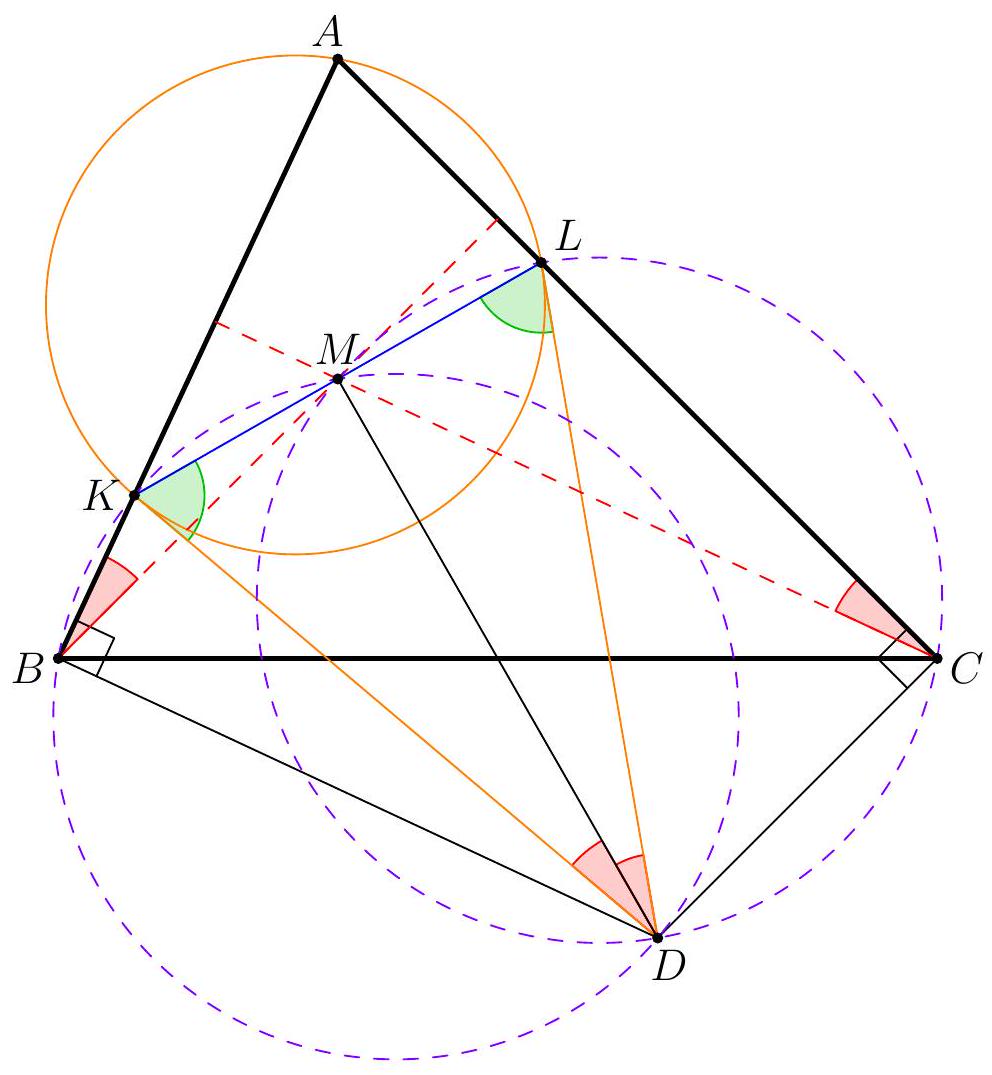\n\nFigure 1: Diagram to solution 1", "solution": "Let $M$ be the midpoint of $K L$. We will prove that $M$ is the orthocentre of $A B C$. Since $D K$ and $D L$ are tangent to the same circle, $|D K|=|D L|$ and hence $D M \\perp K L$. The theorem of Thales in circle $A B C$ also gives $D B \\perp B A$ and $D C \\perp C A$. The right angles then give that quadrilaterals $B D M K$ and $D M L C$ are cyclic.\n\nIf $\\angle B A C=\\alpha$, then clearly $\\angle D K M=\\angle M L D=\\alpha$ by angle in the alternate segment of circle $A K L$, and so $\\angle M D K=\\angle L D M=\\frac{\\pi}{2}-\\alpha$, which thanks to cyclic quadrilaterals gives $\\angle M B K=\\angle L C M=\\frac{\\pi}{2}-\\alpha$. From this, we have $B M \\perp A C$ and $C M \\perp A B$, and so $M$ indeed is the orthocentre of $A B C$.", "metadata": {"resource_path": "EGMO/segmented/en-2023-solutions.jsonl", "problem_match": "\nProblem 2.", "solution_match": "\nSolution 1. "}} |
| {"year": "2023", "tier": "T2", "problem_label": "2", "problem_type": null, "exam": "EGMO", "problem": "We are given an acute triangle $A B C$. Let $D$ be the point on its circumcircle such that $A D$ is a diameter. Suppose that points $K$ and $L$ lie on segments $A B$ and $A C$, respectively, and that $D K$ and $D L$ are tangent to circle $A K L$.\n\nShow that line $K L$ passes through the orthocentre of $A B C$.\nThe altitudes of a triangle meet at its orthocentre.\n\n\nFigure 1: Diagram to solution 1", "solution": "Preliminaries\n\nLet $A B C$ be a triangle with circumcircle $\\Gamma$. Let $X$ be a point in the plane. The Simson line (Wallace-Simson line) is defined via the following theorem. Drop perpendiculars from $X$ to each of the three side lines of $A B C$. The feet of these perpendiculars are collinear (on\nthe Simson line of $X$ ) if and only if $X$ lies of $\\Gamma$. The Simson line of $X$ in the circumcircle bisects the line segment $X H$ where $H$ is the orthocentre of triangle $A B C$. See Figure 2\n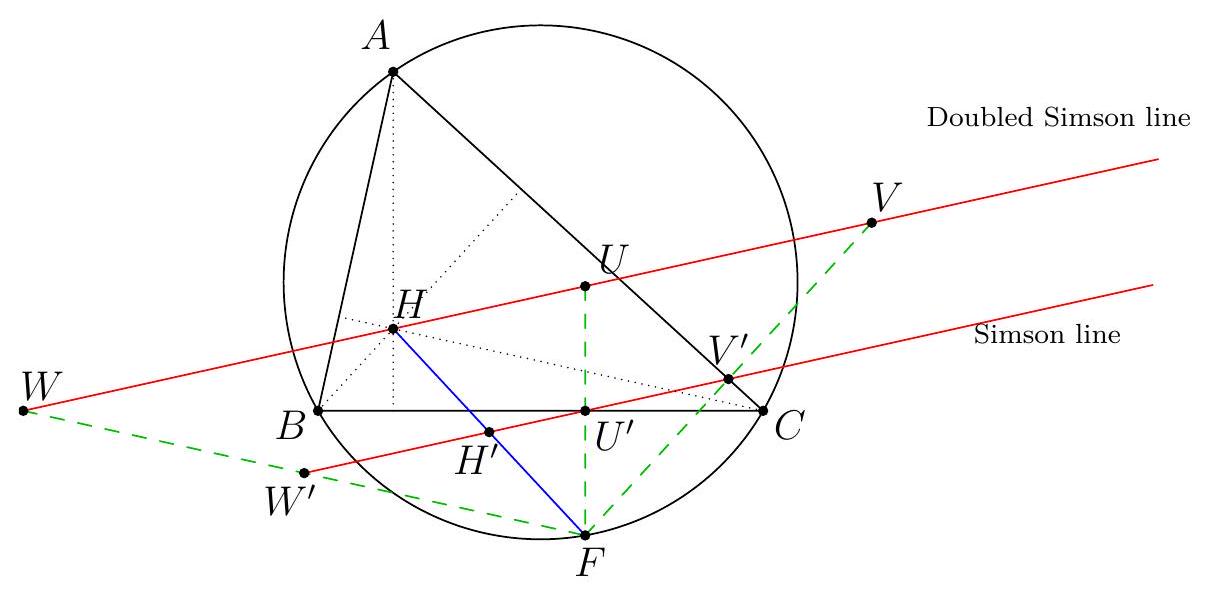\n\nFigure 2: The Wallace-Simson configuration\nWhen $X$ is on $\\Gamma$, we can enlarge from $X$ with scale factor 2 (a homothety) to take the Simson line to the doubled Simson line which passes through the orthocentre $H$ and contains the reflections of $X$ in each of the three sides of $A B C$.", "metadata": {"resource_path": "EGMO/segmented/en-2023-solutions.jsonl", "problem_match": "\nProblem 2.", "solution_match": "# Solution 2. "}} |
| {"year": "2023", "tier": "T2", "problem_label": "2", "problem_type": null, "exam": "EGMO", "problem": "We are given an acute triangle $A B C$. Let $D$ be the point on its circumcircle such that $A D$ is a diameter. Suppose that points $K$ and $L$ lie on segments $A B$ and $A C$, respectively, and that $D K$ and $D L$ are tangent to circle $A K L$.\n\nShow that line $K L$ passes through the orthocentre of $A B C$.\nThe altitudes of a triangle meet at its orthocentre.\n\n\nFigure 1: Diagram to solution 1", "solution": "of the problem\n\n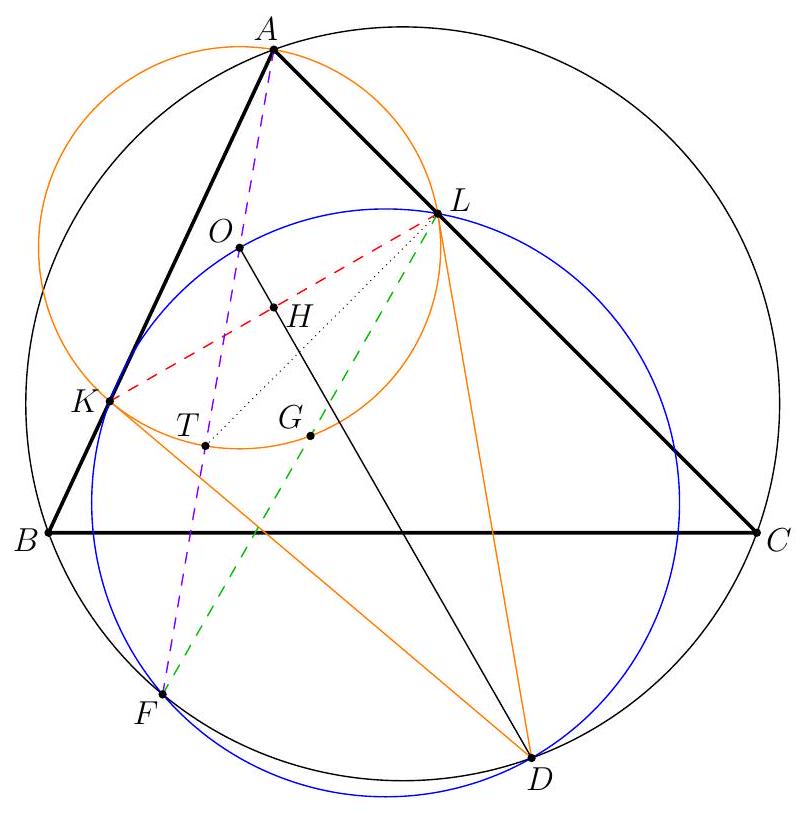\n\nFigure 3: Three circles do the work\nLet $\\Gamma$ be the circle $A B C, \\Sigma$ be the circle $A K L$ with centre $O$, and $\\Omega$ be the circle on diameter $O D$ so $K$ and $L$ are on this circle by converse of Thales. Let $\\Omega$ and $\\Gamma$ meet at $D$ and $F$. By Thales in both circles, $\\angle A F D$ and $\\angle O F D$ are both right angles so $A O F$ is a line. Let $A F$ meet $\\Sigma$ again at $T$ so $A T$ (containing $O$ ) is a diameter of this circle and by Thales, $T L \\perp A C$.\nLet $G$ (on $\\Sigma$ ) be the reflection of $K$ in $A F$. Now $A T$ is the internal angle bisector of $\\angle G A K$ so, by an upmarket use of angles in the same segment (of $\\Sigma$ ), $T L$ is the internal\nangle bisector of $\\angle G L K$. Thus the line $G L$ is the reflection of the line $K L$ in $T L$, and so also the reflection of $K L$ in the line $A C$ (internal and external angle bisectors).\n\nOur next project is to show that $L G F$ are collinear. Well $\\angle F L K=\\angle F O K$ (angles in the same segment of $\\Omega$ ) and $\\angle G L K=\\angle G A K$ (angles in the same segment of $\\Sigma$ ) $=2 \\angle O A K$ ( $A K G$ is isosceles with apex $A)=\\angle T O K$ (since $O A K$ is isosceles with apex $O$, and this is an external angle at $O$ ). The point $T$ lies in the interior of the line segment $F O$ so $\\angle T O K=\\angle F O K$. Therefore $\\angle F L K=\\angle G L K$ so $L G F$ is a line.\n\nNow from the second paragraph, $F$ is on the reflection of $K L$ in $A C$. By symmetry, $F$ is also on the reflection of $K L$ in $A B$. Therefore the reflections of $F$ in $A B$ and $A C$ are both on $K L$ which must therefore be the doubled Wallace-Simson line of $F$. Therefore the orthocentre of $A B C$ lies on $K L$.", "metadata": {"resource_path": "EGMO/segmented/en-2023-solutions.jsonl", "problem_match": "\nProblem 2.", "solution_match": "# Solution "}} |
| {"year": "2023", "tier": "T2", "problem_label": "2", "problem_type": null, "exam": "EGMO", "problem": "We are given an acute triangle $A B C$. Let $D$ be the point on its circumcircle such that $A D$ is a diameter. Suppose that points $K$ and $L$ lie on segments $A B$ and $A C$, respectively, and that $D K$ and $D L$ are tangent to circle $A K L$.\n\nShow that line $K L$ passes through the orthocentre of $A B C$.\nThe altitudes of a triangle meet at its orthocentre.\n\n\nFigure 1: Diagram to solution 1", "solution": "Let $H$ be the orthocentre of triangle $A B C$ and $\\Sigma$ the circumcircle of $A K L$ with centre $O$. Let $\\Omega$ be the circle with diameter $O D$, which contains $K$ and $L$ by Thales, and let $\\Gamma$ be the circumcircle of $A B C$ containing $D$. Denote the second intersection of $\\Omega$ and $\\Gamma$ by $F$. Since $O D$ and $A D$ are diameters of $\\Omega$ and $\\Gamma$ we have $\\angle O F D=\\frac{\\pi}{2}=\\angle A F D$, so the points $A, O, F$ are collinear. Let $M$ and $N$ be the second intersections of $C H$ and $B H$ with $\\Gamma$, respectively. It is well-known that $M$ and $N$ are the reflections of $H$ in $A B$ and $A C$, respectively (because $\\angle N C A=\\angle N B A=\\angle A C M=\\angle A B M$ ). By collinearity of $A, O, F$ and the angles in $\\Gamma$ we have\n\n$$\n\\angle N F O=\\angle N F A=\\angle N B A=\\frac{\\pi}{2}-\\angle B A C=\\frac{\\pi}{2}-\\angle K A L\n$$\n\nSince $D L$ is tangent to $\\Sigma$ we obtain\n\n$$\n\\angle N F O=\\frac{\\pi}{2}-\\angle K L D=\\angle L D O,\n$$\n\nwhere the last equality follows from the fact that $O D$ is bisector of $\\angle L D K$ since $L D$\n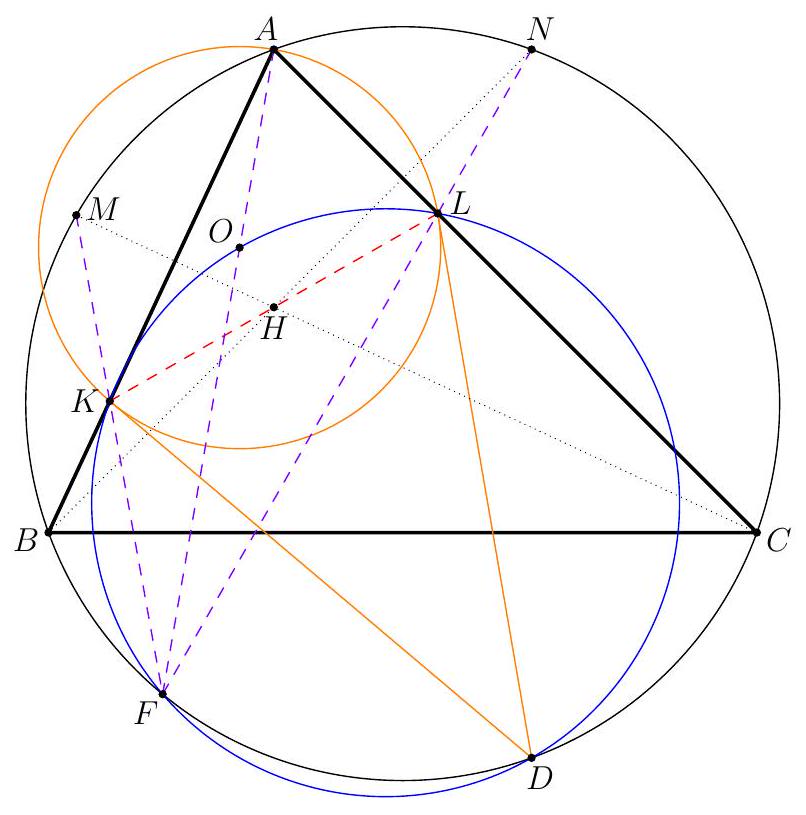\n\nFigure 4: Diagram to Solution 3\nand $K D$ are tangent to $\\Sigma$. Furthermore, $\\angle L D O=\\angle L F O$ since these are angles in $\\Omega$. Hence, $\\angle N F O=\\angle L F O$, which implies that points $N, L, F$ are collinear. Similarly points $M, K, F$ are collinear. Since $N$ and $M$ are reflections of $H$ in $A C$ and $A B$ we have\n\n$$\n\\angle L H N=\\angle H N L=\\angle B N F=\\angle B M F=\\angle B M K=\\angle K H B .\n$$\n\nHence,\n\n$$\n\\angle L H K=\\angle L H N+\\angle N H K=\\angle K H B+\\angle N H K=\\pi\n$$\n\nand the points $L, H, K$ are collinear.", "metadata": {"resource_path": "EGMO/segmented/en-2023-solutions.jsonl", "problem_match": "\nProblem 2.", "solution_match": "\nSolution 3. "}} |
| {"year": "2023", "tier": "T2", "problem_label": "2", "problem_type": null, "exam": "EGMO", "problem": "We are given an acute triangle $A B C$. Let $D$ be the point on its circumcircle such that $A D$ is a diameter. Suppose that points $K$ and $L$ lie on segments $A B$ and $A C$, respectively, and that $D K$ and $D L$ are tangent to circle $A K L$.\n\nShow that line $K L$ passes through the orthocentre of $A B C$.\nThe altitudes of a triangle meet at its orthocentre.\n\n\nFigure 1: Diagram to solution 1", "solution": "As in Solution 3 let $M$ and $N$ be the reflections of the orthocentre in $A B$ and $A C$. Let $\\angle B A C=\\alpha$. Then $\\angle N D M=\\pi-\\angle M A N=\\pi-2 \\alpha$.\n\nLet $M K$ and $N L$ intersect at $F$. See Figure 3.\nClaim. $\\angle N F M=\\pi-2 \\alpha$, so $F$ lies on the circumcircle.\nProof. Since $K D$ and $L D$ are tangents to circle $A K L$, we have $|D K|=|D L|$ and $\\angle D K L=\\angle K L D=\\alpha$, so $\\angle L D K=\\pi-2 \\alpha$.\nBy definition of $M, N$ and $D, \\angle M N D=\\angle A N D-\\angle A N M=\\frac{\\pi}{2}-\\left(\\frac{\\pi}{2}-\\alpha\\right)=\\alpha$ and analogously $\\angle D M N=\\alpha$. Hence $|D M|=|D N|$.\n\nFrom $\\angle N D M=\\angle L D K=\\pi-2 \\alpha$ if follows that $\\angle L D N=\\angle K D M$. Since $|D K|=|D L|$ and $|D M|=|D N|$, triangles $M D K$ and $N D L$ are related by a rotation about $D$ through angle $\\pi-2 \\alpha$, and hence the angle between $M K$ and $N L$ is $\\pi-2 \\alpha$, which proved the claim.\n\nWe now finish as in Solution 3:\n\n$$\n\\begin{gathered}\n\\angle M H K=\\angle K M H=\\angle F M C=\\angle F A C \\\\\n\\angle L H N=\\angle H N L=\\angle B N F=\\angle B A F\n\\end{gathered}\n$$\n\nAs $\\angle B A F+\\angle F A C=\\alpha$, we have $\\angle L H K=\\alpha+\\angle N H M=\\alpha+\\pi-\\alpha=\\pi$, so $H$ lies on $K L$.", "metadata": {"resource_path": "EGMO/segmented/en-2023-solutions.jsonl", "problem_match": "\nProblem 2.", "solution_match": "\nSolution 4. "}} |
| {"year": "2023", "tier": "T2", "problem_label": "2", "problem_type": null, "exam": "EGMO", "problem": "We are given an acute triangle $A B C$. Let $D$ be the point on its circumcircle such that $A D$ is a diameter. Suppose that points $K$ and $L$ lie on segments $A B$ and $A C$, respectively, and that $D K$ and $D L$ are tangent to circle $A K L$.\n\nShow that line $K L$ passes through the orthocentre of $A B C$.\nThe altitudes of a triangle meet at its orthocentre.\n\n\nFigure 1: Diagram to solution 1", "solution": "Since $A D$ is a diameter, it is well known that $D B H C$ is a parallelogram (indeed, both $B D$ and $C H$ are perpendicular to $A B$, hence parallel, and similarly for $D C \\| B H)$. Let $B^{\\prime}, C^{\\prime}$ be the reflections of $D$ in lines $A K B$ and $A L C$, respectively; since $A B D$ and $A C D$ are right angles, these are also the factor-2 homotheties of $B$ and $C$ with respect to $D$, hence $H$ is the midpoint of $B^{\\prime} C^{\\prime}$. We will prove that $B^{\\prime} K C^{\\prime} L$ is a parallelogram: it will then follow that the midpoint of $B^{\\prime} C^{\\prime}$, which is $H$, is also the midpoint of $K L$, and in particular is on the line, as we wanted to show.\n\nWe will prove $B^{\\prime} K C^{\\prime} L$ is a parallelogram by showing that $B^{\\prime} K$ and $C^{\\prime} L$ are the same length and direction. Indeed, for lengths we have $K B^{\\prime}=K D=L D=L C^{\\prime}$, where the first and last equalities arise from the reflections defining $B^{\\prime}$ and $C^{\\prime}$, and the middle one\nis equality of tangents. For directions, let $\\alpha, \\beta, \\gamma$ denote the angles of triangle $A K L$. Immediate angle chasing in the circle $A K L$, and the properties of the reflections, yield\n\n$$\n\\begin{aligned}\n\\angle C^{\\prime} L C & =\\angle C L D=\\angle A K L=\\beta \\\\\n\\angle B K B^{\\prime} & =\\angle D K B=\\angle K L A=\\gamma \\\\\n& \\angle L D K=2 \\alpha-\\pi\n\\end{aligned}\n$$\n\nand therefore in directed angles $(\\bmod 2 \\pi)$ we have\n$\\angle\\left(C^{\\prime} L, B^{\\prime} K\\right)=\\angle C^{\\prime} L C+\\angle C L D+\\angle L D K+\\angle D K B+\\angle B K B^{\\prime}=2 \\alpha+2 \\beta+2 \\gamma-\\pi=\\pi$\nand hence $C^{\\prime} L$ and $B^{\\prime} K$ are parallel and in opposite directions, i.e. $C^{\\prime} L$ and $K B^{\\prime}$ are in the same direction, as claimed.\n\nComment. While not necessary for the final solution, the following related observation motivates how the fact that $H$ is the midpoint of $K L$ (and therefore $B^{\\prime} K C^{\\prime} L$ is a parallelogram) was first conjectured. We have $A B^{\\prime}=A D=A C^{\\prime}$ by the reflections, i.e. $B^{\\prime} A C^{\\prime}$ is an isosceles triangle with $H$ being the midpoint of the base. Thus $A H$ is the median, altitude and angle bisector in $B^{\\prime} A C^{\\prime}$, thus $\\angle B^{\\prime} A K+\\angle K A H=\\angle H A L+\\angle L A C^{\\prime}$. Since from the reflections we also have $\\angle B^{\\prime} A K=\\angle K A D$ and $\\angle D A L=\\angle L A C^{\\prime}$ it follows that $\\angle H A L=\\angle K A D$ and $\\angle K A H=\\angle D A L$. Since $D$ is the symmedian point in $A K L$, the angle conjugation implies $A H$ is the median line of $K L$. Thus, if $H$ is indeed on $K L$ (as the problem assures us), it can only be the midpoint of $K L$.", "metadata": {"resource_path": "EGMO/segmented/en-2023-solutions.jsonl", "problem_match": "\nProblem 2.", "solution_match": "\nSolution 5. "}} |
| {"year": "2023", "tier": "T2", "problem_label": "2", "problem_type": null, "exam": "EGMO", "problem": "We are given an acute triangle $A B C$. Let $D$ be the point on its circumcircle such that $A D$ is a diameter. Suppose that points $K$ and $L$ lie on segments $A B$ and $A C$, respectively, and that $D K$ and $D L$ are tangent to circle $A K L$.\n\nShow that line $K L$ passes through the orthocentre of $A B C$.\nThe altitudes of a triangle meet at its orthocentre.\n\n\nFigure 1: Diagram to solution 1", "solution": "There are a number of \"phantom point\" arguments which define $K^{\\prime}$ and $L^{\\prime}$ in terms of angles and then deduce that these points are actually $K$ and $L$.\n\nNote: In these solutions it is necessary to show that $K$ and $L$ are uniquely determined by the conditions of the problem. One example of doing this is the following:\nTo prove uniqueness of $K$ and $L$, let us consider that there exist two other points $K^{\\prime}$ and $L^{\\prime}$ that satisfy the same properties ( $K^{\\prime}$ on $A B$ and $L^{\\prime}$ on $A C$ such that $D K^{\\prime}$ and $D L^{\\prime}$ are tangent to the circle $\\left.A K^{\\prime} L^{\\prime}\\right)$.\nThen, we have that $D K=D L$ and $D K^{\\prime}=D L^{\\prime}$. We also have that $\\angle K D L=\\angle K^{\\prime} D L^{\\prime}=$ $\\pi-2 \\angle A$. Hence, we deduce $\\angle K D K^{\\prime}=\\angle K D L-\\angle K^{\\prime} D L=\\angle K^{\\prime} D L^{\\prime}-\\angle K^{\\prime} D L=\\angle L D L^{\\prime}$ Thus we have that $\\triangle K D K^{\\prime} \\equiv \\triangle L D L^{\\prime}$, so we deduce $\\angle D K A=\\angle D K K^{\\prime}=\\angle D L L^{\\prime}=$ $\\pi-\\angle A L D$. This implies that $A K D L$ is concyclic, which is clearly a contradiction since $\\angle K A L+\\angle K D L=\\pi-\\angle B A C$.", "metadata": {"resource_path": "EGMO/segmented/en-2023-solutions.jsonl", "problem_match": "\nProblem 2.", "solution_match": "\nSolution 6. "}} |
| {"year": "2023", "tier": "T2", "problem_label": "2", "problem_type": null, "exam": "EGMO", "problem": "We are given an acute triangle $A B C$. Let $D$ be the point on its circumcircle such that $A D$ is a diameter. Suppose that points $K$ and $L$ lie on segments $A B$ and $A C$, respectively, and that $D K$ and $D L$ are tangent to circle $A K L$.\n\nShow that line $K L$ passes through the orthocentre of $A B C$.\nThe altitudes of a triangle meet at its orthocentre.\n\n\nFigure 1: Diagram to solution 1", "solution": "We will use the usual complex number notation, where we will use a capital letter (like $Z$ ) to denote the point associated to a complex number (like z). Consider $\\triangle A K L$ on the unit circle. So, we have $a \\cdot \\bar{a}=k \\cdot \\bar{k}=l \\cdot \\bar{l}=1 \\quad$ As point $D$ is the intersection of the tangents to the unit circle at $K$ and $L$, we have that\n\n$$\nd=\\frac{2 k l}{k+l} \\text { and } \\bar{d}=\\frac{2}{k+l}\n$$\n\nDefining $B$ as the foot of the perpendicular from $D$ on the line $A K$, and $C$ as the foot of the perpendicular from $D$ on the line $A L$, we have the formulas:\n\n$$\nb=\\frac{1}{2}\\left(d+\\frac{(a-k) \\bar{d}+\\bar{a} k-a \\bar{k}}{\\bar{a}-\\bar{k}}\\right)\n$$\n\n$$\nc=\\frac{1}{2}\\left(d+\\frac{(a-l) \\bar{d}+\\bar{a} l-a \\bar{l}}{\\bar{a}-\\bar{l}}\\right)\n$$\n\nSimplyfing these formulas, we get:\n\n$$\n\\begin{gathered}\nb=\\frac{1}{2}\\left(d+\\frac{(a-k) \\frac{2}{k+l}+\\frac{k}{a}-\\frac{a}{k}}{\\frac{1}{a}-\\frac{1}{k}}\\right)=\\frac{1}{2}\\left(d+\\frac{\\frac{2(a-k)}{k+l}+\\frac{k^{2}-a^{2}}{a k}}{\\frac{k-a}{a k}}\\right) \\\\\nb=\\frac{1}{2}\\left(\\frac{2 k l}{k+l}-\\frac{2 a k}{k+l}+(a+k)\\right)=\\frac{k(l-a)}{k+l}+\\frac{1}{2}(k+a) \\\\\nc=\\frac{1}{2}\\left(d+\\frac{(a-l) \\frac{2}{k+l}+\\frac{l}{a}-\\frac{a}{l}}{\\frac{1}{a}-\\frac{1}{l}}\\right)=\\frac{1}{2}\\left(d+\\frac{\\frac{2(a-l)}{k+l}+\\frac{l^{2}-a^{2}}{a l}}{\\frac{l-a}{a l}}\\right) \\\\\nc=\\frac{1}{2}\\left(\\frac{2 k l}{k+l}-\\frac{2 a l}{k+l}+(a+l)\\right)=\\frac{l(k-a)}{k+l}+\\frac{1}{2}(l+a)\n\\end{gathered}\n$$\n\nLet $O$ be the the circumcenter of triangle $\\triangle A B C$. As $A D$ is the diameter of this circle, we have that:\n\n$$\no=\\frac{a+d}{2}\n$$\n\nDefining $H$ as the orthocentre of the $\\triangle A B C$, we get that:\n\n$$\n\\begin{gathered}\nh=a+b+c-2 \\cdot o=a+\\left(\\frac{k(l-a)}{k+l}+\\frac{1}{2}(k+a)\\right)+\\left(\\frac{l(k-a)}{k+l}+\\frac{1}{2}(l+a)\\right)-(a+d) \\\\\nh=a+\\frac{2 k l}{k+l}-\\frac{a(k+l)}{k+l}+\\frac{1}{2} k++\\frac{1}{2} l++a-\\left(a+\\frac{2 k l}{k+l}\\right) \\\\\nh=\\frac{1}{2}(k+l)\n\\end{gathered}\n$$\n\nHence, we conclude that $H$ is the midpoint of $K L$, so $H, K, L$ are collinear.", "metadata": {"resource_path": "EGMO/segmented/en-2023-solutions.jsonl", "problem_match": "\nProblem 2.", "solution_match": "\nSolution 7. "}} |
| {"year": "2023", "tier": "T2", "problem_label": "2", "problem_type": null, "exam": "EGMO", "problem": "We are given an acute triangle $A B C$. Let $D$ be the point on its circumcircle such that $A D$ is a diameter. Suppose that points $K$ and $L$ lie on segments $A B$ and $A C$, respectively, and that $D K$ and $D L$ are tangent to circle $A K L$.\n\nShow that line $K L$ passes through the orthocentre of $A B C$.\nThe altitudes of a triangle meet at its orthocentre.\n\n\nFigure 1: Diagram to solution 1", "solution": "Let us employ the barycentric coordinates. Set $A(1,0,0), K(0,1,0), L(0,0,1)$.\nThe tangent at $K$ of $(A K L)$ is $a^{2} z+c^{2} x=0$, and the tangent of of $L$ at $(A K L)$ is $a^{2} y+b^{2} x=0$. Their intersection is\n\n$$\nD\\left(-a^{2}: b^{2}: c^{2}\\right)\n$$\n\nSince $B \\in A K$, we can let $B(1-t, t, 0)$. Solving for $\\overrightarrow{A B} \\cdot \\overrightarrow{B D}=0$ gives\n\n$$\nt=\\frac{3 b^{2}+c^{2}-a^{2}}{2\\left(b^{2}+c^{2}-a^{2}\\right)} \\Longrightarrow B=\\left(\\frac{-a^{2}-b^{2}+c^{2}}{2\\left(b^{2}+c^{2}-a^{2}\\right)}, \\frac{-a^{2}+3 b^{2}+c^{2}}{2\\left(b^{2}+c^{2}-a^{2}\\right)}, 0\\right)\n$$\n\nLikewise, $C$ has the coordinate\n\n$$\nC=\\left(\\frac{-a^{2}+b^{2}-c^{2}}{2\\left(b^{2}+c^{2}-a^{2}\\right)}, 0, \\frac{-a^{2}+b^{2}+3 c^{2}}{2\\left(b^{2}+c^{2}-a^{2}\\right)}\\right) .\n$$\n\nThe altitude from $B$ for triangle $A B C$ is\n\n$$\n-b^{2}\\left(x-z-\\frac{-a^{2}-b^{2}+c^{2}}{2\\left(b^{2}+c^{2}-a^{2}\\right)}\\right)+\\left(c^{2}-a^{2}\\right)\\left(y-\\frac{-a^{2}+3 b^{2}+c^{2}}{2\\left(b^{2}+c^{2}-a^{2}\\right)}\\right)=0\n$$\n\nAlso the altitude from $C$ for triangle $A B C$ is\n\n$$\n-c^{2}\\left(x-y-\\frac{-a^{2}+b^{2}-c^{2}}{2\\left(b^{2}+c^{2}-a^{2}\\right)}\\right)+\\left(a^{2}-b^{2}\\right)\\left(z-\\frac{-a^{2}+b^{2}+3 c^{2}}{2\\left(b^{2}+c^{2}-a^{2}\\right)}\\right)=0\n$$\n\nThe intersection of these two altitudes, which is the orthocenter of triangle $A B C$, has the barycentric coordinate\n\n$$\nH=(0,1 / 2,1 / 2)\n$$\n\nwhich is the midpoint of the segment $K L$.", "metadata": {"resource_path": "EGMO/segmented/en-2023-solutions.jsonl", "problem_match": "\nProblem 2.", "solution_match": "\nSolution 8. "}} |
| {"year": "2023", "tier": "T2", "problem_label": "3", "problem_type": null, "exam": "EGMO", "problem": "Let $k$ be a positive integer. Lexi has a dictionary $\\mathcal{D}$ consisting of some $k$-letter strings containing only the letters $A$ and $B$. Lexi would like to write either the letter $A$ or the letter $B$ in each cell of a $k \\times k$ grid so that each column contains a string from $\\mathcal{D}$ when read from top-to-bottom and each row contains a string from $\\mathcal{D}$ when read from left-to-right.\n\nWhat is the smallest integer $m$ such that if $\\mathcal{D}$ contains at least $m$ different strings, then Lexi can fill her grid in this manner, no matter what strings are in $\\mathcal{D}$ ?", "solution": "We claim the minimum value of $m$ is $2^{k-1}$.\nFirstly, we provide a set $\\mathcal{S}$ of size $2^{k-1}-1$ for which Lexi cannot fill her grid. Consider the set of all length- $k$ strings containing only $A$ s and $B$ shich end with a $B$, and remove the string consisting of $k B$ s. Clearly there are 2 independent choices for each of the first $k-1$ letters and 1 for the last letter, and since exactly one string is excluded, there must be exactly $2^{k-1}-1$ strings in this set.\n\nSuppose Lexi tries to fill her grid. For each row to have a valid string, it must end in a $B$. But then the right column would necessarily contain $k B \\mathrm{~s}$, and not be in our set. Thus, Lexi cannot fill her grid with our set, and we must have $m \\geqslant 2^{k-1}$.\nNow, consider any set $\\mathcal{S}$ with at least $2^{k-1}$ strings. Clearly, if $\\mathcal{S}$ contained either the uniform string with $k A$ s or the string with $k B \\mathrm{~s}$, then Lexi could fill her grid with all of the relevant letters and each row and column would contain that string.\nConsider the case where $\\mathcal{S}$ contains neither of those strings. Among all $2^{k}$ possible length$k$ strings with $A \\mathrm{~s}$ and $B \\mathrm{~s}$, each has a complement which corresponds to the string with $B$ s in every position where first string had $A$ s and vice-versa. Clearly, the string with all $A$ s is paired with the string with all $B$ s. We may assume that we do not take the two uniform strings and thus applying the pigeonhole principle to the remaining set of strings, we must have two strings which are complementary.\nLet this pair of strings be $\\ell, \\ell^{\\prime} \\in \\mathcal{S}$ in some order. Define the set of indices $\\mathcal{J}$ corresponding to the $A$ s in $\\ell$ and thus the $B \\mathrm{~s}$ in $\\ell^{\\prime}$, and all other indices (not in $\\mathcal{J}$ ) correspond to $B \\mathrm{~s}$ in $\\ell$ (and thus $A$ s in $\\ell^{\\prime}$ ). Then, we claim that Lexi puts an $A$ in the cell in row $r$, column $c$ if $r, c \\in \\mathcal{J}$ or $r, c \\notin \\mathcal{J}$, and a $B$ otherwise, each row and column contains a string in $\\mathcal{S}$.\nWe illustrate this with a simple example: If $k=6$ and we have that $A A A B A B$ and $B B B A B A$ are both in the dictionary, then Lexi could fill the table as follows:\n\n| A | A | A | B | A | B |\n| :---: | :---: | :---: | :---: | :---: | :---: |\n| A | A | A | B | A | B |\n| A | A | A | B | A | B |\n| B | B | B | A | B | A |\n| A | A | A | B | A | B |\n| B | B | B | A | B | A |\n\nSuppose we are looking at row $i$ or column $i$ for $i \\in \\mathcal{J}$. Then by construction the string in this row/column contains $A$ s at indices $k$ with $k \\in \\mathcal{J}$ and $B$ s elsewhere, and thus is precisely $\\ell$. Suppose instead we are looking at row $i$ or column $i$ for $i \\notin \\mathcal{J}$. Then again\nby construction the string in this row/column contains $A$ s at indices $k$ with $k \\notin \\mathcal{J}$ and $B$ s elsewhere, and thus is precisely $\\ell^{\\prime}$. So each row and column indeed contains a string in $\\mathcal{S}$.\n\nThus, for any $\\mathcal{S}$ with $|\\mathcal{S}| \\geqslant 2^{k-1}$, Lexi can definitely fill the grid appropriately. Since we know $m \\geqslant 2^{k-1}$, $2^{k-1}$ is the minimum possible value of $m$ as claimed.", "metadata": {"resource_path": "EGMO/segmented/en-2023-solutions.jsonl", "problem_match": "\nProblem 3.", "solution_match": "\nSolution."}} |
| {"year": "2023", "tier": "T2", "problem_label": "4", "problem_type": null, "exam": "EGMO", "problem": "Turbo the snail sits on a point on a circle with circumference 1. Given an infinite sequence of positive real numbers $c_{1}, c_{2}, c_{3}, \\ldots$, Turbo successively crawls distances $c_{1}, c_{2}, c_{3}, \\ldots$ around the circle, each time choosing to crawl either clockwise or counterclockwise.\nFor example, if the sequence $c_{1}, c_{2}, c_{3}, \\ldots$ is $0.4,0.6,0.3, \\ldots$, then Turbo may start crawling as follows:\n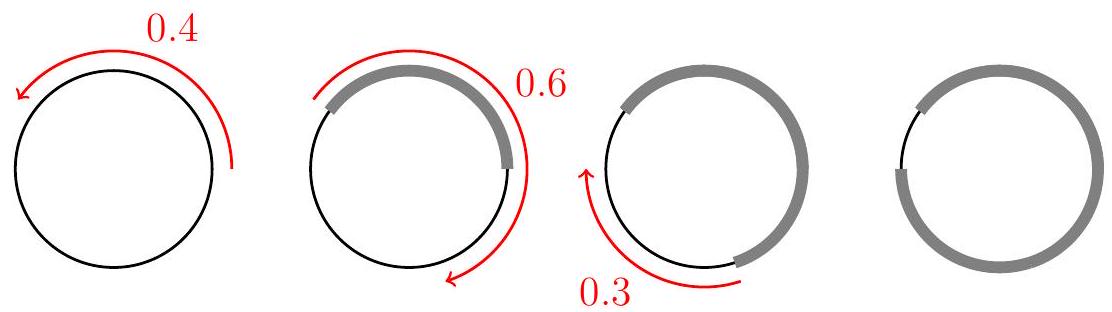\n\nDetermine the largest constant $C>0$ with the following property: for every sequence of positive real numbers $c_{1}, c_{2}, c_{3}, \\ldots$ with $c_{i}<C$ for all $i$, Turbo can (after studying the sequence) ensure that there is some point on the circle that it will never visit or crawl across.", "solution": "The largest possible $C$ is $C=\\frac{1}{2}$.\nFor $0<C \\leqslant \\frac{1}{2}$, Turbo can simply choose an arbitrary point $P$ (different from its starting point) to avoid. When Turbo is at an arbitrary point $A$ different from $P$, the two arcs $A P$ have total length 1 ; therefore, the larger of the two the arcs (or either arc in case $A$ is diametrically opposite to $P$ ) must have length $\\geqslant \\frac{1}{2}$. By always choosing this larger arc (or either arc in case $A$ is diametrically opposite to $P$ ), Turbo will manage to avoid the point $P$ forever.\nFor $C>\\frac{1}{2}$, we write $C=\\frac{1}{2}+a$ with $a>0$, and we choose the sequence\n\n$$\n\\frac{1}{2}, \\quad \\frac{1+a}{2}, \\quad \\frac{1}{2}, \\quad \\frac{1+a}{2}, \\quad \\frac{1}{2}, \\quad \\ldots\n$$\n\nIn other words, $c_{i}=\\frac{1}{2}$ if $i$ is odd and $c_{i}=\\frac{1+a}{2}<C$ when $i$ is even. We claim Turbo must eventually visit all points on the circle. This is clear when it crawls in the same direction two times in a row; after all, we have $c_{i}+c_{i+1}>1$ for all $i$. Therefore, we are left with the case that Turbo alternates crawling clockwise and crawling counterclockwise. If it, without loss of generality, starts by going clockwise, then it will always crawl a distance $\\frac{1}{2}$ clockwise followed by a distance $\\frac{1+a}{2}$ counterclockwise. The net effect is that it crawls a distance $\\frac{a}{2}$ counterclockwise. Because $\\frac{a}{2}$ is positive, there exists a positive integer $N$ such that $\\frac{a}{2} \\cdot N>1$. After $2 N$ crawls, Turbo will have crawled a distance $\\frac{a}{2}$ counterclockwise $N$ times, therefore having covered a total distance of $\\frac{a}{2} \\cdot N>1$, meaning that it must have crawled over all points on the circle.\n\nNote: Every sequence of the form $c_{i}=x$ if $i$ is odd, and $c_{i}=y$ if $i$ is even, where $0<x, y<C$, such that $x+y \\geqslant 1$, and $x \\neq y$ satisfies the conditions with the same argument. There might be even more possible examples.", "metadata": {"resource_path": "EGMO/segmented/en-2023-solutions.jsonl", "problem_match": "\nProblem 4.", "solution_match": "\nSolution 1. "}} |
| {"year": "2023", "tier": "T2", "problem_label": "4", "problem_type": null, "exam": "EGMO", "problem": "Turbo the snail sits on a point on a circle with circumference 1. Given an infinite sequence of positive real numbers $c_{1}, c_{2}, c_{3}, \\ldots$, Turbo successively crawls distances $c_{1}, c_{2}, c_{3}, \\ldots$ around the circle, each time choosing to crawl either clockwise or counterclockwise.\nFor example, if the sequence $c_{1}, c_{2}, c_{3}, \\ldots$ is $0.4,0.6,0.3, \\ldots$, then Turbo may start crawling as follows:\n\n\nDetermine the largest constant $C>0$ with the following property: for every sequence of positive real numbers $c_{1}, c_{2}, c_{3}, \\ldots$ with $c_{i}<C$ for all $i$, Turbo can (after studying the sequence) ensure that there is some point on the circle that it will never visit or crawl across.", "solution": "Alternative solution (to show that $C \\leqslant \\frac{1}{2}$ )\nWe consider the following related problem:\nWe assume instead that the snail Chet is moving left and right on the real line. Find the size $M$ of the smallest (closed) interval, that we cannot force Chet out of, using a sequence of real numbers $d_{i}$ with $0<d_{i}<1$ for all $i$.\n\nThen $C=1 / M$. Indeed if for every sequence $c_{1}, c_{2}, \\ldots$, with $c_{i}<C$ there exists a point that Turbo can avoid, then the circle can be cut open at the avoided point and mapped to an interval of size $M$ such that Chet can stay inside this interval for any sequence of the from $c_{1} / C, c_{2} / C, \\ldots$, see Figure 5 . However, all sequences $d_{1}, d_{2}, \\ldots$ with $d_{i}<1$ can be written in this form. Similarly if for every sequence $d_{1}, d_{2}, \\ldots$, there exists an interval of length smaller or equal $M$ that we cannot force Chet out of, this projects to a subset of the circle, that we cannot force Turbo out of using any sequence of the form $d_{1} / M, d_{2} / M, \\ldots$. These are again exactly all the sequences with elements in $[0, C)$.\n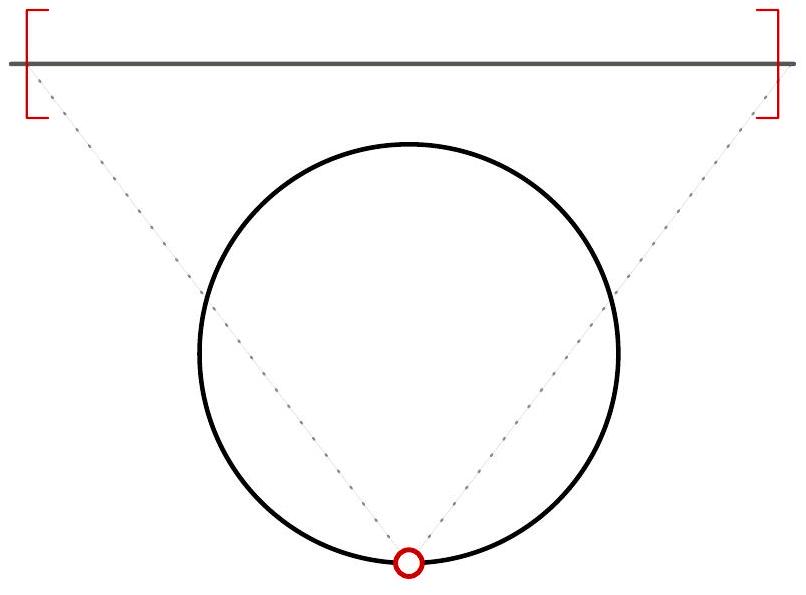\n\nFigure 5: Chet and Turbo equivalence\nClaim: $M \\geqslant 2$.\nProof. Suppose not, so $M<2$. Say $M=2-2 \\varepsilon$ for some $\\varepsilon>0$ and let $[-1+\\varepsilon, 1-\\varepsilon]$ be a minimal interval, that Chet cannot be forced out of. Then we can force Chet arbitrarily close to $\\pm(1-\\varepsilon)$. In partiular, we can force Chet out of $\\left[-1+\\frac{4}{3} \\varepsilon, 1-\\frac{4}{3} \\varepsilon\\right]$ by minimality of $M$. This means that there exists a sequence $d_{1}, d_{2}, \\ldots$ for which Chet has to leave $\\left[-1+\\frac{4}{3} \\varepsilon, 1-\\frac{4}{3} \\varepsilon\\right]$, which means he ends up either in the interval $\\left[-1+\\varepsilon,-1+\\frac{4}{3} \\varepsilon\\right)$ or in the interval $\\left(1-\\frac{4}{3} \\varepsilon, 1-\\varepsilon\\right]$.\n\nNow consider the sequence,\n\n$$\nd_{1}, \\quad 1-\\frac{7}{6} \\varepsilon, \\quad 1-\\frac{2}{3} \\varepsilon, \\quad 1-\\frac{2}{3} \\varepsilon, 1-\\frac{7}{6} \\varepsilon, \\quad d_{2}, 1-\\frac{7}{6} \\varepsilon, 1-\\frac{2}{3} \\varepsilon, 1-\\frac{2}{3} \\varepsilon, 1-\\frac{7}{6} \\varepsilon, d_{3}, \\ldots\n$$\n\nobtained by adding the sequence $1-\\frac{7}{6} \\varepsilon, \\quad 1-\\frac{2}{3} \\varepsilon, \\quad 1-\\frac{2}{3} \\varepsilon, \\quad 1-\\frac{7}{6} \\varepsilon$ in between every two steps. We claim that this sequence forces Chet to leave the larger interval $[-1+\\varepsilon, 1-\\varepsilon]$. Indeed no two consecutive elements in the sequence $1-\\frac{7}{6} \\varepsilon, \\quad 1-\\frac{2}{3} \\varepsilon, \\quad 1-\\frac{2}{3} \\varepsilon, \\quad 1-\\frac{7}{6} \\varepsilon$ can\nhave the same sign, because the sum of any two consecutive terms is larger than $2-2 \\varepsilon$ and Chet would leave the interval $[-1+\\varepsilon, 1-\\varepsilon]$. It follows that the $\\left(1-\\frac{7}{6} \\varepsilon\\right.$ )'s and the ( $1-\\frac{2}{3} \\varepsilon$ )'s cancel out, so the position after $d_{k}$ is the same as before $d_{k+1}$. Hence, the positions after each $d_{k}$ remain the same as in the original sequence. Thus, Chet is also forced to the boundary in the new sequence.\nIf Chet is outside the interval $\\left[-1+\\frac{4}{3} \\varepsilon, 1-\\frac{4}{3} \\varepsilon\\right]$, then Chet has to move $1-\\frac{7}{6} \\varepsilon$ towards 0 , and ends in $\\left[-\\frac{1}{6} \\varepsilon, \\frac{1}{6} \\varepsilon\\right]$. Chet then has to move by $1-\\frac{2}{3} \\varepsilon$, which means that he has to leave the interval $[-1+\\varepsilon, 1-\\varepsilon]$. Indeed the absolute value of the final position is at least $1-\\frac{5}{6} \\varepsilon$. This contradicts the assumption, that we cannot force Chet out of $[-1+\\varepsilon, 1-\\varepsilon]$. Hence $M \\geqslant 2$ as needed.", "metadata": {"resource_path": "EGMO/segmented/en-2023-solutions.jsonl", "problem_match": "\nProblem 4.", "solution_match": "\nSolution 2. "}} |
| {"year": "2023", "tier": "T2", "problem_label": "5", "problem_type": null, "exam": "EGMO", "problem": "We are given a positive integer $s \\geqslant 2$. For each positive integer $k$, we define its twist $k^{\\prime}$ as follows: write $k$ as $a s+b$, where $a, b$ are non-negative integers and $b<s$, then $k^{\\prime}=b s+a$. For the positive integer $n$, consider the infinite sequence $d_{1}, d_{2}, \\ldots$ where $d_{1}=n$ and $d_{i+1}$ is the twist of $d_{i}$ for each positive integer $i$.\n\nProve that this sequence contains 1 if and only if the remainder when $n$ is divided by $s^{2}-1$ is either 1 or $s$.", "solution": "First, we consider the difference $k-k^{\\prime \\prime}$. If $k=a s+b$ as in the problem statement, then $k^{\\prime}=b s+a$. We write $a=l s+m$ with $m, l$ non-negative numbers and $m \\leq s-1$. This gives $k^{\\prime \\prime}=m s+(b+l)$ and hence $k-k^{\\prime \\prime}=(a-m) s-l=l\\left(s^{2}-1\\right)$.\n\nWe conclude\nFact 1.1. $k \\geq k^{\\prime \\prime}$ for every every $k \\geq 1$\nFact 1.2. $s^{2}-1$ divides the difference $k-k^{\\prime \\prime}$.\nFact 1.2 implies that the sequences $d_{1}, d_{3}, d_{5}, \\ldots$ and $d_{2}, d_{4}, d_{6}, \\ldots$ are constant modulo $s^{2}-1$. Moreover, Fact 1.1 says that the sequences are (weakly) decreasing and hence eventually constant. In other words, the sequence $d_{1}, d_{2}, d_{3}, \\ldots$ is 2 -periodic modulo $s^{2}-1$ (from the start) and is eventually 2-periodic.\n\nNow, assume that some term in the sequence is equal to 1 . The next term is equal to $1^{\\prime}=s$ and since the sequence is 2 -periodic from the start modulo $s^{2}-1$, we conclude that $d_{1}$ is either equal to 1 or $s$ modulo $s^{2}-1$. This proves the first implication.\n\nTo prove the other direction, assume that $d_{1}$ is congruent to 1 or $s$ modulo $s^{2}-1$. We need the observation that once one of the sequences $d_{1}, d_{3}, d_{5}, \\ldots$ or $d_{2}, d_{4}, d_{6}, \\ldots$ stabilises, then their value is less than $s^{2}$. This is implied by the following fact.\n\nFact 1.3. If $k=k^{\\prime \\prime}$, then $k=k^{\\prime \\prime}<s^{2}$.\nProof. We use the expression for $k-k^{\\prime \\prime}$ found before. If $k=k^{\\prime \\prime}$, then $l=0$, and so $k^{\\prime \\prime}=m s+b$. Both $m$ and $b$ are reminders after division by $s$, so they are both $\\leq s-1$. This gives $k^{\\prime \\prime} \\leq(s-1) s+(s-1)<s^{2}$.\n\nUsing Fact 1.2, it follows that the sequence $d_{1}, d_{3}, d_{5}, \\ldots$ is constant to 1 or $s$ modulo $s^{2}-1$ and stabilises to 1 or $s$ by Fact 1.3. Since $s^{\\prime}=1$, we conclude that the sequence contains a 1.", "metadata": {"resource_path": "EGMO/segmented/en-2023-solutions.jsonl", "problem_match": "\nProblem 5.", "solution_match": "\nSolution 1. "}} |
| {"year": "2023", "tier": "T2", "problem_label": "5", "problem_type": null, "exam": "EGMO", "problem": "We are given a positive integer $s \\geqslant 2$. For each positive integer $k$, we define its twist $k^{\\prime}$ as follows: write $k$ as $a s+b$, where $a, b$ are non-negative integers and $b<s$, then $k^{\\prime}=b s+a$. For the positive integer $n$, consider the infinite sequence $d_{1}, d_{2}, \\ldots$ where $d_{1}=n$ and $d_{i+1}$ is the twist of $d_{i}$ for each positive integer $i$.\n\nProve that this sequence contains 1 if and only if the remainder when $n$ is divided by $s^{2}-1$ is either 1 or $s$.", "solution": "We make a number of initial observations. Let $k$ be a positive integer.\nFact 2.1. If $k \\geq s^{2}$, then $k^{\\prime}<k$.\nProof. Write $k=a s+b$, as in the problem statement. If $k \\geq s^{2}$, then $a \\geq s$ because $b<s$. So, $k^{\\prime}=b s+a \\leq(s-1) s+a \\leq a s \\leq a s+b=k$. Moreover, we cannot have equality since that would imply $s-1=b=0$.\n\nFact 2.2. If $k \\leq s^{2}-1$, then $k^{\\prime} \\leq s^{2}-1$ and $k^{\\prime \\prime}=k$.\n\nProof. Write $k=a s+b$, as in the problem statement. If $k<s^{2}$, then it must hold $1 \\leq a, b<s$, hence $k^{\\prime}=b s+a<s^{2}$ and $k^{\\prime \\prime}=(b s+a)^{\\prime}=a s+b=k$.\n\nFact 2.3. We have $k^{\\prime} \\equiv s k\\left(\\bmod s^{2}-1\\right)\\left(\\right.$ or equivalently $\\left.k \\equiv s k^{\\prime}\\left(\\bmod s^{2}-1\\right)\\right)$.\nProof. We write $k=a s+b$, as in the problem statement. Now,\n\n$$\ns k-k^{\\prime}=s(a s+b)-(b s+a)=a\\left(s^{2}-1\\right) \\equiv 0 \\quad\\left(\\bmod s^{2}-1\\right),\n$$\n\nas desired.\nCombining Facts 2.1 and 2.2 , we find that the sequence $d_{1}, d_{2}, d_{3} \\ldots$ is eventually periodic with period 2, starting at the first value less than $s^{2}$. From Fact 2.3, it follows that\n\n$$\nk^{\\prime \\prime} \\equiv s k^{\\prime} \\equiv s^{2} k \\equiv k \\quad\\left(\\bmod s^{2}-1\\right)\n$$\n\nand hence the sequence is periodic modulo $s^{2}-1$ from the start with period 2 .\n\nNow, if the sequence contains 1 , the sequence eventually alternates between 1 and $s$ since the twist of 1 is $s$ and vice versa. Using periodicity modulo $s^{2}-1$, we must have $n \\equiv 1, s$ $\\left(\\bmod s^{2}-1\\right)$. Conversely, if $n \\equiv 1, s\\left(\\bmod s^{2}-1\\right)$ then the eventual period must contain at least one value congruent to either 1 or $s$ modulo $s^{2}-1$. Since these values must be less than $s^{2}$, this implies that the sequence eventually alternates between 1 and $s$, showing that it contains a 1 .", "metadata": {"resource_path": "EGMO/segmented/en-2023-solutions.jsonl", "problem_match": "\nProblem 5.", "solution_match": "\nSolution 2. "}} |
| {"year": "2023", "tier": "T2", "problem_label": "5", "problem_type": null, "exam": "EGMO", "problem": "We are given a positive integer $s \\geqslant 2$. For each positive integer $k$, we define its twist $k^{\\prime}$ as follows: write $k$ as $a s+b$, where $a, b$ are non-negative integers and $b<s$, then $k^{\\prime}=b s+a$. For the positive integer $n$, consider the infinite sequence $d_{1}, d_{2}, \\ldots$ where $d_{1}=n$ and $d_{i+1}$ is the twist of $d_{i}$ for each positive integer $i$.\n\nProve that this sequence contains 1 if and only if the remainder when $n$ is divided by $s^{2}-1$ is either 1 or $s$.", "solution": "We give an alternate proof of the direct implication: if the sequence contains a 1 , then the first term is 1 or $s$ modulo $s^{2}-1$. We prove the following fact, which is a combination of Facts 2.1 and 2.3.\nFact 3.1. For all $k \\geq s^{2}$, we have $\\left(k-s^{2}+1\\right)^{\\prime} \\in\\left\\{k^{\\prime}, k^{\\prime}-s^{2}+1\\right\\}$.\nProof. We write $k=a s+b$, as in the problem statement. Since $k \\geq s^{2}$, we have $a \\geq s$. If $b<s-1$, then\n\n$$\n\\left(k-s^{2}+1\\right)^{\\prime}=((a-s) s+(b+1))^{\\prime}=(b+1) s+(a-s)=b s+a=k^{\\prime}\n$$\n\nOn the other hand, if $b=s-1$, then\n\n$$\n\\left(k-s^{2}+1\\right)^{\\prime}=((a-s+1) s+0)^{\\prime}=0 s+(a-s+1)=a-s+1=k^{\\prime}-s^{2}+1\n$$\n\nNow assume $n \\geq s^{2}$ and the sequence $d_{1}, d_{2}, \\ldots$ contains a 1 . Denote by $e_{1}, e_{2}, \\ldots$ the sequence constructed as in the problem statement, but with initial value $e_{1}=n-s^{2}+1$. Using the above fact, we deduce that $e_{i} \\equiv d_{i}\\left(\\bmod s^{2}-1\\right)$ and $e_{i} \\leq d_{i}$ for all $i \\geq 1$ by induction on $i$. Hence, the sequence $e_{1}, e_{2}, \\ldots$ also contains a 1 .\n\nSince the conclusion we are trying to reach only depends on the residue of $d_{1}$ modulo $s^{2}-1$, we conclude that without loss of generality we can assume $n<s^{2}$.\n\nUsing Fact 2.2, it now follows that the sequence $d_{1}, d_{2}, \\ldots$ is periodic with period two. Since 1 and $s$ are twists of each other, it follows that if this sequence contains a 1 , it must be alternating between 1 and $s$. Hence, $d_{1} \\equiv 1, s\\left(\\bmod s^{2}-1\\right)$ as desired.\n\nFor the other direction we can make a similar argument, observing that the second of the two cases in the proof of Fact 3.1 can only apply to finitely many terms of the sequence $d_{1}, d_{2}, d_{3}, \\ldots$, allowing us to also go the other way.", "metadata": {"resource_path": "EGMO/segmented/en-2023-solutions.jsonl", "problem_match": "\nProblem 5.", "solution_match": "\nSolution 3. "}} |
| {"year": "2023", "tier": "T2", "problem_label": "5", "problem_type": null, "exam": "EGMO", "problem": "We are given a positive integer $s \\geqslant 2$. For each positive integer $k$, we define its twist $k^{\\prime}$ as follows: write $k$ as $a s+b$, where $a, b$ are non-negative integers and $b<s$, then $k^{\\prime}=b s+a$. For the positive integer $n$, consider the infinite sequence $d_{1}, d_{2}, \\ldots$ where $d_{1}=n$ and $d_{i+1}$ is the twist of $d_{i}$ for each positive integer $i$.\n\nProve that this sequence contains 1 if and only if the remainder when $n$ is divided by $s^{2}-1$ is either 1 or $s$.", "solution": "First assume that $d_{k}=1$ for some $k$. Let $k$ be the smallest such index. If $k=1$ then $n=1$, so we may assume $k \\geqslant 2$.\n\nThen $d_{k-1}=a s+b$ for some non-negative integers $a, b$ satisfying $b<s$ and $b s+a=1$. The only solution is $b=0, a=1$, so $d_{k-1}=s$. So, if $k=2$, then $n=s$, so we may assume $k \\geqslant 3$.\n\nThen there exist non-negative integers $c, d$ satisfying $d_{k-2}=c s+d, d<s$ and $d s+c=s$. We have two solutions: $d=0, c=s$ and $d=1, c=0$. However, in the second case we get $d_{k-2}=1$, which contradicts the minimality of $k$. Hence, $d_{k-2}=s^{2}$. If $k=3$, then $n=d_{1}=s^{2}$, which gives remainder 1 when divided by $s^{2}-1$.\n\nAssume now that $k \\geqslant 4$. We will show that for each $m \\in\\{3,4, \\ldots, k-1\\}$ there exist $b_{1}, b_{2}, \\ldots, b_{m-2} \\in\\{0,1, \\ldots, s-1\\}$ such that\n\n$$\nd_{k-m}=s^{m}-\\sum_{i=1}^{m-2} b_{i}\\left(s^{m-i}-s^{m-i-2}\\right) .\n$$\n\nWe will prove this equality by induction on $m$. If $m=3$, then $d_{k-3}=a_{1} s+b_{1}$ for some non-negative integers $a_{1}, b_{1}$ satisfying $b_{1}<s$ and $b_{1} s+a_{1}=d_{k-2}=s^{2}$. Then $a_{1}=s^{2}-b_{1} s$, so $d_{k-3}=s^{3}-b_{1}\\left(s^{2}-1\\right)$, which proves (9) for $m=3$.\nAssume that (9) holds for some $m$ and consider $d_{k-(m+1)}$. There exist non-negative integers $a_{m-1}, b_{m-1}$ such that $d_{k-(m+1)}=a_{m-1} s+b_{m-1}, b_{m-1}<s$ and $d_{k-m}=b_{m-1} s+a_{m-1}$. Using the inductive assumption we get\n\n$$\na_{m-1}=d_{k-m}-b_{m-1} s=s^{m}-\\sum_{i=1}^{m-2} b_{i}\\left(s^{m-i}-s^{m-i-2}\\right)-b_{m-1} s,\n$$\n\ntherefore\n\n$$\n\\begin{aligned}\nd_{k-(m+1)} & =a_{m-1} s+b_{m-1}=s^{m+1}-\\sum_{i=1}^{m-2} b_{i}\\left(s^{m-i}-s^{m-i-2}\\right) s-b_{m-1} s^{2}+b_{m-1} \\\\\n& =s^{m+1}-\\sum_{i=1}^{m-1} b_{i}\\left(s^{m+1-i}-s^{m-i-1}\\right)\n\\end{aligned}\n$$\n\nwhich completes the proof of (9). In particular, for $m=k-1$ we get\n\n$$\nd_{1}=s^{k-1}-\\sum_{i=1}^{k-3} b_{i}\\left(s^{k-i-1}-s^{k-i-3}\\right) .\n$$\n\nThe above sum is clearly divisible by $s^{2}-1$, and it is clear that the remainder of $s^{k-1}$ when divided by $s^{2}-1$ is 1 when $k$ is odd, and $s$ when $k$ is even. It follows that the remainder when $n=d_{1}$ is divided by $s^{2}-1$ is either 1 or $s$.\n\nTo prove the other implication, assume that $n$ gives remainder 1 or $s$ when divided by $s^{2}-1$. If $n \\in\\left\\{1, s, s^{2}\\right\\}$, then one of the numbers $d_{1}, d_{2}$ and $d_{3}$ is 1 . We therefore assume that $n>s^{2}$. Since the reminder when a power of $s$ is divided by $s^{2}-1$ is either 1 or $s$, there exists a positive integer $m$ such that $s^{m}-n$ is non-negative and divisible by $s^{2}-1$. By our assumption $m \\geqslant 3$. We also take the smallest such $m$, so that $n>s^{m-2}$. The quotient $\\frac{s^{m}-n}{s^{2}-1}$ is therefore smaller than $s^{m-2}$, so there exist $b_{1}, \\ldots, b_{m-2} \\in\\{0,1, \\ldots, s-1\\}$ such that $\\frac{s^{m}-n}{s^{2}-1}=\\sum_{i=1}^{m-2} b_{i} s^{i-1}$. It follows that\n\n$$\nn=s^{m}-\\sum_{i=1}^{m-2} b_{i}\\left(s^{i+1}-s^{i-1}\\right) .\n$$\n\nWe now show that\n\n$$\nd_{j}=s^{m+1-j}-\\sum_{i=1}^{m-1-j} b_{i}\\left(s^{i+1}-s^{i-1}\\right)\n$$\n\nfor $j=1,2, \\ldots, m-2$ by induction on $j$. For $j=1$ this follows from $d_{1}=n$. Assume now that (10) holds for some $j<m-2$. Then\n\n$$\nd_{j}=\\left(s^{m-j}-\\sum_{i=2}^{m-1-j} b_{i}\\left(s^{i}-s^{i-2}\\right)-b_{1} s\\right) s+b_{1}\n$$\n\nAs $d_{j}$ is positive and $b_{1} \\in\\{0,1, \\ldots, s-1\\}$, the expression $s^{m-j}-\\sum_{i=2}^{m-1-j} b_{i}\\left(s^{i}-s^{i-2}\\right)-b_{1} s$ has to be non-negative, so we can compute the twist of $d_{j}$ as\n\n$$\nd_{j+1}=b_{1} s+s^{m-j}-\\sum_{i=2}^{m-1-j} b_{i}\\left(s^{i}-s^{i-2}\\right)-b_{1} s=s^{m-j}-\\sum_{i=1}^{m-2-j} b_{i}\\left(s^{i+1}-s^{i-1}\\right),\n$$\n\nwhich finishes the induction.\nNow we use (10) for $j=m-2$ and get $d_{m-2}=s^{3}-b_{1}\\left(s^{2}-1\\right)=\\left(s^{2}-b_{1} s\\right)+b_{1}$. Then $d_{m-1}=b_{1} s+s^{2}-b_{1} s=s^{2}=s \\cdot s+0, d_{m}=0 \\cdot s+s=s=1 \\cdot s+0$ and $d_{m+1}=0 \\cdot s+1=1$.", "metadata": {"resource_path": "EGMO/segmented/en-2023-solutions.jsonl", "problem_match": "\nProblem 5.", "solution_match": "\nSolution 4. "}} |
| {"year": "2023", "tier": "T2", "problem_label": "6", "problem_type": null, "exam": "EGMO", "problem": "Let $A B C$ be a triangle with circumcircle $\\Omega$. Let $S_{b}$ and $S_{c}$ respectively denote the midpoints of the arcs $A C$ and $A B$ that do not contain the third vertex. Let $N_{a}$ denote the midpoint of arc $B A C$ (the arc $B C$ containing $A$ ). Let $I$ be the incentre of $A B C$. Let $\\omega_{b}$ be the circle that is tangent to $A B$ and internally tangent to $\\Omega$ at $S_{b}$, and let $\\omega_{c}$ be the circle that is tangent to $A C$ and internally tangent to $\\Omega$ at $S_{c}$. Show that the line $I N_{a}$, and the line through the intersections of $\\omega_{b}$ and $\\omega_{c}$, meet on $\\Omega$.\n\nThe incentre of a triangle is the centre of its incircle, the circle inside the triangle that is tangent to all three sides.\n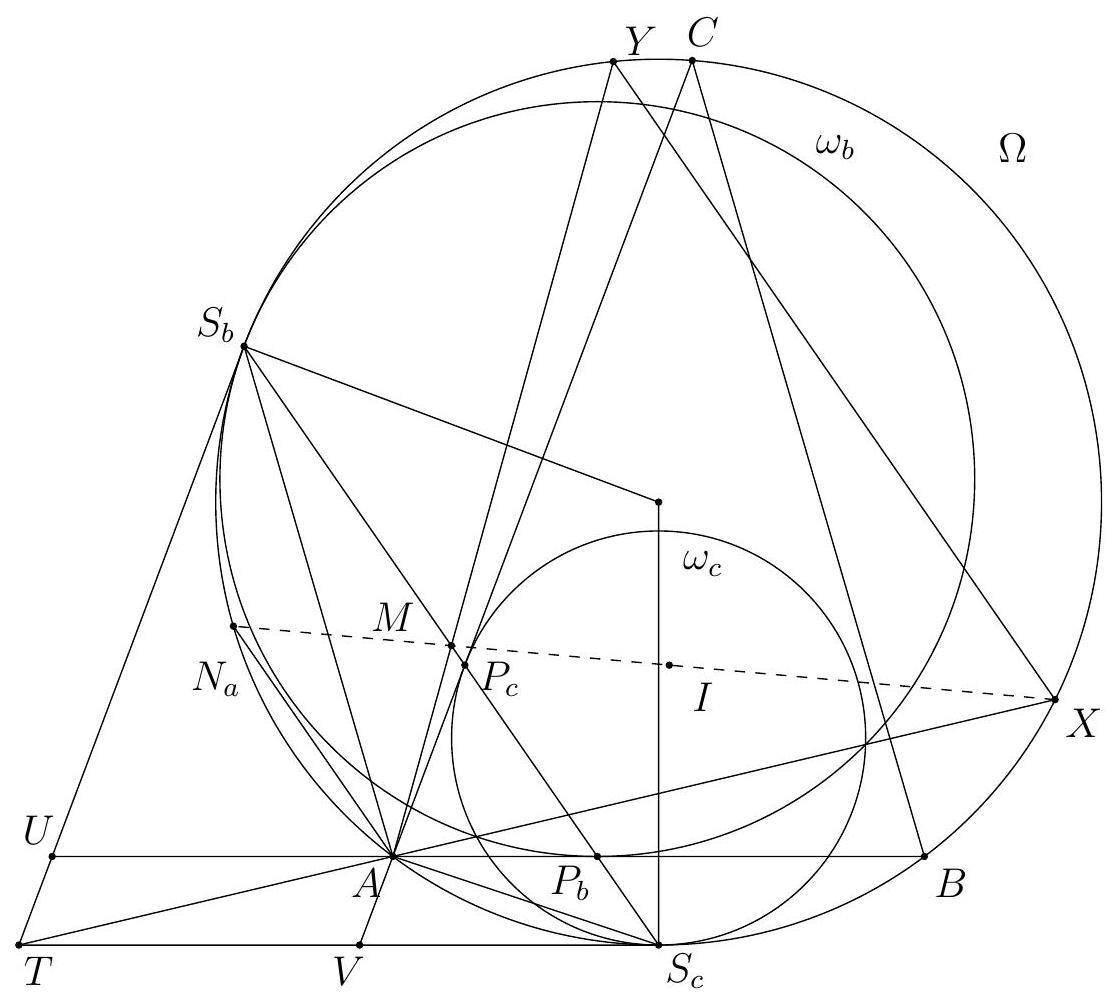\n\nFigure 6: Diagram to Solution 1", "solution": "Part I: First we show that A lies on the radical axis of $\\omega_{b}$ and $\\omega_{c}$.\nWe first note that the line through the intersections of two circles is the radical line of the two circles. Let the tangents to $\\Omega$ at $S_{b}$ and $S_{c}$ intersect at $T$. Clearly $T$ is on the radical axis of $\\omega_{b}$ and $\\omega_{c}$ (and in fact is the radical centre of $\\omega_{b}, \\omega_{c}$ and $\\Omega$ ).\nWe next show that $A$ lies on the radical axis of $\\omega_{b}$ and $\\omega_{c}$. Let $P_{b}$ denote the point of tangency of $\\omega_{b}$ and $A B$, and let $P_{c}$ denote the point of tangency of $\\omega_{c}$ and $A C$. Furthermore, let $U$ be the intersection of the tangent to $\\Omega$ at $S_{b}$ with the line $A B$, and let $V$ be the intersection of the tangent to $\\Omega$ at $S_{c}$ with the line $A C$. Then $T V A U$ is parallelogram. Morover, due to equality of tangent segments we have $\\left|U S_{b}\\right|=\\left|U P_{b}\\right|,\\left|V P_{c}\\right|=\\left|V S_{c}\\right|$ and $\\left|T S_{b}\\right|=\\left|T S_{c}\\right|$. It follows that\n\n$$\n\\begin{aligned}\n\\left|A P_{b}\\right| & =\\left|U P_{b}\\right|-|U A|=\\left|U S_{b}\\right|-|T V|=\\left|T S_{b}\\right|-|T U|-|T V| \\\\\n& =\\left|T S_{s}\\right|-|T V|-|T U|=\\left|V S_{c}\\right|-|A V|=\\left|V P_{c}\\right|-|V A|=\\left|A P_{c}\\right|\n\\end{aligned}\n$$\n\nBut $\\left|A P_{b}\\right|,\\left|A P_{c}\\right|$ are exactly the square roots of powers of $A$ with respect to $\\omega_{b}$ and $\\omega_{c}$, hence $A$ is indeed on their radical axis.\n\nThus, the radical axis of $\\omega_{b}, \\omega_{c}$ is $A T$.\nPart II: Consider the triangle $A S_{b} S_{c}$. Note that since $T$ is the intersection of the tangents at $S_{b}$ and $S_{c}$ to the circumcircle of $A S_{b} S_{c}$, it follows that $A T$ is the symmedian of $A$ in this triangle. Let $X$ denote the second intersection of the symmedian $A T$ with $\\Omega$. We wish to show that $X$ is also on $I N_{a}$.\n\nNote that $A N_{a}$ is the external angle bisector of angle $A$, and therefore it is parallel to $S_{b} S_{c}$. Let $M$ denote the midpoint of $S_{b} S_{c}$, and let $Y$ be the second intersection of $A M$ with $\\Omega$. Since in $A S_{b} S_{c}, A X T$ is the symmedian and $A M Y$ is the median, it follows that $X Y$ is also parallel to $S_{b} S_{c}$. Thus, reflecting in the perpendicular bisector of $S_{b} S_{c}$ sends the line $A M Y$ to line $N_{a} M X$.\n\nNext, consider the quadrilateral $A S_{b} I S_{c}$. From the trillium theorem we have $\\left|S_{b} A\\right|=\\left|S_{b} I\\right|$ and $\\left|S_{c} A\\right|=\\left|S_{c} I\\right|$, thus the quadrilateral is a kite, from which it follows that the reflection of the line $A M$ in $S_{b} S_{c}$ is the line $I M$. But previously we have seen that this is also the line $N_{a} M X$. Thus $M, I, N_{a}$ and $X$ are collinear, as we wanted to show.", "metadata": {"resource_path": "EGMO/segmented/en-2023-solutions.jsonl", "problem_match": "\nProblem 6.", "solution_match": "\nSolution 1. "}} |
| {"year": "2023", "tier": "T2", "problem_label": "6", "problem_type": null, "exam": "EGMO", "problem": "Let $A B C$ be a triangle with circumcircle $\\Omega$. Let $S_{b}$ and $S_{c}$ respectively denote the midpoints of the arcs $A C$ and $A B$ that do not contain the third vertex. Let $N_{a}$ denote the midpoint of arc $B A C$ (the arc $B C$ containing $A$ ). Let $I$ be the incentre of $A B C$. Let $\\omega_{b}$ be the circle that is tangent to $A B$ and internally tangent to $\\Omega$ at $S_{b}$, and let $\\omega_{c}$ be the circle that is tangent to $A C$ and internally tangent to $\\Omega$ at $S_{c}$. Show that the line $I N_{a}$, and the line through the intersections of $\\omega_{b}$ and $\\omega_{c}$, meet on $\\Omega$.\n\nThe incentre of a triangle is the centre of its incircle, the circle inside the triangle that is tangent to all three sides.\n\n\nFigure 6: Diagram to Solution 1", "solution": "This is a variation of Solution 1 which avoids the theory of the symmedian point.\n\nWe begin by showing that the radical axis of $\\omega_{b}, \\omega_{c}$ is $A T$ as in Solution 1.\nPart II: We introduce the point $S_{a}$ with the obvious meaning. Observe that the incentre $I$ of $A B C$ is the orthocentre of $S_{a} S_{b} S_{c}$ either because this is well-known, or because of an angle argument that $A$ reflects in $S_{b} S_{c}$ to $I$ (and similar results by cyclic change of letters). Therefore $A S_{a}$ is perpendicular to $S_{b} S_{c}$.\n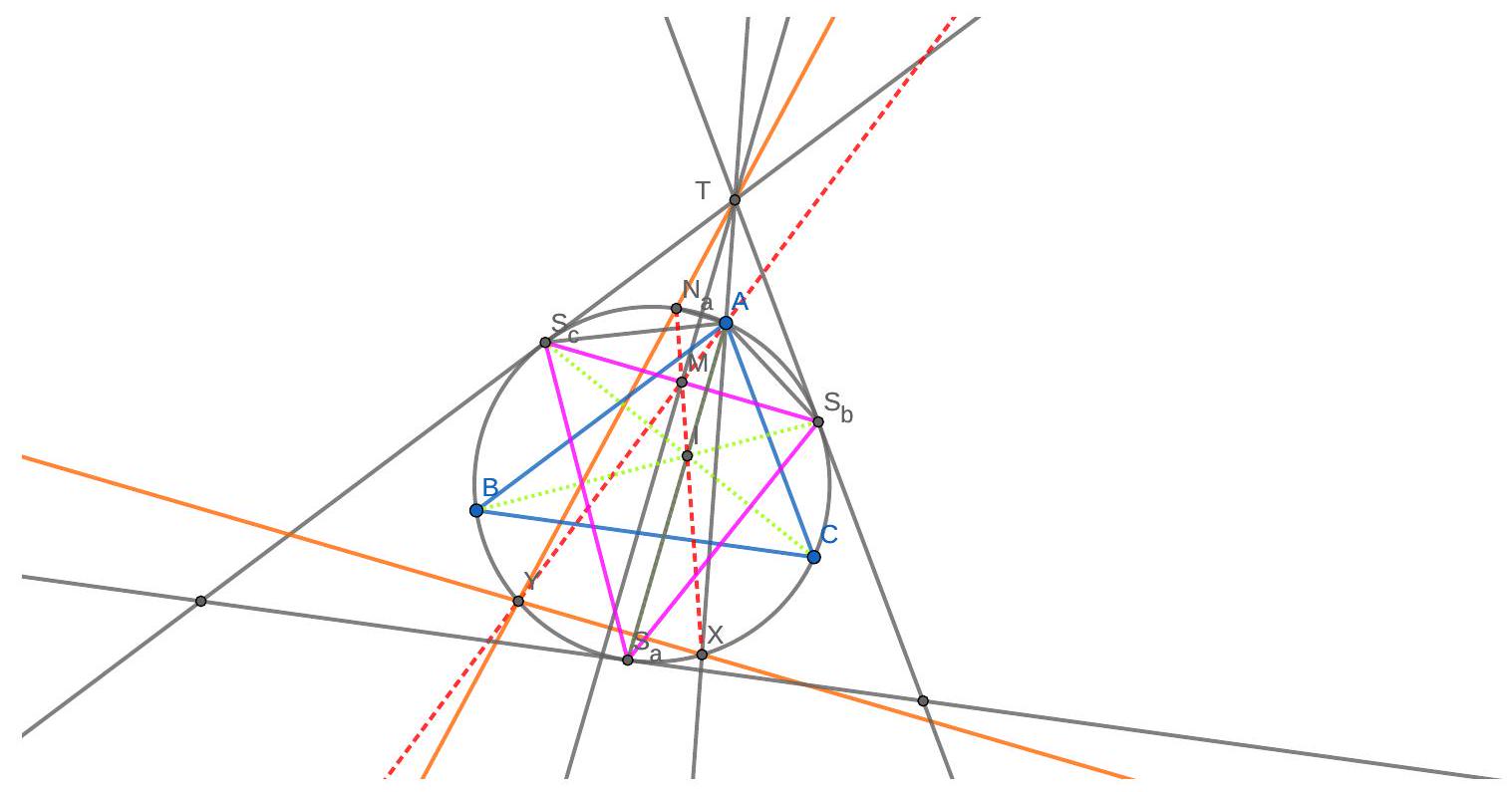\n\nFigure 7: A reflections argument for Solution 2\nLet $M$ denote the midpoint of $S_{b} S_{c}$. Then $A$ is the reflection of $S_{a}$ in the diameter parallel to $S_{b} S_{c}$, so the reflection of $A$ in the diameter perpendicular to $S_{b} S_{c}$ is $N_{a}$, the antipode\nof $S_{a}$. Let the reflection of $X$ in $T M$ be $Y$, so $T Y$ passes through $N_{a}$ and is the reflection of $T X$ in $T M$.\n\nNow $S_{b} S_{c}$ is the polar line of $T$ with respect to $\\Omega$, so $A Y$ and $N_{a} X$ meet on this line, and by symmetry at its midpoint $M$. The line $N_{a} M X$ is therefore the reflection of the line $Y M A$ in $S_{b} S_{c}$, and so $N_{a} M X$ passes through $I$ (the reflection of $A$ in $S_{b} S_{c}$ ).\n\nThe triangle $A S_{c} S_{b}$ can be taken as generic, and from the argument above we can extract the fact that the symmedian point and the centroid are isogonal conjugates in that triangle.", "metadata": {"resource_path": "EGMO/segmented/en-2023-solutions.jsonl", "problem_match": "\nProblem 6.", "solution_match": "\nSolution 2. "}} |
| {"year": "2023", "tier": "T2", "problem_label": "6", "problem_type": null, "exam": "EGMO", "problem": "Let $A B C$ be a triangle with circumcircle $\\Omega$. Let $S_{b}$ and $S_{c}$ respectively denote the midpoints of the arcs $A C$ and $A B$ that do not contain the third vertex. Let $N_{a}$ denote the midpoint of arc $B A C$ (the arc $B C$ containing $A$ ). Let $I$ be the incentre of $A B C$. Let $\\omega_{b}$ be the circle that is tangent to $A B$ and internally tangent to $\\Omega$ at $S_{b}$, and let $\\omega_{c}$ be the circle that is tangent to $A C$ and internally tangent to $\\Omega$ at $S_{c}$. Show that the line $I N_{a}$, and the line through the intersections of $\\omega_{b}$ and $\\omega_{c}$, meet on $\\Omega$.\n\nThe incentre of a triangle is the centre of its incircle, the circle inside the triangle that is tangent to all three sides.\n\n\nFigure 6: Diagram to Solution 1", "solution": "Assume the notation from Solution 1, part I of Solution 1, and let $O$ be the centre of $\\Omega$.\n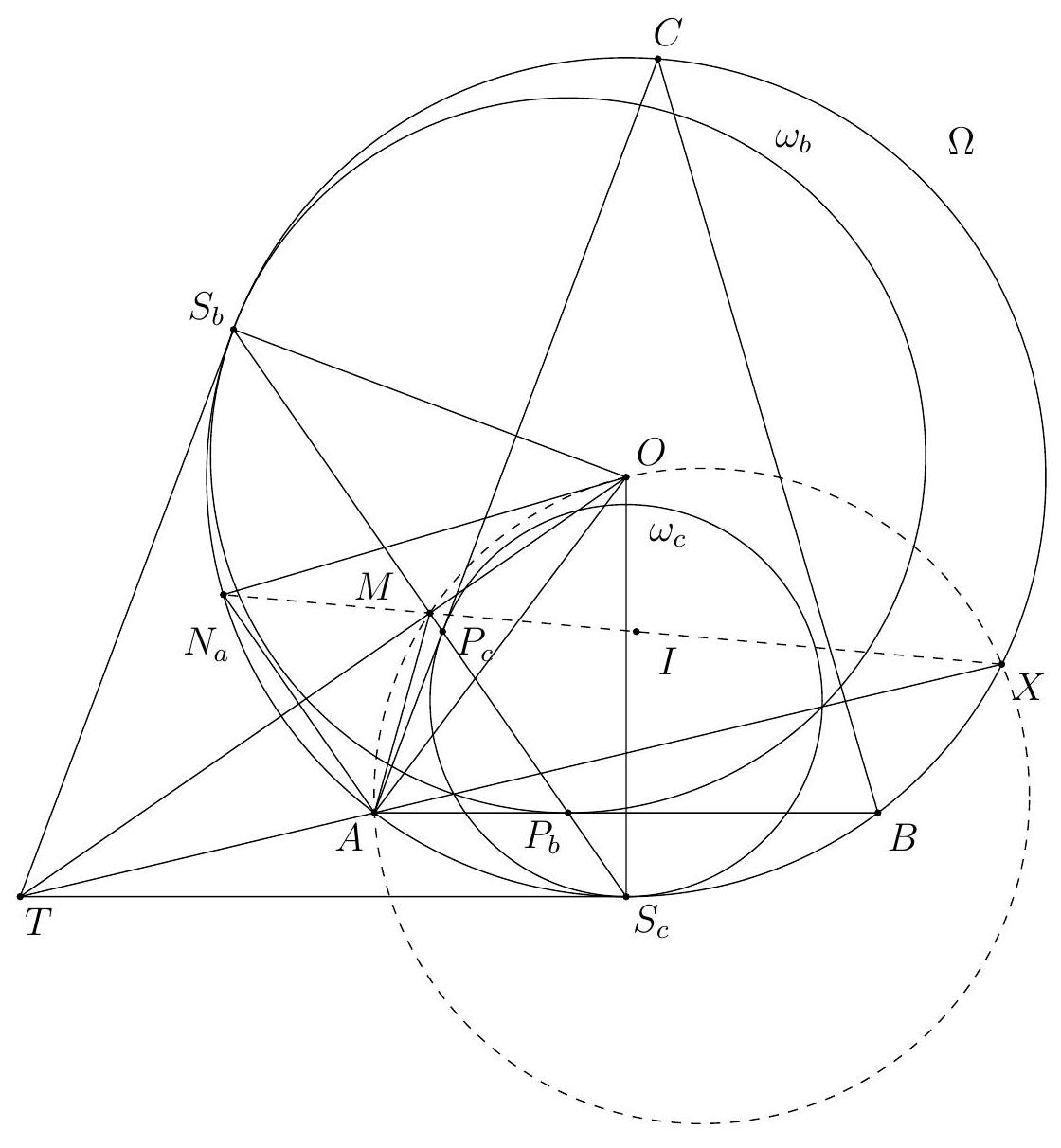\n\nFigure 8: Diagram to Solution 3\nPart II: As in Solution 1, by the trillelium theorem, $S_{c} S_{b}$ bisects $A I$, and since $N_{a} A \\| S_{b} S_{c}$, then $O T$ is a bisector of $A N_{a}$. This implies $\\left|M N_{a}\\right|=|M A|=|M I|$, since $M$ is the midpoint of $S_{c} S_{b}$ and lies also on $O T$. Hence, $M$ is the circumcentre of triangle $I A N_{a}$. But this triangle has a right angle at $A$ (since $A I$ and $A N_{a}$ are the inner and outer angle bisector at $A$ ), hence $M$ lies on $I N_{a}$.\n\nAgain, let $X$ be the second intersection of $T A$ and $\\Omega$. By the above, it suffices to prove that $X$ lies on the line $N_{a} M$. From the power of point $T$ with respect to $\\Omega$ we get $|T A| \\cdot|T X|=\\left|T S_{c}\\right|^{2}$. Since $M$ is the foot of the altitude of right triangle $T S_{c} O$, we obtain\n$\\left|T S_{c}\\right|^{2}=|T M| \\cdot|T O|$. Hence, $|T A| \\cdot|T X|=|T M| \\cdot|T O|$ so the points $O, M, A, X$ are concyclic. It follows that $\\angle M X A=\\angle M O A=\\frac{1}{2} \\angle N_{a} O A=\\angle N_{a} X A$. Hence, $X$ lies on the line $N_{a} M$.\nRemark. To show that $O M A X$ is cyclic, one can also invert the line $T A X$ in the circumcircle of the triangle $A B C$.", "metadata": {"resource_path": "EGMO/segmented/en-2023-solutions.jsonl", "problem_match": "\nProblem 6.", "solution_match": "\nSolution 3. "}} |
| {"year": "2023", "tier": "T2", "problem_label": "6", "problem_type": null, "exam": "EGMO", "problem": "Let $A B C$ be a triangle with circumcircle $\\Omega$. Let $S_{b}$ and $S_{c}$ respectively denote the midpoints of the arcs $A C$ and $A B$ that do not contain the third vertex. Let $N_{a}$ denote the midpoint of arc $B A C$ (the arc $B C$ containing $A$ ). Let $I$ be the incentre of $A B C$. Let $\\omega_{b}$ be the circle that is tangent to $A B$ and internally tangent to $\\Omega$ at $S_{b}$, and let $\\omega_{c}$ be the circle that is tangent to $A C$ and internally tangent to $\\Omega$ at $S_{c}$. Show that the line $I N_{a}$, and the line through the intersections of $\\omega_{b}$ and $\\omega_{c}$, meet on $\\Omega$.\n\nThe incentre of a triangle is the centre of its incircle, the circle inside the triangle that is tangent to all three sides.\n\n\nFigure 6: Diagram to Solution 1", "solution": "Part I is done as in solution 1.\n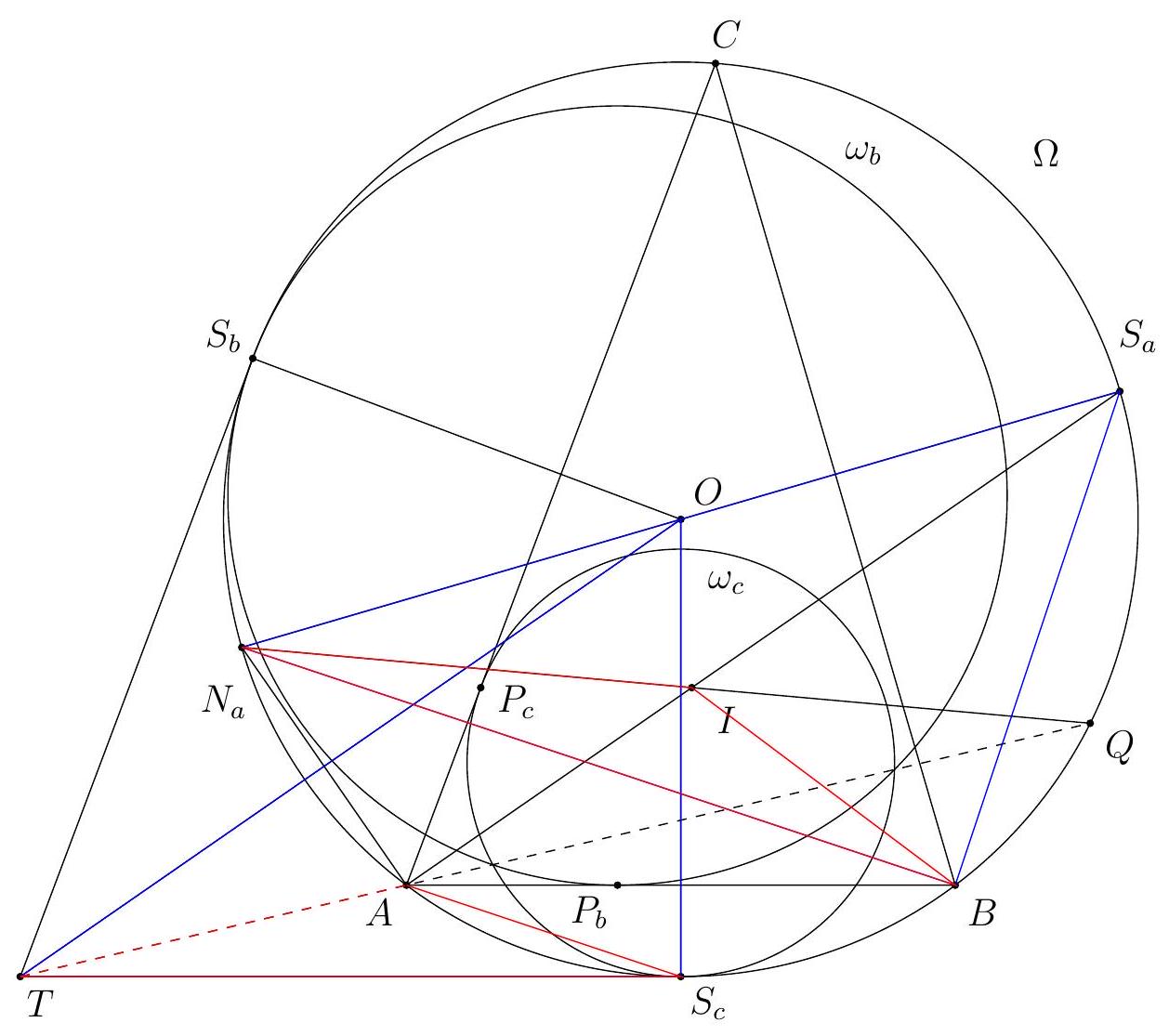\n\nFigure 9: Diagram to Solution 4\nPart II: as in Solution 1 we show that $A N_{a} \\| S_{b} S_{c}$. In particular, $\\angle N_{a} O T=\\angle T O A$. The conclusion of the problem trivially holds if $|A B|=|A C|$, therefore we assume without loss of generality that $|A C|>|A B|$. Let $S_{a}$ be the midpoint of the arc $B C$ which does not contain $A$. Then $N_{a} S_{a}$ is a diameter, so $\\angle S_{a} B N_{a}=\\frac{\\pi}{2}=\\angle O S_{c} T$. We also compute $\\angle B N_{a} S_{a}=\\angle B A S_{a}=\\frac{1}{2} \\angle B A C=\\frac{1}{2} \\angle S_{c} T S_{b}=\\angle S_{c} T O$. It follows that the triangles $T S_{c} O$ and $N_{a} B S_{a}$ are similar. In particular,\n\n$$\n\\frac{\\left|N_{a} B\\right|}{\\left|T S_{c}\\right|}=\\frac{\\left|S_{a} B\\right|}{\\left|O S_{c}\\right|}\n$$\n\nNext we compute\n\n$$\n\\angle I S_{a} B=\\angle N_{a} S_{a} B-\\angle N_{a} S_{a} I=\\angle T O S_{c}-\\frac{1}{2} \\angle N_{a} O A=\\angle T O S_{c}-\\angle T O A=\\angle A O S_{c}\n$$\n\nand\n$\\angle I B N_{a}=\\angle C B N_{a}-\\angle C B I=\\frac{1}{2}\\left(\\pi-\\angle B N_{a} C\\right)-\\frac{1}{2} \\angle C B A=\\frac{1}{2} \\angle A C B=\\angle A C S_{c}=\\angle A S_{c} T$,\nhence\n\n$$\n\\angle S_{a} B I=\\frac{\\pi}{2}-\\angle I B N_{a}=\\frac{\\pi}{2}-\\angle A S_{c} T=\\angle O S_{c} A\n$$\n\nTogether with (13) it follows that the triangles $I B S_{a}$ and $A S_{c} O$ are similar, so $\\frac{\\left|S_{a} B\\right|}{\\left|O S_{c}\\right|}=$ $\\frac{|I B|}{\\left|A S_{c}\\right|}$, and (12) implies $\\frac{\\left|N_{a} B\\right|}{\\left|T S_{c}\\right|}=\\frac{|I B|}{\\left|A S_{c}\\right|}$. Consequently, by (14) the triangles $T S_{c} A$ and $N_{a} B I$ are similar and therefore $\\angle S_{c} T A=\\angle B N_{a} I$. Now let $Q$ be the second intersection of $N_{a} I$ with $\\Omega$. Then $\\angle B N_{a} I=\\angle B N_{a} Q=\\angle B A Q$, so $\\angle S_{c} T A=\\angle B A Q$. Since $A B$ is parallel to $T S_{c}$, we get $A Q \\| T A$, i.e. $A, T, Q$ are collinear.\nRemark. After proving similarity of triangles $T S_{c} O$ and $N_{a} B S_{a}$ one can use spiral symmetry to show similarity of triangles $T S_{c} A$ and $N_{a} B I$.", "metadata": {"resource_path": "EGMO/segmented/en-2023-solutions.jsonl", "problem_match": "\nProblem 6.", "solution_match": "\nSolution 4. "}} |
| {"year": "2023", "tier": "T2", "problem_label": "6", "problem_type": null, "exam": "EGMO", "problem": "Let $A B C$ be a triangle with circumcircle $\\Omega$. Let $S_{b}$ and $S_{c}$ respectively denote the midpoints of the arcs $A C$ and $A B$ that do not contain the third vertex. Let $N_{a}$ denote the midpoint of arc $B A C$ (the arc $B C$ containing $A$ ). Let $I$ be the incentre of $A B C$. Let $\\omega_{b}$ be the circle that is tangent to $A B$ and internally tangent to $\\Omega$ at $S_{b}$, and let $\\omega_{c}$ be the circle that is tangent to $A C$ and internally tangent to $\\Omega$ at $S_{c}$. Show that the line $I N_{a}$, and the line through the intersections of $\\omega_{b}$ and $\\omega_{c}$, meet on $\\Omega$.\n\nThe incentre of a triangle is the centre of its incircle, the circle inside the triangle that is tangent to all three sides.\n\n\nFigure 6: Diagram to Solution 1", "solution": "Part I: First we show that $A$ lies on the radical axis between $\\omega_{b}$ and $\\omega_{c}$.\nLet $T$ be the radical center of the circumcircle, $\\omega_{b}$ and $\\omega_{c}$; then $T S_{b}$ and $T S_{c}$ are common tangents of the circles, as shown in Figure 5a. Moreover, let $P_{b}=A B \\cap S_{b} S_{c}$ and $P_{c}=$ $A C \\cap S_{b} S_{c}$. The triangle $T S_{c} S_{b}$ is isosceles: $A B \\| T S_{c}$ and $A C \\| T S_{b}$ so\n\n$$\n\\angle A P_{b} P_{c}=\\angle T S_{c} S_{b}=\\angle S_{c} S_{b} T=\\angle P_{b} P_{c} A\n$$\n\nFrom these angles we can see that $\\omega_{b}$ passes through $P_{b}, \\omega_{c}$ passes through $P_{c}$, and finally $A P_{b}$ and $A P_{c}$ are equal tangents to $\\omega_{b}$ and $\\omega_{c}$, so $A$ lies on the radical axis.\n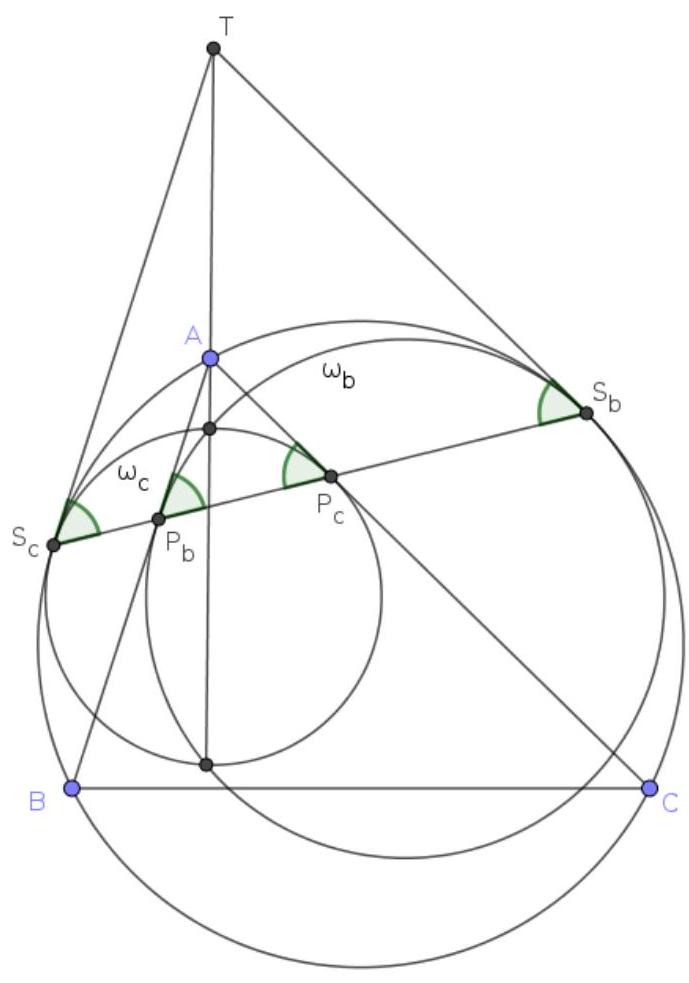\n\nFigure 5a\n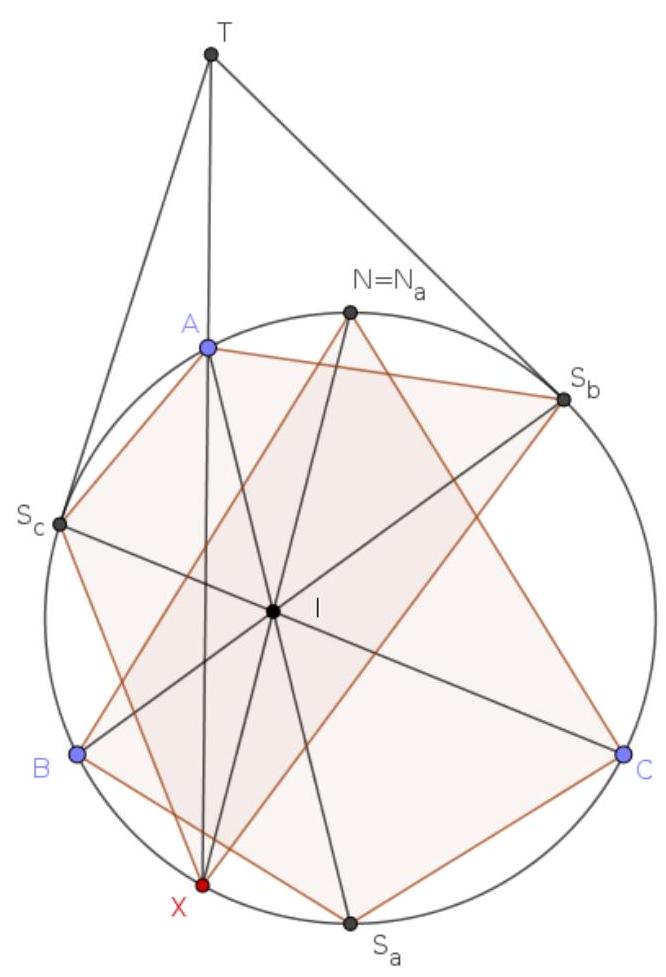\n\nFigure 5b\n\nPart II. Let the radical axis $T A$ meet the circumcircle again at $X$, let $S_{a}$ be the midpoint of the arc $B C$ opposite to $A$, and let $X I$ meet the circumcirlce again at $N$. (See Figure 2.) For solving the problem, we have prove that $N_{a}=N$.\n\nThe triples of points $A, I, S_{a} ; B, I, S_{b}$ and $C, I, S_{c}$ are collinear because they lie on the angle bisectors of the triangle $A B C$.\n\nNotice that the quadrilateral $A S_{c} X S_{b}$ is harmonic, because the tangents at $S_{b}$ and $S_{c}$, and the line $A X$ are concurrent at $T$. This quadrilateral can be projected (or inverted) to the quadrilateral $S_{a} C N B$ through $I$. So, $S_{a} C N B$ also is a harmonic quadrilateral. Due to $S_{a} B=S_{a} C$, this implies $N B=N C$, so $N=N_{a}$. Done.\n\nRemark. Instead of mentioning inversion and harmonic quadrilaterals, from the similar triangles $\\triangle T S_{c} A \\sim \\triangle T X S_{c}$ and $\\triangle T A S_{b} \\sim \\triangle T S_{b} X$ we can get\n\n$$\n\\frac{A S_{c}}{S_{c} X}=\\frac{A S_{b}}{S_{b} X}\n$$\n\nThen, we can apply the trigonometric form of Ceva's theorem to triangle $B C X$\n\n$$\n\\frac{\\sin \\angle B X N_{a}}{\\sin \\angle N_{a} X C} \\cdot \\frac{\\sin \\angle C B S_{b}}{\\sin \\angle S_{b} B X} \\cdot \\frac{\\sin \\angle X C S_{c}}{\\sin \\angle S_{c} C B}=\\frac{B N_{a}}{N_{a} C} \\cdot \\frac{-C S_{b}}{S_{b} X} \\cdot \\frac{X S_{c}}{-S_{c} B}=1 \\cdot \\frac{S_{b} A}{S_{b} N_{a}} \\cdot \\frac{N_{a} S_{c}}{S_{c} B}=1,\n$$\n\nso the Cevians $B S_{b}, C S_{c}$ and $X N_{a}$ are concurrent.", "metadata": {"resource_path": "EGMO/segmented/en-2023-solutions.jsonl", "problem_match": "\nProblem 6.", "solution_match": "\nSolution 5. "}} |
| {"year": "2023", "tier": "T2", "problem_label": "6", "problem_type": null, "exam": "EGMO", "problem": "Let $A B C$ be a triangle with circumcircle $\\Omega$. Let $S_{b}$ and $S_{c}$ respectively denote the midpoints of the arcs $A C$ and $A B$ that do not contain the third vertex. Let $N_{a}$ denote the midpoint of arc $B A C$ (the arc $B C$ containing $A$ ). Let $I$ be the incentre of $A B C$. Let $\\omega_{b}$ be the circle that is tangent to $A B$ and internally tangent to $\\Omega$ at $S_{b}$, and let $\\omega_{c}$ be the circle that is tangent to $A C$ and internally tangent to $\\Omega$ at $S_{c}$. Show that the line $I N_{a}$, and the line through the intersections of $\\omega_{b}$ and $\\omega_{c}$, meet on $\\Omega$.\n\nThe incentre of a triangle is the centre of its incircle, the circle inside the triangle that is tangent to all three sides.\n\n\nFigure 6: Diagram to Solution 1", "solution": "Part I: First let's show that this is equivalent to proving that $T A$ and $N_{a} I$ intersect in $\\Omega$.\n\nLemma: Let's recall that if we have two circles $\\omega_{1}$ and $\\omega_{2}$ which are internally tangent at point $X$ and if we have a line $A B$ tangent to $\\omega_{2}$ at $Y$. Let $M$ be the midpoint of the arc $A B$ not containing $Z$. We have that $Z, Y, M$ are collinear.\n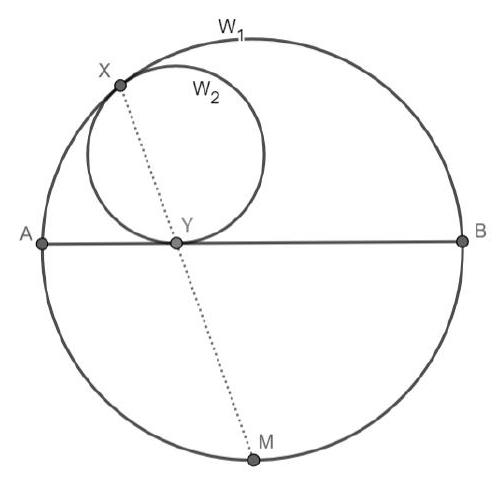", "metadata": {"resource_path": "EGMO/segmented/en-2023-solutions.jsonl", "problem_match": "\nProblem 6.", "solution_match": "\nSolution 6. "}} |
| {"year": "2023", "tier": "T2", "problem_label": "6", "problem_type": null, "exam": "EGMO", "problem": "Let $A B C$ be a triangle with circumcircle $\\Omega$. Let $S_{b}$ and $S_{c}$ respectively denote the midpoints of the arcs $A C$ and $A B$ that do not contain the third vertex. Let $N_{a}$ denote the midpoint of arc $B A C$ (the arc $B C$ containing $A$ ). Let $I$ be the incentre of $A B C$. Let $\\omega_{b}$ be the circle that is tangent to $A B$ and internally tangent to $\\Omega$ at $S_{b}$, and let $\\omega_{c}$ be the circle that is tangent to $A C$ and internally tangent to $\\Omega$ at $S_{c}$. Show that the line $I N_{a}$, and the line through the intersections of $\\omega_{b}$ and $\\omega_{c}$, meet on $\\Omega$.\n\nThe incentre of a triangle is the centre of its incircle, the circle inside the triangle that is tangent to all three sides.\n\n\nFigure 6: Diagram to Solution 1", "solution": "Lemma\nLet $P_{b}=A B \\cap \\omega_{b}$ and $P_{c}=A C \\cap \\omega_{c}$. We can notice by the lemma that $S_{b}, P_{b}$ and $S_{c}$ are collinear, and similarly $S_{c}, P_{c}$ and $S_{b}$ are also collinear. Therefore $S_{c}, P_{b}, P_{c}$, and $S_{b}$ are collinear, and since $\\angle A P_{b} P_{c}=\\frac{\\angle A B C}{2}+\\frac{\\angle A C B}{2}=\\angle A P_{c} P_{b}$ then $A P_{b}=A P_{c}$ so $A$ is on the radical axis of $\\omega_{b}$ and $\\omega_{c}$. Let $T$ be the intersection of the tangent lines of $\\Omega$ through $S_{c}$ and $S_{b}$. Since $T S_{c}=T S_{b}$ then $A T$ is the radical axis between $\\omega_{b}$ and $\\omega_{c}$.\n\nPart II: $T A$ and $N_{a} I$ intersect in $\\Omega$.\n\nLet $\\omega_{a}$ the $A$-mixtilinear incircle (that is, the circle internally tangent to $\\Omega$, and tangent to both $A B$ and $A C$ ), and let $X=\\Omega \\cap \\omega_{a}$. It is known that $N_{a}, I, X$ are collinear.\n\nLet $M_{c}$ and $M_{b}$ be the tangent points of $\\omega_{A}$ to $A B$ and $A C$ respectively, then by the lemma $X, M_{c}, S_{c}$ are collinear and $X, M_{b}, S_{b}$ are collinear. We can see that $S_{c} T S_{b}$ and $M_{c} A M_{b}$ are homothetic with respect to $X$; therefore $T$ and $A$ are homothetic with respect to $X$, impying that $T, A, X$ are collinear.\n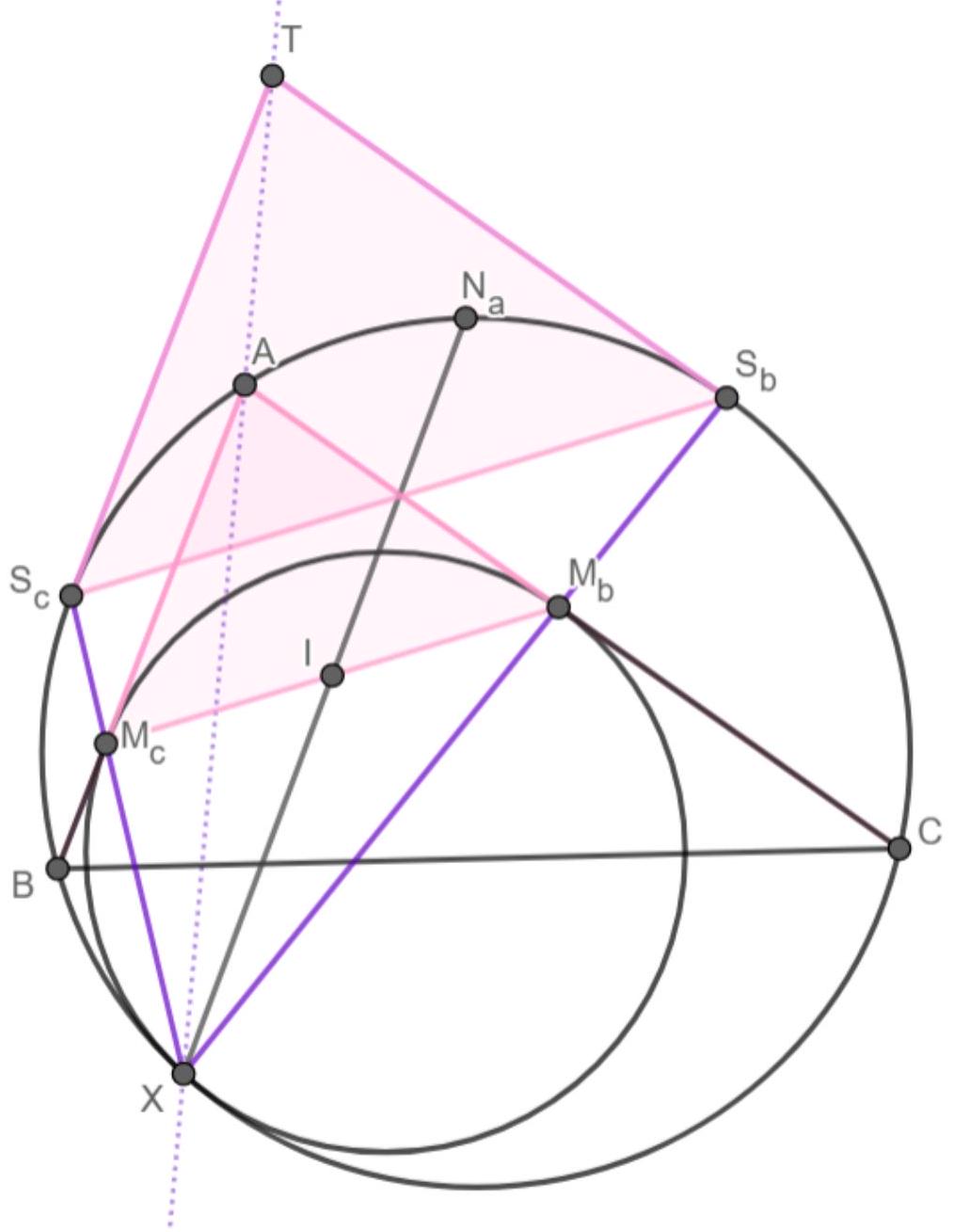\n\nFigure 10: Diagram to Solution 6", "metadata": {"resource_path": "EGMO/segmented/en-2023-solutions.jsonl", "problem_match": "\nProblem 6.", "solution_match": "\nSolution 6: "}} |
|
|