| {"year": "2000", "tier": "T3", "problem_label": "1", "problem_type": null, "exam": "INMO", "problem": "The in-circle of triangle $A B C$ touches the sides $B C, C A$ and $A B$ in $K, L$ and $M$ respectively. The line through $A$ and parallel to $L K$ meets $M K$ in $P$ and the line through $A$ and parallel to $M K$ meets $L K$ in $Q$. Show that the line $P Q$ bisects the sides $A B$ and $A C$ of triangle $A B C$.", "solution": "Let $A P, A Q$ produced meet $B C$ in $D, E$ respectively.\n\n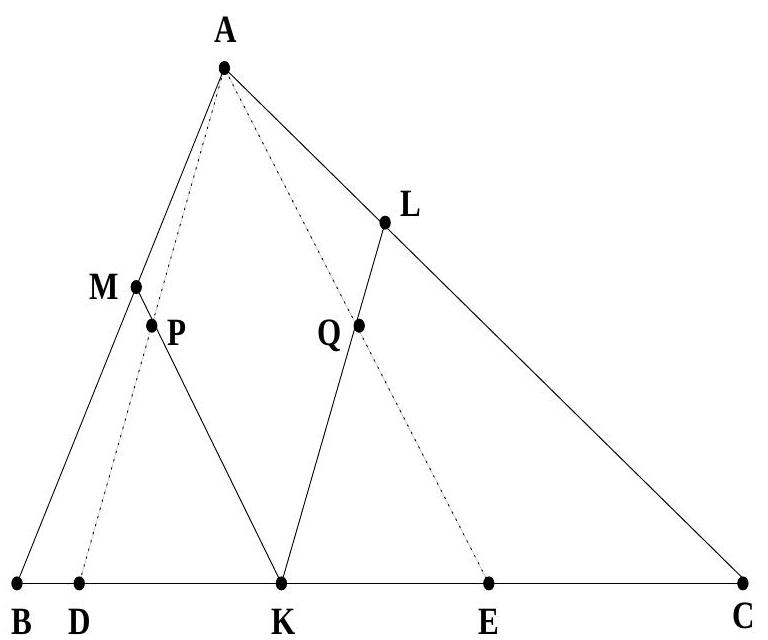\n\nSince $M K$ is parallel to $A E$, we have $\\angle A E K=\\angle M K B$. Since $B K=B M$, both being tangents to the circle from $B, \\angle M K B=\\angle B M K$. This with the fact that $M K$ is parallel to $A E$ gives us $\\angle A E K=\\angle M A E$. This shows that $M A E K$ is an isosceles trapezoid. We conclude that $M A=K E$. Similarly, we can prove that $A L=D K$. But $A M=A L$. We get that $D K=K E$. Since $K P$ is parallel to $A E$, we get $D P=P A$ and similarly $E Q=Q A$. This implies that $P Q$ is parallel to $D E$ and hence bisects $A B, A C$ when produced.\n\n[The same argument holds even if one or both of $P$ and $Q$ lie outside triangle $A B C$.]", "metadata": {"resource_path": "INMO/segmented/en-2000.jsonl", "problem_match": "\n1.", "solution_match": "\nSolution. :"}} |
| {"year": "2000", "tier": "T3", "problem_label": "2", "problem_type": null, "exam": "INMO", "problem": "Solve for integers $x, y, z$ :\n\n$$\nx+y=1-z, \\quad x^{3}+y^{3}=1-z^{2}\n$$", "solution": "Eliminating $z$ from the given set of equations, we get\n\n$$\nx^{3}+y^{3}+\\{1-(x+y)\\}^{2}=1\n$$\n\nThis factors to\n\n$$\n(x+y)\\left(x^{2}-x y+y^{2}+x+y-2\\right)=0\n$$\n\nCase 1. Suppose $x+y=0$. Then $z=1$ and $(x, y, z)=(m,-m, 1)$, where $m$ is an integer give one family of solutions.\n\nCase 2. Suppose $x+y \\neq 0$. Then we must have\n\n$$\nx^{2}-x y+y^{2}+x+y-2=0 \\text {. }\n$$\n\nThis can be written in the form\n\n$$\n(2 x-y+1)^{2}+3(y+1)^{2}=12\n$$\n\nHere there are two possibilities:\n\n$$\n2 x-y+1=0, y+1= \\pm 2 ; \\quad 2 x-y+1= \\pm 3, y+1= \\pm 1\n$$\n\nAnalysing all these cases we get\n\n$$\n(x, y, z)=(0,1,0),(-2,-3,6),(1,0,0),(0,-2,3),(-2,0,3),(-3,-2,6) .\n$$", "metadata": {"resource_path": "INMO/segmented/en-2000.jsonl", "problem_match": "\n2.", "solution_match": "\nSol. :"}} |
| {"year": "2000", "tier": "T3", "problem_label": "3", "problem_type": null, "exam": "INMO", "problem": "If $a, b, c, x$ are real numbers such that $a b c \\neq 0$ and\n\n$$\n\\frac{x b+(1-x) c}{a}=\\frac{x c+(1-x) a}{b}=\\frac{x a+(1-x) b}{c}\n$$\n\nthen prove that either $a+b+c=0$ or $a=b=c$.", "solution": "Suppose $a+b+c \\neq 0$ and let the common value be $\\lambda$. Then\n\n$$\n\\lambda=\\frac{x b+(1-x) c+x c+(1-x) a+x a+(1-x) b}{a+b+c}=1\n$$\n\nWe get two equations:\n\n$$\n-a+x b+(1-x) c=0, \\quad(1-x) a-b+x c=0\n$$\n\n(The other equation is a linear combination of these two.) Using these two equations, we get the relations\n\n$$\n\\frac{a}{1-x+x^{2}}=\\frac{b}{x^{2}-x+1}=\\frac{c}{(1-x)^{2}+x}\n$$\n\nSince $1-x+x^{2} \\neq 0$, we get $a=b=c$.", "metadata": {"resource_path": "INMO/segmented/en-2000.jsonl", "problem_match": "\n3.", "solution_match": "\nSol. :"}} |
| {"year": "2000", "tier": "T3", "problem_label": "4", "problem_type": null, "exam": "INMO", "problem": "In a convex quadrilateral $P Q R S, P Q=R S,(\\sqrt{3}+1) Q R=S P$ and $\\angle R S P-\\angle S P Q=$ $30^{\\circ}$. Prove that\n\n$$\n\\angle P Q R-\\angle Q R S=90^{\\circ}\n$$", "solution": "Let $[$ Fig $]$ denote the area of Fig. We have\n\n$$\n[P Q R S]=[P Q R]+[R S P]=[Q R S]+[S P Q]\n$$\n\nLet us write $P Q=p, Q R=q, R S=r, S P=s$. The above relations reduce to\n\n$$\np q \\sin \\angle P Q R+r s \\sin \\angle R S P=q r \\sin \\angle Q R S+s p \\sin \\angle S P Q\n$$\n\nUsing $p=r$ and $(\\sqrt{3}+1) q=s$ and dividing by $p q$, we get\n\n$$\n\\sin \\angle P Q R+(\\sqrt{3}+1) \\sin \\angle R S P=\\sin \\angle Q R S+(\\sqrt{3}+1) \\sin \\angle S P Q\n$$\n\nTherefore, $\\sin \\angle P Q R-\\sin \\angle Q R S=(\\sqrt{3}+1)(\\sin \\angle S P Q-\\sin \\angle R S P)$.\n\n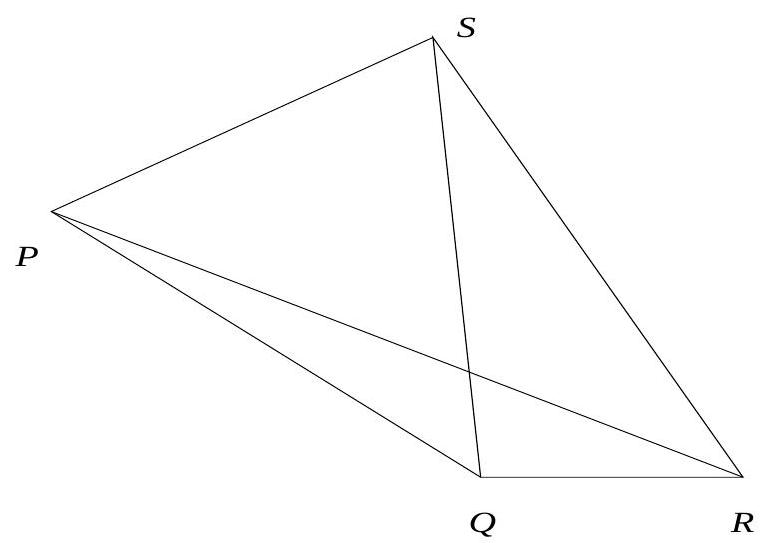\n\nFig. 2.\n\nThis can be written in the form\n\n$$\n\\begin{aligned}\n2 \\sin & \\frac{\\angle P Q R-\\angle Q R S}{2} \\cos \\frac{\\angle P Q R+\\angle Q R S}{2} \\\\\n& =(\\sqrt{3}+1) 2 \\sin \\frac{\\angle S P Q-\\angle R S P}{2} \\cos \\frac{\\angle S P Q+\\angle R S P}{2}\n\\end{aligned}\n$$\n\nUsing the relations\n\n$$\n\\cos \\frac{\\angle P Q R+\\angle Q R S}{2}=-\\cos \\frac{\\angle S P Q+\\angle R S P}{2}\n$$\n\nand\n\n$$\n\\sin \\frac{\\angle S P Q-\\angle R S P}{2}=-\\sin 15^{\\circ}=-\\frac{(\\sqrt{3}-1)}{2 \\sqrt{2}}\n$$\n\nwe obtain\n\n$$\n\\sin \\frac{\\angle P Q R-\\angle Q R S}{2}=(\\sqrt{3}+1)\\left[-\\frac{(\\sqrt{3}-1)}{2 \\sqrt{2}}\\right]=\\frac{1}{\\sqrt{2}}\n$$\n\nThis shows that\n\n$$\n\\frac{\\angle P Q R-\\angle Q R S}{2}=\\frac{\\pi}{4} \\quad \\text { or } \\quad \\frac{3 \\pi}{4}\n$$\n\nUsing the convexity of $P Q R S$, we can rule out the latter alternative. We obtain\n\n$$\n\\angle P Q R-\\angle Q R S=\\frac{\\pi}{2}\n$$", "metadata": {"resource_path": "INMO/segmented/en-2000.jsonl", "problem_match": "\n4.", "solution_match": "\nSol. :"}} |
| {"year": "2000", "tier": "T3", "problem_label": "5", "problem_type": null, "exam": "INMO", "problem": "Let $a, b, c$ be three real numbers such that $1 \\geq a \\geq b \\geq c \\geq 0$. Prove that if $\\lambda$ is a root of the cubic equation $x^{3}+a x^{2}+b x+c=0$ (real or complex), then $|\\lambda| \\leq 1$.", "solution": "Since $\\lambda$ is a root of the equation $x^{3}+a x^{2}+b x+c=0$, we have\n\n$$\n\\lambda^{3}=-a \\lambda^{2}-b \\lambda-c\n$$\n\nThis implies that\n\n$$\n\\begin{aligned}\n\\lambda^{4} & =-a \\lambda^{3}-b \\lambda^{2}-c \\lambda \\\\\n& =(1-a) \\lambda^{3}+(a-b) \\lambda^{2}+(b-c) \\lambda+c\n\\end{aligned}\n$$\n\nwhere we have used again\n\n$$\n-\\lambda^{3}-a \\lambda^{2}-b \\lambda-c=0\n$$\n\nSuppose $|\\lambda| \\geq 1$. Then we obtain\n\n$$\n\\begin{aligned}\n|\\lambda|^{4} & \\leq(1-a)|\\lambda|^{3}+(a-b)|\\lambda|^{2}+(b-c)|\\lambda|+c \\\\\n& \\leq(1-a)|\\lambda|^{3}+(a-b)|\\lambda|^{3}+(b-c)|\\lambda|^{3}+c|\\lambda|^{3} \\\\\n& \\leq|\\lambda|^{3}\n\\end{aligned}\n$$\n\nThis shows that $|\\lambda| \\leq 1$. Hence the only possibility in this case is $|\\lambda|=1$. We conclude that $|\\lambda| \\leq 1$ is always true.", "metadata": {"resource_path": "INMO/segmented/en-2000.jsonl", "problem_match": "\n5.", "solution_match": "\nSol. :"}} |
| {"year": "2000", "tier": "T3", "problem_label": "6", "problem_type": null, "exam": "INMO", "problem": "For any natural number $n,(n \\geq 3)$, let $f(n)$ denote the number of non-congruent integer-sided triangles with perimeter $n$ (e.g., $f(3)=1, f(4)=0, f(7)=2$ ). Show that\n\n(a) $f(1999)>f(1996)$\n\n(b) $f(2000)=f(1997)$.", "solution": "(a) Let $a, b, c$ be the sides of a triangle with $a+b+c=1996$, and each being a positive integer. Then $a+1, b+1, c+1$ are also sides of a triangle with perimeter 1999 because\n\n$$\na<b+c \\quad \\Longrightarrow \\quad a+1<(b+1)+(c+1)\n$$\n\nand so on. Moreover $(999,999,1)$ form the sides of a triangle with perimeter 1999, which is not obtainable in the form $(a+1, b+1, c+1)$ where $a, b, c$ are the integers and the sides of a triangle with $a+b+c=1996$. We conclude that $f(1999)>f(1996)$.\n\n(b) As in the case (a) we conclude that $f(2000) \\geq f(1997)$. On the other hand, if $x, y, z$ are the integer sides of a triangle with $x+y+z=2000$, and say $x \\geq y \\geq z \\geq 1$, then we cannot have $z=1$; for otherwise we would get $x+y=1999$ forcing $x, y$ to have opposite parity so that $x-y \\geq 1=z$ violating triangle inequality for $x, y, z$. Hence $x \\geq y \\geq z>1$. This implies that $x-1 \\geq y-1 \\geq z-1>0$. We already have $x<y+z$. If $x \\geq y+z-1$, then we see that $y+z-1 \\leq x<y+z$, showing that $y+z-1=x$. Hence we obtain $2000=x+y+z=2 x+1$ which is impossible. We conclude that $x<y+z-1$. This shows that $x-1<(y-1)+(z-1)$ and hence $x-1, y-1, z-1$ are the sides of a triangle with perimeter 1997. This gives $f(2000) \\leq f(1997)$. Thus we obtain the desired result.", "metadata": {"resource_path": "INMO/segmented/en-2000.jsonl", "problem_match": "\n6.", "solution_match": "\nSol. :"}} |
|
|


