| {"year": "2001", "tier": "T3", "problem_label": "1", "problem_type": null, "exam": "INMO", "problem": "Let $A B C$ be a triangle in which no angle is $90^{\\circ}$. For any point $P$ in the plane of the triangle, let $A_{1}, B_{1}, C_{1}$ denote the reflections of $P$ in the sides $B C, C A, A B$ respectively. Prove the following statements:\n\n(a) If $P$ is the incentre or an excentre of $A B C$, then $P$ is the circumcentre of $A_{1} B_{1} C_{1}$;\n\n(b) If $P$ is the circumcentre of $A B C$, then $P$ is the orthocentre of $A_{1} B_{1} C_{1}$;\n\n(c) If $P$ is the orthocentre of $A B C$, then $P$ is either the incentre or an excentre of $A_{1} B_{1} C_{1}$.", "solution": "(a)\n\n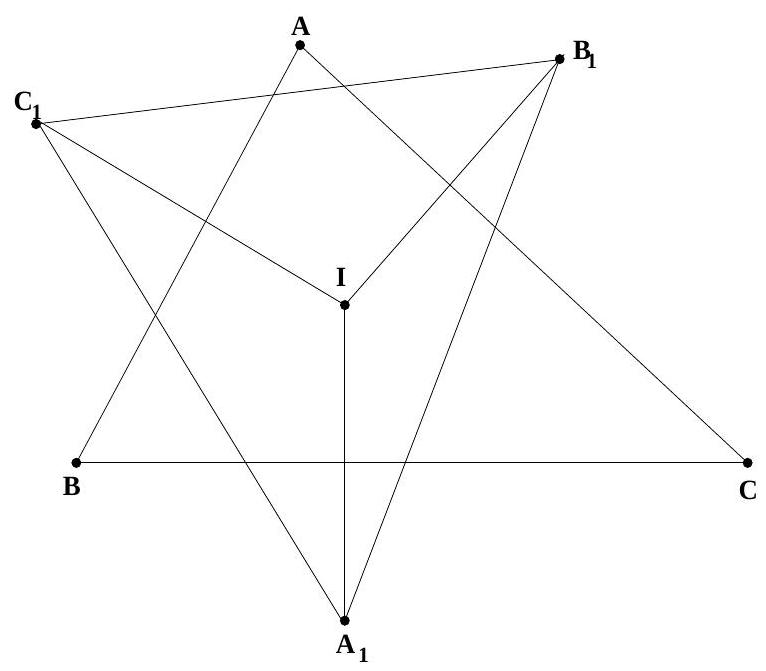\n\nIf $P=I$ is the incentre of triangle $A B C$, and $r$ its inradius, then it is clear that $A_{1} I=B_{1} I=C_{1} I=2 r$. It follows that $I$ is the circumcentre of $A_{1} B_{1} C_{1}$. On the otherhand if $P=I_{1}$ is the excentre of $A B C$ opposite $A$ and $r_{1}$ the corresponding exradius, then again we see that $A_{1} I_{1}=B_{1} I_{1}=C_{1} I_{1}=2 r_{1}$. Thus $I_{1}$ is the circumcentre of $A_{1} B_{1} C_{1}$.\n\n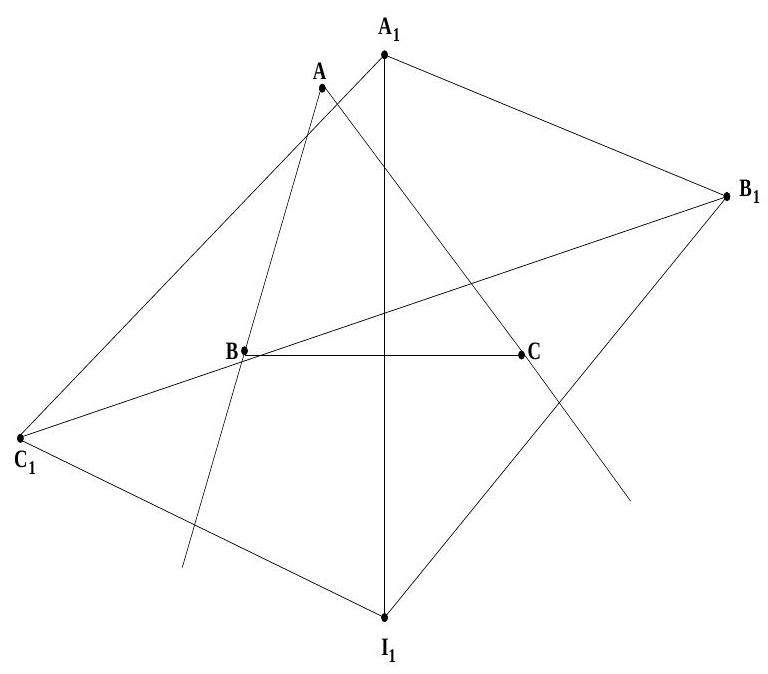\n\n(b)\n\nLet $P=O$ be the circumcentre of $A B C$. By definition, it follows that $O A_{1}$ bisects and is bisected by $B C$ and so on. Let $D, E, F$ be the mid-points of $B C, C A, A B$ respectively. Then $F E$ is parallel to $B C$. But $E, F$ are also mid-points of $O B_{1}, O C_{1}$ and hence $F E$ is parallel to $B_{1} C_{1}$ as well. We conclude that $B C$ is parallel to $B_{1} C_{1}$. Since $O A_{1}$ is perpendicular to $B C$, it follows that $O A_{1}$ is perpendicular to $B_{1} C_{1}$. Similarly $O B_{1}$ is perpendicular to $C_{1} A_{1}$ and $O C_{1}$ is perpendicular to $A_{1} B_{1}$. These imply that $O$ is the orthocentre of $A_{1} B_{1} C_{1}$. (This applies whether $O$ is inside or outside $A B C$.)\n\n(c)\n\nlet $P=H$, the orthocentre of $A B C$. We consider two possibilities; $H$ falls inside $A B C$ and $H$ falls outside $A B C$.\n\nSuppose $H$ is inside $A B C$; this happens if $A B C$ is an acute triangle. It is known that $A_{1}, B_{1}, C_{1}$ lie on the circumcircle of $A B C$. Thus $\\angle C_{1} A_{1} A=\\angle C_{1} C A=90^{\\circ}-A$. Similarly $\\angle B_{1} A_{1} A=\\angle B_{1} B A=90^{\\circ}-A$. These show that $\\angle C_{1} A_{1} A=\\angle B_{1} A_{1} A$. Thus $A_{1} A$ is an internal bisector of $\\angle C_{1} A_{1} B_{1}$. Similarly we can show that $B_{1}$ bisects $\\angle A_{1} B_{1} C_{1}$ and $C_{1} C$ bisects $\\angle B_{1} C_{1} A_{1}$. Since $A_{1} A, B_{1} B, C_{1} C$ concur at $H$, we conclude that $H$ is the incentre of $A_{1} B_{1} C_{1}$.\n\nOR If $D, E, F$ are the feet of perpendiculars of $A, B, C$ to the sides $B C, C A, A B$ respectively, then we see that $E F, F D, D E$ are respectively parallel to $B_{1} C_{1}, C_{1} A_{1}$, $A_{1} B_{1}$. This implies that $\\angle C_{1} A_{1} H=\\angle F D H=\\angle A B E=90^{\\circ}-A$, as $B D H F$ is a cyclic quadrilateral. Similarly, we can show that $\\angle B_{1} A_{1} H=90^{\\circ}-A$. It follows that $A_{1} H$ is the internal bisector of $\\angle C_{1} A_{1} B_{1}$. We can proceed as in the earlier case.\n\nIf $H$ is outside $A B C$, the same proofs go through again, except that two of $A_{1} H$, $B_{1} H, C_{1} H$ are external angle bisectors and one of these is an internal angle bisector. Thus $H$ becomes an excentre of triangle $A_{1} B_{1} C_{1}$.", "metadata": {"resource_path": "INMO/segmented/en-2001.jsonl", "problem_match": "\n1.", "solution_match": "## Solution:"}} |
| {"year": "2001", "tier": "T3", "problem_label": "2", "problem_type": null, "exam": "INMO", "problem": "Show that the equation\n\n$$\nx^{2}+y^{2}+z^{2}=(x-y)(y-z)(z-x)\n$$\n\nhas infinitely many solutions in integers $x, y, z$.", "solution": "We seek solutions $(x, y, z)$ which are in arithmetic progression. Let us put $y-x=z-y=d>0$ so that the equation reduces to the form\n\n$$\n3 y^{2}+2 d^{2}=2 d^{3}\n$$\n\nThus we get $3 y^{2}=2(d-1) d^{2}$. We conclude that $2(d-1)$ is 3 times a square. This is satisfied if $d-1=6 n^{2}$ for some $n$. Thus $d=6 n^{2}+1$ and $3 y^{2}=d^{2} \\cdot 2\\left(6 n^{2}\\right)$ giving us $y^{2}=4 d^{2} n^{2}$. Thus we can take $y=2 d n=2 n\\left(6 n^{2}+1\\right)$. From this we obtain $x=y-d=(2 n-1)\\left(6 n^{2}+1\\right), z=y+d=(2 n+1)\\left(6 n^{2}+1\\right)$. It is easily verified that\n\n$$\n(x, y, z)=\\left((2 n-1)\\left(6 n^{2}+1\\right), 2 n\\left(6 n^{2}+1\\right),(2 n+1)\\left(6 n^{2}+1\\right)\\right)\n$$\n\nis indeed a solution for a fixed $n$ and this gives an infinite set of solutions as $n$ varies over natural numbers.", "metadata": {"resource_path": "INMO/segmented/en-2001.jsonl", "problem_match": "\n2.", "solution_match": "\nSolution:"}} |
| {"year": "2001", "tier": "T3", "problem_label": "3", "problem_type": null, "exam": "INMO", "problem": "If $a, b, c$ are positive real numbers such that $a b c=1$, prove that\n\n$$\na^{b+c} b^{c+a} c^{a+b} \\leq 1\n$$", "solution": "Note that the inequality is symmetric in $a, b, c$ so that we may assume that $a \\geq b \\geq c$. Since $a b c=1$, it follows that $a \\geq 1$ and $c \\leq 1$. Using $b=1 / a c$, we get\n\n$$\na^{b+c} b^{c+a} c^{a+b}=\\frac{a^{b+c} c^{a+b}}{a^{c+a} c^{c+a}}=\\frac{c^{b-c}}{a^{a-b}} \\leq 1\n$$\n\nbecause $c \\leq 1, b \\geq c, a \\geq 1$ and $a \\geq b$.", "metadata": {"resource_path": "INMO/segmented/en-2001.jsonl", "problem_match": "\n3.", "solution_match": "\nSolution:"}} |
| {"year": "2001", "tier": "T3", "problem_label": "4", "problem_type": null, "exam": "INMO", "problem": "Given any nine integers show that it is possible to choose, from among them, four integers $a, b, c, d$ such that $a+b-c-d$ is divisible by 20 . Further show that such a selection is not possible if we start with eight integers instead of nine.", "solution": "Suppose there are four numbers $a, b, c, d$ among the given nine numbers which leave the same remainder modulo 20 . Then $a+b \\equiv c+d(\\bmod 20)$ and we are done.\n\nIf not, there are two possibilities:\n\n(1) We may have two disjoint pairs $\\{a, c\\}$ and $\\{b, d\\}$ obtained from the given nine numbers such that $a \\equiv c(\\bmod 20)$ and $b \\equiv d(\\bmod 20)$. In this case we get $a+b \\equiv c+d$ $(\\bmod 20)$.\n\n(2) Or else there are at most three numbers having the same remainder modulo 20 and the remaining six numbers leave distinct remainders which are also different from the first remainder (i.e., the remainder of the three numbers). Thus there are at least 7 disinct remainders modulo 20 that can be obtained from the given set of nine numbers. These 7 remainders give rise to $\\binom{7}{2}=21$ pairs of numbers. By pigeonhole principle, there must be two pairs $\\left(r_{1}, r_{2}\\right),\\left(r_{3}, r_{4}\\right)$ such that $r_{1}+r_{2} \\equiv r_{3}+r_{4}(\\bmod 20)$. Going back we get four numbers $a, b, c, d$ such that $a+b \\equiv c+d(\\bmod 20)$.\n\nIf we take the numbers $0,0,0,1,2,4,7,12$, we check that the result is not true for these eight numbers.", "metadata": {"resource_path": "INMO/segmented/en-2001.jsonl", "problem_match": "\n4.", "solution_match": "## Solution:"}} |
| {"year": "2001", "tier": "T3", "problem_label": "5", "problem_type": null, "exam": "INMO", "problem": "Let $A B C$ be a triangle and $D$ be the mid-point of side $B C$. Suppose $\\angle D A B=\\angle B C A$ and $\\angle D A C=15^{\\circ}$. Show that $\\angle A D C$ is obtuse. Further, if $O$ is the circumcentre of $A D C$, prove that triangle $A O D$ is equilateral.", "solution": "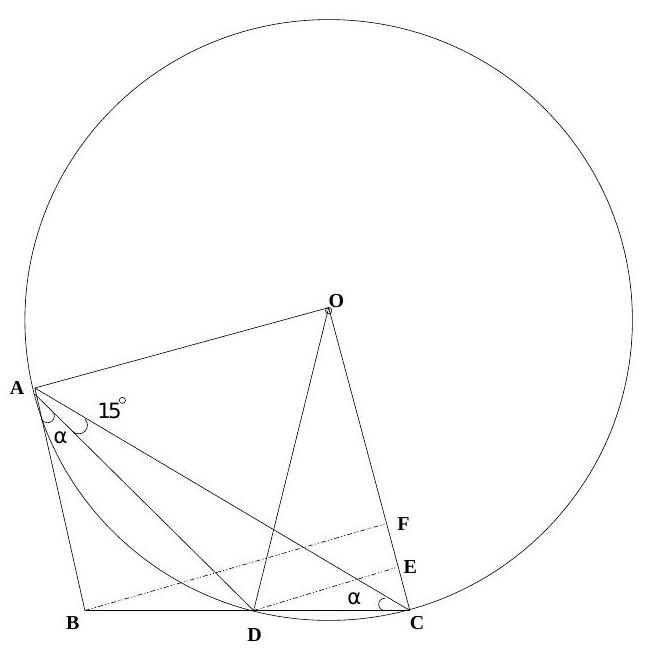\n\nLet $\\alpha$ denote the equal angles $\\angle B A D=\\angle D C A$. Using sine rule in triangles $D A B$ and $D A C$, we get\n\n$$\n\\frac{A D}{\\sin B}=\\frac{B D}{\\sin \\alpha}, \\quad \\frac{C D}{\\sin 15^{\\circ}}=\\frac{A D}{\\sin \\alpha}\n$$\n\nEliminating $\\alpha$ (using $B D=D C$ and $2 \\alpha+B+15^{\\circ}=\\pi$ ), we obtain $1+\\cos \\left(B+15^{\\circ}\\right)=$ $2 \\sin B \\sin 15^{\\circ}$. But we know that $2 \\sin B \\sin 15^{\\circ}=\\cos \\left(B-15^{\\circ}\\right)-\\cos \\left(B+15^{\\circ}\\right)$. Putting $\\beta=B-15^{\\circ}$, we get a relation $1+2 \\cos (\\beta+30)=\\cos \\beta$. We write this in the form\n\n$$\n(1-\\sqrt{3}) \\cos \\beta+\\sin \\beta=1\n$$\n\nSince $\\sin \\beta \\leq 1$, it follows that $(1-\\sqrt{3}) \\cos \\beta \\geq 0$. We conclude that $\\cos \\beta \\leq 0$ and hence that $\\beta$ is obtuse. So is angle $B$ and hence $\\angle A D C$.\n\nWe have the relation $(1-\\sqrt{3}) \\cos \\beta+\\sin \\beta=1$. If we set $x=\\tan (\\beta / 2)$, then we get, using $\\cos \\beta=\\left(1-x^{2}\\right) /\\left(1+x^{2}\\right), \\sin \\beta=2 x /\\left(1+x^{2}\\right)$,\n\n$$\n(\\sqrt{3}-2) x^{2}+2 x-\\sqrt{3}=0\n$$\n\nSolving for $x$, we obtain $x=1$ or $x=\\sqrt{3}(2+\\sqrt{3})$. If $x=\\sqrt{3}(2+\\sqrt{3})$, then $\\tan (\\beta / 2)>2+\\sqrt{3}=\\tan 75^{\\circ}$ giving us $\\beta>150^{\\circ}$. This forces that $B>165^{\\circ}$ and hence $B+A>165^{\\circ}+15^{\\circ}=180^{\\circ}$, a contradiction. thus $x=1$ giving us $\\beta=\\pi / 2$. This gives $B=105^{\\circ}$ and hence $\\alpha=30^{\\circ}$. Thus $\\angle D A O=60^{\\circ}$. Since $O A=O D$, the result follows.\n\n## OR\n\nLet $m_{a}$ denote the median $A D$. Then we can compute\n\n$$\n\\cos \\alpha=\\frac{c^{2}+m_{a}^{2}-\\left(a^{2} / 4\\right)}{2 c m_{a}}, \\quad \\sin \\alpha=\\frac{2 \\Delta}{c m_{a}}\n$$\n\nwhere $\\Delta$ denotes the area of triangle $A B C$. These two expressions give\n\n$$\n\\cot \\alpha=\\frac{c^{2}+m_{a}^{2}-\\left(a^{2} / 4\\right)}{4 \\Delta}\n$$\n\nSimilarly, we obtain\n\n$$\n\\cot \\angle C A D=\\frac{b^{2}+m_{a}^{2}-\\left(a^{2} / 4\\right)}{4 \\Delta}\n$$\n\nThus we get\n\n$$\n\\cot \\alpha-\\cot 15^{\\circ}=\\frac{c^{2}-a^{2}}{4 \\Delta}\n$$\n\nSimilarly we can also obtain\n\n$$\n\\cot B-\\cot \\alpha=\\frac{c^{2}-a^{2}}{4 \\Delta}\n$$\n\ngiving us the relation\n\n$$\n\\cot B=2 \\cot \\alpha-\\cot 15^{\\circ}\n$$\n\nIf $B$ is acute then $2 \\cot \\alpha>\\cot 15^{\\circ}=2+\\sqrt{3}>2 \\sqrt{3}$. It follows that $\\cot \\alpha>\\sqrt{3}$. This implies that $\\alpha<30^{\\circ}$ and hence\n\n$$\nB=180^{\\circ}-2 \\alpha-15^{\\circ}>105^{\\circ}\n$$\n\nThis contradiction forces that angle $B$ is obtuse and consequently $\\angle A D C$ is obtuse.\n\nSince $\\angle B A D=\\alpha=\\angle A C D$, the line $A B$ is tangent to the circumcircle $\\Gamma$ of $A D C$ at $A$. Hence $O A$ is perpendicular to $A B$. Draw $D E$ and $B F$ perpendicular to $A C$, and join $O D$. Since $\\angle D A C=15^{\\circ}$, we see that $\\angle D O C=30^{\\circ}$ and hence $D E=O D / 2$. But $D E$ is parallel to $B F$ and $B D=D C$ shows that $B F=2 D E$. We conclude that\n$B F=D O$. But $D O=A O$, both being radii of $\\Gamma$. Thus $B F=A O$. Using right triangles $B F O$ and $B A O$, we infer that $A B=O F$. We conclude that $A B F O$ is a rectangle. In particular $\\angle A O F=90^{\\circ}$. It follows that\n\n$$\n\\angle A O D=90^{\\circ}-\\angle D O C=90^{\\circ}-30^{\\circ}=60^{\\circ}\n$$\n\nSince $O A=O D$, we conclude that $A O D$ is equilateral.\n\nOR\n\nNote that triangles $A B D$ and $C B A$ are similar. Thus we have the ratios\n\n$$\n\\frac{A B}{B D}=\\frac{C B}{B A}\n$$\n\nThis reduces to $a^{2}=2 c^{2}$ giving us $a=\\sqrt{2} c$. This is equivalent to $\\sin ^{2}\\left(\\alpha+15^{\\circ}\\right)=$ $2 \\sin ^{2} \\alpha$. We write this in the form\n\n$$\n\\cos 15^{\\circ}+\\cot \\alpha \\sin 15^{\\circ}=\\sqrt{2}\n$$\n\nSolving for $\\cot \\alpha$, we get $\\cot \\alpha=\\sqrt{3}$. We conclude that $\\alpha=30^{\\circ}$, and the result follows.", "metadata": {"resource_path": "INMO/segmented/en-2001.jsonl", "problem_match": "\n5.", "solution_match": "## Solution:"}} |
| {"year": "2001", "tier": "T3", "problem_label": "6", "problem_type": null, "exam": "INMO", "problem": "Let $\\mathbf{R}$ denote the set of all real numbers. Find all functions $f: \\mathbf{R} \\rightarrow \\mathbf{R}$ satisfying the condition\n\n$$\nf(x+y)=f(x) f(y) f(x y)\n$$\n\nfor all $x, y$ in $\\mathbf{R}$.", "solution": "Putting $x=0, y=0$, we get $f(0)=f(0)^{3}$ so that $f(0)=0,1$ or -1 . If $f(0)=0$, then taking $y=0$ in the given equation, we obtain $f(x)=f(x) f(0)^{2}=0$ for all $x$.\n\nSuppose $f(0)=1$. Taking $y=-x$, we obtain\n\n$$\n1=f(0)=f(x-x)=f(x) f(-x) f\\left(-x^{2}\\right)\n$$\n\nThis shows that $f(x) \\neq 0$ for any $x \\in \\mathbf{R}$. Taking $x=1, y=x-1$, we obtain\n\n$$\nf(x)=f(1) f(x-1)^{2}=f(1)[f(x) f(-x) f(-x)]^{2}\n$$\n\nUsing $f(x) \\neq 0$, we conclude that $1=k f(x)(f(-x))^{2}$, where $k=$\n\n$f(1)(f(-1))^{2}$. Changing $x$ to $-x$ here, we also infer that $1=k f(-x)(f(x))^{2}$. Comparing these expressions we see that $f(-x)=f(x)$. It follows that $1=k f(x)^{3}$. Thus $f(x)$ is constant for all $x$. Since $f(0)=1$, we conclude that $f(x)=1$ for all real $x$.\n\nIf $f(0)=-1$, a similar analysis shows that $f(x)=-1$ for all $x \\in \\mathbf{R}$. We can verify that each of these functions satisfies the given functional equation. Thus there are three solutions, all of them being constant functions.", "metadata": {"resource_path": "INMO/segmented/en-2001.jsonl", "problem_match": "\n6.", "solution_match": "\nSolution:"}} |
|
|


