| {"year": "2007", "tier": "T3", "problem_label": "1", "problem_type": null, "exam": "INMO", "problem": "In a triangle $A B C$ right-angled at $C$, the median through $B$ bisects the angle between $B A$ and the bisector of $\\angle B$. Prove that\n\n$$\n\\frac{5}{2}<\\frac{A B}{B C}<3\n$$", "solution": "Since $E$ is the mid-point of $A C$, we have $A E=$ $E C=b / 2$. Since $B D$ bisects $\\angle A B C$, we also know that $C D=a b /(a+c)$. Since $B E$ bisects $\\angle A B D$, we also have\n\n$$\n\\frac{B D^{2}}{B A^{2}}=\\frac{D E^{2}}{E A^{2}}\n$$\n\nHowever,\n\n$$\n\\begin{aligned}\nB D^{2} & =B C^{2}+C D^{2}=a^{2}+\\frac{a^{2} b^{2}}{(a+c)^{2}} \\\\\nD E^{2} & =\\left(\\frac{b}{2}-\\frac{a b}{a+c}\\right)^{2}\n\\end{aligned}\n$$\n\n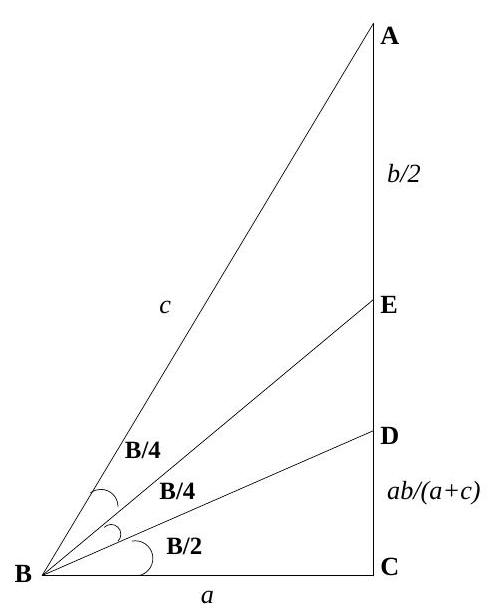\n\nUsing these in the above expression and simplifying, we get\n\n$$\na^{2}\\left\\{(a+c)^{2}+b^{2}\\right\\}=c^{2}(c-a)^{2}\n$$\n\nUsing $c^{2}=a^{2}+b^{2}$ and eliminating $b$, we obtain\n\n$$\nc^{3}-2 a c^{2}-a^{2} c-2 a^{3}=0\n$$\n\nIntroducing $t=c / a$, this reduces to a cubic equation;\n\n$$\nt^{3}-2 t^{2}-t-2=0\n$$\n\nConsider the function $f(t)=t^{3}-2 t^{2}-t-2$ for $t>0$ (as $c / a$ is positive). For $0<t \\leq 2$, we see that $f(t)=t^{2}(t-2)-t-2<0$. We also observe that $f(t)=(t-2)\\left(t^{2}-1\\right)-4$ is strictly increasing on $(2, \\infty)$. It is easy to compute\n\n$$\nf(5 / 2)=-\\frac{11}{8}<0, \\quad \\text { and } \\quad f(3)=4>0\n$$\n\nHence there is a unique value of $t$ in the interval $(5 / 2,3)$ such that $f(t)=0$. We conclude that\n\n$$\n\\frac{5}{2}<\\frac{c}{a}<3\n$$", "metadata": {"resource_path": "INMO/segmented/en-2007.jsonl", "problem_match": "\n1.", "solution_match": "## Solution 1:"}} |
| {"year": "2007", "tier": "T3", "problem_label": "1", "problem_type": null, "exam": "INMO", "problem": "In a triangle $A B C$ right-angled at $C$, the median through $B$ bisects the angle between $B A$ and the bisector of $\\angle B$. Prove that\n\n$$\n\\frac{5}{2}<\\frac{A B}{B C}<3\n$$", "solution": "Let us take $\\angle B / 4=\\theta$. Then $\\angle E B C=\\angle D B E=\\theta$ and $\\angle C B D=$ $2 \\theta$.Using sine rule in triangles $B E A$ and $B E C$, we get\n\n$$\n\\begin{aligned}\n\\frac{B E}{\\sin A} & =\\frac{A E}{\\sin \\theta} \\\\\n\\frac{B E}{\\sin 90^{\\circ}} & =\\frac{C E}{\\sin 3 \\theta}\n\\end{aligned}\n$$\n\nSince $A E=C E$, we obtain $\\sin 3 \\theta \\sin A=\\sin \\theta$. However $A=90^{\\circ}-4 \\theta$. Thus we get $\\sin 3 \\theta \\cos 4 \\theta=\\sin \\theta$. Note that\n\n$$\n\\frac{c}{a}=\\frac{1}{\\cos 4 \\theta}=\\frac{\\sin 3 \\theta}{\\sin \\theta}=3-4 \\sin ^{2} \\theta\n$$\n\nThis shows that $c / a<3$. Using $c / a=3-4 \\sin ^{2} \\theta$, it is easy to compute $\\cos 2 \\theta=((c / a)-1) / 2$. Hence\n\n$$\n\\frac{a}{c}=\\cos 4 \\theta=\\frac{1}{2}\\left(\\frac{c}{a}-1\\right)^{2}-1\n$$\n\nSuppose $c / a \\leq 5 / 2$. Then $((c / a)-1)^{2} \\leq 9 / 4$ and $a / c \\geq 2 / 5$. Thus\n\n$$\n\\frac{2}{5} \\leq \\frac{a}{c}=\\frac{1}{2}\\left(\\frac{c}{a}-1\\right)^{2}-1 \\leq \\frac{9}{8}-1=\\frac{1}{8}\n$$\n\nwhich is absurd. We conclude that $c / a>5 / 2$.", "metadata": {"resource_path": "INMO/segmented/en-2007.jsonl", "problem_match": "\n1.", "solution_match": "\nSolution 2:"}} |
| {"year": "2007", "tier": "T3", "problem_label": "2", "problem_type": null, "exam": "INMO", "problem": "Let $n$ be a natural number such that $n=a^{2}+b^{2}+c^{2}$, for some natural numbers $a, b, c$. Prove that\n\n$$\n9 n=\\left(p_{1} a+q_{1} b+r_{1} c\\right)^{2}+\\left(p_{2} a+q_{2} b+r_{2} c\\right)^{2}+\\left(p_{3} a+q_{3} b+r_{3} c\\right)^{2}\n$$\n\nwhere $p_{j}$ 's, $q_{j}$ 's, $r_{j}$ 's are all nonzero integers. Further, if 3 does not divide at least one of $a, b, c$, prove that $9 n$ can be expressed in the form $x^{2}+y^{2}+z^{2}$, where $x, y, z$ are natural numbers none of which is divisible by 3 .", "solution": "It can be easily seen that\n\n$$\n9 n=(2 b+2 c-a)^{2}+(2 c+2 a-b)^{2}+(2 a+2 b-c)^{2}\n$$\n\nThus we can take $p_{1}=p_{2}=p_{3}=2, q_{1}=q_{2}=q_{3}=2$ and $r_{1}=r_{2}=r_{3}=-1$. Suppose 3 does not divide $\\operatorname{gcd}(a, b, c)$. Then 3 does divide at least one of $a, b, c$; say 3 does not divide $a$. Note that each of $2 b+2 c-a, 2 c+2 a-b$ and $2 a+2 b-c$ is either divisible by 3 or none of them is divisible by 3 , as the difference of any two sums is always divisible by 3 . If 3 does not divide $2 b+2 c-a$, then we have the required representation. If 3 divides $2 b+2 c-a$, then 3 does not divide $2 b+2 c+a$. On the other hand, we also note that\n\n$$\n9 n=(2 b+2 c+a)^{2}+(2 c-2 a-b)^{2}+(-2 a+2 b-c)^{2}=x^{2}+y^{2}+z^{2}\n$$\n\nwhere $x=2 b+2 c+a, y=2 c-2 a-b$ and $z=-2 a+2 b-c$. Since $x-y=3(b+a)$ and 3 does not divide $x$, it follows that 3 does not divide $y$ as well. Similarly, we conclude that 3 does not divide $z$.", "metadata": {"resource_path": "INMO/segmented/en-2007.jsonl", "problem_match": "\n2.", "solution_match": "\nSolution:"}} |
| {"year": "2007", "tier": "T3", "problem_label": "3", "problem_type": null, "exam": "INMO", "problem": "Let $m$ and $n$ be positive integers such that the equation $x^{2}-m x+n=0$ has real roots $\\alpha$ and $\\beta$. Prove that $\\alpha$ and $\\beta$ are integers if and only if $[m \\alpha]+[m \\beta]$ is the square of an integer. (Here $[x]$ denotes the largest integer not exceeding $x$.)", "solution": "If $\\alpha$ and $\\beta$ are both integers, then\n\n$$\n[m \\alpha]+[m \\beta]=m \\alpha+m \\beta=m(\\alpha+\\beta)=m^{2}\n$$\n\nThis proves one implication.\n\nObserve that $\\alpha+\\beta=m$ and $\\alpha \\beta=n$. We use the property of integer function: $x-1<[x] \\leq x$ for any real number $x$. Thus\n\n$m^{2}-2=m(\\alpha+\\beta)-2=m \\alpha-1+m \\beta-1<[m \\alpha]+[m \\beta] \\leq m(\\alpha+\\beta)=m^{2}$.\n\nSince $m$ and $n$ are positive integers, both $\\alpha$ and $\\beta$ must be positive. If $m \\geq 2$, we observe that there is no square between $m^{2}-2$ and $m^{2}$. Hence, either $m=1$ or $[m \\alpha]+[m \\beta]=m^{2}$. If $m=1$, then $\\alpha+\\beta=1$ implies that both $\\alpha$ and $\\beta$ are positive reals smaller than 1 . Hence $n=\\alpha \\beta$ cannot be a positive integer. We conclude that $[m \\alpha]+[m \\beta]=m^{2}$. Putting $m=\\alpha+\\beta$ in this relation, we get\n\n$$\n\\left[\\alpha^{2}+n\\right]+\\left[\\beta^{2}+n\\right]=(\\alpha+\\beta)^{2}\n$$\n\nUsing $[x+k]=[x]+k$ for any real number $x$ and integer $k$, this reduces to\n\n$$\n\\left[\\alpha^{2}\\right]+\\left[\\beta^{2}\\right]=\\alpha^{2}+\\beta^{2}\n$$\n\nThis shows that $\\alpha^{2}$ and $\\beta^{2}$ are both integers. On the other hand,\n\n$$\n\\alpha^{2}-\\beta^{2}=(\\alpha+\\beta)(\\alpha-\\beta)=m(\\alpha-\\beta)\n$$\n\nThus\n\n$$\n(\\alpha-\\beta)=\\frac{\\alpha^{2}-\\beta^{2}}{m}\n$$\n\nis a rational number. Since $\\alpha+\\beta=m$ is a rational number, it follows that both $\\alpha$ and $\\beta$ are rational numbers. However, both $\\alpha^{2}$ and $\\beta^{2}$ are integers. Hence each of $\\alpha$ and $\\beta$ is an integer.", "metadata": {"resource_path": "INMO/segmented/en-2007.jsonl", "problem_match": "\n3.", "solution_match": "\nSolution:"}} |
| {"year": "2007", "tier": "T3", "problem_label": "4", "problem_type": null, "exam": "INMO", "problem": "Let $\\sigma=\\left(a_{1}, a_{2}, a_{3}, \\ldots, a_{n}\\right)$ be a permutation of $(1,2,3, \\ldots, n)$. A pair $\\left(a_{i}, a_{j}\\right)$ is said to correspond to an inversion of $\\sigma$, if $i<j$ but $a_{i}>a_{j}$. (Example: In the permutation $(2,4,5,3,1)$, there are 6 inversions corresponding to the pairs $(2,1)$, $(4,3),(4,1),(5,3),(5,1),(3,1)$.) How many permutations of $(1,2,3, \\ldots n)$, $(n \\geq 3)$, have exactly two inversions?", "solution": "In a permutation of $(1,2,3, \\ldots, n)$, two inversions can occur in only one of the following two ways:\n\n(A) Two disjoint consecutive pairs are interchanged:\n\n$$\n\\begin{aligned}\n& (1,2,3, j-1, j, j+1, j+2 \\ldots k-1, k, k+1, k+2, \\ldots, n) \\\\\n& \\quad \\longrightarrow(1,2, \\ldots j-1, j+1, j, j+2, \\ldots, k-1, k+1, k, k+2, \\ldots, n)\n\\end{aligned}\n$$\n\n(B) Each block of three consecutive integers can be permuted in any of the following 2 ways;\n\n$$\n\\begin{aligned}\n& (1,2,3, \\ldots k, k+1, k+2, \\ldots, n) \\longrightarrow(1,2, \\ldots, k+2, k, k+1, \\ldots, n) \\\\\n& (1,2,3, \\ldots k, k+1, k+2, \\ldots, n) \\longrightarrow(1,2, \\ldots, k+1, k+2, k, \\ldots, n)\n\\end{aligned}\n$$\n\nConsider case (A). For $j=1$, there are $n-3$ possible values of $k$; for $j=2$, there are $n-4$ possibilities for $k$ and so on. Thus the number of permutations with two inversions of this type is\n\n$$\n1+2+\\cdots+(n-3)=\\frac{(n-3)(n-2)}{2}\n$$\n\nIn case (B), we see that there are $n-2$ permutations of each type, since $k$ can take values from 1 to $n-2$. Hence we get $2(n-2)$ permutations of this type.\n\nFinally, the number of permutations with two inversions is\n\n$$\n\\frac{(n-3)(n-2)}{2}+2(n-2)=\\frac{(n+1)(n-2)}{2}\n$$", "metadata": {"resource_path": "INMO/segmented/en-2007.jsonl", "problem_match": "\n4.", "solution_match": "\nSolution:"}} |
| {"year": "2007", "tier": "T3", "problem_label": "5", "problem_type": null, "exam": "INMO", "problem": "Let $A B C$ be a triangle in which $A B=A C$. Let $D$ be the mid-point of $B C$ and $P$ be a point on $A D$. Suppose $E$ is the foot of perpendicular from $P$ on $A C$. If $\\frac{A P}{P D}=\\frac{B P}{P E}=\\lambda, \\frac{B D}{A D}=m$ and $z=m^{2}(1+\\lambda)$, prove that\n\n$$\nz^{2}-\\left(\\lambda^{3}-\\lambda^{2}-2\\right) z+1=0\n$$\n\nHence show that $\\lambda \\geq 2$ and $\\lambda=2$ if and only if $A B C$ is equilateral.", "solution": "Let $A D=h, P D=y$ and $B D=D C=a$. We\n\n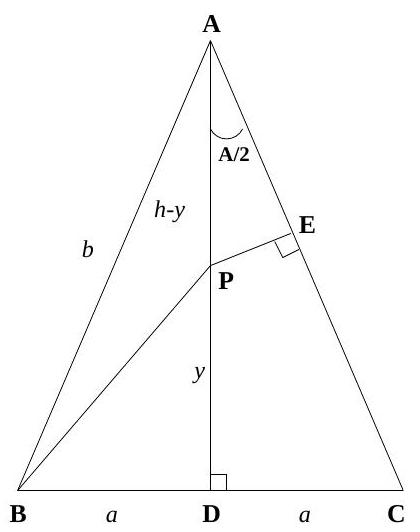\nobserve that $B P^{2}=a^{2}+y^{2}$. Moreover,\n\n$P E=P A \\sin \\angle D A C=(h-y) \\frac{D C}{A C}=\\frac{a(h-y)}{b}$,\n\nwhere $b=A C=A B$. Using $A P / P D=(h-$ $y) / y$, we obtain $y=h /(1+\\lambda)$. Thus\n\n$$\n\\lambda^{2}=\\frac{B P^{2}}{P E^{2}}=\\frac{\\left(a^{2}+y^{2}\\right) b^{2}}{(h-y)^{2} a^{2}}\n$$\n\nBut $(h-y)=\\lambda y=\\lambda h /(1+\\lambda)$ and $b^{2}=a^{2}+h^{2}$. Thus we obtain\n\n$$\n\\lambda^{4}=\\frac{\\left(a^{2}(1+\\lambda)^{2}+h^{2}\\right)\\left(a^{2}+h^{2}\\right)}{a^{2} h^{2}}\n$$\n\nUsing $m=a / h$ and $z=m^{2}(1+\\lambda)$, this simplifies to\n\n$$\nz^{2}-z\\left(\\lambda^{3}-\\lambda^{2}-2\\right)+1=0\n$$\n\nDividing by $z$, this gives\n\n$$\nz+\\frac{1}{z}=\\lambda^{3}-\\lambda^{2}-2\n$$\n\nHowever $z+(1 / z) \\geq 2$ for any positive real number $z$. Thus $\\lambda^{3}-\\lambda^{2}-4 \\geq 0$. This may be written in the form $(\\lambda-2)\\left(\\lambda^{2}+\\lambda+2\\right) \\geq 0$. But $\\lambda^{2}+\\lambda+2>0$. (For example, one may check that its discriminant is negative.) Hence $\\lambda \\geq 2$. If $\\lambda=2$, then $z+(1 / z)=2$ and hence $z=1$. This gives $m^{2}=1 / 3$ or $\\tan (A / 2)=m=1 / \\sqrt{3}$. Thus $A=60^{\\circ}$ and hence $A B C$ is equilateral.\n\nConversely, if triangle $A B C$ is equilateral, then $m=\\tan (A / 2)=1 / \\sqrt{3}$ and hence $z=(1+\\lambda) / 3$. Substituting this in the equation satisfied by $z$, we obtain\n\n$$\n(1+\\lambda)^{2}-3(1+\\lambda)\\left(\\lambda^{3}-\\lambda^{2}-2\\right)+9=0\n$$\n\nThis may be written in the form $(\\lambda-2)\\left(3 \\lambda^{3}+6 \\lambda^{2}+8 \\lambda+8\\right)=0$. Here the second factor is positive because $\\lambda>0$. We conclude that $\\lambda=2$.", "metadata": {"resource_path": "INMO/segmented/en-2007.jsonl", "problem_match": "\n5.", "solution_match": "## Solution:"}} |
| {"year": "2007", "tier": "T3", "problem_label": "6", "problem_type": null, "exam": "INMO", "problem": "If $x, y, z$ are positive real numbers, prove that\n\n$$\n(x+y+z)^{2}(y z+z x+x y)^{2} \\leq 3\\left(y^{2}+y z+z^{2}\\right)\\left(z^{2}+z x+x^{2}\\right)\\left(x^{2}+x y+y^{2}\\right)\n$$", "solution": "We begin with the observation that\n\n$$\nx^{2}+x y+y^{2}=\\frac{3}{4}(x+y)^{2}+\\frac{1}{4}(x-y)^{2} \\geq \\frac{3}{4}(x+y)^{2}\n$$\n\nand similar bounds for $y^{2}+y z+z^{2}, z^{2}+z x+x^{2}$. Thus\n\n$$\n3\\left(x^{2}+x y+y^{2}\\right)\\left(y^{2}+y z+z^{2}\\right)\\left(z^{2}+z x+x^{2}\\right) \\geq \\frac{81}{64}(x+y)^{2}(y+z)^{2}(z+x)^{2}\n$$\n\nThus it is sufficient to prove that\n\n$$\n(x+y+z)(x y+y z+z x) \\leq \\frac{9}{8}(x+y)(y+z)(z+x)\n$$\n\nEquivalently, we need to prove that\n\n$$\n8(x+y+z)(x y+y z+z x) \\leq 9(x+y)(y+z)(z+x)\n$$\n\nHowever, we note that\n\n$$\n(x+y)(y+z)(z+x)=(x+y+z)(y z+z x+x y)-x y z\n$$\n\nThus the required inequality takes the form\n\n$$\n(x+y)(y+z)(z+x) \\geq 8 x y z\n$$\n\nThis follows from AM-GM inequalities;\n\n$$\nx+y \\geq 2 \\sqrt{x y}, \\quad y+z \\geq 2 \\sqrt{y z}, \\quad z+x \\geq 2 \\sqrt{z x}\n$$", "metadata": {"resource_path": "INMO/segmented/en-2007.jsonl", "problem_match": "\n6.", "solution_match": "\nSolution 1:"}} |
| {"year": "2007", "tier": "T3", "problem_label": "6", "problem_type": null, "exam": "INMO", "problem": "If $x, y, z$ are positive real numbers, prove that\n\n$$\n(x+y+z)^{2}(y z+z x+x y)^{2} \\leq 3\\left(y^{2}+y z+z^{2}\\right)\\left(z^{2}+z x+x^{2}\\right)\\left(x^{2}+x y+y^{2}\\right)\n$$", "solution": "Let us introduce $x+y=c, y+z=a$ and $z+x=b$. Then $a, b, c$ are the sides of a triangle. If $s=(a+b+c) / 2$, then it is easy to calculate $x=s-a, y=s-b, z=s-c$ and $x+y+z=s$. We also observe that\n\n$x^{2}+x y+y^{2}=(x+y)^{2}-x y=c^{2}-\\frac{1}{4}(c+a-b)(c+b-a)=\\frac{3}{4} c^{2}+\\frac{1}{4}(a-b)^{2} \\geq \\frac{3}{4} c^{2}$.\n\nMoreover, $x y+y z+z x=(s-a)(s-b)+(s-b)(s-c)+(s-c)(s-a)$. Thus it si sufficient to prove that\n\n$$\ns \\sum(s-a)(s-b) \\leq \\frac{9}{8} a b c\n$$\n\nBut, $\\sum(s-a)(s-b)=r(4 R+r)$, where $r, R$ are respectively the in-radius, the circum-radius of the triangle whose sides are $a, b, c$, and $a b c=4 R r s$. Thus the inequality reduces to\n\n$$\nr(4 R+r) \\leq \\frac{9}{2} R r\n$$\n\nThis is simply $2 r \\leq R$. This follows from $I O^{2}=R(R-2 r)$, where $I$ is the incentre and $O$ the circumcentre.", "metadata": {"resource_path": "INMO/segmented/en-2007.jsonl", "problem_match": "\n6.", "solution_match": "\nSolution 2:"}} |
| {"year": "2007", "tier": "T3", "problem_label": "6", "problem_type": null, "exam": "INMO", "problem": "If $x, y, z$ are positive real numbers, prove that\n\n$$\n(x+y+z)^{2}(y z+z x+x y)^{2} \\leq 3\\left(y^{2}+y z+z^{2}\\right)\\left(z^{2}+z x+x^{2}\\right)\\left(x^{2}+x y+y^{2}\\right)\n$$", "solution": "If we set $x=\\lambda a, y=\\lambda b, z=\\lambda c$, then the inequality changes to\n\n$$\n(a+b+c)^{2}(a b+b c+c a)^{2} \\leq 3\\left(a^{2}+a b+b^{2}\\right)\\left(b^{2}+b c+c^{2}\\right)\\left(c^{2}+c a+a^{2}\\right)\n$$\n\nThis shows that we may assume $x+y+z=1$. Let $\\alpha=x y+y z+z x$. We see that\n\n$$\n\\begin{aligned}\nx^{2}+x y+y^{2} & =(x+y)^{2}-x y \\\\\n& =(x+y)(1-z)-x y \\\\\n& =x+y-\\alpha=1-z-\\alpha\n\\end{aligned}\n$$\n\nThus\n\n$$\n\\begin{aligned}\n\\prod\\left(x^{2}+x y+y^{2}\\right) & =(1-\\alpha-z)(1-\\alpha-x)(1-\\alpha-y) \\\\\n& =(1-\\alpha)^{3}-(1-\\alpha)^{2}+(1-\\alpha) \\alpha-x y z \\\\\n& =\\alpha^{2}-\\alpha^{3}-x y z\n\\end{aligned}\n$$\n\nThus we need to prove that $\\alpha^{2} \\leq 3\\left(\\alpha^{2}-\\alpha^{3}-x y z\\right)$. This reduces to\n\n$$\n3 x y z \\leq \\alpha^{2}(2-3 \\alpha)\n$$\n\nHowever\n\n$$\n3 \\alpha=3(x y+y z+z x) \\leq(x+y+z)^{2}=1\n$$\n\nso that $2-3 \\alpha \\geq 1$. Thus it suffices to prove that $3 x y z \\leq \\alpha^{2}$. But\n\n$$\n\\begin{aligned}\n\\alpha^{2}-3 x y z & =(x y+y z+z x)^{2}-3 x y z(x+y+z) \\\\\n& =\\sum_{\\text {cyclic }} x^{2} y^{2}-x y z(x+y+z) \\\\\n& =\\frac{1}{2} \\sum_{\\text {cyclic }}(x y-y z)^{2} \\geq 0\n\\end{aligned}\n$$", "metadata": {"resource_path": "INMO/segmented/en-2007.jsonl", "problem_match": "\n6.", "solution_match": "\nSolution 3:"}} |
|
|


