| {"year": "2008", "tier": "T3", "problem_label": "1", "problem_type": null, "exam": "INMO", "problem": "Let $A B C$ be a triangle, $I$ its in-centre; $A_{1}, B_{1}, C_{1}$ be the reflections of $I$ in $B C, C A, A B$ respectively. Suppose the circum-circle of triangle $A_{1} B_{1} C_{1}$ passes through $A$. Prove that $B_{1}, C_{1}$, $I, I_{1}$ are concyclic, where $I_{1}$ is the in-centre of triangle $A_{1} B_{1} C_{1}$.", "solution": "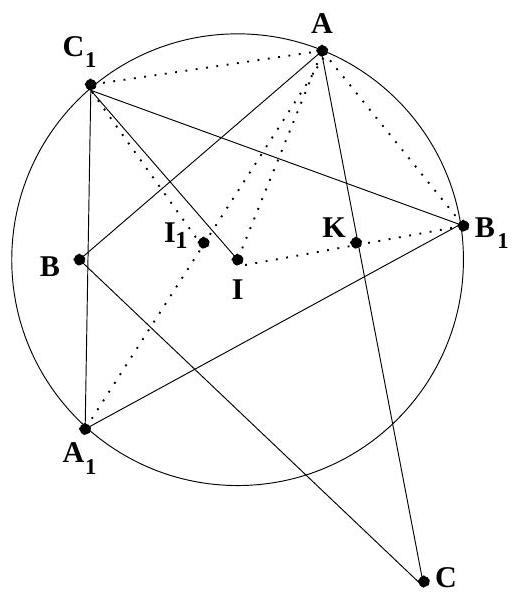\n\nNote that $I A_{1}=I B_{1}=I C_{1}=2 r$, where $r$ is the in-radius of the triangle $A B C$. Hence $I$ is the circum-centre of the triangle $A_{1} B_{1} C_{1}$.\n\nLet $K$ be the point of intersection of $I B_{1}$ and $A C$. Then $I K=r, I A=2 r$ and $\\angle I K A=90^{\\circ}$. It follows that $\\angle I A K=30^{\\circ}$ and hence $\\angle I A B_{1}=60^{\\circ}$. Thus $A I B_{1}$ is an equilateral triangle. Similarly triangle $A I C_{1}$ is also equilateral. We hence obtain $A B_{1}=A C_{1}=A I=I B_{1}=I C_{1}=2 r$.\n\nWe also observe that $\\angle B_{1} I C_{1}=120^{\\circ}$ and $I B_{1} A C_{1}$ is a rhombus. Thus $\\angle B_{1} A C_{1}=120^{\\circ}$ and by concyclicity $\\angle A_{1}=60^{\\circ}$. Since $A B_{1}=A C_{1}, A$ is the midpoint of the arc $B_{1} A C_{1}$. It follows that $A_{1} A$ bisects $\\angle A_{1}$ and $I_{1}$ lies on the line $A_{1} A$. This implies that\n\n$$\n\\angle B_{1} I_{1} C_{1}=90^{\\circ}+\\angle A_{1} / 2=90^{\\circ}+30^{\\circ}=120^{\\circ}\n$$\n\nSince $\\angle B_{1} I C_{1}=120^{\\circ}$, we conclude that $B_{1}, I, I_{1}, C_{1}$ are concyclic. (Further $A$ is the centre.)", "metadata": {"resource_path": "INMO/segmented/en-2008.jsonl", "problem_match": "\n1.", "solution_match": "## Solution:"}} |
| {"year": "2008", "tier": "T3", "problem_label": "2", "problem_type": null, "exam": "INMO", "problem": "Find all triples $(p, x, y)$ such that $p^{x}=y^{4}+4$, where $p$ is a prime and $x, y$ are natural numbers.", "solution": "We begin with the standard factorisation\n\n$$\ny^{4}+4=\\left(y^{2}-2 y+2\\right)\\left(y^{2}+2 y+2\\right)\n$$\n\nThus we have $y^{2}-2 y+2=p^{m}$ and $y^{2}+2 y+2=p^{n}$ for some positive integers $m$ and $n$ such that $m+n=x$. Since $y^{2}-2 y+2<y^{2}+2 y+2$, we have $m<n$ so that $p^{m}$ divides $p^{n}$. Thus $y^{2}-2 y+2$ divides $y^{2}+2 y+2$. Writing $y^{2}+2 y+2=y^{2}-2 y+2+4 y$, we infer that $y^{2}-2 y+2$ divides $4 y$ and hence $y^{2}-2 y+2$ divides $4 y^{2}$. But\n\n$$\n4 y^{2}=4\\left(y^{2}-2 y+2\\right)+8(y-1)\n$$\n\nThus $y^{2}-2 y+2$ divides $8(y-1)$. Since $y^{2}-2 y+2$ divides both $4 y$ and $8(y-1)$, we conclude that it also divides 8 . This gives $y^{2}-2 y+2=1,2,4$ or 8 .\n\nIf $y^{2}-2 y+2=1$, then $y=1$ and $y^{4}+4=5$, giving $p=5$ and $x=1$. If $y^{2}-2 y+2=2$, then $y^{2}-2 y=0$ giving $y=2$. But then $y^{4}+4=20$ is not the power of a prime. The equations $y^{2}-2 y+2=4$ and $y^{2}-2 y+2=8$ have no integer solutions. We conclude that $(p, x, y)=(5,1,1)$ is the only solution.\n\nAlternatively, using $y^{2}-2 y+2=p^{m}$ and $y^{2}+2 y+2=p^{n}$, we may get\n\n$$\n4 y=p^{m}\\left(p^{n-m}-1\\right)\n$$\n\nIf $m>0$, then $p$ divides 4 or $y$. If $p$ divides 4 , then $p=2$. If $p$ divides $y$, then $y^{2}-2 y+2=p^{m}$ shows that $p$ divides 2 and hence $p=2$. But then $2^{x}=y^{4}+4$, which shows that $y$ is even. Taking $y=2 z$, we get $2^{x-2}=4 z^{4}+1$. This implies that $z=0$ and hence $y=0$, which is a contradiction. Thus $m=0$ and $y^{2}-2 y+2=1$. This gives $y=1$ and hence $p=5, x=1$.", "metadata": {"resource_path": "INMO/segmented/en-2008.jsonl", "problem_match": "\n2.", "solution_match": "\nSolution:"}} |
| {"year": "2008", "tier": "T3", "problem_label": "3", "problem_type": null, "exam": "INMO", "problem": "Let $A$ be a set of real numbers such that $A$ has at least four elements. Suppose $A$ has the property that $a^{2}+b c$ is a rational number for all distinct numbers $a, b, c$ in $A$. Prove that there exists a positive integer $M$ such that $a \\sqrt{M}$ is a rational number for every $a$ in $A$.", "solution": "Suppose $0 \\in A$. Then $a^{2}=a^{2}+0 \\times b$ is rational and $a b=0^{2}+a b$ is also rational for all $a, b$ in $A, a \\neq 0, b \\neq 0, a \\neq b$. Hence $a=a_{1} \\sqrt{M}$ for some rational $a_{1}$ and natural number $M$. For any $b \\neq 0$, we have\n\n$$\nb \\sqrt{M}=\\frac{a b}{a_{1}}\n$$\n\nwhich is a rational number.\n\nHence we may assume 0 is not in $A$. If there is a number $a$ in $A$ such that $-a$ is also in $A$, then again we can get the conclusion as follows. Consider two other elements $c, d$ in $A$. Then $c^{2}+d a$ is rational and $c^{2}-d a$ is also rational. It follows that $c^{2}$ is rational and $d a$ is rational. Similarly, $d^{2}$ and $c a$ are also rationals. Thus $d / c=(d a) /(c a)$ is rational. Note that we can vary $d$ over $A$ with $d \\neq c$ and $d \\neq a$. Again $c^{2}$ is rational implies that $c=c_{1} \\sqrt{M}$ for some rational $c_{1}$ and natural number $M$. We observe that $c \\sqrt{M}=c_{1} M$ is rational, and\n\n$$\na \\sqrt{M}=\\frac{c a}{c_{1}}\n$$\n\nso that $a \\sqrt{M}$ is a rational number. Similarly is the case with $-a \\sqrt{M}$. For any other element $d$,\n\n$$\nb \\sqrt{M}=M c_{1} \\frac{d}{c}\n$$\n\nis a rational number.\n\nThus we may now assume that 0 is not in $A$ and $a+b \\neq 0$ for any $a, b$ in $A$. Let $a, b, c, d$ be four distinct elements of $A$. We may assume $|a|>\\mid b$. Then $d^{2}+a b$ and $d^{2}+b c$ are rational numbers and so is their difference $a b-b c$. Writing $a^{2}+a b=a^{2}+b c+(a b-b c)$, and using the facts $a^{2}+b c$, $a b-b c$ are rationals, we conclude that $a^{2}+a b$ is also a rational number. Similarly, $b^{2}+a b$ is also a rational number.\n\nConsider\n\n$$\nq=\\frac{a}{b}=\\frac{a^{2}+a b}{b^{2}+a b}\n$$\n\nNote that $a^{2}+a b>0$. Thus $q$ is a rational number and $a=b q$. This gives $a^{2}+a b=b^{2}\\left(q^{2}+q\\right)$. Let us take $b^{2}\\left(q^{2}+q\\right)=l$. Then\n\n$$\n|b|=\\sqrt{\\frac{l}{q^{2}+q}}=\\sqrt{\\frac{x}{y}}\n$$\n\nwhere $x$ and $y$ are natural numbers. Take $M=x y$. Then $|b| \\sqrt{M}=x$ is a rational number. Finally, for any $c$ in $A$, we have\n\n$$\nc \\sqrt{M}=b \\sqrt{M} \\frac{c}{b}\n$$\n\nis also a rational number.", "metadata": {"resource_path": "INMO/segmented/en-2008.jsonl", "problem_match": "\n3.", "solution_match": "\nSolution:"}} |
| {"year": "2008", "tier": "T3", "problem_label": "4", "problem_type": null, "exam": "INMO", "problem": "All the points with integer coordinates in the $x y$-plane are coloured using three colours, red, blue and green, each colour being used at least once. It is known that the point $(0,0)$ is coloured red and the point $(0,1)$ is coloured blue. Prove that there exist three points with integer coordinates of distinct colours which form the vertices of a right-angled triangle.", "solution": "Consider the lattice points(points with integer coordinates) on the lines $y=0$ and $y=1$, other than $(0,0)$ and $(0,1)$, If one of them, say $A=(p, 1)$, is coloured green, then we have a right-angled triangle with $(0,0),(0,1)$ and $A$ as vertices, all having different colours. (See Figures 1 and 2.)\n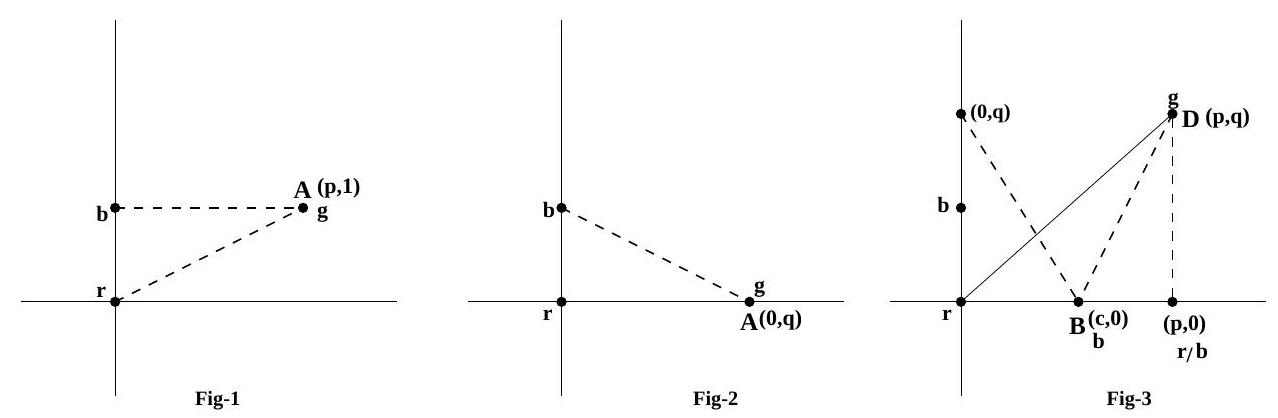\n\nIf not, the lattice points on $y=0$ and $y=1$ are all red or blue. We consider three different cases.\n\nCase 1. Suppose a point $B=(c, 0)$ is blue. Consider a green point $D=(p, q)$ in the plane. Suppose $p \\neq 0$. If its projection $(p, 0)$ on the $x$-axis is red, then $(p, q),(p, 0)$ and $(c, 0)$ are the vertices of a required type of right-angled triangle. If $(p, 0)$ is blue, then we can consider the triangle whose vertices are $(0,0),(p, 0)$ and $(p, q)$. If $p=0$, then the points $D,(0,0)$ and $(c, 0)$ will work.(Figure 3.)\n\nCase 2. A point $D=(c, 1)$, on the line $y=1$, is red. A similar argument works in this case.\n\n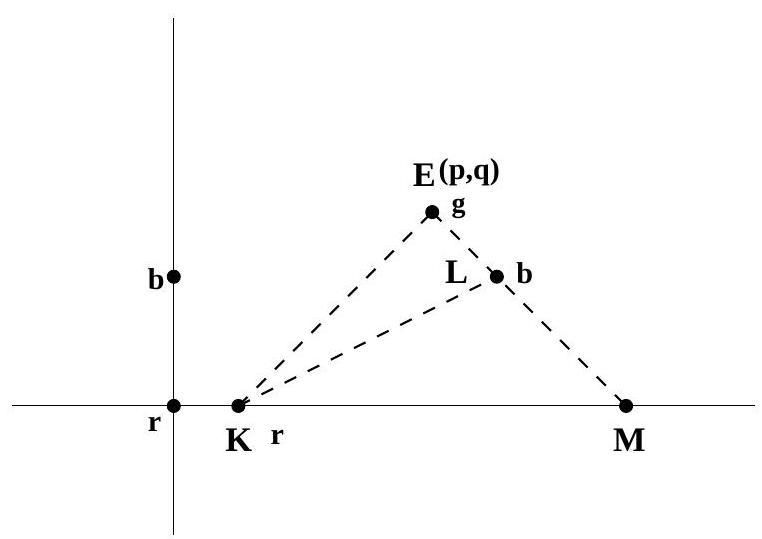\n\nFig-4\n\nCase 3. Suppose all the lattice points on the line $y=0$ are red and all on the line $y=1$ are blue points. Consider a green point $E=(p, q)$, where $q \\neq 0$ and $q \\neq 1$.(See Figure 4.) Consider an isosceles right-angled triangle $E K M$ with $\\angle E=90^{\\circ}$ such that the hypotenuse $K M$ is a part of the $x$-axis. Let $E M$ intersect $y=$ in $L$. Then $K$ is a red point and $L$ is a blue point. Hence $E K L$ is a desired triangle.", "metadata": {"resource_path": "INMO/segmented/en-2008.jsonl", "problem_match": "\n4.", "solution_match": "\nSolution:"}} |
| {"year": "2008", "tier": "T3", "problem_label": "5", "problem_type": null, "exam": "INMO", "problem": "Let $A B C$ be a triangle; $\\Gamma_{A}, \\Gamma_{B}, \\Gamma_{C}$ be three equal, disjoint circles inside $A B C$ such that $\\Gamma_{A}$ touches $A B$ and $A C ; \\Gamma_{B}$ touches $A B$; and $B C$, and $\\Gamma_{C}$ touches $B C$ and $C A$. Let $\\Gamma$ be a circle touching circles $\\Gamma_{A}, \\Gamma_{B}, \\Gamma_{C}$ externally. Prove that the line joining the circum-centre $O$ and the in-centre $I$ of triangle $A B C$ passes through the centre of $\\Gamma$.", "solution": "Let $O_{1}, O_{2}, O_{3}$ be the centres of the circles $\\Gamma_{A}, \\Gamma_{B}, \\Gamma_{C}$ respectively, and let $P$ be the circum-centre of the triangle $O_{1} O_{2} O_{3}$. Let $x$ denote the common radius of three circles $\\Gamma_{A}, \\Gamma_{B}$, $\\Gamma_{C}$. Note that $P$ is also the centre of the circle $\\Gamma$, as $O_{1} P, O_{2} P, O_{3} P$ each exceed the radius of $\\Gamma$ by $x$. Let $D, X, K, L, M$ be respectively the projections of $I, P, O, O_{1}, O_{2}$ on $B C$.\n\n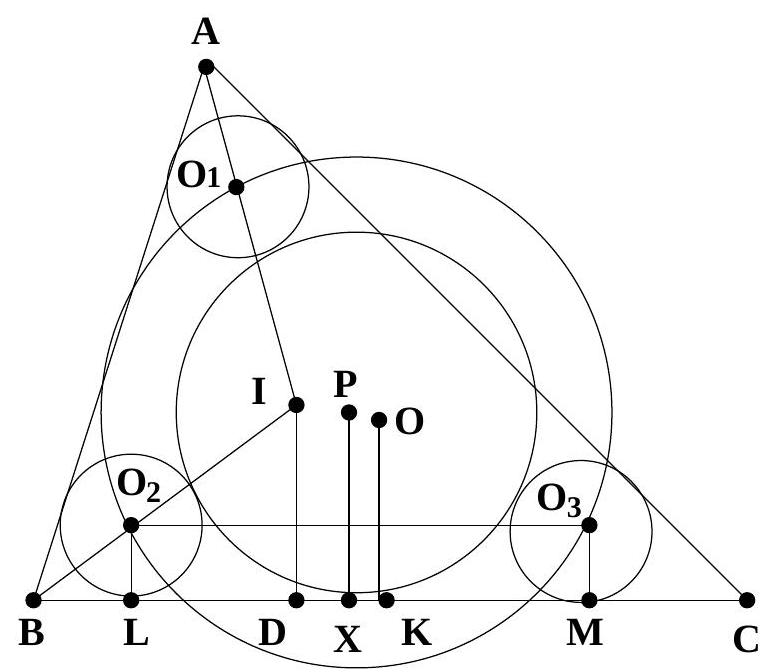\n\nFrom $\\frac{B L}{B D}=\\frac{L O_{2}}{D I}$, we get $B L=x(s-b) / r$, as $I D=r$ and $B D=(s-b)$. Similarly, $C M=$ $x(s-c) / r$. Therefore, $L M=a-\\frac{x}{r}(s-b+s-c)=\\frac{a}{r}(r-x)$. Since $O_{2} L M O_{3}$ is a rectangle and $P X$ is the perpendicular bisector of $\\mathrm{O}_{2} \\mathrm{O}_{3}$, it is perpendicular bisector of $L M$ as well. Thus\n\n$$\n\\begin{aligned}\nL X & =\\frac{1}{2} L M=\\frac{a}{2 r}(r-x) \\\\\nB X & =B L+L X=\\frac{x}{r}(s-b)+\\frac{a}{2 r}(r-x)=\\frac{a}{2}-\\frac{x(b-c)}{2 r} \\\\\nD K & =B K-B D=\\frac{a}{2}-(s-b)=\\frac{b-c}{2} \\\\\nX K & =B K-B X=\\frac{a}{2}-\\frac{a}{2}+\\frac{x(b-c)}{2 r}=\\frac{x(b-c)}{2 r}\n\\end{aligned}\n$$\n\nHence we get\n\n$$\n\\frac{X K}{D K}=\\frac{x}{r}\n$$\n\nWe observe that the sides of triangle $\\mathrm{O}_{1} \\mathrm{O}_{2} \\mathrm{O}_{3}$ are\n\n$$\nO_{2} O_{3}=L M=\\frac{a}{r}(r-x), \\quad O_{3} O_{1}=\\frac{b}{r}(r-x), \\quad O_{1} O_{2}=\\frac{c}{r}(r-x)\n$$\n\nThus the sides of $O_{1} O_{2} O_{3}$ and those of $A B C$ are in the ratio $(r-x) / r$. Further, as the sides of $O_{1} O_{2} O_{3}$ are parallel to those of $A B C$, we see that $I$ is the in-centre of $O_{1} O_{2} O_{3}$ as well. This gives $I P / I O=(r-x) / r$, and hence $P O / I O=x / r$. Thus we obtain\n\n$$\n\\frac{X K}{D K}=\\frac{P O}{I O}\n$$\n\nIt follows that $I, P, O$ are collinear.\n\nAlternately, we also infer that $I$ is the centre of homothety which takes the figure $\\mathrm{O}_{1} \\mathrm{O}_{2} \\mathrm{O}_{3}$ to $A B C$. Hence it takes $P$ to $O$. It follows that $I, P, O$ are collinear", "metadata": {"resource_path": "INMO/segmented/en-2008.jsonl", "problem_match": "\n5.", "solution_match": "\nSolution:"}} |
| {"year": "2008", "tier": "T3", "problem_label": "6", "problem_type": null, "exam": "INMO", "problem": "Let $P(x)$ be a given polynomial with integer coefficients. Prove that there exist two polynomials $Q(x)$ and $R(x)$, again with integer coefficients, such that (i) $P(x) Q(x)$ is a polynomial in $x^{2}$; and (ii) $P(x) R(x)$ is a polynomial in $x^{3}$.", "solution": "Let $P(x)=a_{0}+a_{1} x+a_{2} x^{2}+\\cdots+a_{n} x^{n}$ be a polynomial with integer coefficients.\n\nPart (i) We may write\n\n$$\nP(x)=a_{0}+a_{2} x^{2}+a_{4} x^{4}+\\cdots+x\\left(a_{1}+a_{3} x^{2}+a_{5} x^{5}+\\cdots\\right)\n$$\n\nDefine\n\n$$\nQ(x)=a_{0}+a_{2} x^{2}+a_{4} x^{4}+\\cdots-x\\left(a_{1}+a_{3} x^{2}+a_{5} x^{5}+\\cdots\\right)\n$$\n\nThen $Q(x)$ is also a polynomial with integer coefficients and\n\n$$\nP(x) Q(x)=\\left(a_{0}+a_{2} x^{2}+a_{4} x^{4}+\\cdots\\right)^{2}-x^{2}\\left(a_{1}+a_{3} x^{2}+a_{5} x^{5}+\\cdots\\right)^{2}\n$$\n\nis a polynomial in $x^{2}$.\n\nPart (ii) We write again\n\n$$\nP(x)=A(x)+x B(x)+x^{2} C(x)\n$$\n\nwhere\n\n$$\n\\begin{aligned}\n& A(x)=a_{0}+a_{3} x^{3}+a_{6} x^{6}+\\cdots \\\\\n& B(x)=a_{1}+a_{4} x^{3}+a_{7} x^{6}+\\cdots \\\\\n& C(x)=a_{2}+a_{5} x^{3}+a_{8} x^{6}+\\cdots\n\\end{aligned}\n$$\n\nNote that $A(x), B(x)$ and $C(x)$ are polynomials with integer coefficients and each of these is a polynomial in $x^{3}$. We may introduce\n\n$$\n\\begin{aligned}\n& S(x)=A(x)+\\omega x B(x)+\\omega^{2} x^{2} C(x) \\\\\n& T(x)=A(x)+\\omega^{2} x B(x)+\\omega x^{2} C(x)\n\\end{aligned}\n$$\n\nwhere $\\omega$ is an imaginary cube-root of unity. Then\n\n$$\n\\begin{aligned}\nS(x) T(x)=(A(x))^{2}+x^{2}(B(x))^{2}+x^{4}(C(x))^{2} & \\\\\n& -x A(x) B(x)-x^{3} B(x) C(x)-x^{2} C(x) A(x)\n\\end{aligned}\n$$\n\nsince $\\omega^{3}=1$ and $\\omega+\\omega^{2}=-1$. Taking $R(x)=S(x) T(x)$, we obtain\n\n$$\nP(x) R(x)=(A(x))^{3}+x^{3}(B(x))^{3}+x^{6}(C(x))^{3}-3 x^{3} A(x) B(x) C(x)\n$$\n\nwhich is a polynomial in $x^{3}$. This follows from the identity\n\n$$\n(a+b+c)\\left(a^{2}+b^{2}+c^{2}-a b-b c-c a\\right)=a^{3}+b^{3}+c^{3}-3 a b c\n$$\n\nAlternately, $R(x)$ may be directly defined by\n\n$$\n\\begin{aligned}\n& R(x)=(A(x))^{2}+x^{2}(B(x))^{2}+x^{4}(C(x))^{2} \\\\\n&-x A(x) B(x)-x^{3} B(x) C(x)-x^{2} C(x) A(x)\n\\end{aligned}\n$$", "metadata": {"resource_path": "INMO/segmented/en-2008.jsonl", "problem_match": "\n6.", "solution_match": "\nSolution:"}} |
|
|


