| {"year": "2010", "tier": "T3", "problem_label": "1", "problem_type": null, "exam": "INMO", "problem": "Let $A B C$ be a triangle with circum-circle $\\Gamma$. Let $M$ be a point in the interior of triangle $A B C$ which is also on the bisector of $\\angle A$. Let $A M, B M, C M$ meet $\\Gamma$ in $A_{1}, B_{1}, C_{1}$ respectively. Suppose $P$ is the point of intersection of $A_{1} C_{1}$ with $A B$; and $Q$ is the point of intersection of $A_{1} B_{1}$ with $A C$. Prove that $P Q$ is parallel to $B C$.", "solution": "Let $A=2 \\alpha$. Then $\\angle A_{1} A C=\\angle B A A_{1}=\\alpha$. Thus\n\n$$\n\\angle A_{1} B_{1} C=\\alpha=\\angle B B_{1} A_{1}=\\angle A_{1} C_{1} C=\\angle B C_{1} A_{1}\n$$\n\nWe also have $\\angle B_{1} C Q=\\angle A A_{1} B_{1}=\\beta$, say. It follows that triangles $M A_{1} B_{1}$ and $Q C B_{1}$ are similar and hence\n\n$$\n\\frac{Q C}{M A_{1}}=\\frac{B_{1} C}{B_{1} A_{1}}\n$$\n\n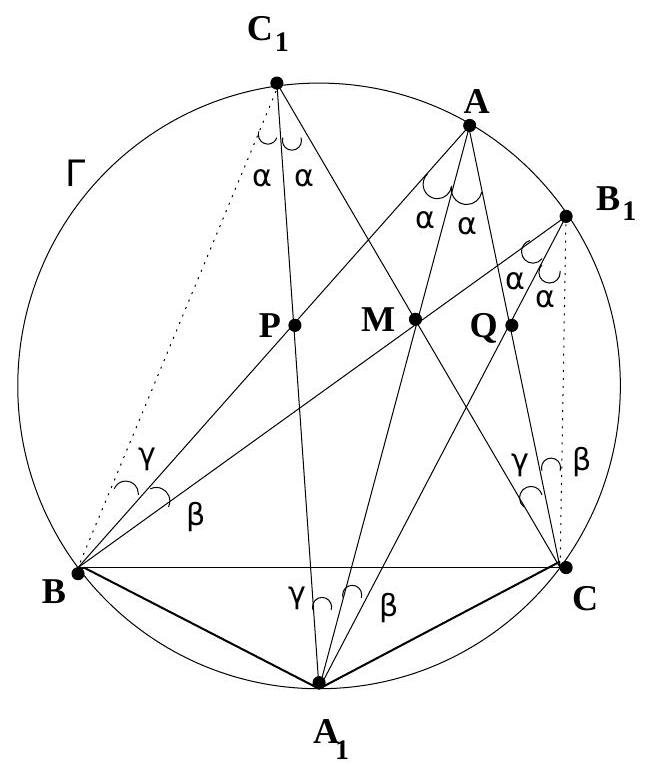\n\nSimilarly, triangles $A C M$ and $C_{1} A_{1} M$ are similar and we get\n\n$$\n\\frac{A C}{A M}=\\frac{C_{1} A_{1}}{C_{1} M}\n$$\n\nUsing the point $P$, we get similar ratios:\n\n$$\n\\frac{P B}{M A_{1}}=\\frac{C_{1} B}{A_{1} C_{1}}, \\quad \\frac{A B}{A M}=\\frac{A_{1} B_{1}}{M B_{1}}\n$$\n\nThus,\n\n$$\n\\frac{Q C}{P B}=\\frac{A_{1} C_{1} \\cdot B_{1} C}{C_{1} B \\cdot B_{1} A_{1}}\n$$\n\nand\n\n$$\n\\begin{aligned}\n\\frac{A C}{A B} & =\\frac{M B_{1} \\cdot C_{1} A_{1}}{A_{1} B_{1} \\cdot C_{1} M} \\\\\n& =\\frac{M B_{1}}{C_{1} M} \\frac{C_{1} A_{1}}{A_{1} B_{1}}=\\frac{M B_{1}}{C_{1} M} \\frac{C_{1} B \\cdot Q C}{P B \\cdot B_{1} C}\n\\end{aligned}\n$$\n\nHowever, triangles $C_{1} B M$ and $B_{1} C M$ are similar, which gives\n\n$$\n\\frac{B_{1} C}{C_{1} B}=\\frac{M B_{1}}{M C_{1}}\n$$\n\nPutting this in the last expression, we get\n\n$$\n\\frac{A C}{A B}=\\frac{Q C}{P B}\n$$\n\nWe conclude that $P Q$ is parallel to $B C$.", "metadata": {"resource_path": "INMO/segmented/en-2010.jsonl", "problem_match": "\n1.", "solution_match": "\nSolution:"}} |
| {"year": "2010", "tier": "T3", "problem_label": "2", "problem_type": null, "exam": "INMO", "problem": "Find all natural numbers $n>1$ such that $n^{2}$ does not divide $(n-2)$ !.", "solution": "Suppose $n=p q r$, where $p<q$ are primes and $r>1$. Then $p \\geq 2, q \\geq 3$ and $r \\geq 2$, not necessarily a prime. Thus we have\n\n$$\n\\begin{aligned}\n& n-2 \\geq n-p=p q r-p \\geq 5 p>p \\\\\n& n-2 \\geq n-q=q(p r-1) \\geq 3 q>q \\\\\n& n-2 \\geq n-p r=p r(q-1) \\geq 2 p r>p r \\\\\n& n-2 \\geq n-q r=q r(p-1) \\geq q r\n\\end{aligned}\n$$\n\nObserve that $p, q, p r, q r$ are all distinct. Hence their product divides $(n-2)$ !. Thus $n^{2}=p^{2} q^{2} r^{2}$ divides $(n-2)$ ! in this case. We conclude that either $n=p q$ where $p, q$ are distinct primes or $n=p^{k}$ for some prime $p$.\n\nCase 1. Suppose $n=p q$ for some primes $p, q$, where $2<p<q$. Then $p \\geq 3$ and $q \\geq 5$. In this case\n\n$$\n\\begin{aligned}\n& n-2>n-p=p(q-1) \\geq 4 p \\\\\n& n-2>n-q=q(p-1) \\geq 2 q\n\\end{aligned}\n$$\n\nThus $p, q, 2 p, 2 q$ are all distinct numbers in the set $\\{1,2,3, \\ldots, n-2\\}$. We see that $n^{2}=p^{2} q^{2}$ divides $(n-2)!$. We conclude that $n=2 q$ for some prime $q \\geq 3$. Note that $n-2=2 q-2<2 q$ in this case so that $n^{2}$ does not divide $(n-2)!$.\n\nCase 2. Suppose $n=p^{k}$ for some prime $p$. We observe that $p, 2 p, 3 p, \\ldots\\left(p^{k-1}-1\\right) p$ all lie in the set $\\{1,2,3, \\ldots, n-2\\}$. If $p^{k-1}-1 \\geq 2 k$, then there are at least $2 k$ multiples of $p$ in the set $\\{1,2,3, \\ldots, n-2\\}$. Hence $n^{2}=p^{2 k}$ divides $(n-2)!$. Thus $p^{k-1}-1<2 k$.\n\nIf $k \\geq 5$, then $p^{k-1}-1 \\geq 2^{k-1}-1 \\geq 2 k$, which may be proved by an easy induction. Hence $k \\leq 4$. If $k=1$, we get $n=p$, a prime. If $k=2$, then $p-1<4$ so that $p=2$ or 3 ; we get $n=2^{2}=4$ or $n=3^{2}=9$. For $k=3$, we have $p^{2}-1<6$ giving $p=2$; $n=2^{3}=8$ in this case. Finally, $k=4$ gives $p^{3}-1<8$. Again $p=2$ and $n=2^{4}=16$. However $n^{2}=2^{8}$ divides 14! and hence is not a solution.\n\nThus $n=p, 2 p$ for some prime $p$ or $n=8,9$. It is easy to verify that these satisfy the conditions of the problem.", "metadata": {"resource_path": "INMO/segmented/en-2010.jsonl", "problem_match": "\n2.", "solution_match": "\nSolution:"}} |
| {"year": "2010", "tier": "T3", "problem_label": "3", "problem_type": null, "exam": "INMO", "problem": "Find all non-zero real numbers $x, y, z$ which satisfy the system of equations:\n\n$$\n\\begin{aligned}\n\\left(x^{2}+x y+y^{2}\\right)\\left(y^{2}+y z+z^{2}\\right)\\left(z^{2}+z x+x^{2}\\right) & =x y z \\\\\n\\left(x^{4}+x^{2} y^{2}+y^{4}\\right)\\left(y^{4}+y^{2} z^{2}+z^{4}\\right)\\left(z^{4}+z^{2} x^{2}+x^{4}\\right) & =x^{3} y^{3} z^{3}\n\\end{aligned}\n$$", "solution": "Since $x y z \\neq 0$, We can divide the second relation by the first. Observe that\n\n$$\nx^{4}+x^{2} y^{2}+y^{4}=\\left(x^{2}+x y+y^{2}\\right)\\left(x^{2}-x y+y^{2}\\right)\n$$\n\nholds for any $x, y$. Thus we get\n\n$$\n\\left(x^{2}-x y+y^{2}\\right)\\left(y^{2}-y z+z^{2}\\right)\\left(z^{2}-z x+x^{2}\\right)=x^{2} y^{2} z^{2}\n$$\n\nHowever, for any real numbers $x, y$, we have\n\n$$\nx^{2}-x y+y^{2} \\geq|x y|\n$$\n\nSince $x^{2} y^{2} z^{2}=|x y||y z||z x|$, we get\n\n$$\n|x y||y z||z x|=\\left(x^{2}-x y+y^{2}\\right)\\left(y^{2}-y z+z^{2}\\right)\\left(z^{2}-z x+x^{2}\\right) \\geq|x y||y z||z x|\n$$\n\nThis is possible only if\n\n$$\nx^{2}-x y+y^{2}=|x y|, \\quad y^{2}-y z+z^{2}=|y z|, \\quad z^{2}-z x+x^{2}=|z x|\n$$\n\nhold simultaneously. However $|x y|= \\pm x y$. If $x^{2}-x y+y^{2}=-x y$, then $x^{2}+y^{2}=0$ giving $x=y=0$. Since we are looking for nonzero $x, y, z$, we conclude that $x^{2}-x y+y^{2}=x y$ which is same as $x=y$. Using the other two relations, we also get $y=z$ and $z=x$. The first equation now gives $27 x^{6}=x^{3}$. This gives $x^{3}=1 / 27$ (since $x \\neq 0$ ), or $x=1 / 3$. We thus have $x=y=z=1 / 3$. These also satisfy the second relation, as may be verified.", "metadata": {"resource_path": "INMO/segmented/en-2010.jsonl", "problem_match": "\n3.", "solution_match": "\nSolution:"}} |
| {"year": "2010", "tier": "T3", "problem_label": "4", "problem_type": null, "exam": "INMO", "problem": "How many 6-tuples $\\left(a_{1}, a_{2}, a_{3}, a_{4}, a_{5}, a_{6}\\right)$ are there such that each of $a_{1}, a_{2}, a_{3}, a_{4}, a_{5}, a_{6}$ is from the set $\\{1,2,3,4\\}$ and the six expressions\n\n$$\na_{j}^{2}-a_{j} a_{j+1}+a_{j+1}^{2}\n$$\n\nfor $j=1,2,3,4,5,6$ (where $a_{7}$ is to be taken as $a_{1}$ ) are all equal to one another?", "solution": "Without loss of generality, we may assume that $a_{1}$ is the largest among $a_{1}, a_{2}, a_{3}, a_{4}, a_{5}, a_{6}$. Consider the relation\n\n$$\na_{1}^{2}-a_{1} a_{2}+a_{2}^{2}=a_{2}^{2}-a_{2} a_{3}+a_{3}^{2}\n$$\n\nThis leads to\n\n$$\n\\left(a_{1}-a_{3}\\right)\\left(a_{1}+a_{3}-a_{2}\\right)=0\n$$\n\nObserve that $a_{1} \\geq a_{2}$ and $a_{3}>0$ together imply that the second factor on the left side is positive. Thus $a_{1}=a_{3}=\\max \\left\\{a_{1}, a_{2}, a_{3}, a_{4}, a_{5}, a_{6}\\right\\}$. Using this and the relation\n\n$$\na_{3}^{2}-a_{3} a_{4}+a_{4}^{2}=a_{4}^{2}-a_{4} a_{5}+a_{5}^{2}\n$$\n\nwe conclude that $a_{3}=a_{5}$ as above. Thus we have\n\n$$\na_{1}=a_{3}=a_{5}=\\max \\left\\{a_{1}, a_{2}, a_{3}, a_{4}, a_{5}, a_{6}\\right\\}\n$$\n\nLet us consider the other relations. Using\n\n$$\na_{2}^{2}-a_{2} a_{3}+a_{3}^{2}=a_{3}^{2}-a_{3} a_{4}+a_{4}^{2}\n$$\n\nwe get $a_{2}=a_{4}$ or $a_{2}+a_{4}=a_{3}=a_{1}$. Similarly, two more relations give either $a_{4}=a_{6}$ or $a_{4}+a_{6}=a_{5}=a_{1}$; and either $a_{6}=a_{2}$ or $a_{6}+a_{2}=a_{1}$. Let us give values to $a_{1}$ and count the number of six-tuples in each case.\n\n(A) Suppose $a_{1}=1$. In this case all $a_{j}$ 's are equal and we get only one six-tuple $(1,1,1,1,1,1)$.\n\n(B) If $a_{1}=2$, we have $a_{3}=a_{5}=2$. We observe that $a_{2}=a_{4}=a_{6}=1$ or $a_{2}=a_{4}=$ $a_{6}=2$. We get two more six-tuples: $(2,1,2,1,2,1),(2,2,2,2,2,2)$.\n\n(C) Taking $a_{1}=3$, we see that $a_{3}=a_{5}=3$. In this case we get nine possibilities for $\\left(a_{2}, a_{4}, a_{6}\\right)$\n\n$$\n(1,1,1),(2,2,2),(3,3,3),(1,1,2),(1,2,1),(2,1,1),(1,2,2),(2,1,2),(2,2,1)\n$$\n\n(D) In the case $a_{1}=4$, we have $a_{3}=a_{5}=4$ and\n\n$$\n\\begin{aligned}\n\\left(a_{2}, a_{4}, a_{6}\\right)=(2,2,2),(4,4,4) & ,(1,1,1),(3,3,3) \\\\\n& (1,1,3),(1,3,1),(3,1,1),(1,3,3),(3,1,3),(3,3,1)\n\\end{aligned}\n$$\n\nThus we get $1+2+9+10=22$ solutions. Since $\\left(a_{1}, a_{3}, a_{5}\\right)$ and $\\left(a_{2}, a_{4}, a_{6}\\right)$ may be interchanged, we get 22 more six-tuples. However there are 4 common among these, namely, $(1,1,1,1,1,1),(2,2,2,2,2,2),(3,3,3,3,3,3)$ and $(4,4,4,4,4,4)$. Hence the total number of six-tuples is $22+22-4=40$.", "metadata": {"resource_path": "INMO/segmented/en-2010.jsonl", "problem_match": "\n4.", "solution_match": "\nSolution:"}} |
| {"year": "2010", "tier": "T3", "problem_label": "5", "problem_type": null, "exam": "INMO", "problem": "Let $A B C$ be an acute-angled triangle with altitude $A K$. Let $H$ be its ortho-centre and $O$ be its circum-centre. Suppose $K O H$ is an acute-angled triangle and $P$ its circum-centre. Let $Q$ be the reflection of $P$ in the line $H O$. Show that $Q$ lies on the line joining the mid-points of $A B$ and $A C$.", "solution": "Let $D$ be the mid-point of $B C ; M$ that of $H K$; and $T$ that of $O H$. Then $P M$ is perpendicular to $H K$ and $P T$ is perpendicular to $O H$. Since $Q$ is the reflection of $P$ in $H O$, we observe that $P, T, Q$ are collinear, and $P T=T Q$. Let $Q L, T N$ and $O S$ be the perpendiculars drawn respectively from $Q, T$ and $O$ on to the altitude $A K$.(See the figure.)\n\n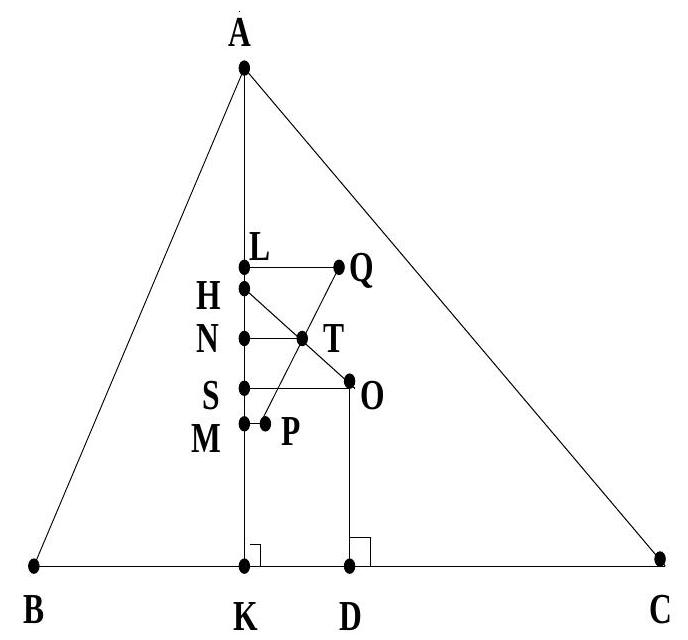\n\nWe have $L N=N M$, since $T$ is the mid-point of $Q P ; H N=N S$, since $T$ is the mid-point of $O H$; and $H M=M K$, as $P$ is the circum-centre of $K H O$. We obtain\n\n$$\nL H+H N=L N=N M=N S+S M\n$$\n\nwhich gives $L H=S M$. We know that $A H=2 O D$. Thus\n\n$$\n\\begin{aligned}\nA L=A H & -L H=2 O D-L H=2 S K-S M=S K+(S K-S M)=S K+M K \\\\\n& =S K+H M=S K+H S+S M=S K+H S+L H=S K+L S=L K\n\\end{aligned}\n$$\n\nThis shows that $L$ is the mid-point of $A K$ and hence lies on the line joining the midpoints of $A B$ and $A C$. We observe that the line joining the mid-points of $A B$ and $A C$ is also perpendicular to $A K$. Since $Q L$ is perpendicular to $A K$, we conclude that $Q$ also lies on the line joining the mid-points of $A B$ and $A C$.\n\nRemark: It may happen that $H$ is above $L$ as in the adjoining figure, but the result remains true here as well. We have $H N=N S, L N=N M$, and $H M=$ $M K$ as earlier. Thus $H N=H L+L N$ and $N S=$ $S M+N M$ give $H L=S M$. Now $A L=A H+H L=$ $2 O D+S M=2 S K+S M=S K+(S K+S M)=$ $S K+M K=S K+H M=S K+H L+L M=S K+$ $S M+L M=L K$. The conclusion that $Q$ lies on the line joining the mid-points of $A B$ and $A C$ follows as earlier.\n\n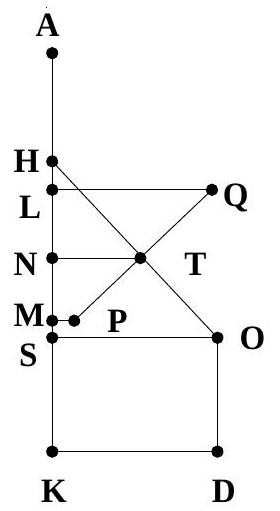", "metadata": {"resource_path": "INMO/segmented/en-2010.jsonl", "problem_match": "\n5.", "solution_match": "\nSolution:"}} |
| {"year": "2010", "tier": "T3", "problem_label": "6", "problem_type": null, "exam": "INMO", "problem": "Define a sequence $\\left\\langle a_{n}\\right\\rangle_{n \\geq 0}$ by $a_{0}=0, a_{1}=1$ and\n\n$$\na_{n}=2 a_{n-1}+a_{n-2}\n$$\n\nfor $n \\geq 2$.\n\n(a) For every $m>0$ and $0 \\leq j \\leq m$, prove that $2 a_{m}$ divides $a_{m+j}+(-1)^{j} a_{m-j}$.\n\n(b) Suppose $2^{k}$ divides $n$ for some natural numbers $n$ and $k$. Prove that $2^{k}$ divides $a_{n}$.", "solution": "(a) Consider $f(j)=a_{m+j}+(-1)^{j} a_{m-j}, 0 \\leq j \\leq m$, where $m$ is a natural number. We observe that $f(0)=2 a_{m}$ is divisible by $2 a_{m}$. Similarly,\n\n$$\nf(1)=a_{m+1}-a_{m-1}=2 a_{m}\n$$\n\nis also divisible by $2 a_{m}$. Assume that $2 a_{m}$ divides $f(j)$ for all $0 \\leq j<l$, where $l \\leq m$. We prove that $2 a_{m}$ divides $f(l)$. Observe\n\n$$\n\\begin{aligned}\n& f(l-1)=a_{m+l-1}+(-1)^{l-1} a_{m-l+1} \\\\\n& f(l-2)=a_{m+l-2}+(-1)^{l-2} a_{m-l+2}\n\\end{aligned}\n$$\n\nThus we have\n\n$$\n\\begin{aligned}\na_{m+l} & =2 a_{m+l-1}+a_{m+l-2} \\\\\n& =2 f(l-1)-2(-1)^{l-1} a_{m-l+1}+f(l-2)-(-1)^{l-2} a_{m-l+2} \\\\\n& =2 f(l-1)+f(l-2)+(-1)^{l-1}\\left(a_{m-l+2}-2 a_{m-l+1}\\right) \\\\\n& =2 f(l-1)+f(l-2)+(-1)^{l-1} a_{m-l}\n\\end{aligned}\n$$\n\nThis gives\n\n$$\nf(l)=2 f(l-1)+f(l-2)\n$$\n\nBy induction hypothesis $2 a_{m}$ divides $f(l-1)$ and $f(l-2)$. Hence $2 a_{m}$ divides $f(l)$. We conclude that $2 a_{m}$ divides $f(j)$ for $0 \\leq j \\leq m$.\n\n(b) We see that $f(m)=a_{2 m}$. Hence $2 a_{m}$ divides $a_{2 m}$ for all natural numbers $m$. Let $n=2^{k} l$ for some $l \\geq 1$. Taking $m=2^{k-1} l$, we see that $2 a_{m}$ divides $a_{n}$. Using an easy induction, we conclude that $2^{k} a_{l}$ divides $a_{n}$. In particular $2^{k}$ divides $a_{n}$.", "metadata": {"resource_path": "INMO/segmented/en-2010.jsonl", "problem_match": "\n6.", "solution_match": "## Solution:"}} |
|
|


